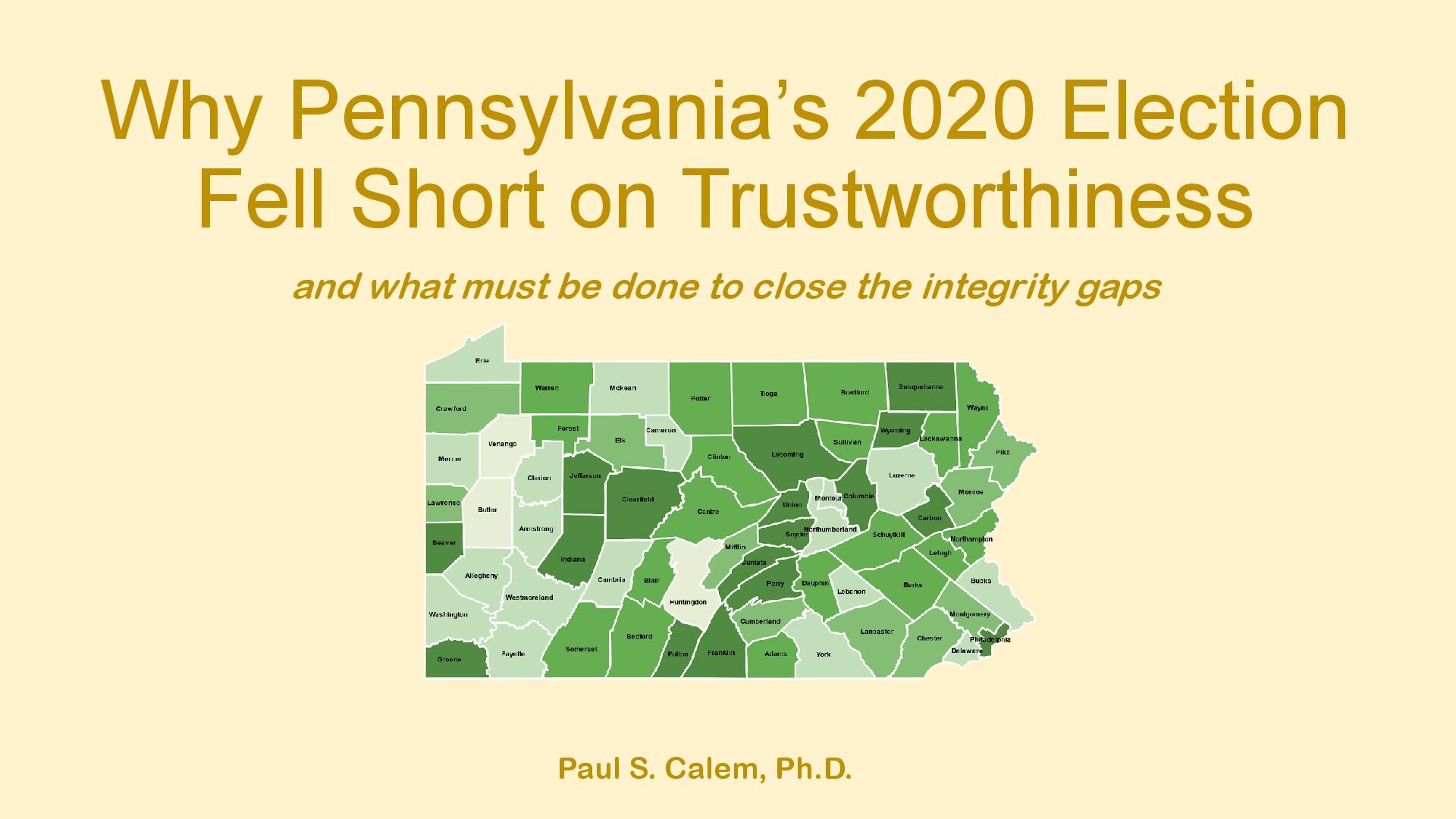
my book The Big Flip, the culmination of extensive research spanning four years, including rigorous data analysis (unrivaledpolitics.com/the-book) • All data relied on are official data from the Pennsylvania DOS • Three overarching conclusions: • The mail-in voting process in Pennsylvania was not secure in 2020 nor is so today (PA Act 77 did not anticipate the risks tied to mail-in voting) • The data analysis raises serious questions about whether election security was breached or rules were violated in 2020 • However, it may be possible to restore trust through common sense measures to mitigate election integrity risks
of risk and multiplying threat scenarios resulting from introduction of no-excuse mail-in voting • Weak controls and inadequate safeguards • Opaque processes Integrity Risks Were Excessive and Remain So!
and ballot send-out queues • National Academies of Sciences, Engineering, and Medicine, Securing the Vote (2018) • U. of Pittsburgh (Pitt Cyber), “Blue Ribbon Commission Report” (January 2019) • CISA.gov, “Mail-in Voting in 2020 Infrastructure Risk Assessment” (July 28, 2020) • New, less detectable voter identity theft scenarios • These can be facilitated by pre-existing weaknesses in the SURE registration database such as duplicate and stale records; a 2019 report from the PA Auditor General found many such flaws • Facilitation of malevolent ballot and application harvesting scenarios • Facilitation of impermissible cross-state voting activities
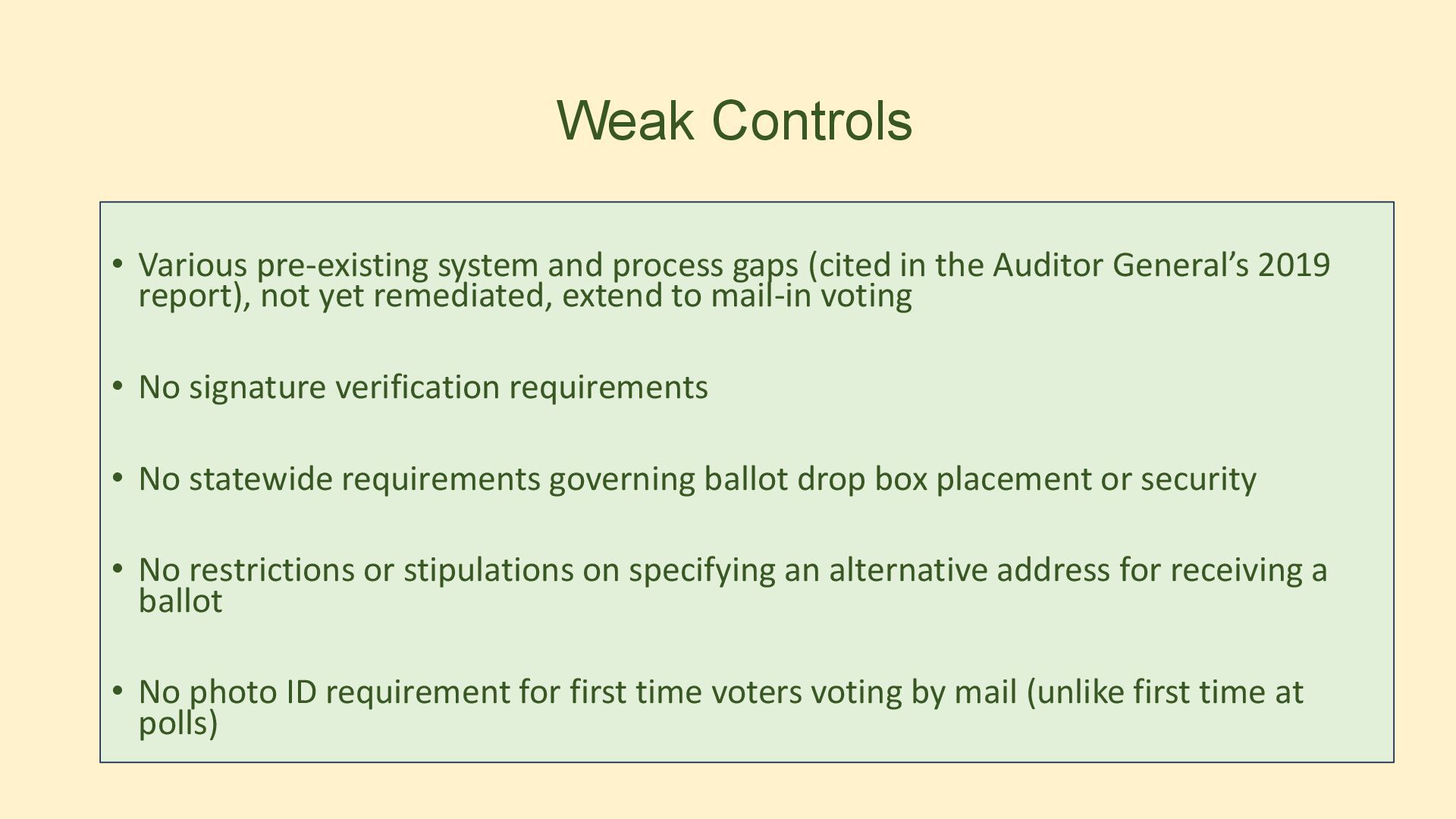
in the Auditor General’s 2019 report), not yet remediated, extend to mail-in voting • No signature verification requirements • No statewide requirements governing ballot drop box placement or security • No restrictions or stipulations on specifying an alternative address for receiving a ballot • No photo ID requirement for first time voters voting by mail (unlike first time at polls)
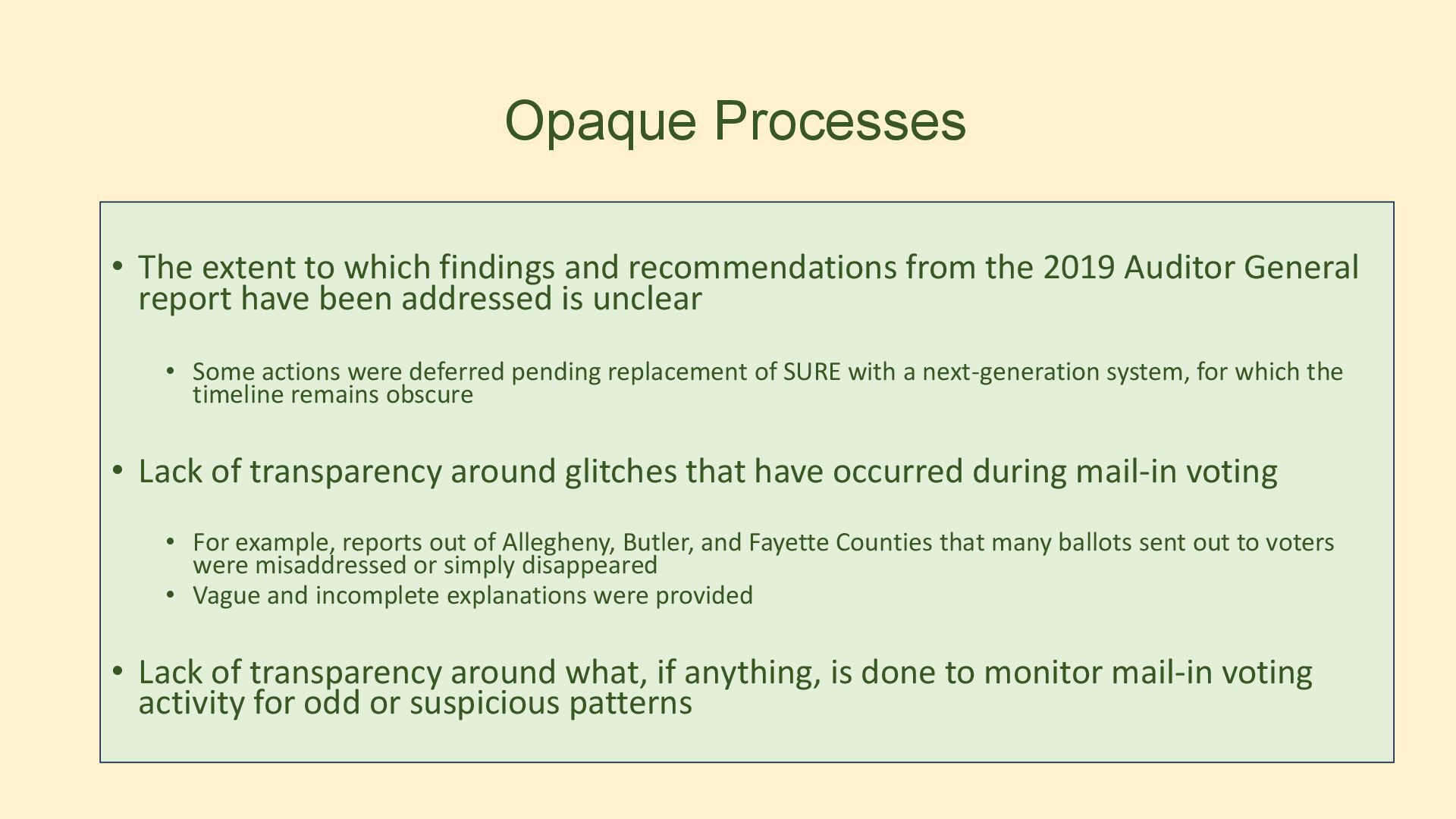
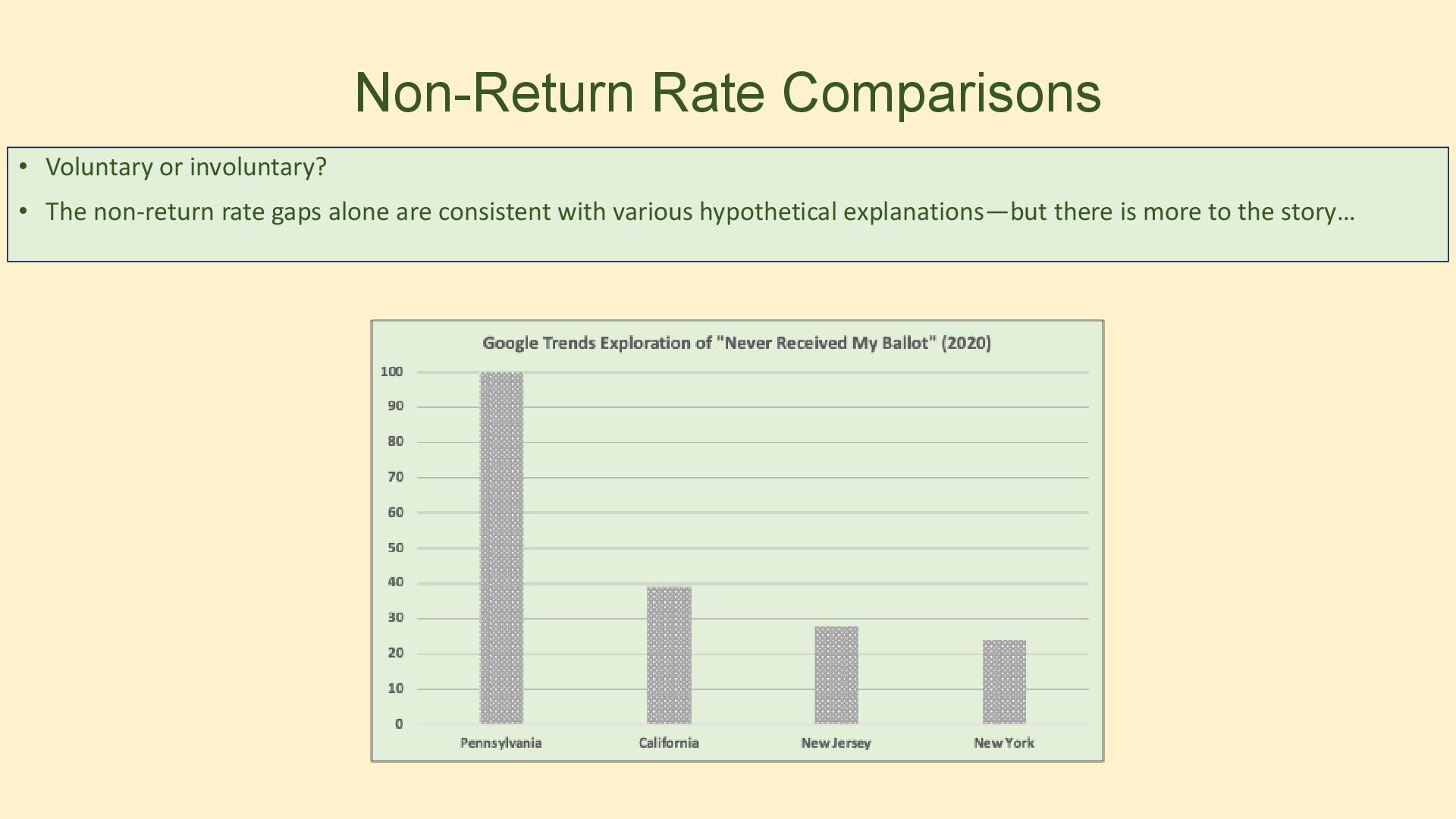
from the 2019 Auditor General report have been addressed is unclear • Some actions were deferred pending replacement of SURE with a next-generation system, for which the timeline remains obscure • Lack of transparency around glitches that have occurred during mail-in voting • For example, reports out of Allegheny, Butler, and Fayette Counties that many ballots sent out to voters were misaddressed or simply disappeared • Vague and incomplete explanations were provided • Lack of transparency around what, if anything, is done to monitor mail-in voting activity for odd or suspicious patterns
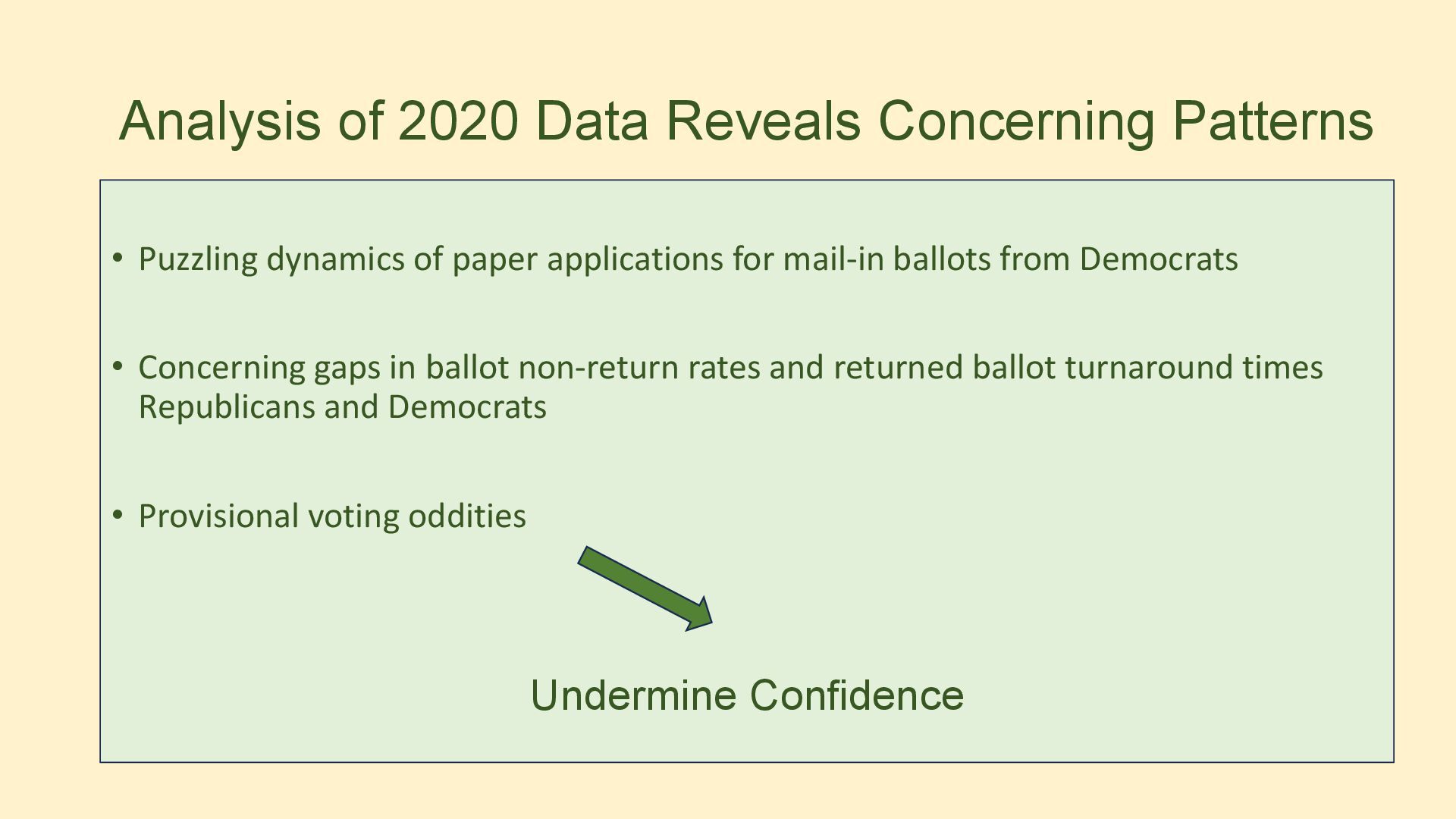
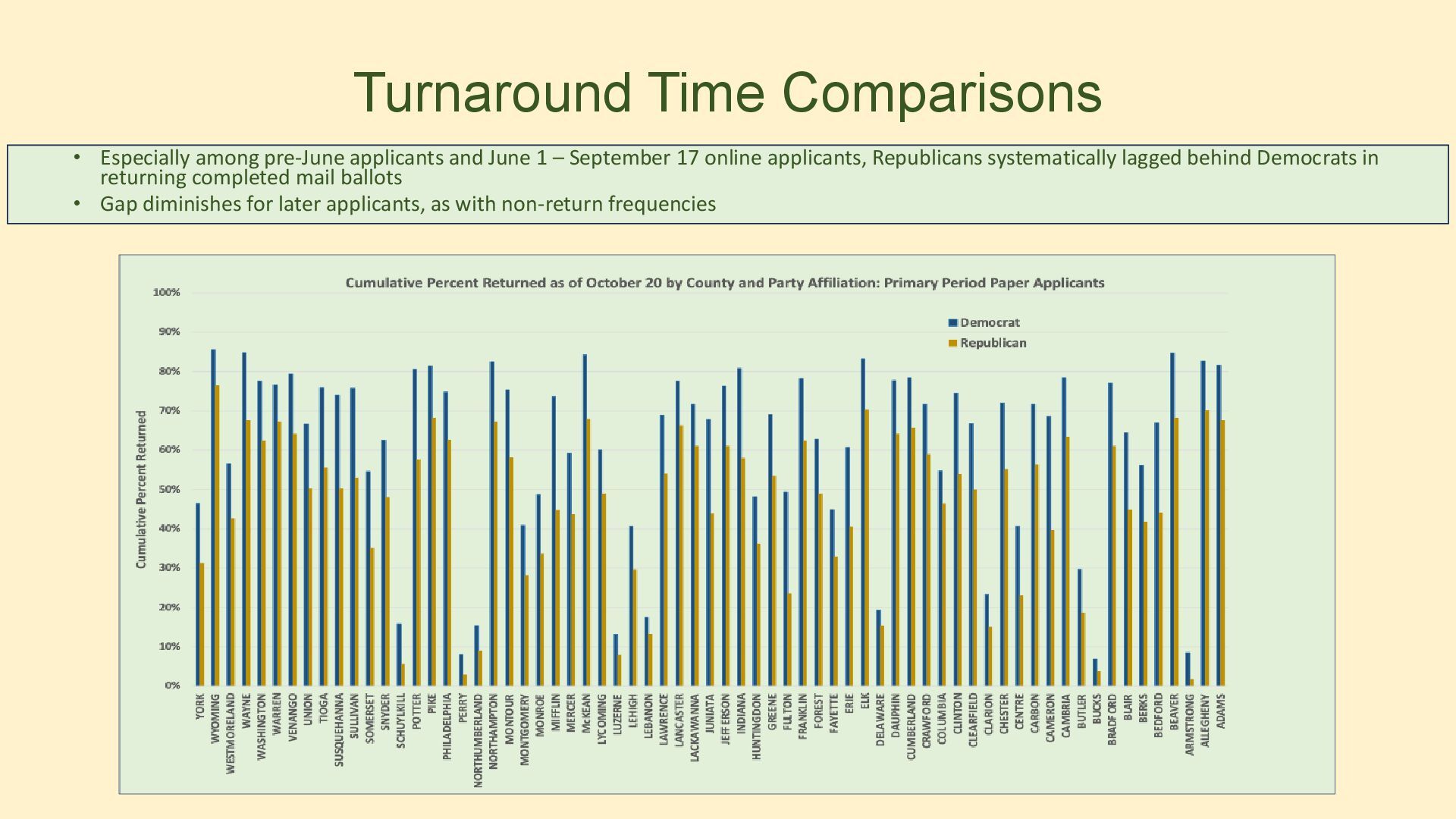
of paper applications for mail-in ballots from Democrats • Concerning gaps in ballot non-return rates and returned ballot turnaround times Republicans and Democrats • Provisional voting oddities Undermine Confidence
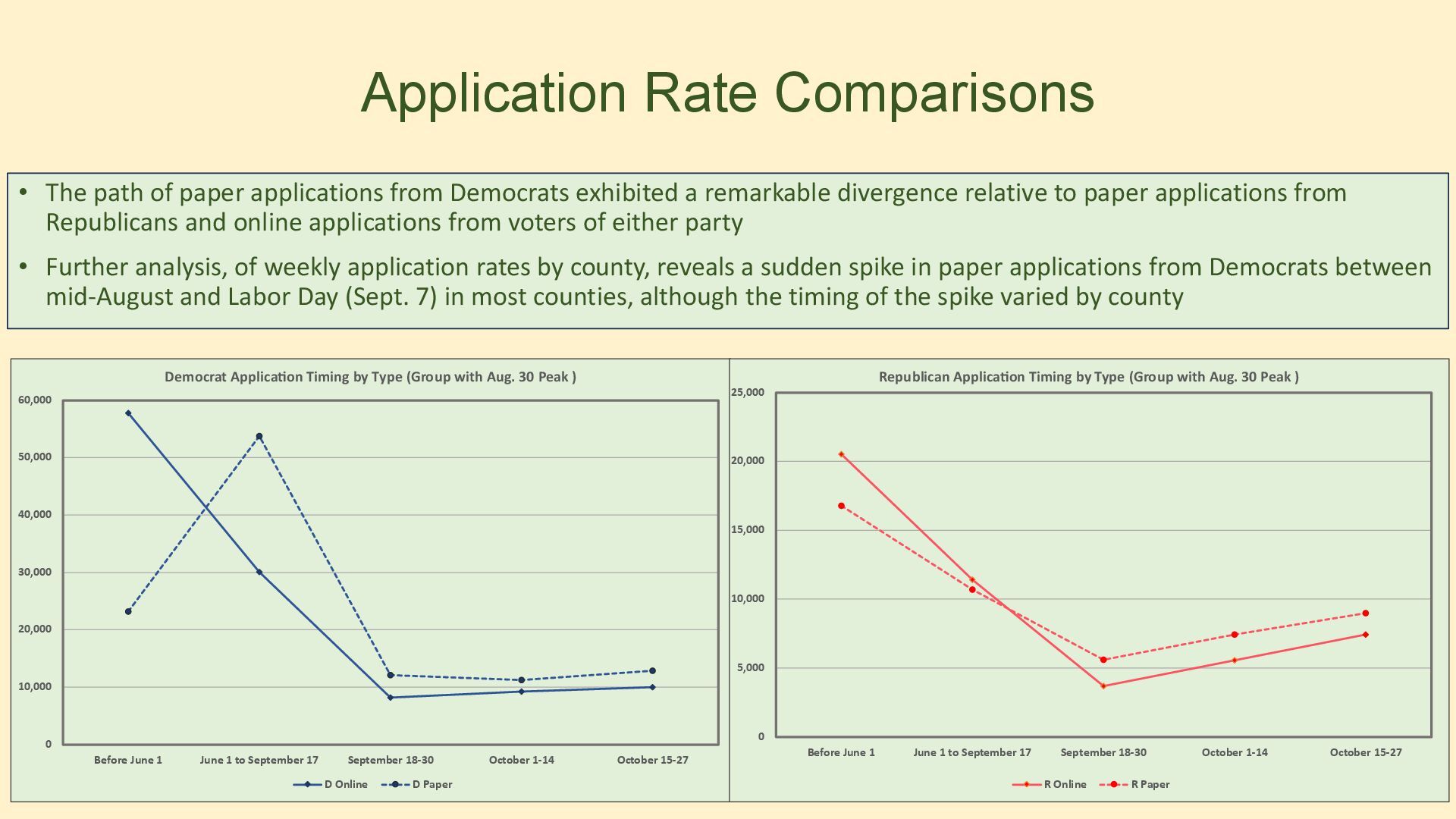
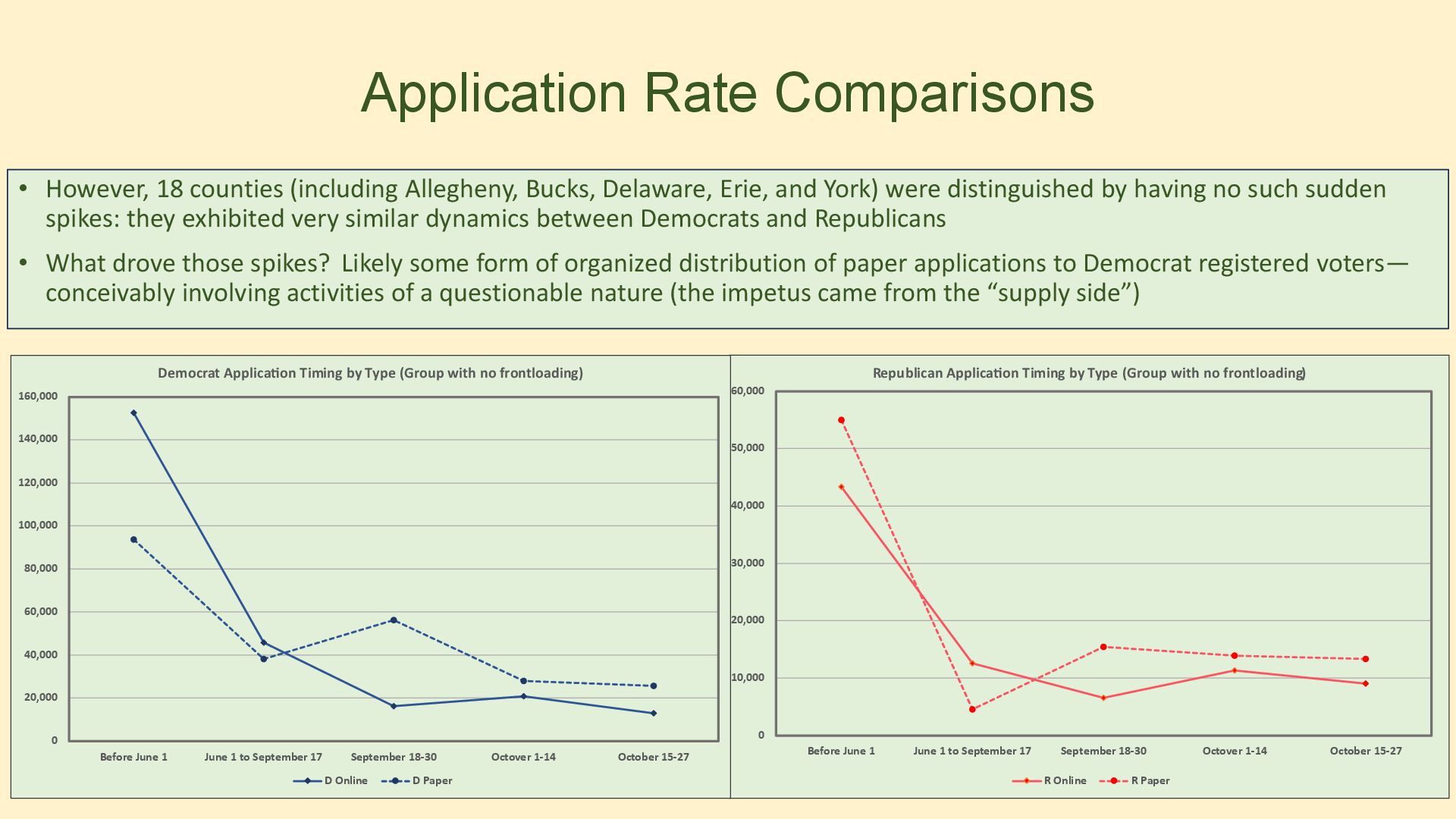
Democrats exhibited a remarkable divergence relative to paper applications from Republicans and online applications from voters of either party • Further analysis, of weekly application rates by county, reveals a sudden spike in paper applications from Democrats between mid-August and Labor Day (Sept. 7) in most counties, although the timing of the spike varied by county
Delaware, Erie, and York) were distinguished by having no such sudden spikes: they exhibited very similar dynamics between Democrats and Republicans • What drove those spikes? Likely some form of organized distribution of paper applications to Democrat registered voters— conceivably involving activities of a questionable nature (the impetus came from the “supply side”)
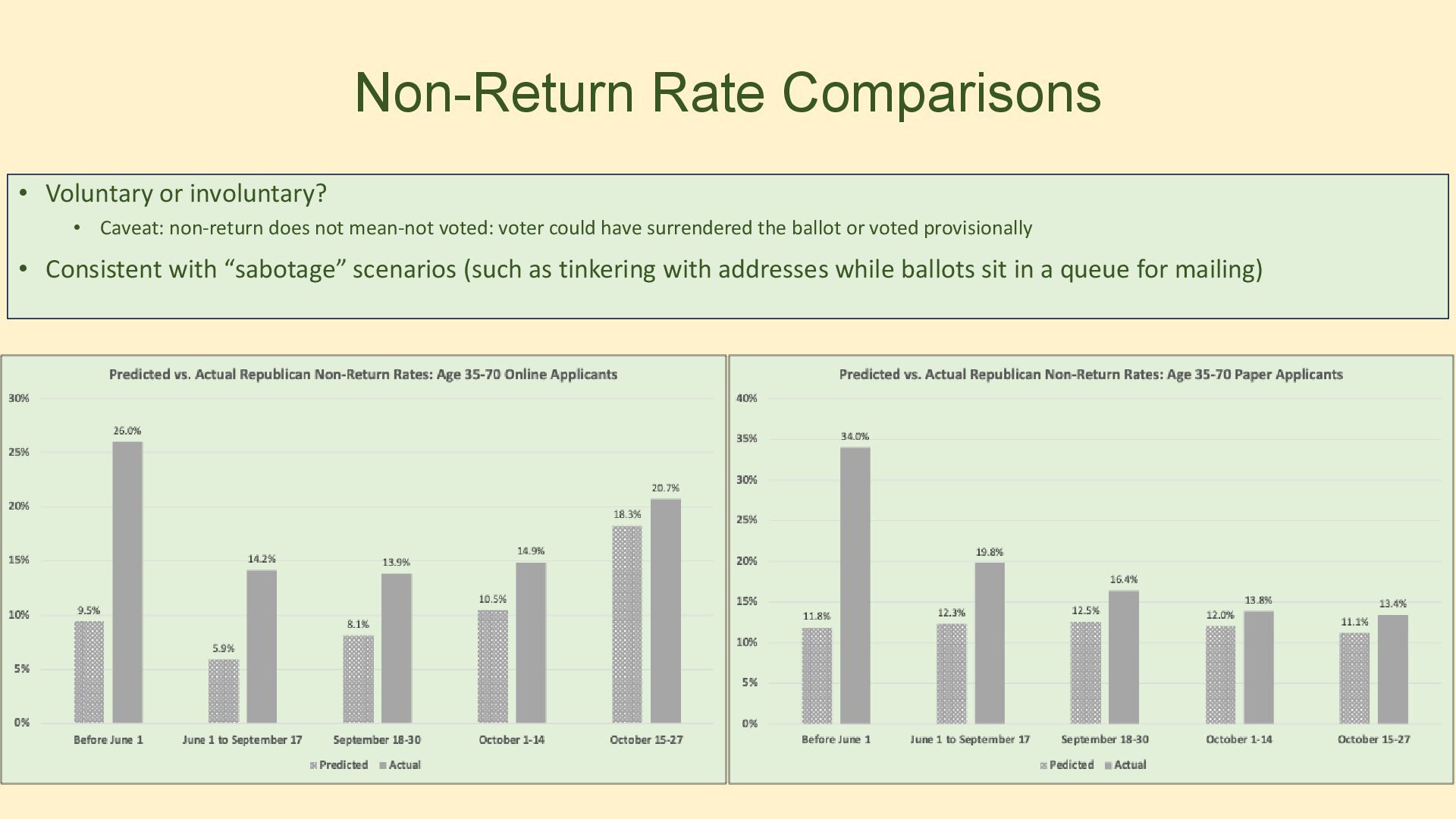
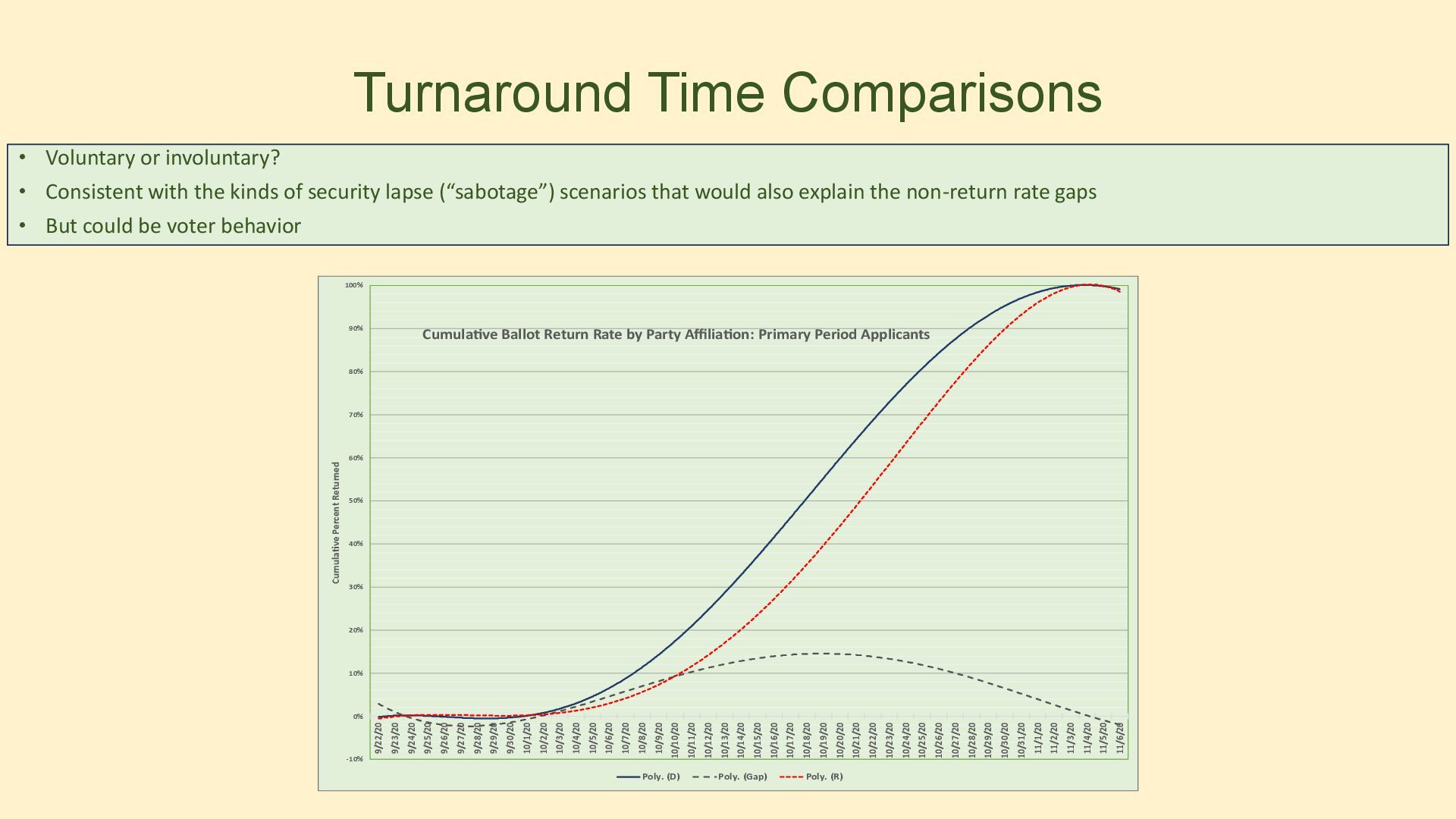
does not mean-not voted: voter could have surrendered the ballot or voted provisionally • Consistent with “sabotage” scenarios (such as tinkering with addresses while ballots sit in a queue for mailing)
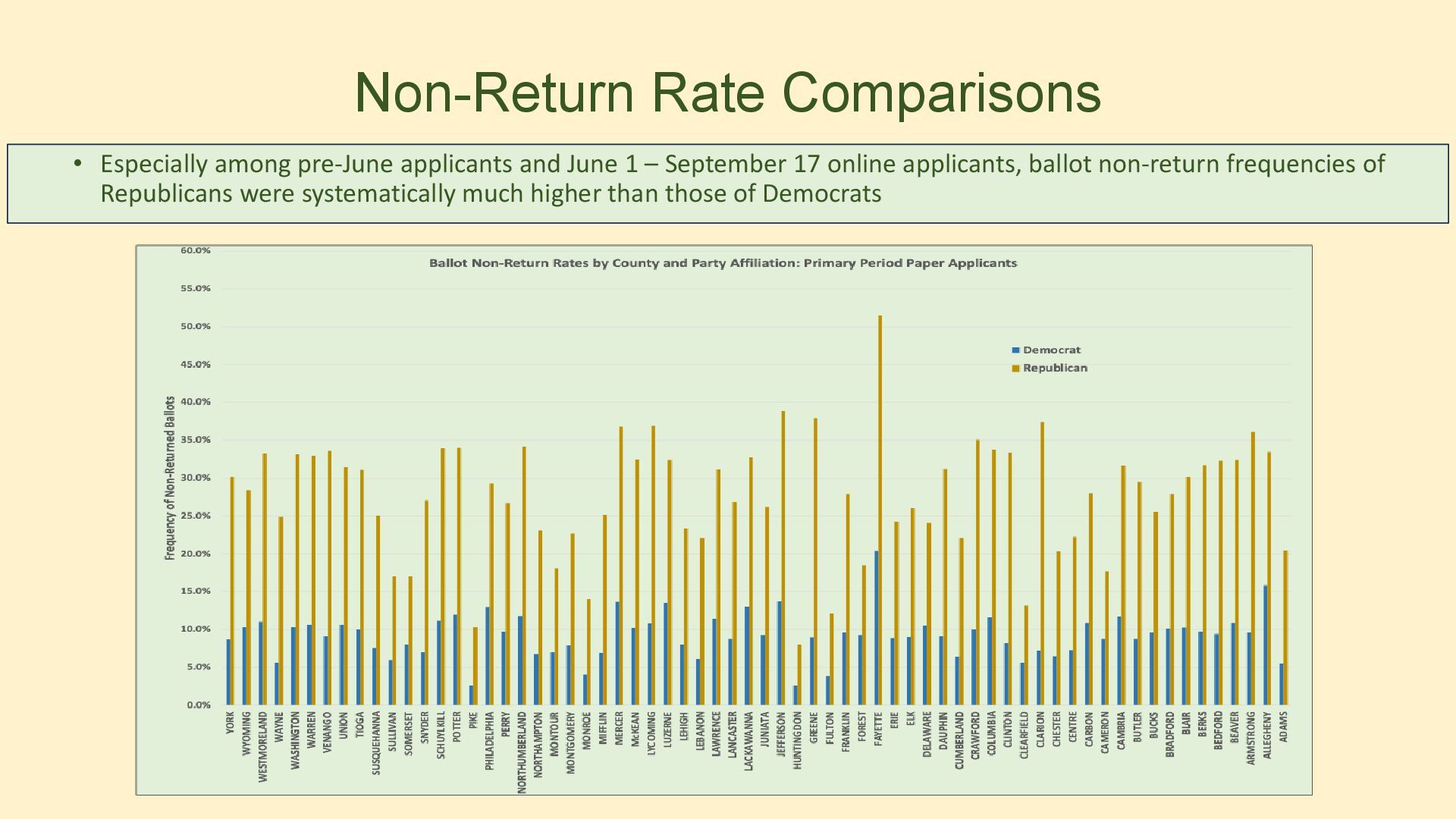
1 – September 17 online applicants, Republicans systematically lagged behind Democrats in returning completed mail ballots • Gap diminishes for later applicants, as with non-return frequencies
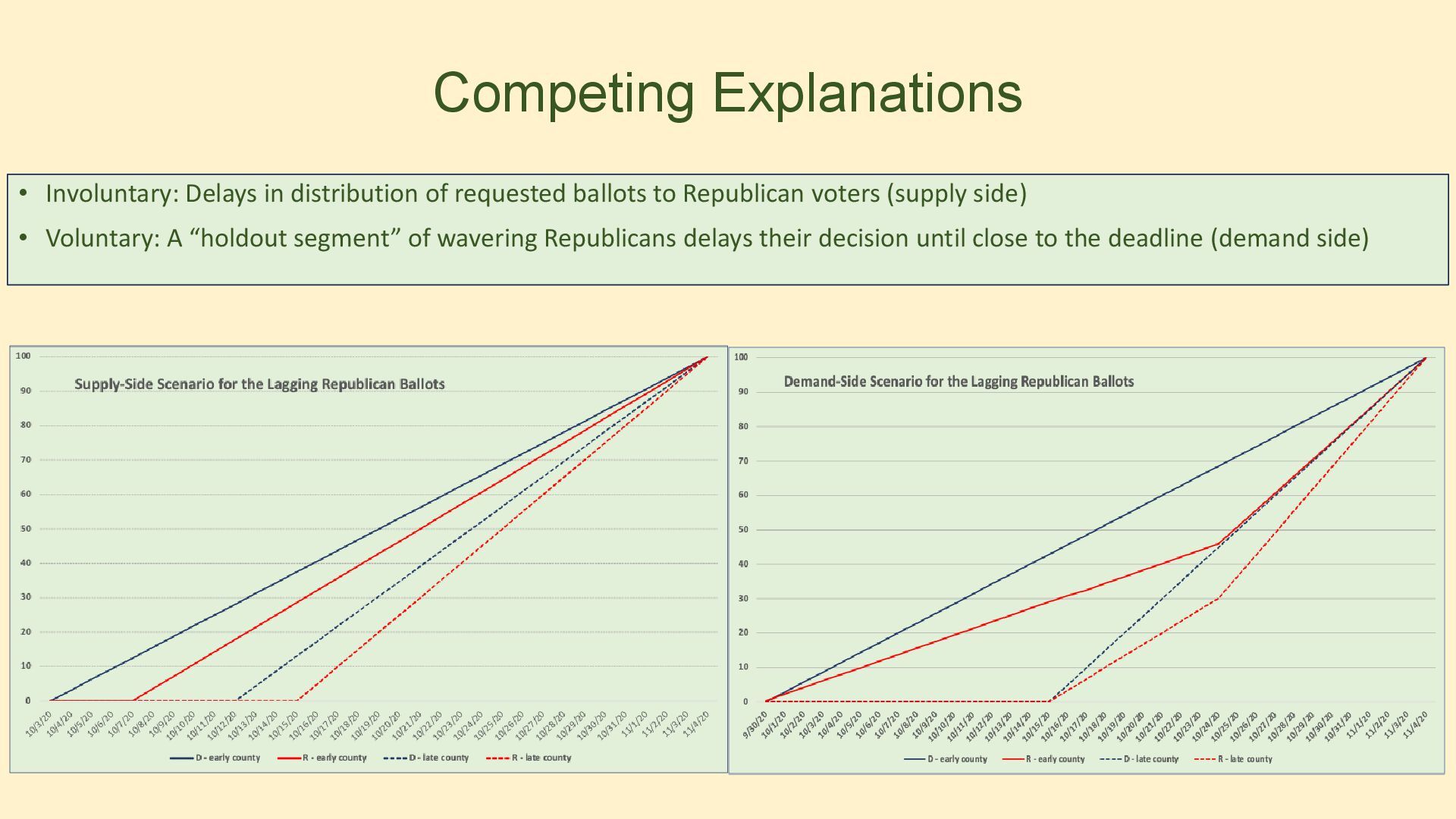
to Republican voters (supply side) • Voluntary: A “holdout segment” of wavering Republicans delays their decision until close to the deadline (demand side)
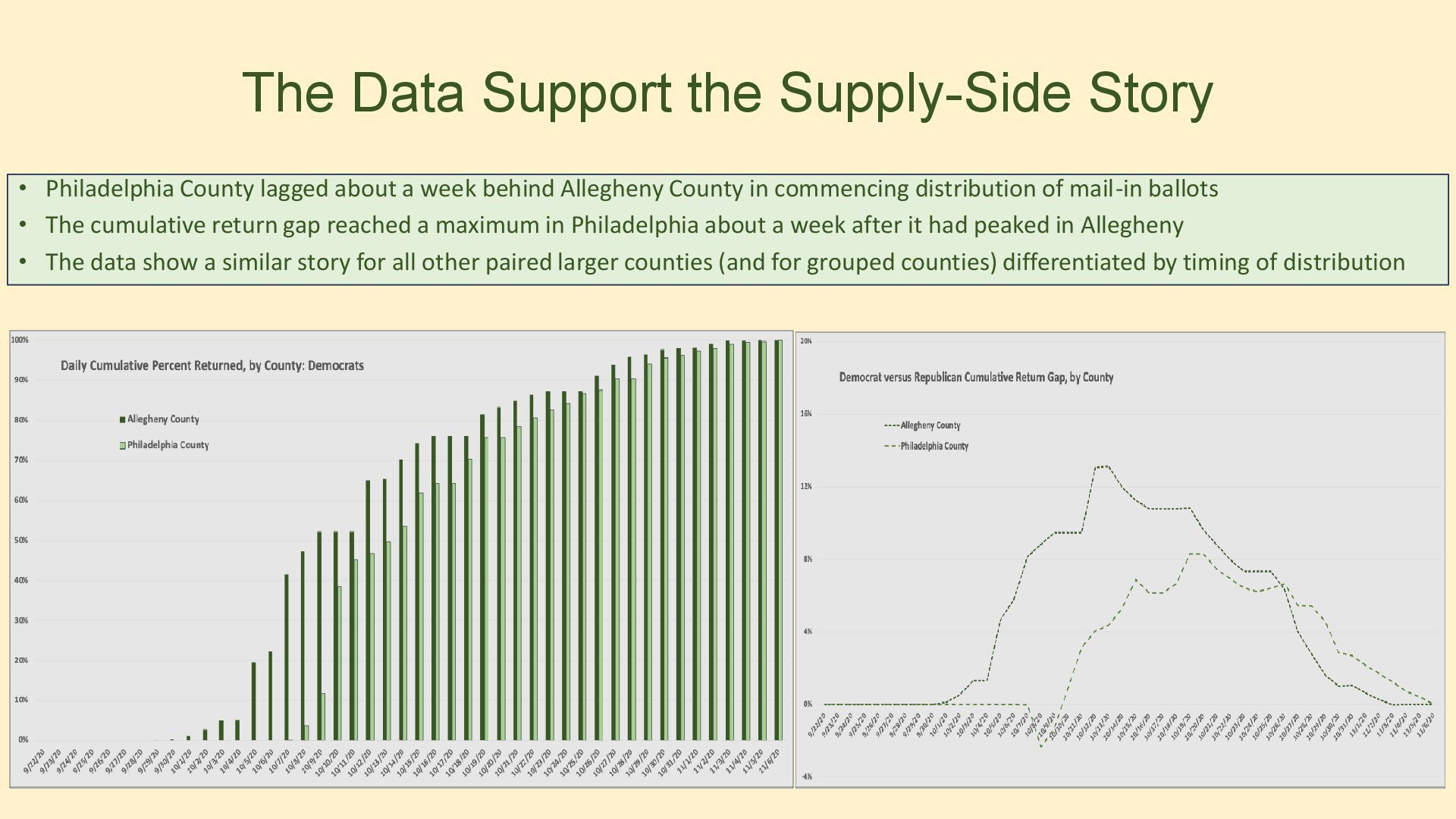
about a week behind Allegheny County in commencing distribution of mail-in ballots • The cumulative return gap reached a maximum in Philadelphia about a week after it had peaked in Allegheny • The data show a similar story for all other paired larger counties (and for grouped counties) differentiated by timing of distribution
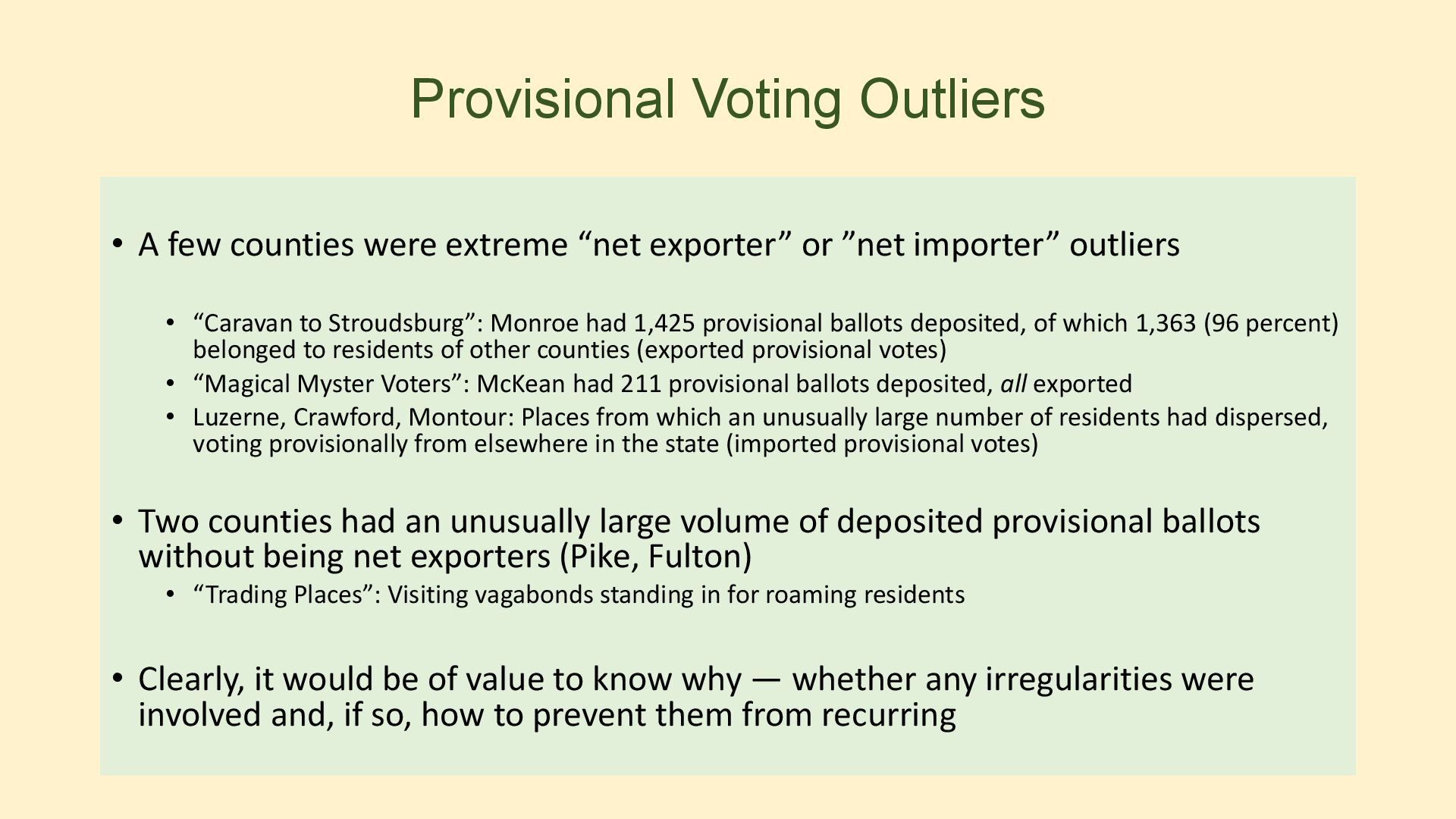
exporter” or ”net importer” outliers • “Caravan to Stroudsburg”: Monroe had 1,425 provisional ballots deposited, of which 1,363 (96 percent) belonged to residents of other counties (exported provisional votes) • “Magical Myster Voters”: McKean had 211 provisional ballots deposited, all exported • Luzerne, Crawford, Montour: Places from which an unusually large number of residents had dispersed, voting provisionally from elsewhere in the state (imported provisional votes) • Two counties had an unusually large volume of deposited provisional ballots without being net exporters (Pike, Fulton) • “Trading Places”: Visiting vagabonds standing in for roaming residents • Clearly, it would be of value to know why — whether any irregularities were involved and, if so, how to prevent them from recurring
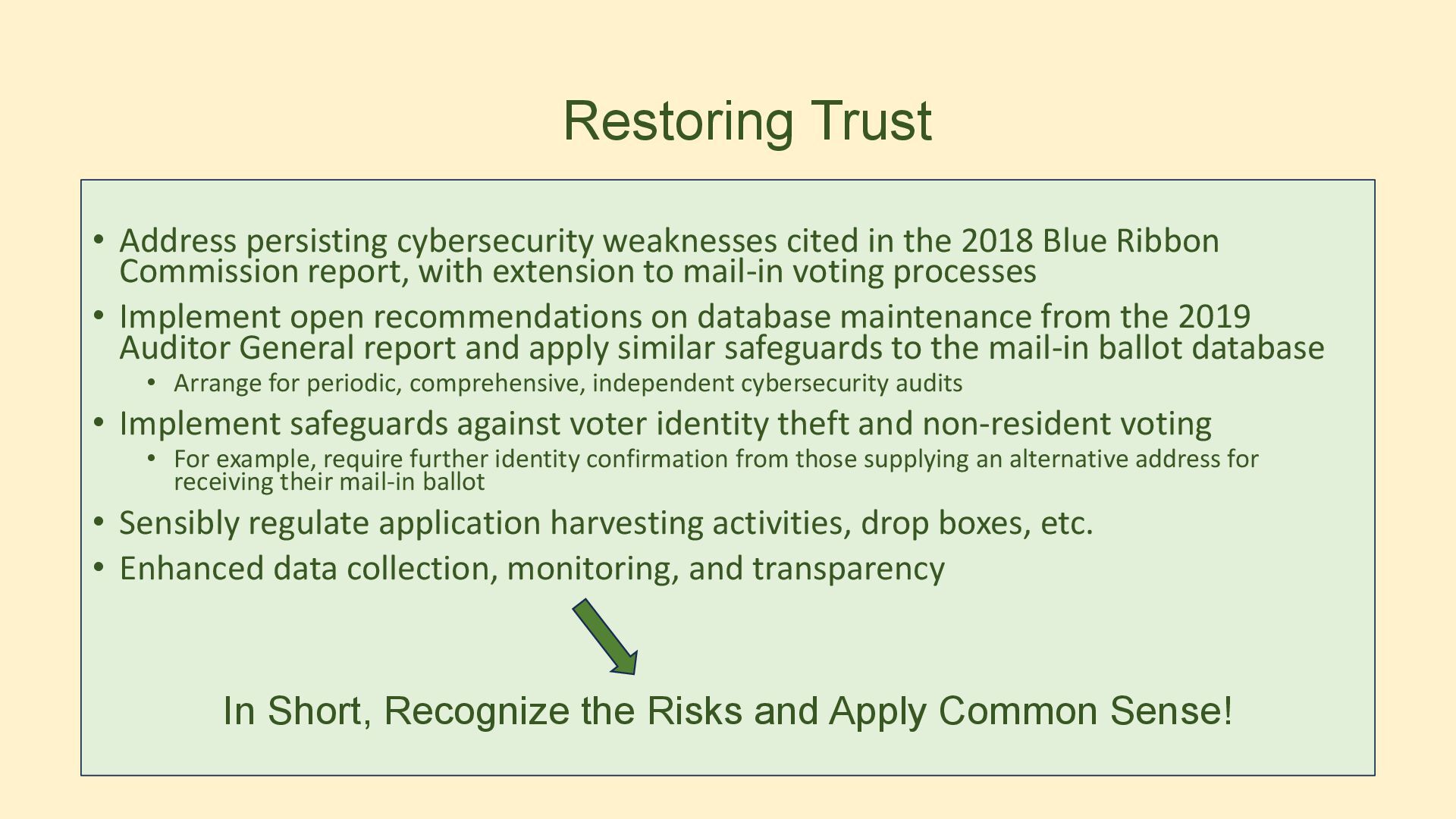
2018 Blue Ribbon Commission report, with extension to mail-in voting processes • Implement open recommendations on database maintenance from the 2019 Auditor General report and apply similar safeguards to the mail-in ballot database • Arrange for periodic, comprehensive, independent cybersecurity audits • Implement safeguards against voter identity theft and non-resident voting • For example, require further identity confirmation from those supplying an alternative address for receiving their mail-in ballot • Sensibly regulate application harvesting activities, drop boxes, etc. • Enhanced data collection, monitoring, and transparency In Short, Recognize the Risks and Apply Common Sense!


 youten622
 nnchiba
 rfujii
 murakawatakuya
 tkng
tkng
 butchi
 institutdelelevage
 sokikatayama
 dk999
dk999
 yukiar
 tsantalis
 junkurihara
 samanthasiow
 marketingsoph
 shlominoach
 codingconduct
 chriscoyier
 katiecoart
 aleyda
 hatefulcrawdad
 baasie
 mfonobong