Upgrade to Pro — share decks privately, control downloads, hide ads and more …

Universal hydrodynamic mechanisms for crystalli...

Universal hydrodynamic mechanisms for crystallization in active colloidal suspensions

Presented in IASBS-ICTP School on
Active Matter and Chemotaxis
on May 25, 2016

We derive, using the boundary integral formulation of Stokes flow, exact expressions for forces and torques between active colloidal particles near a plane wall. From the leading terms of these expressions we identify universal mechanisms for the crystallization of active colloids. Through detailed simulations, we find that active crystallization is not an activated process, as in equilibrium, but proceeds through a spinodal-like instability.

Avatar for Rajesh Singh

Rajesh Singh

May 25, 2016

More Decks by Rajesh Singh

Other Decks in Science

Transcript

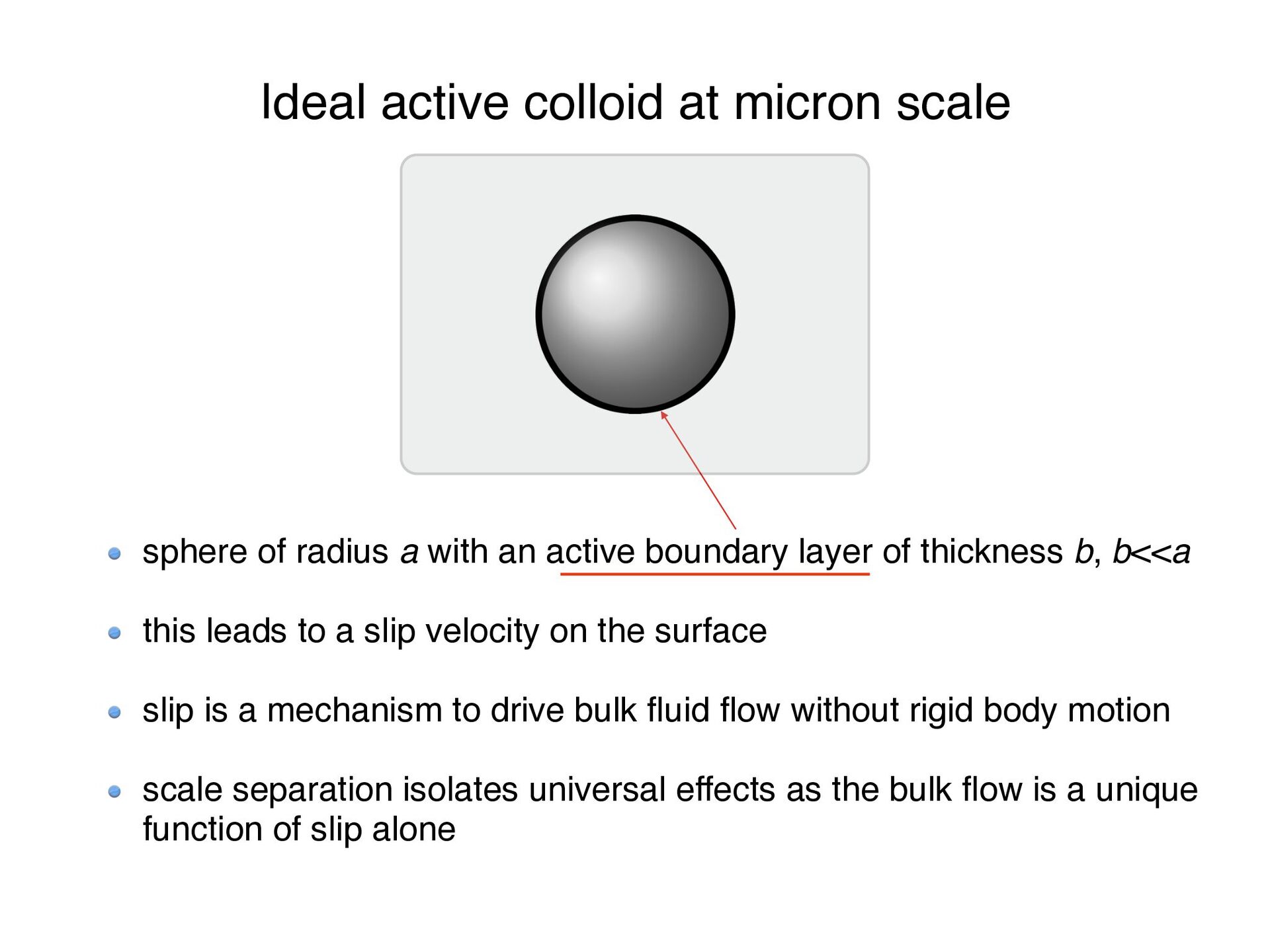
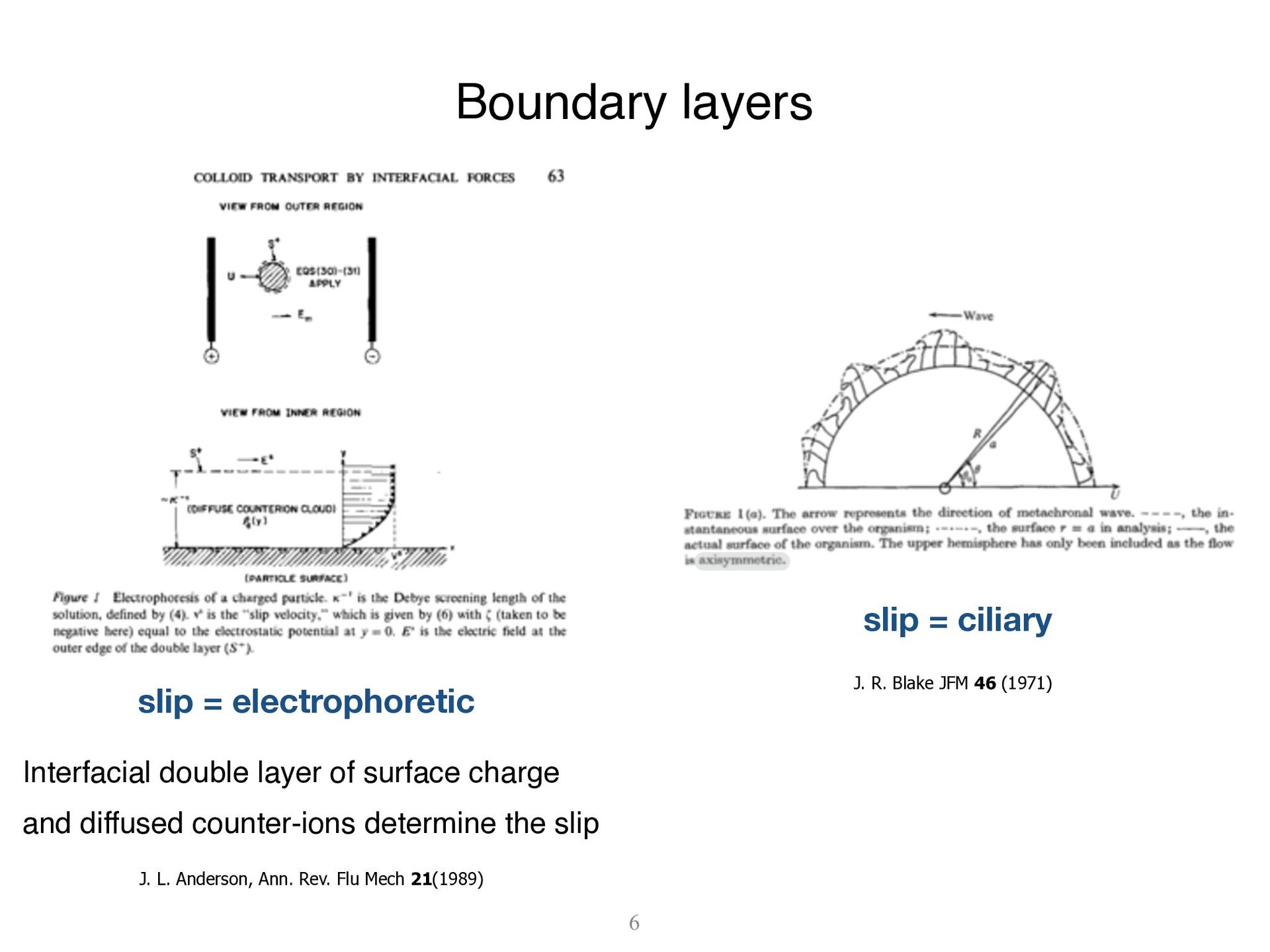
  1. Ideal active colloid at micron scale sphere of radius a

    with an active boundary layer of thickness b, b<<a this leads to a slip velocity on the surface slip is a mechanism to drive bulk fluid flow without rigid body motion scale separation isolates universal effects as the bulk flow is a unique function of slip alone
  2. 6 Interfacial double layer of surface charge and diffused counter-ions

    determine the slip slip = electrophoretic J. L. Anderson, Ann. Rev. Flu Mech 21(1989) Boundary layers J. R. Blake JFM 46 (1971) slip = ciliary
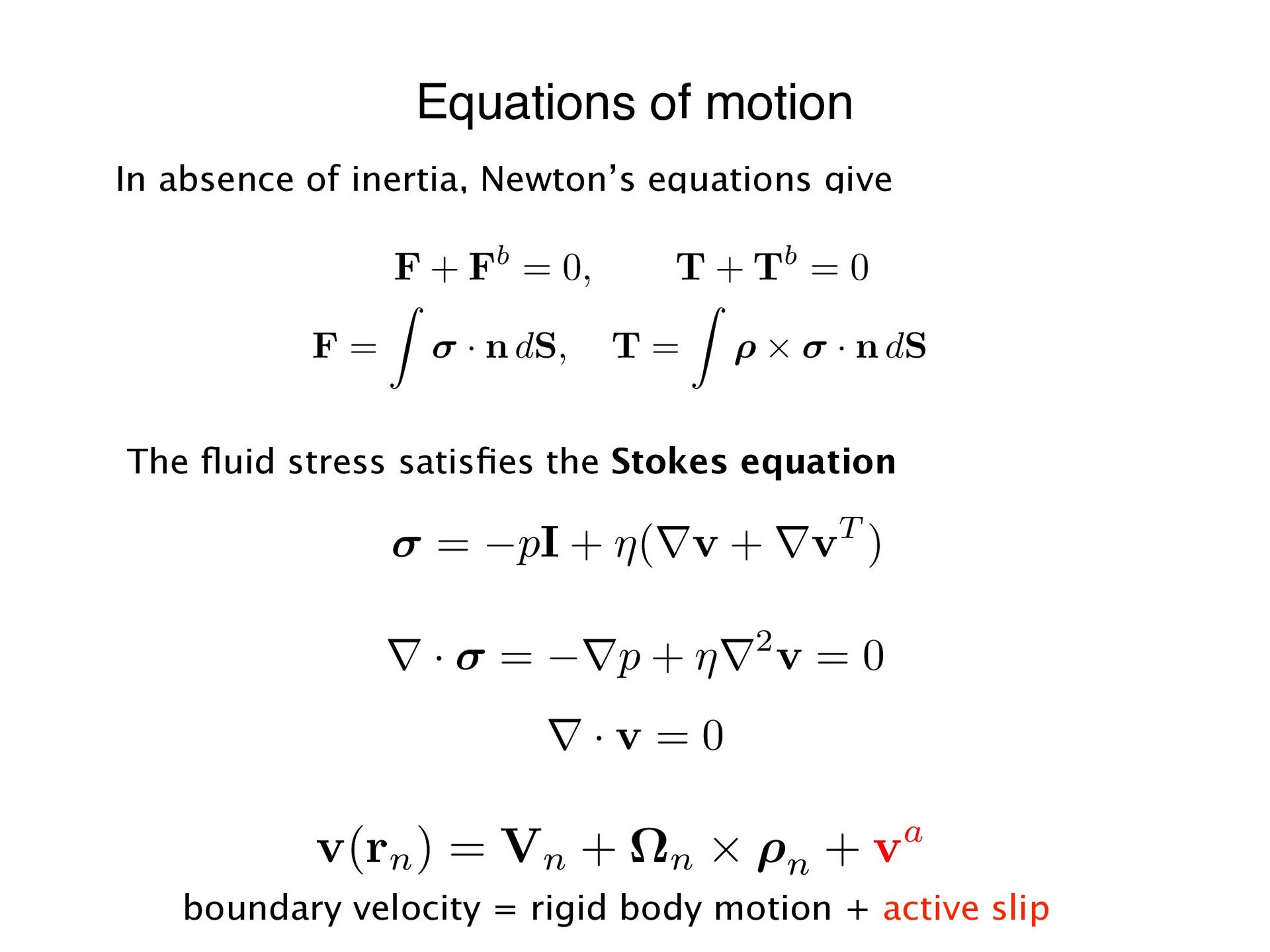
  3. Equations of motion In absence of inertia, Newton’s equations give

    F + Fb = 0, T + Tb = 0 F = Z · n dS, T = Z ⇢ ⇥ · n dS = pI + ⌘(rv + rvT ) r · = rp + ⌘r2v = 0 r · v = 0 The fluid stress satisfies the Stokes equation boundary velocity = rigid body motion + active slip v(rn) = Vn + ⌦n ⇥ ⇢n + va
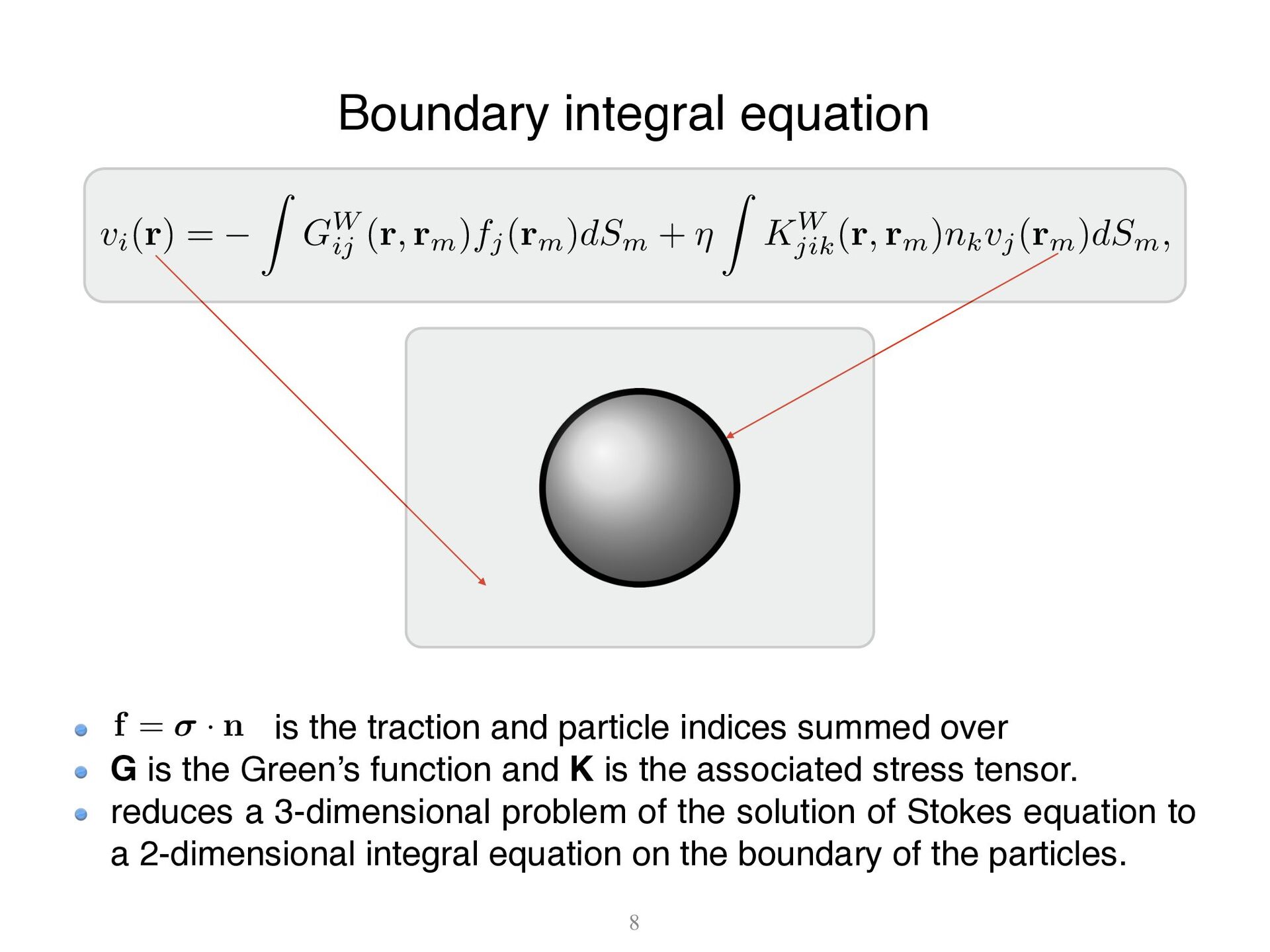
  4. 8 Boundary integral equation vi(r) = Z GW ij (r,

    rm)fj(rm)dSm + ⌘ Z KW jik (r, rm)nkvj(rm)dSm, is the traction and particle indices summed over G is the Green’s function and K is the associated stress tensor. reduces a 3-dimensional problem of the solution of Stokes equation to a 2-dimensional integral equation on the boundary of the particles. f = · n
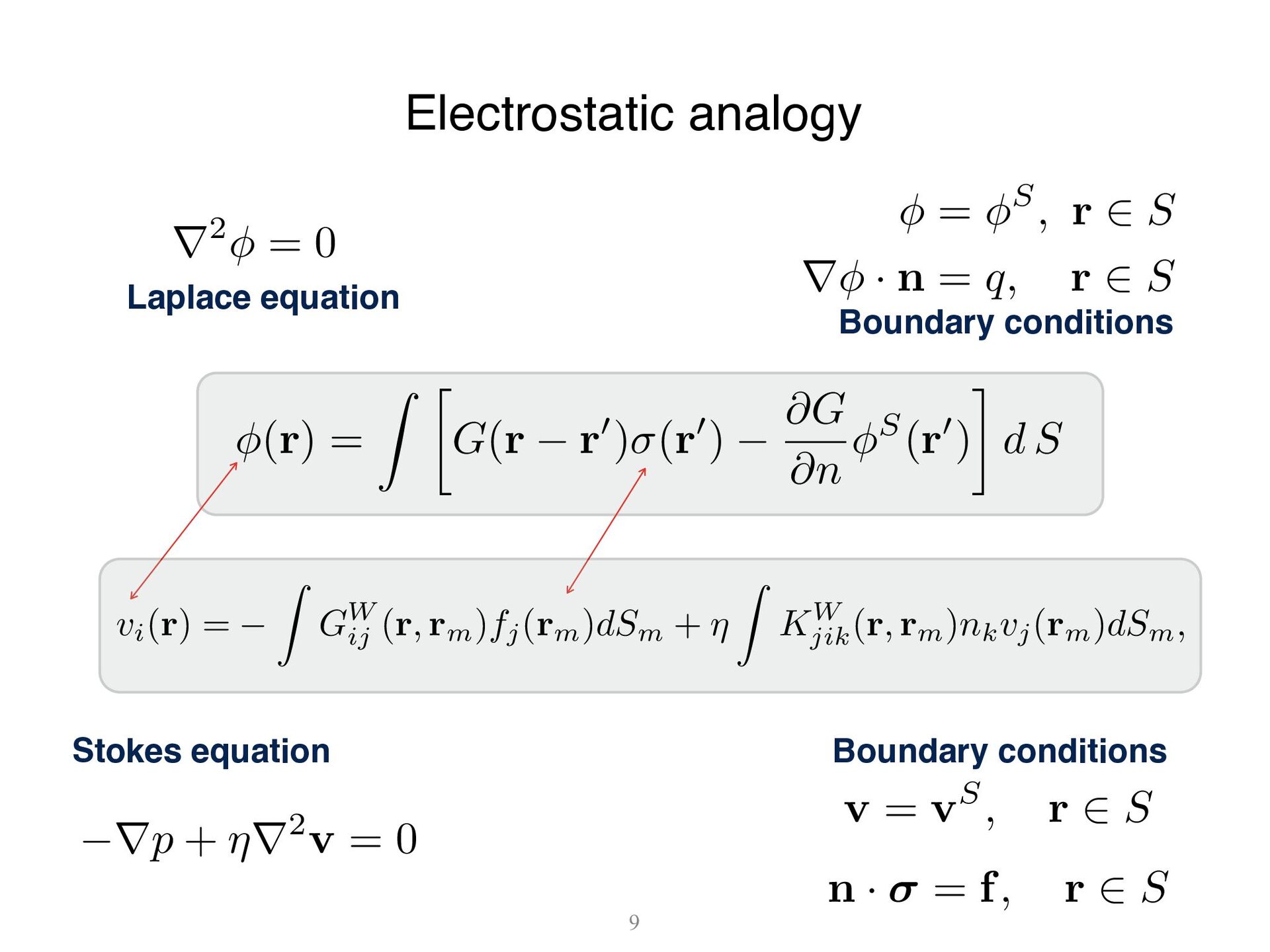
  5. 9 Electrostatic analogy r2 = 0 = S, r 2

    S r · n = q, r 2 S Laplace equation Boundary conditions (r) = Z  G(r r0) (r0) @G @n S(r0) d S Stokes equation Boundary conditions rp + ⌘r2v = 0 v = vS, r 2 S n · = f, r 2 S vi(r) = Z GW ij (r, rm)fj(rm)dSm + ⌘ Z KW jik (r, rm)nkvj(rm)dSm,
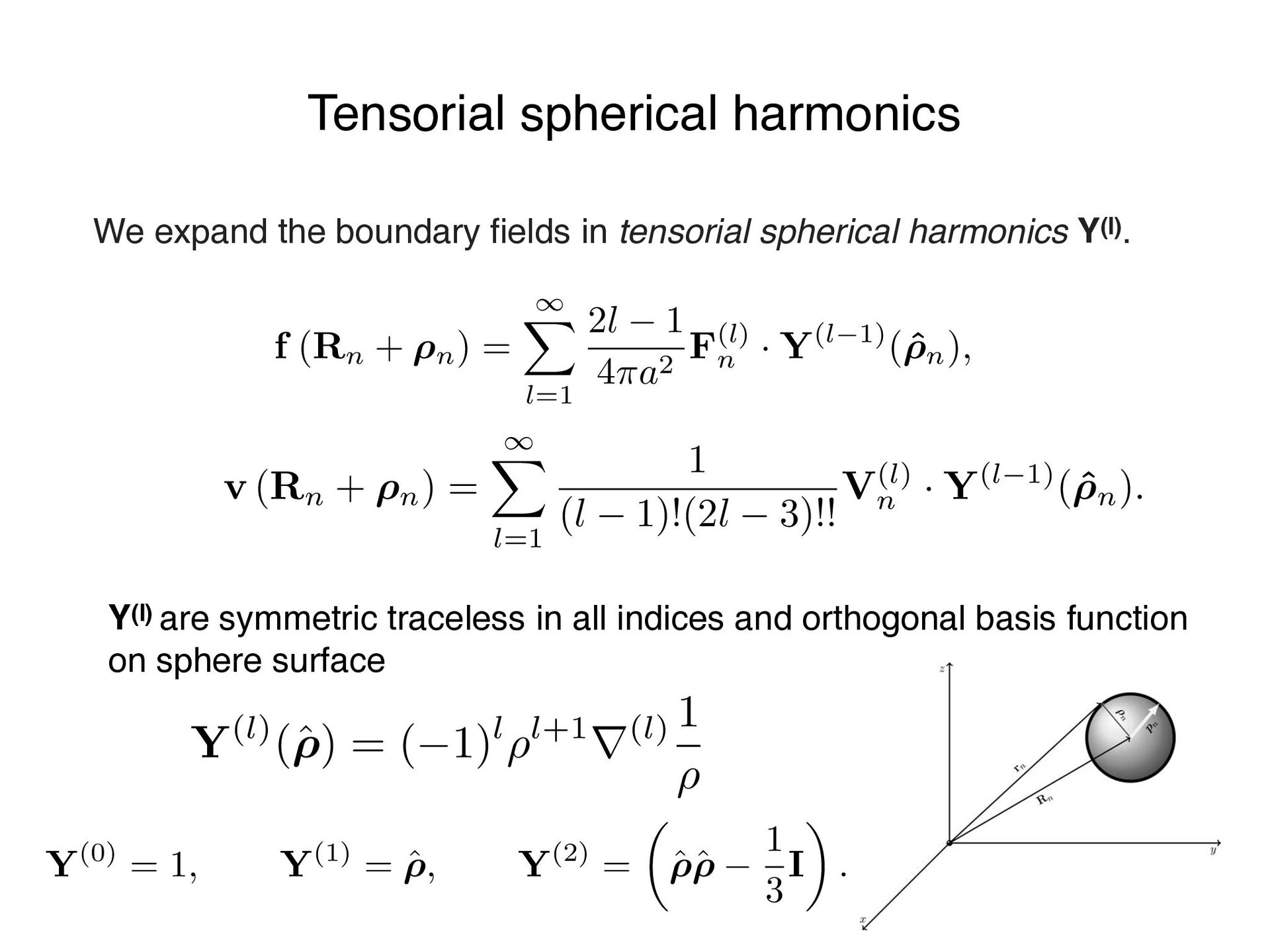
  6. Y(l)(ˆ ⇢) = ( 1)l⇢l+1r(l) 1 ⇢ f (Rn +

    ⇢n) = 1 X l=1 2l 1 4⇡a2 F(l) n · Y(l 1)(ˆ ⇢n), v (Rn + ⇢n) = 1 X l=1 1 (l 1)!(2l 3)!! V(l) n · Y(l 1)(ˆ ⇢n). Y(0) = 1, Y(1) = ˆ ⇢, Y(2) = ✓ ˆ ⇢ˆ ⇢ 1 3 I ◆ . Tensorial spherical harmonics We expand the boundary fields in tensorial spherical harmonics Y(l). Y(l) are symmetric traceless in all indices and orthogonal basis function on sphere surface
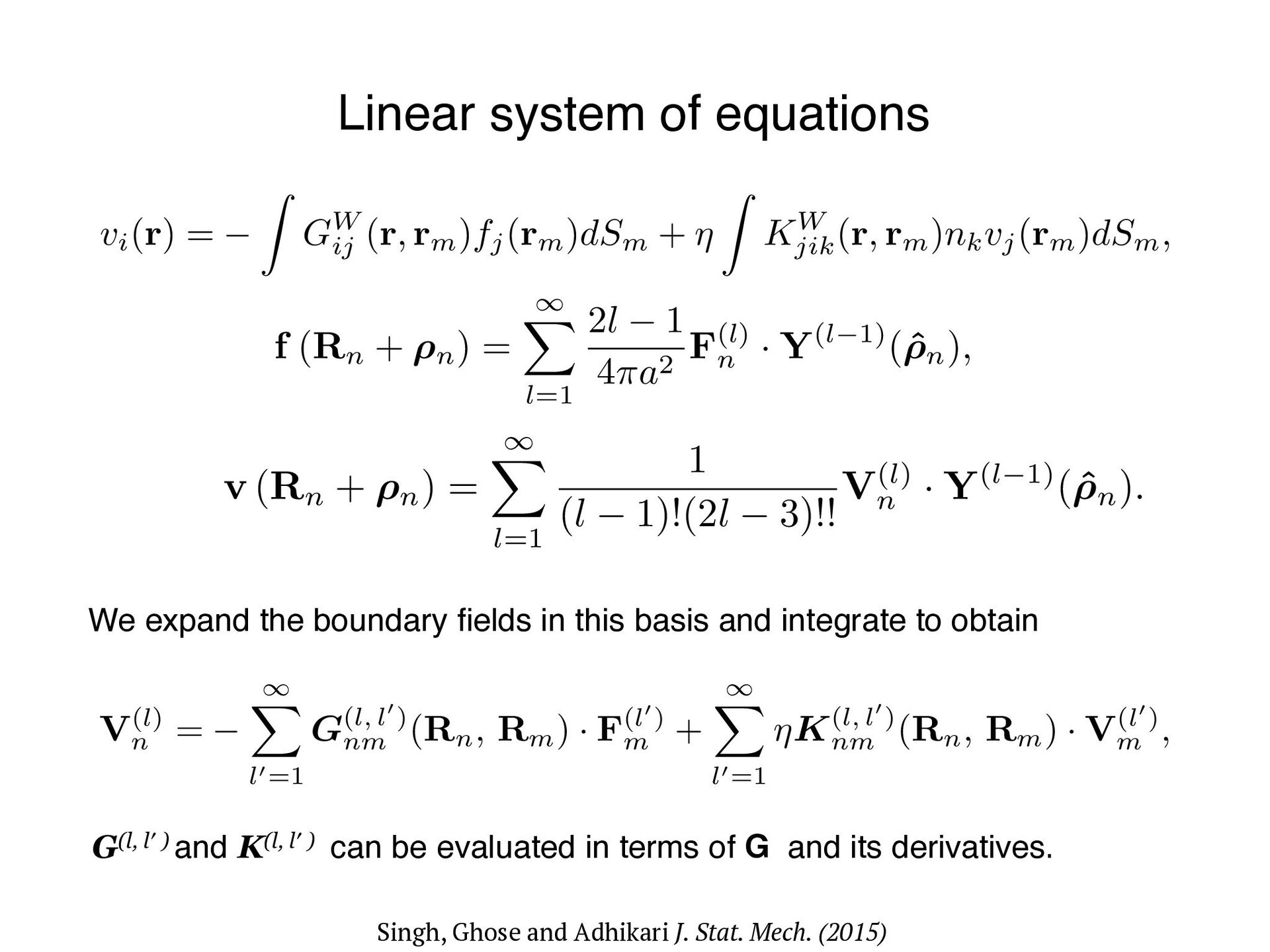
  7. f (Rn + ⇢n) = 1 X l=1 2l 1

    4⇡a2 F(l) n · Y(l 1)(ˆ ⇢n), v (Rn + ⇢n) = 1 X l=1 1 (l 1)!(2l 3)!! V(l) n · Y(l 1)(ˆ ⇢n). vi(r) = Z GW ij (r, rm)fj(rm)dSm + ⌘ Z KW jik (r, rm)nkvj(rm)dSm, Linear system of equations V(l) n = 1 X l0=1 G(l, l0) nm (Rn, Rm) · F(l0) m + 1 X l0=1 ⌘K(l, l0) nm (Rn, Rm) · V(l0) m , We expand the boundary fields in this basis and integrate to obtain G(l, l′ ) and K(l, l′ ) can be evaluated in terms of G and its derivatives. Singh, Ghose and Adhikari J. Stat. Mech. (2015)
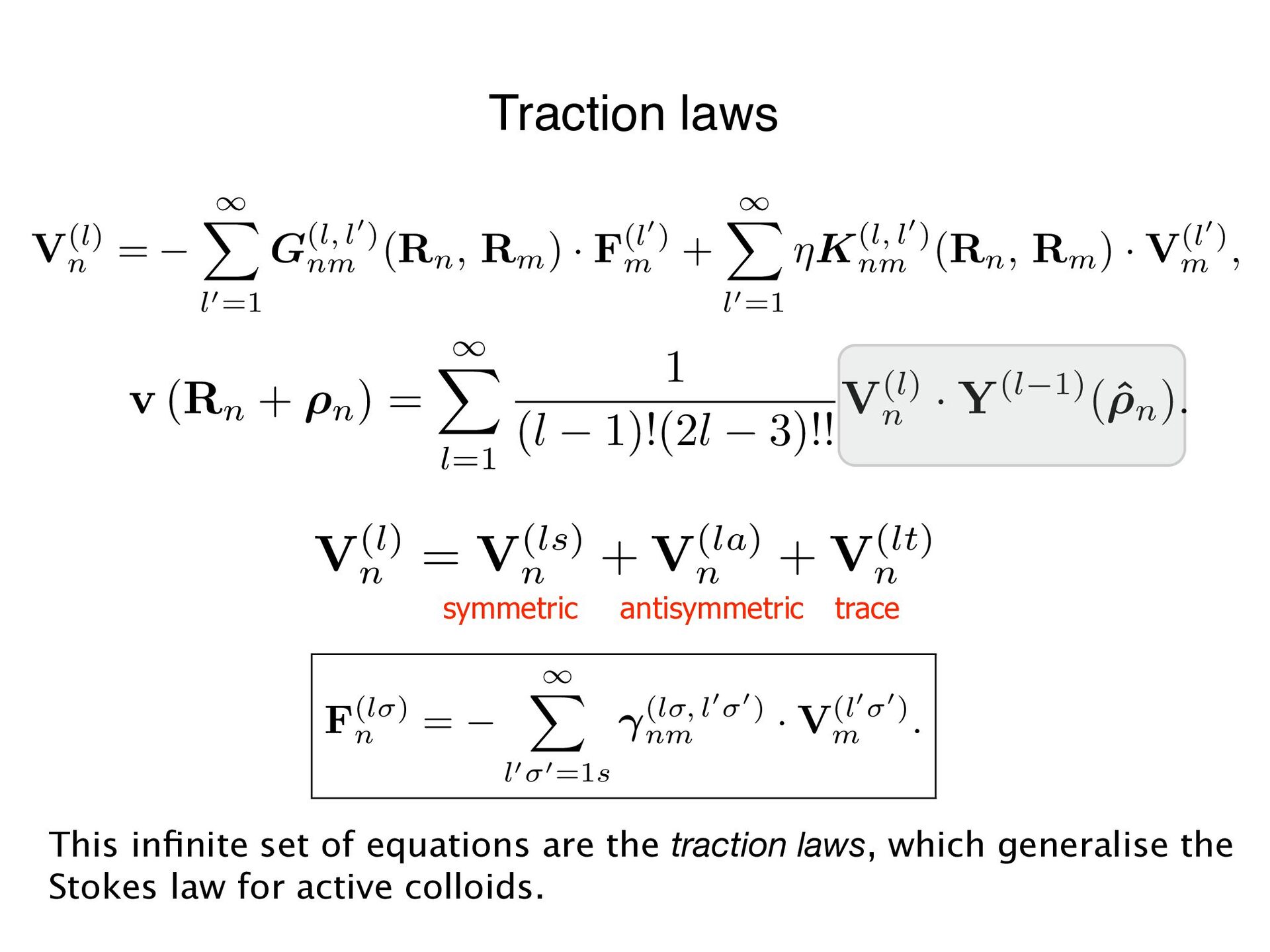
  8. Traction laws V(l) n = 1 X l0=1 G(l, l0)

    nm (Rn, Rm) · F(l0) m + 1 X l0=1 ⌘K(l, l0) nm (Rn, Rm) · V(l0) m , v (Rn + ⇢n) = 1 X l=1 1 (l 1)!(2l 3)!! V(l) n · Y(l 1)(ˆ ⇢n). V(l) n = V(ls) n + V(la) n + V(lt) n symmetric antisymmetric trace F(l ) n = 1 X l0 0=1s (l , l0 0) nm · V(l0 0) m . This infinite set of equations are the traction laws, which generalise the Stokes law for active colloids.
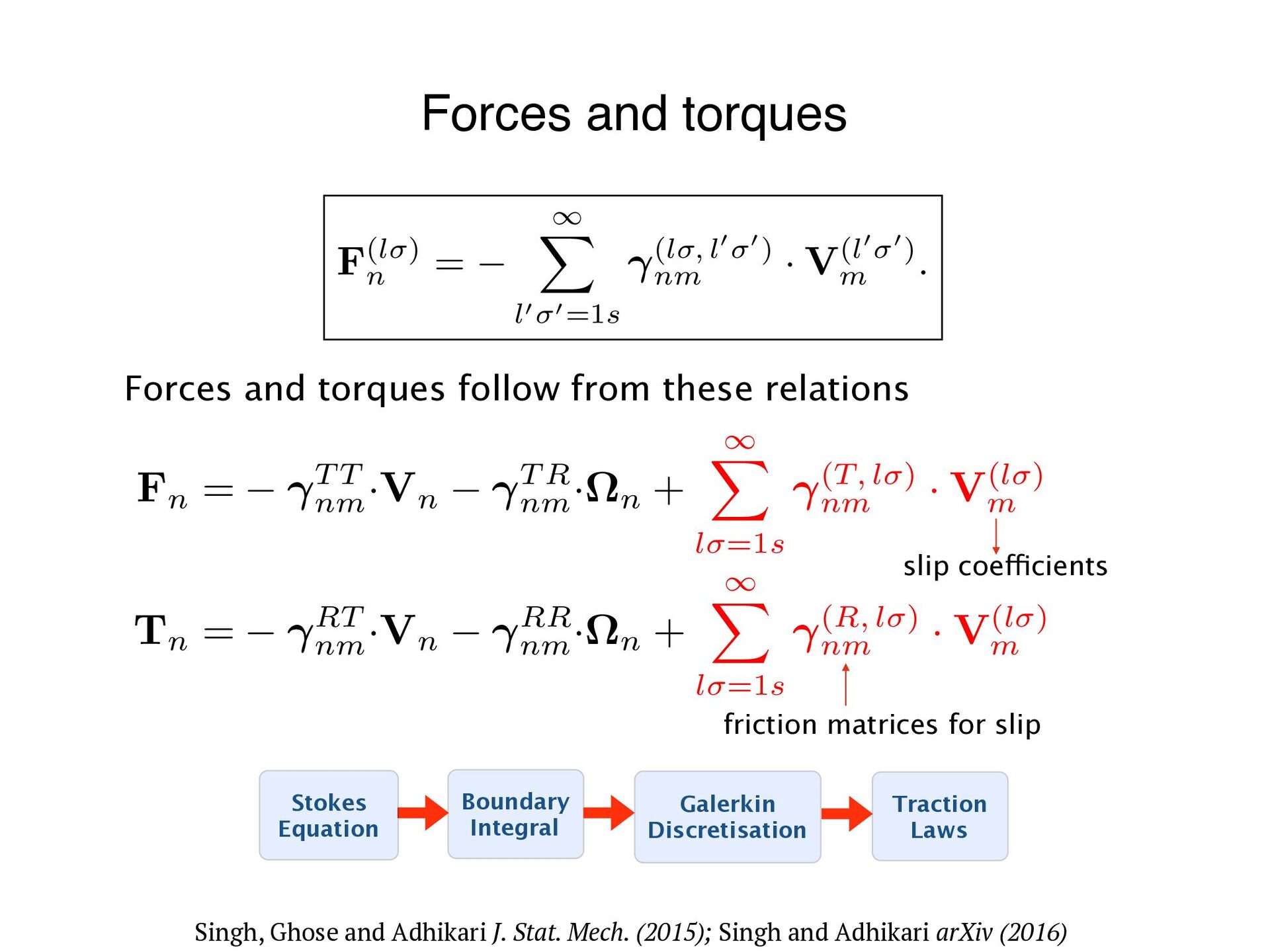
  9. Forces and torques follow from these relations F(l ) n

    = 1 X l0 0=1s (l , l0 0) nm · V(l0 0) m . Forces and torques Singh, Ghose and Adhikari J. Stat. Mech. (2015); Singh and Adhikari arXiv (2016) Fn = T T nm ·Vn T R nm ·⌦n + 1 X l =1s (T, l ) nm · V(l ) m Tn = RT nm ·Vn RR nm ·⌦n + 1 X l =1s (R, l ) nm · V(l ) m friction matrices for slip slip coe!cients Boundary Integral Galerkin Discretisation Stokes Equation Traction Laws
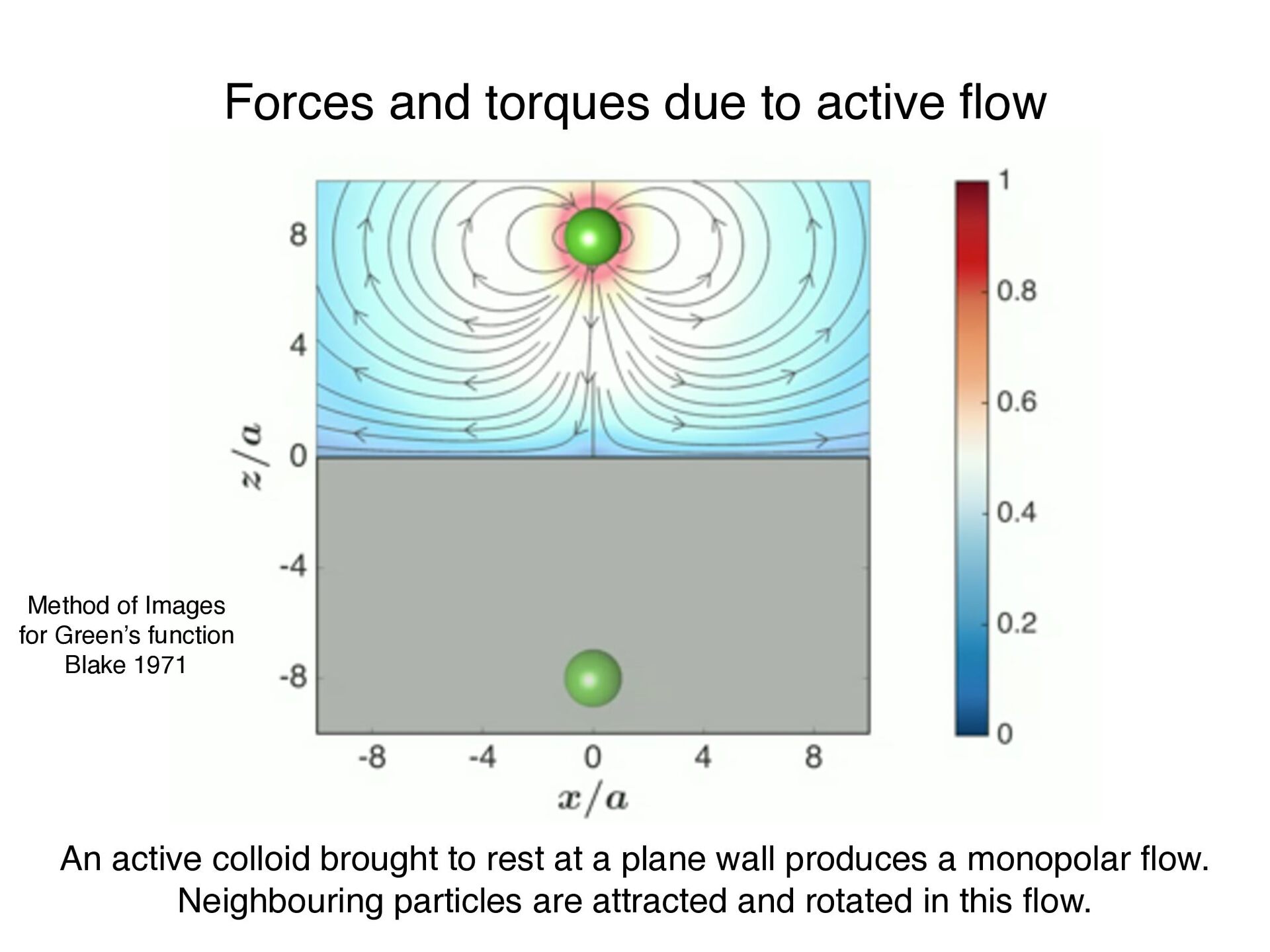
  10. Forces and torques due to active flow An active colloid

    brought to rest at a plane wall produces a monopolar flow. Neighbouring particles are attracted and rotated in this flow. Method of Images for Green’s function Blake 1971
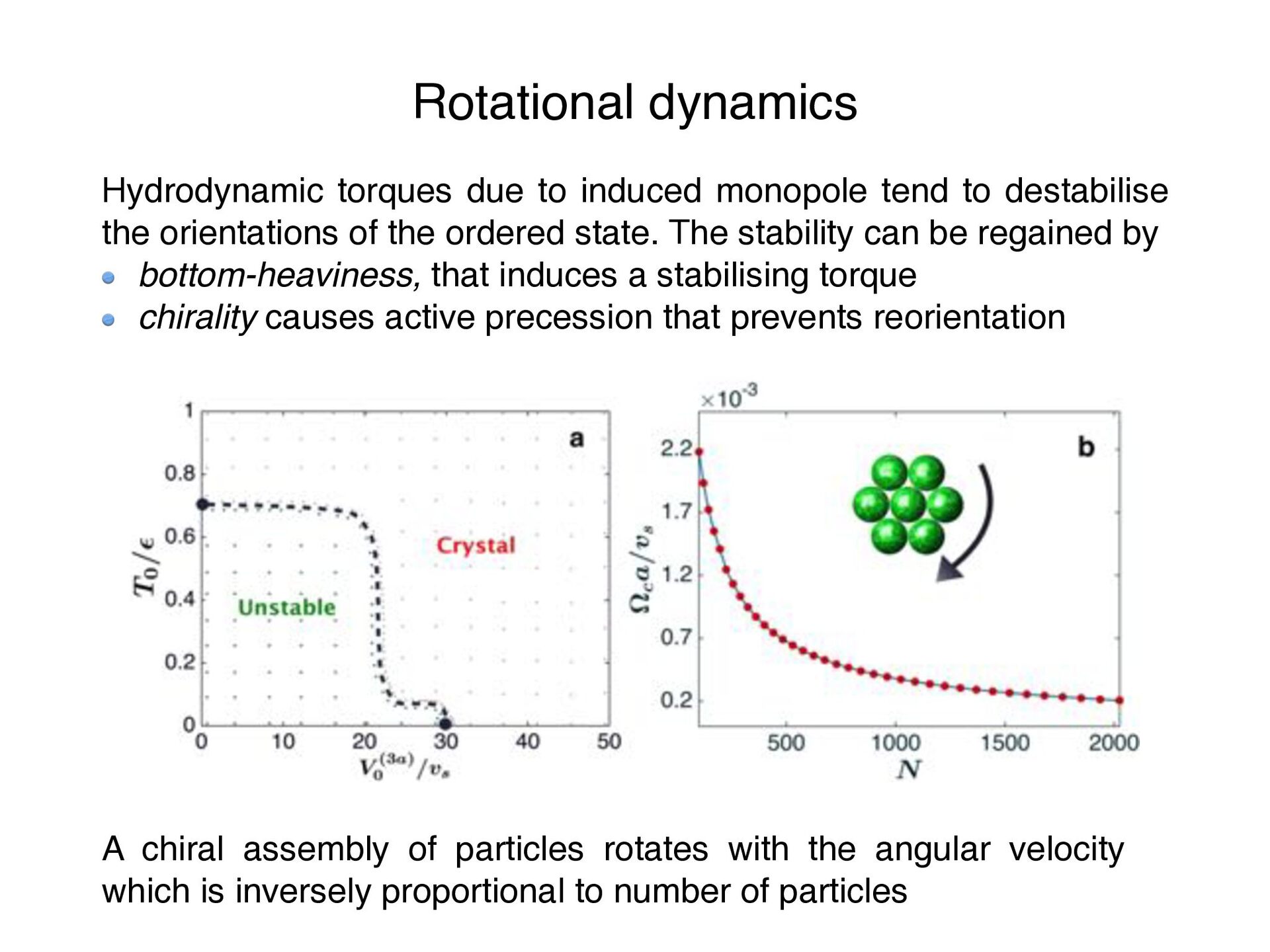
  11. Rotational dynamics Hydrodynamic torques due to induced monopole tend to

    destabilise the orientations of the ordered state. The stability can be regained by bottom-heaviness, that induces a stabilising torque chirality causes active precession that prevents reorientation A chiral assembly of particles rotates with the angular velocity which is inversely proportional to number of particles
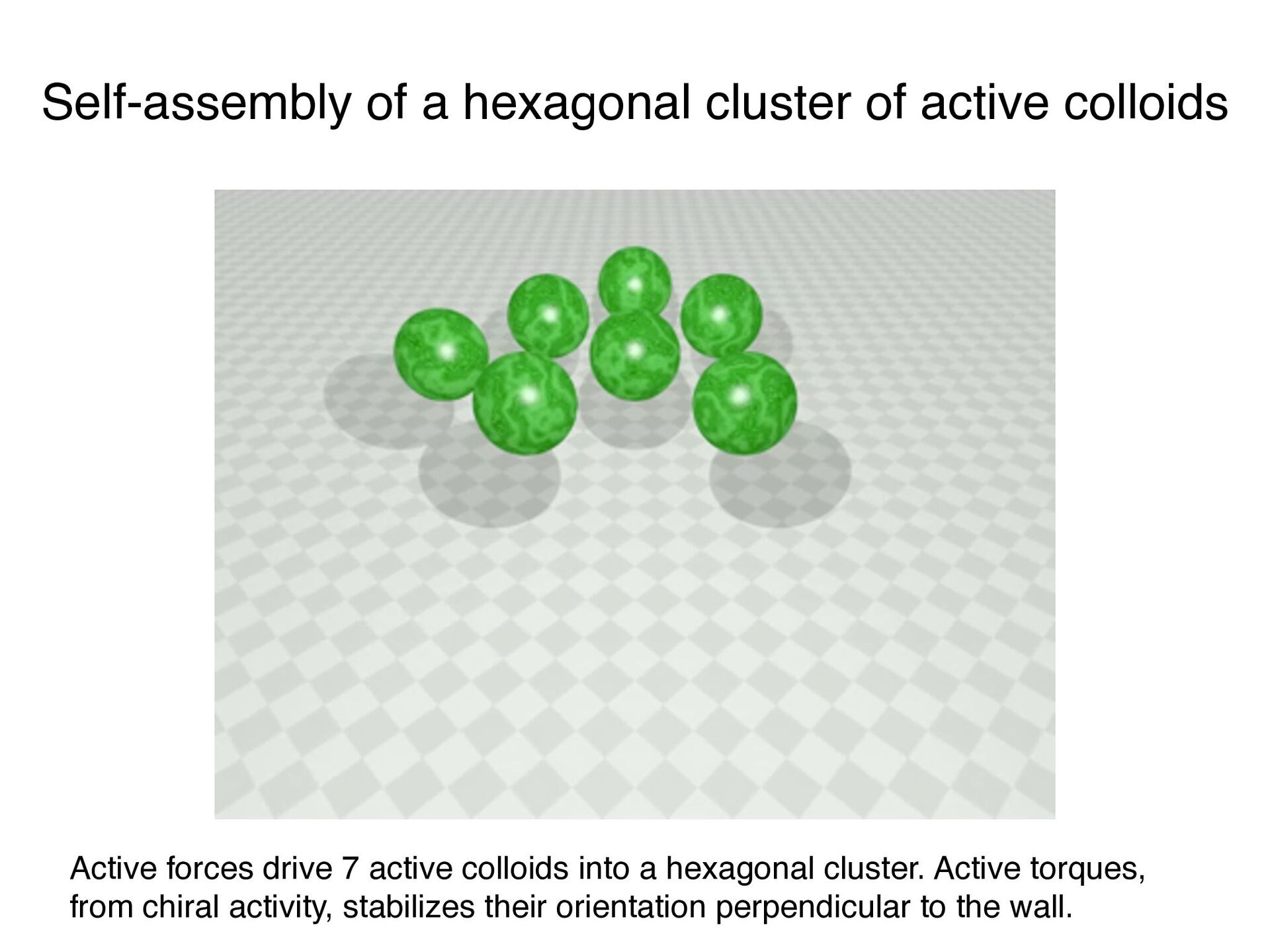
  12. Active forces drive 7 active colloids into a hexagonal cluster.

    Active torques, from chiral activity, stabilizes their orientation perpendicular to the wall. Self-assembly of a hexagonal cluster of active colloids
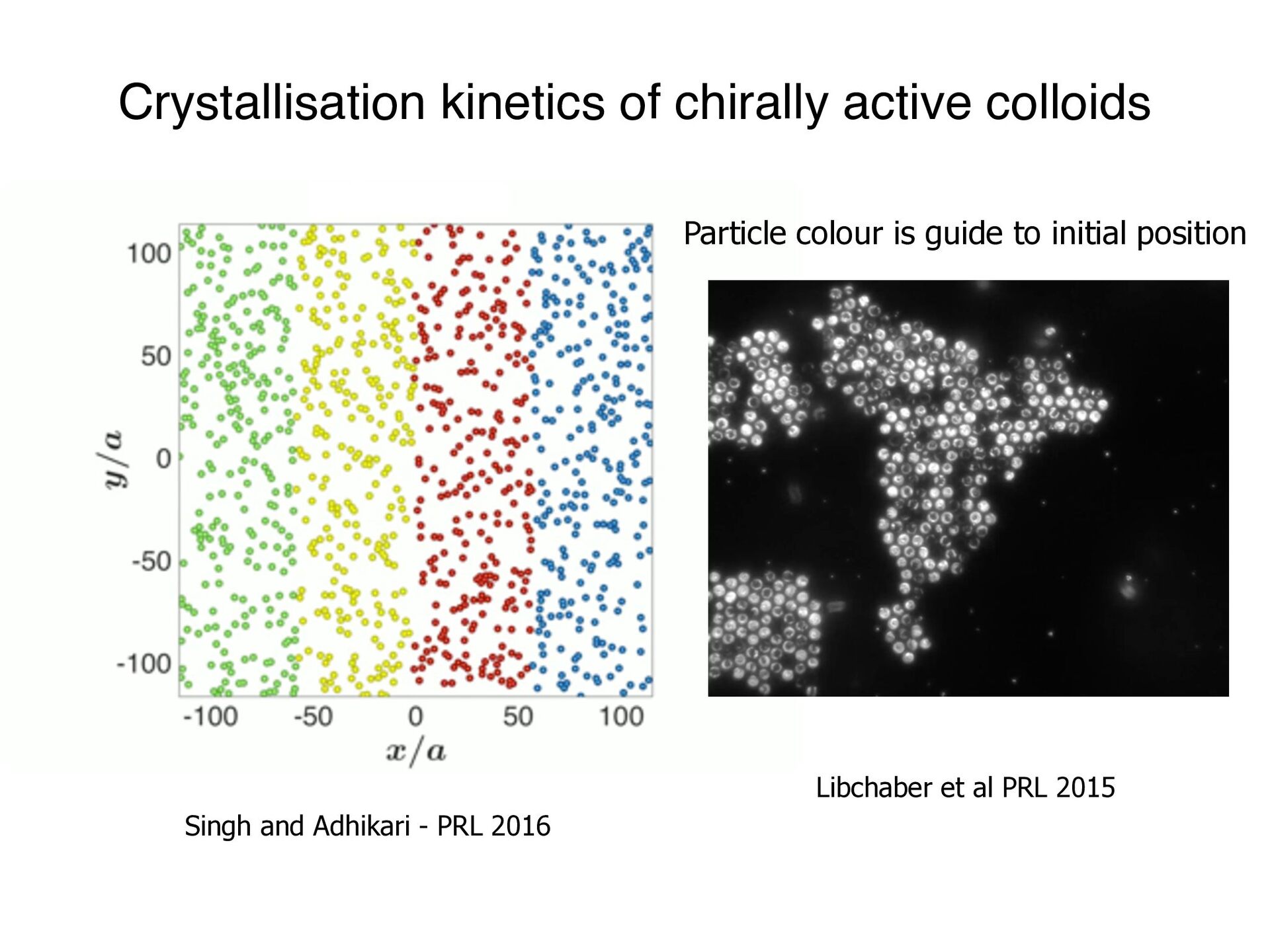
  13. Active crystallization observed in experiment Crystallisation kinetics of chirally active

    colloids Singh and Adhikari - PRL 2016 Libchaber et al PRL 2015 Particle colour is guide to initial position
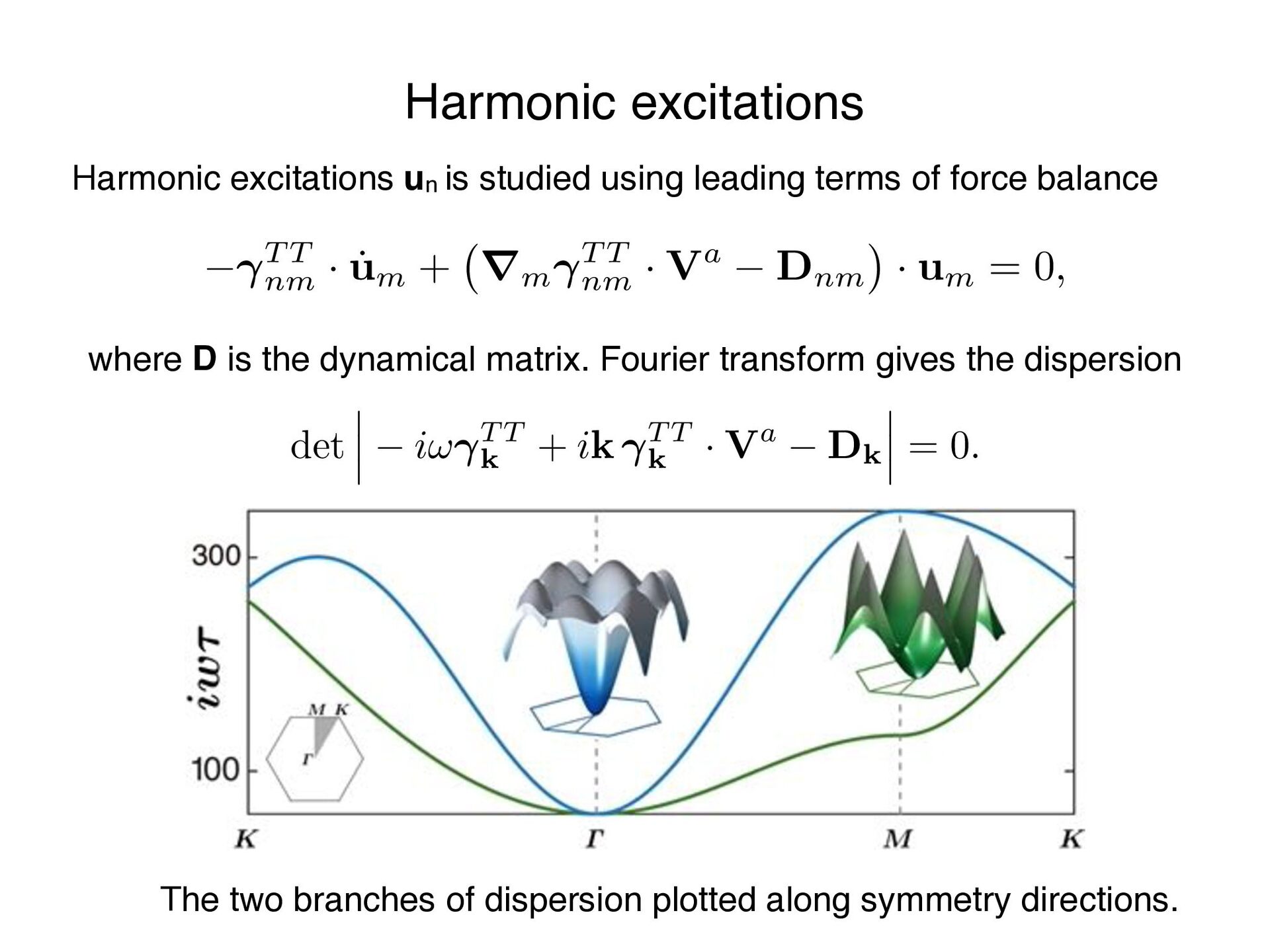
  14. Harmonic excitations Harmonic excitations un is studied using leading terms

    of force balance T T nm · ˙ um + rm T T nm · Va Dnm · um = 0, det i! T T k + ik T T k · Va Dk = 0. where D is the dynamical matrix. Fourier transform gives the dispersion The two branches of dispersion plotted along symmetry directions.
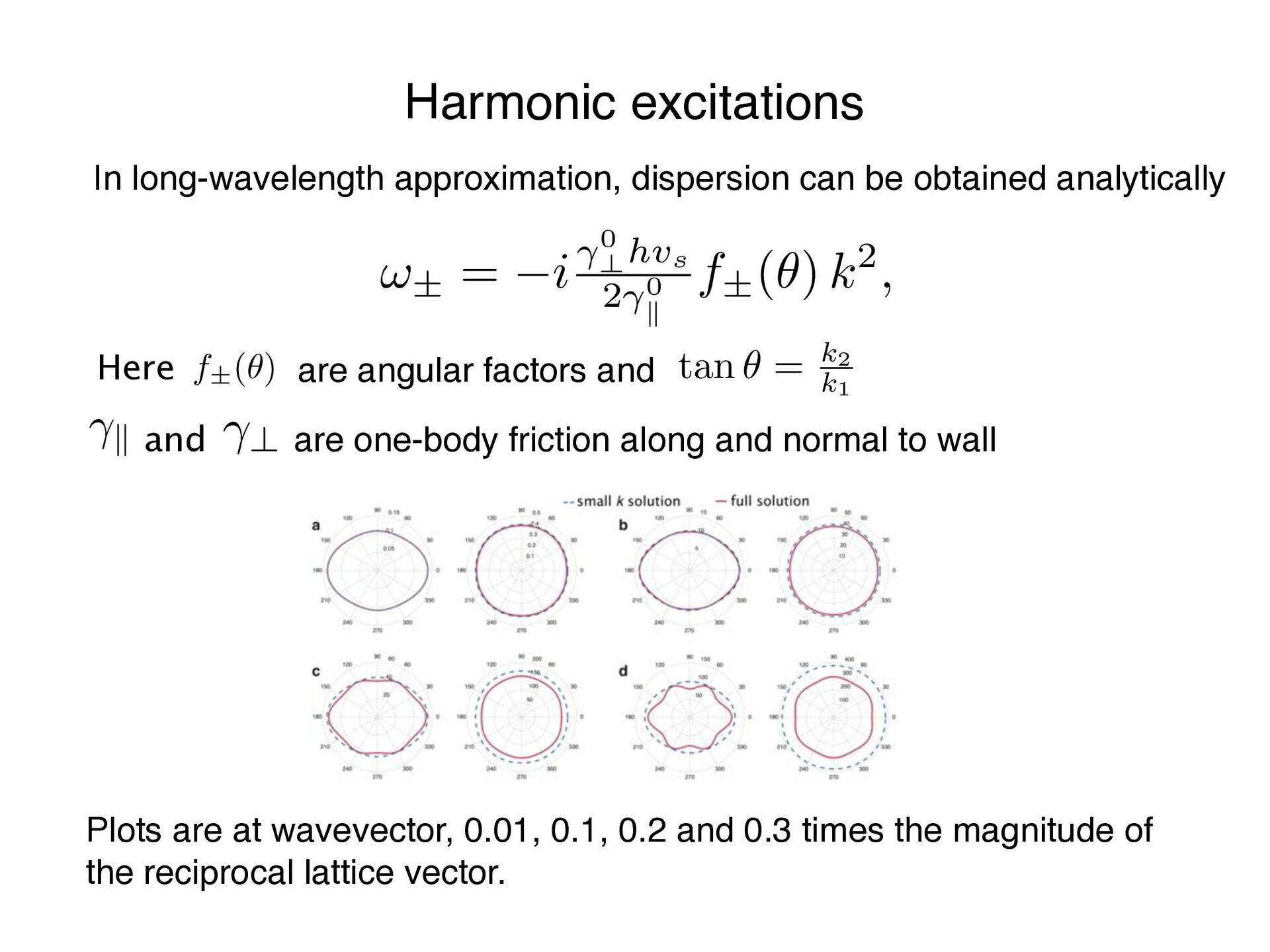
  15. Harmonic excitations In long-wavelength approximation, dispersion can be obtained analytically

    !± = i 0 ? hvs 2 0 k f±(✓) k2, k ? and are one-body friction along and normal to wall tan ✓ = k2 k1 Here are angular factors and f±(✓) Plots are at wavevector, 0.01, 0.1, 0.2 and 0.3 times the magnitude of the reciprocal lattice vector.
  16. • Formalism for calculating hydrodynamic forces and torques between active

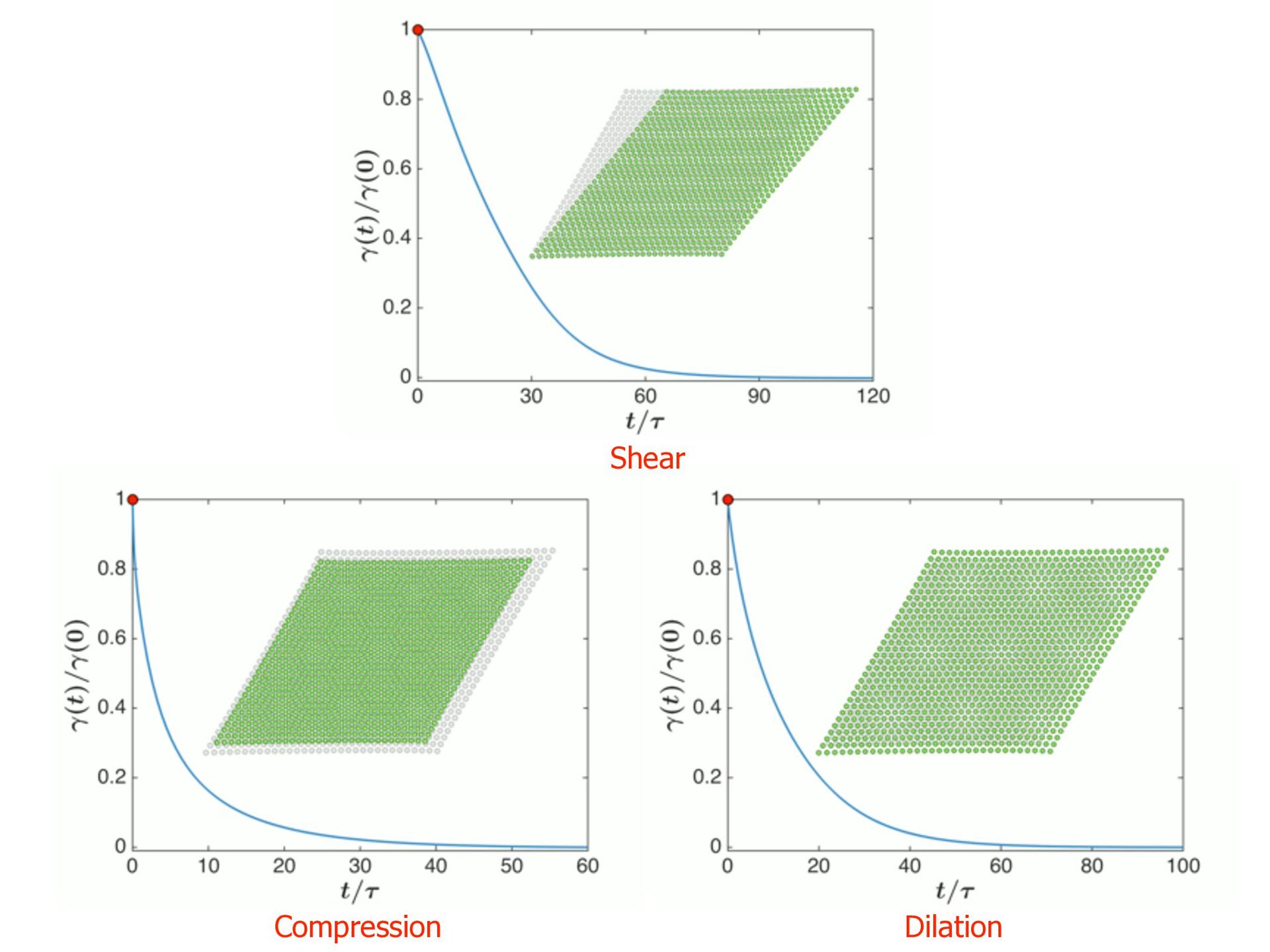
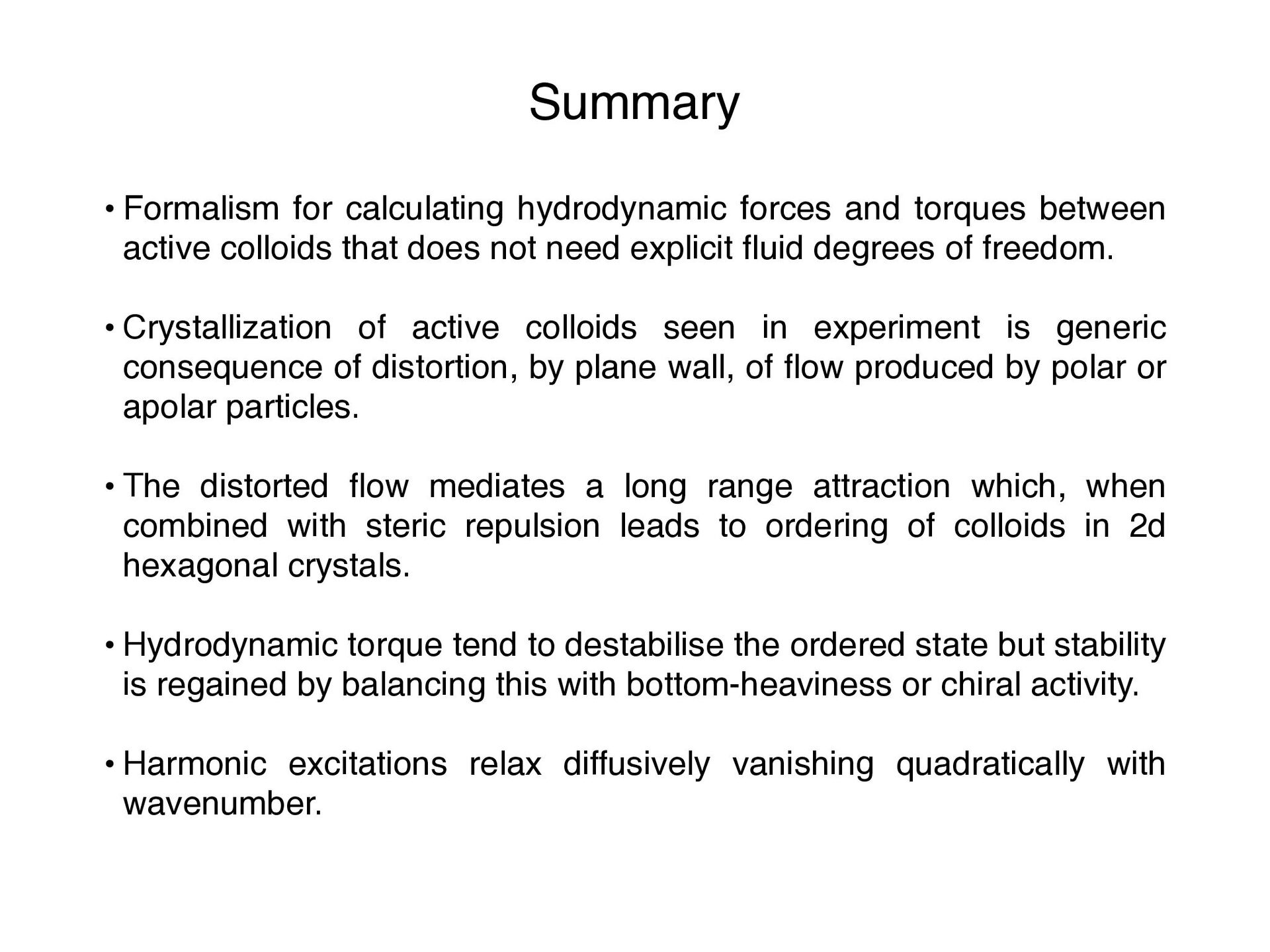
    colloids that does not need explicit fluid degrees of freedom. • Crystallization of active colloids seen in experiment is generic consequence of distortion, by plane wall, of flow produced by polar or apolar particles. • The distorted flow mediates a long range attraction which, when combined with steric repulsion leads to ordering of colloids in 2d hexagonal crystals. • Hydrodynamic torque tend to destabilise the ordered state but stability is regained by balancing this with bottom-heaviness or chiral activity. • Harmonic excitations relax diffusively vanishing quadratically with wavenumber. Summary