$30 off During Our Annual Pro Sale. View Details »

kumamoto_transportation_innovation_eng

 kumamoto_transportation_innovation_eng

Avatar for Traffic Brain

Traffic Brain

November 21, 2025
Tweet

More Decks by Traffic Brain

Other Decks in Research

Transcript

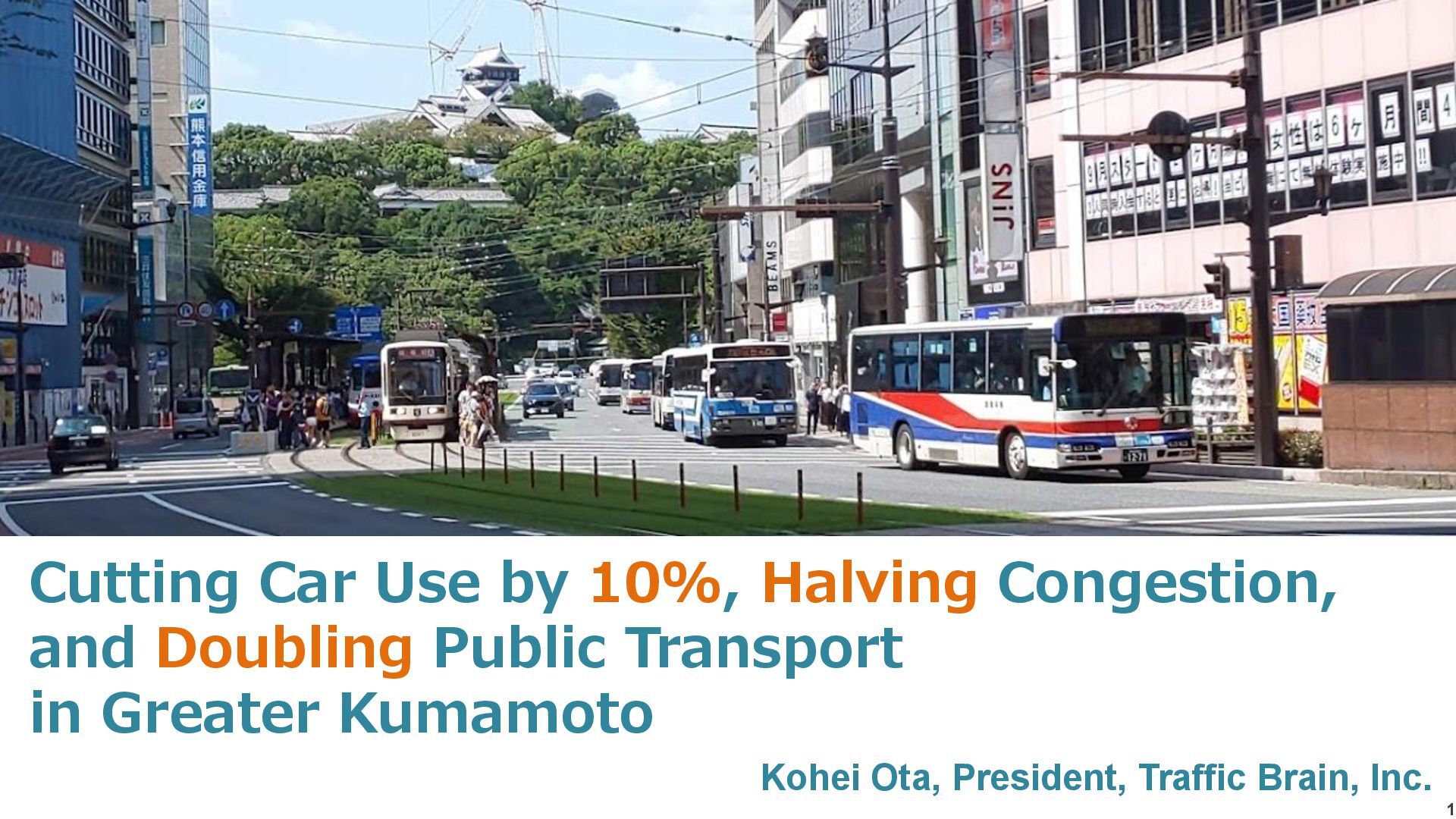
  1. 1 Kohei Ota, President, Traffic Brain, Inc. Cutting Car Use

    by 10%, Halving Congestion, and Doubling Public Transport in Greater Kumamoto
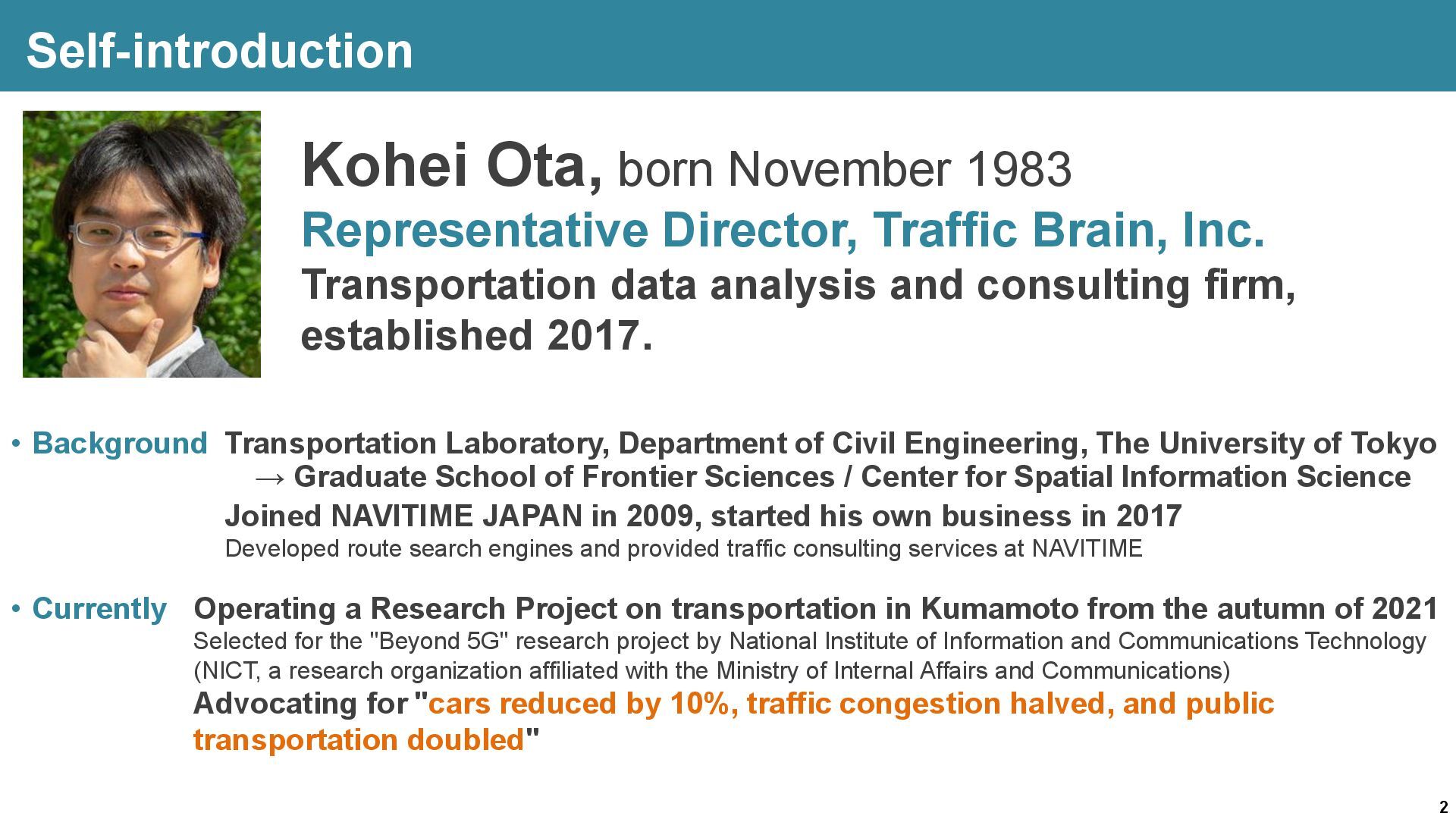
  2. 2 2 Self-introduction Kohei Ota, born November 1983 Representative Director,

    Traffic Brain, Inc. Transportation data analysis and consulting firm, established 2017. • Background Transportation Laboratory, Department of Civil Engineering, The University of Tokyo → Graduate School of Frontier Sciences / Center for Spatial Information Science Joined NAVITIME JAPAN in 2009, started his own business in 2017 Developed route search engines and provided traffic consulting services at NAVITIME • Currently Operating a Research Project on transportation in Kumamoto from the autumn of 2021 Selected for the "Beyond 5G" research project by National Institute of Information and Communications Technology (NICT, a research organization affiliated with the Ministry of Internal Affairs and Communications) Advocating for "cars reduced by 10%, traffic congestion halved, and public transportation doubled"
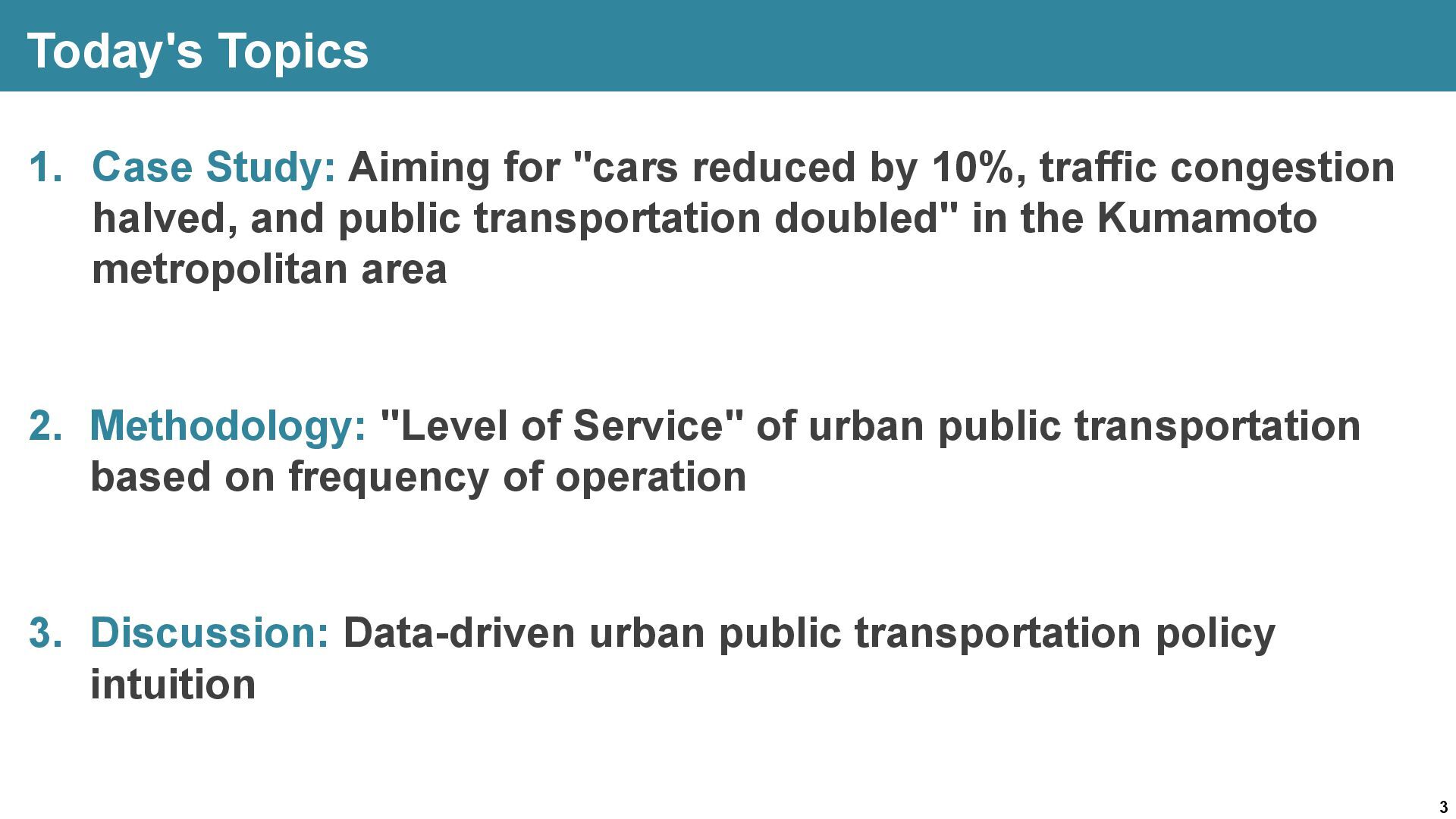
  3. 3 Today's Topics 1. Case Study: Aiming for "cars reduced

    by 10%, traffic congestion halved, and public transportation doubled" in the Kumamoto metropolitan area 2. Methodology: "Level of Service" of urban public transportation based on frequency of operation 3. Discussion: Data-driven urban public transportation policy intuition
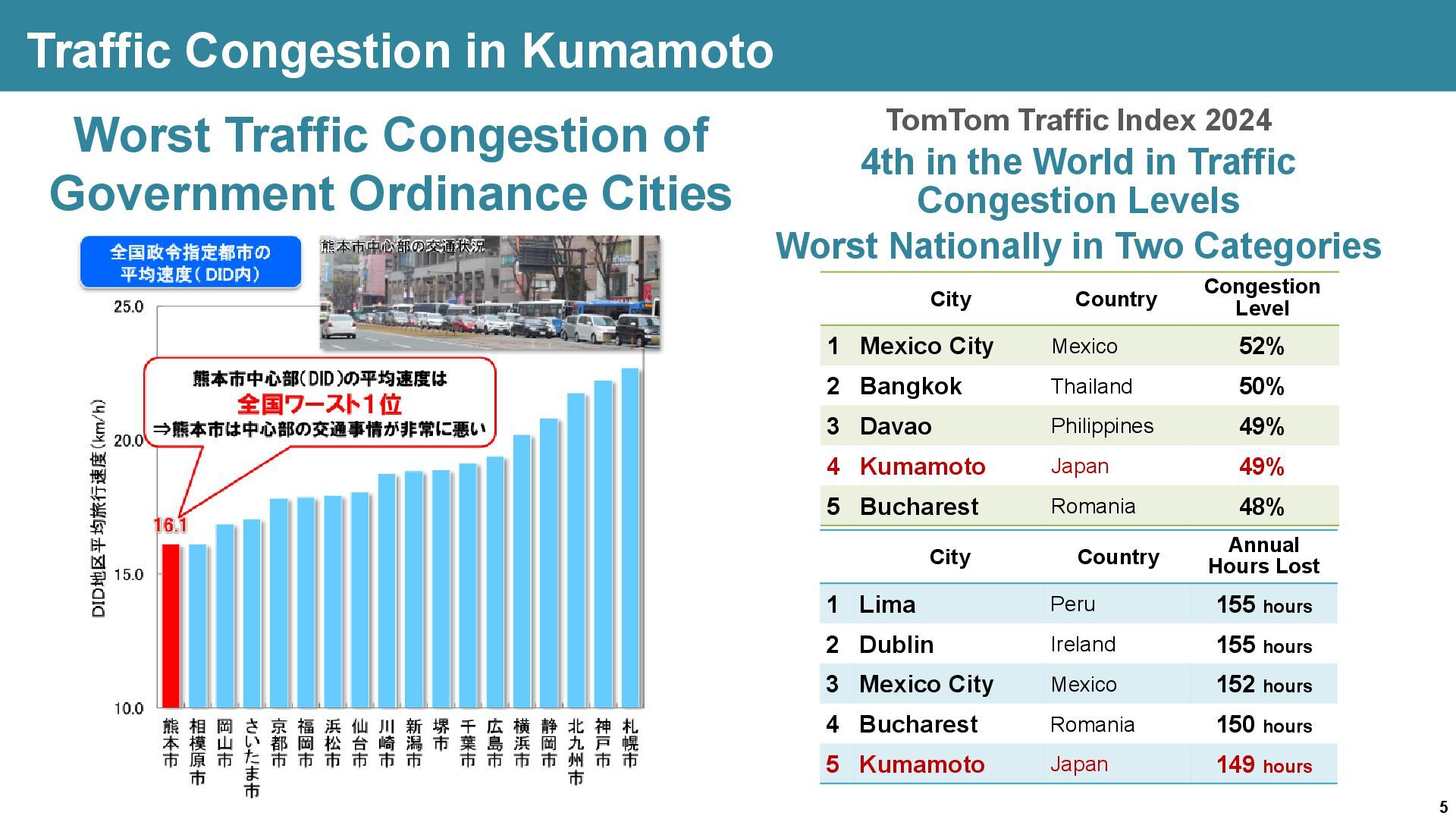
  4. 5 Traffic Congestion in Kumamoto Worst Traffic Congestion of Government

    Ordinance Cities TomTom Traffic Index 2024 4th in the World in Traffic Congestion Levels Worst Nationally in Two Categories City Country Congestion Level 1 Mexico City Mexico 52% 2 Bangkok Thailand 50% 3 Davao Philippines 49% 4 Kumamoto Japan 49% 5 Bucharest Romania 48% City Country Annual Hours Lost 1 Lima Peru 155 hours 2 Dublin Ireland 155 hours 3 Mexico City Mexico 152 hours 4 Bucharest Romania 150 hours 5 Kumamoto Japan 149 hours
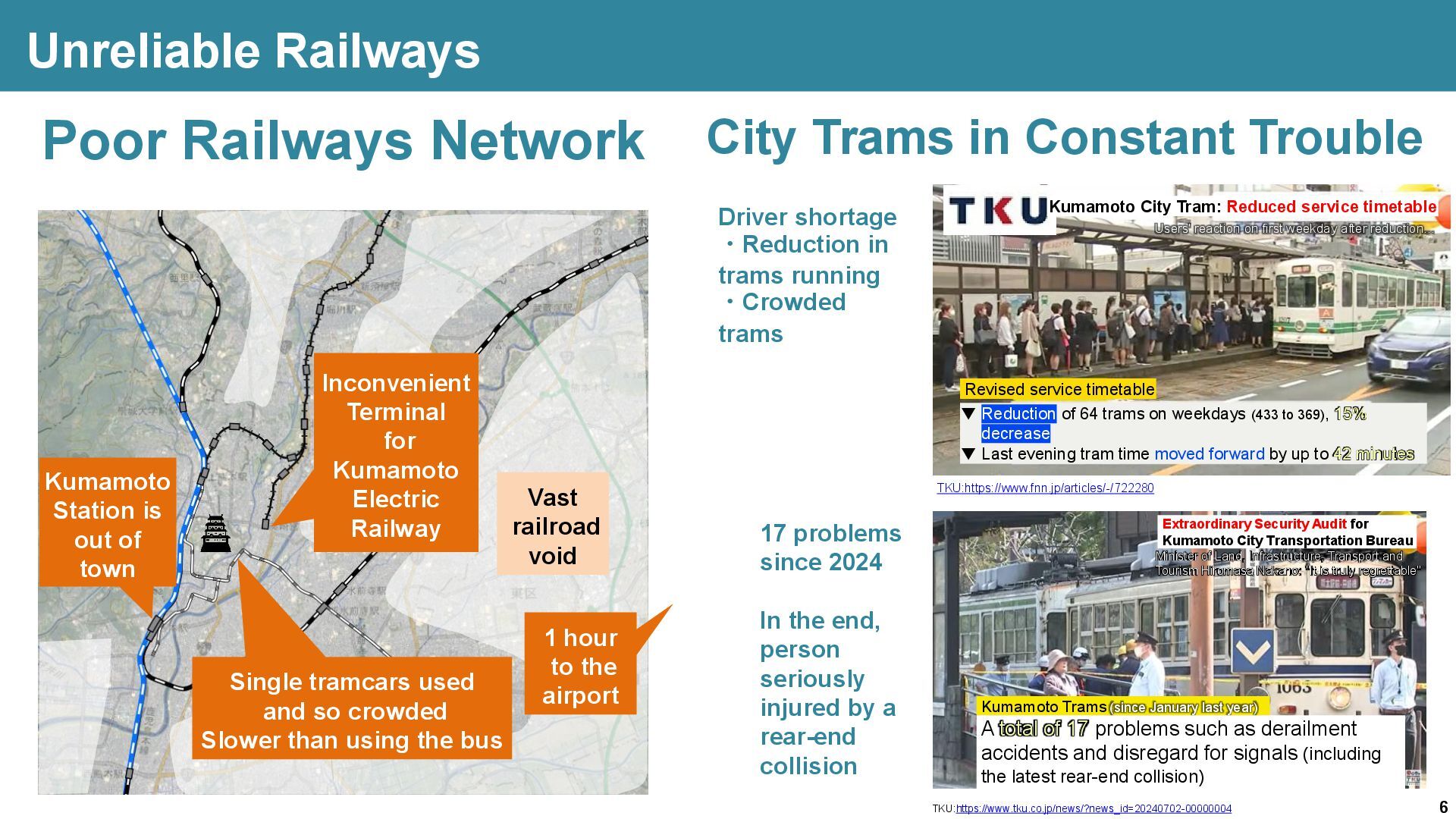
  5. 6 Unreliable Railways TKU:https://www.fnn.jp/articles/-/722280 Driver shortage ・Reduction in trams running

    ・Crowded trams 17 problems since 2024 In the end, person seriously injured by a rear-end collision TKU:https://www.tku.co.jp/news/?news_id=20240702-00000004 Kumamoto Station is out of town Vast railroad void Inconvenient Terminal for Kumamoto Electric Railway 1 hour to the airport Single tramcars used and so crowded Slower than using the bus Poor Railways Network City Trams in Constant Trouble Kumamoto City Tram: Reduced service timetable Users' reaction on first weekday after reduction... Revised service timetable ▼ Reduction of 64 trams on weekdays (433 to 369), 15% decrease ▼ Last evening tram time moved forward by up to 42 minutes Extraordinary Security Audit for Kumamoto City Transportation Bureau Minister of Land, Infrastructure, Transport and Tourism Hiromasa Nakano: "It is truly regrettable" Kumamoto Trams (since January last year) A total of 17 problems such as derailment accidents and disregard for signals (including the latest rear-end collision)
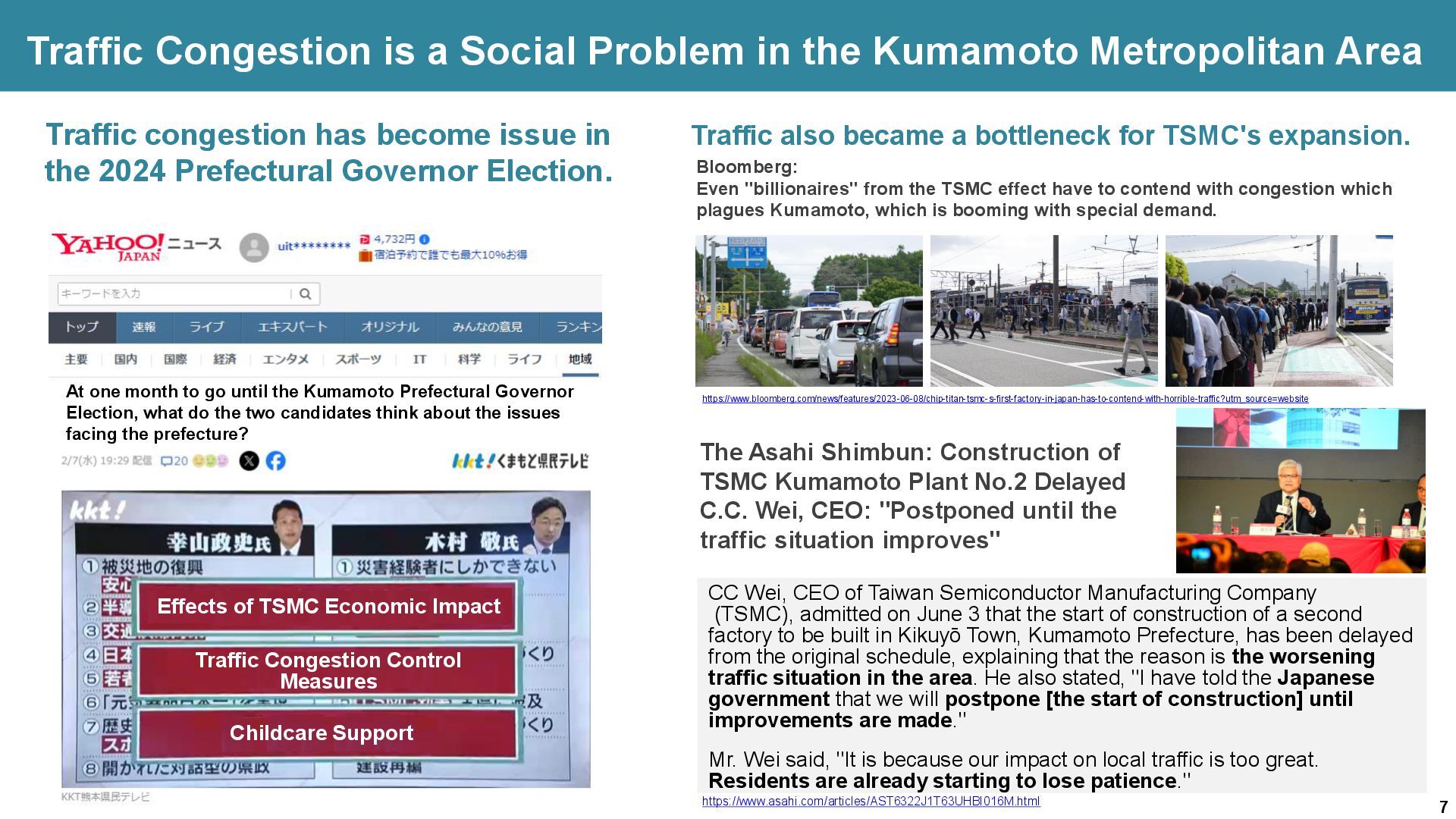
  6. 7 Traffic Congestion is a Social Problem in the Kumamoto

    Metropolitan Area Traffic congestion has become issue in the 2024 Prefectural Governor Election. Traffic also became a bottleneck for TSMC's expansion. CC Wei, CEO of Taiwan Semiconductor Manufacturing Company (TSMC), admitted on June 3 that the start of construction of a second factory to be built in Kikuyō Town, Kumamoto Prefecture, has been delayed from the original schedule, explaining that the reason is the worsening traffic situation in the area. He also stated, "I have told the Japanese government that we will postpone [the start of construction] until improvements are made." Mr. Wei said, "It is because our impact on local traffic is too great. Residents are already starting to lose patience." https://www.asahi.com/articles/AST6322J1T63UHBI016M.html Bloomberg: Even "billionaires" from the TSMC effect have to contend with congestion which plagues Kumamoto, which is booming with special demand. https://www.bloomberg.com/news/features/2023-06-08/chip-titan-tsmc-s-first-factory-in-japan-has-to-contend-with-horrible-traffic?utm_source=website The Asahi Shimbun: Construction of TSMC Kumamoto Plant No.2 Delayed C.C. Wei, CEO: "Postponed until the traffic situation improves" At one month to go until the Kumamoto Prefectural Governor Election, what do the two candidates think about the issues facing the prefecture? Effects of TSMC Economic Impact Traffic Congestion Control Measures Childcare Support
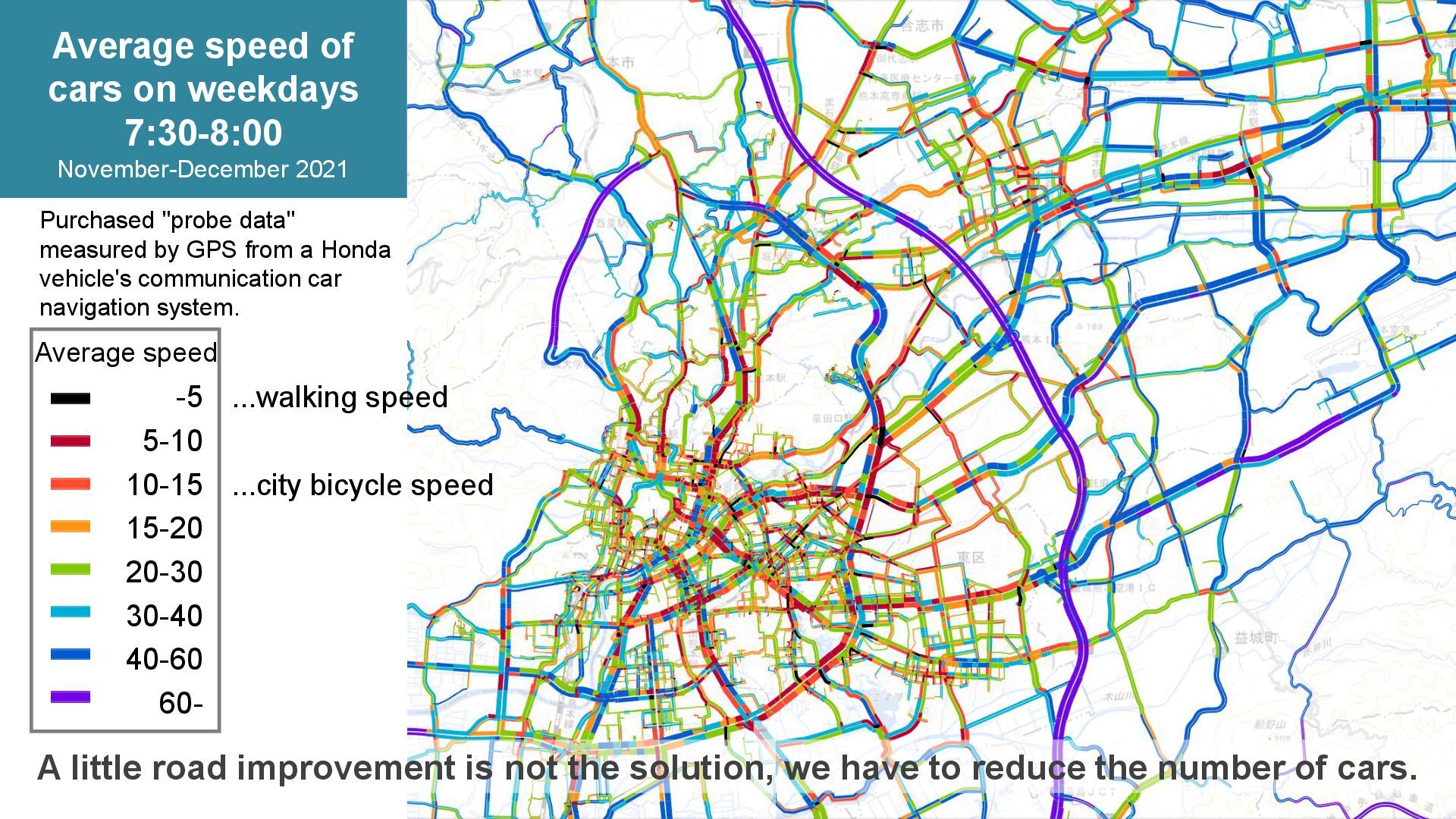
  7. 8 Average speed of cars on weekdays 7:30-8:00 November-December 2021

    -5 5-10 10-15 15-20 20-30 30-40 40-60 60- Average speed ...walking speed ...city bicycle speed Purchased "probe data" measured by GPS from a Honda vehicle's communication car navigation system. A little road improvement is not the solution, we have to reduce the number of cars.
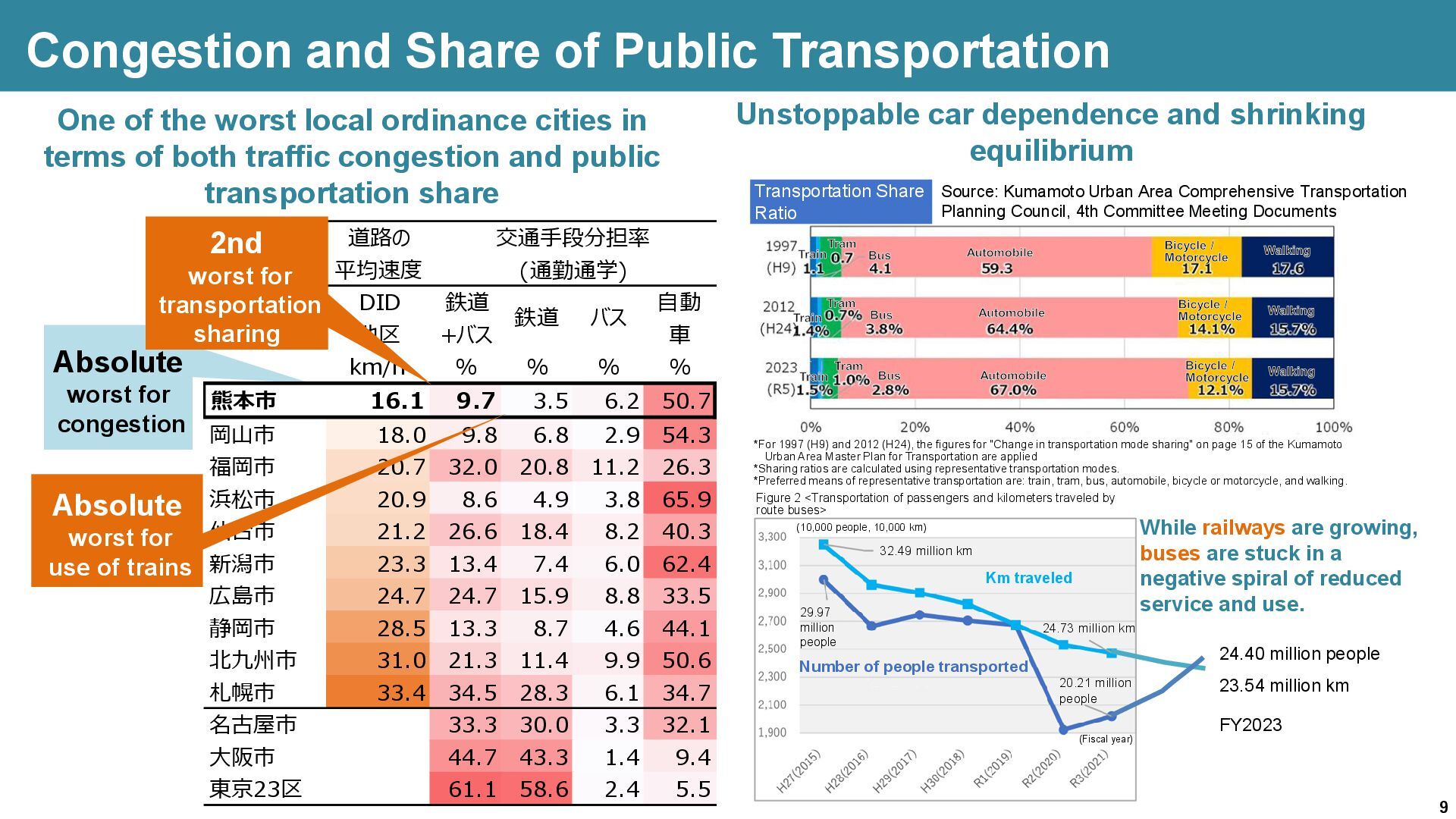
  8. 9 Congestion and Share of Public Transportation Absolute worst for

    congestion 道路の 平均速度 DID 地区 鉄道 +バス 鉄道 バス 自動 車 km/h % % % % 熊本市 16.1 9.7 3.5 6.2 50.7 岡山市 18.0 9.8 6.8 2.9 54.3 福岡市 20.7 32.0 20.8 11.2 26.3 浜松市 20.9 8.6 4.9 3.8 65.9 仙台市 21.2 26.6 18.4 8.2 40.3 新潟市 23.3 13.4 7.4 6.0 62.4 広島市 24.7 24.7 15.9 8.8 33.5 静岡市 28.5 13.3 8.7 4.6 44.1 北九州市 31.0 21.3 11.4 9.9 50.6 札幌市 33.4 34.5 28.3 6.1 34.7 名古屋市 33.3 30.0 3.3 32.1 大阪市 44.7 43.3 1.4 9.4 東京23区 61.1 58.6 2.4 5.5 交通手段分担率 (通勤通学) 2nd worst for transportation sharing One of the worst local ordinance cities in terms of both traffic congestion and public transportation share Absolute worst for use of trains Unstoppable car dependence and shrinking equilibrium FY2023 Transportation Share Ratio Tram Bus Automobile Bicycle / Motorcycle Walking Train Tram Bus Automobile Train Tram Bus Train Automobile Bicycle / Motorcycle Bicycle / Motorcycle Walking Walking *For 1997 (H9) and 2012 (H24), the figures for "Change in transportation mode sharing" on page 15 of the Kumamoto Urban Area Master Plan for Transportation are applied *Sharing ratios are calculated using representative transportation modes. *Preferred means of representative transportation are: train, tram, bus, automobile, bicycle or motorcycle, and walking. Figure 2 <Transportation of passengers and kilometers traveled by route buses> (10,000 people, 10,000 km) 32.49 million km Km traveled 29.97 million people Number of people transported 24.73 million km 20.21 million people (Fiscal year) Source: Kumamoto Urban Area Comprehensive Transportation Planning Council, 4th Committee Meeting Documents While railways are growing, buses are stuck in a negative spiral of reduced service and use. 24.40 million people 23.54 million km
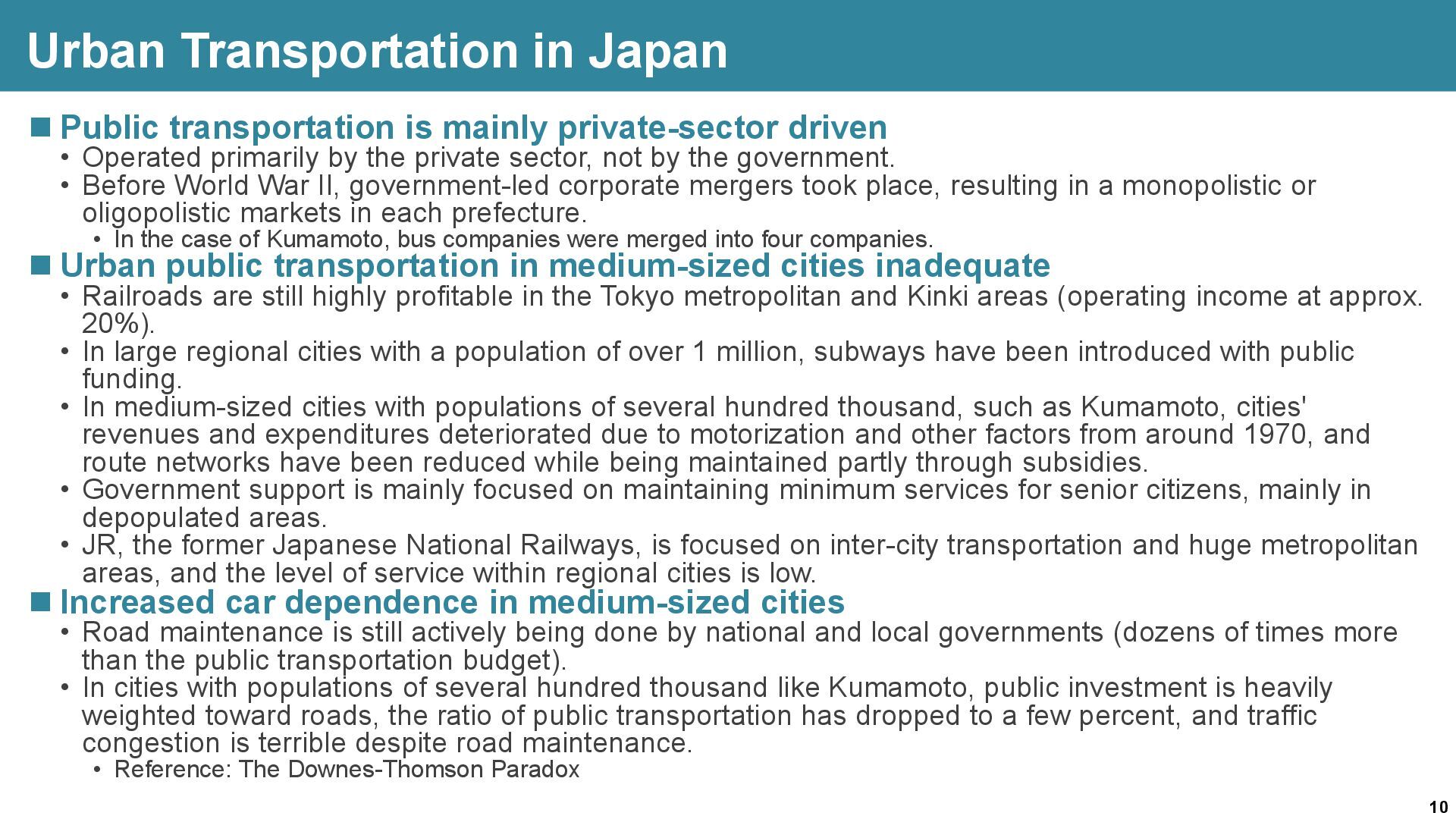
  9. 10 Urban Transportation in Japan ◼ Public transportation is mainly

    private-sector driven • Operated primarily by the private sector, not by the government. • Before World War II, government-led corporate mergers took place, resulting in a monopolistic or oligopolistic markets in each prefecture. • In the case of Kumamoto, bus companies were merged into four companies. ◼ Urban public transportation in medium-sized cities inadequate • Railroads are still highly profitable in the Tokyo metropolitan and Kinki areas (operating income at approx. 20%). • In large regional cities with a population of over 1 million, subways have been introduced with public funding. • In medium-sized cities with populations of several hundred thousand, such as Kumamoto, cities' revenues and expenditures deteriorated due to motorization and other factors from around 1970, and route networks have been reduced while being maintained partly through subsidies. • Government support is mainly focused on maintaining minimum services for senior citizens, mainly in depopulated areas. • JR, the former Japanese National Railways, is focused on inter-city transportation and huge metropolitan areas, and the level of service within regional cities is low. ◼ Increased car dependence in medium-sized cities • Road maintenance is still actively being done by national and local governments (dozens of times more than the public transportation budget). • In cities with populations of several hundred thousand like Kumamoto, public investment is heavily weighted toward roads, the ratio of public transportation has dropped to a few percent, and traffic congestion is terrible despite road maintenance. • Reference: The Downes-Thomson Paradox
  10. 11 Q. What is meant by "cars reduced by 10%,

    traffic congestion halved, and public transportation doubled"?
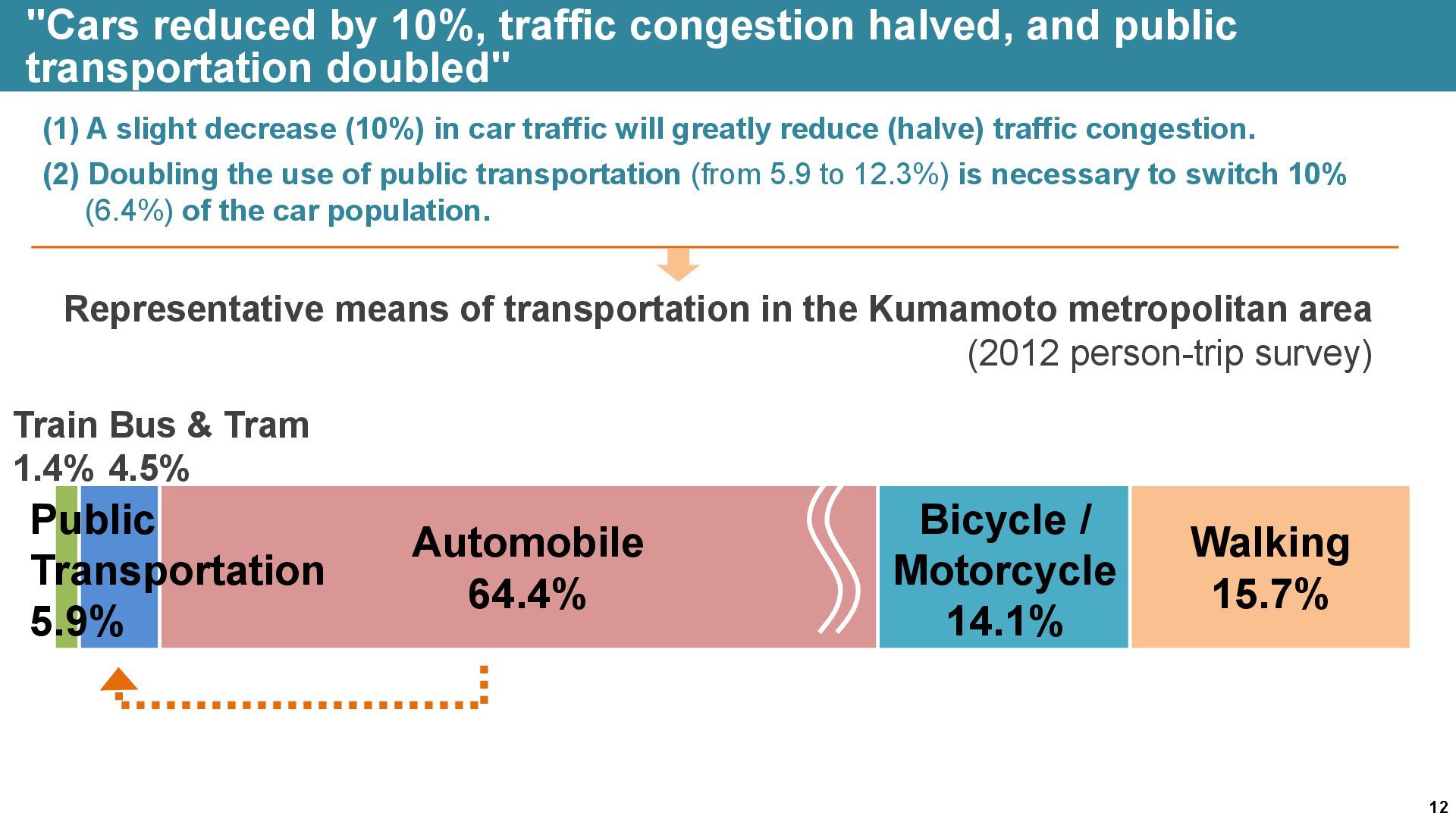
  11. 12 "Cars reduced by 10%, traffic congestion halved, and public

    transportation doubled" Automobile 64.4% Bicycle / Motorcycle 14.1% Walking 15.7% Public Transportation 5.9% Train 1.4% Bus & Tram 4.5% (1) A slight decrease (10%) in car traffic will greatly reduce (halve) traffic congestion. (2) Doubling the use of public transportation (from 5.9 to 12.3%) is necessary to switch 10% (6.4%) of the car population. Representative means of transportation in the Kumamoto metropolitan area (2012 person-trip survey)
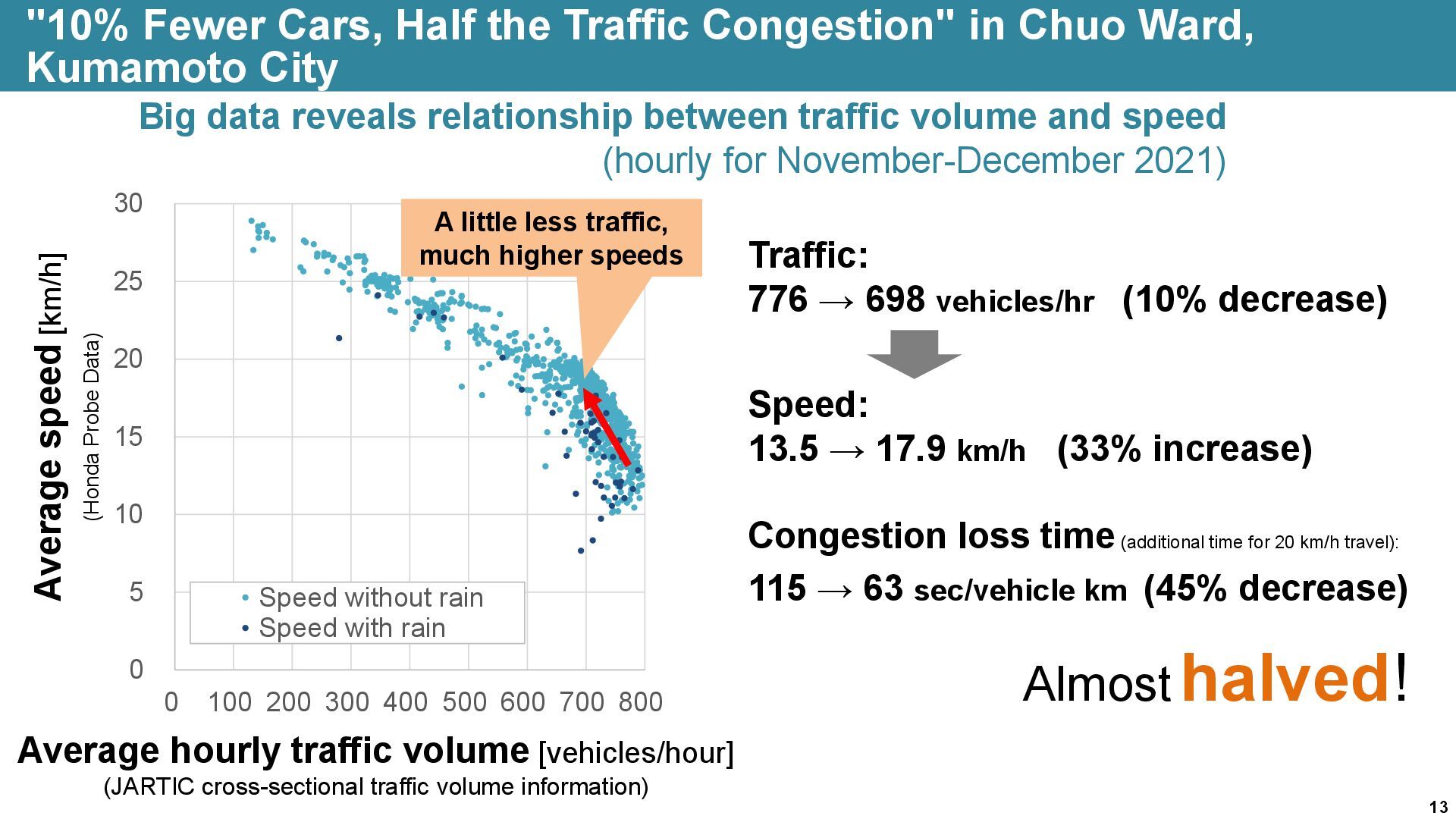
  12. 13 "10% Fewer Cars, Half the Traffic Congestion" in Chuo

    Ward, Kumamoto City Average hourly traffic volume [vehicles/hour] (JARTIC cross-sectional traffic volume information) Average speed [km/h] (Honda Probe Data) Traffic: 776 → 698 vehicles/hr (10% decrease) Speed: 13.5 → 17.9 km/h (33% increase) Congestion loss time (additional time for 20 km/h travel): 115 → 63 sec/vehicle km (45% decrease) 0 5 10 15 20 25 30 0 100 200 300 400 500 600 700 800 Speed without rain Speed with rain Almost halved! Big data reveals relationship between traffic volume and speed (hourly for November-December 2021) A little less traffic, much higher speeds
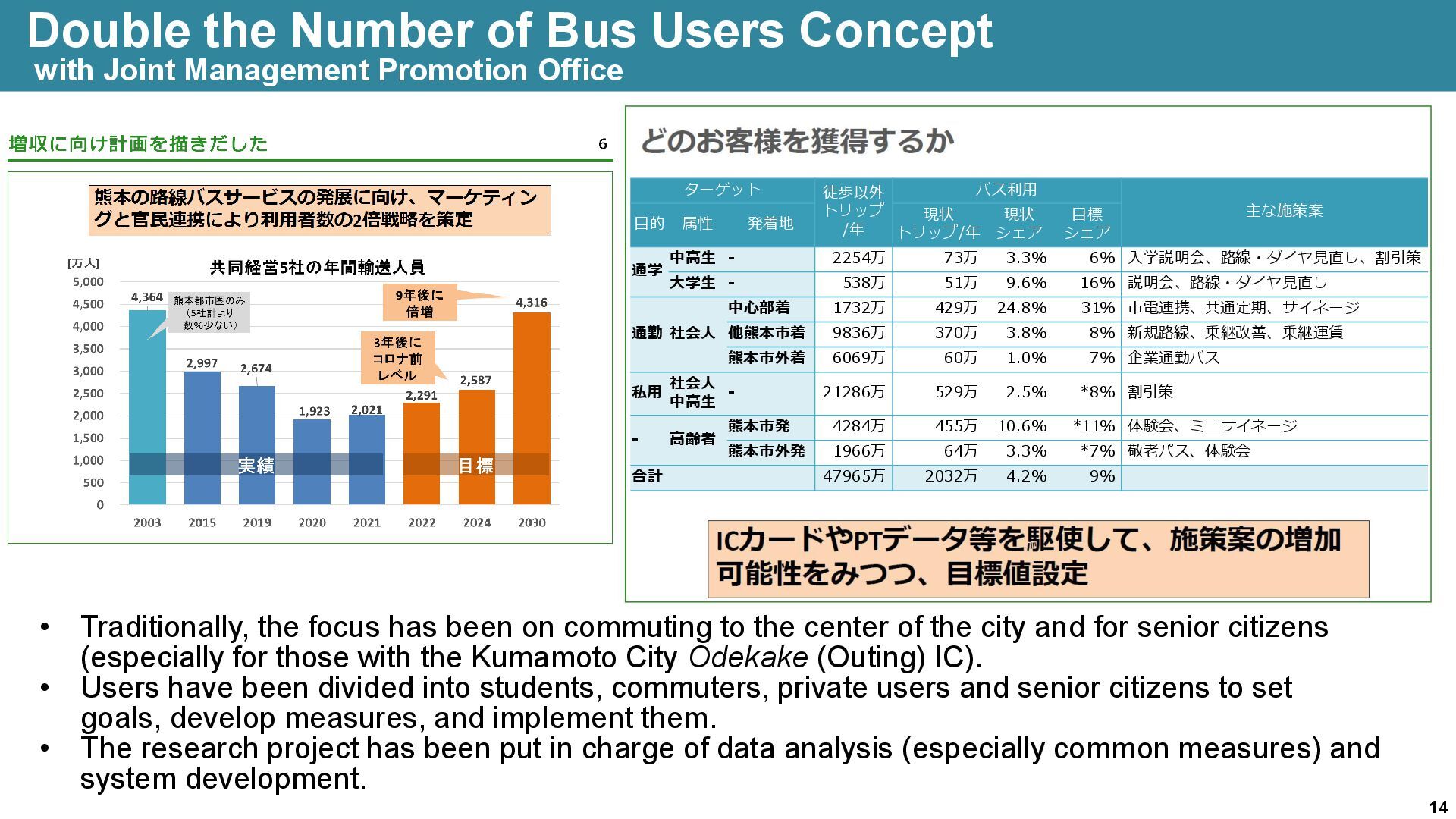
  13. 14 Double the Number of Bus Users Concept with Joint

    Management Promotion Office 主な施策案 バス利用 徒歩以外 トリップ /年 ターゲット 目標 シェア 現状 シェア 現状 トリップ/年 発着地 属性 目的 入学説明会、路線・ダイヤ見直し、割引策 6% 3.3% 73万 2254万 - 中高生 通学 説明会、路線・ダイヤ見直し 16% 9.6% 51万 538万 - 大学生 市電連携、共通定期、サイネージ 31% 24.8% 429万 1732万 中心部着 社会人 通勤 新規路線、乗継改善、乗継運賃 8% 3.8% 370万 9836万 他熊本市着 企業通勤バス 7% 1.0% 60万 6069万 熊本市外着 割引策 *8% 2.5% 529万 21286万 - 社会人 中高生 私用 体験会、ミニサイネージ *11% 10.6% 455万 4284万 熊本市発 高齢者 - 敬老パス、体験会 *7% 3.3% 64万 1966万 熊本市外発 9% 4.2% 2032万 47965万 合計 • Traditionally, the focus has been on commuting to the center of the city and for senior citizens (especially for those with the Kumamoto City Odekake (Outing) IC). • Users have been divided into students, commuters, private users and senior citizens to set goals, develop measures, and implement them. • The research project has been put in charge of data analysis (especially common measures) and system development.
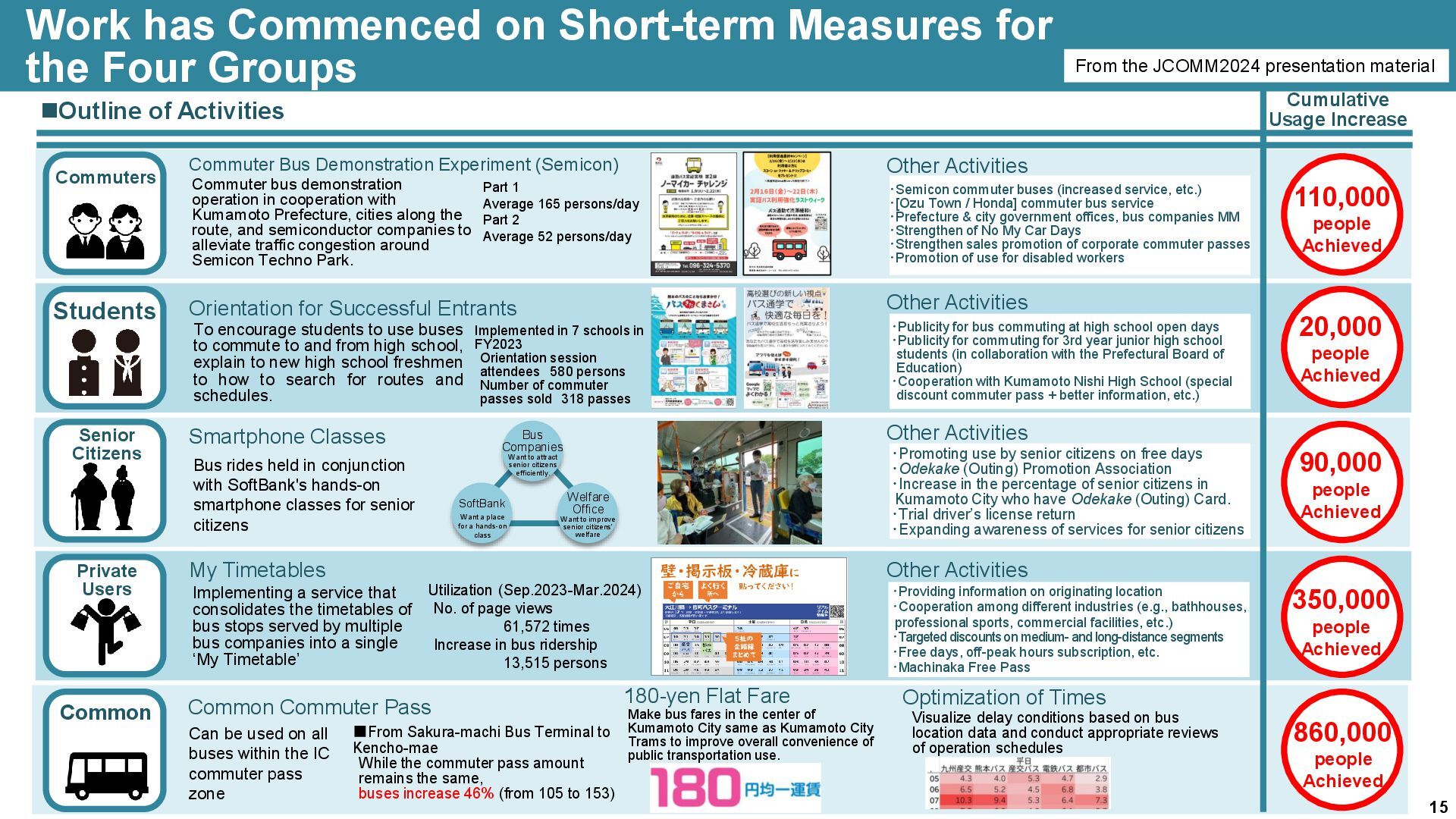
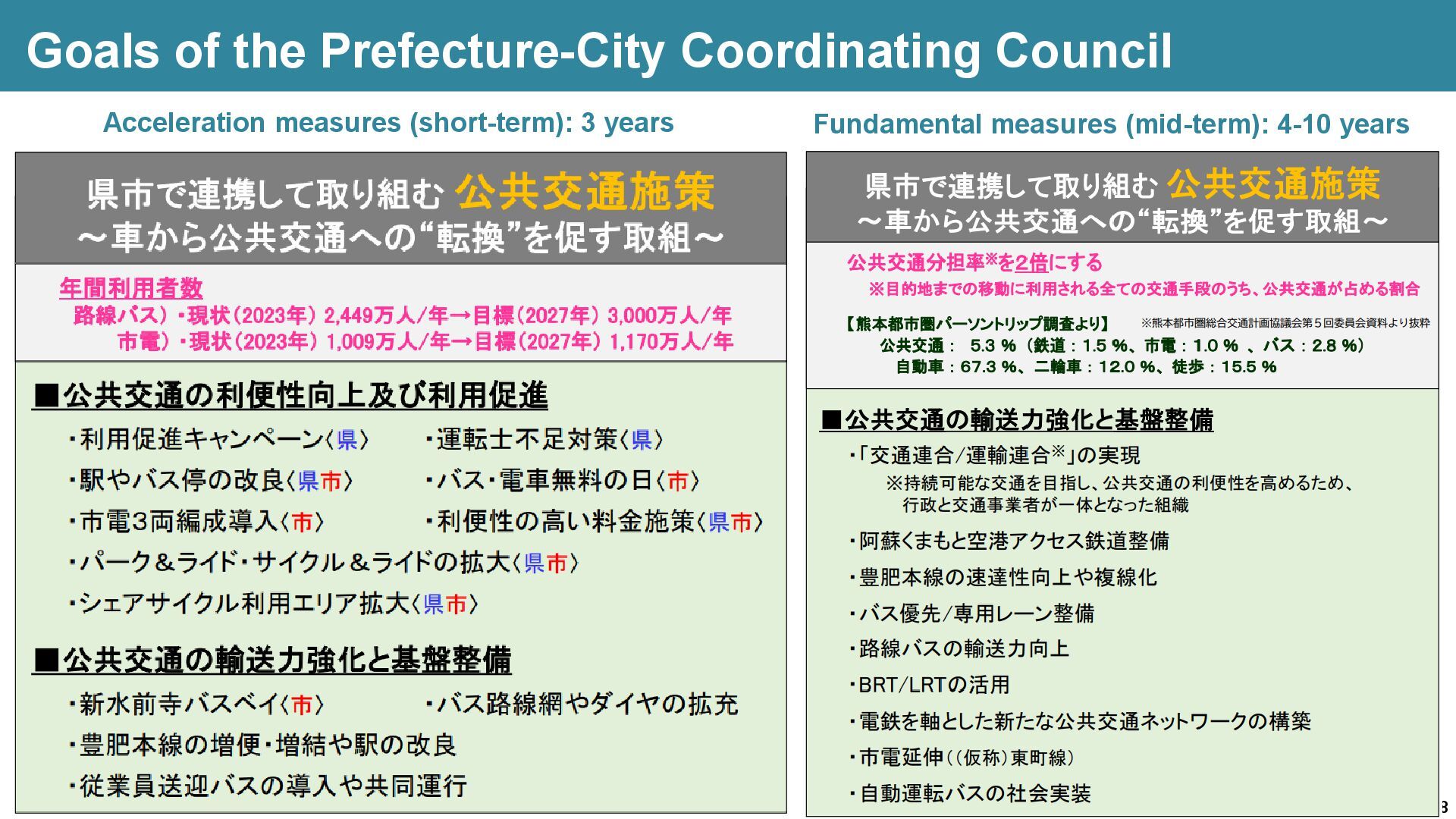
  14. 15 Work has Commenced on Short-term Measures for the Four

    Groups From the JCOMM2024 presentation material ◼Outline of Activities Cumulative Usage Increase 110,000 people Achieved 20,000 people Achieved 90,000 people Achieved 350,000 people Achieved 860,000 people Achieved Commuters Students Senior Citizens Private Users Common Commuter Bus Demonstration Experiment (Semicon) Other Activities ・Semicon commuter buses (increased service, etc.) ・[Ozu Town / Honda] commuter bus service ・Prefecture & city government offices, bus companies MM ・Strengthen of No My Car Days ・Strengthen sales promotion of corporate commuter passes ・Promotion of use for disabled workers Orientation for Successful Entrants Other Activities ・Publicity for bus commuting at high school open days ・Publicity for commuting for 3rd year junior high school students (in collaboration with the Prefectural Board of Education) ・Cooperation with Kumamoto Nishi High School (special discount commuter pass + better information, etc.) Smartphone Classes Other Activities ・Promoting use by senior citizens on free days ・Odekake (Outing) Promotion Association ・Increase in the percentage of senior citizens in Kumamoto City who have Odekake (Outing) Card. ・Trial driver’s license return ・Expanding awareness of services for senior citizens My Timetables Other Activities ・Providing information on originating location ・Cooperation among different industries (e.g., bathhouses, professional sports, commercial facilities, etc.) ・Targeted discounts on medium- and long-distance segments ・Free days, off-peak hours subscription, etc. ・Machinaka Free Pass Common Commuter Pass 180-yen Flat Fare Optimization of Times Can be used on all buses within the IC commuter pass zone Make bus fares in the center of Kumamoto City same as Kumamoto City Trams to improve overall convenience of public transportation use. Visualize delay conditions based on bus location data and conduct appropriate reviews of operation schedules To encourage students to use buses to commute to and from high school, explain to new high school freshmen to how to search for routes and schedules. Implemented in 7 schools in FY2023 Orientation session attendees 580 persons Number of commuter passes sold 318 passes Commuter bus demonstration operation in cooperation with Kumamoto Prefecture, cities along the route, and semiconductor companies to alleviate traffic congestion around Semicon Techno Park. Bus rides held in conjunction with SoftBank's hands-on smartphone classes for senior citizens Implementing a service that consolidates the timetables of bus stops served by multiple bus companies into a single ‘My Timetable’ Part 1 Average 165 persons/day Part 2 Average 52 persons/day Bus Companies Want to attract senior citizens efficiently. SoftBank Want a place for a hands-on class Welfare Office Want to improve senior citizens’ welfare Utilization (Sep.2023-Mar.2024) No. of page views 61,572 times Increase in bus ridership 13,515 persons ▪From Sakura-machi Bus Terminal to Kencho-mae While the commuter pass amount remains the same, buses increase 46% (from 105 to 153)
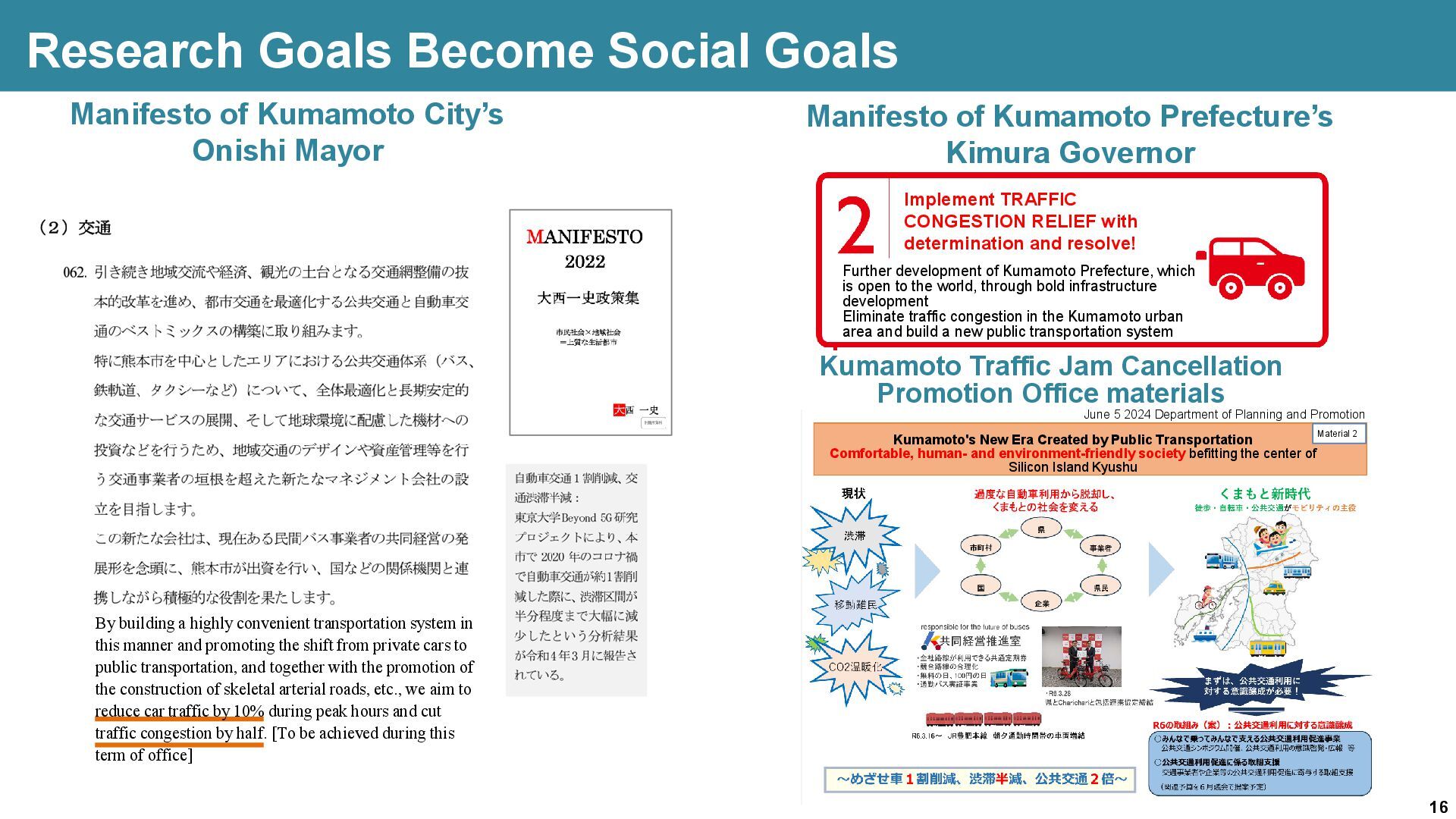
  15. 16 Research Goals Become Social Goals Manifesto of Kumamoto City’s

    Onishi Mayor Kumamoto Traffic Jam Cancellation Promotion Office materials Manifesto of Kumamoto Prefecture’s Kimura Governor By building a highly convenient transportation system in this manner and promoting the shift from private cars to public transportation, and together with the promotion of the construction of skeletal arterial roads, etc., we aim to reduce car traffic by 10% during peak hours and cut traffic congestion by half. [To be achieved during this term of office] Implement TRAFFIC CONGESTION RELIEF with determination and resolve! Further development of Kumamoto Prefecture, which is open to the world, through bold infrastructure development Eliminate traffic congestion in the Kumamoto urban area and build a new public transportation system Kumamoto's New Era Created by Public Transportation Comfortable, human- and environment-friendly society befitting the center of Silicon Island Kyushu June 5 2024 Department of Planning and Promotion Material 2
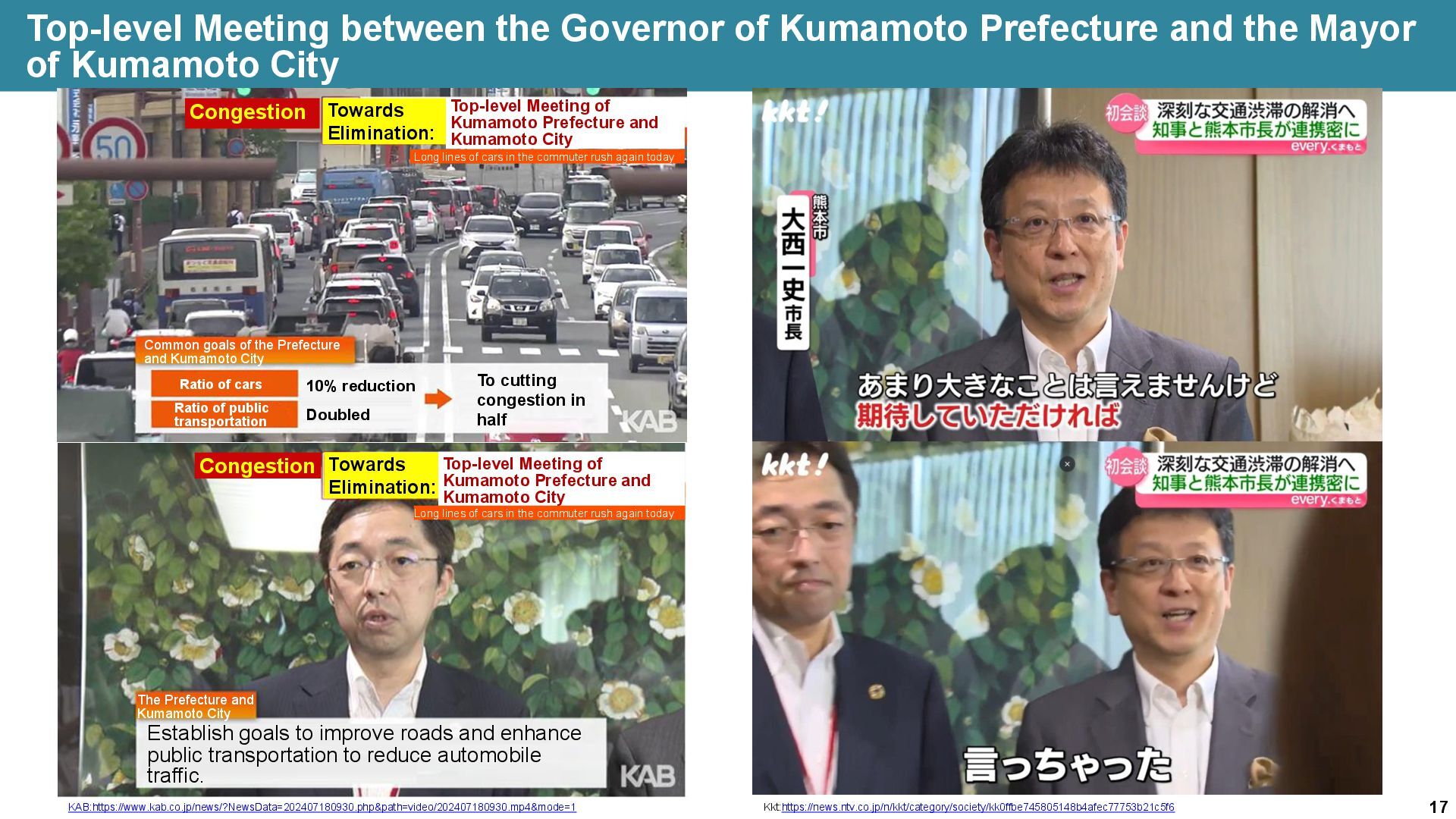
  16. 17 Top-level Meeting between the Governor of Kumamoto Prefecture and

    the Mayor of Kumamoto City KAB:https://www.kab.co.jp/news/?NewsData=202407180930.php&path=video/202407180930.mp4&mode=1 Kkt:https://news.ntv.co.jp/n/kkt/category/society/kk0ffbe745805148b4afec77753b21c5f6 Congestion Towards Elimination: Top-level Meeting of Kumamoto Prefecture and Kumamoto City Long lines of cars in the commuter rush again today Common goals of the Prefecture and Kumamoto City Ratio of cars Ratio of public transportation 10% reduction Doubled To cutting congestion in half Congestion Towards Elimination: Top-level Meeting of Kumamoto Prefecture and Kumamoto City Long lines of cars in the commuter rush again today The Prefecture and Kumamoto City Establish goals to improve roads and enhance public transportation to reduce automobile traffic.
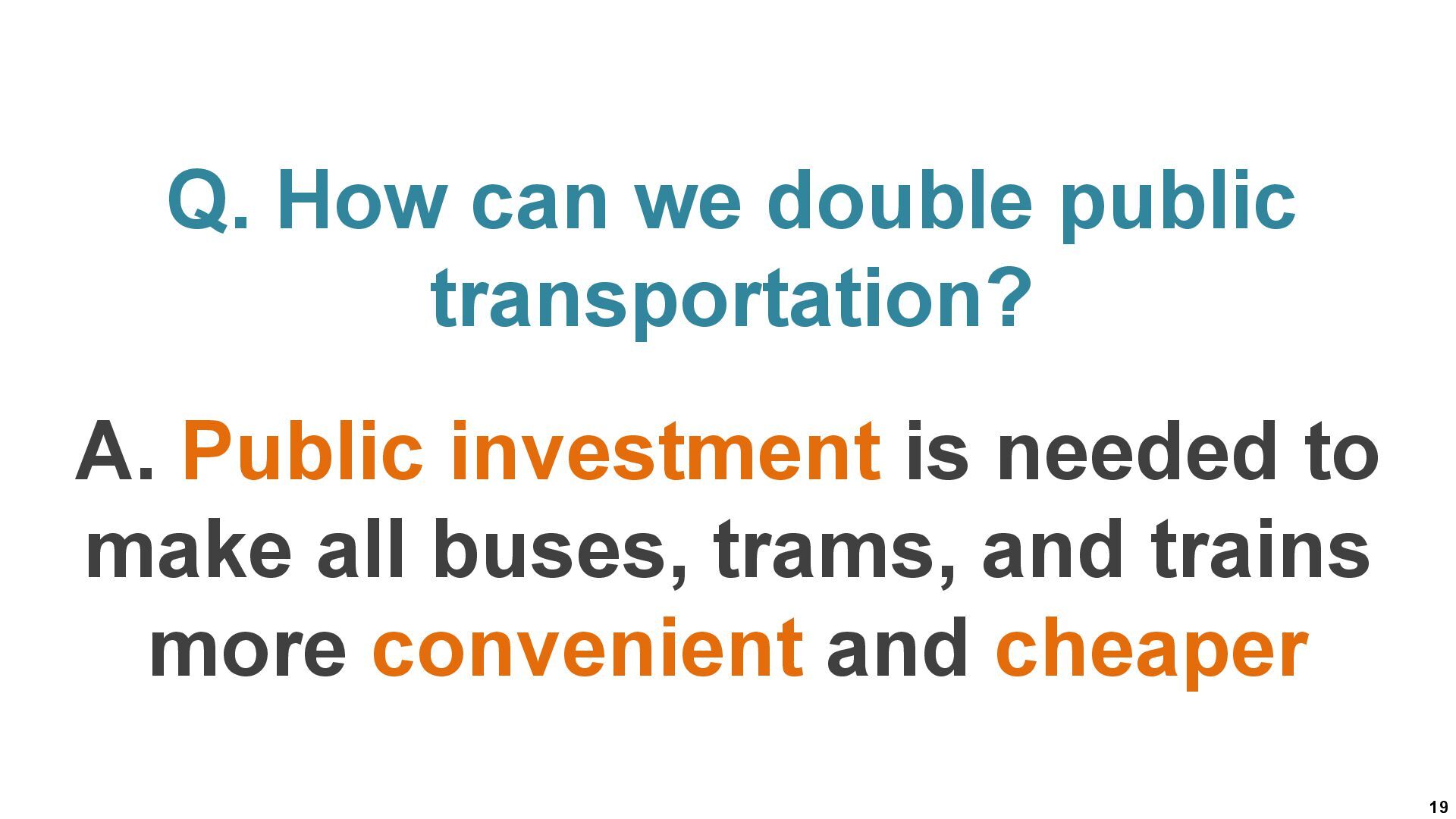
  17. 19 Q. How can we double public transportation? A. Public

    investment is needed to make all buses, trams, and trains more convenient and cheaper
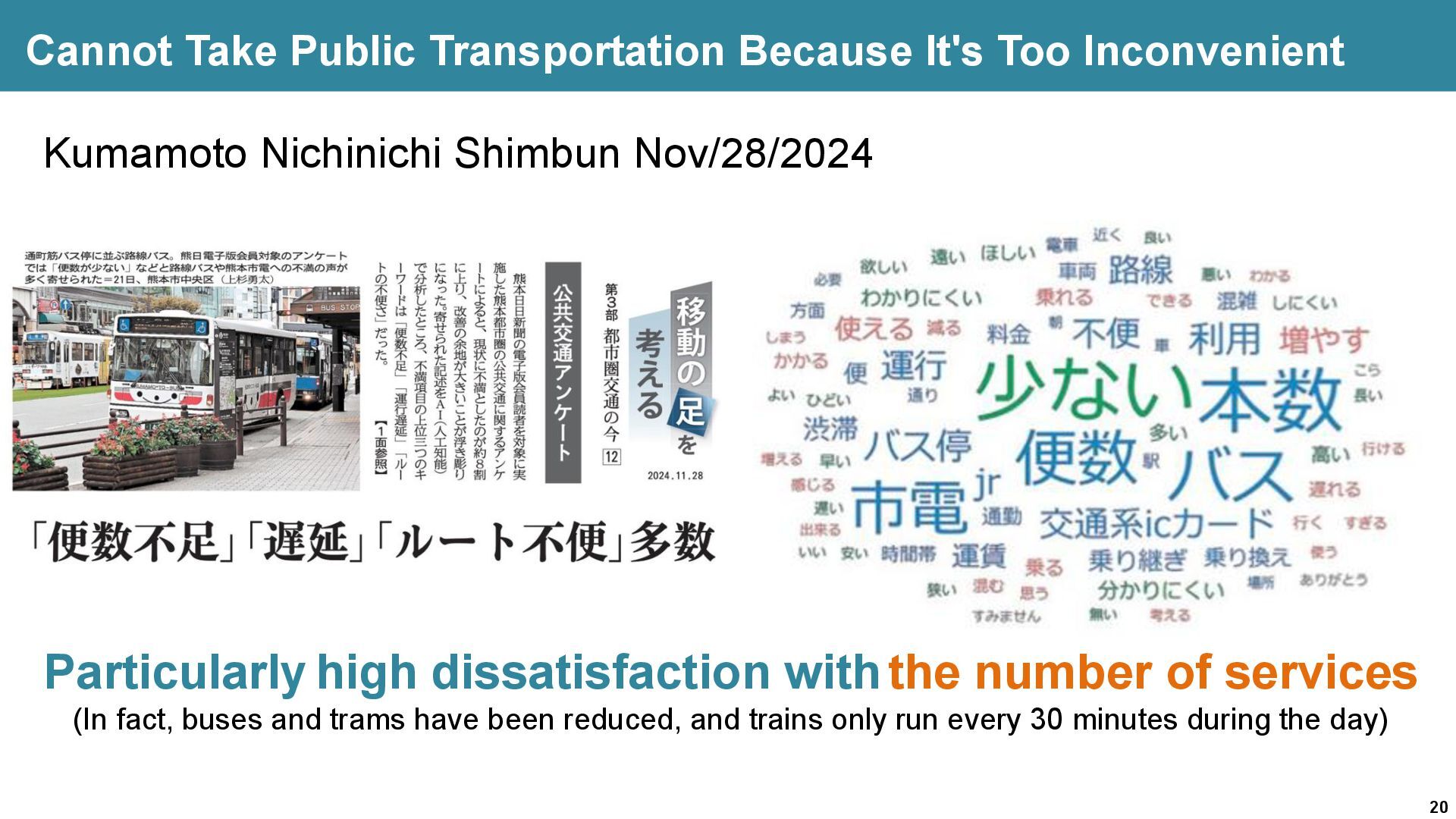
  18. 20 Cannot Take Public Transportation Because It's Too Inconvenient Kumamoto

    Nichinichi Shimbun Nov/28/2024 Particularly high dissatisfaction with the number of services (In fact, buses and trams have been reduced, and trains only run every 30 minutes during the day)
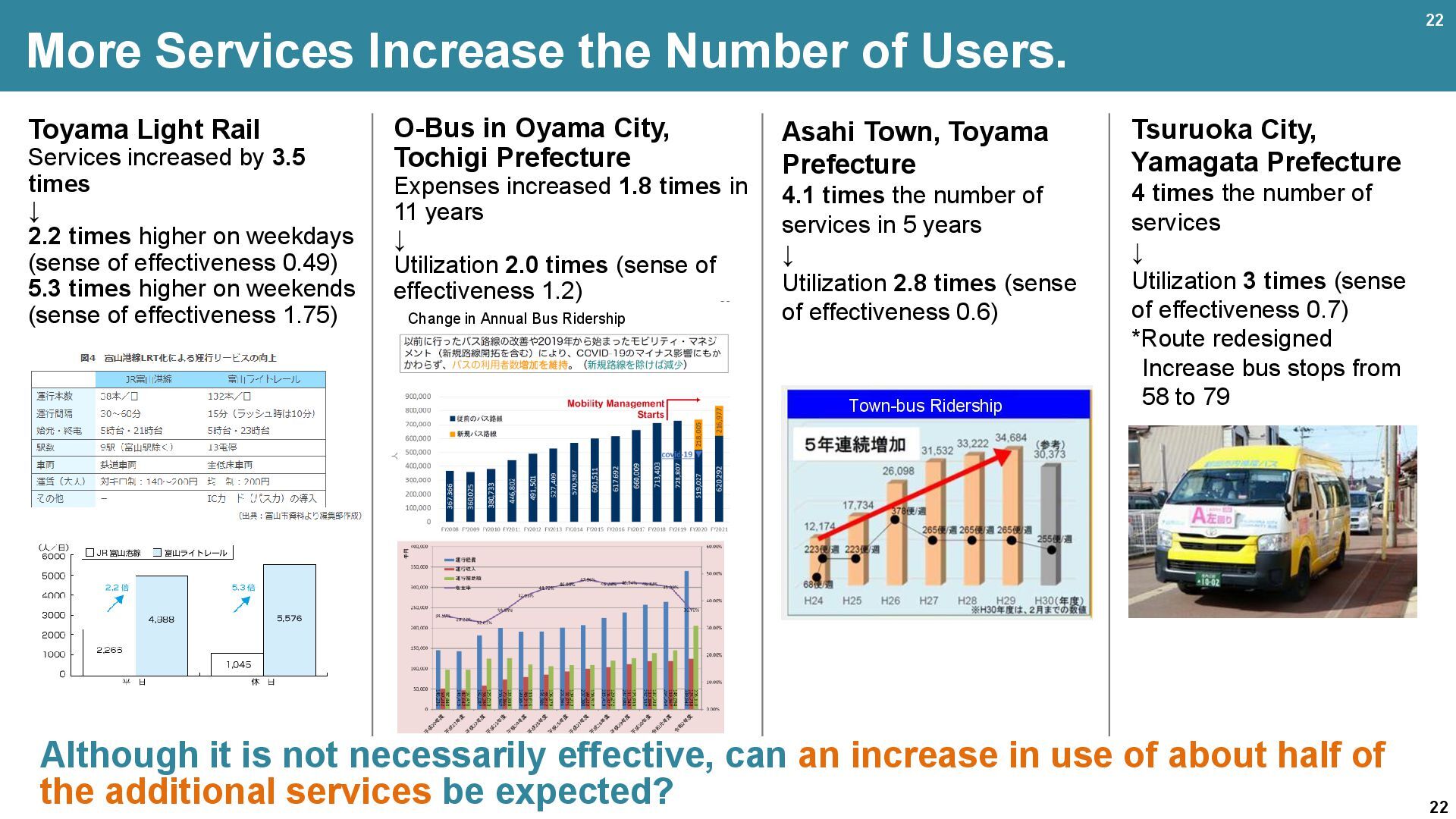
  19. 22 More Services Increase the Number of Users. 22 Toyama

    Light Rail Services increased by 3.5 times ↓ 2.2 times higher on weekdays (sense of effectiveness 0.49) 5.3 times higher on weekends (sense of effectiveness 1.75) O-Bus in Oyama City, Tochigi Prefecture Expenses increased 1.8 times in 11 years ↓ Utilization 2.0 times (sense of effectiveness 1.2) Asahi Town, Toyama Prefecture 4.1 times the number of services in 5 years ↓ Utilization 2.8 times (sense of effectiveness 0.6) Tsuruoka City, Yamagata Prefecture 4 times the number of services ↓ Utilization 3 times (sense of effectiveness 0.7) *Route redesigned Increase bus stops from 58 to 79 Although it is not necessarily effective, can an increase in use of about half of the additional services be expected? Change in Annual Bus Ridership Town-bus Ridership
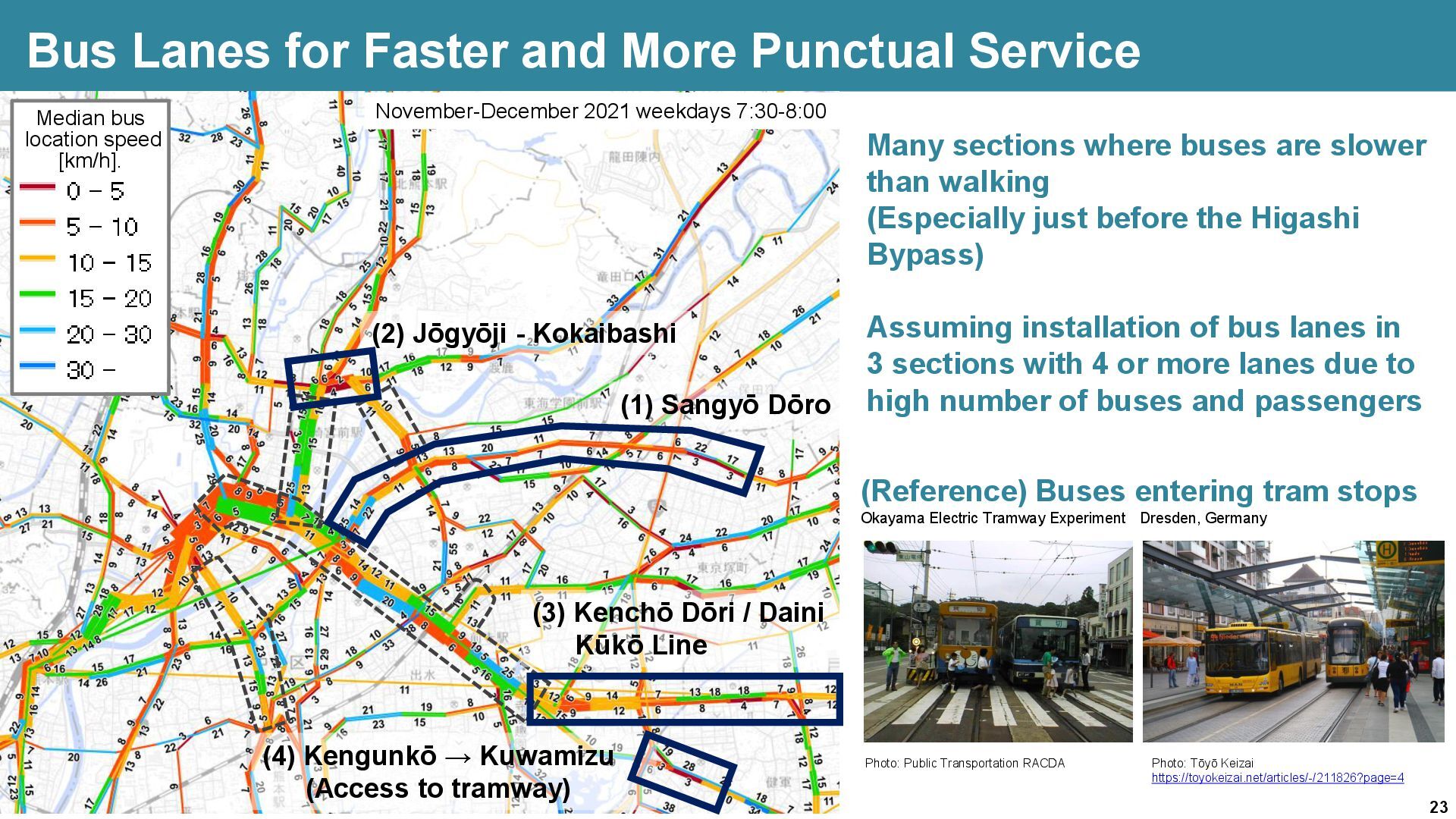
  20. 23 Bus Lanes for Faster and More Punctual Service Median

    bus location speed [km/h]. (2) Jōgyōji - Kokaibashi (1) Sangyō Dōro (3) Kenchō Dōri / Daini Kūkō Line Many sections where buses are slower than walking (Especially just before the Higashi Bypass) Assuming installation of bus lanes in 3 sections with 4 or more lanes due to high number of buses and passengers November-December 2021 weekdays 7:30-8:00 (4) Kengunkō → Kuwamizu (Access to tramway) (Reference) Buses entering tram stops Okayama Electric Tramway Experiment Dresden, Germany Photo: Tōyō Keizai https://toyokeizai.net/articles/-/211826?page=4 Photo: Public Transportation RACDA
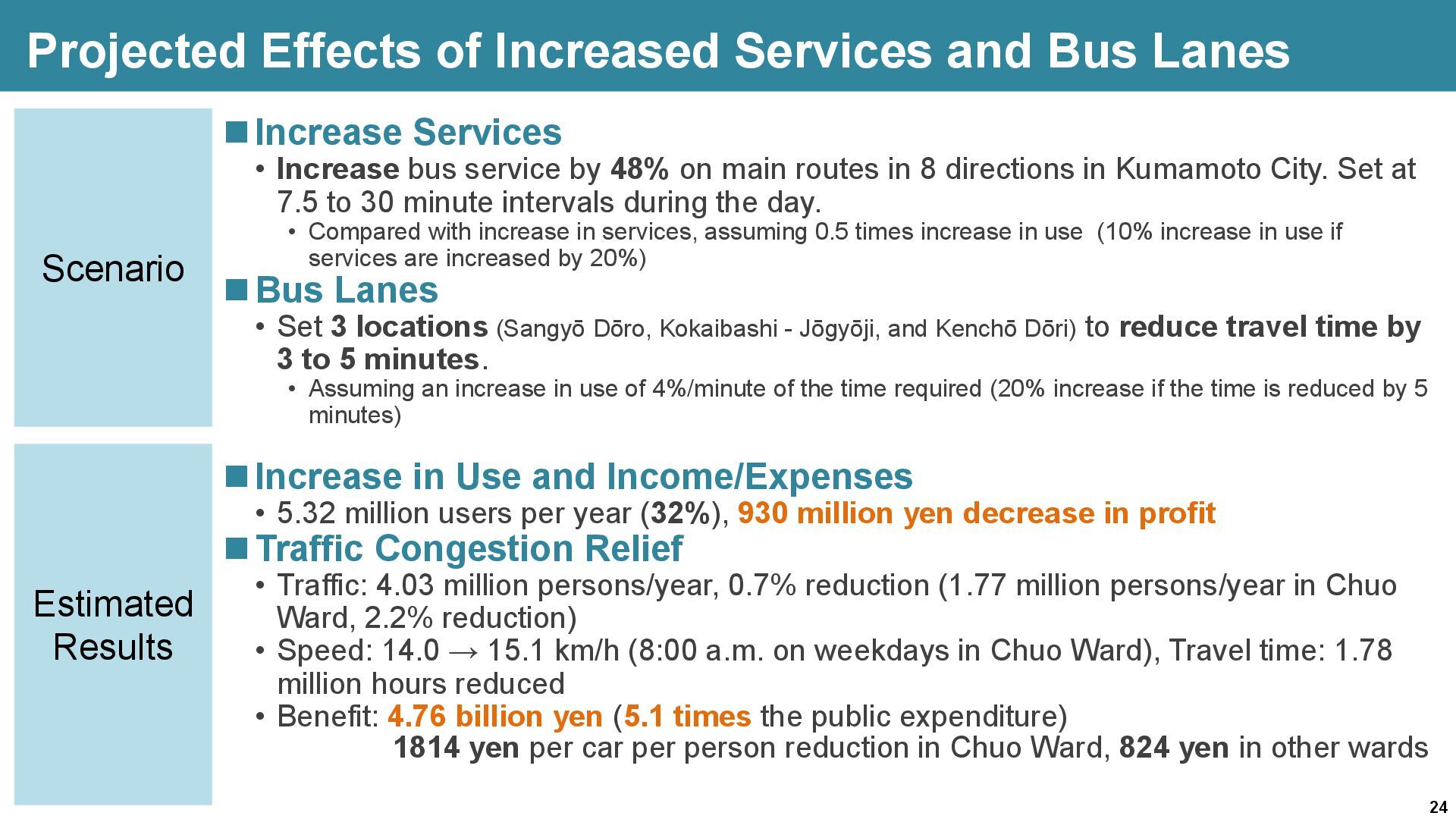
  21. 24 Projected Effects of Increased Services and Bus Lanes ◼Increase

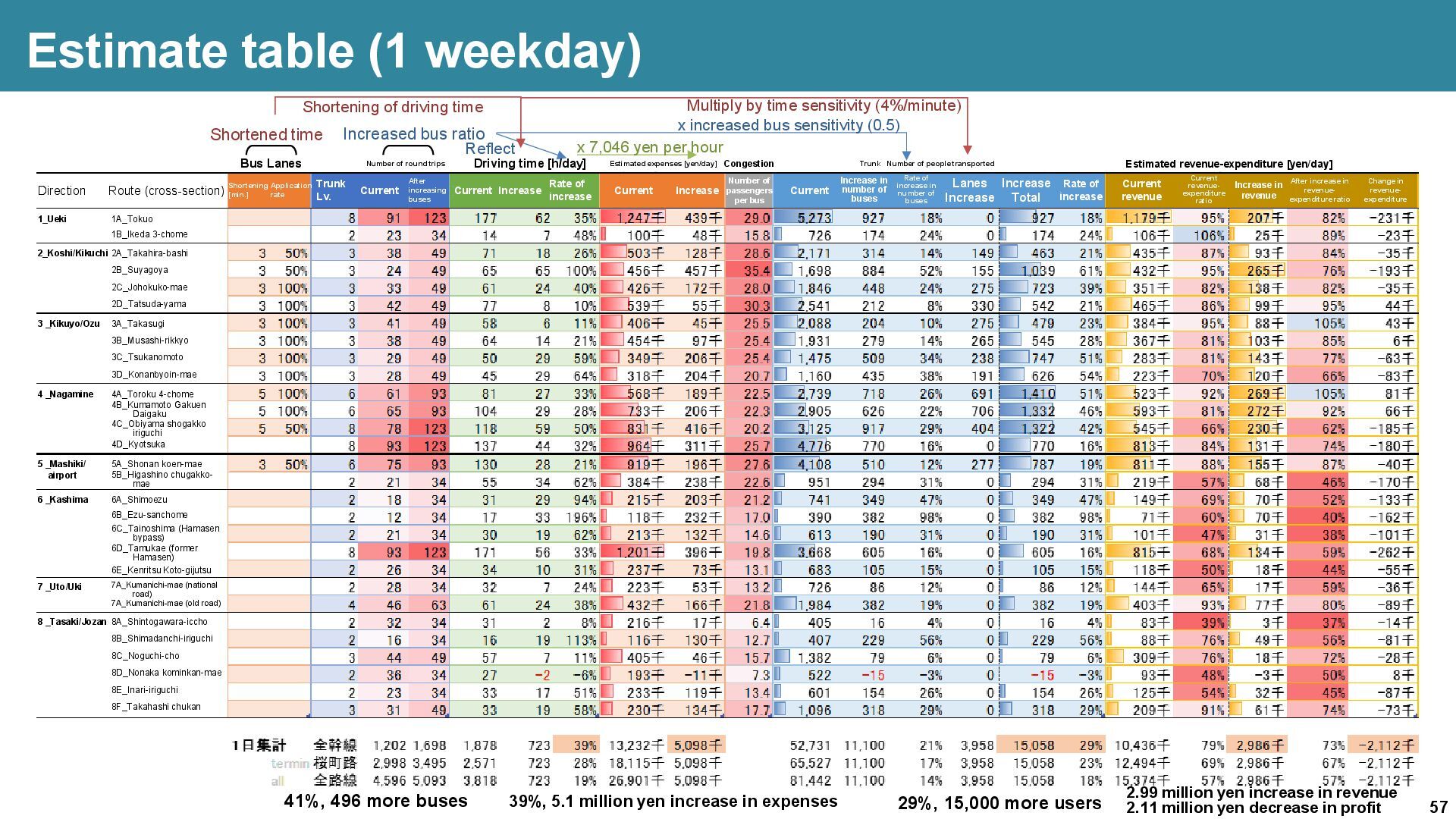
    Services • Increase bus service by 48% on main routes in 8 directions in Kumamoto City. Set at 7.5 to 30 minute intervals during the day. • Compared with increase in services, assuming 0.5 times increase in use (10% increase in use if services are increased by 20%) ◼Bus Lanes • Set 3 locations (Sangyō Dōro, Kokaibashi - Jōgyōji, and Kenchō Dōri) to reduce travel time by 3 to 5 minutes. • Assuming an increase in use of 4%/minute of the time required (20% increase if the time is reduced by 5 minutes) ◼Increase in Use and Income/Expenses • 5.32 million users per year (32%), 930 million yen decrease in profit ◼Traffic Congestion Relief • Traffic: 4.03 million persons/year, 0.7% reduction (1.77 million persons/year in Chuo Ward, 2.2% reduction) • Speed: 14.0 → 15.1 km/h (8:00 a.m. on weekdays in Chuo Ward), Travel time: 1.78 million hours reduced • Benefit: 4.76 billion yen (5.1 times the public expenditure) 1814 yen per car per person reduction in Chuo Ward, 824 yen in other wards Scenario Estimated Results
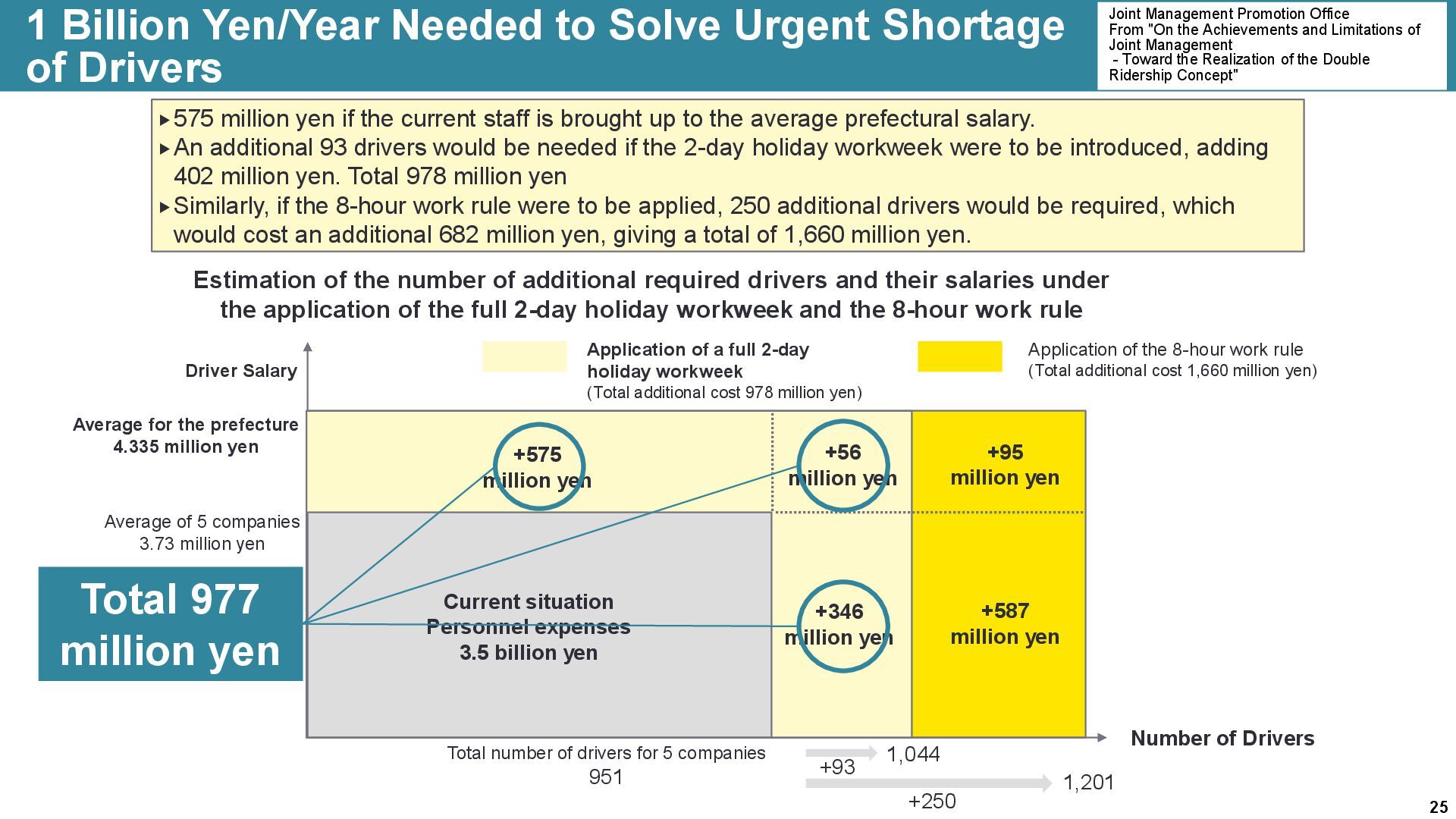
  22. 25 1 Billion Yen/Year Needed to Solve Urgent Shortage of

    Drivers Estimation of the number of additional required drivers and their salaries under the application of the full 2-day holiday workweek and the 8-hour work rule Number of Drivers Driver Salary Average of 5 companies 3.73 million yen Average for the prefecture 4.335 million yen Application of a full 2-day holiday workweek +346 million yen +56 million yen +575 million yen +95 million yen +587 million yen Current situation Personnel expenses 3.5 billion yen Application of the 8-hour work rule (Total additional cost 1,660 million yen) Application of a full 2-day holiday workweek (Total additional cost 978 million yen) Total number of drivers for 5 companies 951 1,044 +93 1,201 +250 575 million yen if the current staff is brought up to the average prefectural salary. An additional 93 drivers would be needed if the 2-day holiday workweek were to be introduced, adding 402 million yen. Total 978 million yen Similarly, if the 8-hour work rule were to be applied, 250 additional drivers would be required, which would cost an additional 682 million yen, giving a total of 1,660 million yen. Joint Management Promotion Office From "On the Achievements and Limitations of Joint Management - Toward the Realization of the Double Ridership Concept" Total 977 million yen
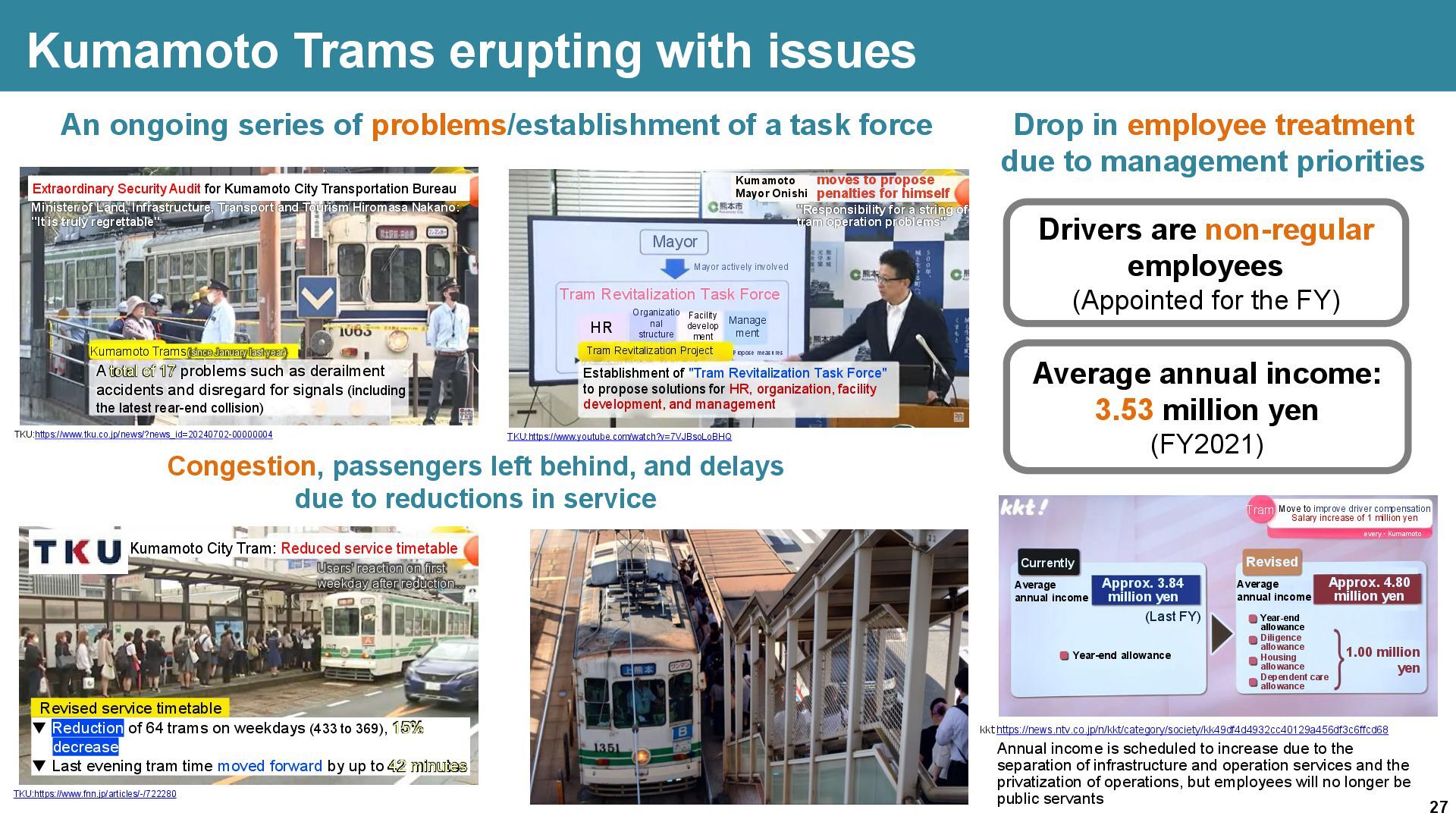
  23. 27 Kumamoto Trams erupting with issues Drop in employee treatment

    due to management priorities An ongoing series of problems/establishment of a task force Congestion, passengers left behind, and delays due to reductions in service TKU:https://www.youtube.com/watch?v=7VJBsoLoBHQ TKU:https://www.fnn.jp/articles/-/722280 TKU:https://www.tku.co.jp/news/?news_id=20240702-00000004 Drivers are non-regular employees (Appointed for the FY) Average annual income: 3.53 million yen (FY2021) Annual income is scheduled to increase due to the separation of infrastructure and operation services and the privatization of operations, but employees will no longer be public servants kkt:https://news.ntv.co.jp/n/kkt/category/society/kk49df4d4932cc40129a456df3c6ffcd68 every・Kumamoto Tram Move to improve driver compensation Salary increase of 1 million yen Currently Average annual income Approx. 3.84 million yen (Last FY) Year-end allowance Revised Average annual income Approx. 4.80 million yen Year-end allowance Diligence allowance Housing allowance Dependent care allowance 1.00 million yen Kumamoto Mayor Onishi moves to propose penalties for himself "Responsibility for a string of tram operation problems" Mayor Mayor actively involved Tram Revitalization Task Force HR Organizatio nal structure Facility develop ment Manage ment Tram Revitalization Project Propose measures Establishment of "Tram Revitalization Task Force" to propose solutions for HR, organization, facility development, and management Extraordinary Security Audit for Kumamoto City Transportation Bureau Minister of Land, Infrastructure, Transport and Tourism Hiromasa Nakano: "It is truly regrettable" Kumamoto Trams (since January last year) A total of 17 problems such as derailment accidents and disregard for signals (including the latest rear-end collision) Kumamoto City Tram: Reduced service timetable Users' reaction on first weekday after reduction... Revised service timetable ▼ Reduction of 64 trams on weekdays (433 to 369), 15% decrease ▼ Last evening tram time moved forward by up to 42 minutes
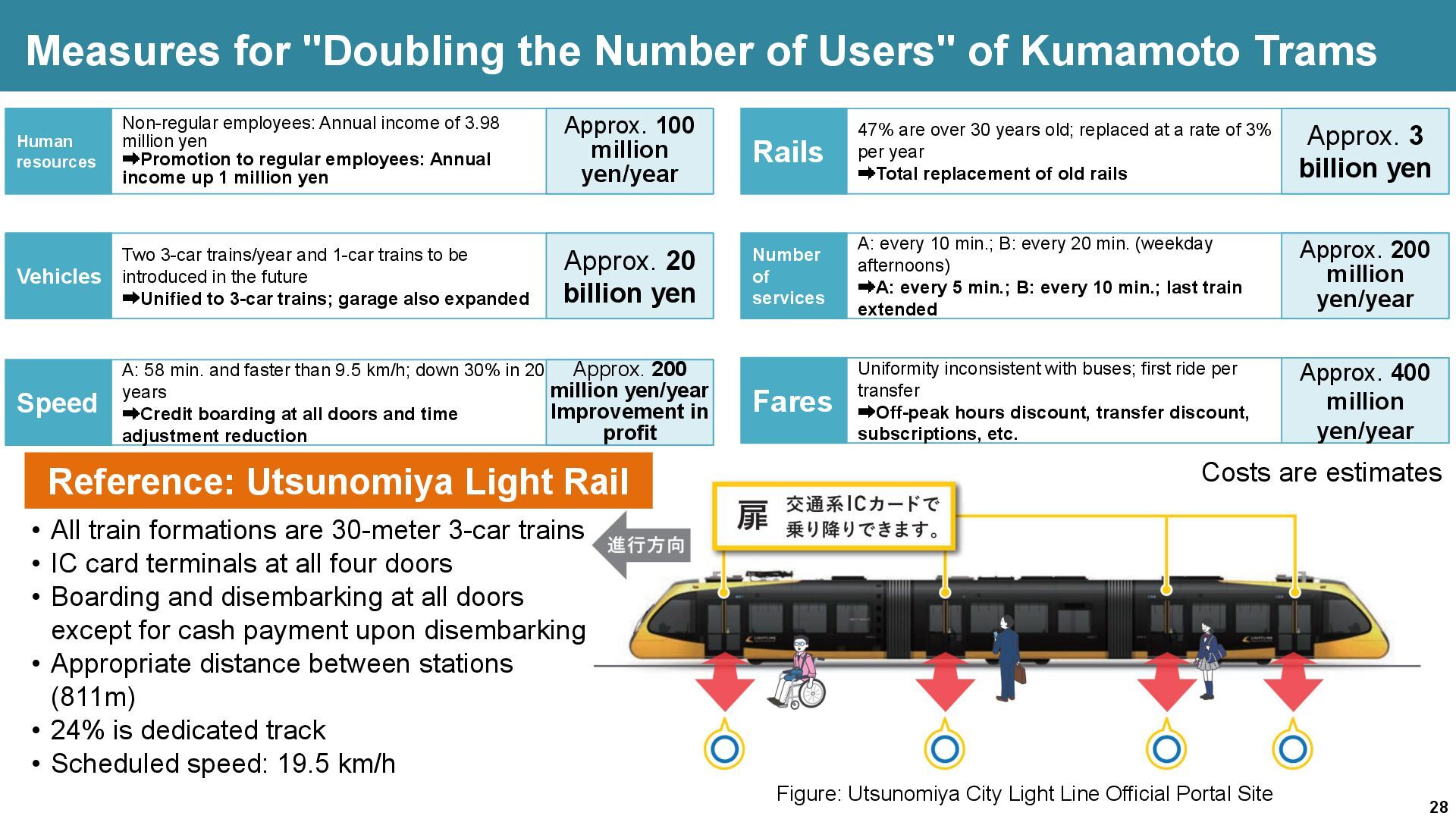
  24. 28 Measures for "Doubling the Number of Users" of Kumamoto

    Trams Non-regular employees: Annual income of 3.98 million yen Promotion to regular employees: Annual income up 1 million yen Approx. 100 million yen/year Human resources Rails 47% are over 30 years old; replaced at a rate of 3% per year Total replacement of old rails Approx. 3 billion yen Two 3-car trains/year and 1-car trains to be introduced in the future Unified to 3-car trains; garage also expanded Approx. 20 billion yen Vehicles A: every 10 min.; B: every 20 min. (weekday afternoons) A: every 5 min.; B: every 10 min.; last train extended Approx. 200 million yen/year Number of services A: 58 min. and faster than 9.5 km/h; down 30% in 20 years Credit boarding at all doors and time adjustment reduction Approx. 200 million yen/year Improvement in profit Speed Uniformity inconsistent with buses; first ride per transfer Off-peak hours discount, transfer discount, subscriptions, etc. Approx. 400 million yen/year Fares Figure: Utsunomiya City Light Line Official Portal Site • All train formations are 30-meter 3-car trains • IC card terminals at all four doors • Boarding and disembarking at all doors except for cash payment upon disembarking • Appropriate distance between stations (811m) • 24% is dedicated track • Scheduled speed: 19.5 km/h Reference: Utsunomiya Light Rail Costs are estimates
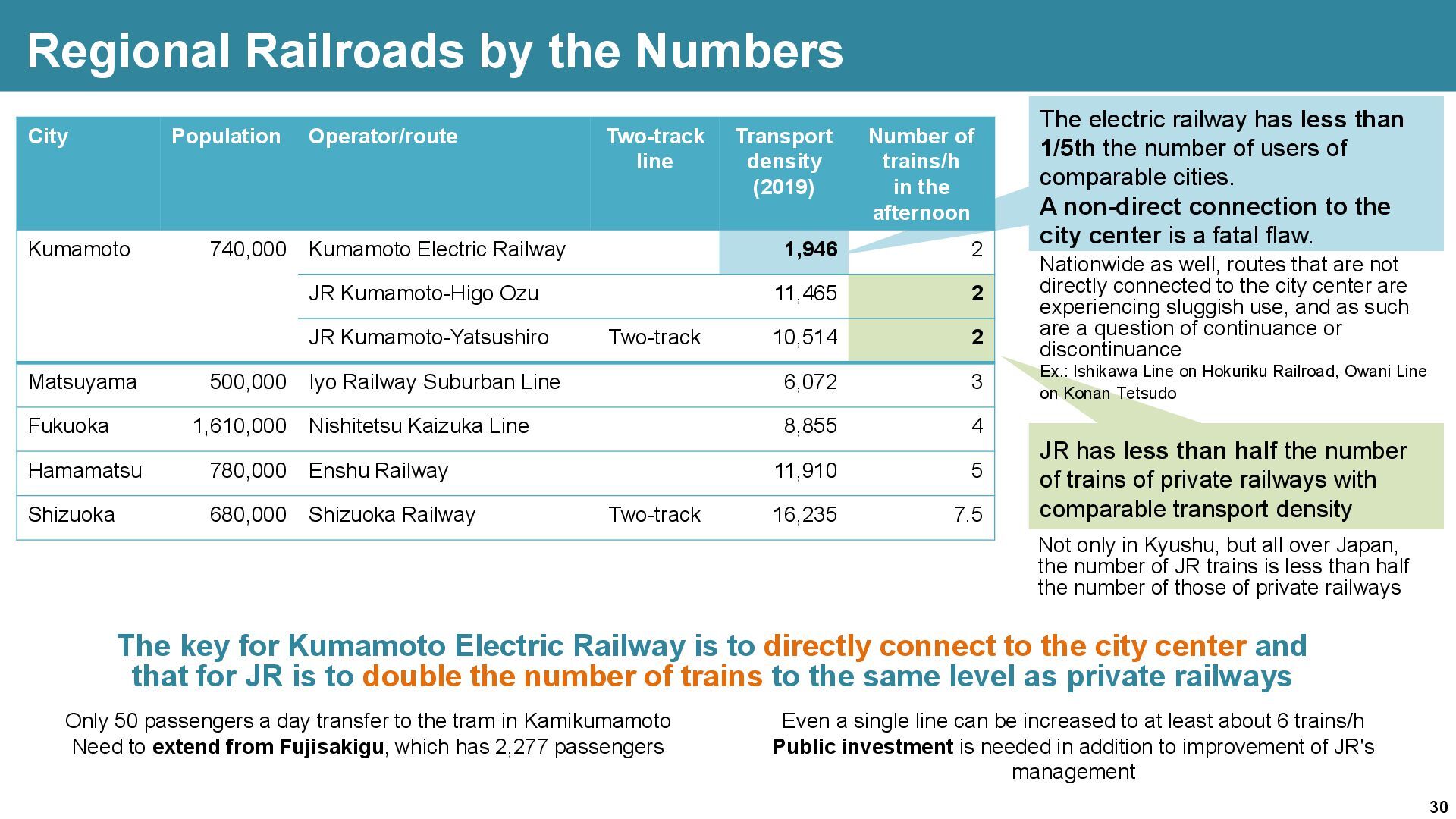
  25. 30 The electric railway has less than 1/5th the number

    of users of comparable cities. A non-direct connection to the city center is a fatal flaw. Regional Railroads by the Numbers City Population Operator/route Two-track line Transport density (2019) Number of trains/h in the afternoon Kumamoto 740,000 Kumamoto Electric Railway 1,946 2 JR Kumamoto-Higo Ozu 11,465 2 JR Kumamoto-Yatsushiro Two-track 10,514 2 Matsuyama 500,000 Iyo Railway Suburban Line 6,072 3 Fukuoka 1,610,000 Nishitetsu Kaizuka Line 8,855 4 Hamamatsu 780,000 Enshu Railway 11,910 5 Shizuoka 680,000 Shizuoka Railway Two-track 16,235 7.5 JR has less than half the number of trains of private railways with comparable transport density Nationwide as well, routes that are not directly connected to the city center are experiencing sluggish use, and as such are a question of continuance or discontinuance Ex.: Ishikawa Line on Hokuriku Railroad, Owani Line on Konan Tetsudo Not only in Kyushu, but all over Japan, the number of JR trains is less than half the number of those of private railways The key for Kumamoto Electric Railway is to directly connect to the city center and that for JR is to double the number of trains to the same level as private railways Only 50 passengers a day transfer to the tram in Kamikumamoto Need to extend from Fujisakigu, which has 2,277 passengers Even a single line can be increased to at least about 6 trains/h Public investment is needed in addition to improvement of JR's management
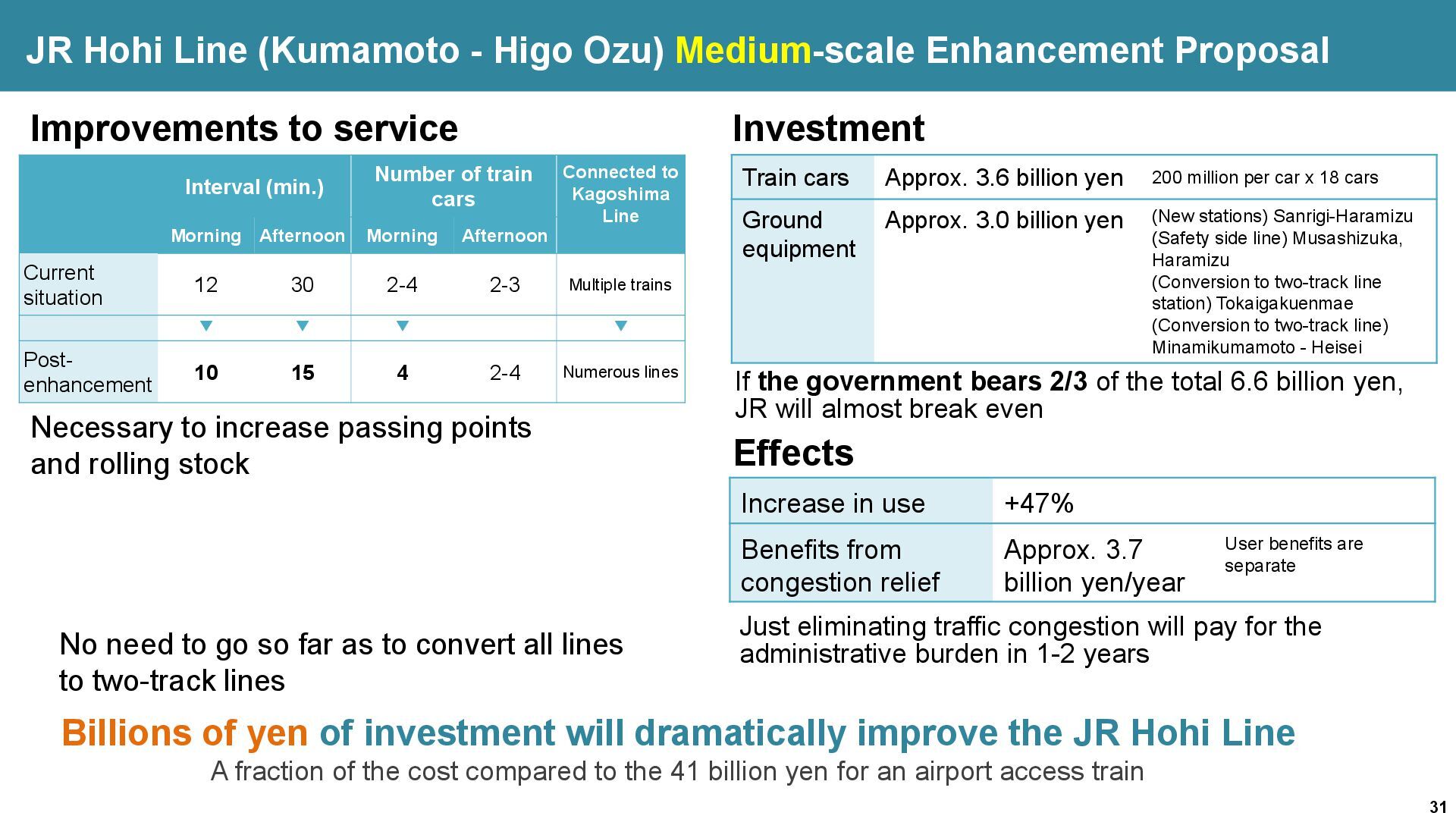
  26. 31 JR Hohi Line (Kumamoto - Higo Ozu) Medium-scale Enhancement

    Proposal Interval (min.) Number of train cars Connected to Kagoshima Line Morning Afternoon Morning Afternoon Current situation 12 30 2-4 2-3 Multiple trains ▼ ▼ ▼ ▼ Post- enhancement 10 15 4 2-4 Numerous lines Train cars Approx. 3.6 billion yen 200 million per car x 18 cars Ground equipment Approx. 3.0 billion yen (New stations) Sanrigi-Haramizu (Safety side line) Musashizuka, Haramizu (Conversion to two-track line station) Tokaigakuenmae (Conversion to two-track line) Minamikumamoto - Heisei If the government bears 2/3 of the total 6.6 billion yen, JR will almost break even Improvements to service Investment Effects Increase in use +47% Benefits from congestion relief Approx. 3.7 billion yen/year User benefits are separate Just eliminating traffic congestion will pay for the administrative burden in 1-2 years Billions of yen of investment will dramatically improve the JR Hohi Line A fraction of the cost compared to the 41 billion yen for an airport access train Necessary to increase passing points and rolling stock No need to go so far as to convert all lines to two-track lines
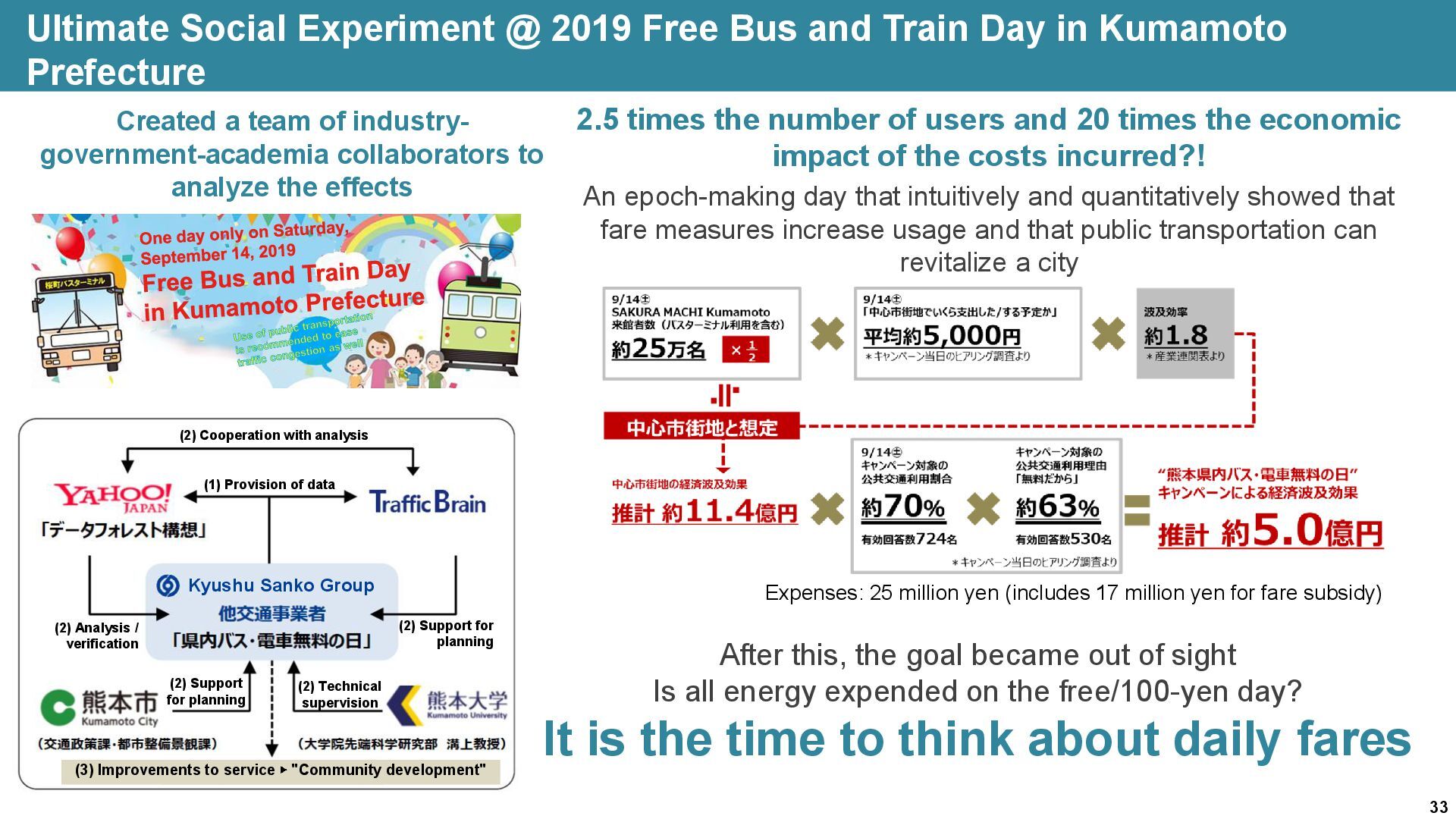
  27. 33 Ultimate Social Experiment @ 2019 Free Bus and Train

    Day in Kumamoto Prefecture Created a team of industry- government-academia collaborators to analyze the effects Expenses: 25 million yen (includes 17 million yen for fare subsidy) 2.5 times the number of users and 20 times the economic impact of the costs incurred?! An epoch-making day that intuitively and quantitatively showed that fare measures increase usage and that public transportation can revitalize a city After this, the goal became out of sight Is all energy expended on the free/100-yen day? It is the time to think about daily fares Use of public transportation is recommended to ease traffic congestion as well (2) Cooperation with analysis (1) Provision of data (2) Analysis / verification (2) Support for planning (2) Support for planning (2) Technical supervision (3) Improvements to service "Community development" Kyushu Sanko Group
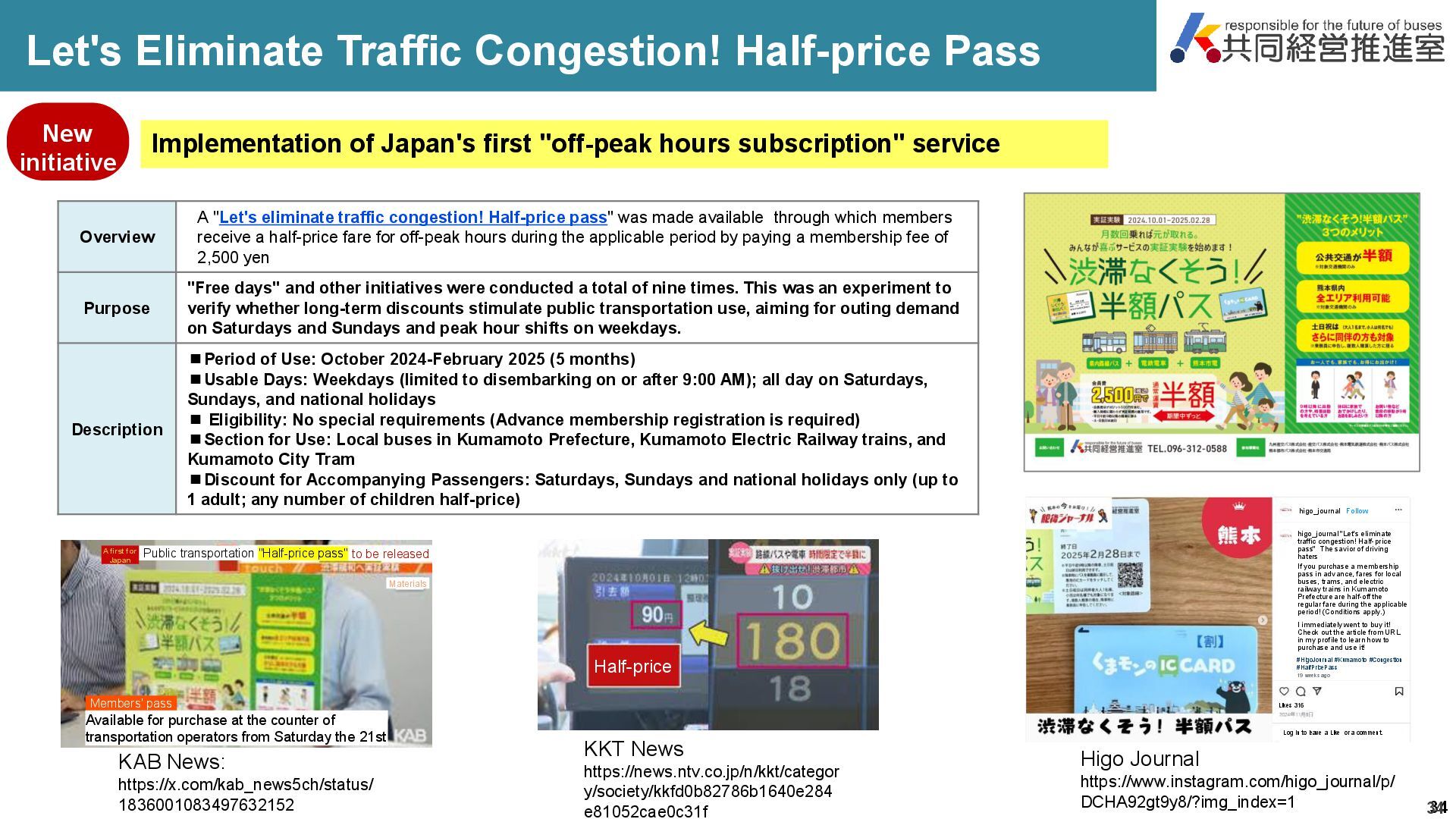
  28. 34 Let's Eliminate Traffic Congestion! Half-price Pass 34 Overview A

    "Let's eliminate traffic congestion! Half-price pass" was made available through which members receive a half-price fare for off-peak hours during the applicable period by paying a membership fee of 2,500 yen Purpose "Free days" and other initiatives were conducted a total of nine times. This was an experiment to verify whether long-term discounts stimulate public transportation use, aiming for outing demand on Saturdays and Sundays and peak hour shifts on weekdays. Description ▪Period of Use: October 2024-February 2025 (5 months) ▪Usable Days: Weekdays (limited to disembarking on or after 9:00 AM); all day on Saturdays, Sundays, and national holidays ▪ Eligibility: No special requirements (Advance membership registration is required) ▪Section for Use: Local buses in Kumamoto Prefecture, Kumamoto Electric Railway trains, and Kumamoto City Tram ▪Discount for Accompanying Passengers: Saturdays, Sundays and national holidays only (up to 1 adult; any number of children half-price) Implementation of Japan's first "off-peak hours subscription" service New initiative KAB News: https://x.com/kab_news5ch/status/ 1836001083497632152 KKT News https://news.ntv.co.jp/n/kkt/categor y/society/kkfd0b82786b1640e284 e81052cae0c31f Higo Journal https://www.instagram.com/higo_journal/p/ DCHA92gt9y8/?img_index=1 higo_journal Follow higo_journal "Let's eliminate traffic congestion! Half-price pass" The savior of driving haters If you purchase a membership pass in advance, fares for local buses, trams, and electric railway trains in Kumamoto Prefecture are half-off the regular fare during the applicable period! (Conditions apply.) Likes 316 #HigoJournal #Kumamoto #Congestion #HalfPricePass I immediately went to buy it! Check out the article from URL in my profile to learn how to purchase and use it! Half-price 19 weeks ago A first for Japan Materials Members' pass Available for purchase at the counter of transportation operators from Saturday the 21st Public transportation "Half-price pass" to be released Log in to leave a Like or a comment.
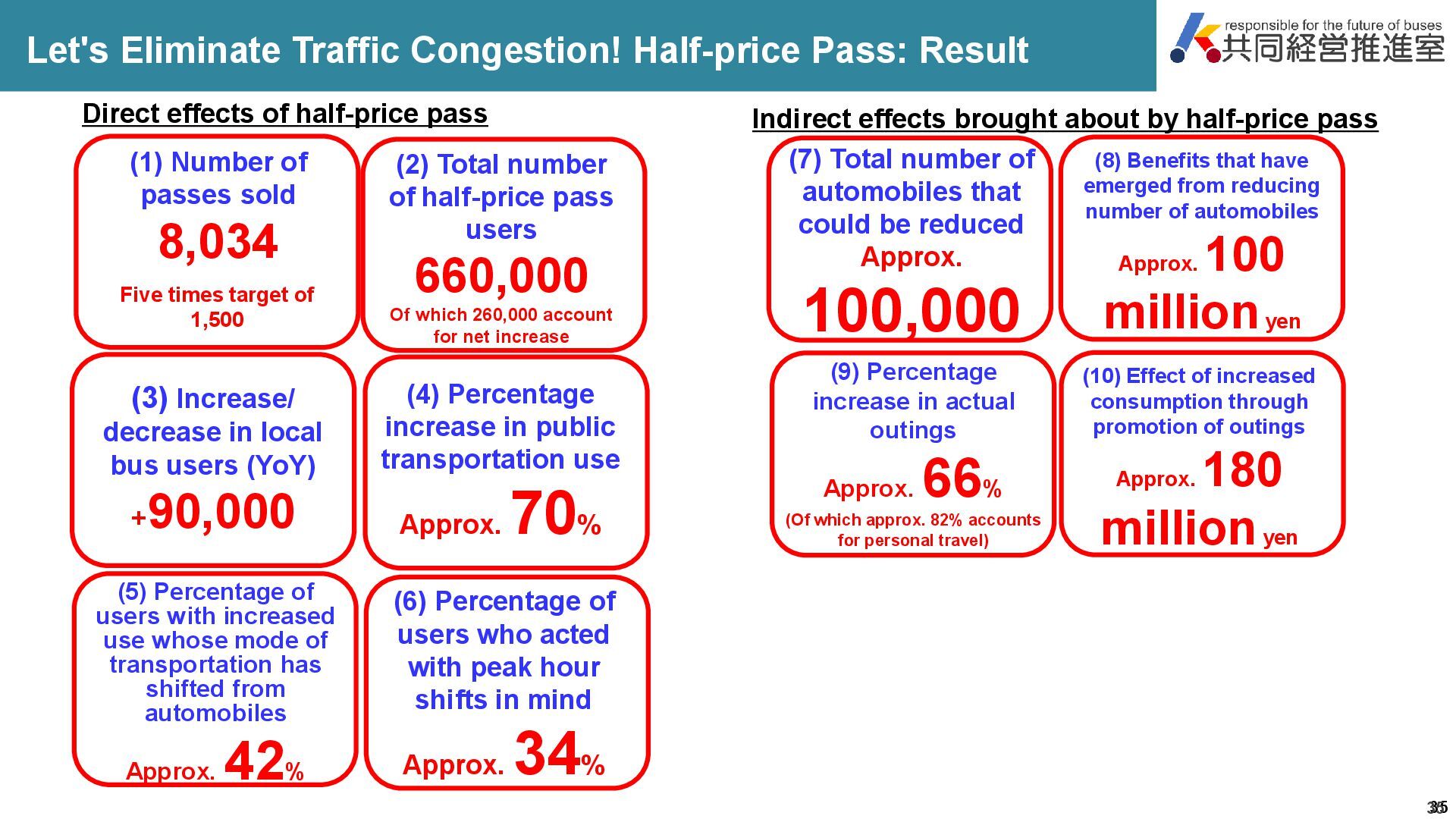
  29. 35 Let's Eliminate Traffic Congestion! Half-price Pass: Result (4) Percentage

    increase in public transportation use Approx. 70% (1) Number of passes sold 8,034 Direct effects of half-price pass Indirect effects brought about by half-price pass (2) Total number of half-price pass users 660,000 Of which 260,000 account for net increase (5) Percentage of users with increased use whose mode of transportation has shifted from automobiles Approx. 42% (3) Increase/ decrease in local bus users (YoY) + 90,000 (9) Percentage increase in actual outings Approx. 66% (Of which approx. 82% accounts for personal travel) (7) Total number of automobiles that could be reduced Approx. 100,000 (8) Benefits that have emerged from reducing number of automobiles Approx. 100 million yen (10) Effect of increased consumption through promotion of outings Approx. 180 million yen (6) Percentage of users who acted with peak hour shifts in mind Approx. 34% 35 Five times target of 1,500
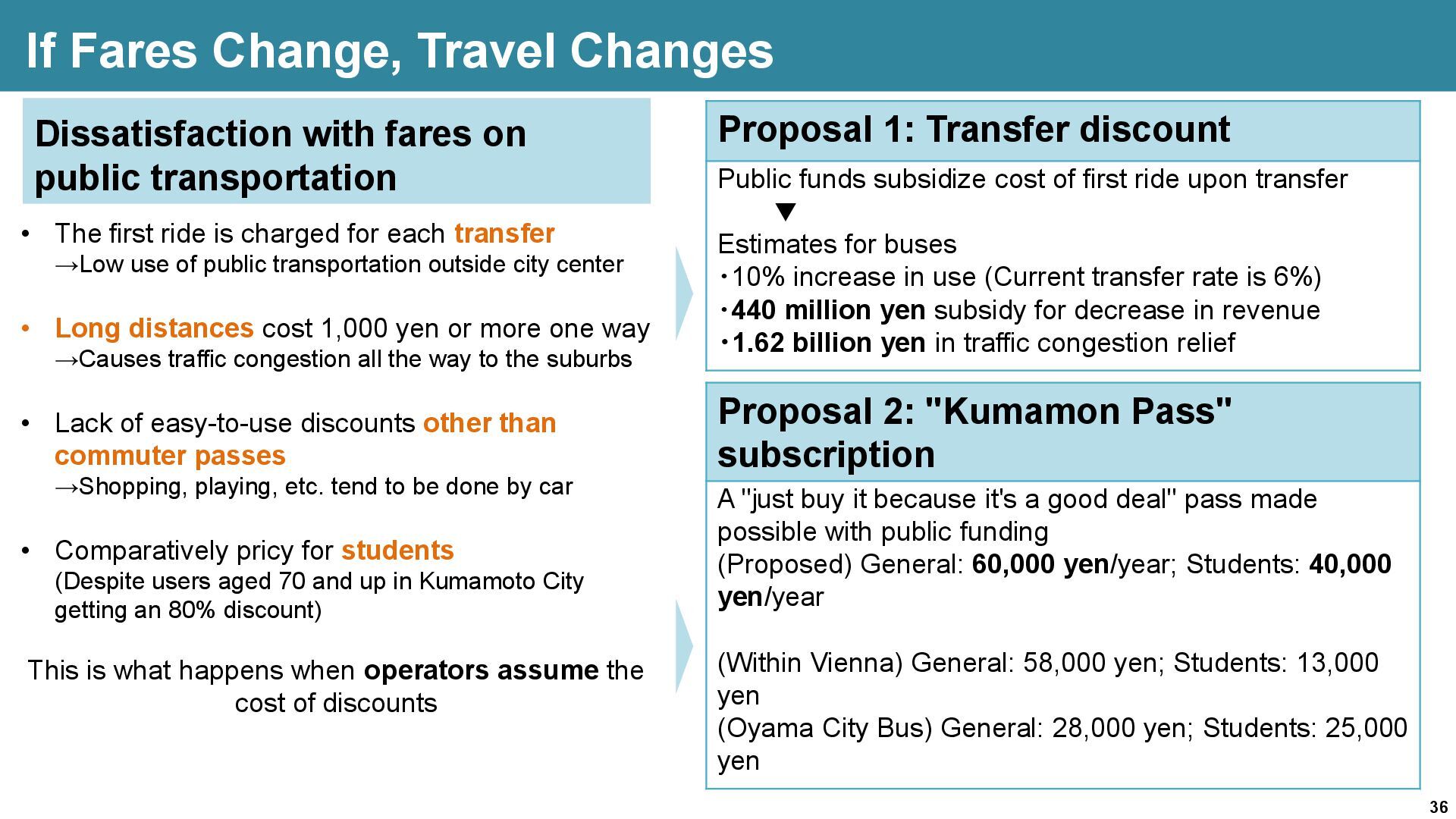
  30. 36 If Fares Change, Travel Changes • The first ride

    is charged for each transfer →Low use of public transportation outside city center • Long distances cost 1,000 yen or more one way →Causes traffic congestion all the way to the suburbs • Lack of easy-to-use discounts other than commuter passes →Shopping, playing, etc. tend to be done by car • Comparatively pricy for students (Despite users aged 70 and up in Kumamoto City getting an 80% discount) This is what happens when operators assume the cost of discounts Proposal 2: "Kumamon Pass" subscription A "just buy it because it's a good deal" pass made possible with public funding (Proposed) General: 60,000 yen/year; Students: 40,000 yen/year (Within Vienna) General: 58,000 yen; Students: 13,000 yen (Oyama City Bus) General: 28,000 yen; Students: 25,000 yen Dissatisfaction with fares on public transportation Proposal 1: Transfer discount Public funds subsidize cost of first ride upon transfer ▼ Estimates for buses ・10% increase in use (Current transfer rate is 6%) ・440 million yen subsidy for decrease in revenue ・1.62 billion yen in traffic congestion relief
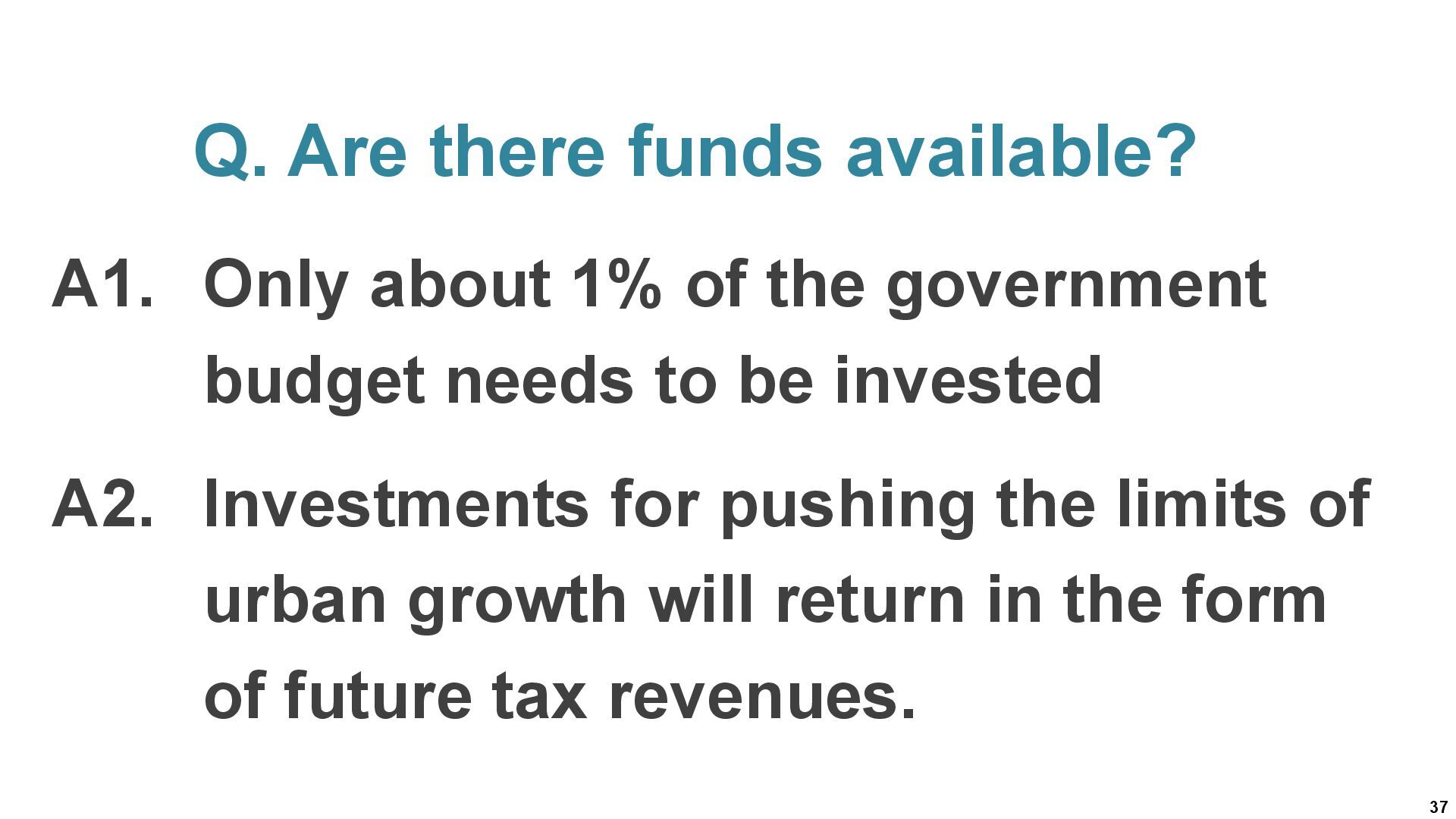
  31. 37 Q. Are there funds available? A1. Only about 1%

    of the government budget needs to be invested A2. Investments for pushing the limits of urban growth will return in the form of future tax revenues.
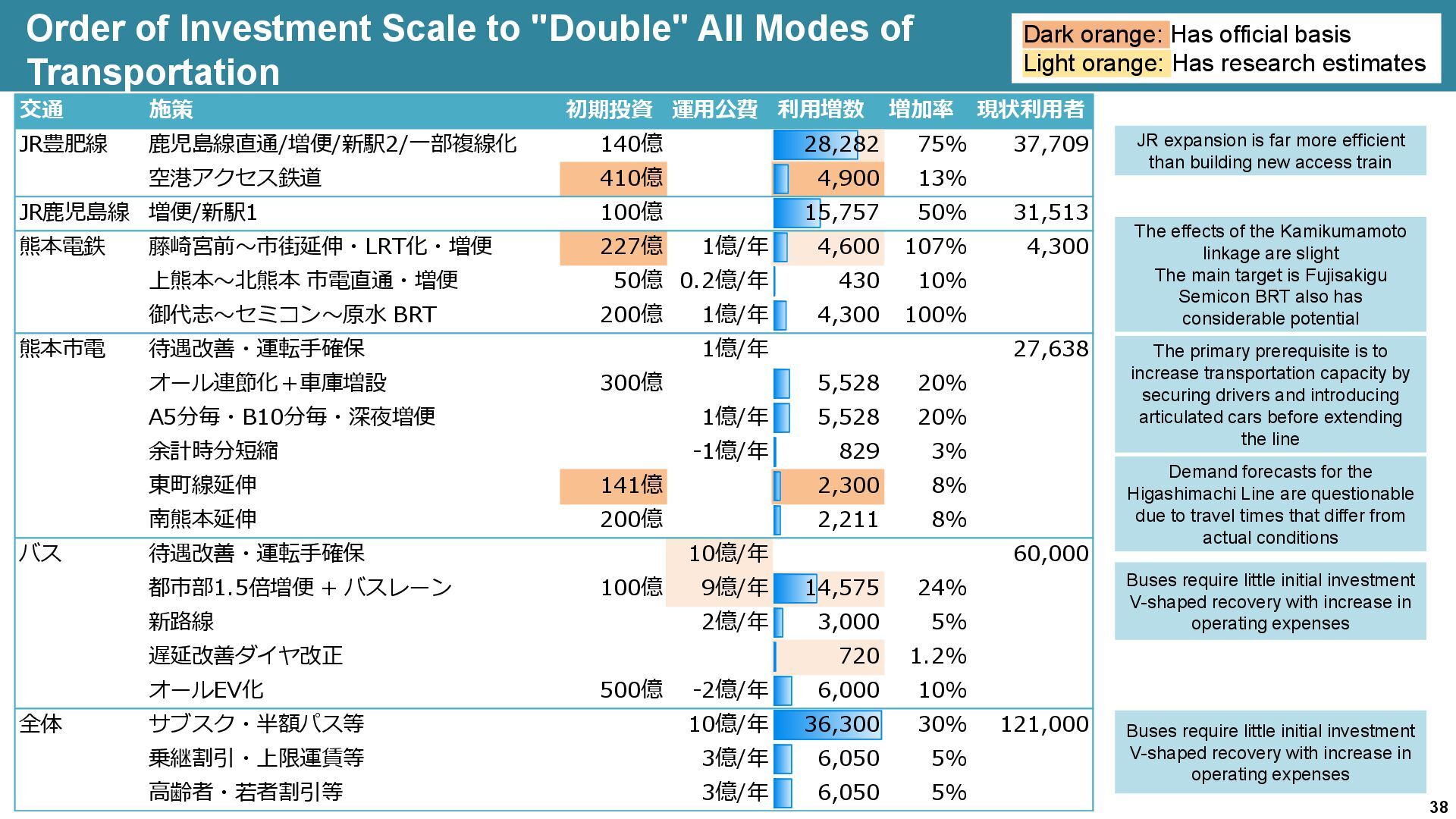
  32. 38 Order of Investment Scale to "Double" All Modes of

    Transportation 交通 施策 初期投資 運用公費 利用増数 増加率 現状利用者 JR豊肥線 鹿児島線直通/増便/新駅2/一部複線化 140億 28,282 75% 37,709 空港アクセス鉄道 410億 4,900 13% JR鹿児島線 増便/新駅1 100億 15,757 50% 31,513 熊本電鉄 藤崎宮前~市街延伸・LRT化・増便 227億 1億/年 4,600 107% 4,300 上熊本~北熊本 市電直通・増便 50億 0.2億/年 430 10% 御代志~セミコン~原水 BRT 200億 1億/年 4,300 100% 熊本市電 待遇改善・運転手確保 1億/年 27,638 オール連節化+車庫増設 300億 5,528 20% A5分毎・B10分毎・深夜増便 1億/年 5,528 20% 余計時分短縮 -1億/年 829 3% 東町線延伸 141億 2,300 8% 南熊本延伸 200億 2,211 8% バス 待遇改善・運転手確保 10億/年 60,000 都市部1.5倍増便 + バスレーン 100億 9億/年 14,575 24% 新路線 2億/年 3,000 5% 遅延改善ダイヤ改正 720 1.2% オールEV化 500億 -2億/年 6,000 10% 全体 サブスク・半額パス等 10億/年 36,300 30% 121,000 乗継割引・上限運賃等 3億/年 6,050 5% 高齢者・若者割引等 3億/年 6,050 5% Dark orange: Has official basis Light orange: Has research estimates JR expansion is far more efficient than building new access train The effects of the Kamikumamoto linkage are slight The main target is Fujisakigu Semicon BRT also has considerable potential The primary prerequisite is to increase transportation capacity by securing drivers and introducing articulated cars before extending the line Demand forecasts for the Higashimachi Line are questionable due to travel times that differ from actual conditions Buses require little initial investment V-shaped recovery with increase in operating expenses Buses require little initial investment V-shaped recovery with increase in operating expenses
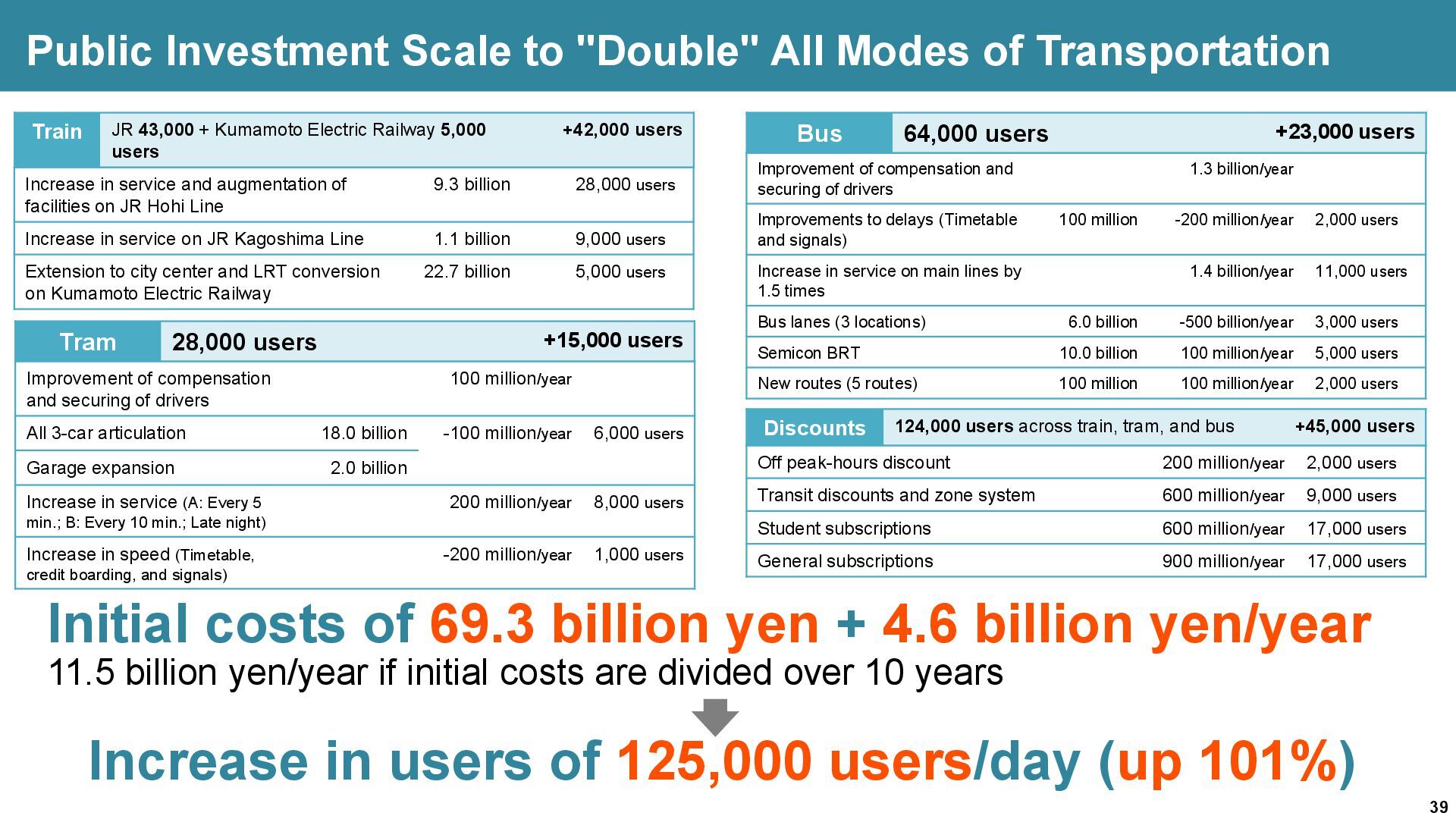
  33. 39 Public Investment Scale to "Double" All Modes of Transportation

    Increase in service and augmentation of facilities on JR Hohi Line 9.3 billion 28,000 users Increase in service on JR Kagoshima Line 1.1 billion 9,000 users Extension to city center and LRT conversion on Kumamoto Electric Railway 22.7 billion 5,000 users Improvement of compensation and securing of drivers 100 million/year All 3-car articulation 18.0 billion -100 million/year 6,000 users Garage expansion 2.0 billion Increase in service (A: Every 5 min.; B: Every 10 min.; Late night) 200 million/year 8,000 users Increase in speed (Timetable, credit boarding, and signals) -200 million/year 1,000 users Improvement of compensation and securing of drivers 1.3 billion/year Improvements to delays (Timetable and signals) 100 million -200 million/year 2,000 users Increase in service on main lines by 1.5 times 1.4 billion/year 11,000 users Bus lanes (3 locations) 6.0 billion -500 billion/year 3,000 users Semicon BRT 10.0 billion 100 million/year 5,000 users New routes (5 routes) 100 million 100 million/year 2,000 users Train JR 43,000 + Kumamoto Electric Railway 5,000 users +42,000 users Tram 28,000 users +15,000 users Bus 64,000 users +23,000 users Off peak-hours discount 200 million/year 2,000 users Transit discounts and zone system 600 million/year 9,000 users Student subscriptions 600 million/year 17,000 users General subscriptions 900 million/year 17,000 users Discounts 124,000 users across train, tram, and bus +45,000 users Initial costs of 69.3 billion yen + 4.6 billion yen/year Increase in users of 125,000 users/day (up 101%) 11.5 billion yen/year if initial costs are divided over 10 years
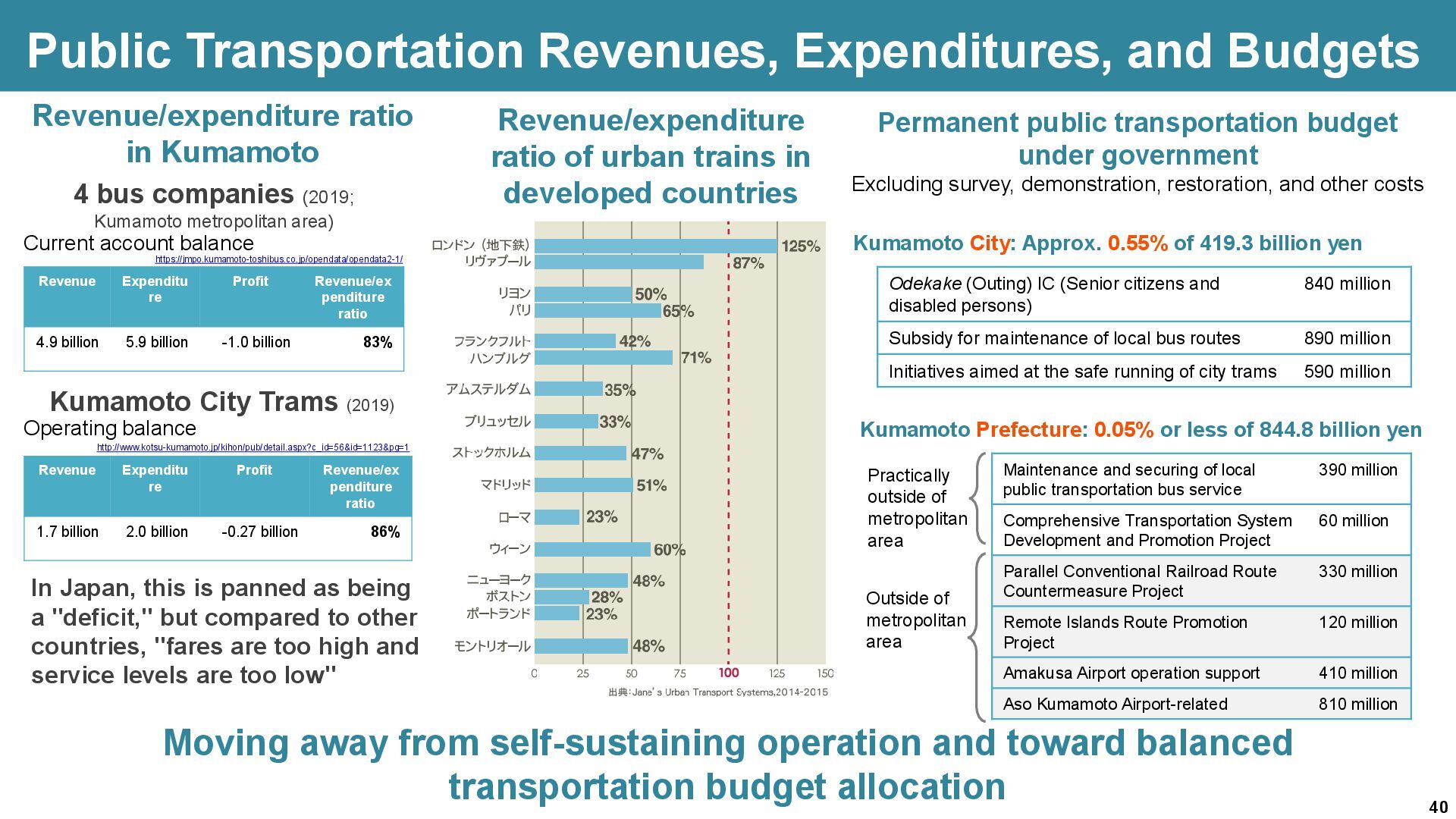
  34. 40 Public Transportation Revenues, Expenditures, and Budgets 4 bus companies

    (2019; Kumamoto metropolitan area) Revenue Expenditu re Profit Revenue/ex penditure ratio 4.9 billion 5.9 billion -1.0 billion 83% Kumamoto City Trams (2019) Current account balance https://jmpo.kumamoto-toshibus.co.jp/opendata/opendata2-1/ Revenue Expenditu re Profit Revenue/ex penditure ratio 1.7 billion 2.0 billion -0.27 billion 86% Operating balance http://www.kotsu-kumamoto.jp/kihon/pub/detail.aspx?c_id=56&id=1123&pg=1 Revenue/expenditure ratio in Kumamoto Revenue/expenditure ratio of urban trains in developed countries Odekake (Outing) IC (Senior citizens and disabled persons) 840 million Subsidy for maintenance of local bus routes 890 million Initiatives aimed at the safe running of city trams 590 million Permanent public transportation budget under government Excluding survey, demonstration, restoration, and other costs Moving away from self-sustaining operation and toward balanced transportation budget allocation In Japan, this is panned as being a "deficit," but compared to other countries, "fares are too high and service levels are too low" Maintenance and securing of local public transportation bus service 390 million Comprehensive Transportation System Development and Promotion Project 60 million Parallel Conventional Railroad Route Countermeasure Project 330 million Remote Islands Route Promotion Project 120 million Amakusa Airport operation support 410 million Aso Kumamoto Airport-related 810 million Practically outside of metropolitan area Outside of metropolitan area Kumamoto City: Approx. 0.55% of 419.3 billion yen Kumamoto Prefecture: 0.05% or less of 844.8 billion yen
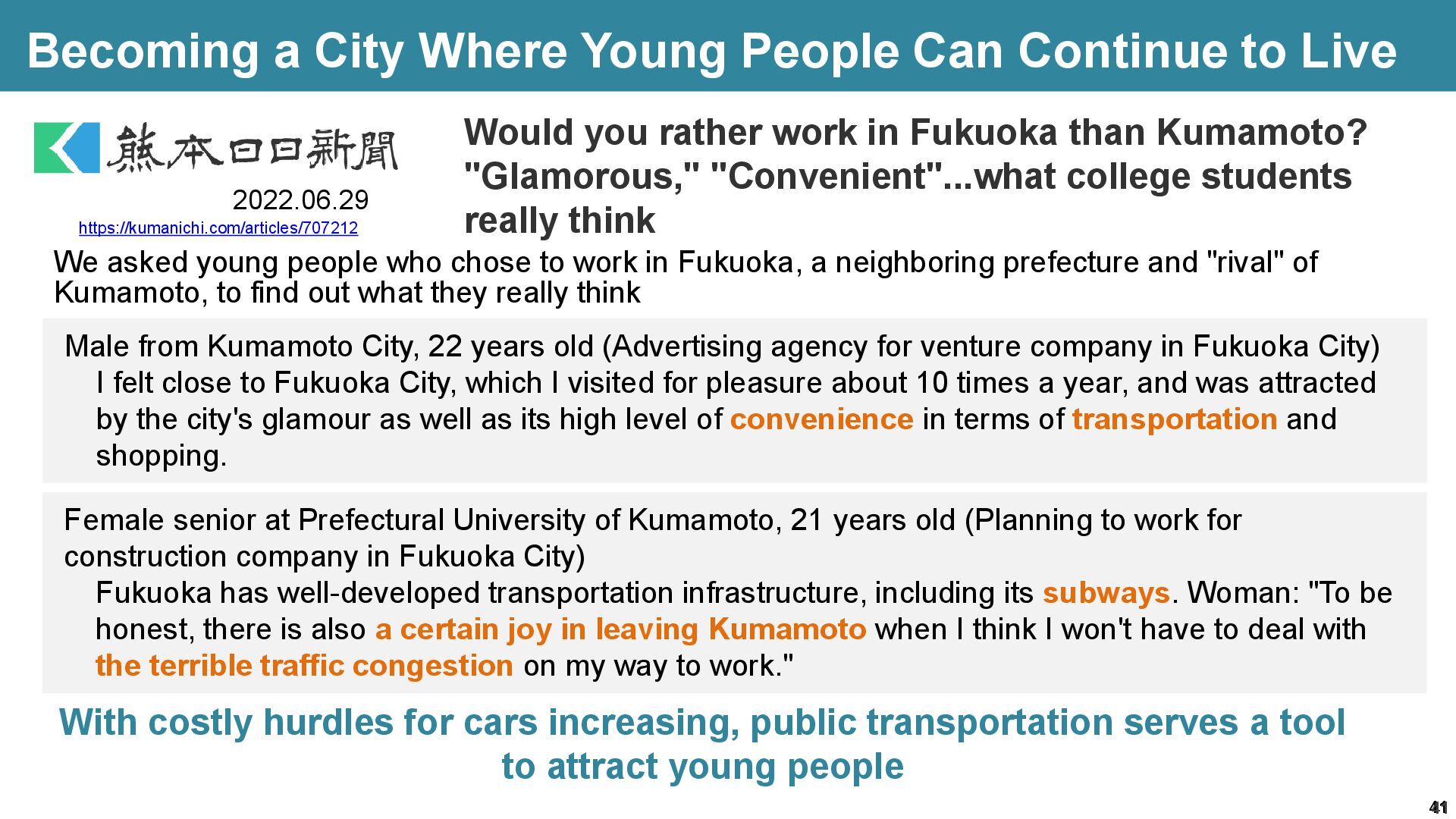
  35. 41 41 Becoming a City Where Young People Can Continue

    to Live Would you rather work in Fukuoka than Kumamoto? "Glamorous," "Convenient"...what college students really think 2022.06.29 https://kumanichi.com/articles/707212 We asked young people who chose to work in Fukuoka, a neighboring prefecture and "rival" of Kumamoto, to find out what they really think Female senior at Prefectural University of Kumamoto, 21 years old (Planning to work for construction company in Fukuoka City) Fukuoka has well-developed transportation infrastructure, including its subways. Woman: "To be honest, there is also a certain joy in leaving Kumamoto when I think I won't have to deal with the terrible traffic congestion on my way to work." Male from Kumamoto City, 22 years old (Advertising agency for venture company in Fukuoka City) I felt close to Fukuoka City, which I visited for pleasure about 10 times a year, and was attracted by the city's glamour as well as its high level of convenience in terms of transportation and shopping. With costly hurdles for cars increasing, public transportation serves a tool to attract young people
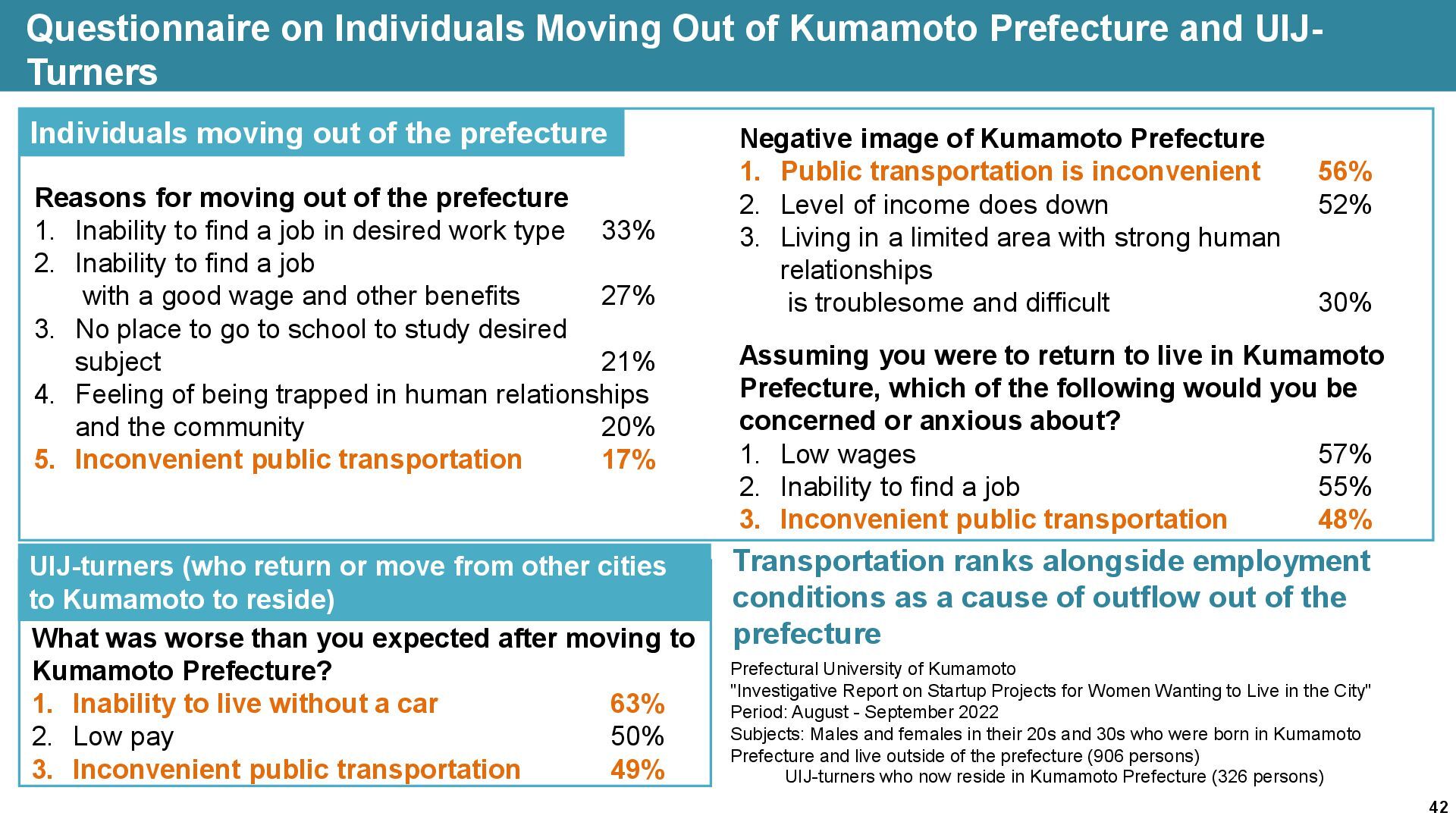
  36. 42 Questionnaire on Individuals Moving Out of Kumamoto Prefecture and

    UIJ- Turners Reasons for moving out of the prefecture 1. Inability to find a job in desired work type 33% 2. Inability to find a job with a good wage and other benefits 27% 3. No place to go to school to study desired subject 21% 4. Feeling of being trapped in human relationships and the community 20% 5. Inconvenient public transportation 17% Negative image of Kumamoto Prefecture 1. Public transportation is inconvenient 56% 2. Level of income does down 52% 3. Living in a limited area with strong human relationships is troublesome and difficult 30% Assuming you were to return to live in Kumamoto Prefecture, which of the following would you be concerned or anxious about? 1. Low wages 57% 2. Inability to find a job 55% 3. Inconvenient public transportation 48% What was worse than you expected after moving to Kumamoto Prefecture? 1. Inability to live without a car 63% 2. Low pay 50% 3. Inconvenient public transportation 49% Individuals moving out of the prefecture UIJ-turners (who return or move from other cities to Kumamoto to reside) Prefectural University of Kumamoto "Investigative Report on Startup Projects for Women Wanting to Live in the City" Period: August - September 2022 Subjects: Males and females in their 20s and 30s who were born in Kumamoto Prefecture and live outside of the prefecture (906 persons) UIJ-turners who now reside in Kumamoto Prefecture (326 persons) Transportation ranks alongside employment conditions as a cause of outflow out of the prefecture
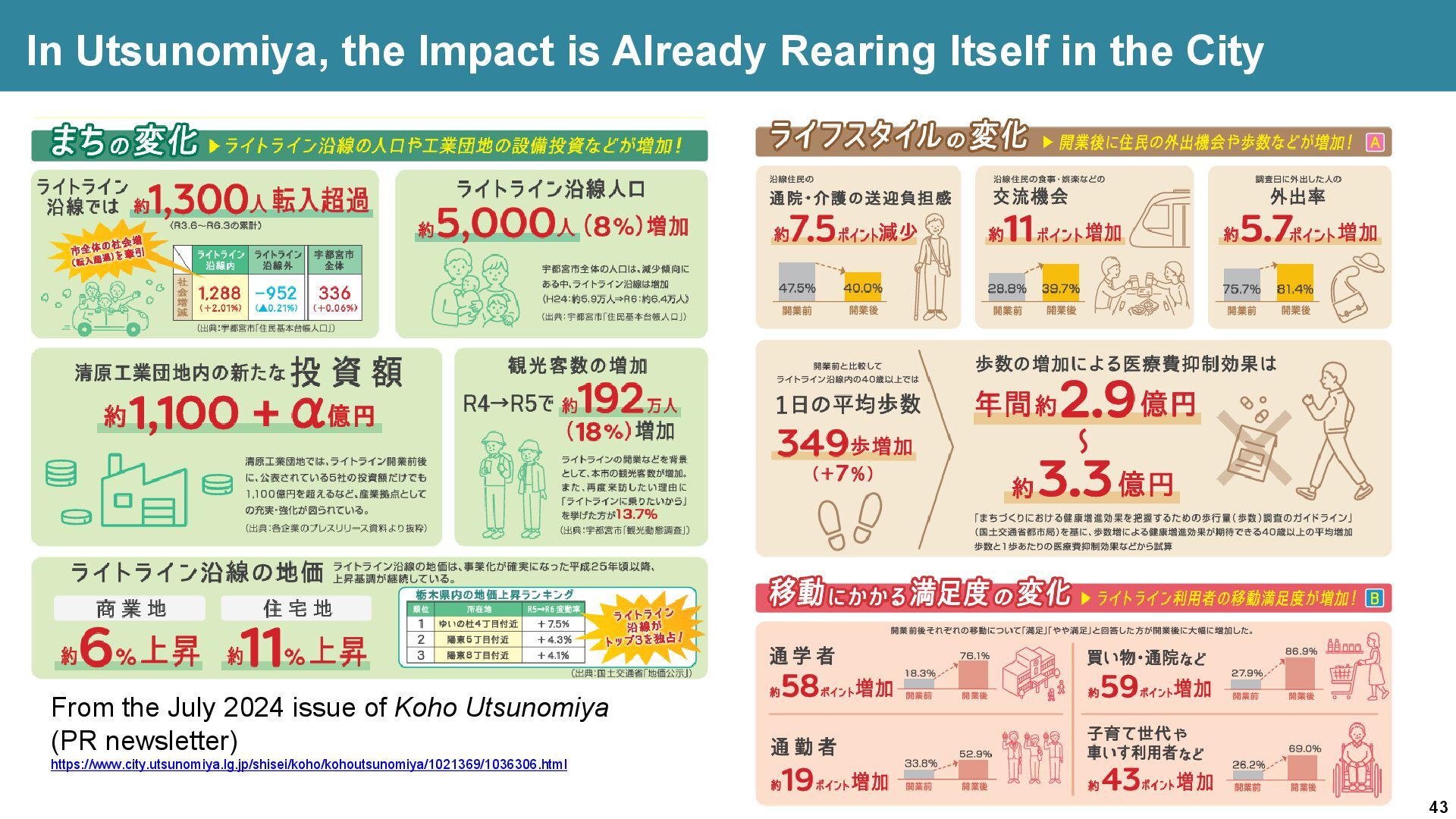
  37. 43 In Utsunomiya, the Impact is Already Rearing Itself in

    the City From the July 2024 issue of Koho Utsunomiya (PR newsletter) https://www.city.utsunomiya.lg.jp/shisei/koho/kohoutsunomiya/1021369/1036306.html
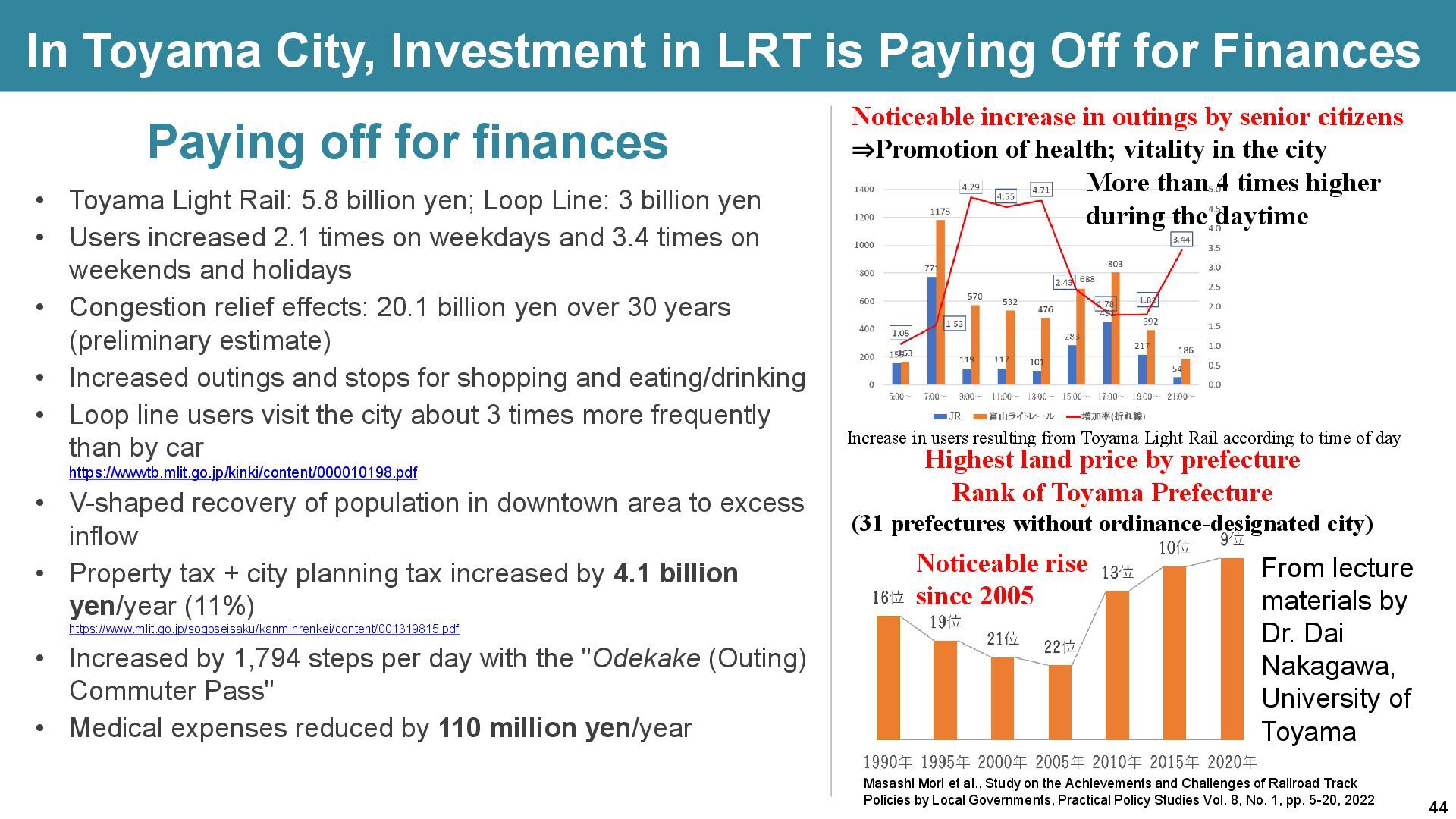
  38. 44 In Toyama City, Investment in LRT is Paying Off

    for Finances • Toyama Light Rail: 5.8 billion yen; Loop Line: 3 billion yen • Users increased 2.1 times on weekdays and 3.4 times on weekends and holidays • Congestion relief effects: 20.1 billion yen over 30 years (preliminary estimate) • Increased outings and stops for shopping and eating/drinking • Loop line users visit the city about 3 times more frequently than by car https://wwwtb.mlit.go.jp/kinki/content/000010198.pdf • V-shaped recovery of population in downtown area to excess inflow • Property tax + city planning tax increased by 4.1 billion yen/year (11%) https://www.mlit.go.jp/sogoseisaku/kanminrenkei/content/001319815.pdf • Increased by 1,794 steps per day with the "Odekake (Outing) Commuter Pass" • Medical expenses reduced by 110 million yen/year Paying off for finances Noticeable rise since 2005 Highest land price by prefecture Rank of Toyama Prefecture (31 prefectures without ordinance-designated city) Masashi Mori et al., Study on the Achievements and Challenges of Railroad Track Policies by Local Governments, Practical Policy Studies Vol. 8, No. 1, pp. 5-20, 2022 Noticeable increase in outings by senior citizens ⇒Promotion of health; vitality in the city More than 4 times higher during the daytime Increase in users resulting from Toyama Light Rail according to time of day From lecture materials by Dr. Dai Nakagawa, University of Toyama
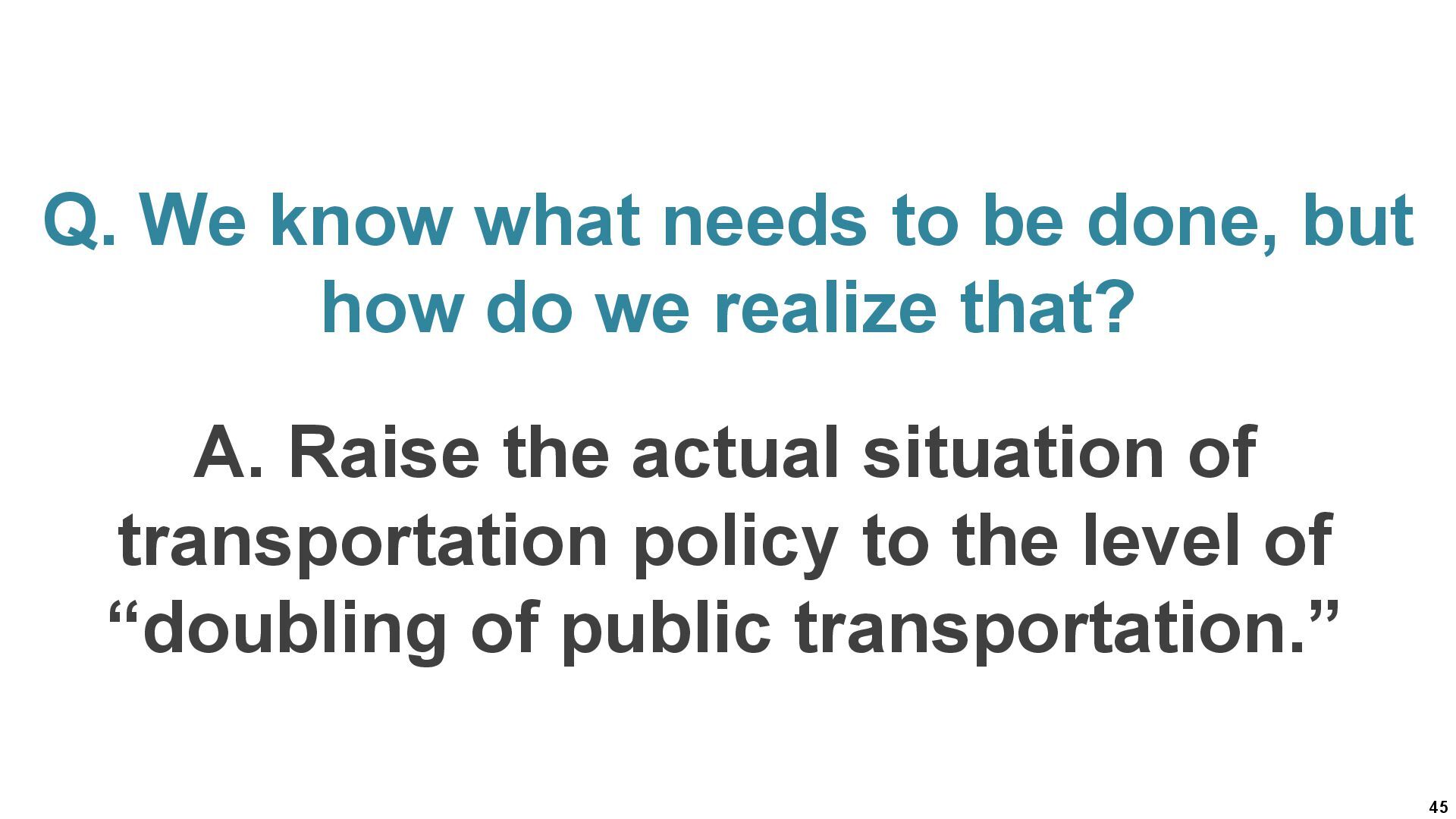
  39. 45 Q. We know what needs to be done, but

    how do we realize that? A. Raise the actual situation of transportation policy to the level of “doubling of public transportation.”
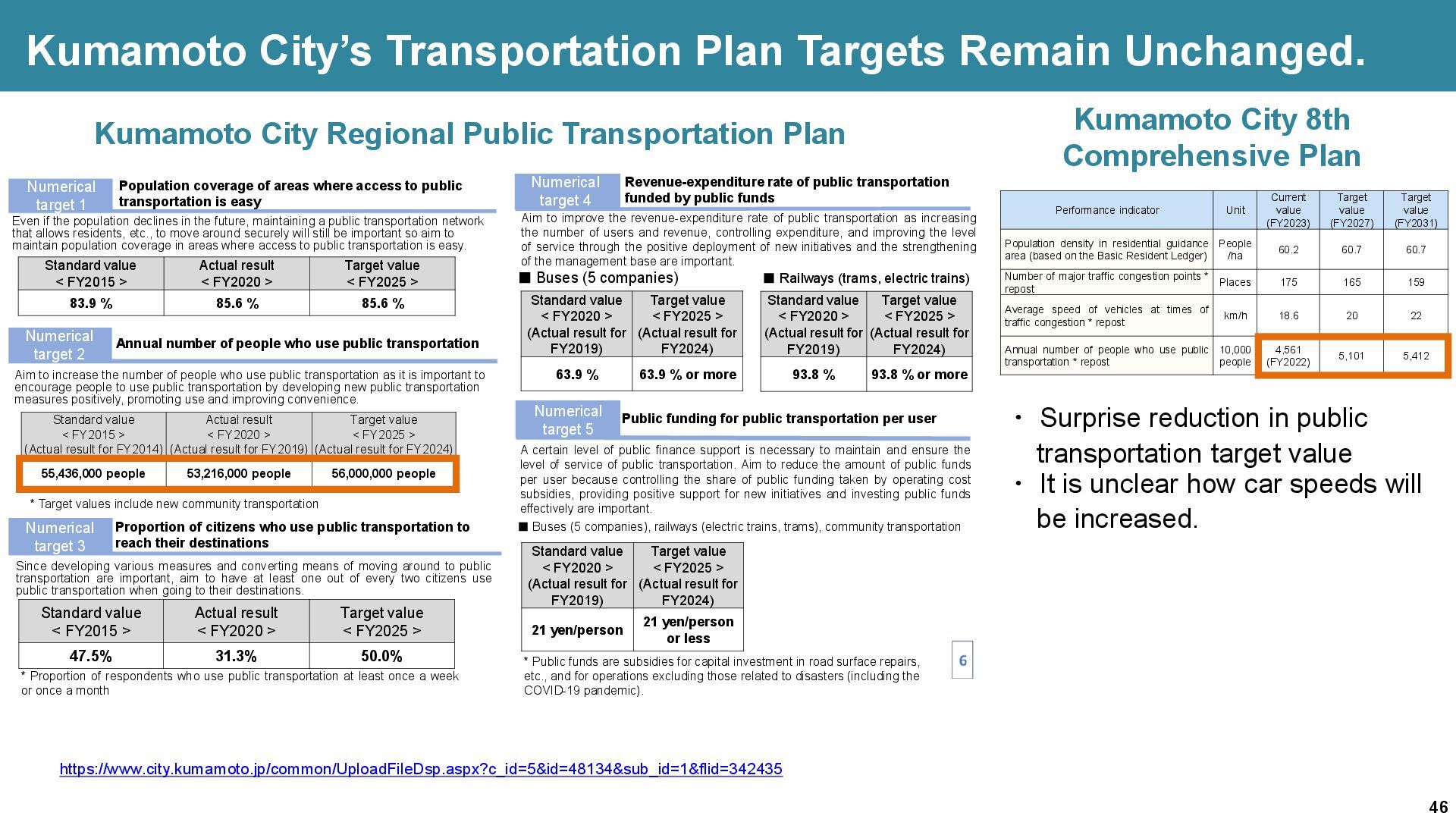
  40. 46 Kumamoto City’s Transportation Plan Targets Remain Unchanged. https://www.city.kumamoto.jp/common/UploadFileDsp.aspx?c_id=5&id=48134&sub_id=1&flid=342435 Kumamoto

    City Regional Public Transportation Plan Kumamoto City 8th Comprehensive Plan ・ Surprise reduction in public transportation target value ・ It is unclear how car speeds will be increased. Numerical target 1 Population coverage of areas where access to public transportation is easy Even if the population declines in the future, maintaining a public transportation network that allows residents, etc., to move around securely will still be important so aim to maintain population coverage in areas where access to public transportation is easy. Numerical target 2 Annual number of people who use public transportation Aim to increase the number of people who use public transportation as it is important to encourage people to use public transportation by developing new public transportation measures positively, promoting use and improving convenience. * Target values include new community transportation Numerical target 3 Proportion of citizens who use public transportation to reach their destinations Since developing various measures and converting means of moving around to public transportation are important, aim to have at least one out of every two citizens use public transportation when going to their destinations. * Proportion of respondents who use public transportation at least once a week or once a month Numerical target 4 Revenue-expenditure rate of public transportation funded by public funds Aim to improve the revenue-expenditure rate of public transportation as increasing the number of users and revenue, controlling expenditure, and improving the level of service through the positive deployment of new initiatives and the strengthening of the management base are important. ▪ Buses (5 companies) ▪ Railways (trams, electric trains) Numerical target 5 Public funding for public transportation per user A certain level of public finance support is necessary to maintain and ensure the level of service of public transportation. Aim to reduce the amount of public funds per user because controlling the share of public funding taken by operating cost subsidies, providing positive support for new initiatives and investing public funds effectively are important. ▪ Buses (5 companies), railways (electric trains, trams), community transportation * Public funds are subsidies for capital investment in road surface repairs, etc., and for operations excluding those related to disasters (including the COVID-19 pandemic). Standard value < FY2015 > Actual result < FY2020 > Target value < FY2025 > 83.9 % 85.6 % 85.6 % Standard value < FY2015 > (Actual result for FY2014) Actual result < FY2020 > (Actual result for FY2019) Target value < FY2025 > (Actual result for FY2024) 55,436,000 people 53,216,000 people 56,000,000 people Standard value < FY2020 > (Actual result for FY2019) Target value < FY2025 > (Actual result for FY2024) 63.9 % 63.9 % or more Standard value < FY2020 > (Actual result for FY2019) Target value < FY2025 > (Actual result for FY2024) 93.8 % 93.8 % or more Standard value < FY2020 > (Actual result for FY2019) Target value < FY2025 > (Actual result for FY2024) 21 yen/person 21 yen/person or less Performance indicator Unit Current value (FY2023) Target value (FY2027) Target value (FY2031) Population density in residential guidance area (based on the Basic Resident Ledger) People /ha 60.2 60.7 60.7 Number of major traffic congestion points * repost Places 175 165 159 Average speed of vehicles at times of traffic congestion * repost km/h 18.6 20 22 Annual number of people who use public transportation * repost 10,000 people 4,561 (FY2022) 5,101 5,412 Standard value < FY2015 > Actual result < FY2020 > Target value < FY2025 > 47.5% 31.3% 50.0%
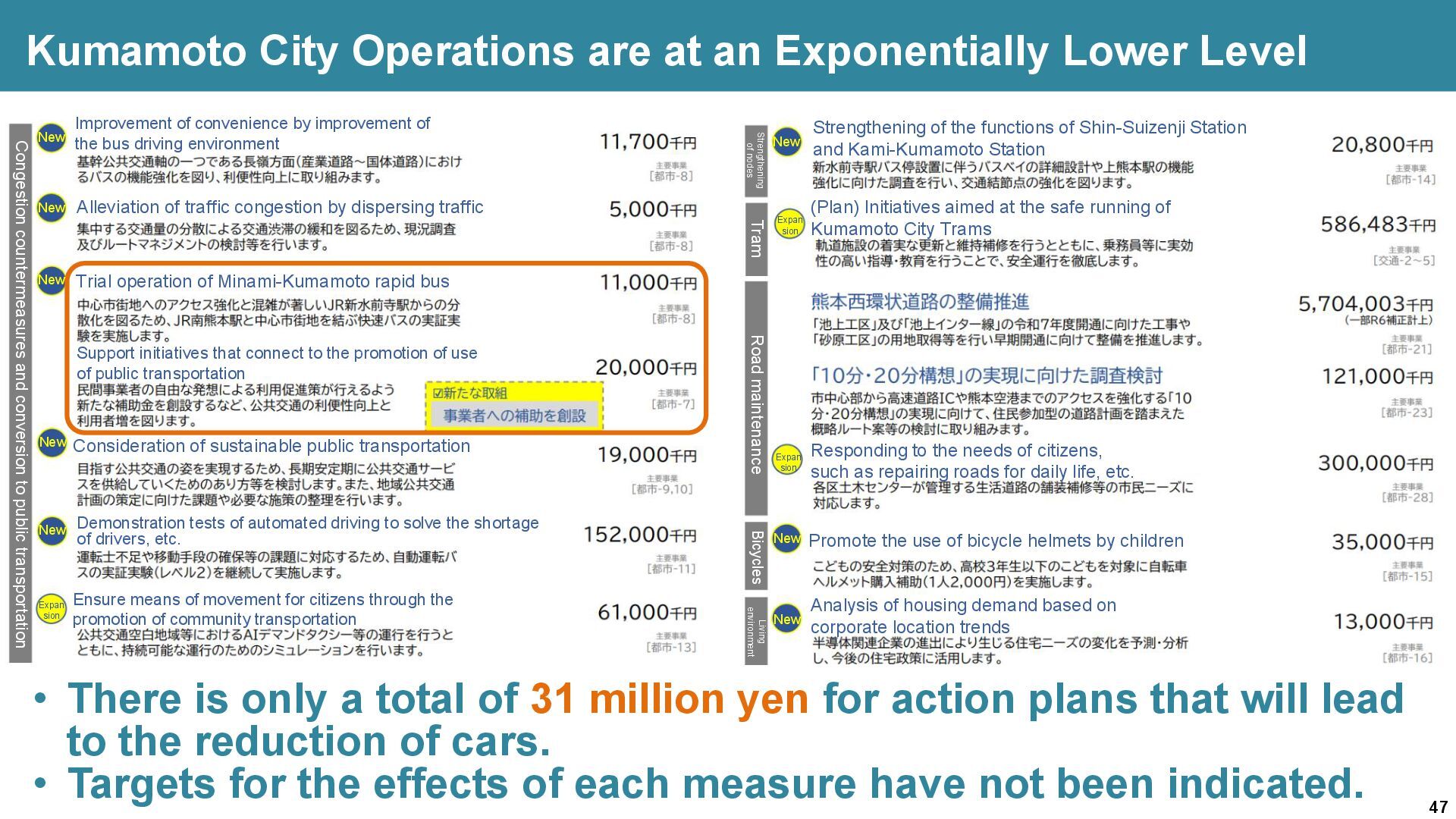
  41. 47 Kumamoto City Operations are at an Exponentially Lower Level

    • There is only a total of 31 million yen for action plans that will lead to the reduction of cars. • Targets for the effects of each measure have not been indicated. Improvement of convenience by improvement of the bus driving environment Alleviation of traffic congestion by dispersing traffic Trial operation of Minami-Kumamoto rapid bus Support initiatives that connect to the promotion of use of public transportation Consideration of sustainable public transportation Demonstration tests of automated driving to solve the shortage of drivers, etc. Ensure means of movement for citizens through the promotion of community transportation Strengthening of nodes Tram Road maintenance Bicycles Living environment Strengthening of the functions of Shin-Suizenji Station and Kami-Kumamoto Station (Plan) Initiatives aimed at the safe running of Kumamoto City Trams Responding to the needs of citizens, such as repairing roads for daily life, etc. Promote the use of bicycle helmets by children Analysis of housing demand based on corporate location trends Congestion countermeasures and conversion to public transportation New New New New New New New Expan sion Expan sion Expan sion New
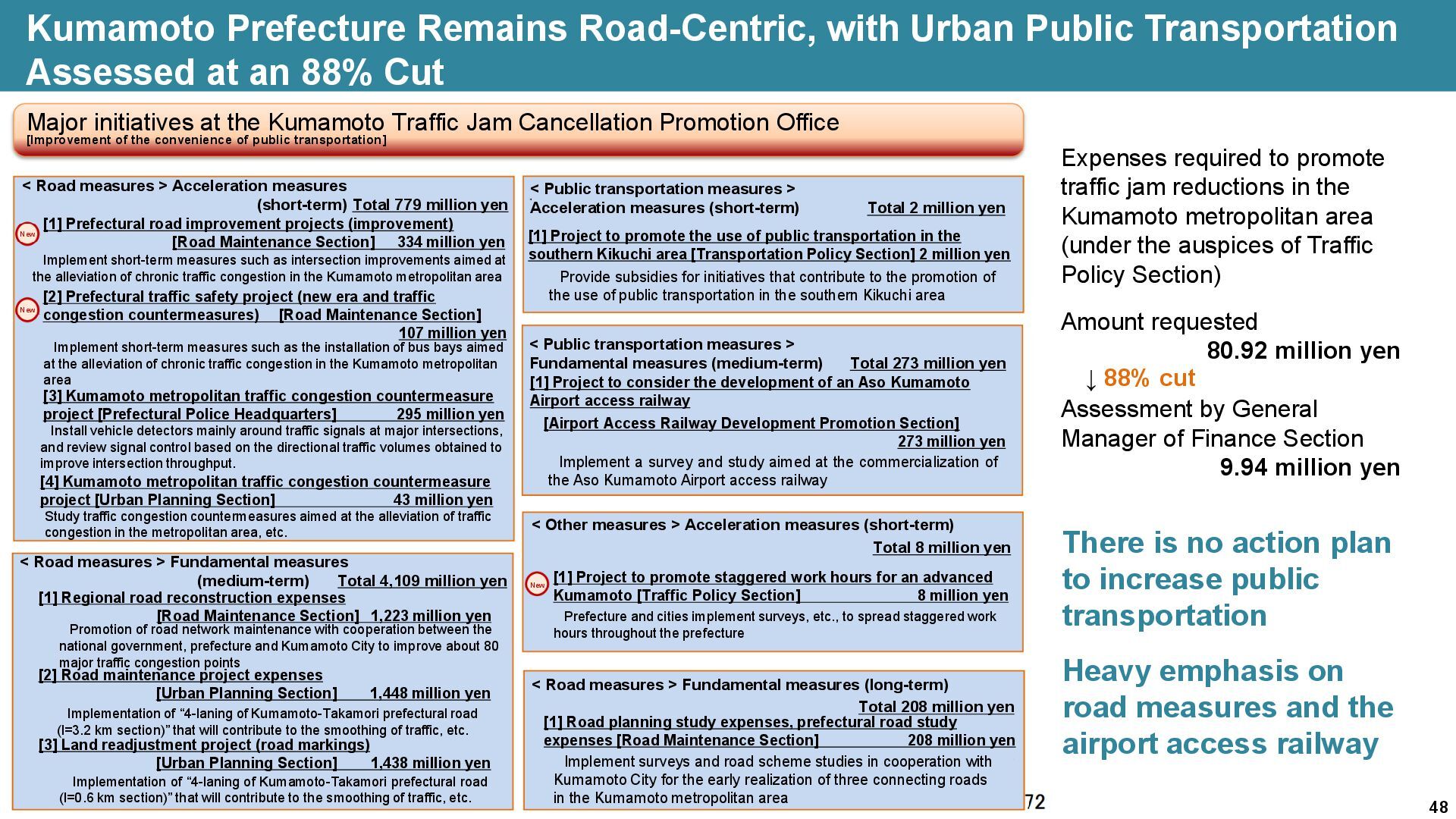
  42. 48 Kumamoto Prefecture Remains Road-Centric, with Urban Public Transportation Assessed

    at an 88% Cut Expenses required to promote traffic jam reductions in the Kumamoto metropolitan area (under the auspices of Traffic Policy Section) Amount requested 80.92 million yen ↓ 88% cut Assessment by General Manager of Finance Section 9.94 million yen There is no action plan to increase public transportation Heavy emphasis on road measures and the airport access railway Major initiatives at the Kumamoto Traffic Jam Cancellation Promotion Office [Improvement of the convenience of public transportation] < Road measures > Acceleration measures (short-term) Total 779 million yen [1] Prefectural road improvement projects (improvement) [Road Maintenance Section] 334 million yen Implement short-term measures such as intersection improvements aimed at the alleviation of chronic traffic congestion in the Kumamoto metropolitan area [2] Prefectural traffic safety project (new era and traffic congestion countermeasures) [Road Maintenance Section] 107 million yen Implement short-term measures such as the installation of bus bays aimed at the alleviation of chronic traffic congestion in the Kumamoto metropolitan area [3] Kumamoto metropolitan traffic congestion countermeasure project [Prefectural Police Headquarters] 295 million yen Install vehicle detectors mainly around traffic signals at major intersections, and review signal control based on the directional traffic volumes obtained to improve intersection throughput. [4] Kumamoto metropolitan traffic congestion countermeasure project [Urban Planning Section] 43 million yen Study traffic congestion countermeasures aimed at the alleviation of traffic congestion in the metropolitan area, etc. < Road measures > Fundamental measures (medium-term) Total 4,109 million yen [1] Regional road reconstruction expenses [Road Maintenance Section] 1,223 million yen Promotion of road network maintenance with cooperation between the national government, prefecture and Kumamoto City to improve about 80 major traffic congestion points [2] Road maintenance project expenses [Urban Planning Section] 1,448 million yen Implementation of “4-laning of Kumamoto-Takamori prefectural road (l=3.2 km section)” that will contribute to the smoothing of traffic, etc. [3] Land readjustment project (road markings) [Urban Planning Section] 1,438 million yen Implementation of “4-laning of Kumamoto-Takamori prefectural road (l=0.6 km section)” that will contribute to the smoothing of traffic, etc. < Public transportation measures > Acceleration measures (short-term) [1] Project to promote the use of public transportation in the southern Kikuchi area [Transportation Policy Section] 2 million yen Provide subsidies for initiatives that contribute to the promotion of the use of public transportation in the southern Kikuchi area < Public transportation measures > Fundamental measures (medium-term) [1] Project to consider the development of an Aso Kumamoto Airport access railway [Airport Access Railway Development Promotion Section] 273 million yen Implement a survey and study aimed at the commercialization of the Aso Kumamoto Airport access railway < Other measures > Acceleration measures (short-term) Total 8 million yen Total 208 million yen < Road measures > Fundamental measures (long-term) [1] Road planning study expenses, prefectural road study expenses [Road Maintenance Section] 208 million yen Implement surveys and road scheme studies in cooperation with Kumamoto City for the early realization of three connecting roads in the Kumamoto metropolitan area [1] Project to promote staggered work hours for an advanced Kumamoto [Traffic Policy Section] 8 million yen Prefecture and cities implement surveys, etc., to spread staggered work hours throughout the prefecture New Total 2 million yen Total 273 million yen New New
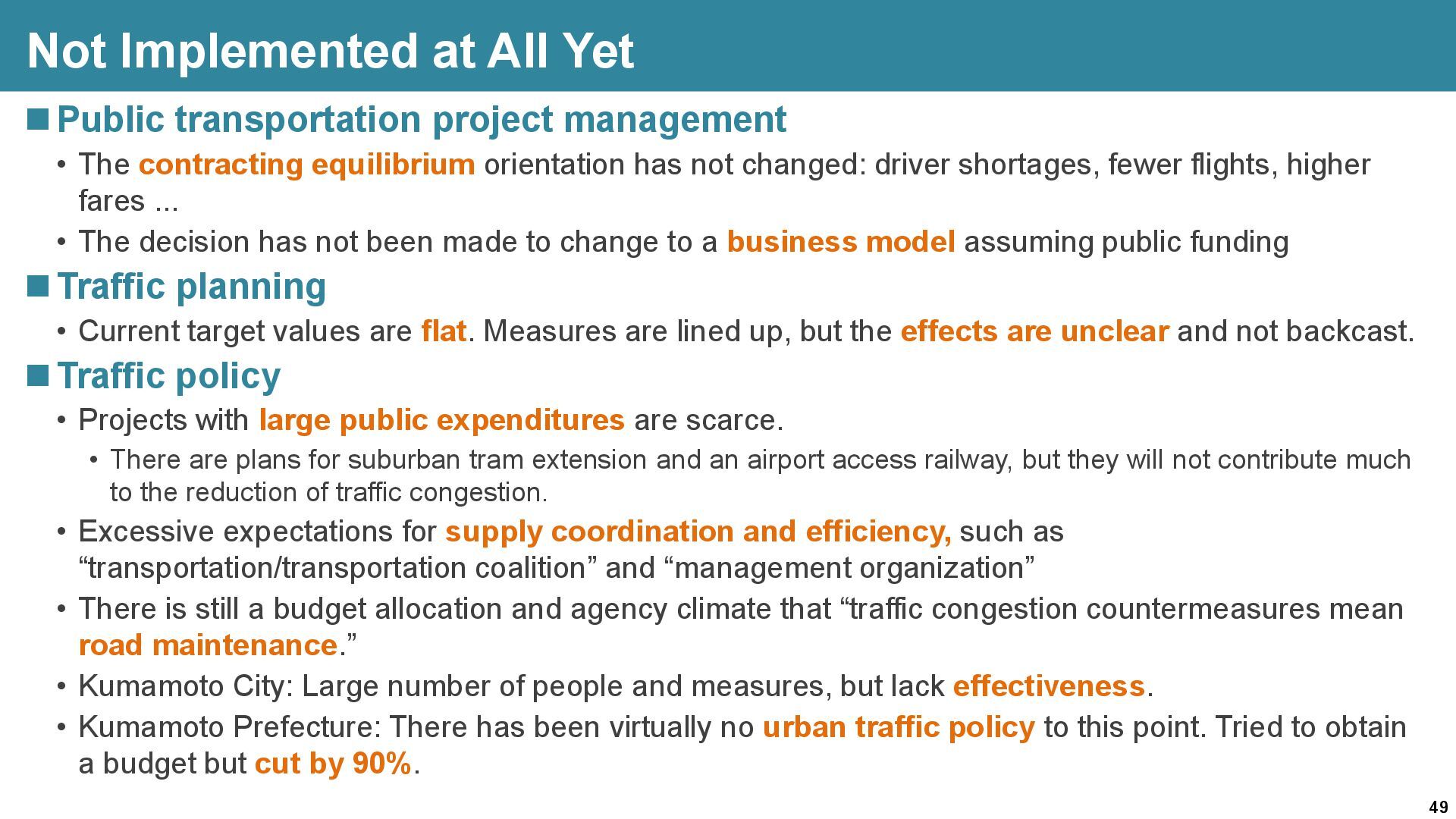
  43. 49 Not Implemented at All Yet ◼Public transportation project management

    • The contracting equilibrium orientation has not changed: driver shortages, fewer flights, higher fares ... • The decision has not been made to change to a business model assuming public funding ◼Traffic planning • Current target values are flat. Measures are lined up, but the effects are unclear and not backcast. ◼Traffic policy • Projects with large public expenditures are scarce. • There are plans for suburban tram extension and an airport access railway, but they will not contribute much to the reduction of traffic congestion. • Excessive expectations for supply coordination and efficiency, such as “transportation/transportation coalition” and “management organization” • There is still a budget allocation and agency climate that “traffic congestion countermeasures mean road maintenance.” • Kumamoto City: Large number of people and measures, but lack effectiveness. • Kumamoto Prefecture: There has been virtually no urban traffic policy to this point. Tried to obtain a budget but cut by 90%.
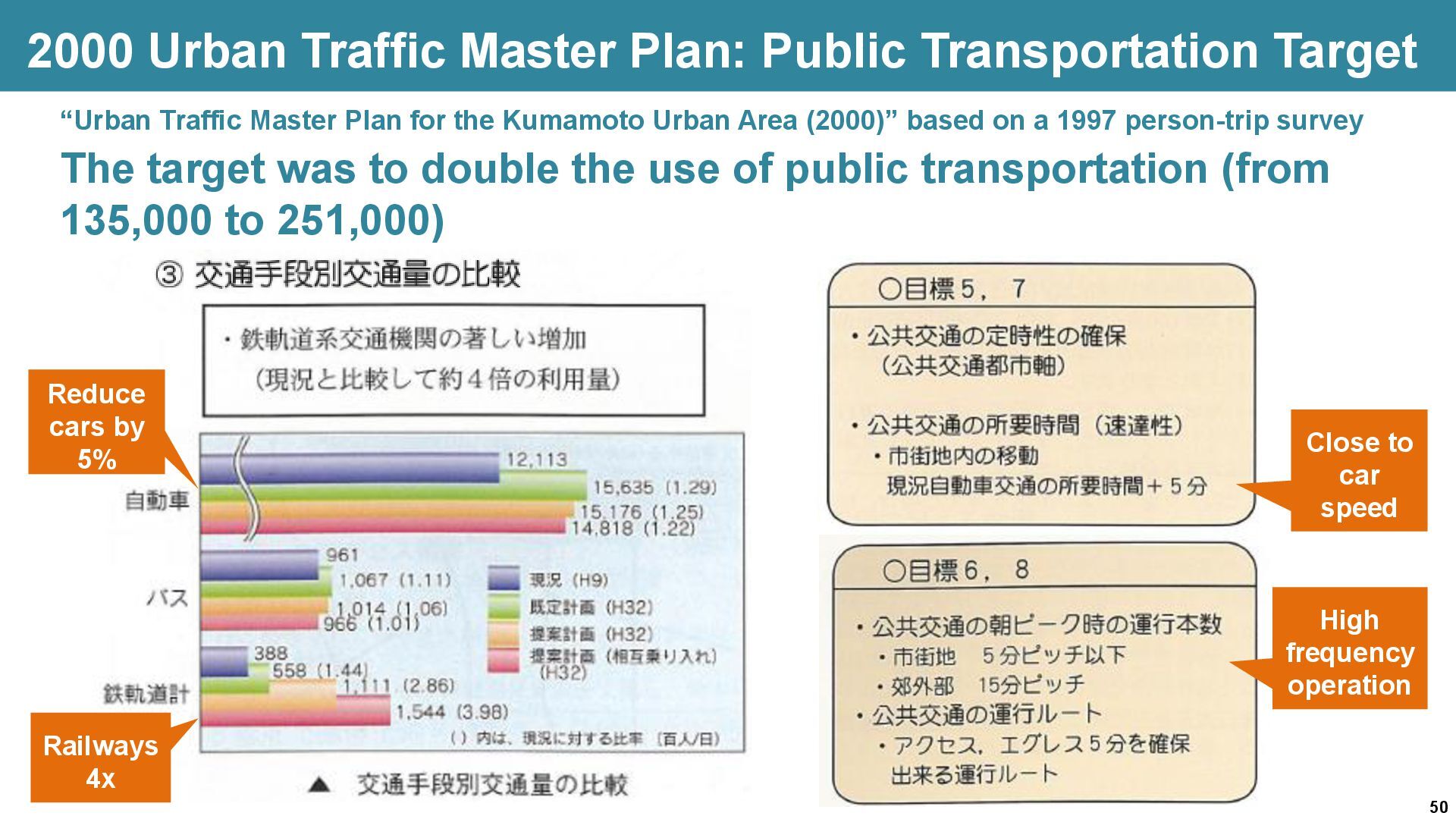
  44. 50 2000 Urban Traffic Master Plan: Public Transportation Target “Urban

    Traffic Master Plan for the Kumamoto Urban Area (2000)” based on a 1997 person-trip survey The target was to double the use of public transportation (from 135,000 to 251,000) Railways 4x Close to car speed High frequency operation Reduce cars by 5%
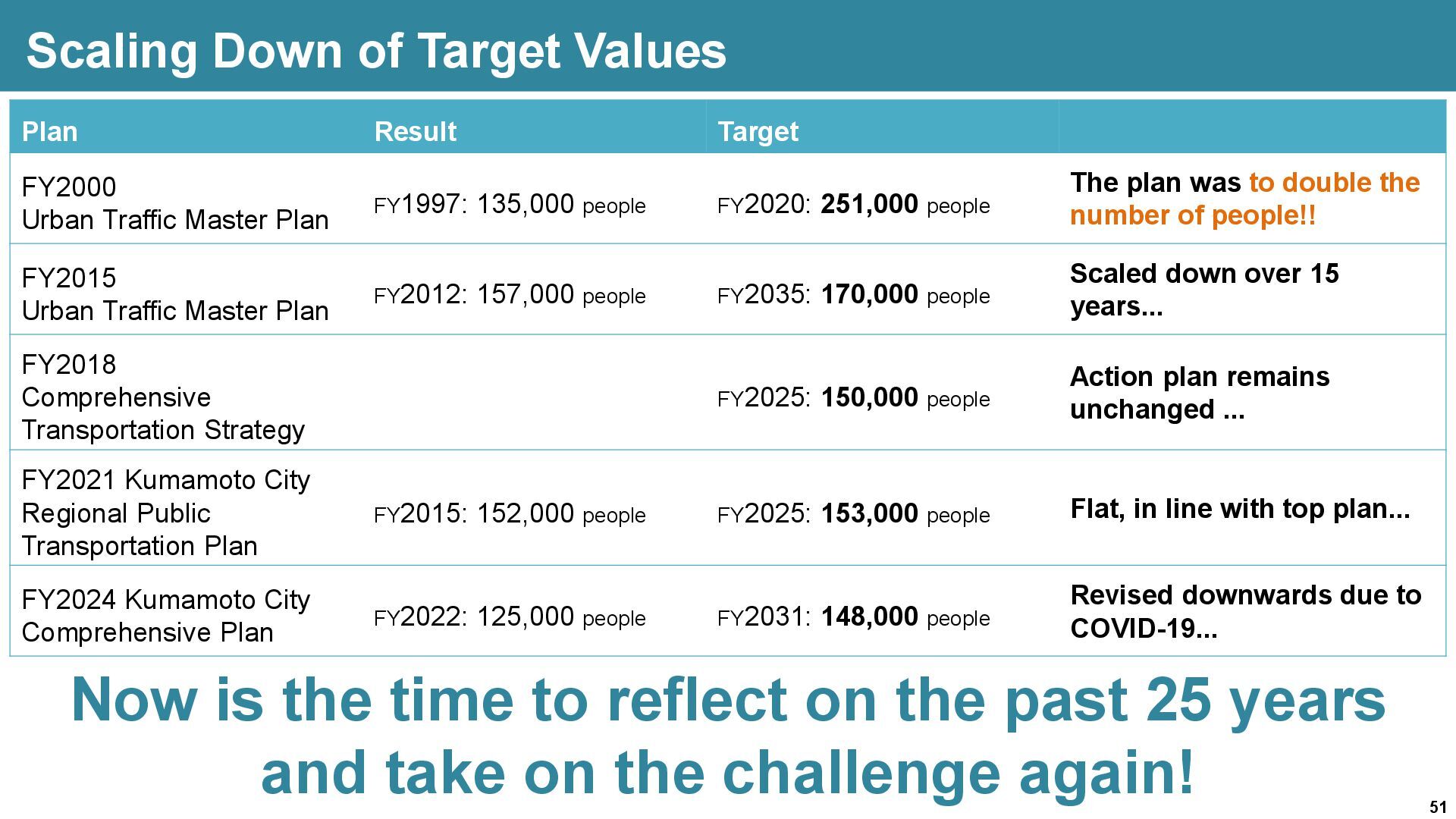
  45. 51 Scaling Down of Target Values Plan Result Target FY2000

    Urban Traffic Master Plan FY1997: 135,000 people FY2020: 251,000 people The plan was to double the number of people!! FY2015 Urban Traffic Master Plan FY2012: 157,000 people FY2035: 170,000 people Scaled down over 15 years... FY2018 Comprehensive Transportation Strategy FY2025: 150,000 people Action plan remains unchanged ... FY2021 Kumamoto City Regional Public Transportation Plan FY2015: 152,000 people FY2025: 153,000 people Flat, in line with top plan... FY2024 Kumamoto City Comprehensive Plan FY2022: 125,000 people FY2031: 148,000 people Revised downwards due to COVID-19... Now is the time to reflect on the past 25 years and take on the challenge again!
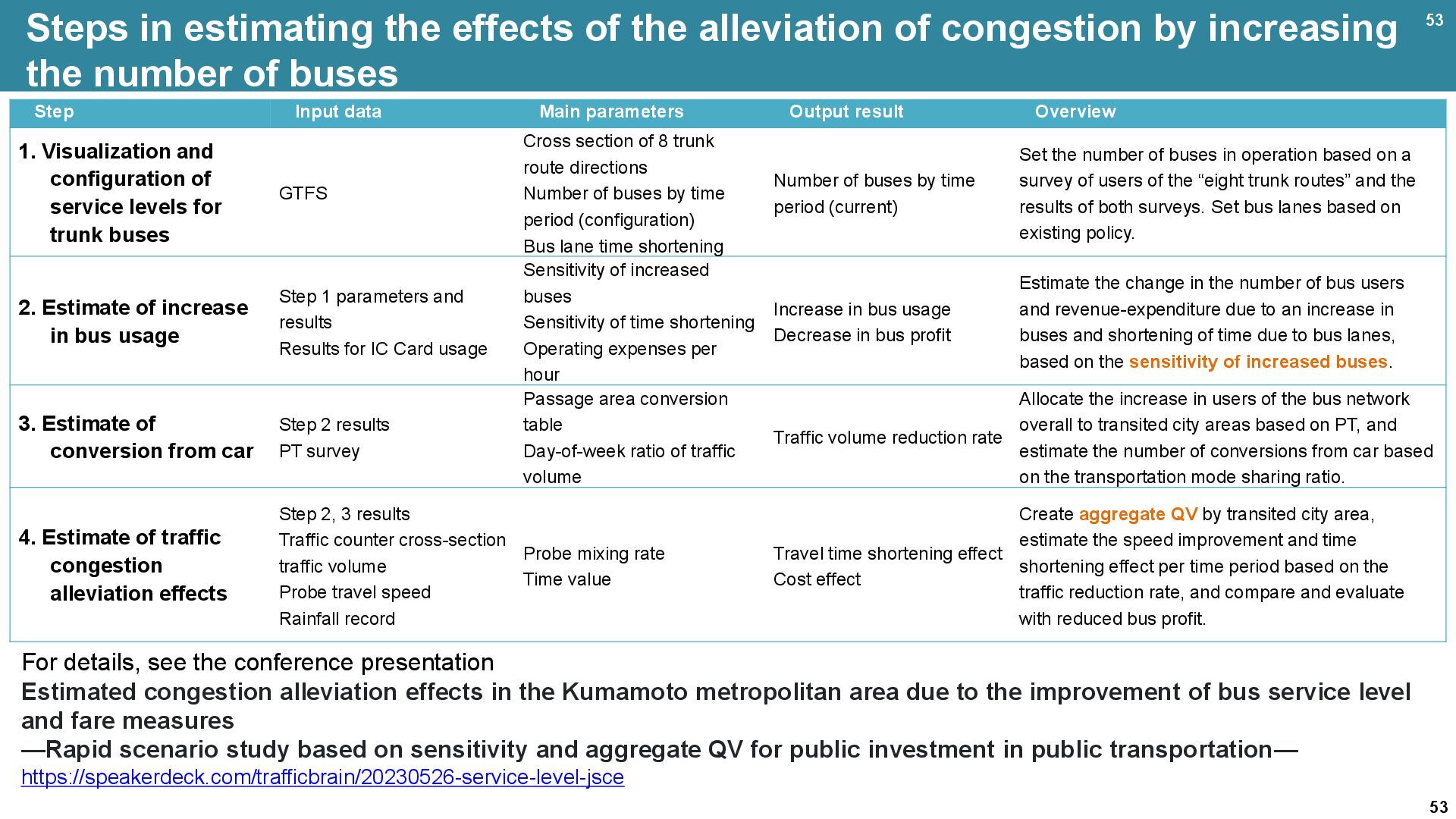
  46. 53 Steps in estimating the effects of the alleviation of

    congestion by increasing the number of buses 53 Step Input data Main parameters Output result Overview 1. Visualization and configuration of service levels for trunk buses GTFS Cross section of 8 trunk route directions Number of buses by time period (configuration) Bus lane time shortening Number of buses by time period (current) Set the number of buses in operation based on a survey of users of the “eight trunk routes” and the results of both surveys. Set bus lanes based on existing policy. 2. Estimate of increase in bus usage Step 1 parameters and results Results for IC Card usage Sensitivity of increased buses Sensitivity of time shortening Operating expenses per hour Increase in bus usage Decrease in bus profit Estimate the change in the number of bus users and revenue-expenditure due to an increase in buses and shortening of time due to bus lanes, based on the sensitivity of increased buses. 3. Estimate of conversion from car Step 2 results PT survey Passage area conversion table Day-of-week ratio of traffic volume Traffic volume reduction rate Allocate the increase in users of the bus network overall to transited city areas based on PT, and estimate the number of conversions from car based on the transportation mode sharing ratio. 4. Estimate of traffic congestion alleviation effects Step 2, 3 results Traffic counter cross-section traffic volume Probe travel speed Rainfall record Probe mixing rate Time value Travel time shortening effect Cost effect Create aggregate QV by transited city area, estimate the speed improvement and time shortening effect per time period based on the traffic reduction rate, and compare and evaluate with reduced bus profit. For details, see the conference presentation Estimated congestion alleviation effects in the Kumamoto metropolitan area due to the improvement of bus service level and fare measures —Rapid scenario study based on sensitivity and aggregate QV for public investment in public transportation— https://speakerdeck.com/trafficbrain/20230526-service-level-jsce
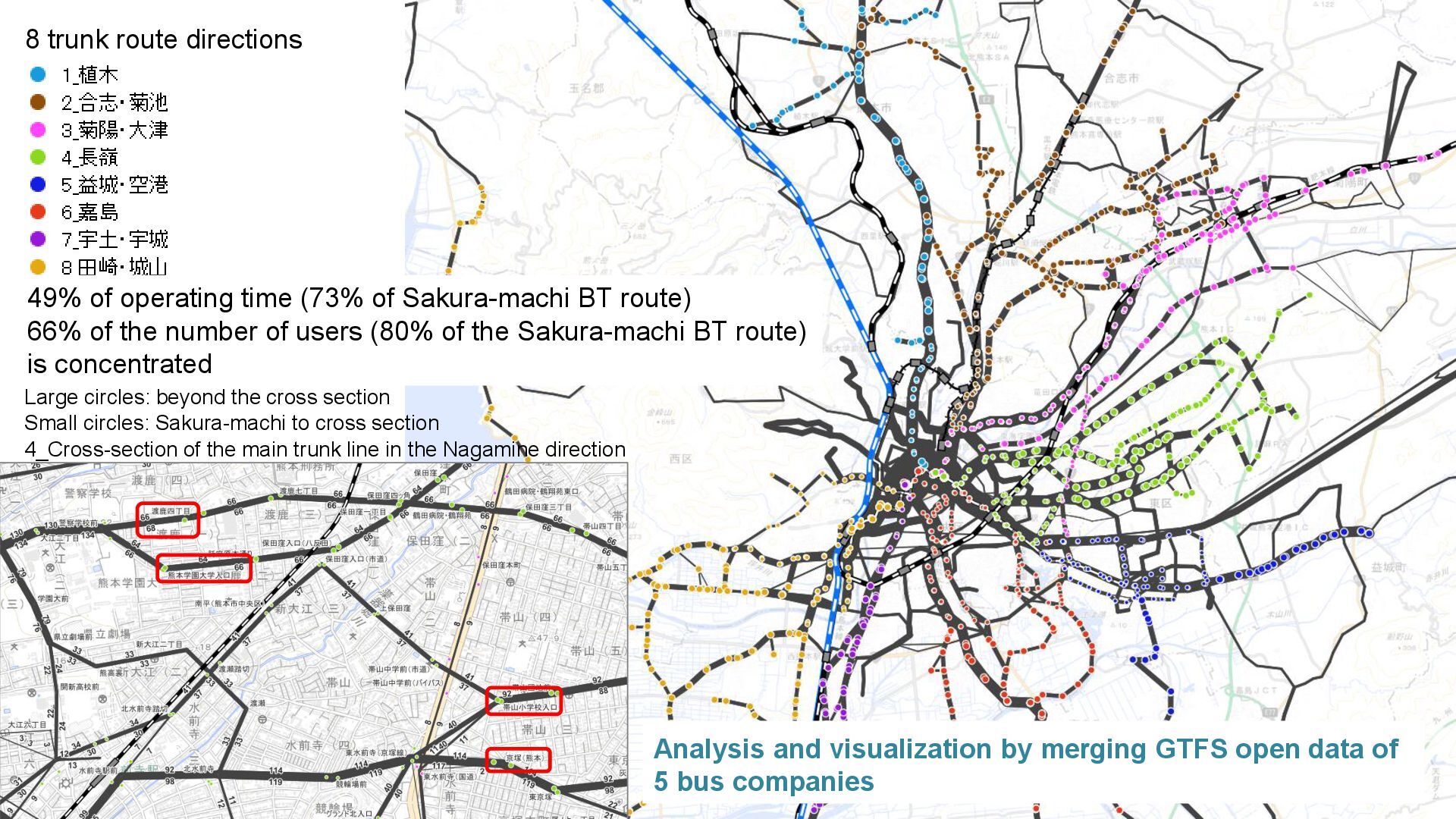
  47. 54 54 8 trunk route directions Large circles: beyond the

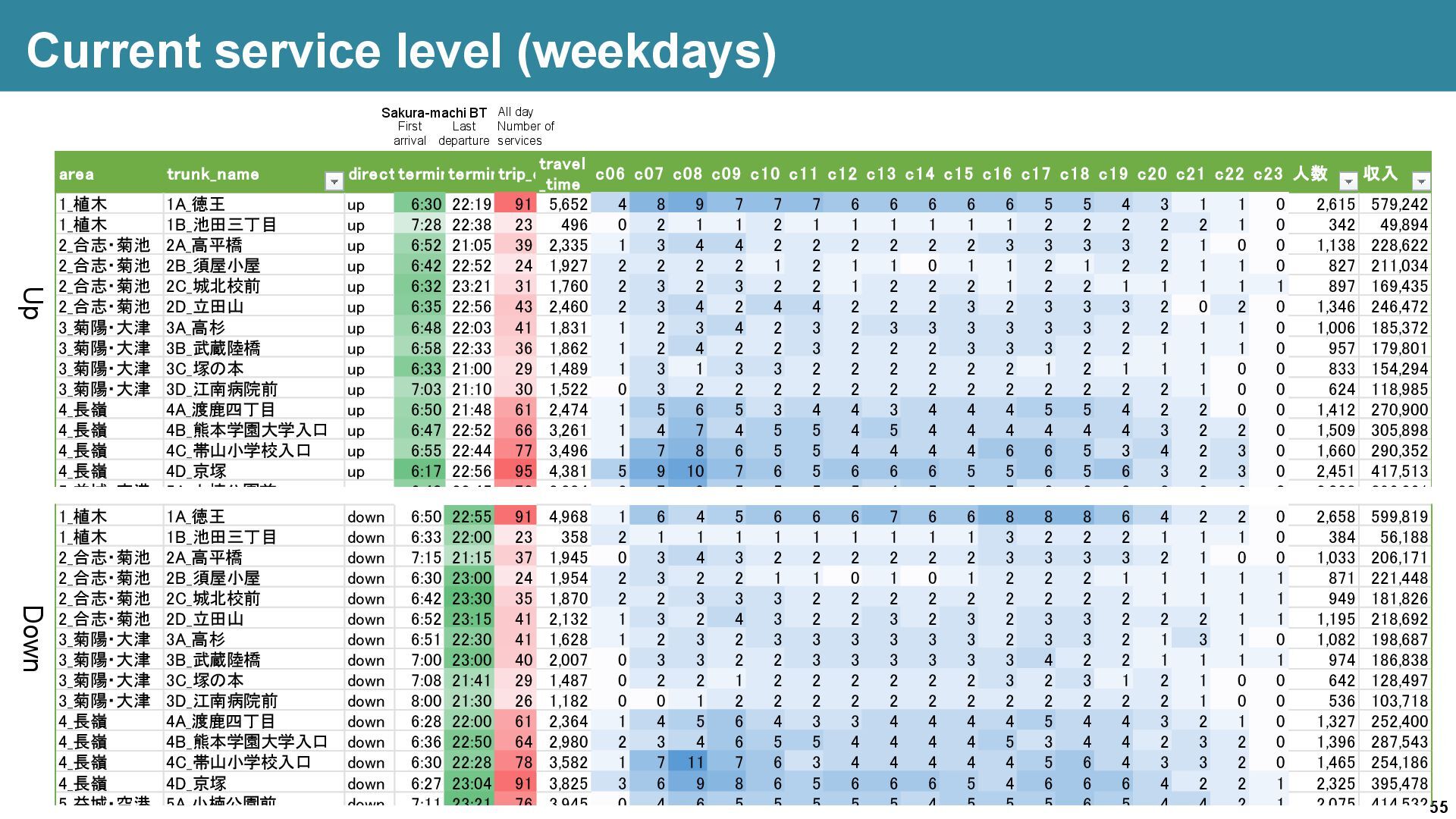
    cross section Small circles: Sakura-machi to cross section 4_Cross-section of the main trunk line in the Nagamine direction 49% of operating time (73% of Sakura-machi BT route) 66% of the number of users (80% of the Sakura-machi BT route) is concentrated Analysis and visualization by merging GTFS open data of 5 bus companies
  48. 55 Current service level (weekdays) area trunk_name direction terminal_time_min terminal_time_max

    trip_count travel _time c06 c07 c08 c09 c10 c11 c12 c13 c14 c15 c16 c17 c18 c19 c20 c21 c22 c23 人数 収入 1_植木 1A_徳王 up 6:30 22:19 91 5,652 4 8 9 7 7 7 6 6 6 6 6 5 5 4 3 1 1 0 2,615 579,242 1_植木 1B_池田三丁目 up 7:28 22:38 23 496 0 2 1 1 2 1 1 1 1 1 1 2 2 2 2 2 1 0 342 49,894 2_合志・菊池 2A_高平橋 up 6:52 21:05 39 2,335 1 3 4 4 2 2 2 2 2 2 3 3 3 3 2 1 0 0 1,138 228,622 2_合志・菊池 2B_須屋小屋 up 6:42 22:52 24 1,927 2 2 2 2 1 2 1 1 0 1 1 2 1 2 2 1 1 0 827 211,034 2_合志・菊池 2C_城北校前 up 6:32 23:21 31 1,760 2 3 2 3 2 2 1 2 2 2 1 2 2 1 1 1 1 1 897 169,435 2_合志・菊池 2D_立田山 up 6:35 22:56 43 2,460 2 3 4 2 4 4 2 2 2 3 2 3 3 3 2 0 2 0 1,346 246,472 3_菊陽・大津 3A_高杉 up 6:48 22:03 41 1,831 1 2 3 4 2 3 2 3 3 3 3 3 3 2 2 1 1 0 1,006 185,372 3_菊陽・大津 3B_武蔵陸橋 up 6:58 22:33 36 1,862 1 2 4 2 2 3 2 2 2 3 3 3 2 2 1 1 1 0 957 179,801 3_菊陽・大津 3C_塚の本 up 6:33 21:00 29 1,489 1 3 1 3 3 2 2 2 2 2 2 1 2 1 1 1 0 0 833 154,294 3_菊陽・大津 3D_江南病院前 up 7:03 21:10 30 1,522 0 3 2 2 2 2 2 2 2 2 2 2 2 2 2 1 0 0 624 118,985 4_長嶺 4A_渡鹿四丁目 up 6:50 21:48 61 2,474 1 5 6 5 3 4 4 3 4 4 4 5 5 4 2 2 0 0 1,412 270,900 4_長嶺 4B_熊本学園大学入口 up 6:47 22:52 66 3,261 1 4 7 4 5 5 4 5 4 4 4 4 4 4 3 2 2 0 1,509 305,898 4_長嶺 4C_帯山小学校入口 up 6:55 22:44 77 3,496 1 7 8 6 5 5 4 4 4 4 6 6 5 3 4 2 3 0 1,660 290,352 4_長嶺 4D_京塚 up 6:17 22:56 95 4,381 5 9 10 7 6 5 6 6 6 5 5 6 5 6 3 2 3 0 2,451 417,513 5_益城・空港 5A_小楠公園前 up 6:40 22:45 73 3,884 2 7 9 5 5 5 5 4 5 5 5 3 3 3 3 2 2 0 2,033 396,261 5_益城・空港 5B_東野中学校前 up 7:17 20:18 21 1,681 0 2 4 1 1 1 1 2 1 1 1 1 2 2 1 0 0 0 512 115,456 6_嘉島 6A_下江津 up 6:54 21:17 17 873 1 5 4 0 1 0 1 0 0 1 0 1 1 0 1 1 0 0 360 73,507 6_嘉島 6B_江津三丁目 up 6:43 19:10 12 521 1 1 0 1 2 0 1 0 1 1 1 1 1 1 0 0 0 0 219 39,683 6_嘉島 6C_田井島(浜線バイパス) up 7:54 20:16 20 913 0 1 1 2 1 2 2 1 2 2 1 2 1 1 1 0 0 0 298 48,341 6_嘉島 6D_田迎(旧浜線) up 6:09 23:41 94 5,093 7 7 8 6 7 4 7 6 7 6 8 5 5 3 3 1 3 1 1,834 409,502 6_嘉島 6E_県立高等技術専門校前 up 6:48 21:08 27 1,083 1 3 2 2 2 2 1 2 1 1 2 2 2 2 1 1 0 0 371 63,821 7_宇土・宇城 7A_熊日前(国道) up 6:20 20:45 28 946 2 2 3 1 2 2 2 1 2 3 2 1 2 2 1 0 0 0 362 71,523 7_宇土・宇城 7B_熊日前(旧道) up 6:38 22:15 46 1,804 2 4 4 3 3 3 3 3 3 3 3 4 3 1 2 1 1 0 1,002 206,554 8_田崎・城山 8A_新土河原一丁目 up 6:30 22:30 32 966 1 1 0 1 3 3 2 3 2 4 1 3 2 2 1 2 1 0 165 33,049 8_田崎・城山 8B_島団地入口 up 6:37 19:26 16 505 1 2 2 1 1 1 1 1 1 1 1 1 1 1 0 0 0 0 209 45,301 8_田崎・城山 8C_野口町 up 6:36 21:37 44 1,775 2 4 4 3 3 3 3 3 3 3 4 2 3 3 0 1 0 0 704 158,219 8_田崎・城山 8D_野中公民館前 up 6:33 23:21 35 822 4 3 1 2 2 2 3 1 2 3 4 2 2 2 0 0 1 1 267 48,397 8_田崎・城山 8E_稲荷入口 up 6:57 19:57 25 1,074 1 3 1 2 2 1 2 2 1 1 3 2 1 3 0 0 0 0 300 62,678 8_田崎・城山 8F_高橋中間 up 6:26 21:11 31 987 2 4 3 2 2 2 2 2 2 2 2 2 1 1 1 1 0 0 563 108,426 Sakura-machi BT All day Number of services Up Down 1_植木 1A_徳王 down 6:50 22:55 91 4,968 1 6 4 5 6 6 6 7 6 6 8 8 8 6 4 2 2 0 2,658 599,819 1_植木 1B_池田三丁目 down 6:33 22:00 23 358 2 1 1 1 1 1 1 1 1 1 3 2 2 2 1 1 1 0 384 56,188 2_合志・菊池 2A_高平橋 down 7:15 21:15 37 1,945 0 3 4 3 2 2 2 2 2 2 3 3 3 3 2 1 0 0 1,033 206,171 2_合志・菊池 2B_須屋小屋 down 6:30 23:00 24 1,954 2 3 2 2 1 1 0 1 0 1 2 2 2 1 1 1 1 1 871 221,448 2_合志・菊池 2C_城北校前 down 6:42 23:30 35 1,870 2 2 3 3 3 2 2 2 2 2 2 2 2 2 1 1 1 1 949 181,826 2_合志・菊池 2D_立田山 down 6:52 23:15 41 2,132 1 3 2 4 3 2 2 3 2 3 2 3 3 2 2 2 1 1 1,195 218,692 3_菊陽・大津 3A_高杉 down 6:51 22:30 41 1,628 1 2 3 2 3 3 3 3 3 3 2 3 3 2 1 3 1 0 1,082 198,687 3_菊陽・大津 3B_武蔵陸橋 down 7:00 23:00 40 2,007 0 3 3 2 2 3 3 3 3 3 3 4 2 2 1 1 1 1 974 186,838 3_菊陽・大津 3C_塚の本 down 7:08 21:41 29 1,487 0 2 2 1 2 2 2 2 2 2 3 2 3 1 2 1 0 0 642 128,497 3_菊陽・大津 3D_江南病院前 down 8:00 21:30 26 1,182 0 0 1 2 2 2 2 2 2 2 2 2 2 2 2 1 0 0 536 103,718 4_長嶺 4A_渡鹿四丁目 down 6:28 22:00 61 2,364 1 4 5 6 4 3 3 4 4 4 4 5 4 4 3 2 1 0 1,327 252,400 4_長嶺 4B_熊本学園大学入口 down 6:36 22:50 64 2,980 2 3 4 6 5 5 4 4 4 4 5 3 4 4 2 3 2 0 1,396 287,543 4_長嶺 4C_帯山小学校入口 down 6:30 22:28 78 3,582 1 7 11 7 6 3 4 4 4 4 4 5 6 4 3 3 2 0 1,465 254,186 4_長嶺 4D_京塚 down 6:27 23:04 91 3,825 3 6 9 8 6 5 6 6 6 5 4 6 6 6 4 2 2 1 2,325 395,478 5_益城・空港 5A_小楠公園前 down 7:11 23:21 76 3,945 0 4 6 5 5 5 5 5 4 5 5 5 6 5 4 4 2 1 2,075 414,532 First arrival Last departure
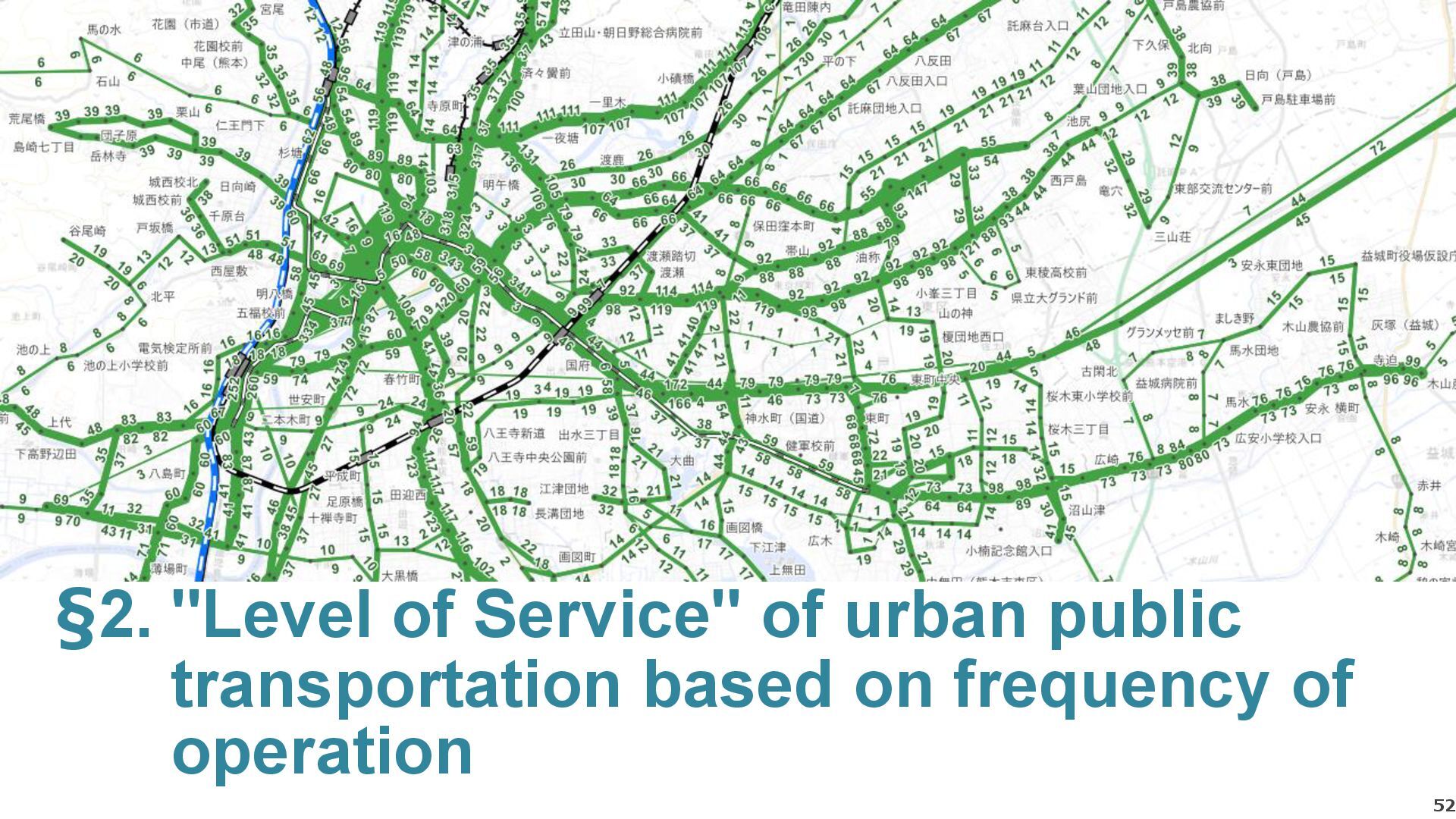
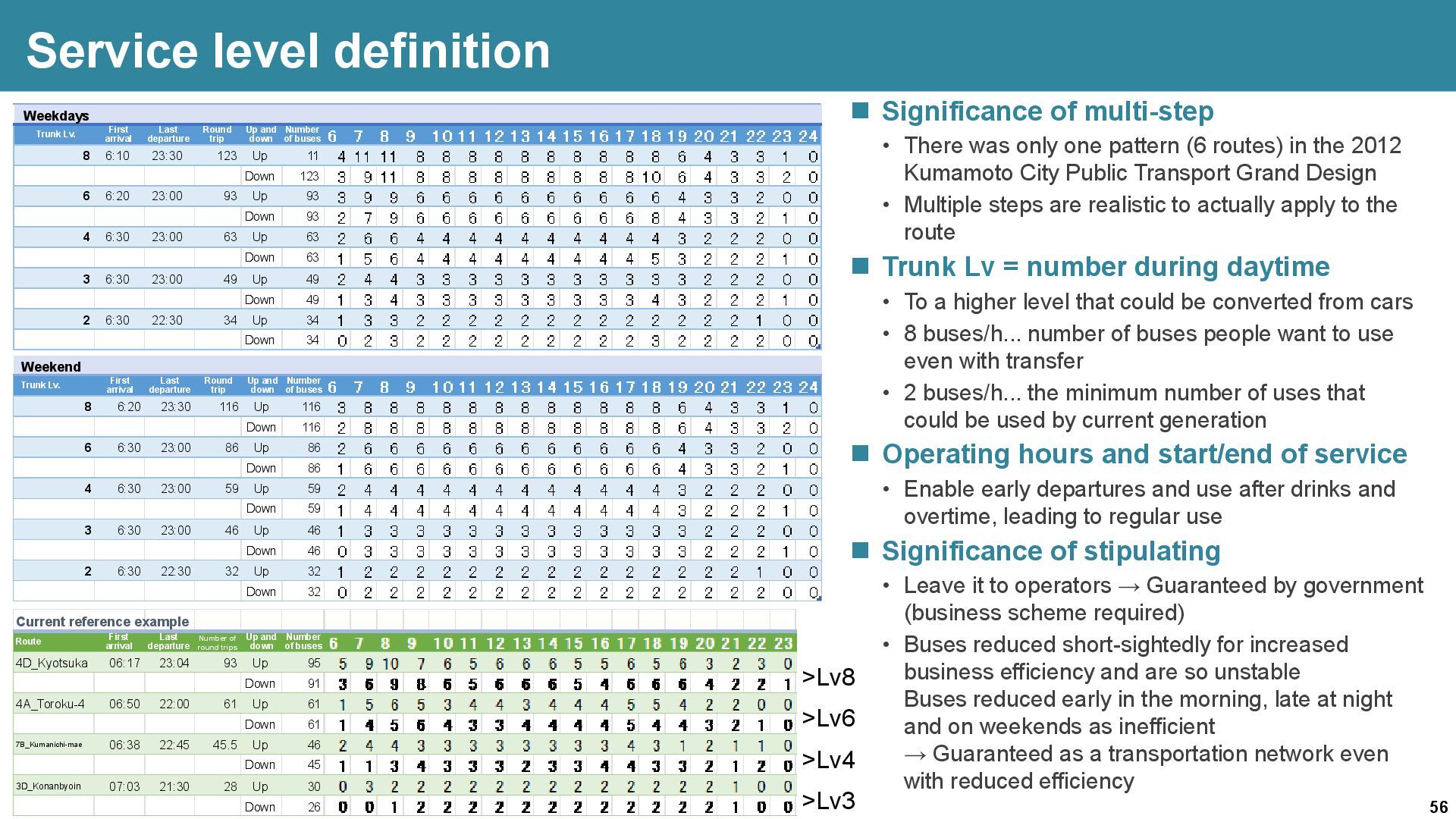
  49. 56 Service level definition ◼ Significance of multi-step • There

    was only one pattern (6 routes) in the 2012 Kumamoto City Public Transport Grand Design • Multiple steps are realistic to actually apply to the route ◼ Trunk Lv = number during daytime • To a higher level that could be converted from cars • 8 buses/h... number of buses people want to use even with transfer • 2 buses/h... the minimum number of uses that could be used by current generation ◼ Operating hours and start/end of service • Enable early departures and use after drinks and overtime, leading to regular use ◼ Significance of stipulating • Leave it to operators → Guaranteed by government (business scheme required) • Buses reduced short-sightedly for increased business efficiency and are so unstable Buses reduced early in the morning, late at night and on weekends as inefficient → Guaranteed as a transportation network even with reduced efficiency >Lv8 >Lv6 >Lv4 >Lv3 Weekdays Trunk Lv. First arrival Last departure Round trip Up and down Number of buses 8 6:10 23:30 123 Up 11 Down 123 6 6:20 23:00 93 Up 93 Down 93 4 6:30 23:00 63 Up 63 Down 63 3 6:30 23:00 49 Up 49 Down 49 2 6:30 22:30 34 Up 34 Down 34 Weekend Trunk Lv. First arrival Last departure Round trip Up and down Number of buses 8 6:20 23:30 116 Up 116 Down 116 6 6:30 23:00 86 Up 86 Down 86 4 6:30 23:00 59 Up 59 Down 59 3 6:30 23:00 46 Up 46 Down 46 2 6:30 22:30 32 Up 32 Down 32 Current reference example Route First arrival Last departure Number of round trips Up and down Number of buses 4D_Kyotsuka 06:17 23:04 93 Up 95 Down 91 4A_Toroku-4 06:50 22:00 61 Up 61 Down 61 7B_Kumanichi-mae 06:38 22:45 45.5 Up 46 Down 45 3D_Konanbyoin 07:03 21:30 28 Up 30 Down 26
  50. 57 Estimate table (1 weekday) Increased bus ratio Reflect x

    7,046 yen per hour x increased bus sensitivity (0.5) Shortened time Shortening of driving time Multiply by time sensitivity (4%/minute) 41%, 496 more buses 39%, 5.1 million yen increase in expenses 29%, 15,000 more users 2.11 million yen decrease in profit 2.99 million yen increase in revenue Bus Lanes Number of round trips Driving time [h/day] Estimated expenses [yen/day] Congestion Trunk Number of people transported Estimated revenue-expenditure [yen/day] Direction Route (cross-section) Shortening [min.] Application rate Trunk Lv. Current After increasing buses Current Increase Rate of increase Current Increase Number of passengers per bus Current Increase in number of buses Rate of increase in number of buses Lanes Increase Increase Total Rate of increase Current revenue Current revenue- expenditure ratio Increase in revenue After increase in revenue- expenditure ratio Change in revenue- expenditure 1_Ueki 1A_Tokuo 1B_Ikeda 3-chome 2_Koshi/Kikuchi 2A_Takahira-bashi 2B_Suyagoya 2C_Johokuko-mae 2D_Tatsuda-yama 3 _Kikuyo/Ozu 3A_Takasugi 3B_Musashi-rikkyo 3C_Tsukanomoto 3D_Konanbyoin-mae 4 _Nagamine 4A_Toroku 4-chome 4B_Kumamoto Gakuen Daigaku 4C_Obiyama shogakko iriguchi 4D_Kyotsuka 5 _Mashiki/ airport 5A_Shonan koen-mae 5B_Higashino chugakko- mae 6 _Kashima 6A_Shimoezu 6B_Ezu-sanchome 6C_Tainoshima (Hamasen bypass) 6D_Tamukae (former Hamasen) 6E_Kenritsu Koto-gijutsu 7 _Uto/Uki 7A_Kumanichi-mae (national road) 7A_Kumanichi-mae (old road) 8 _Tasaki/Jozan 8A_Shintogawara-iccho 8B_Shimadanchi-iriguchi 8C_Noguchi-cho 8D_Nonaka kominkan-mae 8E_Inari-iriguchi 8F_Takahashi chukan
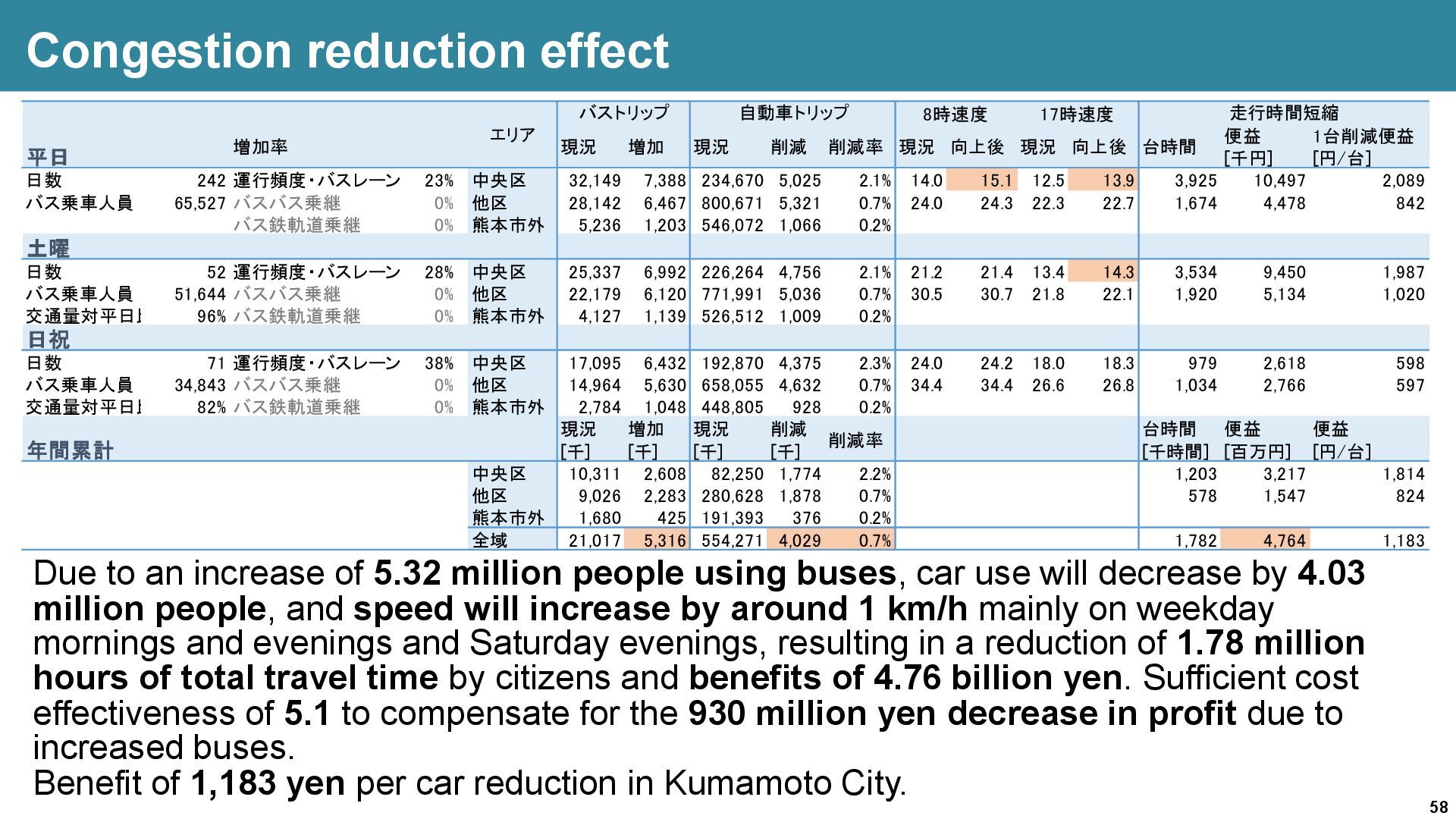
  51. 58 Congestion reduction effect Due to an increase of 5.32

    million people using buses, car use will decrease by 4.03 million people, and speed will increase by around 1 km/h mainly on weekday mornings and evenings and Saturday evenings, resulting in a reduction of 1.78 million hours of total travel time by citizens and benefits of 4.76 billion yen. Sufficient cost effectiveness of 5.1 to compensate for the 930 million yen decrease in profit due to increased buses. Benefit of 1,183 yen per car reduction in Kumamoto City. 平日 増加率 現況 増加 現況 削減 削減率 現況 向上後 現況 向上後 台時間 便益 [千円] 1台削減便益 [円/台] 日数 242 運行頻度・バスレーン 23% 中央区 32,149 7,388 234,670 5,025 2.1% 14.0 15.1 12.5 13.9 3,925 10,497 2,089 バス乗車人員 65,527 バスバス乗継 0% 他区 28,142 6,467 800,671 5,321 0.7% 24.0 24.3 22.3 22.7 1,674 4,478 842 バス鉄軌道乗継 0% 熊本市外 5,236 1,203 546,072 1,066 0.2% 土曜 日数 52 運行頻度・バスレーン 28% 中央区 25,337 6,992 226,264 4,756 2.1% 21.2 21.4 13.4 14.3 3,534 9,450 1,987 バス乗車人員 51,644 バスバス乗継 0% 他区 22,179 6,120 771,991 5,036 0.7% 30.5 30.7 21.8 22.1 1,920 5,134 1,020 交通量対平日比率 96% バス鉄軌道乗継 0% 熊本市外 4,127 1,139 526,512 1,009 0.2% 日祝 日数 71 運行頻度・バスレーン 38% 中央区 17,095 6,432 192,870 4,375 2.3% 24.0 24.2 18.0 18.3 979 2,618 598 バス乗車人員 34,843 バスバス乗継 0% 他区 14,964 5,630 658,055 4,632 0.7% 34.4 34.4 26.6 26.8 1,034 2,766 597 交通量対平日比率 82% バス鉄軌道乗継 0% 熊本市外 2,784 1,048 448,805 928 0.2% 年間累計 現況 [千] 増加 [千] 現況 [千] 削減 [千] 削減率 台時間 [千時間] 便益 [百万円] 便益 [円/台] 中央区 10,311 2,608 82,250 1,774 2.2% 1,203 3,217 1,814 他区 9,026 2,283 280,628 1,878 0.7% 578 1,547 824 熊本市外 1,680 425 191,393 376 0.2% 全域 21,017 5,316 554,271 4,029 0.7% 1,782 4,764 1,183 エリア バストリップ 自動車トリップ 8時速度 17時速度 走行時間短縮
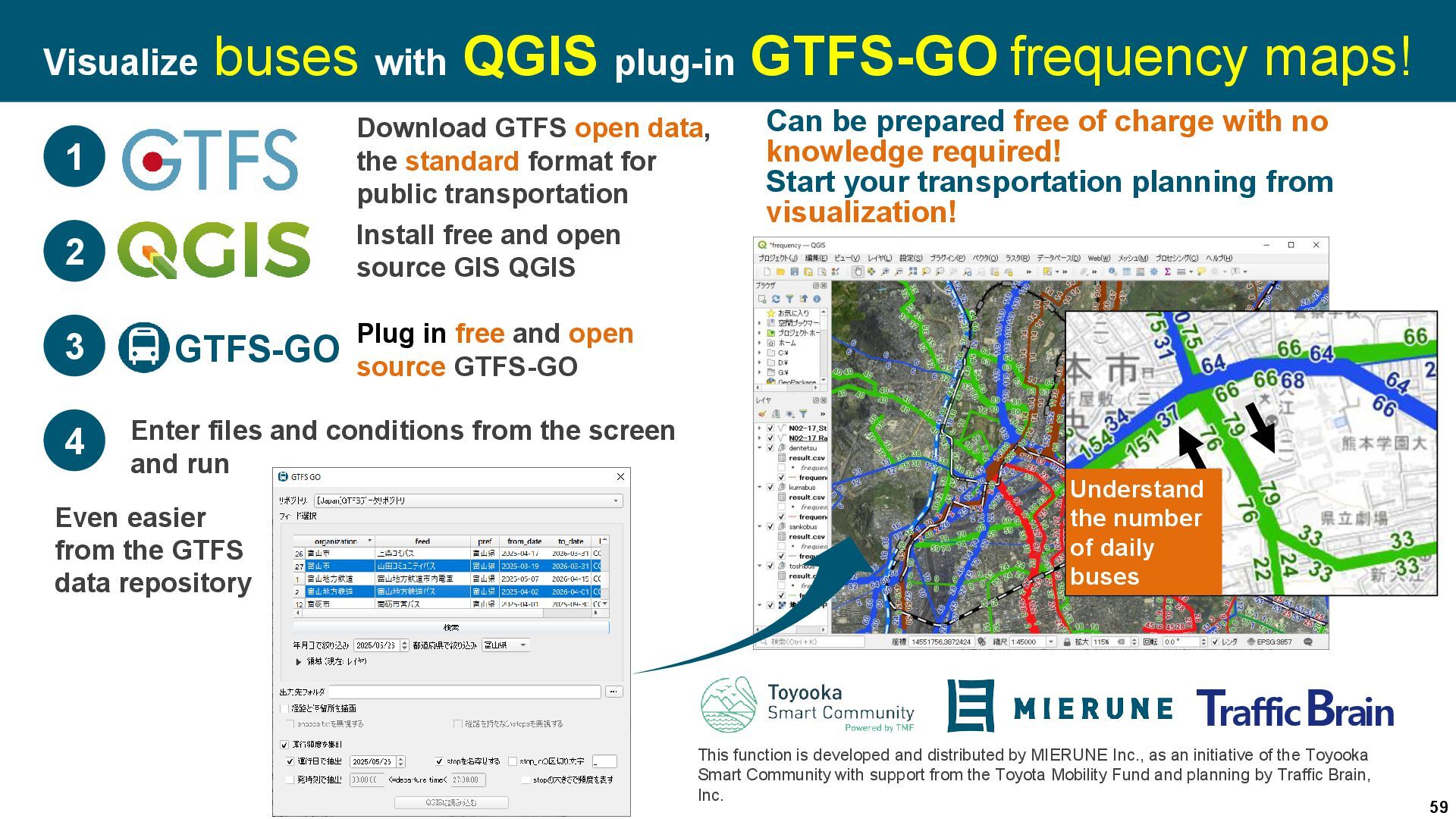
  52. 59 Can be prepared free of charge with no knowledge

    required! Start your transportation planning from visualization! Install free and open source GIS QGIS Download GTFS open data, the standard format for public transportation Plug in free and open source GTFS-GO GTFS-GO Enter files and conditions from the screen and run 1 2 3 4 Visualize buses with QGIS plug-in GTFS-GO frequency maps! This function is developed and distributed by MIERUNE Inc., as an initiative of the Toyooka Smart Community with support from the Toyota Mobility Fund and planning by Traffic Brain, Inc. TrafficBrain Understand the number of daily buses Even easier from the GTFS data repository
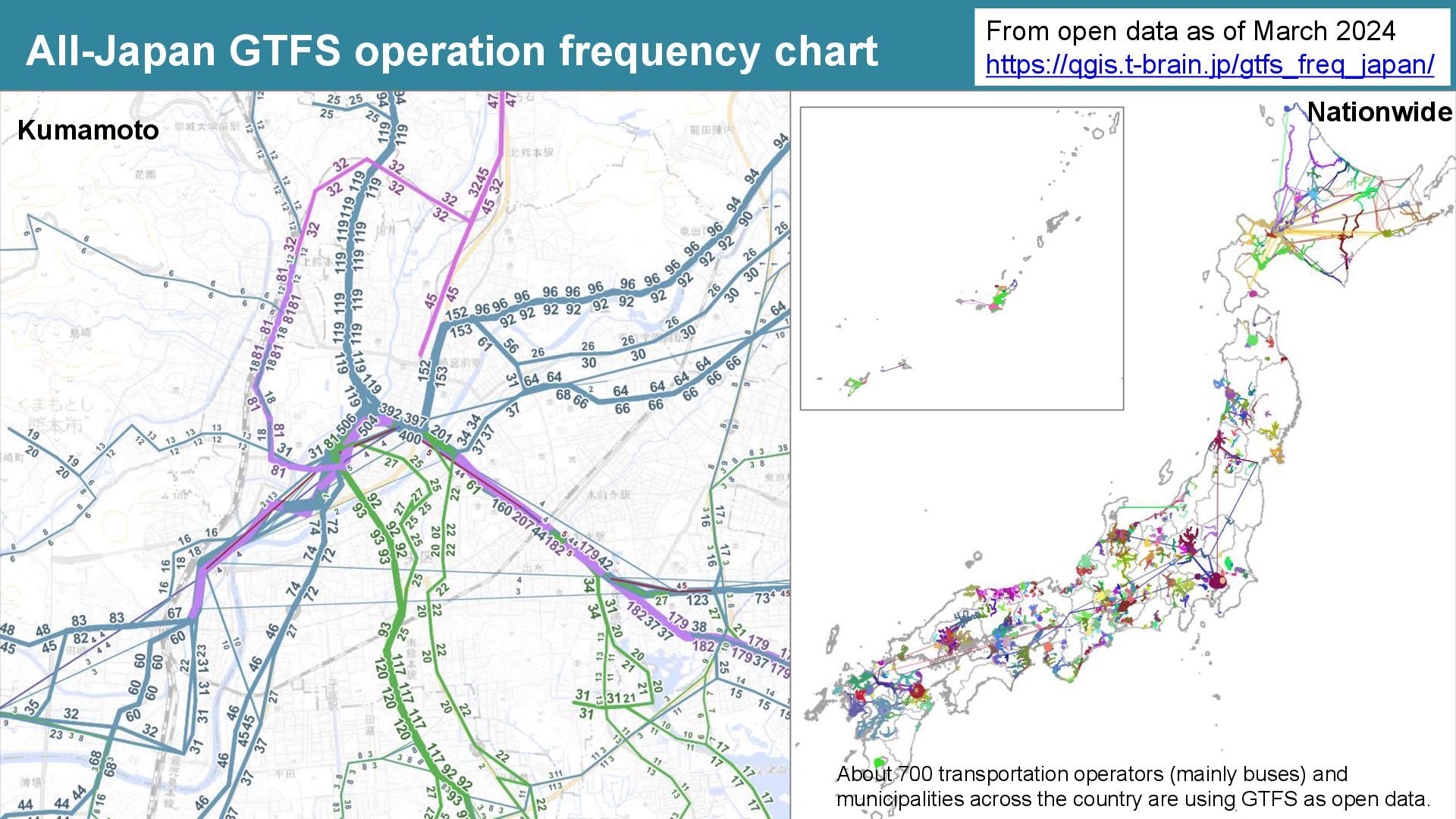
  53. 60 60 All-Japan GTFS operation frequency chart From open data

    as of March 2024 https://qgis.t-brain.jp/gtfs_freq_japan/ Kumamoto Nationwide About 700 transportation operators (mainly buses) and municipalities across the country are using GTFS as open data.
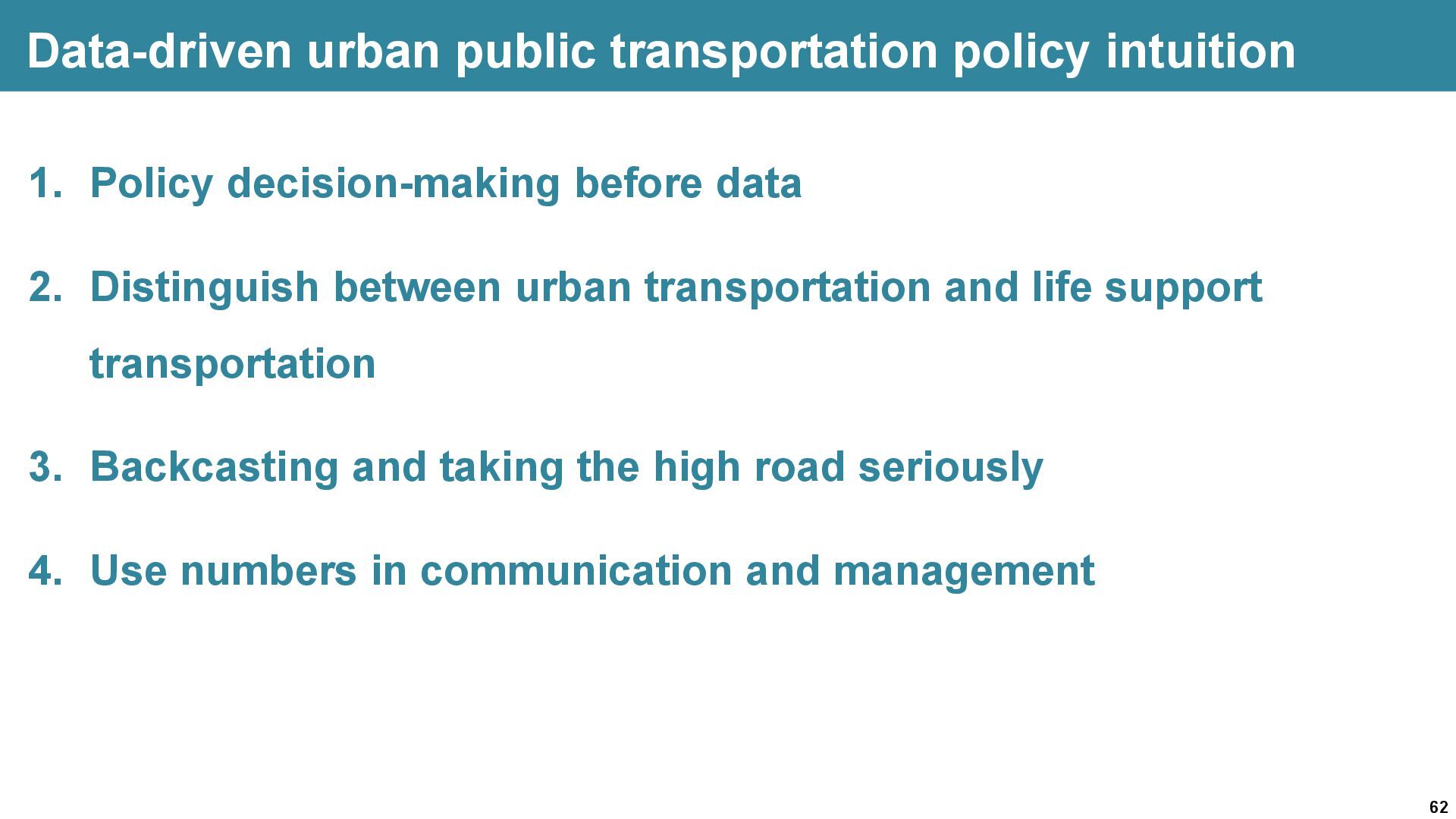
  54. 62 Data-driven urban public transportation policy intuition 1. Policy decision-making

    before data 2. Distinguish between urban transportation and life support transportation 3. Backcasting and taking the high road seriously 4. Use numbers in communication and management
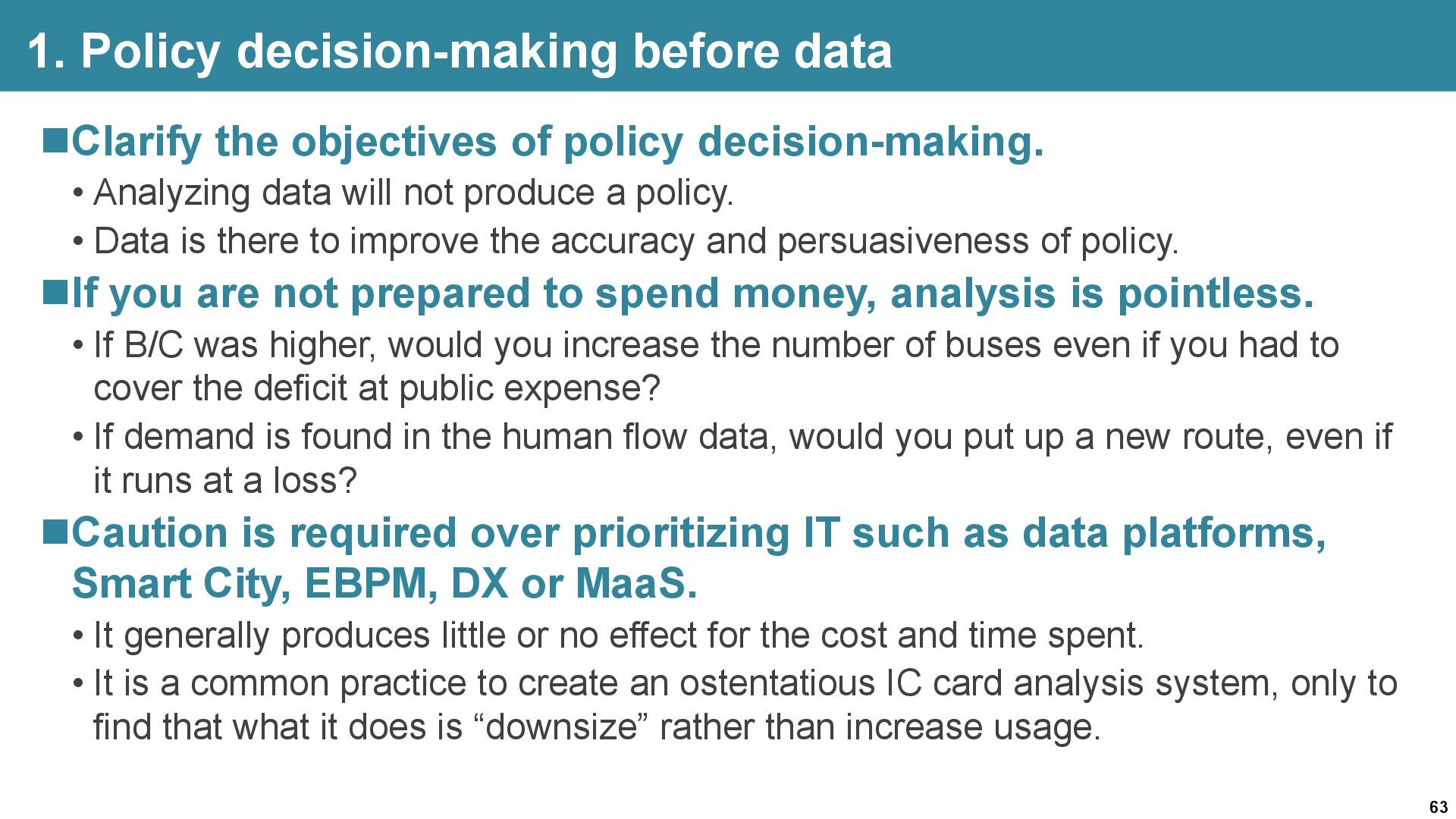
  55. 63 1. Policy decision-making before data ◼Clarify the objectives of

    policy decision-making. • Analyzing data will not produce a policy. • Data is there to improve the accuracy and persuasiveness of policy. ◼If you are not prepared to spend money, analysis is pointless. • If B/C was higher, would you increase the number of buses even if you had to cover the deficit at public expense? • If demand is found in the human flow data, would you put up a new route, even if it runs at a loss? ◼Caution is required over prioritizing IT such as data platforms, Smart City, EBPM, DX or MaaS. • It generally produces little or no effect for the cost and time spent. • It is a common practice to create an ostentatious IC card analysis system, only to find that what it does is “downsize” rather than increase usage.
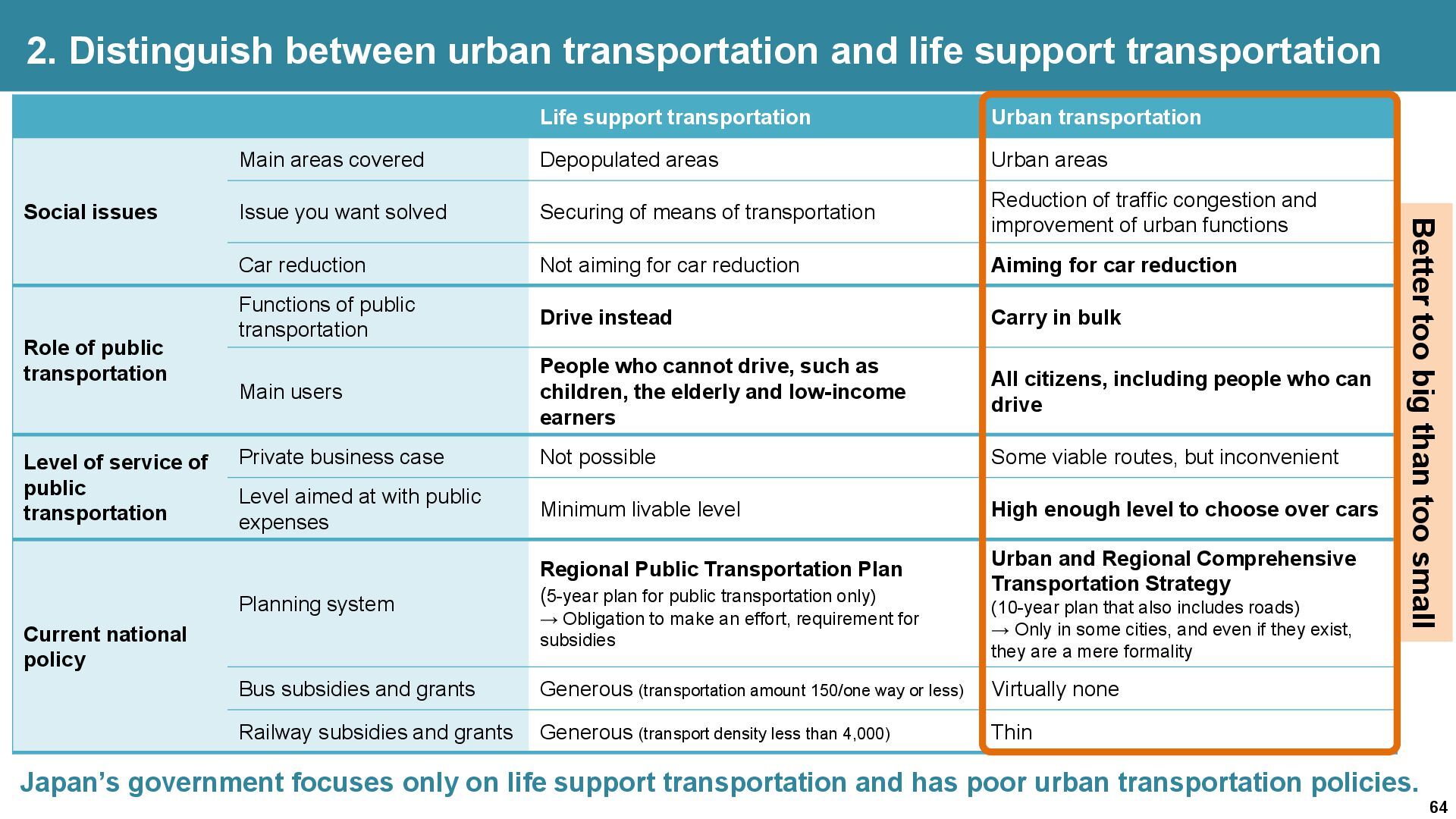
  56. 64 2. Distinguish between urban transportation and life support transportation

    Life support transportation Urban transportation Social issues Main areas covered Depopulated areas Urban areas Issue you want solved Securing of means of transportation Reduction of traffic congestion and improvement of urban functions Car reduction Not aiming for car reduction Aiming for car reduction Role of public transportation Functions of public transportation Drive instead Carry in bulk Main users People who cannot drive, such as children, the elderly and low-income earners All citizens, including people who can drive Level of service of public transportation Private business case Not possible Some viable routes, but inconvenient Level aimed at with public expenses Minimum livable level High enough level to choose over cars Current national policy Planning system Regional Public Transportation Plan (5-year plan for public transportation only) → Obligation to make an effort, requirement for subsidies Urban and Regional Comprehensive Transportation Strategy (10-year plan that also includes roads) → Only in some cities, and even if they exist, they are a mere formality Bus subsidies and grants Generous (transportation amount 150/one way or less) Virtually none Railway subsidies and grants Generous (transport density less than 4,000) Thin Better too big than too small Japan’s government focuses only on life support transportation and has poor urban transportation policies.
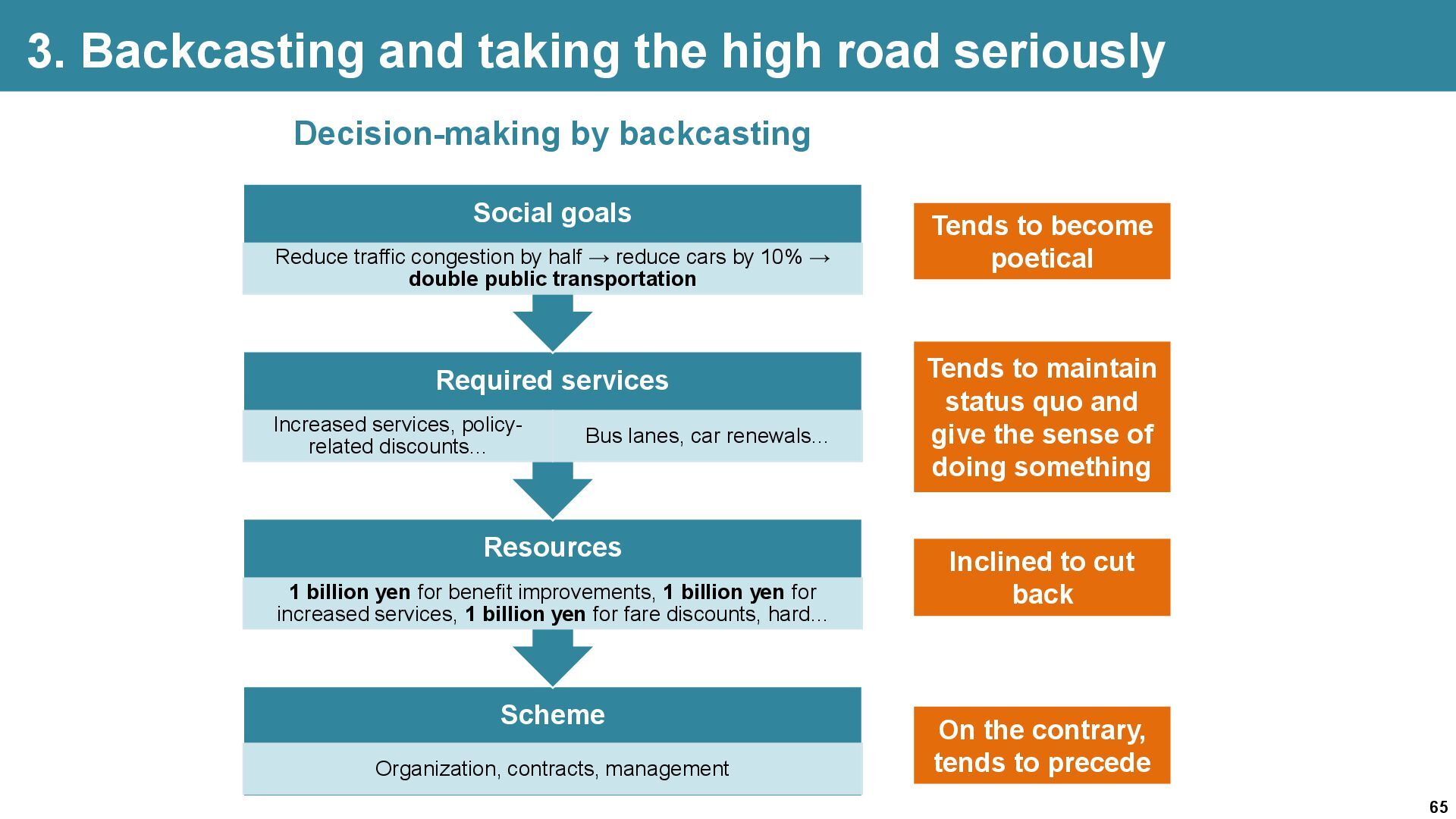
  57. 65 3. Backcasting and taking the high road seriously Scheme

    Organization, contracts, management Resources 1 billion yen for benefit improvements, 1 billion yen for increased services, 1 billion yen for fare discounts, hard... Required services Increased services, policy- related discounts... Bus lanes, car renewals... Social goals Reduce traffic congestion by half → reduce cars by 10% → double public transportation Decision-making by backcasting On the contrary, tends to precede Inclined to cut back Tends to maintain status quo and give the sense of doing something Tends to become poetical
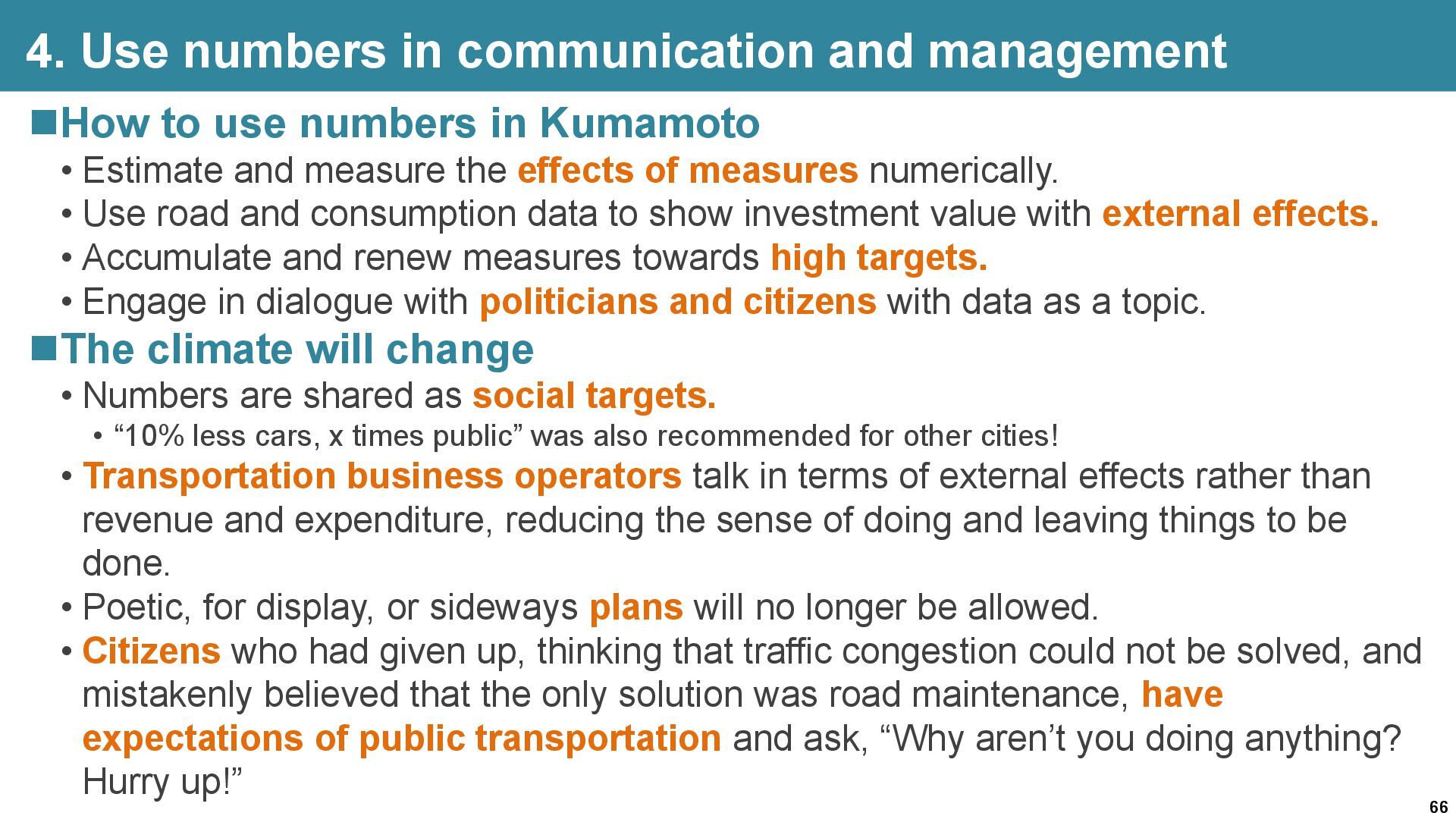
  58. 66 4. Use numbers in communication and management ◼How to

    use numbers in Kumamoto • Estimate and measure the effects of measures numerically. • Use road and consumption data to show investment value with external effects. • Accumulate and renew measures towards high targets. • Engage in dialogue with politicians and citizens with data as a topic. ◼The climate will change • Numbers are shared as social targets. • “10% less cars, x times public” was also recommended for other cities! • Transportation business operators talk in terms of external effects rather than revenue and expenditure, reducing the sense of doing and leaving things to be done. • Poetic, for display, or sideways plans will no longer be allowed. • Citizens who had given up, thinking that traffic congestion could not be solved, and mistakenly believed that the only solution was road maintenance, have expectations of public transportation and ask, “Why aren’t you doing anything? Hurry up!”
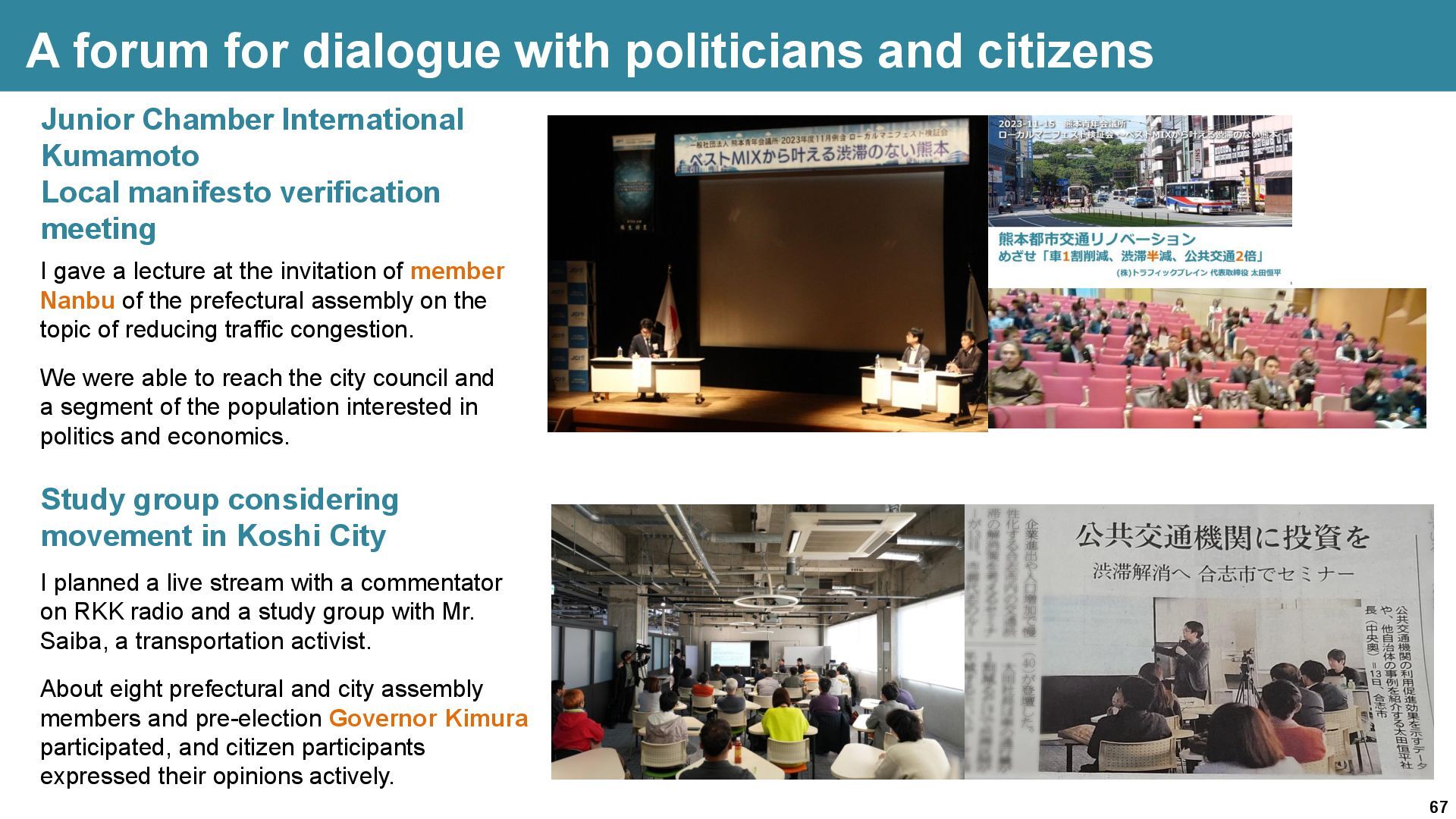
  59. 67 A forum for dialogue with politicians and citizens Junior

    Chamber International Kumamoto Local manifesto verification meeting I gave a lecture at the invitation of member Nanbu of the prefectural assembly on the topic of reducing traffic congestion. We were able to reach the city council and a segment of the population interested in politics and economics. Study group considering movement in Koshi City I planned a live stream with a commentator on RKK radio and a study group with Mr. Saiba, a transportation activist. About eight prefectural and city assembly members and pre-election Governor Kimura participated, and citizen participants expressed their opinions actively.
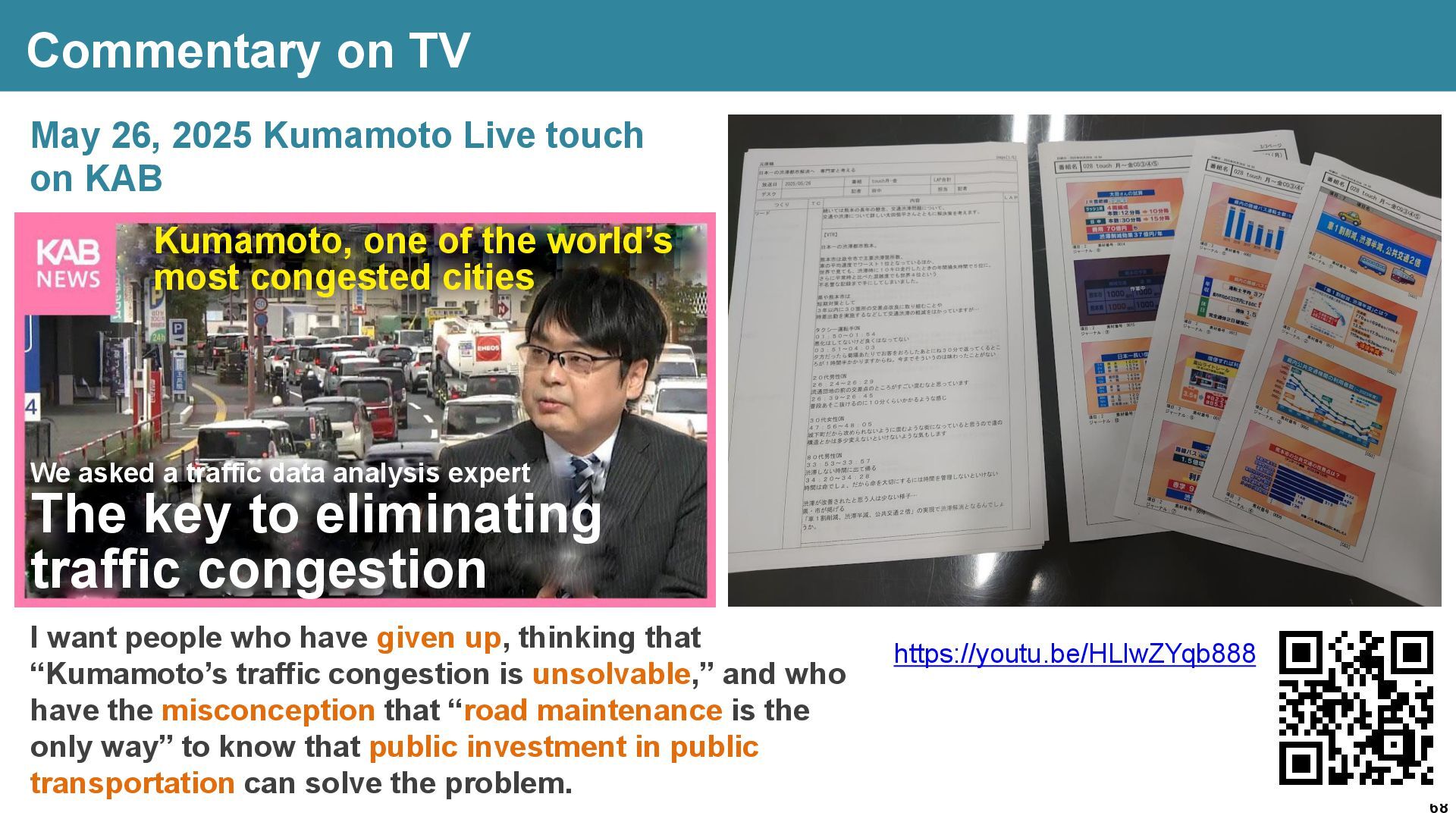
  60. 68 Commentary on TV May 26, 2025 Kumamoto Live touch

    on KAB I want people who have given up, thinking that “Kumamoto’s traffic congestion is unsolvable,” and who have the misconception that “road maintenance is the only way” to know that public investment in public transportation can solve the problem. https://youtu.be/HLlwZYqb888 Kumamoto, one of the world’s most congested cities We asked a traffic data analysis expert The key to eliminating traffic congestion
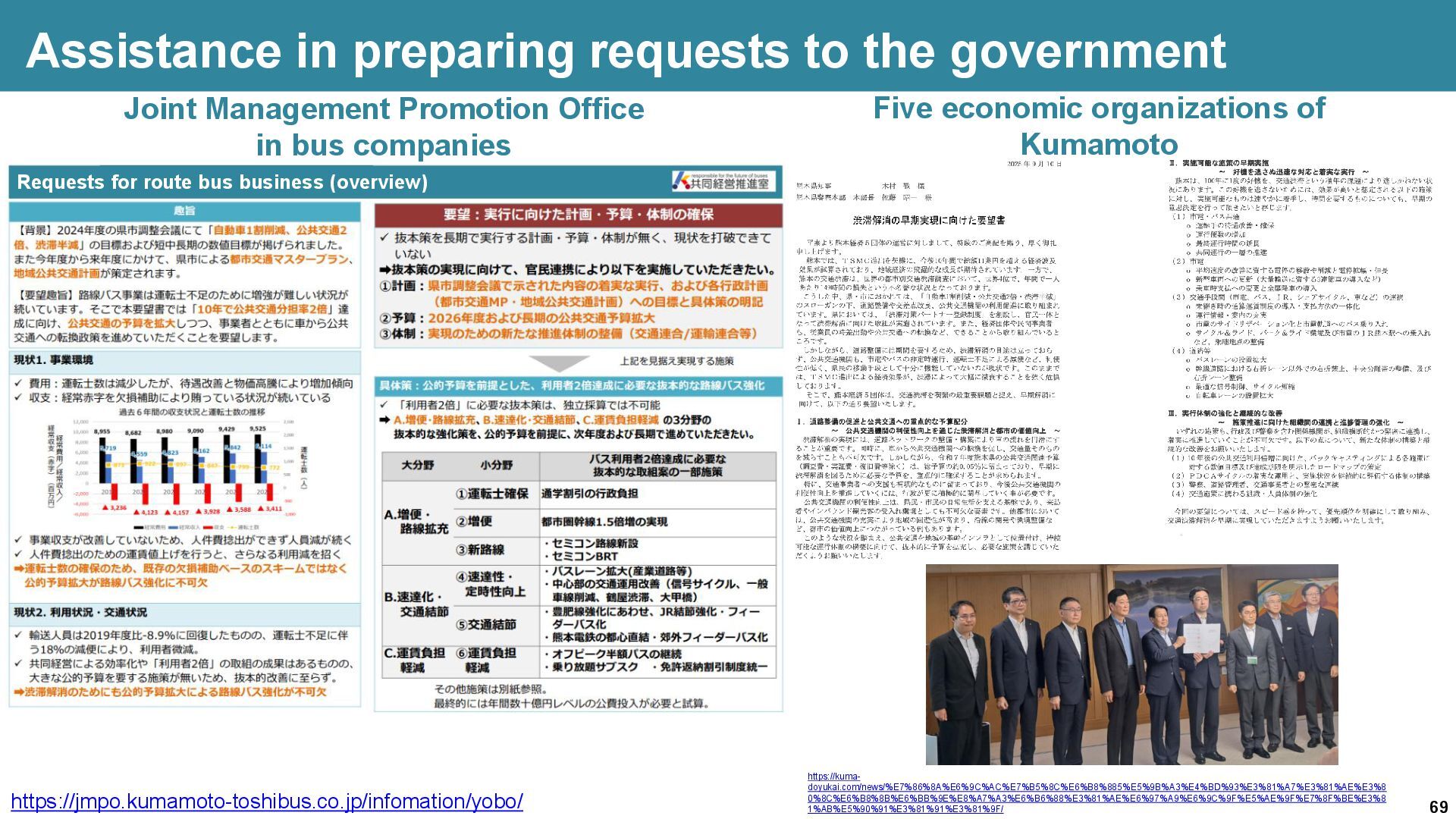
  61. 69 Assistance in preparing requests to the government Joint Management

    Promotion Office in bus companies https://jmpo.kumamoto-toshibus.co.jp/infomation/yobo/ Five economic organizations of Kumamoto https://kuma- doyukai.com/news/%E7%86%8A%E6%9C%AC%E7%B5%8C%E6%B8%885%E5%9B%A3%E4%BD%93%E3%81%A7%E3%81%AE%E3%8 0%8C%E6%B8%8B%E6%BB%9E%E8%A7%A3%E6%B6%88%E3%81%AE%E6%97%A9%E6%9C%9F%E5%AE%9F%E7%8F%BE%E3%8 1%AB%E5%90%91%E3%81%91%E3%81%9F/ Requests for route bus business (overview)
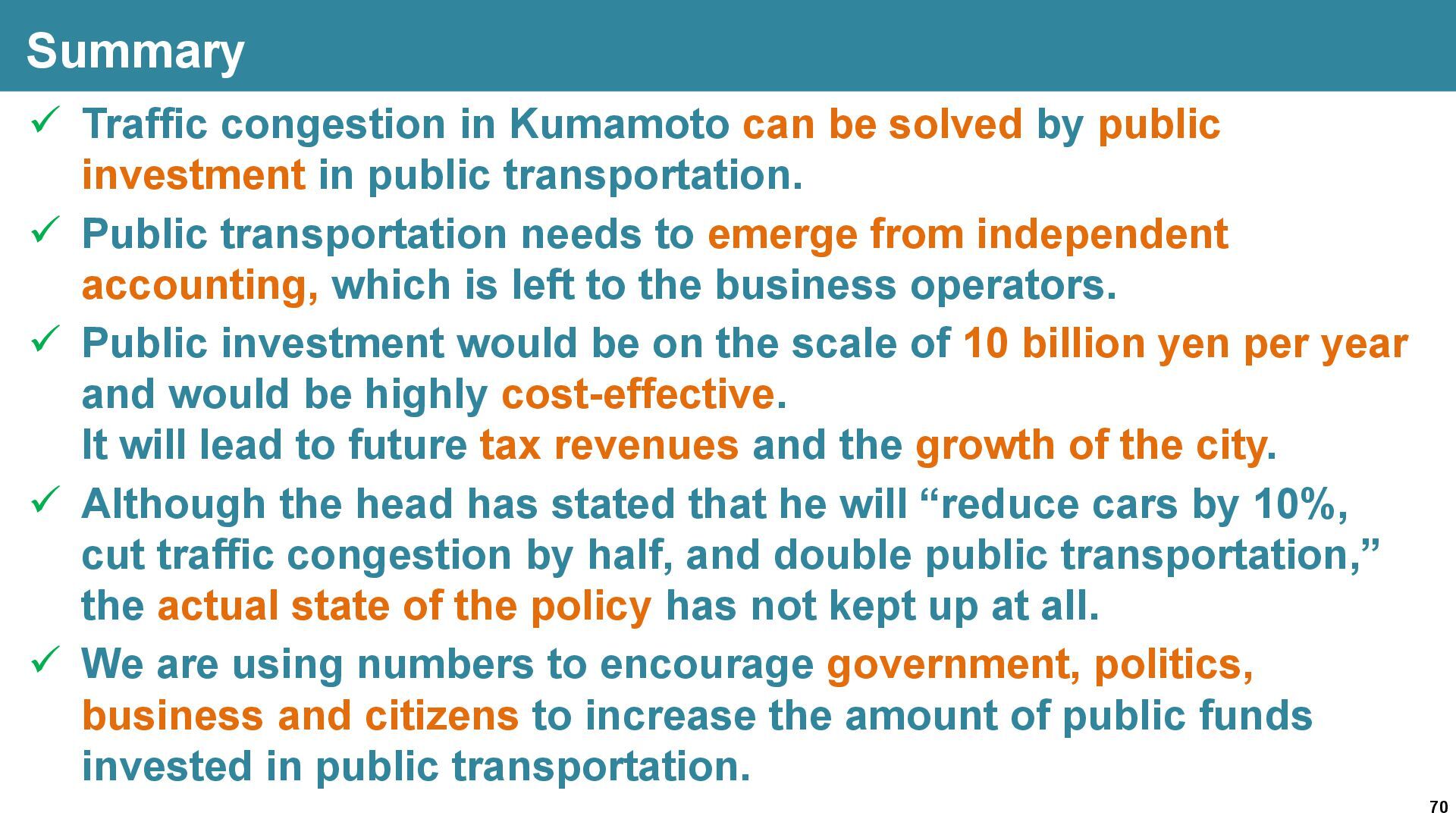
  62. 70 Summary ✓ Traffic congestion in Kumamoto can be solved

    by public investment in public transportation. ✓ Public transportation needs to emerge from independent accounting, which is left to the business operators. ✓ Public investment would be on the scale of 10 billion yen per year and would be highly cost-effective. It will lead to future tax revenues and the growth of the city. ✓ Although the head has stated that he will “reduce cars by 10%, cut traffic congestion by half, and double public transportation,” the actual state of the policy has not kept up at all. ✓ We are using numbers to encourage government, politics, business and citizens to increase the amount of public funds invested in public transportation.