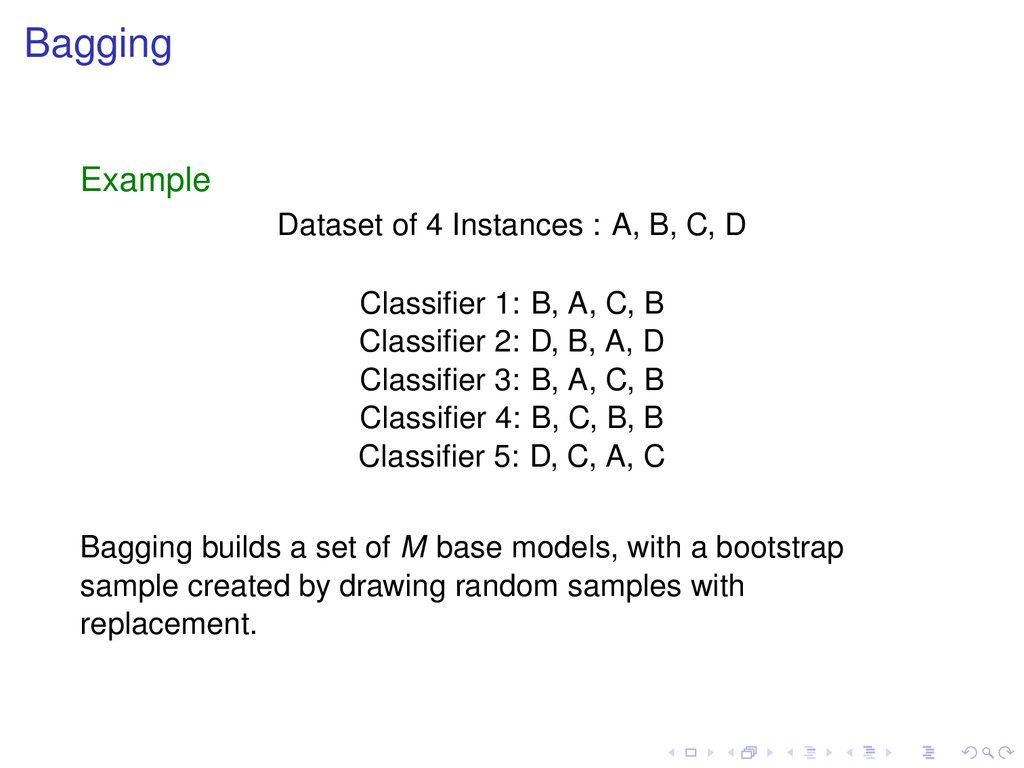
D Classifier 1: B, A, C, B Classifier 2: D, B, A, D Classifier 3: B, A, C, B Classifier 4: B, C, B, B Classifier 5: D, C, A, C Bagging builds a set of M base models, with a bootstrap sample created by drawing random samples with replacement.
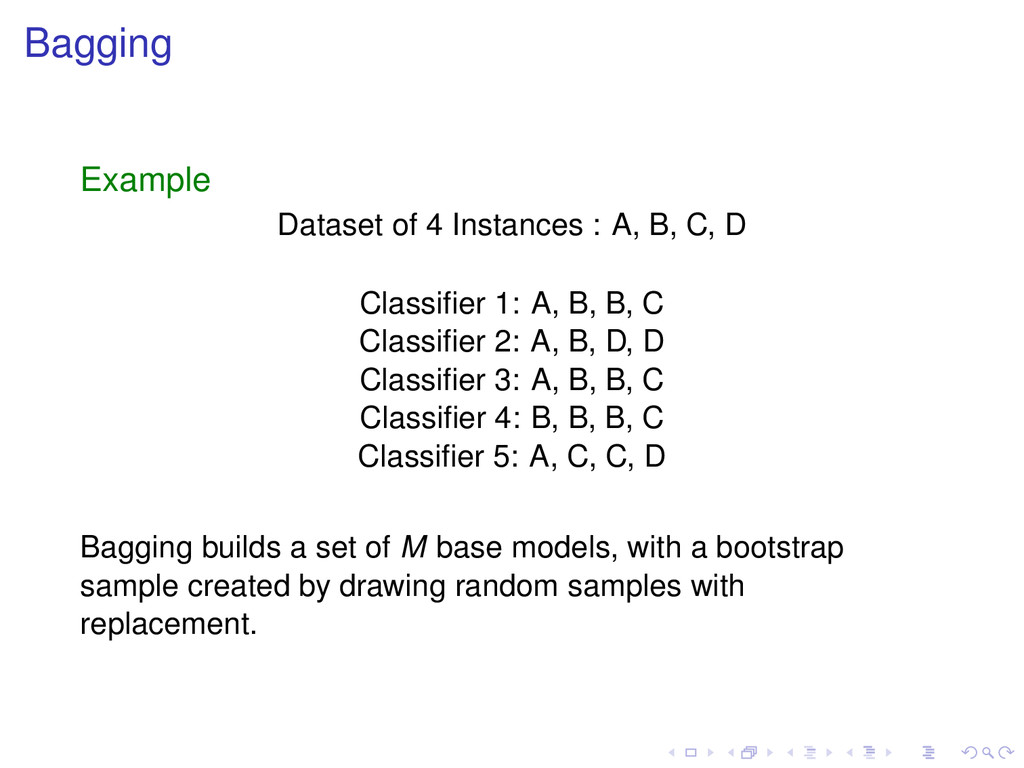
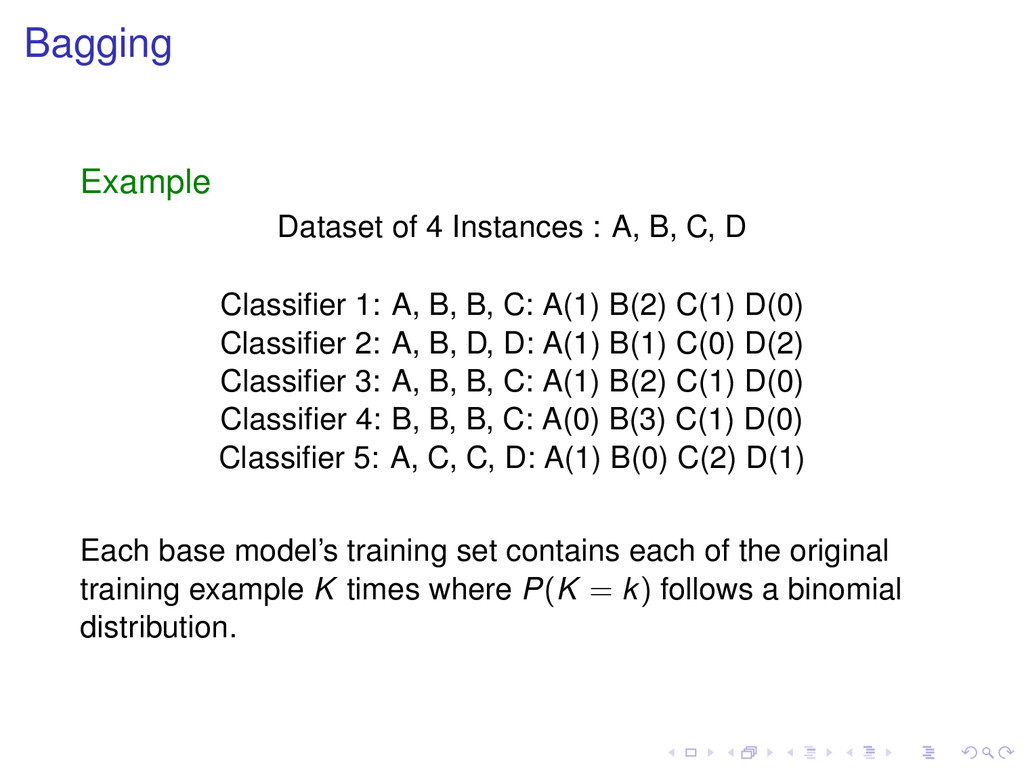
D Classifier 1: A, B, B, C Classifier 2: A, B, D, D Classifier 3: A, B, B, C Classifier 4: B, B, B, C Classifier 5: A, C, C, D Bagging builds a set of M base models, with a bootstrap sample created by drawing random samples with replacement.
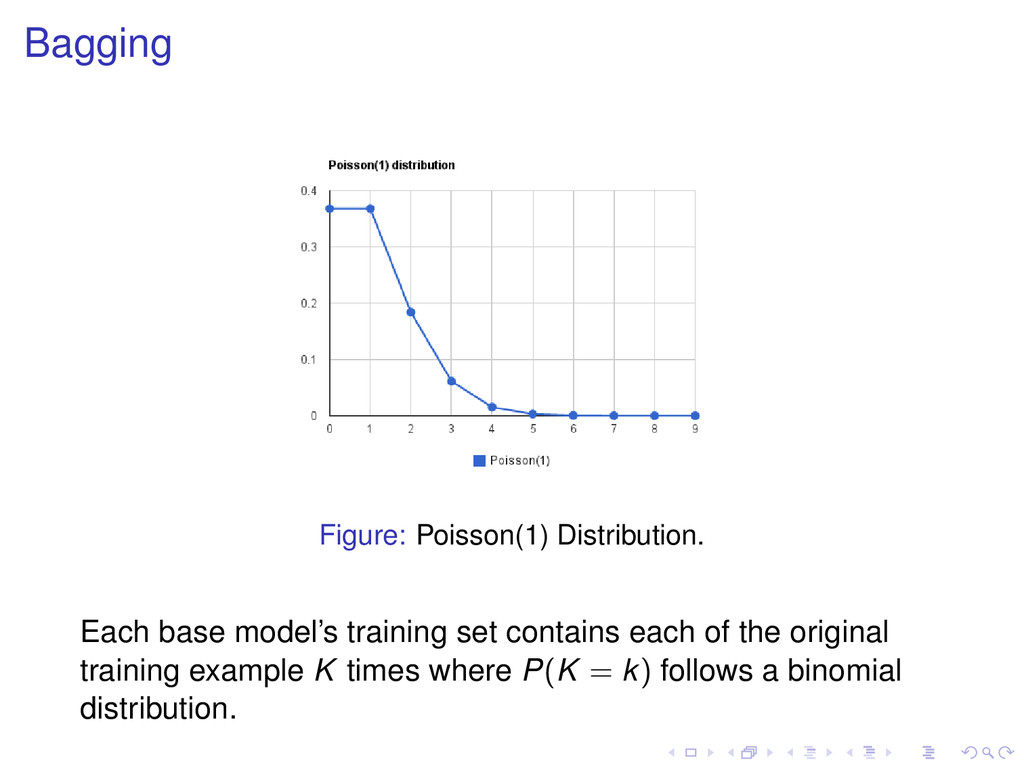
D Classifier 1: A, B, B, C: A(1) B(2) C(1) D(0) Classifier 2: A, B, D, D: A(1) B(1) C(0) D(2) Classifier 3: A, B, B, C: A(1) B(2) C(1) D(0) Classifier 4: B, B, B, C: A(0) B(3) C(1) D(0) Classifier 5: A, C, C, D: A(1) B(0) C(2) D(1) Each base model’s training set contains each of the original training example K times where P(K = k) follows a binomial distribution.
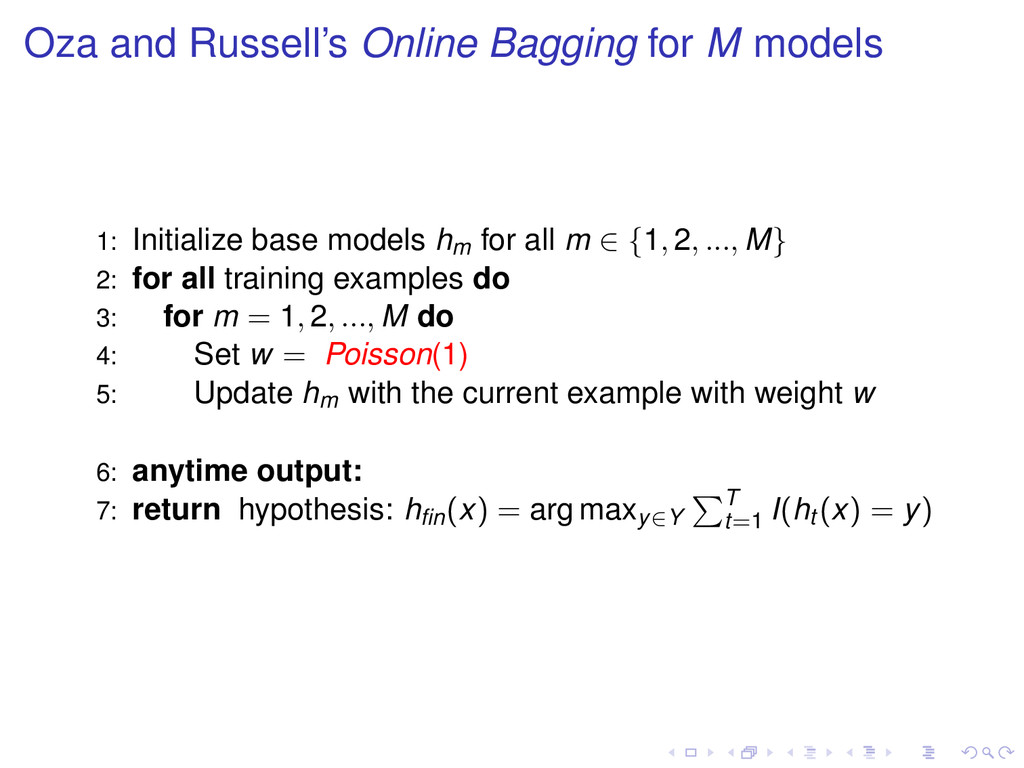
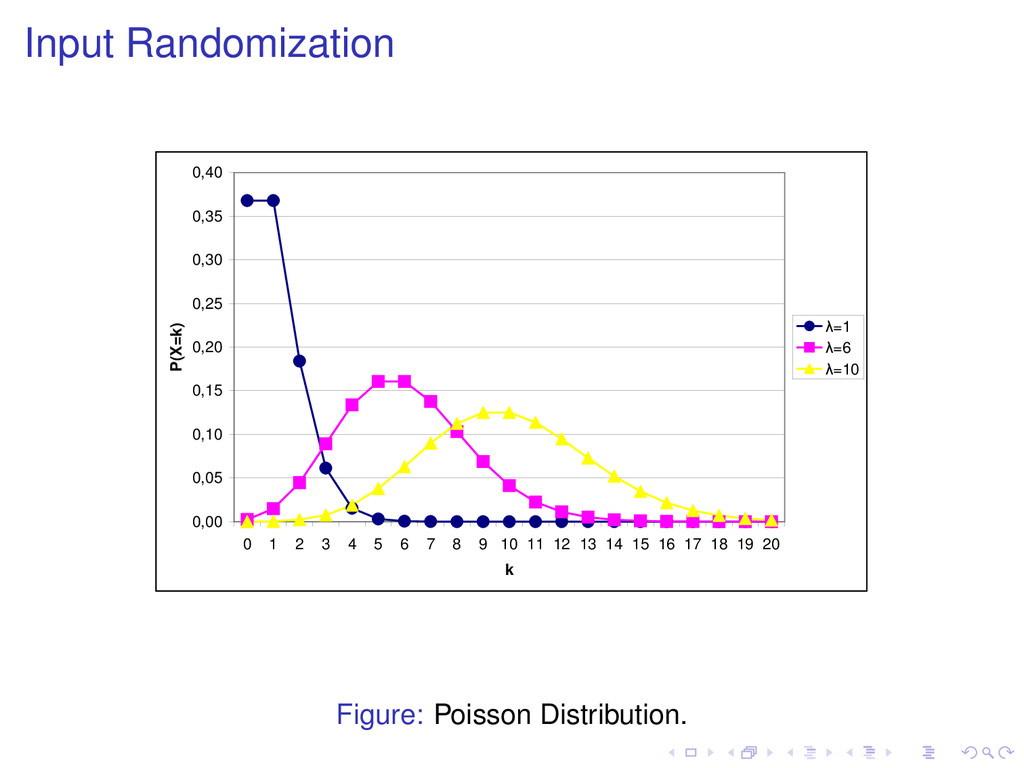
base models hm for all m ∈ {1, 2, ..., M} 2: for all training examples do 3: for m = 1, 2, ..., M do 4: Set w = Poisson(1) 5: Update hm with the current example with weight w 6: anytime output: 7: return hypothesis: hfin(x) = arg maxy∈Y T t=1 I(ht (x) = y)
input training set is obtained by sampling with replacement, like Bagging the nodes of the tree only may use a fixed number of random attributes to split the trees are grown without pruning
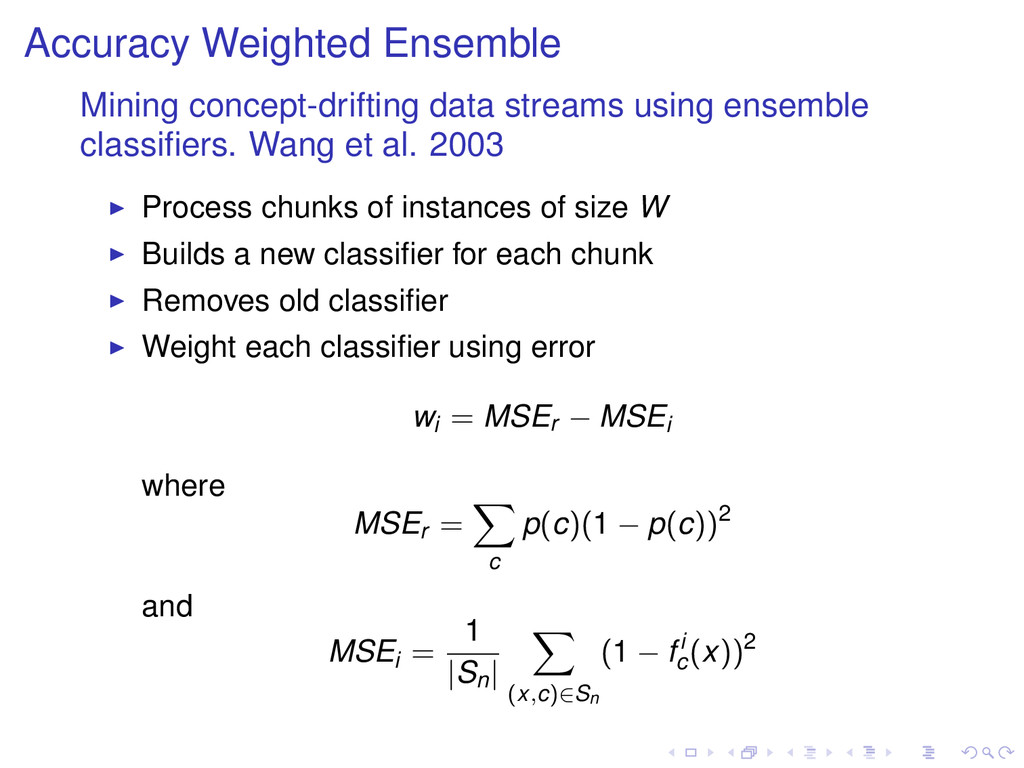
Wang et al. 2003 Process chunks of instances of size W Builds a new classifier for each chunk Removes old classifier Weight each classifier using error wi = MSEr − MSEi where MSEr = c p(c)(1 − p(c))2 and MSEi = 1 |Sn| (x,c)∈Sn (1 − fi c (x))2
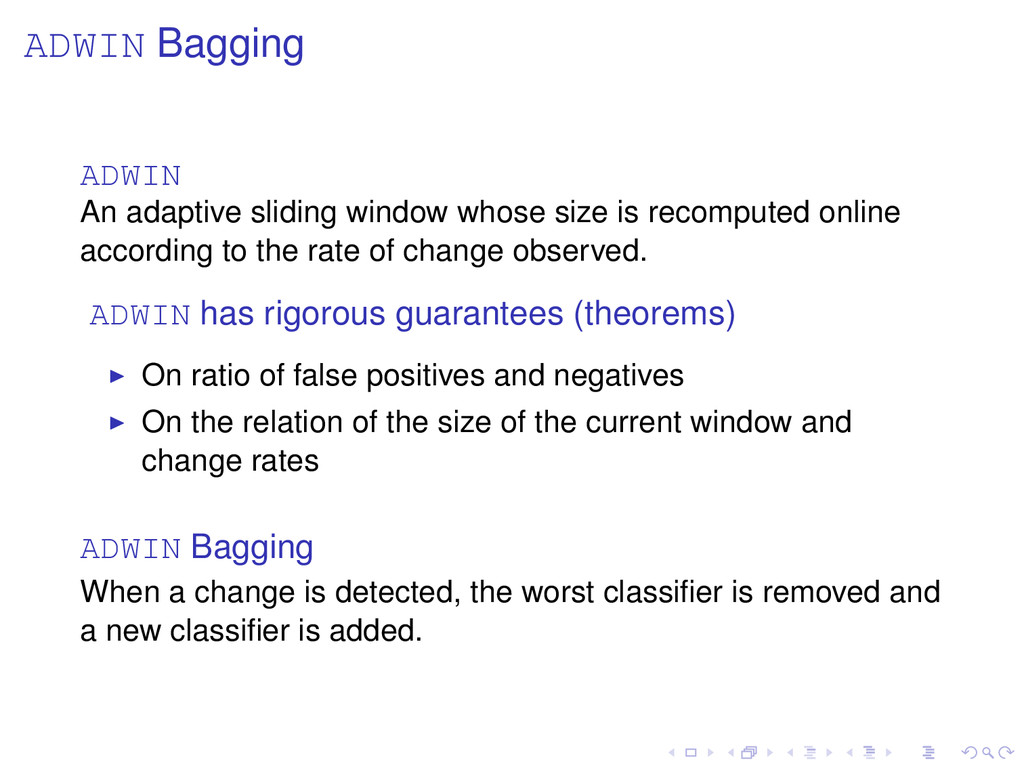
recomputed online according to the rate of change observed. ADWIN has rigorous guarantees (theorems) On ratio of false positives and negatives On the relation of the size of the current window and change rates ADWIN Bagging When a change is detected, the worst classifier is removed and a new classifier is added.
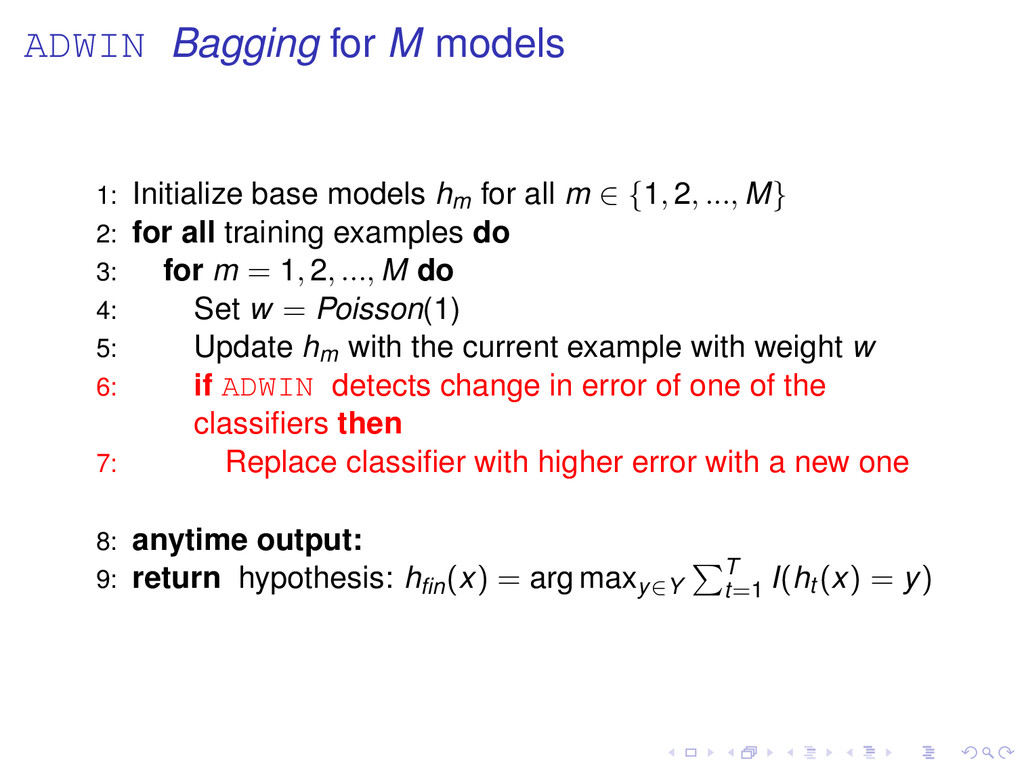
for all m ∈ {1, 2, ..., M} 2: for all training examples do 3: for m = 1, 2, ..., M do 4: Set w = Poisson(1) 5: Update hm with the current example with weight w 6: if ADWIN detects change in error of one of the classifiers then 7: Replace classifier with higher error with a new one 8: anytime output: 9: return hypothesis: hfin(x) = arg maxy∈Y T t=1 I(ht (x) = y)
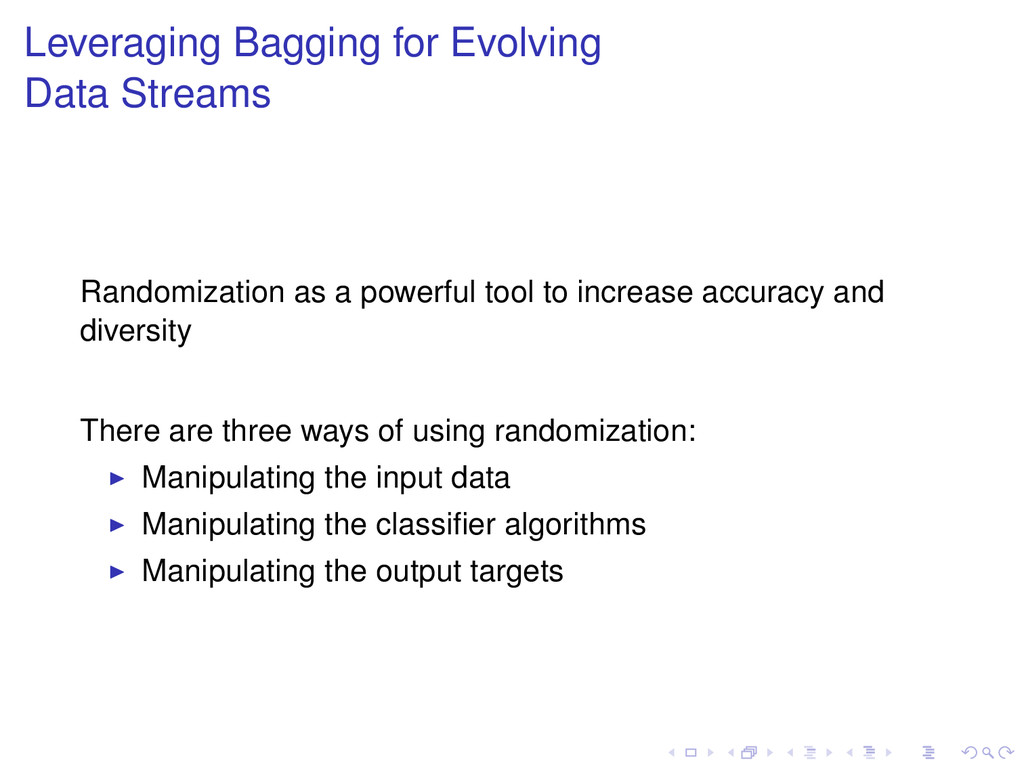
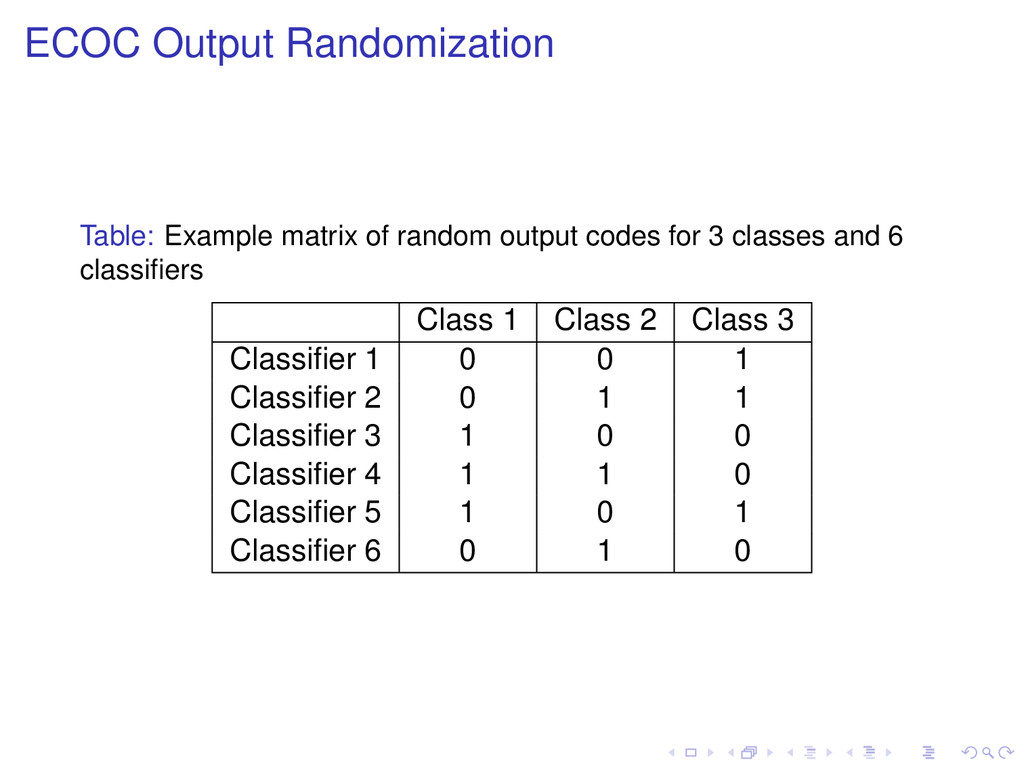
tool to increase accuracy and diversity There are three ways of using randomization: Manipulating the input data Manipulating the classifier algorithms Manipulating the output targets
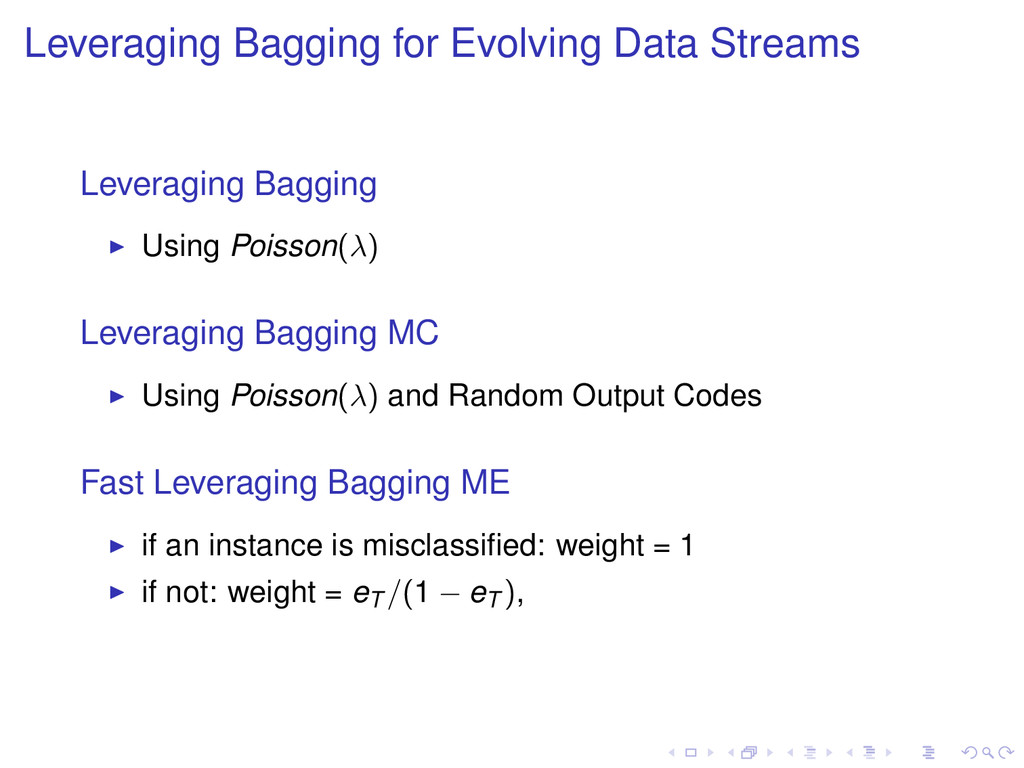
Leveraging Bagging MC Using Poisson(λ) and Random Output Codes Fast Leveraging Bagging ME if an instance is misclassified: weight = 1 if not: weight = eT /(1 − eT ),
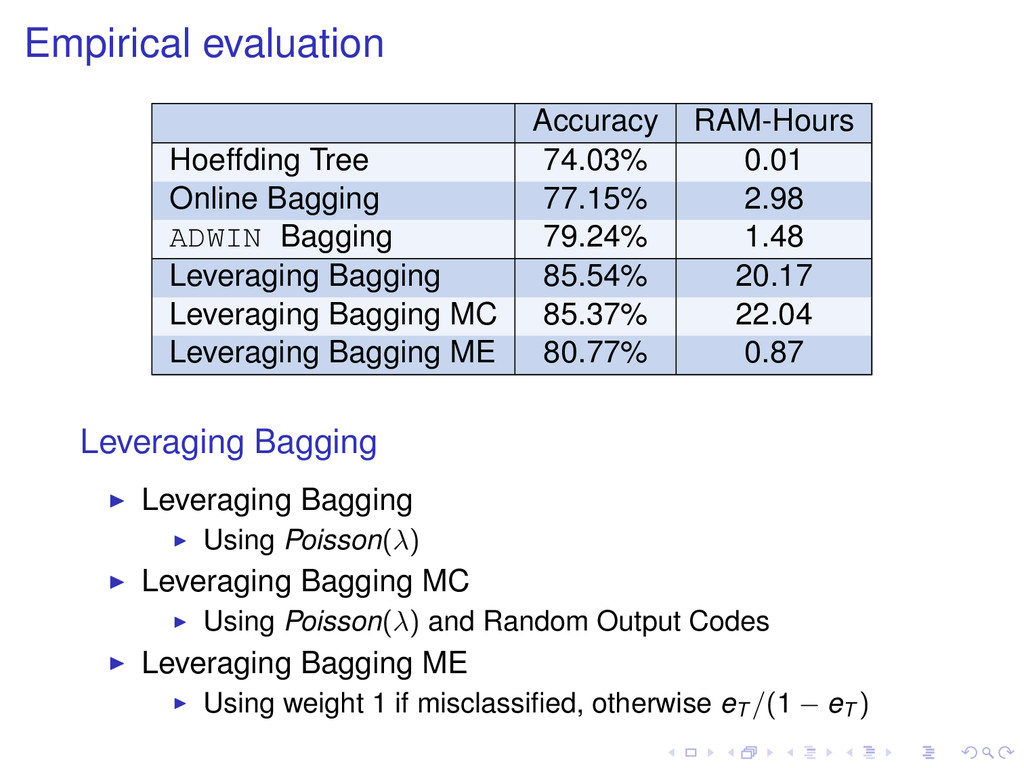
77.15% 2.98 ADWIN Bagging 79.24% 1.48 Leveraging Bagging 85.54% 20.17 Leveraging Bagging MC 85.37% 22.04 Leveraging Bagging ME 80.77% 0.87 Leveraging Bagging Leveraging Bagging Using Poisson(λ) Leveraging Bagging MC Using Poisson(λ) and Random Output Codes Leveraging Bagging ME Using weight 1 if misclassified, otherwise eT /(1 − eT )
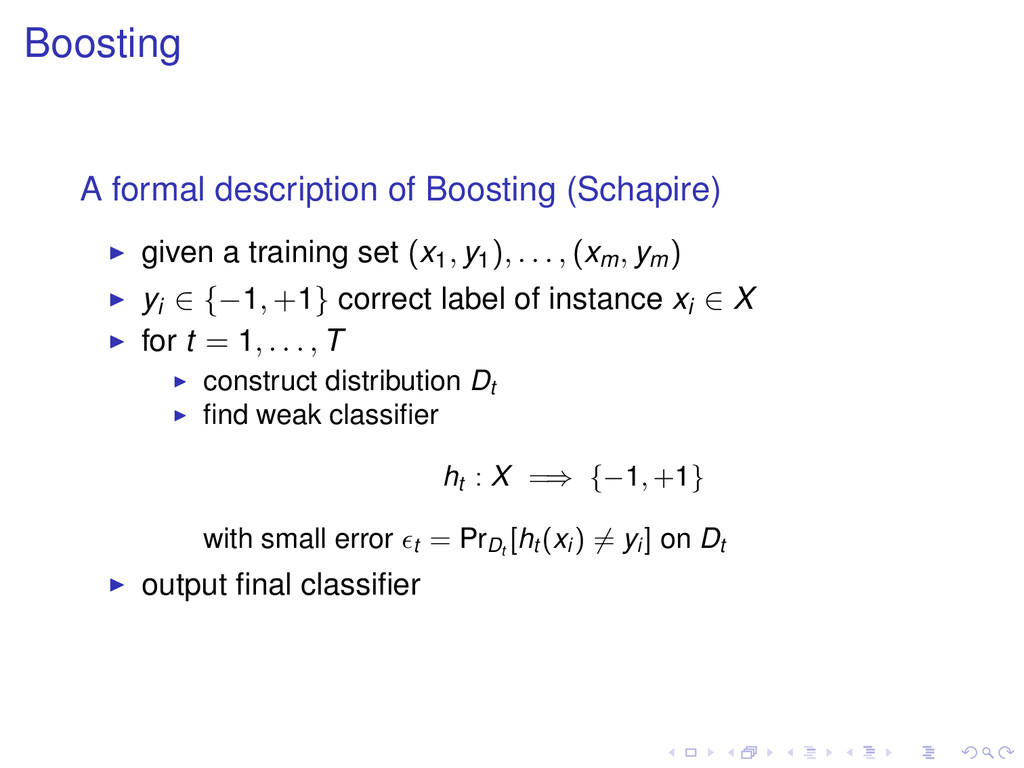
set (x1, y1), . . . , (xm, ym) yi ∈ {−1, +1} correct label of instance xi ∈ X for t = 1, . . . , T construct distribution Dt find weak classifier ht : X =⇒ {−1, +1} with small error t = PrDt [ht (xi ) = yi ] on Dt output final classifier
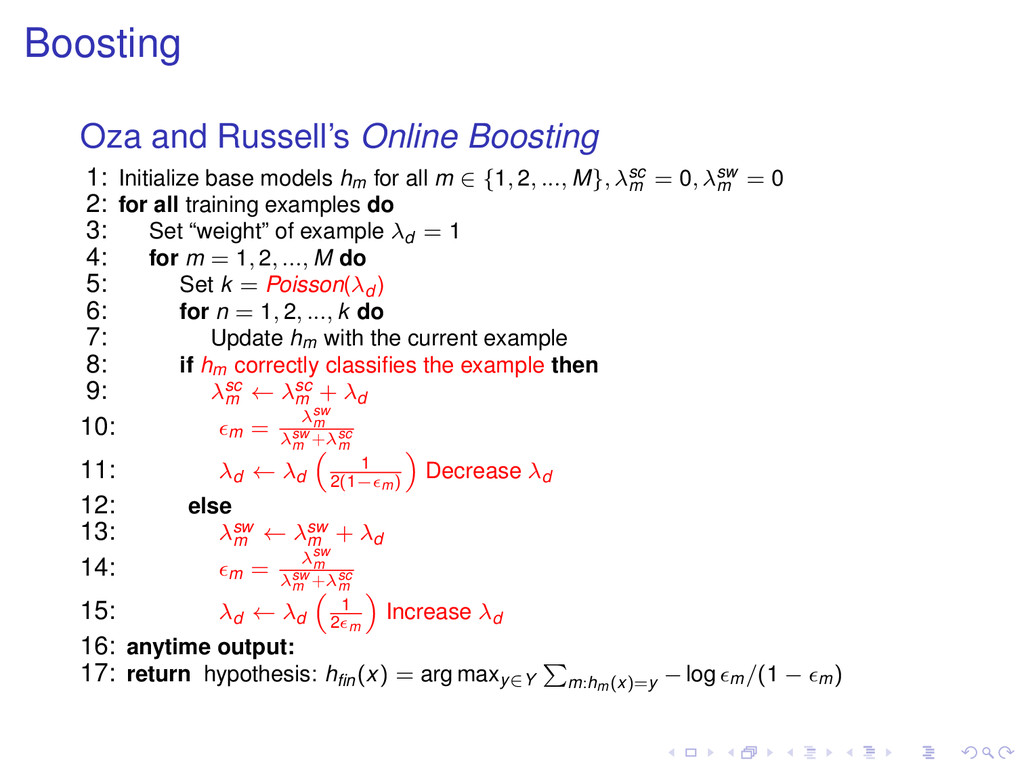
hm for all m ∈ {1, 2, ..., M}, λsc m = 0, λsw m = 0 2: for all training examples do 3: Set “weight” of example λd = 1 4: for m = 1, 2, ..., M do 5: Set k = Poisson(λd ) 6: for n = 1, 2, ..., k do 7: Update hm with the current example 8: if hm correctly classifies the example then 9: λsc m ← λsc m + λd 10: m = λsw m λsw m +λsc m 11: λd ← λd 1 2(1− m) Decrease λd 12: else 13: λsw m ← λsw m + λd 14: m = λsw m λsw m +λsc m 15: λd ← λd 1 2 m Increase λd 16: anytime output: 17: return hypothesis: hfin(x) = arg maxy∈Y m:hm(x)=y − log m/(1 − m)
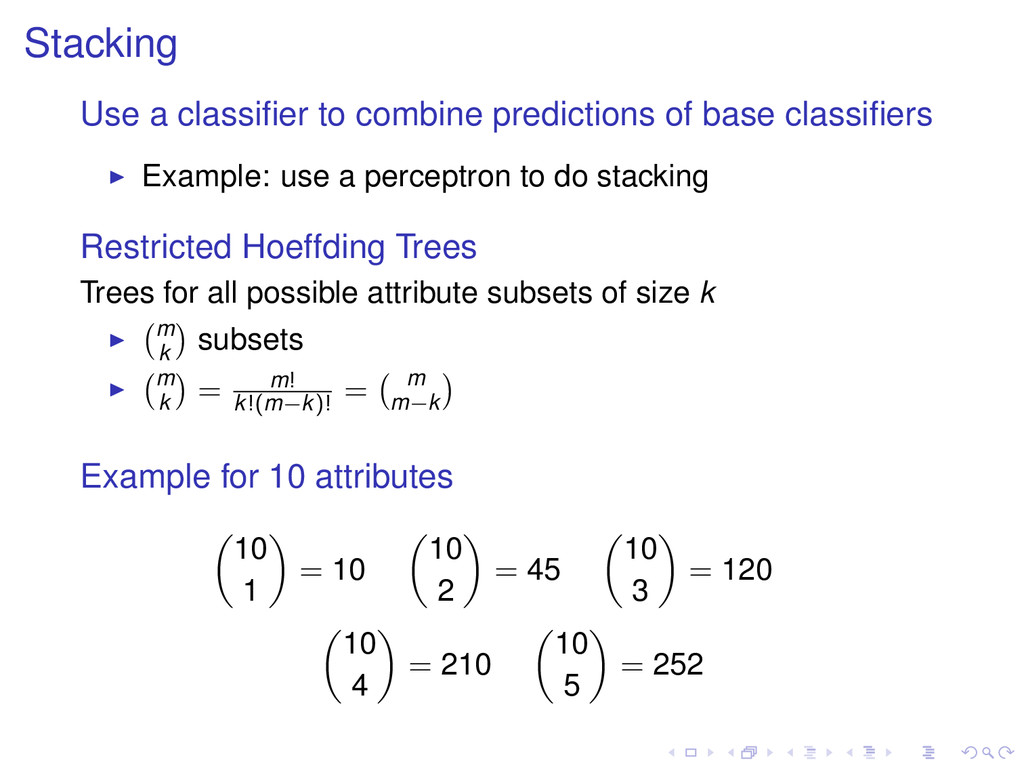
Example: use a perceptron to do stacking Restricted Hoeffding Trees Trees for all possible attribute subsets of size k m k subsets m k = m! k!(m−k)! = m m−k Example for 10 attributes 10 1 = 10 10 2 = 45 10 3 = 120 10 4 = 210 10 5 = 252


 abifet
.png) satai
satai
 institutdelelevage
 analokmaus
 koide3
 ftakahashi
 ayatokanada
 kzmssk
 nzw0301
 sishi2026
 yumaichikawa
 reokashiwa
 inesmontani
 jacobtomlinson
 jeffersonlam
 jnunemaker
 nwiizo
 reverentgeek
 rabernat
 tmiket
 techseoconnect
 sugarenia
 ipullrank
 palkan