Upgrade to Pro — share decks privately, control downloads, hide ads and more …

The Information Disruption Industry and the Ope...

Sponsored · Your Podcast. Everywhere. Effortlessly. Share. Educate. Inspire. Entertain. You do you. We'll handle the rest. →

The Information Disruption Industry and the Operational Environment of the Future

This deck won Second Prize in the 2020 writing competition run by the US Army Futures Command's "Mad Scientist" program.

It predicts that technological intrusion into citizens' daily lives will create an "information disruption industry" designed to thwart digital tracking that will have a profound effect on communications in both the military and civilian sectors.

#digital #digitaltracking #digitalleash #privacy #privacyprotection #privacyconcerns #defense

digital, digital tracking, digital leash, privacy, privacy protection, privacy concerns

Avatar for Vincent H. O'Neil

Vincent H. O'Neil

October 03, 2026

More Decks by Vincent H. O'Neil

Other Decks in Technology

Transcript

  1. Outline • Executive Summary • Introduction • The Expanding Information

    Disruption Industry • Ramifications for the Operational Environment • What to Do—First Steps • Summary
  2. Executive Summary Use of everyday technology to collect personal data

    is increasing, and as these efforts become more intrusive, popular resentment is likely to grow. If that irritation reaches a tipping point, existing privacy protection services will expand enormously—creating an Information Disruption Industry (IDI) dedicated to thwarting the collection, storage, and sale of personal data. The expanded IDI’s efforts will do direct and indirect damage to a wide range of systems—even systems unrelated to personal data collection. This likely scenario has the potential to seriously impact the information landscape in 2035, if not sooner.
  3. Collection of Personal Data People are already concerned about this

    collection: • Mentioning a product in an electronic communication often causes the appearance of online ads about that product • Cases such as the Cambridge Analytica scandal show largescale collection of personal data goes on without public consent • News stories and/or personal notifications about corporate data breaches feed the belief that no collected information is safe
  4. Popular Resentment Resentment: Bitter indignation at being treated unfairly The

    targets of the data collection dislike the invasion of their privacy already. That feeling is multiplied by the realization: • They’re paying for the devices (phones and cars) commonly used to track their behavior, habits, and movements • The tracking and collection is often concealed from them • Their personal devices could potentially be accessed as part of legal proceedings
  5. The Tipping Point Public opinion could be shifted to outright

    resistance by news stories showing data collection can cause actual harm: • Domestic violence victims hiding from their tormentors who were uncovered by technological tracking • Conviction of innocent people through the use of circumstantial evidence gained through personal data collection • Social media analysis by employers and/or universities that rejected qualified candidates
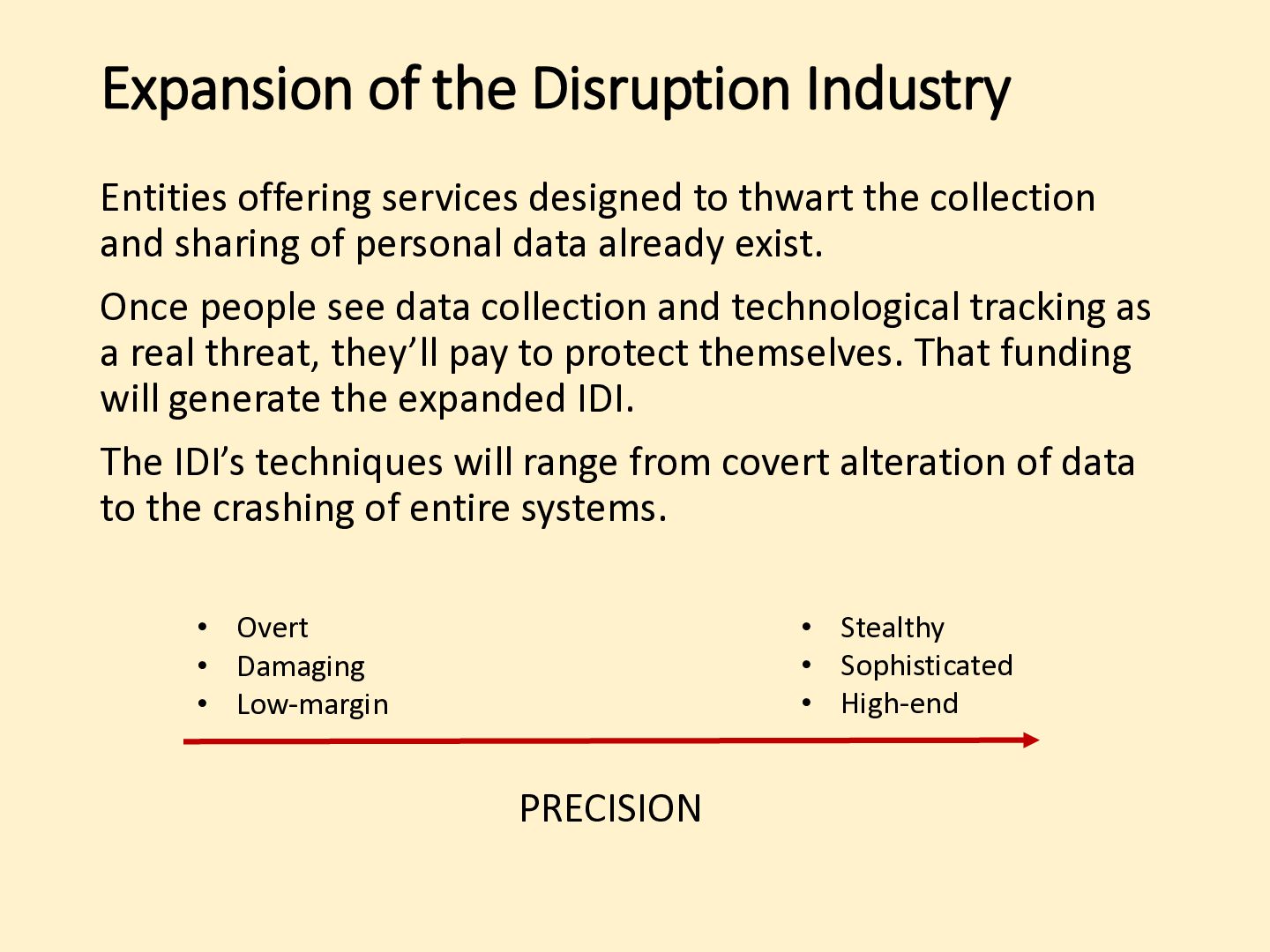
  6. Expansion of the Disruption Industry Entities offering services designed to

    thwart the collection and sharing of personal data already exist. Once people see data collection and technological tracking as a real threat, they’ll pay to protect themselves. That funding will generate the expanded IDI. The IDI’s techniques will range from covert alteration of data to the crashing of entire systems. • Stealthy • Sophisticated • High-end • Overt • Damaging • Low-margin PRECISION
  7. Precise Disruption • Target specific information as directed by the

    client (movements, purchases, personal communications) • Leave other information intact (high credit score, records of education & employment) • Key goal is to do this without detection • Attracts staff from the collection industry—better pay and more socially acceptable • Will still do damage to systems: • Disruption of normal system functions • Unintended consequences • Numerous, uncoordinated actors
  8. Imprecise Disruption • Monkey wrench-in-the-gears approach • Low-end, low-margin business

    • Not concerned with stealth • May crash entire systems • Cover for hackers—identifying a Trojan Horse is difficult when it arrives in the middle of a stampede • May give a significant boost to privacy protection overall: • Cast doubt on the reliability of collection efforts • Reduce the value of purchased data
  9. Legal Acceptance • Numerous court cases (lawsuits and criminal actions)

    are likely to arise from this conflict • Supreme Court rulings that connect the IDI—or its clients— with the defense of individual rights will make the IDI even more socially acceptable and give it legal protection • Even if the collectors pledge to stop gathering personal information, the public is unlikely to believe it • The more precise operators could also offer a service where they monitor clients’ personal information and repair it when it’s damaged by the IDI
  10. Continuous and Widespread Disruption The IDI will attack the collection,

    storage, and dissemination of personal data at every level and at every step in those processes. This will create a kaleidoscopic information landscape populated with data that requires frequent verification and systems that malfunction randomly. All of this will generate second-order effects that will be as harmful as they are unpredictable.
  11. Second-Order Effects The increasingly interconnected nature of the technological world

    will magnify the impact of any disruptions and generate problems in unexpected areas. Hooking everything from household appliances to hospital information systems to the internet creates a myriad of opportunities for intentional—and unintentional—disruption.
  12. Second-Order Effects - Example Tracking technology that utilizes the GPS

    system will be a particularly important target for the IDI. Disrupters seeking to prevent the collection of information regarding a client’s movements could attack the system itself or leverage systems that connect to it. The argument that barriers are in place to prevent this is not sufficient, because the tech is constantly changing. Seemingly minor adjustments to code, hardware, and protocols can create unexpected vulnerabilities.
  13. Ramifications for the Operational Environment The expanded IDI has the

    potential to seriously impact the operational environment in 2035— if not sooner. Most US military technology is created by civilian businesses, and modified versions can be sold in non-military markets. That intersection alone has the potential to render many military systems vulnerable. Former military personnel will also join the ranks of disrupter organizations, bringing valuable knowledge about the setup, operation, and weaknesses of those systems. Additionally, the confused nature of the information landscape will assist actual enemy actors in their attempts to attack government and military systems.
  14. Non-Military Targets These attacks won’t necessarily need to be directed

    at military targets: Disruptions of civilian communication systems will have a negative impact on deployed troops who have gotten used to being able to contact their loved ones. Other disruptions such as compromised credit scores and frozen bank accounts cannot help but distract deployed soldiers from their missions and focus their attention back home.
  15. GPS Disruption Revisiting the previous example regarding the GPS system,

    any disruption of satellite location functionality could have enormous consequences for the operational environment. Lost units, misdirected supplies, and errant ordnance are just a few of the potential ramifications. No matter how advanced the technology becomes, it’s only going to be as accurate as the information it uses and as secure as the other systems it accesses.
  16. Support Systems Use of civilian technology for maintenance and logistical

    functions leaves these vital areas open to the effects of any disruptions that occur in those systems worldwide. Patches and updates for these products are usually mandatory and, while they may be designed to address a problem or shortcoming in the existing system, they could also carry code or information from disrupter organizations.
  17. What to Do—First Steps Operating in this future environment calls

    for a broad approach designed to prepare for and manage the wideranging impact of the expanded IDI. A supervisory authority should be tasked to direct this effort, and every level of the national defense apparatus has a role.
  18. Verify the Data Establish a mechanism to continuously verify information

    and generate alerts: The national defense apparatus uses many technological systems, frequently with overlapping capabilities. That overlap could be leveraged to verify information used across these systems and provide warning when data is inaccurate or a function has been disrupted. The systems don’t need to interface to create these verification capabilities—on the contrary, connection would make them vulnerable to the same threats. As an example, this mechanism could provide ongoing checks that geographical location A is actually situated at geographical location A—and raise a red flag when one system says it is not.
  19. Ask, “What If?” Conduct wargaming at all levels: The operational

    environment includes a multitude of systems that could be impacted by the IDI. The supervisory authority mentioned earlier should require the owners/operators of each system to identify every system that connects to it and every entity that uses it. Each of those systems and entities will undergo similar analysis, creating a continuously updated nodal diagram showing how these separate factors influence each other. That will be the start point for wargaming the possible results of disruptions anywhere across those nodes.
  20. Create Redundancy Identify substitutes and replacements: No amount of wargaming

    or testing will prevent disruptions. Commands and units must be ready to lose systems and keep functioning until those systems are available again. Lessons learned in the wargaming will help identify key capabilities that must be maintained. It will also identify systems that might be leveraged to do the different tasks of the missing system in an emergency. When no such temporary replacement can be found, or when a system is simply too important, the creation of a redundant system may be necessary.
  21. Repair the Damage Fix broken systems quickly: Identifying the “last

    functioning point” before a disruption can help recover a malfunctioning system. Frequent archiving of data and programming can offer a chance of “resetting” the system to an earlier point that brings it back into operation. Lessons learned from cyber attacks and security breaches that occur in peacetimes should be analyzed for techniques that can be applied during wartime. Existing disaster recovery and data recovery programs, both public and private, could be good sources of additional tips and techniques for this.
  22. Identify Quick Fixes Analyze field-expedient solutions: The supervisory authority should

    create a “best practices” center that solicits, verifies, tests, and disseminates information on variations, substitutions, and workarounds developed in the field. These best practices should be promulgated widely, so that people working with System A will be aware of a workaround in System B that can also be applied to System A in an emergency.
  23. Provide Incentives Encourage innovation and participation: Get everyone involved in

    conducting “What if?” analysis and identifying field expedients by creating a rewards program. Money, public acknowledgment, medals, and promotions can help motivate people to ask these questions and come up with solutions ahead of time.
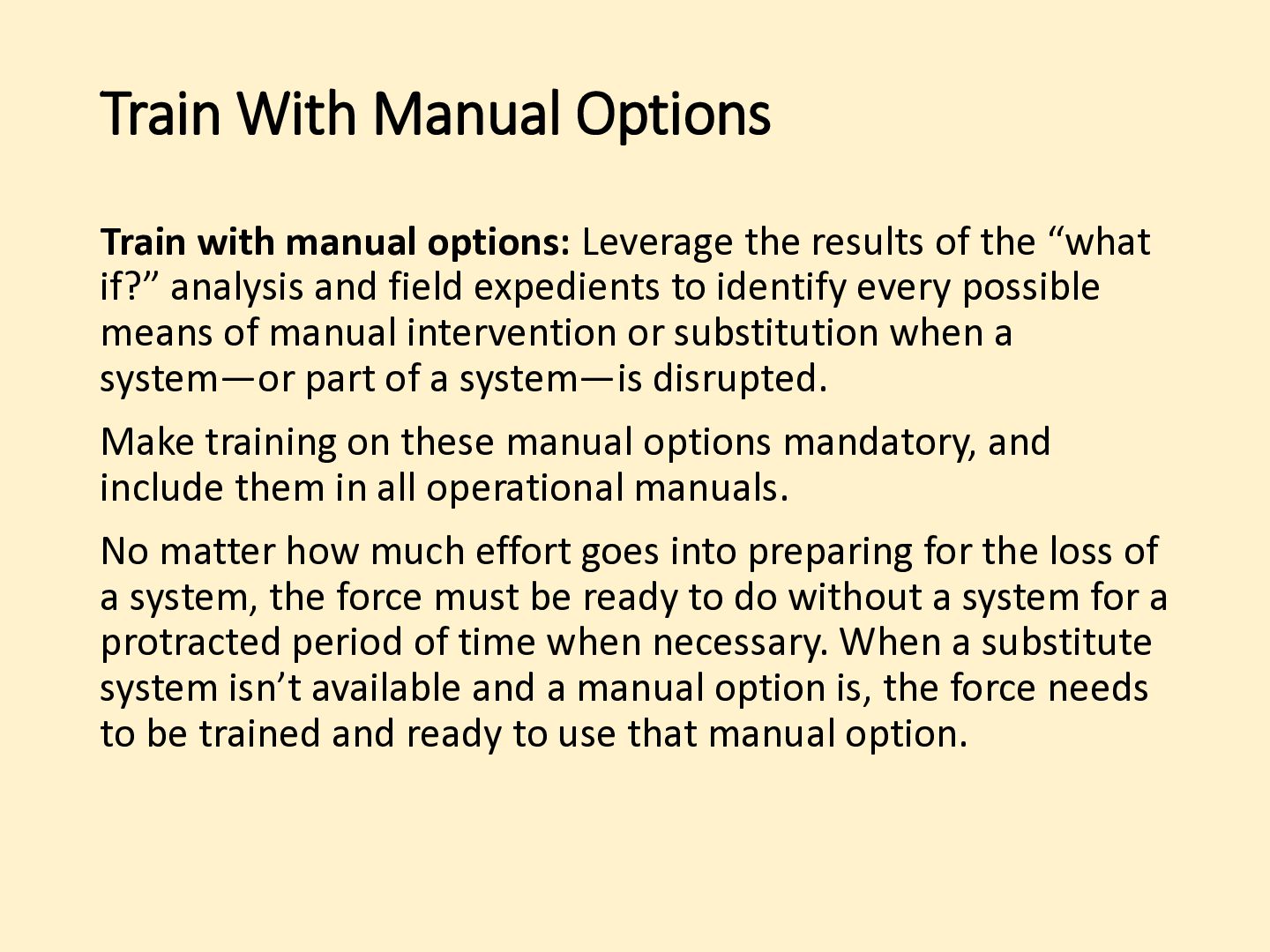
  24. Train With Manual Options Train with manual options: Leverage the

    results of the “what if?” analysis and field expedients to identify every possible means of manual intervention or substitution when a system—or part of a system—is disrupted. Make training on these manual options mandatory, and include them in all operational manuals. No matter how much effort goes into preparing for the loss of a system, the force must be ready to do without a system for a protracted period of time when necessary. When a substitute system isn’t available and a manual option is, the force needs to be trained and ready to use that manual option.
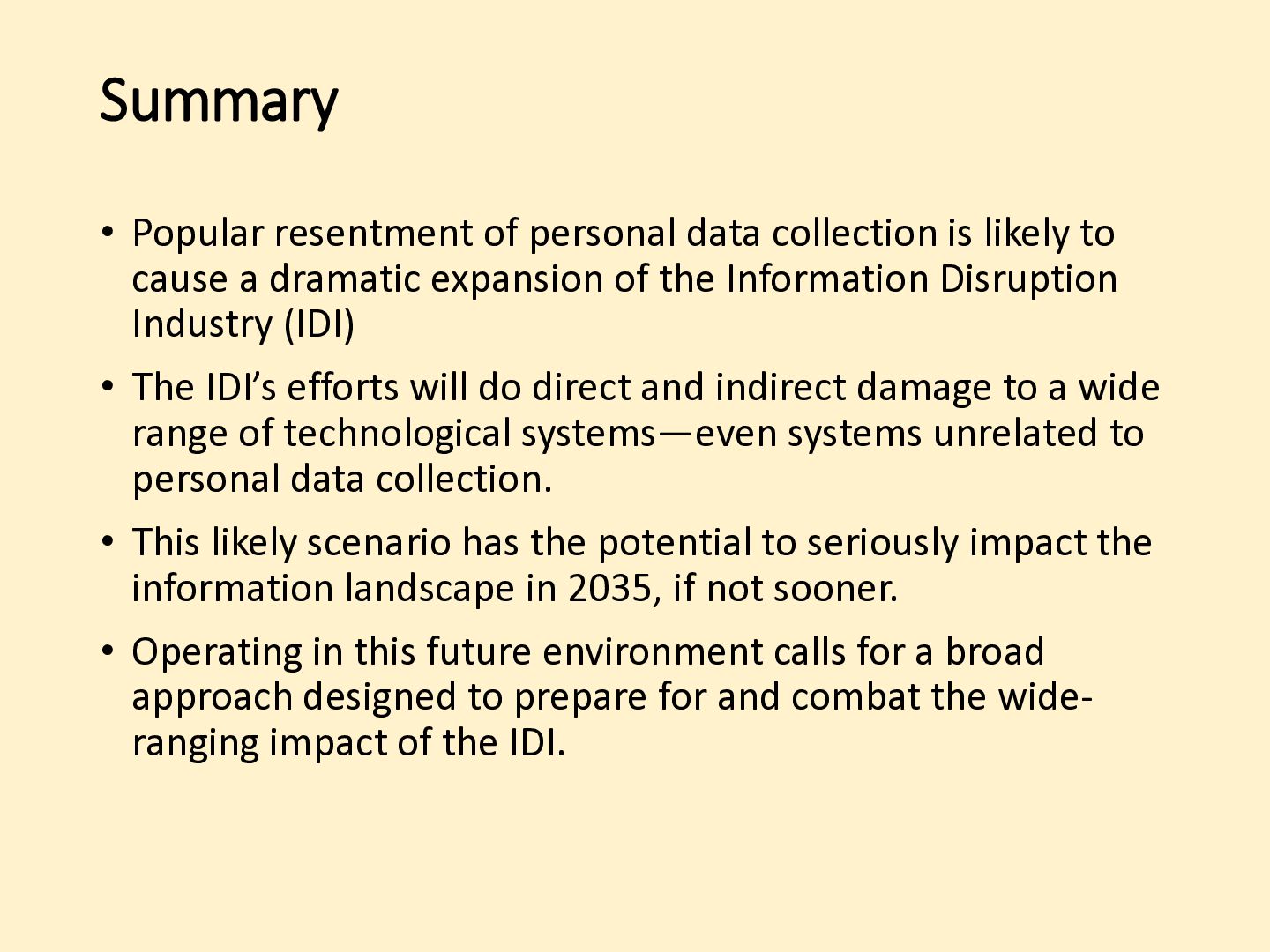
  25. Summary • Popular resentment of personal data collection is likely

    to cause a dramatic expansion of the Information Disruption Industry (IDI) • The IDI’s efforts will do direct and indirect damage to a wide range of technological systems—even systems unrelated to personal data collection. • This likely scenario has the potential to seriously impact the information landscape in 2035, if not sooner. • Operating in this future environment calls for a broad approach designed to prepare for and combat the wideranging impact of the IDI.
  26. About the Author Vincent H. O’Neil is a risk manager,

    writer, and public speaker. He holds degrees from West Point and The Fletcher School. He’s also the author of the Frank Cole mystery novels from St. Martin’s Press and the Sim War military science fiction series (written as Henry V. O’Neil) from HarperCollins. www.vincenthoneil.com www.linkedin.com/in/vincenthoneil