Epic by IRG scrubs offer antimicrobial protection and fluid resistance-ideal for high-risk ICU settings. Edge suits fast-paced units needing flexibility and comfort.
and drug-resistant bacteria every shift. Your scrubs aren't just clothing-they're your first defense layer. When you're choosing between Epic by IRG scrubs and Edge by IRG, the decision comes down to what you actually encounter during your 12-hour shifts in the ICU.
antimicrobial fabric technology that actively fights bacterial growth on the material surface. This matters when you're working with MRSA patients, ventilator-associated pneumonia cases, or handling invasive procedures. The fabric contains silver ion technology that disrupts bacterial cell walls. Edge scrubs focus on moisture-wicking and four-way stretch. They're built for movement-bending over patients, reaching for equipment, rushing between rooms. The fabric breathes better but lacks the antimicrobial layer. Here's the technical breakdown: Epic uses a polyester-spandex blend treated with Silvadur antimicrobial technology. Edge relies on a lighter cotton-poly blend with mechanical stretch fibers. How does your ICU environment determine your choice? Medical-surgical ICUs handle everything from post-op recoveries to septic patients. You're exposed to varied contaminants throughout your shift. Epic's fluid-resistant coating repels blood and secretions-they bead up on the surface instead of soaking through. One study from the Journal of Hospital Infection found that antimicrobial-treated healthcare uniforms showed 90% less bacterial colonization after an eight-hour shift compared to standard scrubs. Cardiac ICUs involve less direct fluid exposure but demand constant movement. You're adjusting Swan-Ganz catheters, repositioning patients, responding to rapid responses. Edge scrubs won't restrict you when you're doing chest compressions or leaning over bed rails. Neuro ICUs present a middle ground. You handle cranial drains and manage patients with compromised immune systems post-surgery. The antimicrobial protection helps, but you also need flexibility for frequent neurological assessments and position changes.
the highest contamination control. These patients have virtually no immune defense. Epic's antimicrobial properties add a layer between environmental bacteria and vulnerable patients. The scrubs themselves become less likely to transfer pathogens between rooms. Burn ICUs expose you to open wounds and frequent dressing changes. Fluid resistance becomes critical-you're dealing with exudate, topical treatments, and irrigation solutions. Epic's coating prevents saturation that could spread contaminants to other patients. General ICUs with standard precautions can function well with Edge. If you're following proper hand hygiene and using PPE correctly, the antimicrobial feature becomes less critical. Your priority shifts to comfort during long shifts. How does laundering affect your decision? Epic scrubs maintain antimicrobial properties through 50 industrial wash cycles. That's roughly three months of regular use if you're washing after every shift. The silver ion treatment is bonded to the fiber, not just coated on top. Edge scrubs hold their stretch and shape through about 100 washes before notable degradation. They're easier to care for-no special detergent requirements, safe for home washing machines. Cost factors in here. Epic scrubs run $45-60 per piece. Edge costs $30-40. But Epic's protective features might justify the price if you're in high-exposure settings. You're potentially reducing your infection risk and extending the time between replacements due to contamination concerns. When should comfort override protection? Night shifts in slower ICU units might favor Edge. You're doing more charting, fewer procedures, less direct patient contact. The breathability prevents overheating during those 7 PM to 7 AM stretches. Float pool nurses moving between units face a tough choice. Epic makes sense if you regularly rotate through trauma, burn, or transplant ICUs. Edge works better if you're mostly covering step-down units and lower-acuity floors. Travel nurses should consider Epic. You don't know the infection control standards at your next assignment. The built-in antimicrobial protection gives you consistency across facilities.
Journal of Infection Control tested healthcare worker uniforms in various ICU settings. Scrubs with antimicrobial treatment showed bacterial counts 75% lower than untreated fabrics after patient contact. The difference was most significant in units treating immunocompromised patients. Another study measured fluid penetration resistance. Treated scrubs prevented strike-through in 95% of exposure events, compared to 60% for standard fabrics. This matters during procedures where splashes occur- central line insertions, airway management, chest tube placements. Are there situations where neither works perfectly? Pediatric ICUs need both features. You're protecting vulnerable patients but also need to move quickly during codes. Some nurses in PICU settings buy both types-Epic for high-risk patient days, Edge for routine monitoring shifts. COVID ICUs during surges required disposable gowns over any scrubs, making the antimicrobial feature redundant. Comfort became the priority since you're layered in PPE for hours. Your choice isn't permanent. Many ICU nurses own both styles and select based on their assignment. If you're scrubbing into an ECMO cannulation, grab Epic. Covering a stable patient load? Edge keeps you comfortable. The right scrubs match your specific unit's contamination risks and physical demands. Epic by IRG scrubs excel in high-exposure environments where protection matters most. Edge serves units where mobility and comfort determine your shift quality.
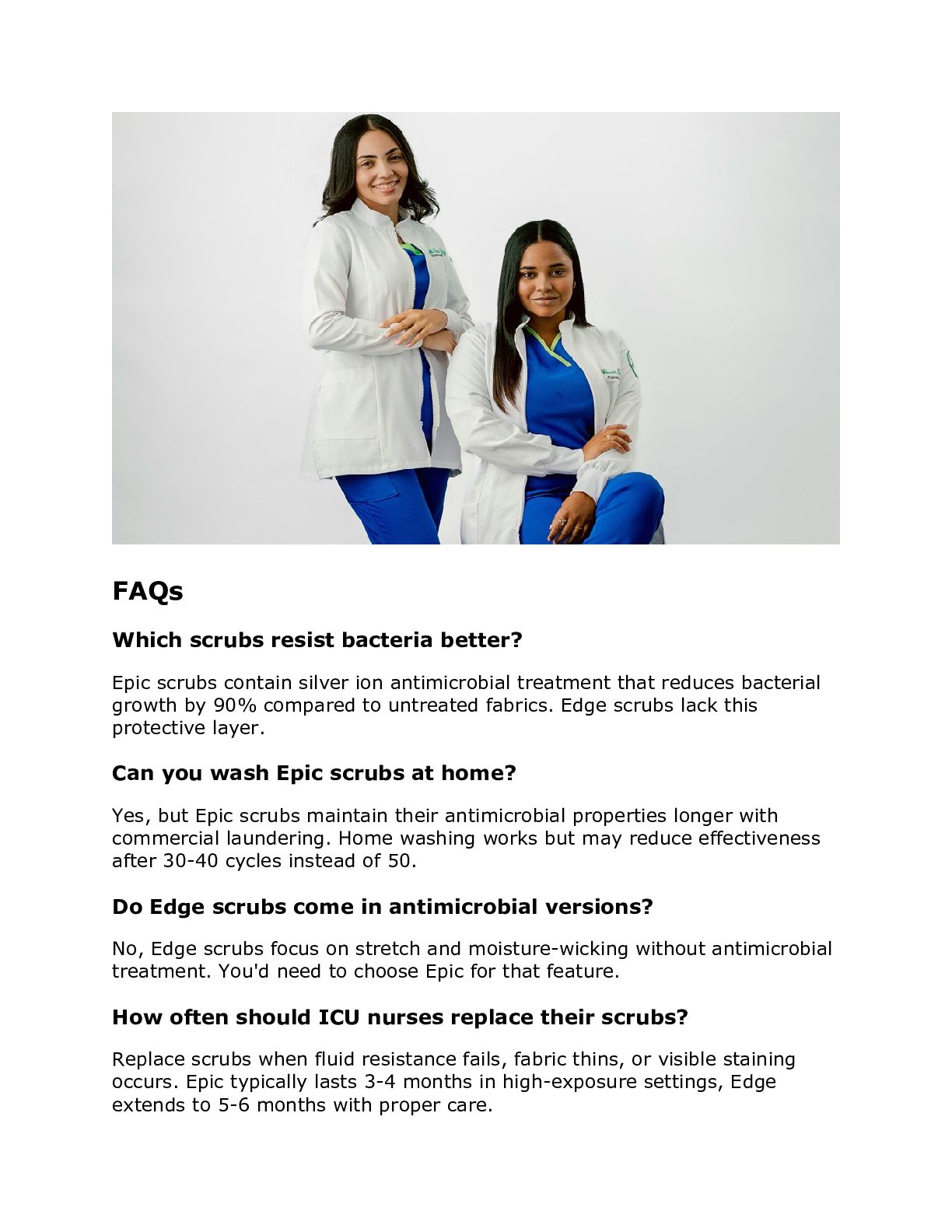
ion antimicrobial treatment that reduces bacterial growth by 90% compared to untreated fabrics. Edge scrubs lack this protective layer. Can you wash Epic scrubs at home? Yes, but Epic scrubs maintain their antimicrobial properties longer with commercial laundering. Home washing works but may reduce effectiveness after 30-40 cycles instead of 50. Do Edge scrubs come in antimicrobial versions? No, Edge scrubs focus on stretch and moisture-wicking without antimicrobial treatment. You'd need to choose Epic for that feature. How often should ICU nurses replace their scrubs? Replace scrubs when fluid resistance fails, fabric thins, or visible staining occurs. Epic typically lasts 3-4 months in high-exposure settings, Edge extends to 5-6 months with proper care.


 woodysshirtsandscrubs
 hr1nursing
 ikuodanaka
 mediphone
 tsogo817421
 nakahara
 roms
 synergymarketing
 e5ua
 xinghr
 auditech2022
 kuradashi
 arid2
 wjessup
 rkendrick25
 tmiket
 schlessera
 katarinadahlin
 sugarenia
 keavy
 ianozsvald
 portentint
 akademiya2063
 tammyeverts