Upgrade to Pro
— share decks privately, control downloads, hide ads and more …
Speaker Deck
Sign up for free
Menu
Search
Features
All features
Private URLs
Password Protection
Custom URLS
Scheduled publishing
Remove Branding
Restrict embedding
Deck Collections
Notes
Features
All features
Private URLs
Password Protection
Custom URLS
Scheduled publishing
Remove Branding
Restrict embedding
Deck Collections
Notes
Explore
Featured decks
Featured speakers
Programming
Technology
Storyboards
Explore
Featured decks
Featured speakers
Programming
Technology
Storyboards
Pricing
Search
Sign in
Sign up for free
Sentiment Analysis: It’s Complicated!
Search
Yuto Kamiwaki
September 20, 2018
Research
96
0
Share
Embed
Copy iframe code
Copy JS code
Copy link
Start on current slide
Sentiment Analysis: It’s Complicated!
2018/09/21文献紹介の発表内容
Yuto Kamiwaki
September 20, 2018
More Decks by Yuto Kamiwaki
See All by Yuto Kamiwaki
Emo2Vec: Learning Generalized Emotion Representation by Multi-task Training
yuto_kamiwaki
0
120
Modeling Naive Psychology of Characters in Simple Commonsense Stories
yuto_kamiwaki
1
220
Using millions of emoji occurrences to learn any-domain representations for detecting sentiment, emotion and sarcasm
yuto_kamiwaki
0
130
Epita at SemEval-2018 Task 1: Sentiment Analysis Using Transfer Learning Approach
yuto_kamiwaki
0
150
Tensor Fusion Network for Multimodal Sentiment Analysis
yuto_kamiwaki
0
290
ADAPT at IJCNLP-2017 Task 4: A Multinomial Naive Bayes Classification Approach for Customer Feedback Analysis task
yuto_kamiwaki
0
180
EmoWordNet: Automatic Expansion of Emotion Lexicon Using English WordNet
yuto_kamiwaki
0
120
ATTENTION-BASED LSTM FOR PSYCHOLOGICAL STRESS DETECTION FROM SPOKEN LANGUAGE USING DISTANT SUPERVISION
yuto_kamiwaki
0
170
BB_twtr at SemEval-2017 Task 4: Twitter Sentiment Analysis with CNNs and LSTMs
yuto_kamiwaki
0
270
Other Decks in Research
See All in Research
論文紹介: Understanding Epistemic Language with a Language-augmented Bayesian Theory of Mind
hisaokatsumi
0
170
論文紹介:Doc-to-LoRA: Learning to Instantly Internalize Contexts
yukako_nakano
0
180
Claude Code × autoresearch 実践
mathbullet
0
290
ros2-perf-multihost: Automated Coordination Framework for Objective Architecture Evaluation in Distributed Systems
takasehideki
0
130
第64回CV・PRML勉強会 論文紹介:Linguistic Priors for Visual Decoupling: Towards Symmetric Vision-Brain Alignment
sokikatayama
0
230
TESSERA: Temporal Embeddings of Surface Spectra for Earth Representation and Analysis
satai
2
100
JICA QUEST 共創×革新プログラム Impact Report(海ノ向こうコーヒー)
ontheslope
0
720
【Zozo Research 技術共有会】三次元領域の現在と展望
mickey_0226
3
660
最先端NLP 2026 論文紹介: Wait, Wait, Wait... Why Do Reasoning Models Loop? / SNLP Paper Review: Wait, Wait, Wait... Why Do Reasoning Models Loop?
tkng
0
250
Google Cloud Next 2026 DM Recap Agentic Data Cloudを添えて / Google Cloud Next 2026 DM Recap
nnaka2992
0
140
2025年度秋葉原ウォーカブルプロジェクト調査報告 「アキバらしいウォーカブル」とは何か
izumiyama_lab
1
240
HackSick vol.7 LT資料【LLMアーキテクチャ入門・事前学習時の躓き所解説】 スパースなAttention・状態空間モデル
rikkabotan7
0
200
Featured
See All Featured
DevOps and Value Stream Thinking: Enabling flow, efficiency and business value
helenjbeal
1
390
Paper Plane (Part 1)
katiecoart
PRO
2
11k
Collaborative Software Design: How to facilitate domain modelling decisions
baasie
1
330
Navigating Algorithm Shifts & AI Overviews - #SMXNext
aleyda
1
1.6k
B2B Lead Gen: Tactics, Traps & Triumph
marketingsoph
0
250
Dealing with People You Can't Stand - Big Design 2015
cassininazir
367
27k
Groundhog Day: Seeking Process in Gaming for Health
codingconduct
0
380
Building the Perfect Custom Keyboard
takai
2
890
From Legacy to Launchpad: Building Startup-Ready Communities
dugsong
0
340
Building Experiences: Design Systems, User Experience, and Full Site Editing
marktimemedia
1
610
Build your cross-platform service in a week with App Engine
jlugia
234
19k
Testing 201, or: Great Expectations
jmmastey
46
8.3k
Transcript
Sentiment Analysis: It’s Complicated! 長岡技術科学大学 自然言語処理研究室 上脇優人 Kian Kenyon-Dean,Eisha Ahmed,Scott
Fujimoto, Jeremy Georges-Filteau,Christopher Glasz, Barleen Kaur,Auguste Lalande,Shruti Bhanderi, Robert Belfer,Nirmal Kanagasabai,Roman Sarrazingendron,Rohit Verma,2Derek Ruths McGill University, Department of Computer Science Proceedings of NAACL-HLT 2018, pages 1886–1895 9月文献紹介
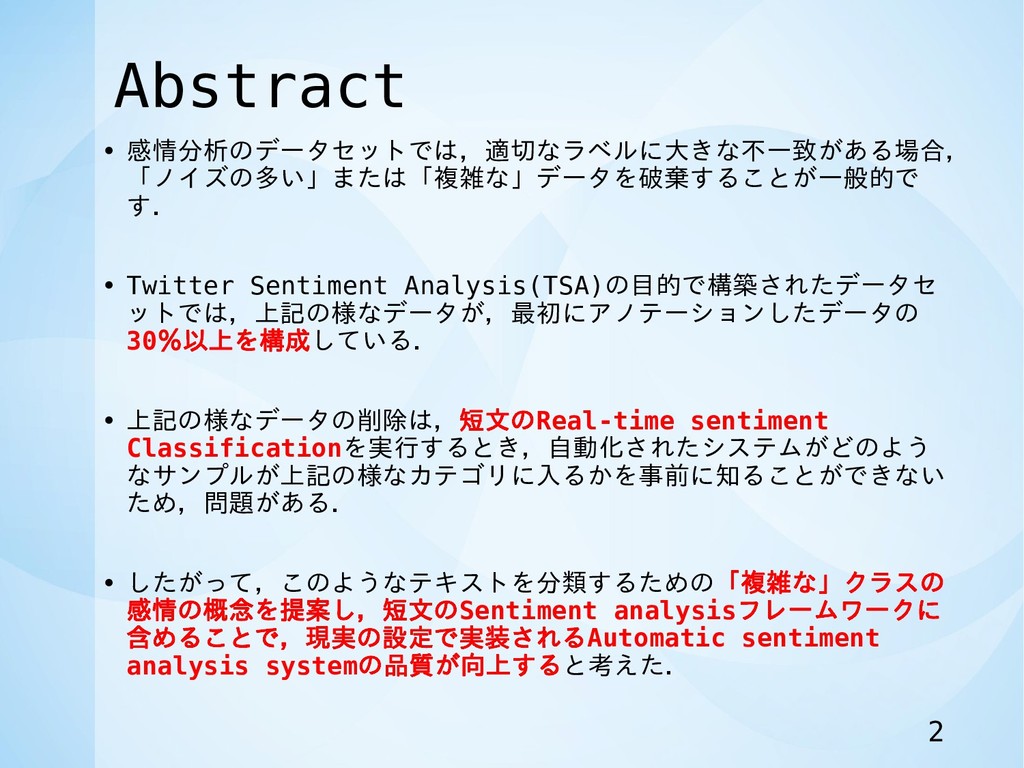
Abstract • 感情分析のデータセットでは,適切なラベルに大きな不一致がある場合, 「ノイズの多い」または「複雑な」データを破棄することが一般的で す. • Twitter Sentiment Analysis(TSA)の目的で構築されたデータセ ットでは,上記の様なデータが,最初にアノテーションしたデータの
30%以上を構成している. • 上記の様なデータの削除は,短文のReal-time sentiment Classificationを実行するとき,自動化されたシステムがどのよう なサンプルが上記の様なカテゴリに入るかを事前に知ることができない ため,問題がある. • したがって,このようなテキストを分類するための「複雑な」クラスの 感情の概念を提案し,短文のSentiment analysisフレームワークに 含めることで,現実の設定で実装されるAutomatic sentiment analysis systemの品質が向上すると考えた. 2
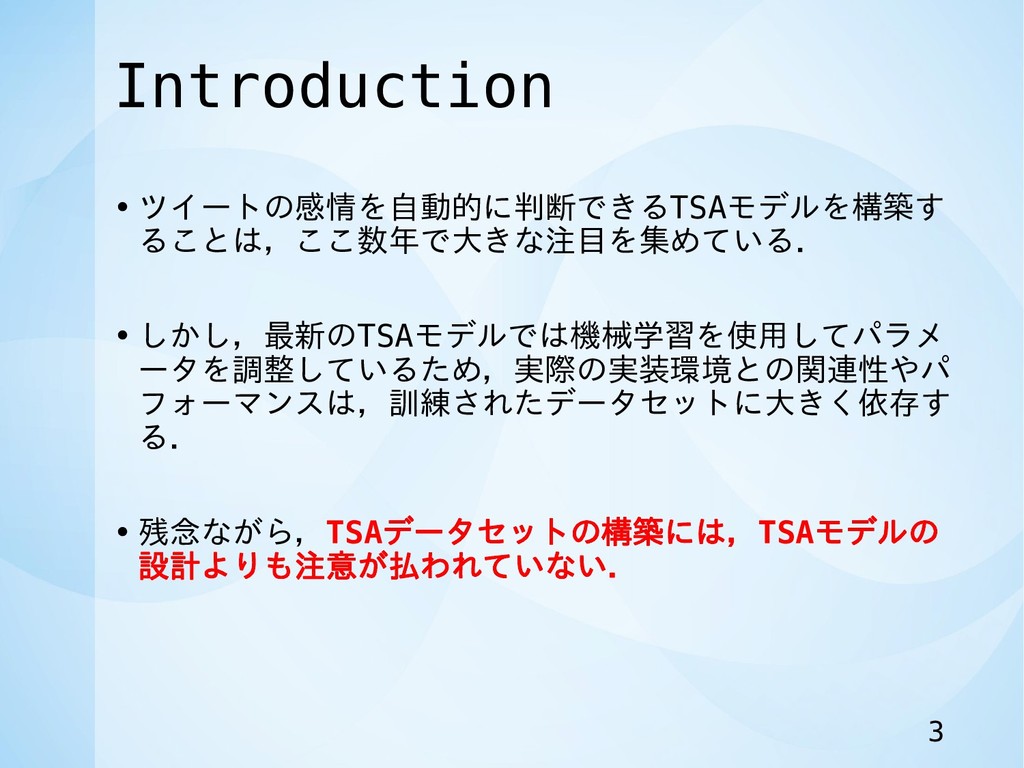
Introduction • ツイートの感情を自動的に判断できるTSAモデルを構築す ることは,ここ数年で大きな注目を集めている. • しかし,最新のTSAモデルでは機械学習を使用してパラメ ータを調整しているため,実際の実装環境との関連性やパ フォーマンスは,訓練されたデータセットに大きく依存す る. •
残念ながら,TSAデータセットの構築には,TSAモデルの 設計よりも注意が払われていない. 3
4
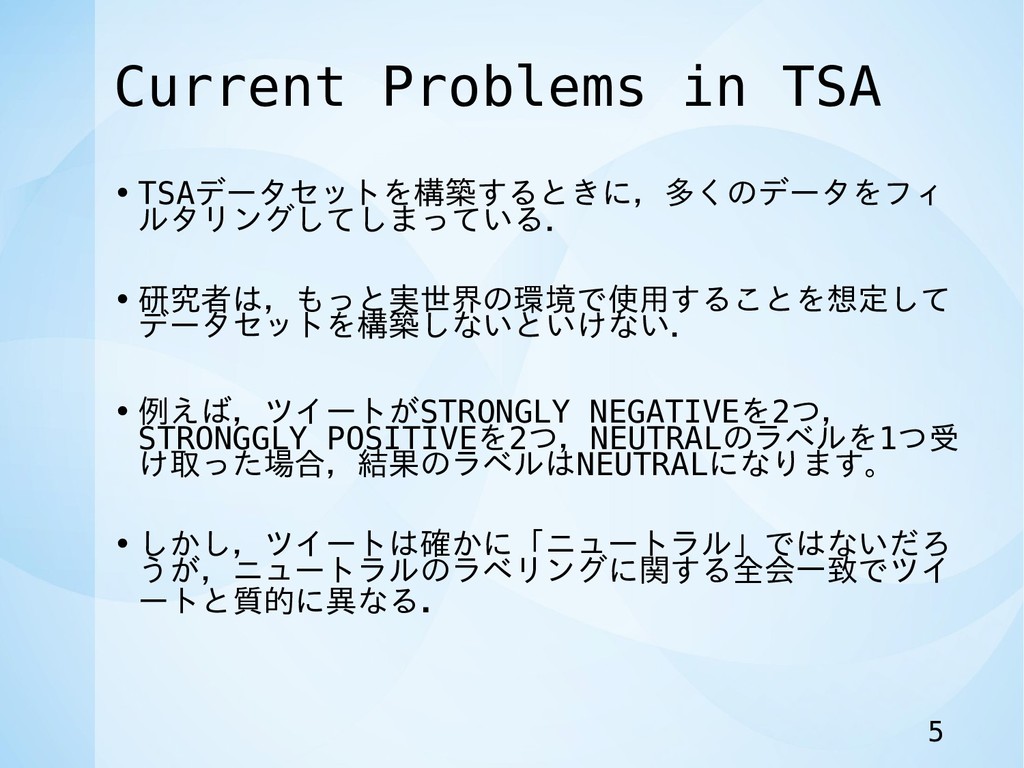
Current Problems in TSA • TSAデータセットを構築するときに,多くのデータをフィ ルタリングしてしまっている. • 研究者は,もっと実世界の環境で使用することを想定して データセットを構築しないといけない.
• 例えば,ツイートがSTRONGLY NEGATIVEを2つ, STRONGGLY POSITIVEを2つ,NEUTRALのラベルを1つ受 け取った場合,結果のラベルはNEUTRALになります。 • しかし,ツイートは確かに「ニュートラル」ではないだろ うが,ニュートラルのラベリングに関する全会一致でツイ ートと質的に異なる. 5
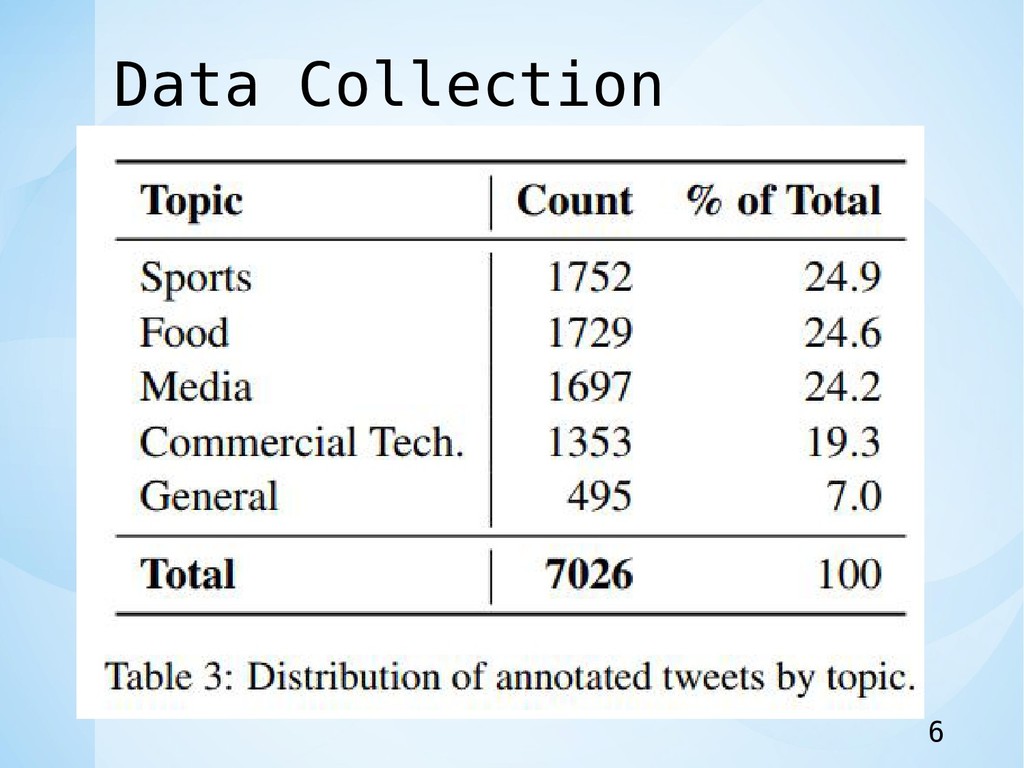
Data Collection 6
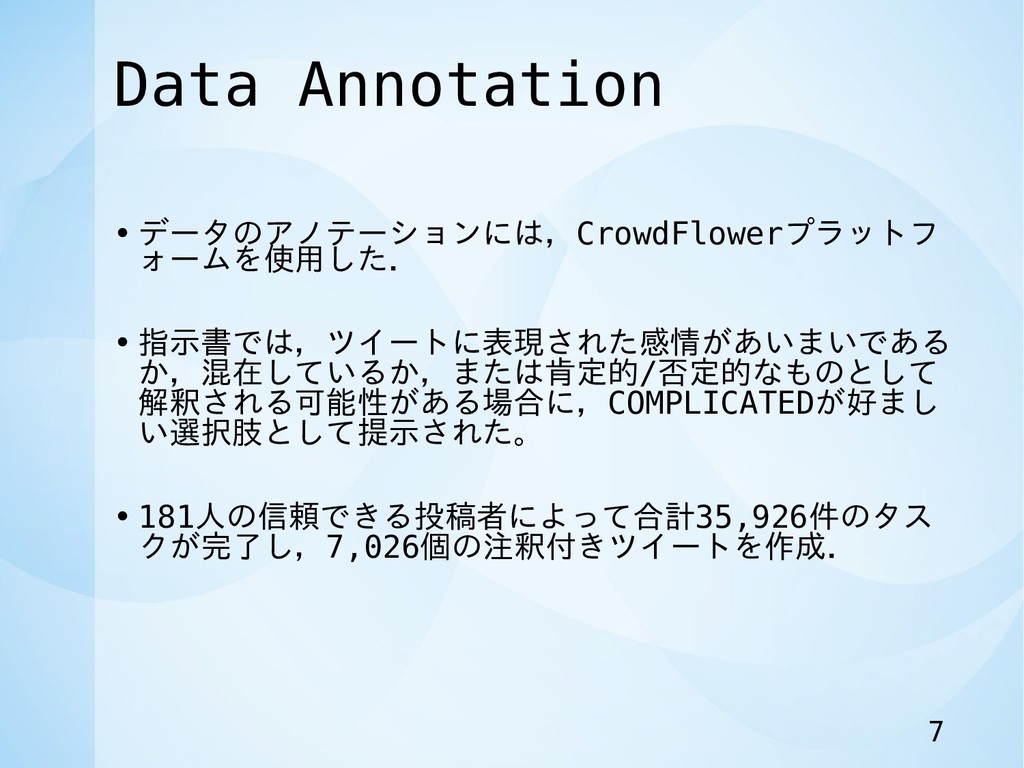
Data Annotation • データのアノテーションには,CrowdFlowerプラットフ ォームを使用した. • 指示書では,ツイートに表現された感情があいまいである か,混在しているか,または肯定的/否定的なものとして 解釈される可能性がある場合に,COMPLICATEDが好まし い選択肢として提示された。
• 181人の信頼できる投稿者によって合計35,926件のタス クが完了し,7,026個の注釈付きツイートを作成. 7
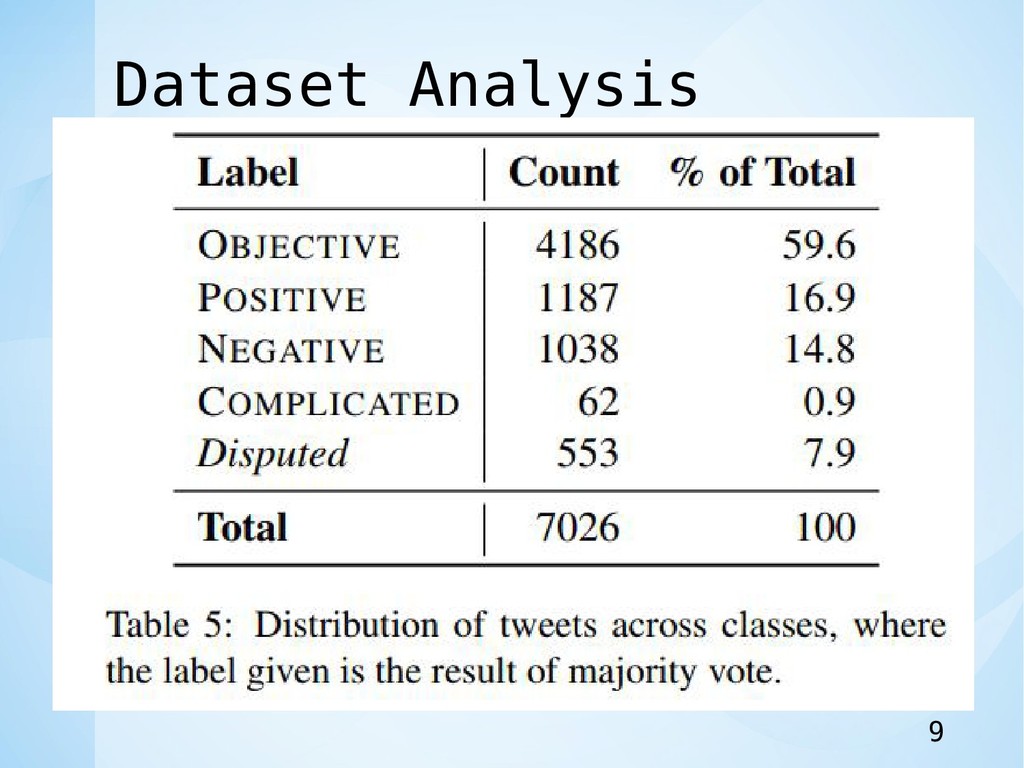
Dataset Analysis • 注釈付きのツイートは,満場一致(5つのうち5つがラベル で合意),コンセンサス(5つのうち4つが合意),多数 (5つのうち3つが合意),またはそれ以外. 8
Dataset Analysis 9
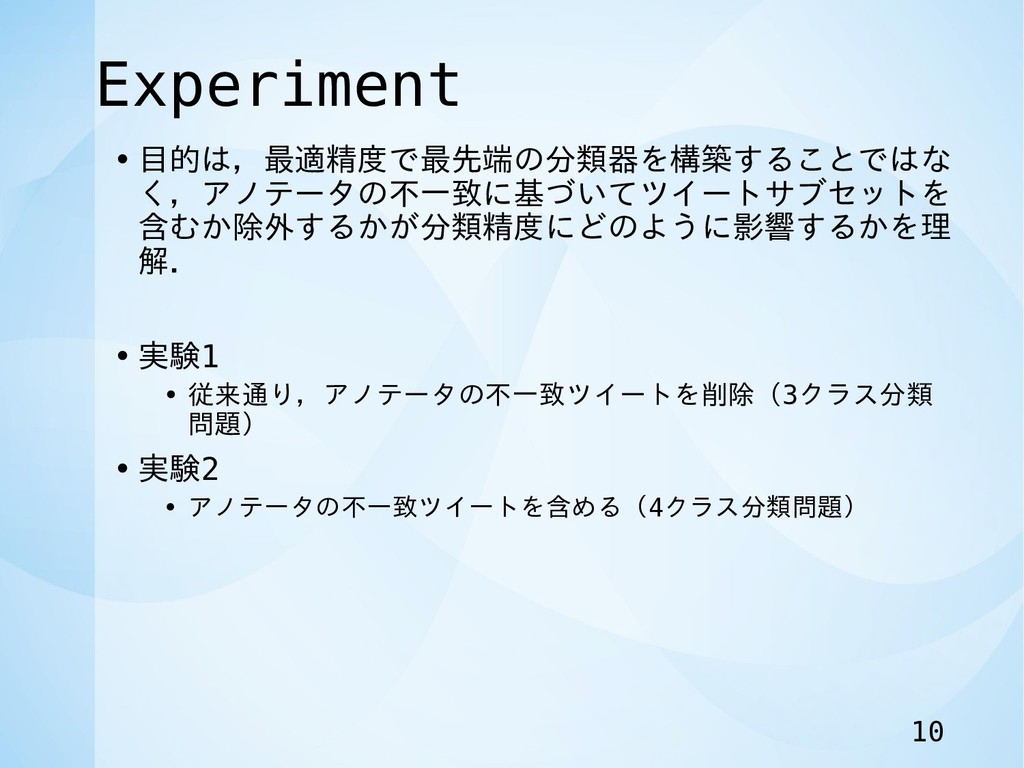
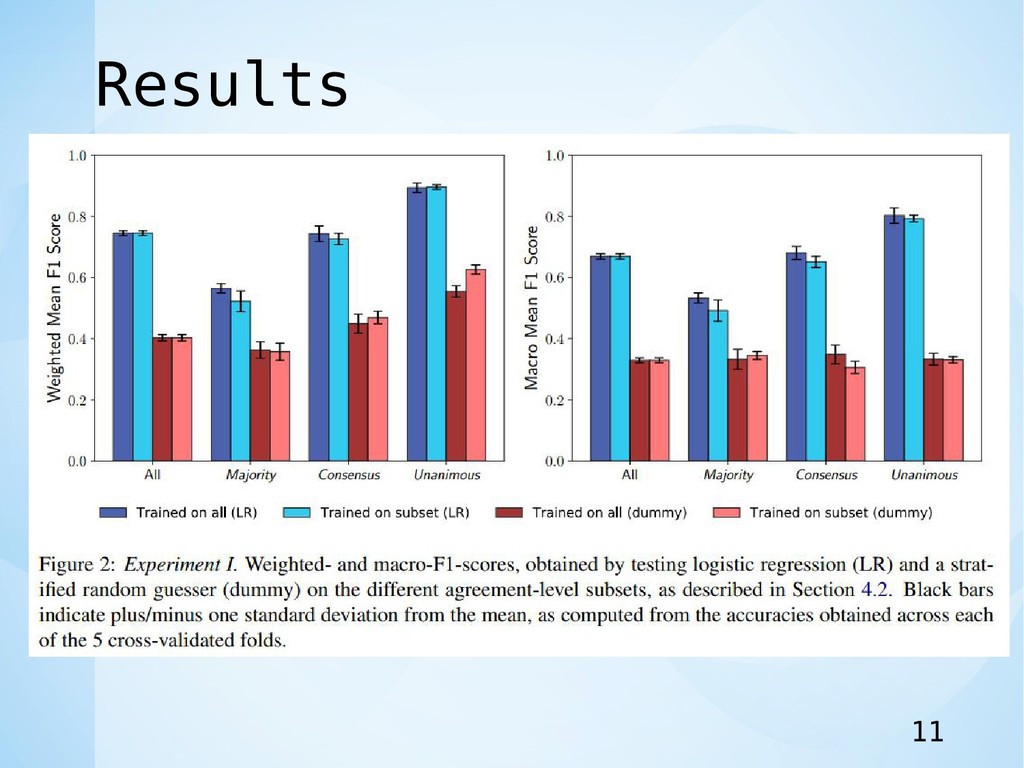
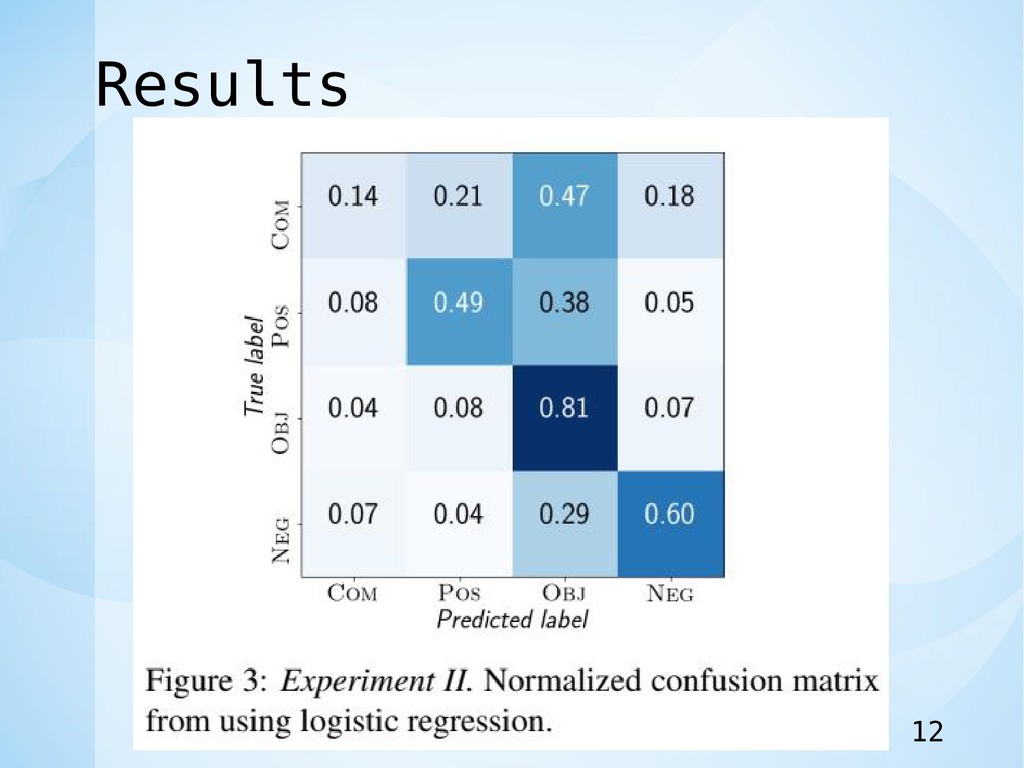
Experiment • 目的は,最適精度で最先端の分類器を構築することではな く,アノテータの不一致に基づいてツイートサブセットを 含むか除外するかが分類精度にどのように影響するかを理 解. • 実験1 • 従来通り,アノテータの不一致ツイートを削除(3クラス分類
問題) • 実験2 • アノテータの不一致ツイートを含める(4クラス分類問題) 10
Results 11
Results 12
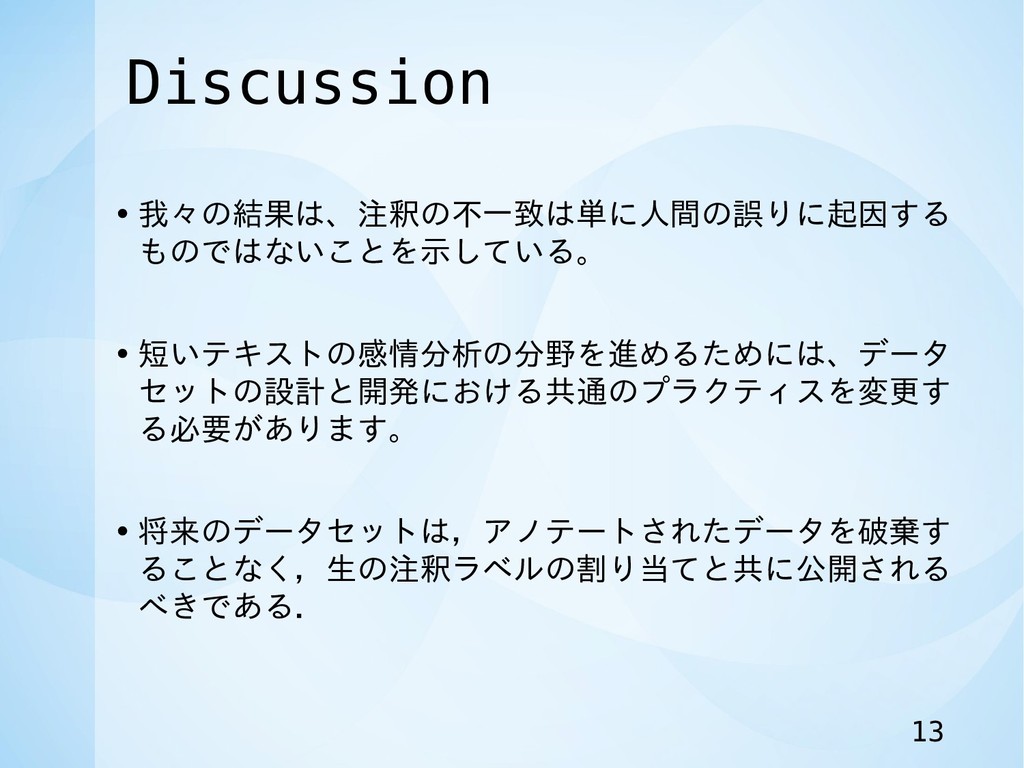
Discussion • 我々の結果は、注釈の不一致は単に人間の誤りに起因する ものではないことを示している。 • 短いテキストの感情分析の分野を進めるためには、データ セットの設計と開発における共通のプラクティスを変更す る必要があります。 • 将来のデータセットは,アノテートされたデータを破棄す
ることなく,生の注釈ラベルの割り当てと共に公開される べきである. 13
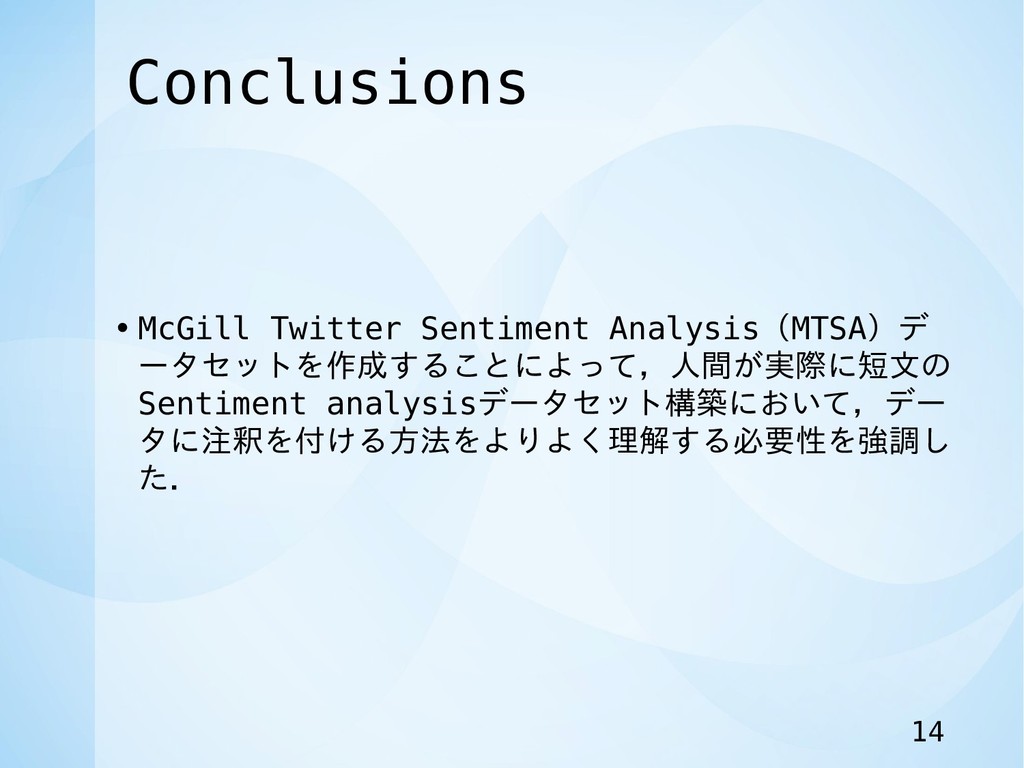
Conclusions • McGill Twitter Sentiment Analysis(MTSA)デ ータセットを作成することによって,人間が実際に短文の Sentiment analysisデータセット構築において,デー タに注釈を付ける方法をよりよく理解する必要性を強調し
た. 14
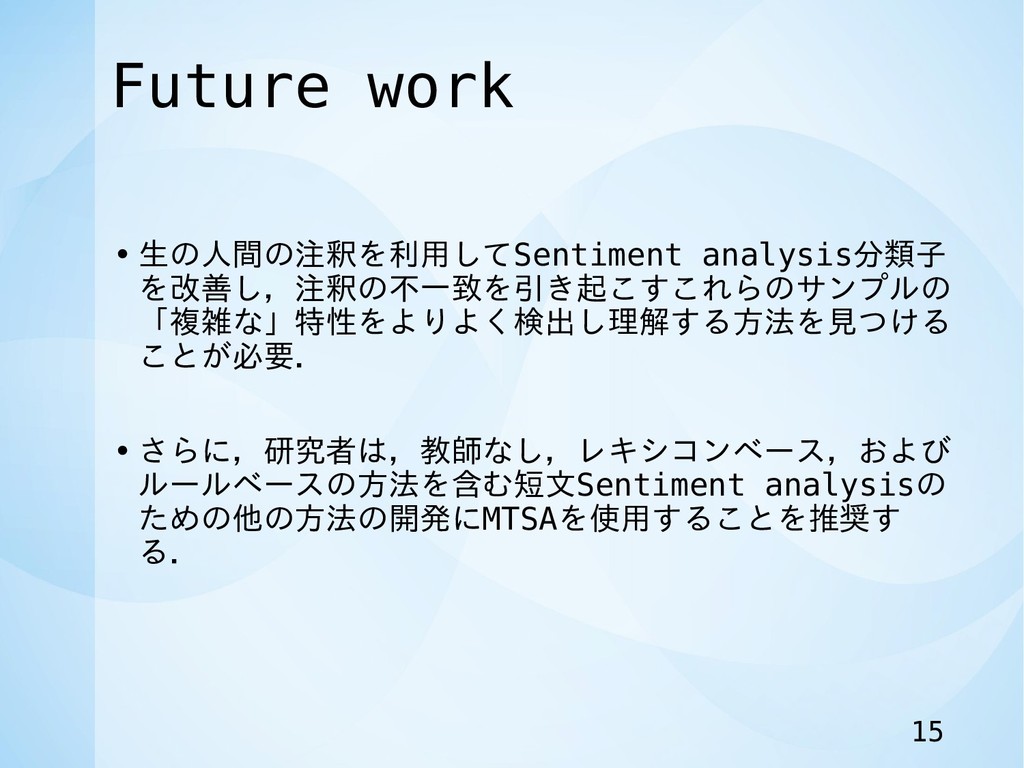
Future work • 生の人間の注釈を利用してSentiment analysis分類子 を改善し,注釈の不一致を引き起こすこれらのサンプルの 「複雑な」特性をよりよく検出し理解する方法を見つける ことが必要. • さらに,研究者は,教師なし,レキシコンベース,および
ルールベースの方法を含む短文Sentiment analysisの ための他の方法の開発にMTSAを使用することを推奨す る. 15


 yuto_kamiwaki
 hisaokatsumi
 yukako_nakano
 mathbullet
 takasehideki
 sokikatayama
.png) satai
satai
 ontheslope
 mickey_0226
 tkng
tkng
 nnaka2992
 izumiyama_lab
 rikkabotan7
.png) helenjbeal
helenjbeal
 katiecoart
 baasie
 aleyda
 marketingsoph
 cassininazir
 codingconduct
 takai
takai
 dugsong
 marktimemedia
 jlugia
 jmmastey