et al. Center for Computational Biology, Johns Hopkins University, Baltimore, MD https://www.biorxiv.org/content/10.1101/2025.05.05.652255v1 Journal club slides by Geo Pertea Lieber Institute for Brain Development
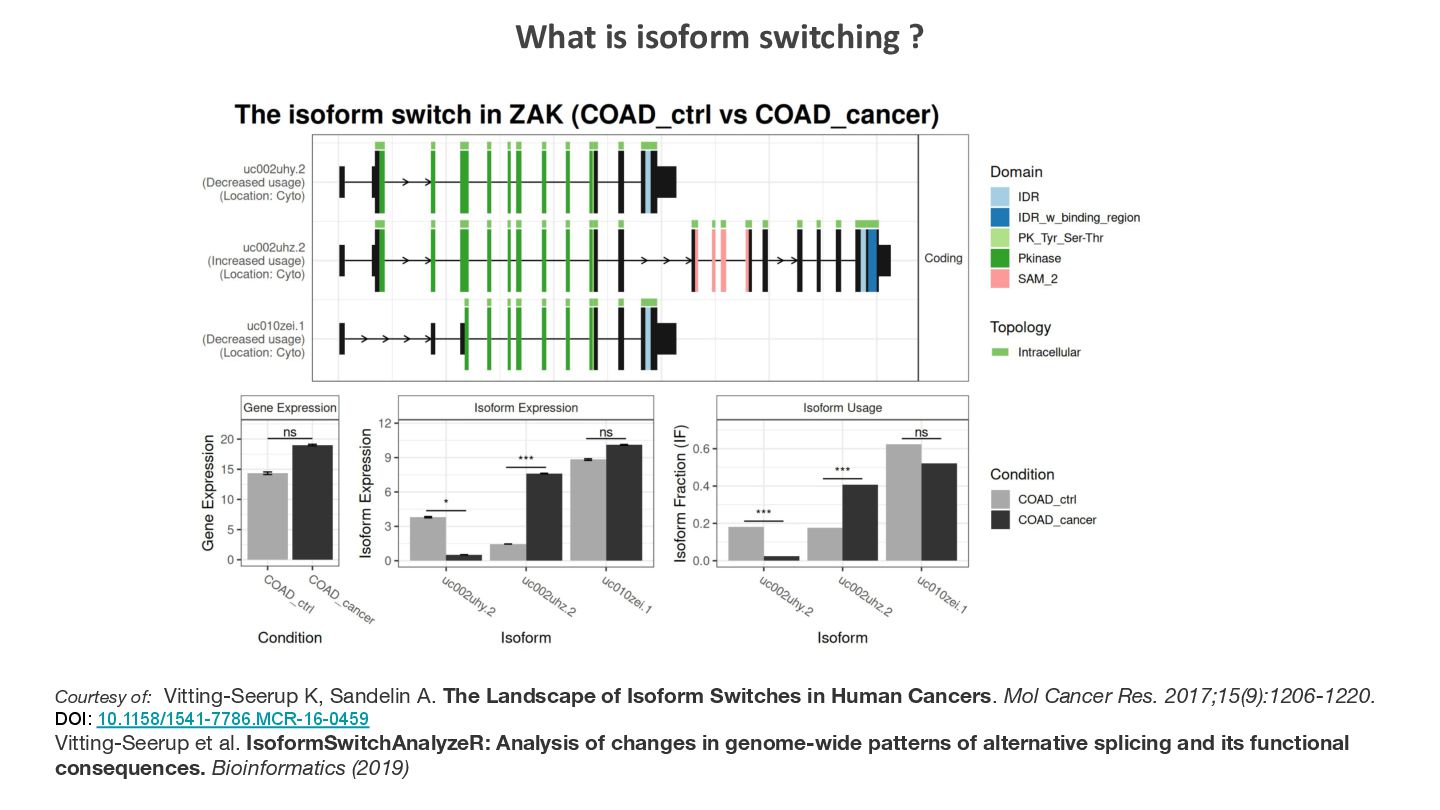
Switches in Human Cancers. Mol Cancer Res. 2017;15(9):1206-1220. DOI: 10.1158/1541-7786.MCR-16-0459 Vitting-Seerup et al. IsoformSwitchAnalyzeR: Analysis of changes in genome-wide patterns of alternative splicing and its functional consequences. Bioinformatics (2019) What is isoform switching ?
et al. (2018). Comprehensive map of age-associated splicing changes across human tissues and their contributions to age-associated diseases. Sci Rep. DOI: 10.1038/s41598-018-29086-2 ◦ comprehensive splicing events study across 48 human tissues (GTEx), including brain, showing superior age prediction vs. gene expression • Wang F et al. (2020). Improved Human Age Prediction by Using Gene Expression Profiles From Multiple Tissues. Sci Rep. DOI: 10.3389/fgene.2020.01025 ◦ single and multi-tissue (GTEx) age prediction • Ren X et al. (2020). RNAAgeCalc: A multi-tissue transcriptional age calculator. PLoS One. 2020 Aug 4;15(8):e0237006. DOI: 10.1371/journal.pone.0237006 • Shokhirev & Johnson (2021). Modeling the human aging transcriptome across tissues, health status, and sex. Aging Cell. DOI: 10.1111/acel.13280 ◦ meta-analysis of 3,060 human samples achieving high accuracy R²=0.98 in brain tissue (age 1-107) • Mboning L et al.(2025) BayesAge 2.0: a maximum likelihood algorithm to predict transcriptomic age. Geroscience. DOI:10.1007/s11357-024-01499-0
samples from LIBD with age ranging from prenatal to 85+ years of age. 341 DLPFC samples Salmon CHESS 3.1.1 transcripts SPIT (DTU) isoform fractions prenatal (56) adult CTL postnatal
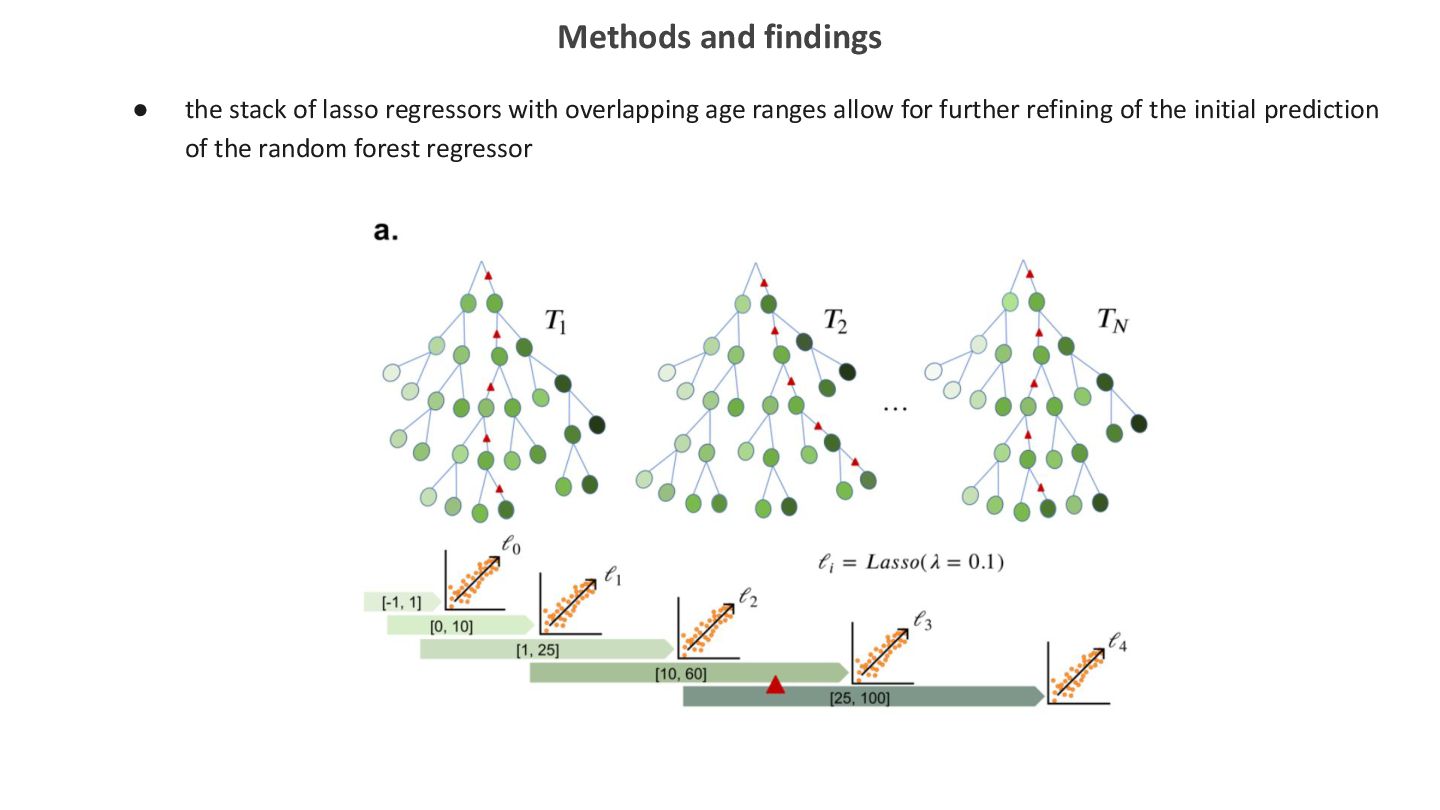
in brain tissue • log-transformed chonological age was used to give greater weight to expression changes in earlier life stages, which improved accuracy • the model was further refined through feature selection, using only top 100 genes (341) transcripts, resulting in R² score of 0.977 feature importances feature selection 341 transcripts (100 genes) initial random forest regressor isoform fractions Methods and findings
a specific age range • this allows for better biological interpretability of the variable contributions of isoform switches in the 100 genes, across different age ranges
on the LIBD data was validated on a dataset of 53 human forebrain samples (Cardoso-Moreira et al., 2019): R²= 0.924 • to assess tissue specificity, a similar model was trained on IFs from 261 GTEx left-ventricle heart samples (ages 20-70) - where it performed very poorly (R²= 0.08) • reproducing the method on macaque transcriptome ◦ generate a better transcritpome annotation (realigning RNAseq to the genome), focusing on strongest predictive isoswitches in PALM and SNAP25 ◦ patterns similar to human isoform switching were observed there, suggesting evolutionary conservation of isoswitches across age ranges
impact of age-related isoform switches on protein structures, protein domain alterations, loss-of-function and other age-related biomolecular changes • protein modifications can impact biological pathways and cellular functions, and can provide a better understanding of the molecular underpinnings of brain development and aging


 gpertea
 yukako_nakano
 xspa2012
 institutdelelevage
 izumiyama_lab
 koide3
 fr0gger
 kohlerjohannes
 gpeyre
 murakawatakuya
 mickey_0226
 kobayashi31
 nzw0301
 tmiket
 jacobian
 cassininazir
 reverentgeek
 eileencodes
 quramy
 kevinliebholz
 jonoalderson
 jacobtomlinson
 sarafernandez
 chrisshort