• Why we do what we do? • How we do what we do? • StratMap and AECOM Geospa4al Solu4ons • Geospa4al Data Products (Category 1) • Custom Geospa4al Data and Services (Category 2) • Ques4ons and Group Discussion
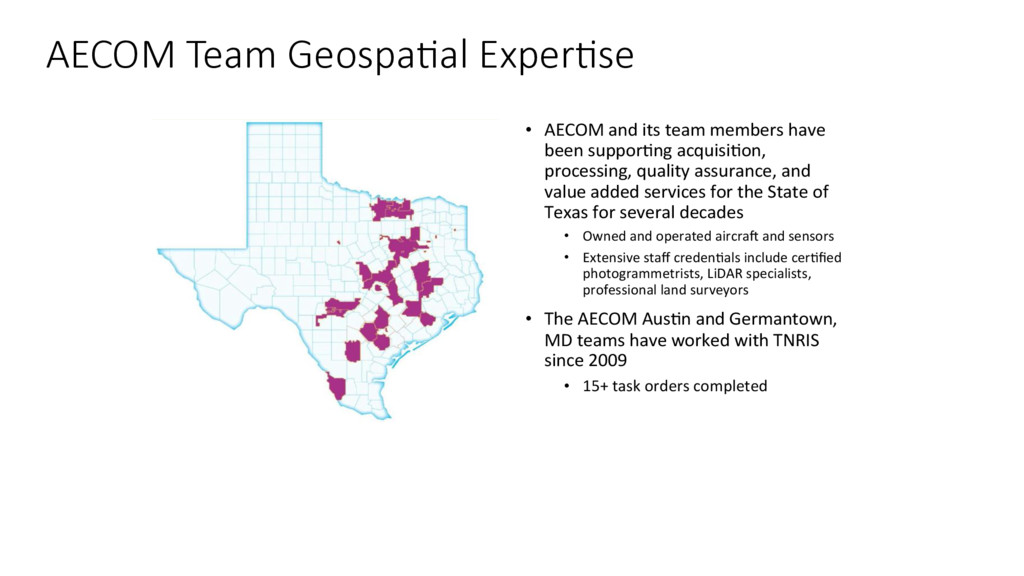
processing, quality assurance, and value added services for the State of Texas for several decades • Owned and operated aircraX and sensors • Extensive staff creden4als include cer4fied photogrammetrists, LiDAR specialists, professional land surveyors • The AECOM Aus4n and Germantown, MD teams have worked with TNRIS since 2009 • 15+ task orders completed AECOM Team Geospa>al Exper>se
of informa4on over large areas: • Feature Data • Air Quality • Change detec4on • Environmental and Social Impact Assessments • Environmental Disaster Response monitoring • Forest Canopy Health assessments • Power Line rou4ng studies • Land Use/Land Cover • Natural Resources • Geology • ReseFlement • Water U4liza4on • Wetland Mapping • Etc… Satellite Imagery Applica>ons
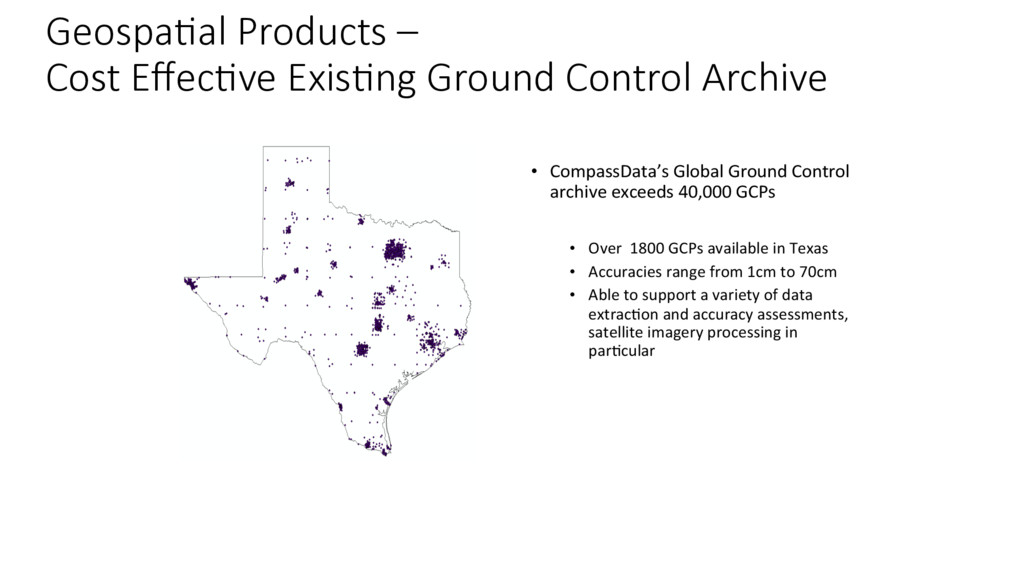
Over 1800 GCPs available in Texas • Accuracies range from 1cm to 70cm • Able to support a variety of data extrac4on and accuracy assessments, satellite imagery processing in par4cular Geospa>al Products – Cost Effec>ve Exis>ng Ground Control Archive
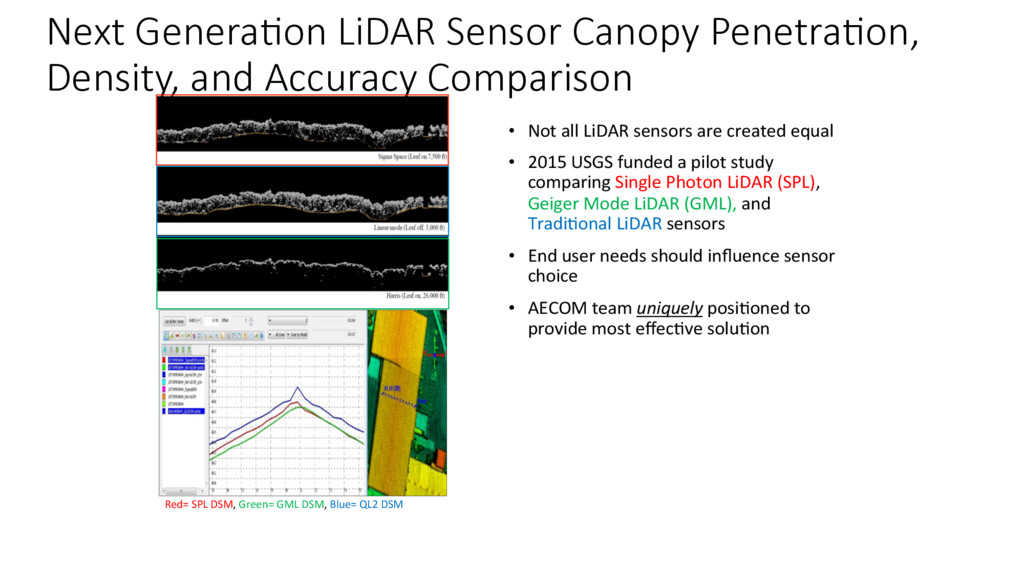
USGS funded a pilot study comparing Single Photon LiDAR (SPL), Geiger Mode LiDAR (GML), and Tradi4onal LiDAR sensors • End user needs should influence sensor choice • AECOM team uniquely posi4oned to provide most effec4ve solu4on Next Genera>on LiDAR Sensor Canopy Penetra>on, Density, and Accuracy Comparison Red= SPL DSM, Green= GML DSM, Blue= QL2 DSM
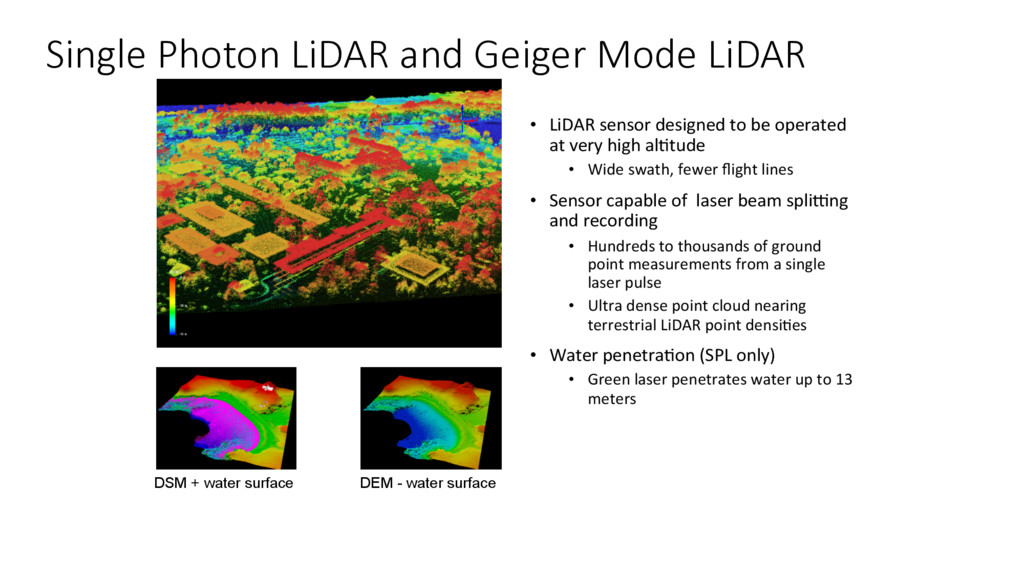
al4tude • Wide swath, fewer flight lines • Sensor capable of laser beam spliqng and recording • Hundreds to thousands of ground point measurements from a single laser pulse • Ultra dense point cloud nearing terrestrial LiDAR point densi4es • Water penetra4on (SPL only) • Green laser penetrates water up to 13 meters Single Photon LiDAR and Geiger Mode LiDAR DSM + water surface DEM - water surface
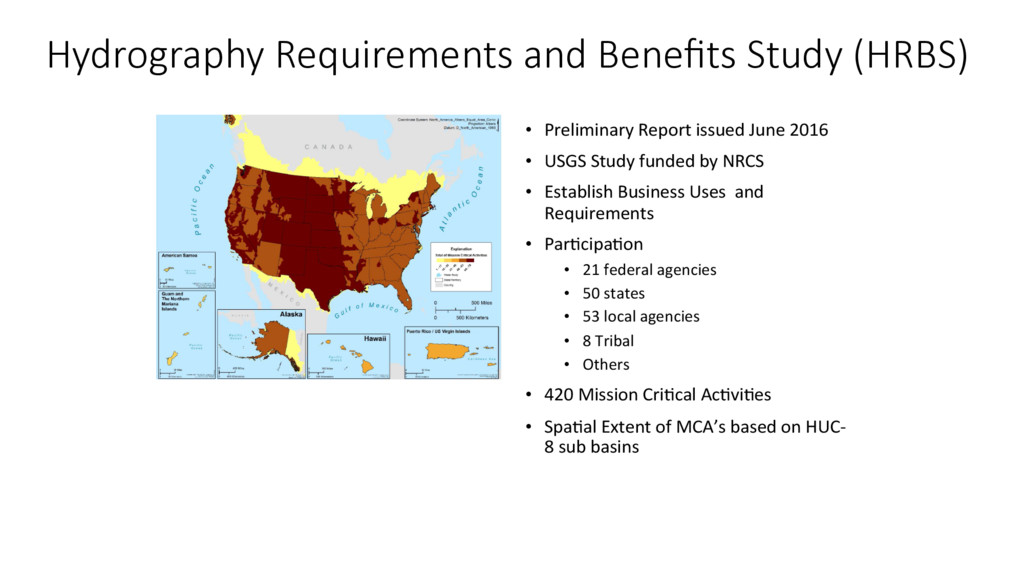
by NRCS • Establish Business Uses and Requirements • Par4cipa4on • 21 federal agencies • 50 states • 53 local agencies • 8 Tribal • Others • 420 Mission Cri4cal Ac4vi4es • Spa4al Extent of MCA’s based on HUC- 8 sub basins Hydrography Requirements and Benefits Study (HRBS)
Resource Management and Protec4on • Implemen4ng Programs of the Clean Water Act • Natural Resource Iden4ficaton and Conserva4on • Science Based Decision Making • Surface Water Data Colleciton and Analysis • Sustaining Healthy Water and EcoSystems • Water Rights Permiqng and Administra4on HRBS and Texas Mission Cri>cal Ac>vi>es
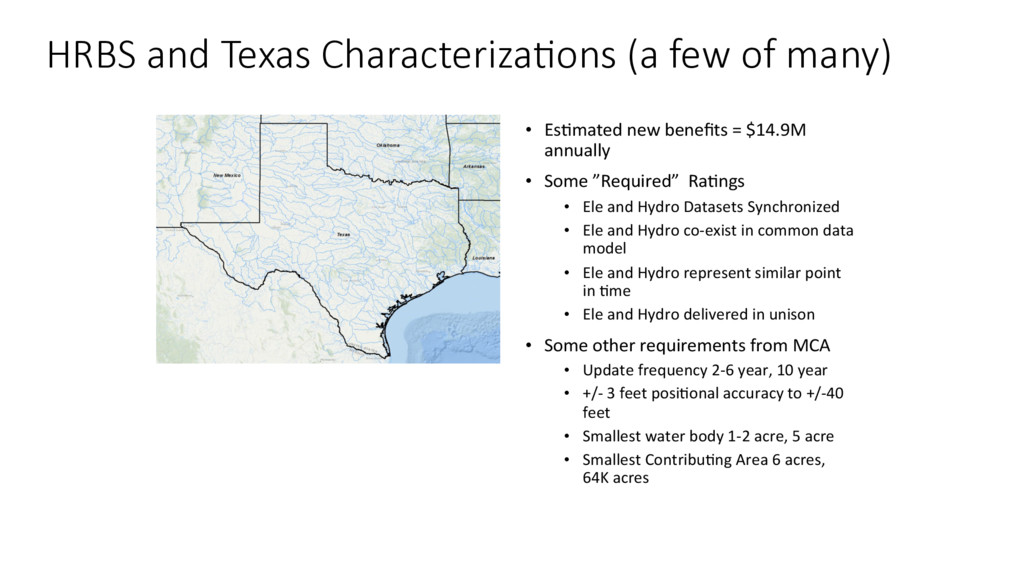
Ra4ngs • Ele and Hydro Datasets Synchronized • Ele and Hydro co-exist in common data model • Ele and Hydro represent similar point in 4me • Ele and Hydro delivered in unison • Some other requirements from MCA • Update frequency 2-6 year, 10 year • +/- 3 feet posi4onal accuracy to +/-40 feet • Smallest water body 1-2 acre, 5 acre • Smallest Contribu4ng Area 6 acres, 64K acres HRBS and Texas Characteriza>ons (a few of many)
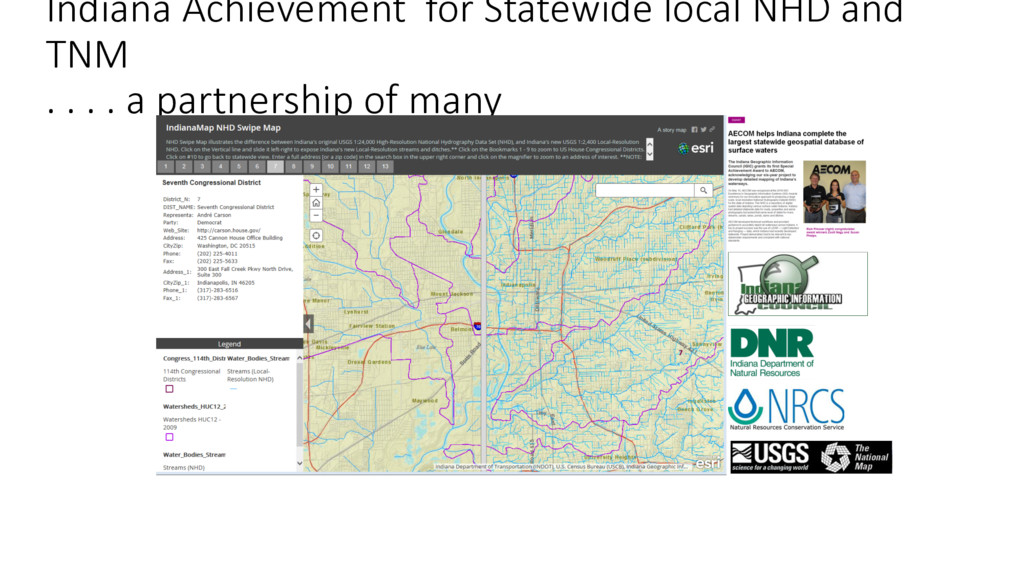
user base • Base Data Collec4on and Prepara4on • LiDAR, imagery, exis4ng NHD, local hydro and stormwater data, dams, etc. • Generate Terrain Reference Files • Local-Res NHD Linework Using Reference Files – Confla4on / AFribu4on for GNIS, Na4onal Map, Reach Numbers, Upload to Na4onal Map, TNRIS, as steward or through steward AECOM Experience with Ele-Hydro (Since 2006)
extraction • Improve techniques for automated conflation/ replacement • Develop services and staged product extractions based on data model Future State • Hydrography data are acquired from lidar source • Integrated Z values • Integrated data model with 3DEP • Data model can relay hydro, 3DEP, or both • Interoperability between NHD, WBD, 3DEP, StreamStats • Produce 20% of CONUS lidar derived hydrography • Produce 10% of CONUS lidar-derived NHD+ • Establish volunteer committees • Establish breakline committee • Event migration for generalization capability • NHD+HR pilot apps • Elehydro research (Committee) • Begin to develop integrated data model Major Actions Early Stages of Development and Planning Draft Timeline, V. Lukas, USGS, March 2016


 texasnaturalresourcesinformationsytem
 occhi
occhi
.png) yamad
yamad
 onk
onk
 makocchi
 kaminashi
 shugo
shugo
 jyouryuusui
 pfn
pfn
 kentarofujii
 hiracky16
 persolserverworks
 genda
genda
 katarinadahlin
 62gerente
 ammeep
 sferik
 lcolladotor
 rakko
rakko
 skipperchong
 jonoalderson
 eitanlees
 sstephenson
 aleyda
 keavy
keavy











![Thank You [email protected] [email protected] [email protected] July 2016](https://files.speakerdeck.com/presentations/4bf7ef610e474c2c996ed22dacff6bed/slide_31.jpg)