What Does an SEO Company Do? Follow One Fix to ...

Share
Embed
What Does an SEO Company Do? Follow One Fix to Validation
What does an SEO company do when recommendations, implementation and verified completion are hard to distinguish? This workshop follows a canonical template fix through ownership, acceptance criteria and production validation. Learn to define deliverables and evidence without confusing completed work with search or business outcomes. Use the framework to answer what does an SEO company do in your next technical SEO engagement: https://guaranteedseoservices.com/what-does-an-seo-company-do/?utm_source=speakerdeck&utm_medium=referral&utm_campaign=blog-what-does-an-seo-company-do

GuaranteedSEOServices
October 26, 2026
Transcript
20 slides
-
What Does an SEO Company Do? Follow One Canonical Fix
from Research to Validation Gaps between responsibilities matter more than team size. Follow a canonical template fix through diagnosis, implementation and validation to see what each person owns, what evidence proves completion and what remains outside the team's control. GuaranteedSEOServices.com October 27, 2026 -
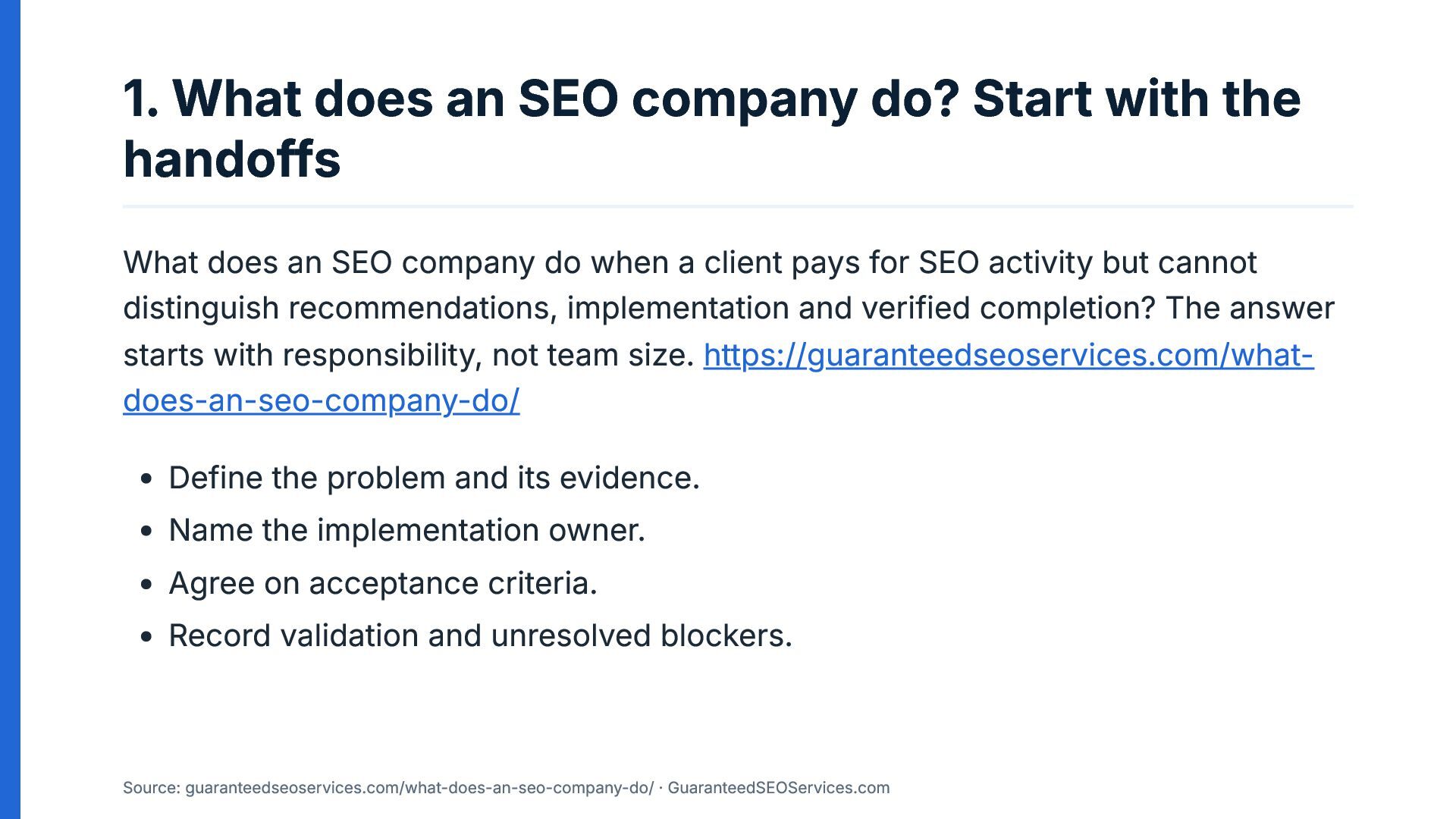
1. What does an SEO company do? Start with the
handoffs What does an SEO company do when a client pays for SEO activity but cannot distinguish recommendations, implementation and verified completion? The answer starts with responsibility, not team size. https://guaranteedseoservices.com/whatdoes-an-seo-company-do/ Define the problem and its evidence. Name the implementation owner. Agree on acceptance criteria. Record validation and unresolved blockers. Source: guaranteedseoservices.com/what-does-an-seo-company-do/ · GuaranteedSEOServices.com -
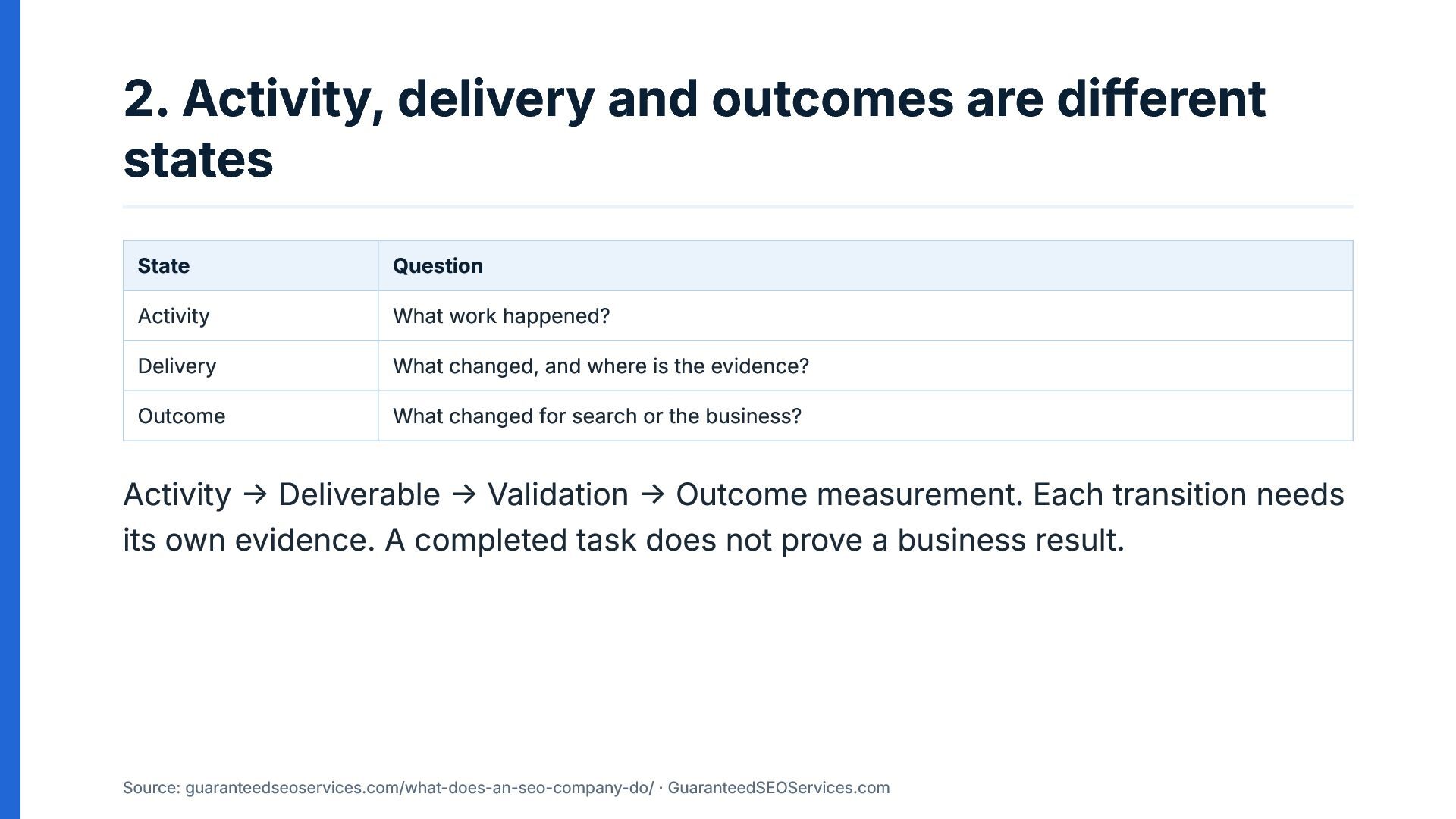
2. Activity, delivery and outcomes are different states State Question
Activity What work happened? Delivery What changed, and where is the evidence? Outcome What changed for search or the business? Activity → Deliverable → Validation → Outcome measurement. Each transition needs its own evidence. A completed task does not prove a business result. Source: guaranteedseoservices.com/what-does-an-seo-company-do/ · GuaranteedSEOServices.com -
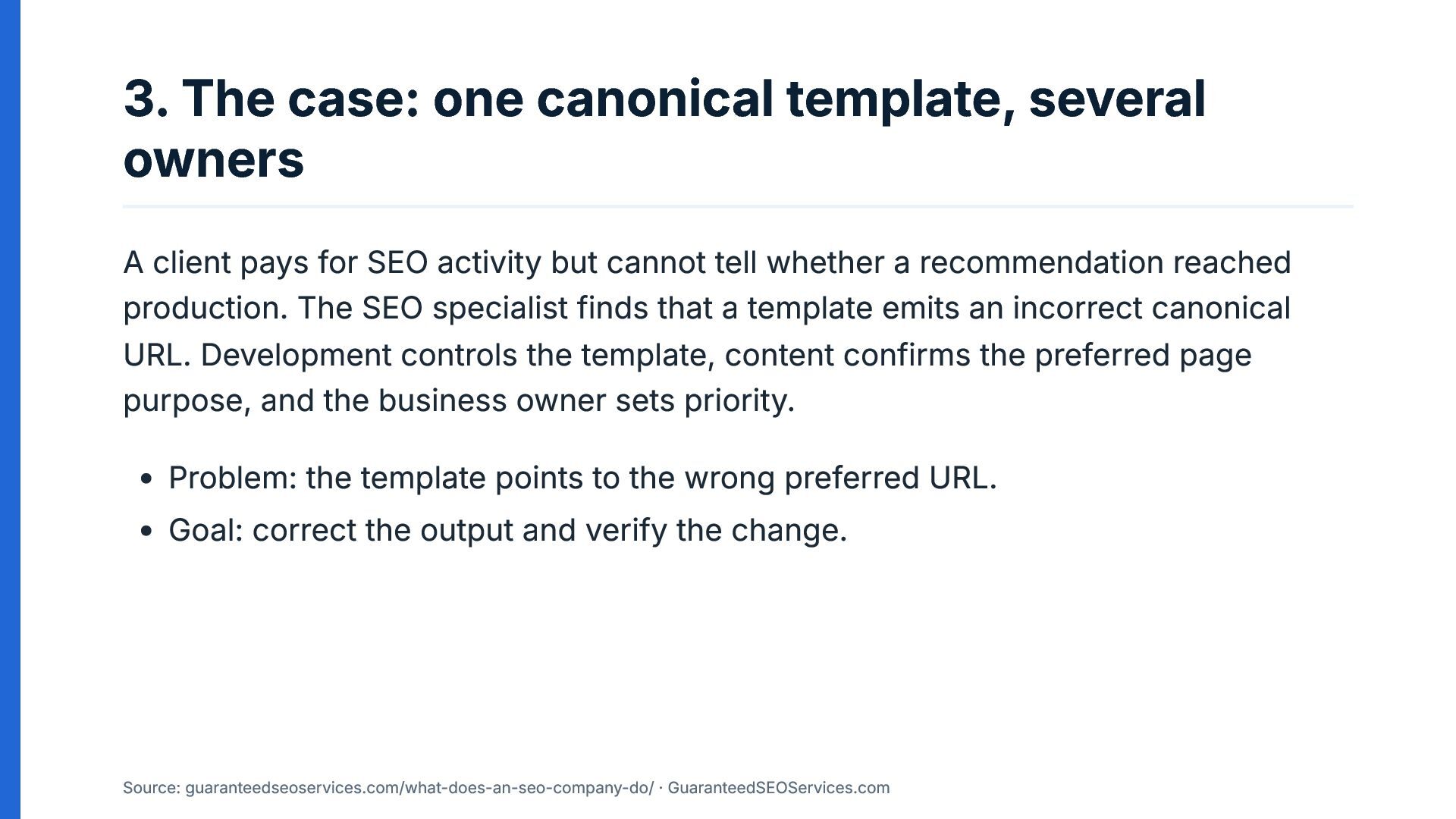
3. The case: one canonical template, several owners A client
pays for SEO activity but cannot tell whether a recommendation reached production. The SEO specialist finds that a template emits an incorrect canonical URL. Development controls the template, content confirms the preferred page purpose, and the business owner sets priority. Problem: the template points to the wrong preferred URL. Goal: correct the output and verify the change. Source: guaranteedseoservices.com/what-does-an-seo-company-do/ · GuaranteedSEOServices.com -
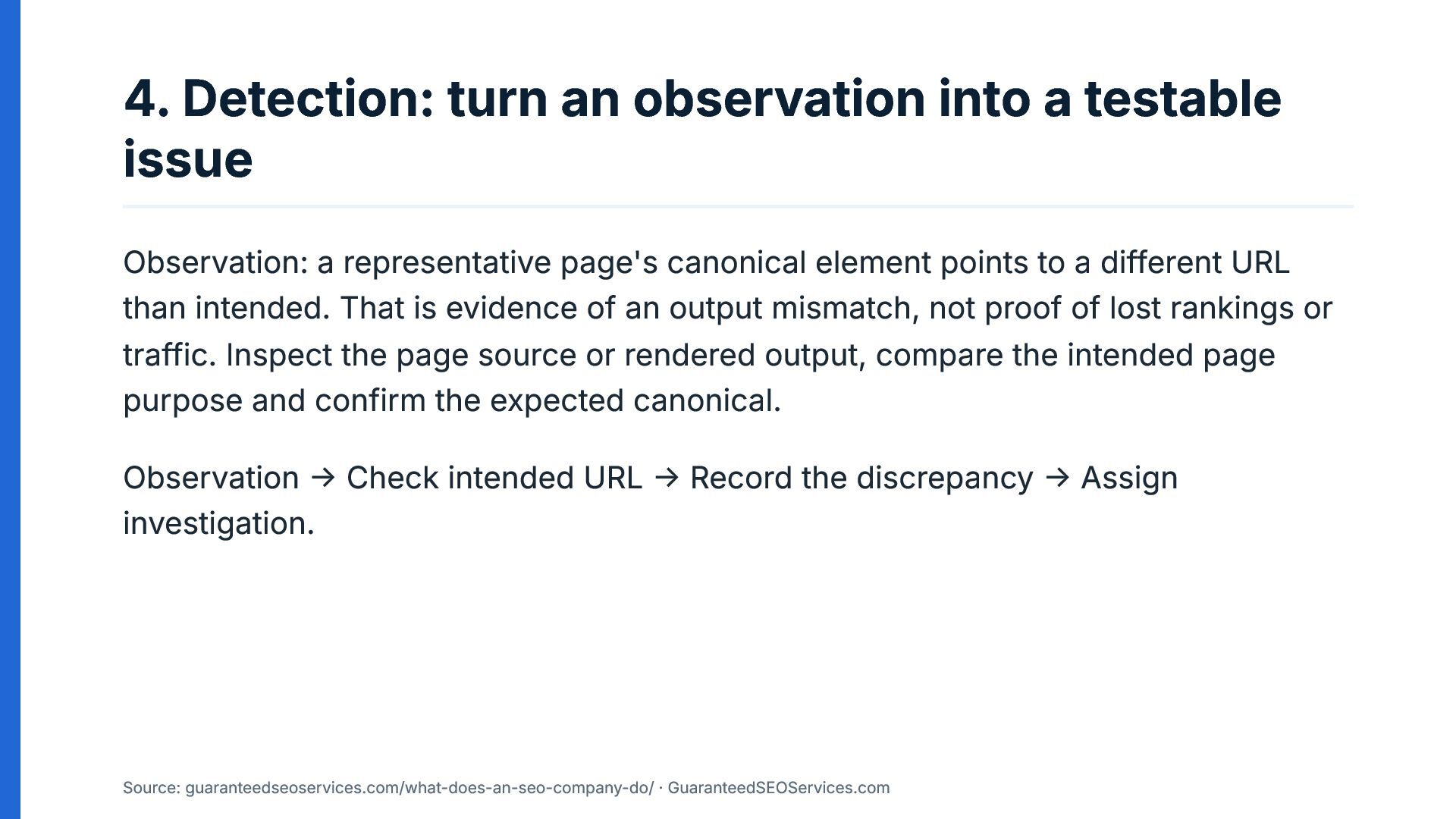
4. Detection: turn an observation into a testable issue Observation:
a representative page's canonical element points to a different URL than intended. That is evidence of an output mismatch, not proof of lost rankings or traffic. Inspect the page source or rendered output, compare the intended page purpose and confirm the expected canonical. Observation → Check intended URL → Record the discrepancy → Assign investigation. Source: guaranteedseoservices.com/what-does-an-seo-company-do/ · GuaranteedSEOServices.com -
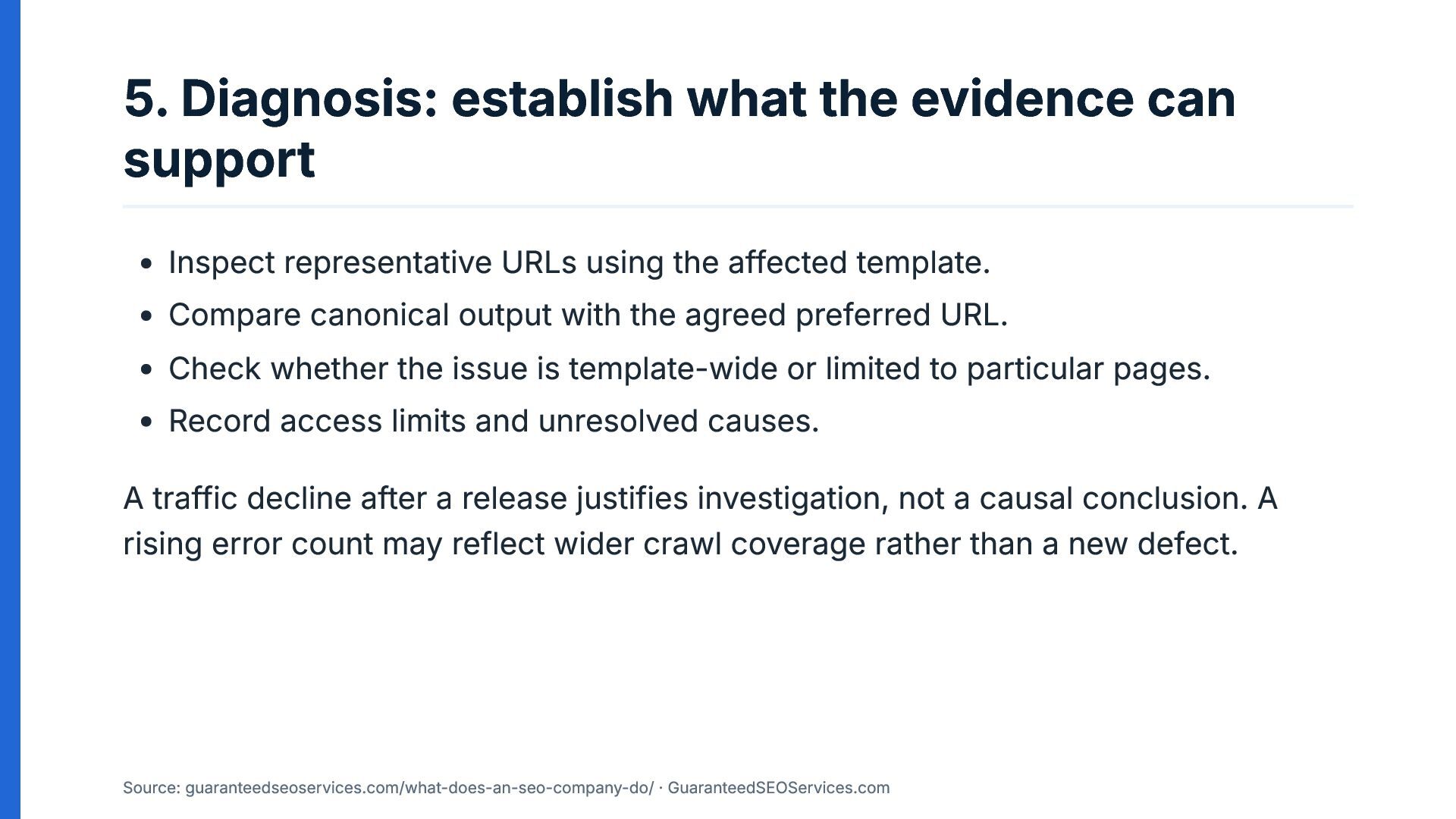
5. Diagnosis: establish what the evidence can support Inspect representative
URLs using the affected template. Compare canonical output with the agreed preferred URL. Check whether the issue is template-wide or limited to particular pages. Record access limits and unresolved causes. A traffic decline after a release justifies investigation, not a causal conclusion. A rising error count may reflect wider crawl coverage rather than a new defect. Source: guaranteedseoservices.com/what-does-an-seo-company-do/ · GuaranteedSEOServices.com -
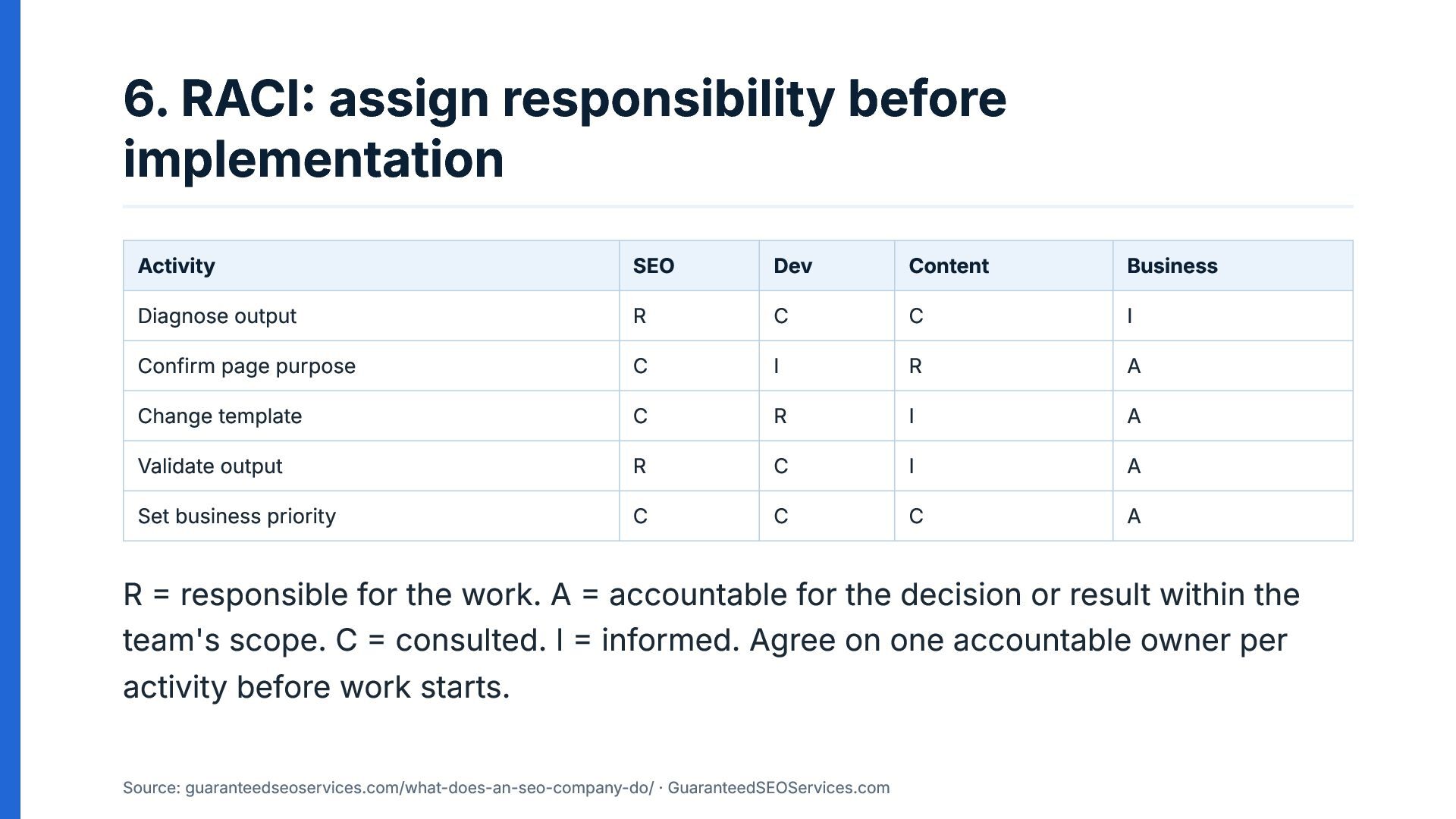
6. RACI: assign responsibility before implementation Activity SEO Dev Content
Business Diagnose output R C C I Confirm page purpose C I R A Change template C R I A Validate output R C I A Set business priority C C C A R = responsible for the work. A = accountable for the decision or result within the team's scope. C = consulted. I = informed. Agree on one accountable owner per activity before work starts. Source: guaranteedseoservices.com/what-does-an-seo-company-do/ · GuaranteedSEOServices.com -
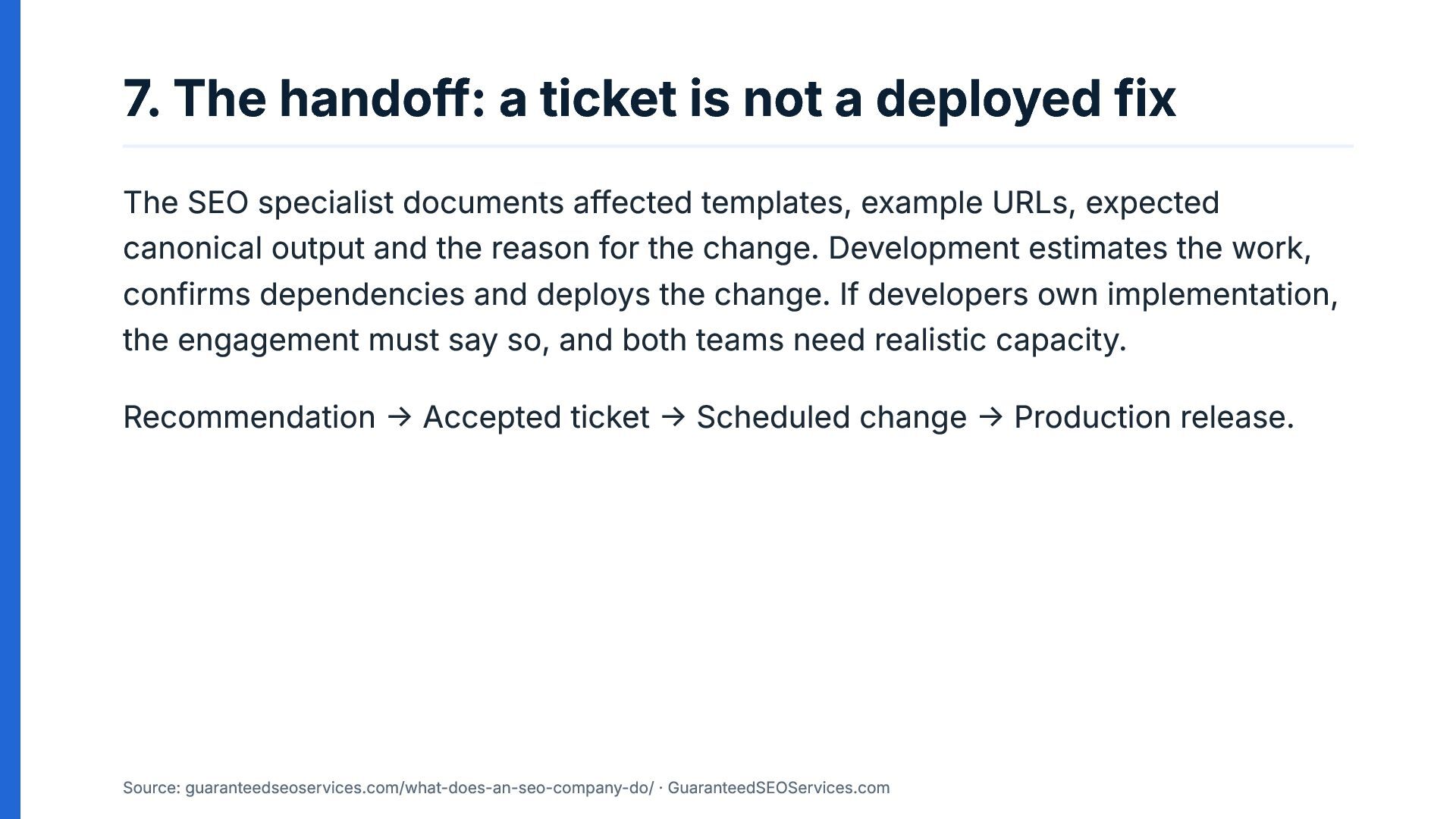
7. The handoff: a ticket is not a deployed fix
The SEO specialist documents affected templates, example URLs, expected canonical output and the reason for the change. Development estimates the work, confirms dependencies and deploys the change. If developers own implementation, the engagement must say so, and both teams need realistic capacity. Recommendation → Accepted ticket → Scheduled change → Production release. Source: guaranteedseoservices.com/what-does-an-seo-company-do/ · GuaranteedSEOServices.com -
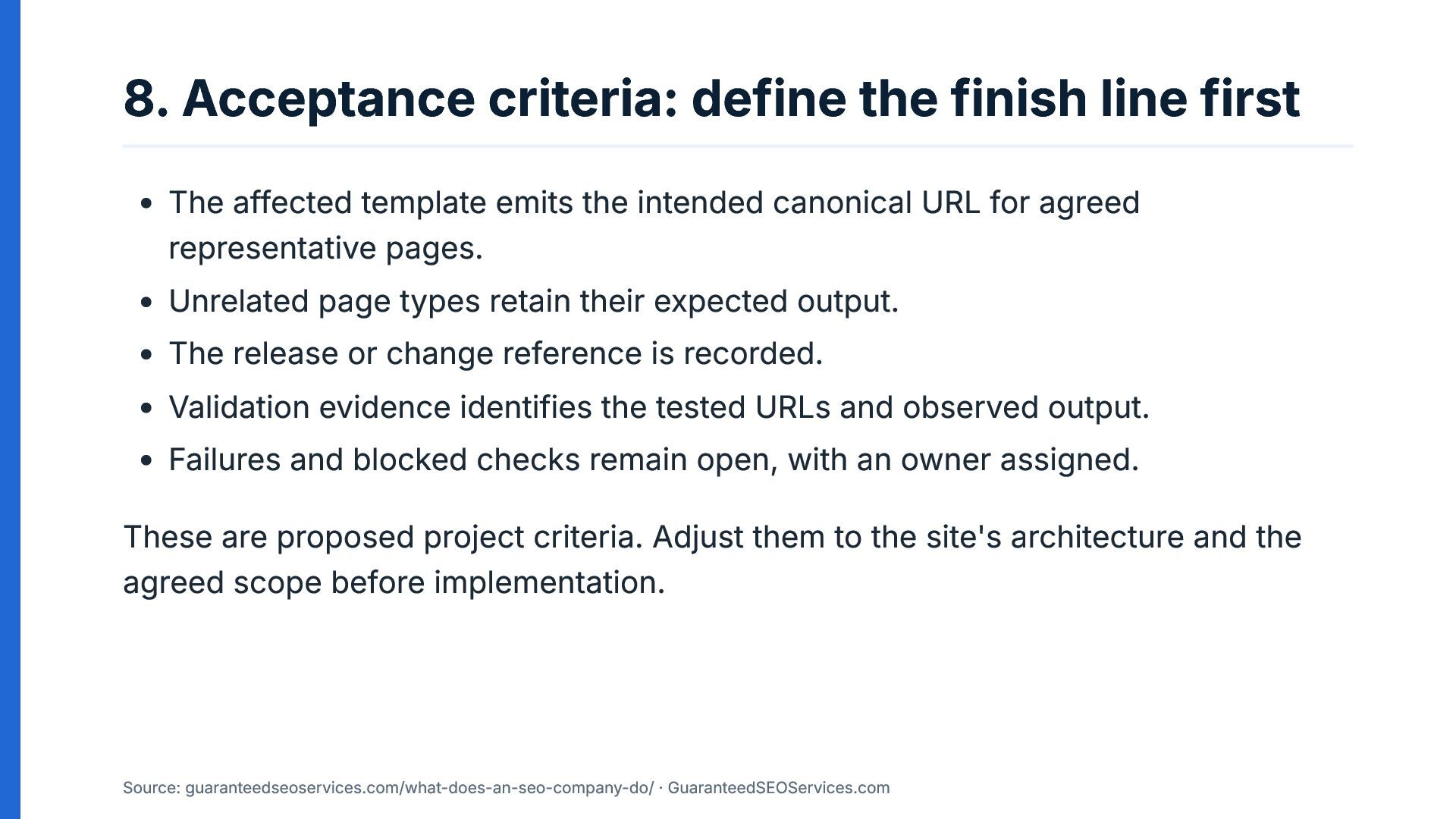
8. Acceptance criteria: define the finish line first The affected
template emits the intended canonical URL for agreed representative pages. Unrelated page types retain their expected output. The release or change reference is recorded. Validation evidence identifies the tested URLs and observed output. Failures and blocked checks remain open, with an owner assigned. These are proposed project criteria. Adjust them to the site's architecture and the agreed scope before implementation. Source: guaranteedseoservices.com/what-does-an-seo-company-do/ · GuaranteedSEOServices.com -
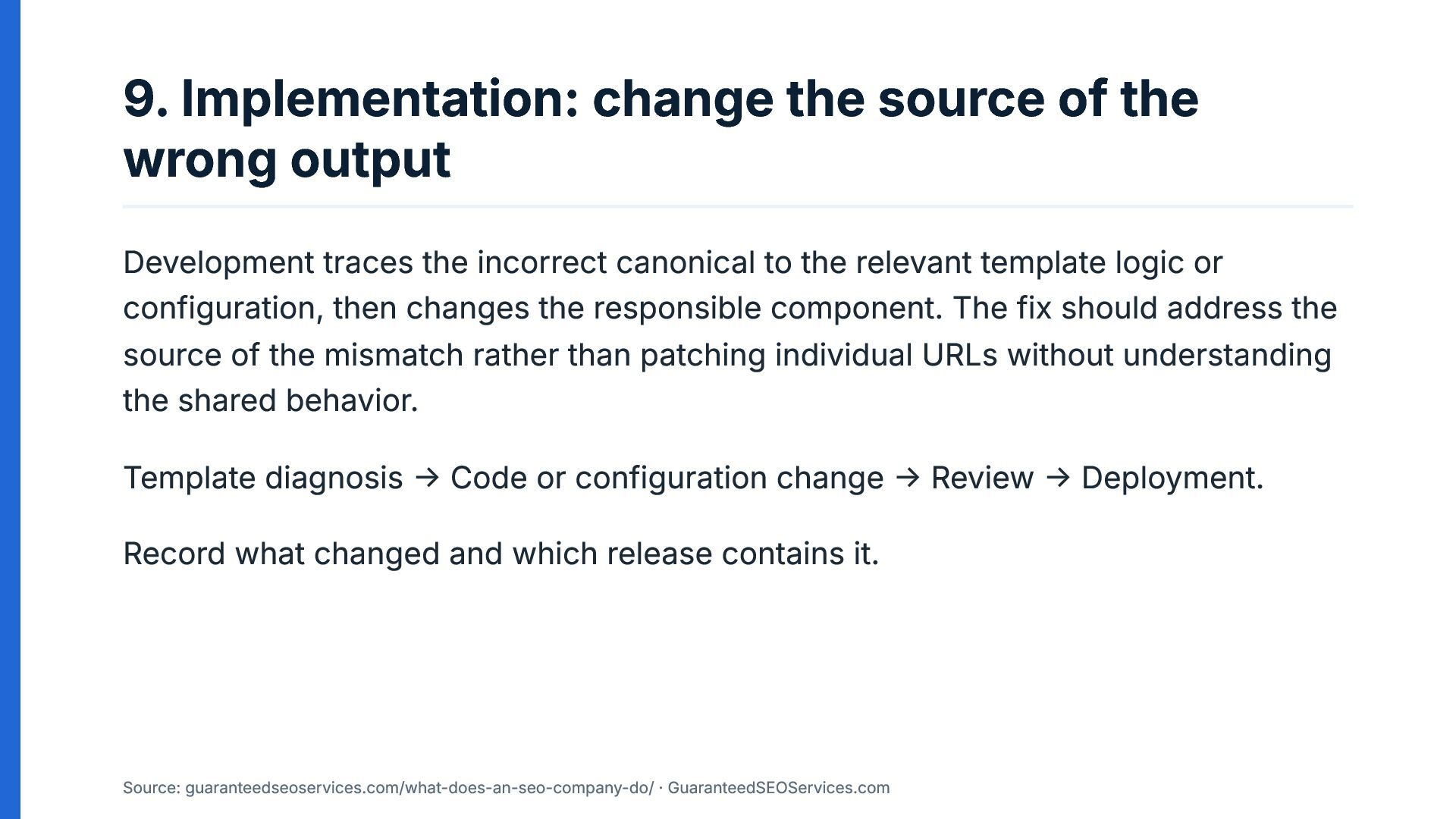
9. Implementation: change the source of the wrong output Development
traces the incorrect canonical to the relevant template logic or configuration, then changes the responsible component. The fix should address the source of the mismatch rather than patching individual URLs without understanding the shared behavior. Template diagnosis → Code or configuration change → Review → Deployment. Record what changed and which release contains it. Source: guaranteedseoservices.com/what-does-an-seo-company-do/ · GuaranteedSEOServices.com -
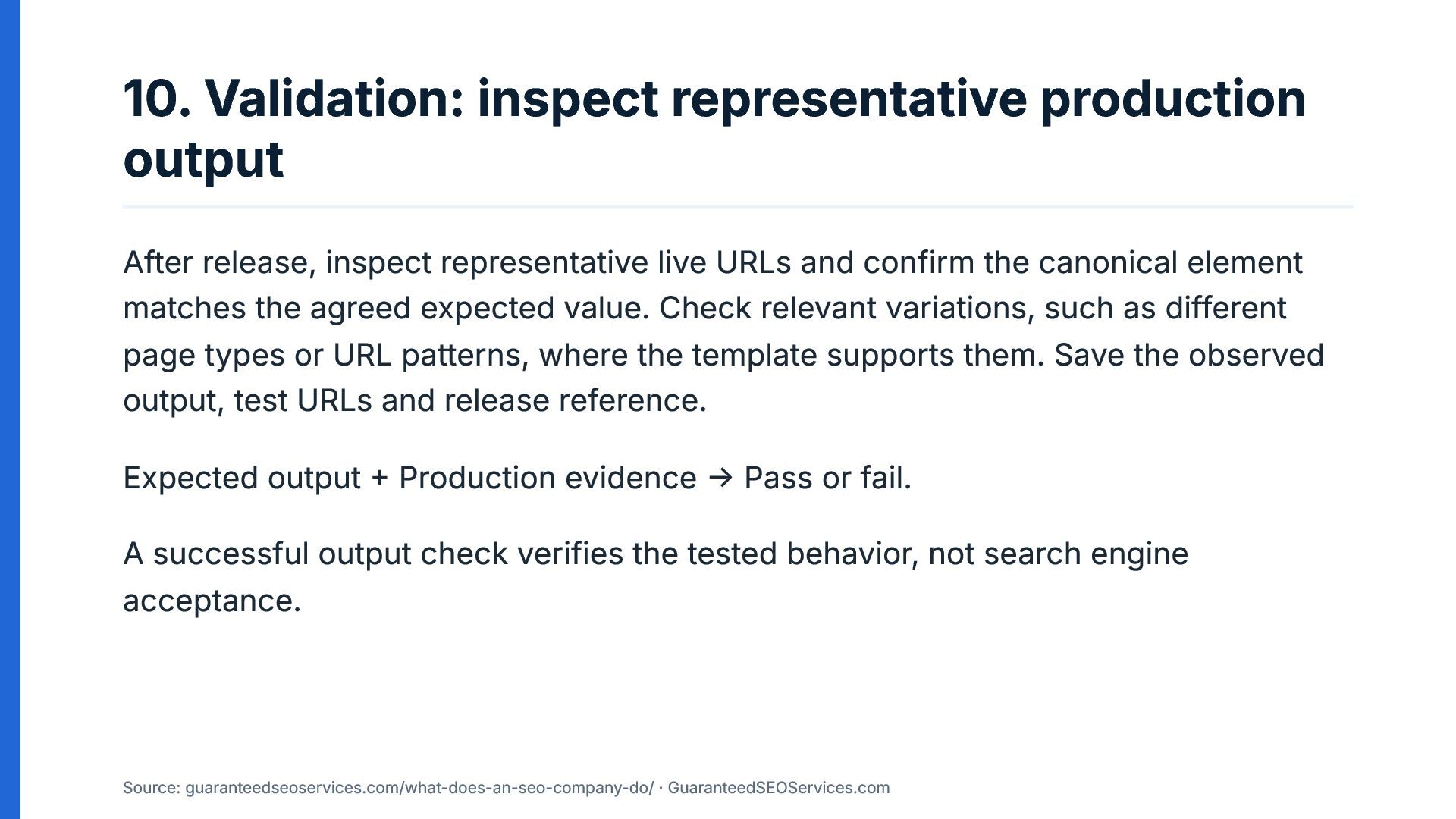
10. Validation: inspect representative production output After release, inspect representative
live URLs and confirm the canonical element matches the agreed expected value. Check relevant variations, such as different page types or URL patterns, where the template supports them. Save the observed output, test URLs and release reference. Expected output + Production evidence → Pass or fail. A successful output check verifies the tested behavior, not search engine acceptance. Source: guaranteedseoservices.com/what-does-an-seo-company-do/ · GuaranteedSEOServices.com -
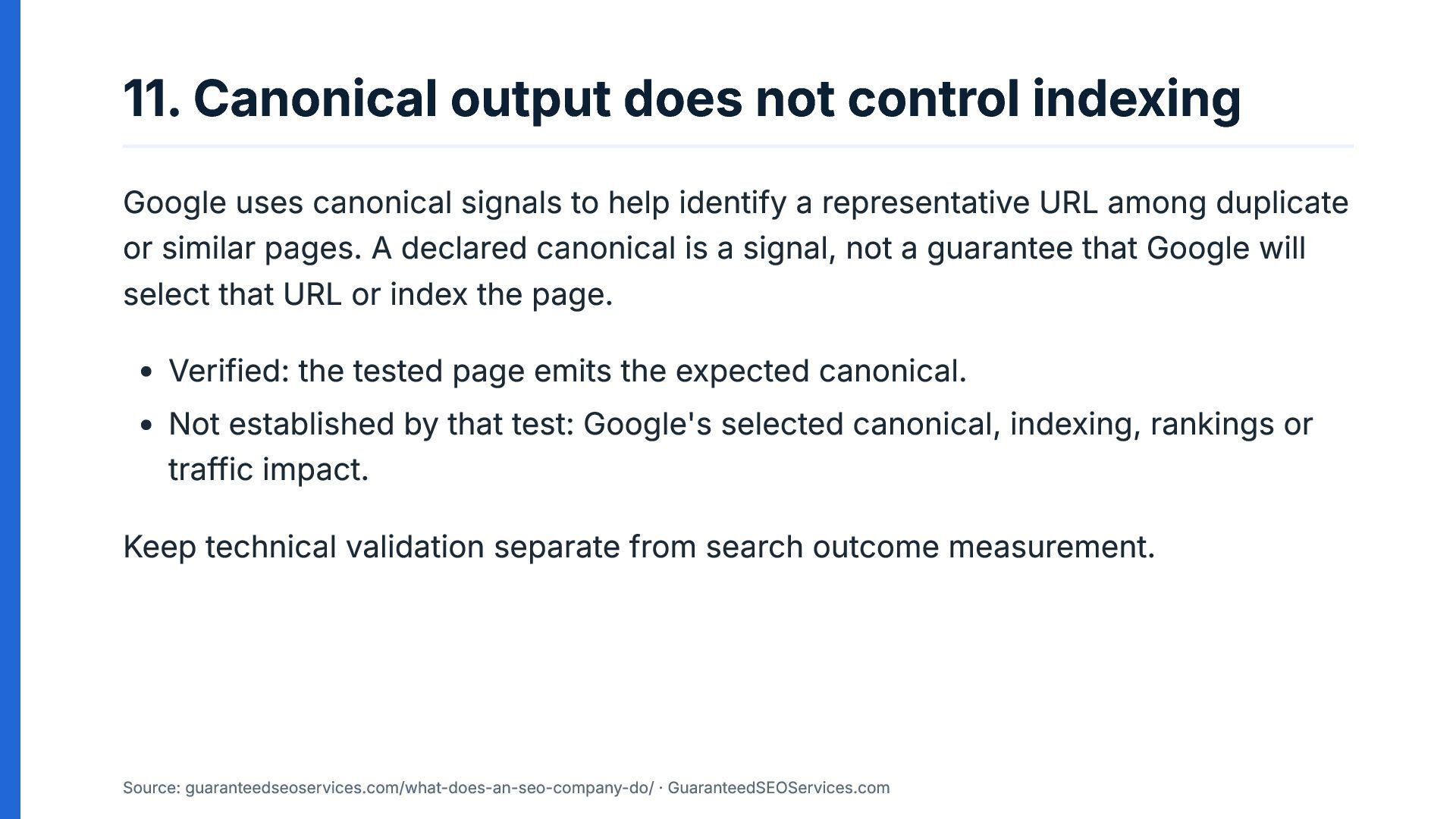
11. Canonical output does not control indexing Google uses canonical
signals to help identify a representative URL among duplicate or similar pages. A declared canonical is a signal, not a guarantee that Google will select that URL or index the page. Verified: the tested page emits the expected canonical. Not established by that test: Google's selected canonical, indexing, rankings or traffic impact. Keep technical validation separate from search outcome measurement. Source: guaranteedseoservices.com/what-does-an-seo-company-do/ · GuaranteedSEOServices.com -
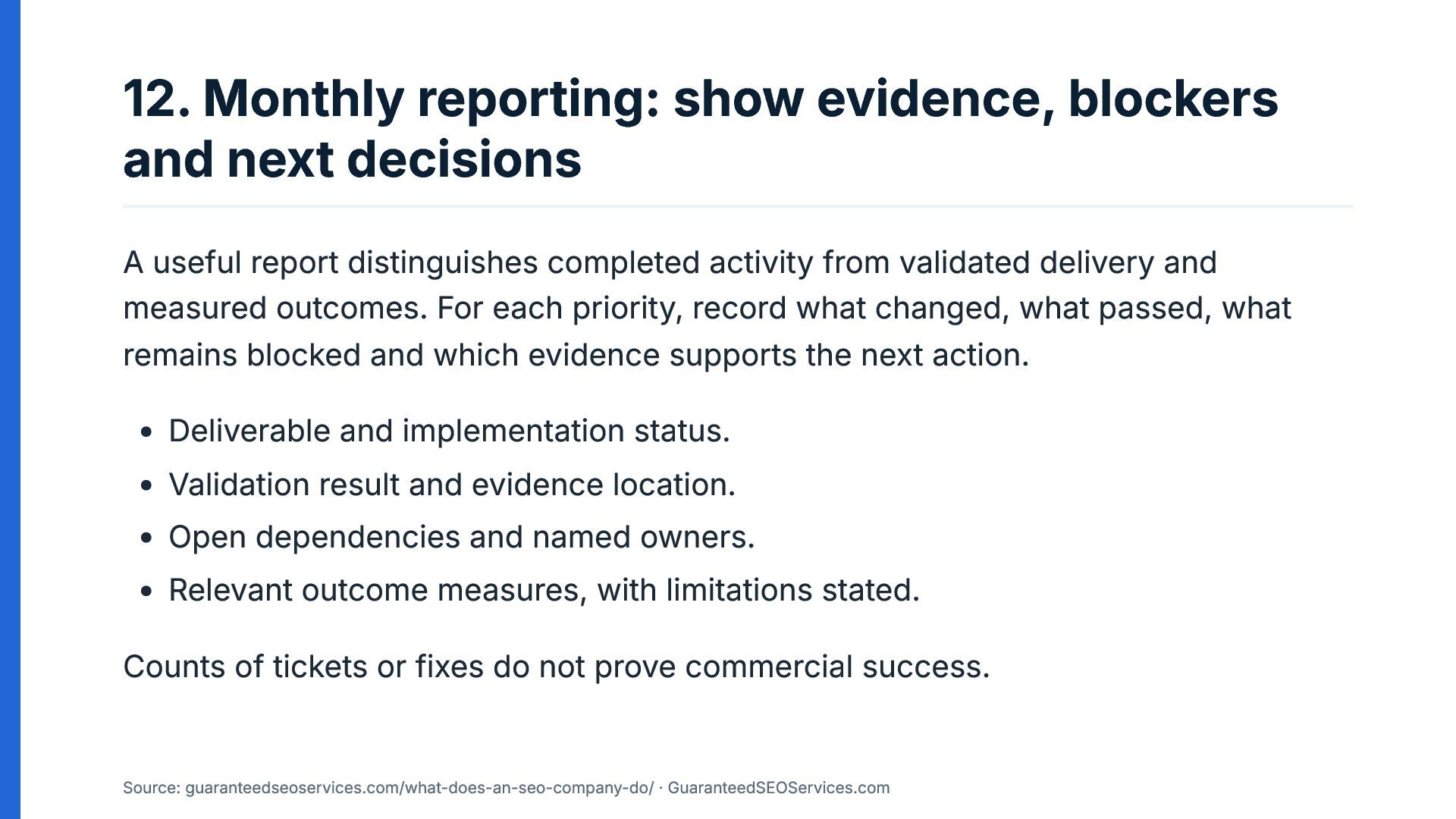
12. Monthly reporting: show evidence, blockers and next decisions A
useful report distinguishes completed activity from validated delivery and measured outcomes. For each priority, record what changed, what passed, what remains blocked and which evidence supports the next action. Deliverable and implementation status. Validation result and evidence location. Open dependencies and named owners. Relevant outcome measures, with limitations stated. Counts of tickets or fixes do not prove commercial success. Source: guaranteedseoservices.com/what-does-an-seo-company-do/ · GuaranteedSEOServices.com -
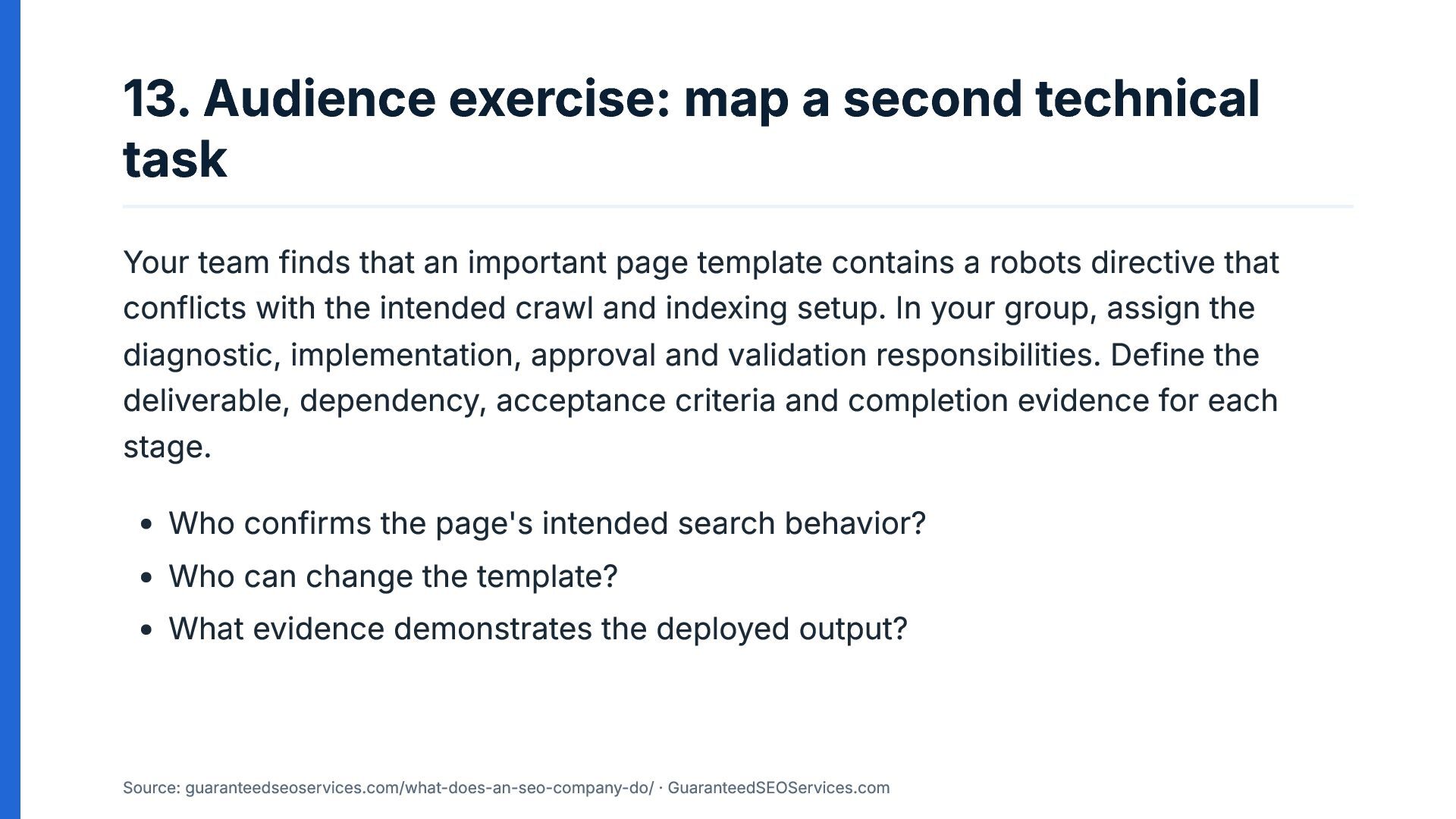
13. Audience exercise: map a second technical task Your team
finds that an important page template contains a robots directive that conflicts with the intended crawl and indexing setup. In your group, assign the diagnostic, implementation, approval and validation responsibilities. Define the deliverable, dependency, acceptance criteria and completion evidence for each stage. Who confirms the page's intended search behavior? Who can change the template? What evidence demonstrates the deployed output? Source: guaranteedseoservices.com/what-does-an-seo-company-do/ · GuaranteedSEOServices.com -
14. Lessons: make every handoff testable Name the owner before
assigning the task. Define the deliverable and acceptance criteria before implementation. Keep production evidence with the change record. Report blockers rather than counting unfinished work as delivery. Measure outcomes separately from work completed. Try the workshop exercise with your team. Use the guide, https://guaranteedseoservices.com/what-does-an-seo-company-do/, and the primary sources in the final source list to agree on your next handoff. Source: guaranteedseoservices.com/what-does-an-seo-company-do/ · GuaranteedSEOServices.com -
Speaker Notes Slide 1 Open with the central problem: a
client may see reports, meetings and recommendations without knowing which changes reached production. Ask the audience to distinguish work performed from a change that another person can verify. The question of what does an SEO company do becomes practical when responsibilities and evidence are explicit. Introduce the canonical template fix as the thread that connects the stages. Slide 2 Explain the three states without treating them as interchangeable. Activity includes investigation, analysis and ticket writing. Delivery means an agreed item has been implemented and checked against acceptance criteria. Outcomes require separate measurement and interpretation, because a completed technical change alone does not establish its effect on search visibility or commercial performance. Slide 3 Walk through the canonical issue and establish the division of work. The specialist identifies the discrepancy, development controls the code or configuration, content helps establish which page should represent the intended purpose, and the business owner decides priority. These roles may sit in different teams or overlap, but the engagement must make ownership clear. Do not suggest that the existence of the defect proves a loss of traffic or rankings. Slide 4 -
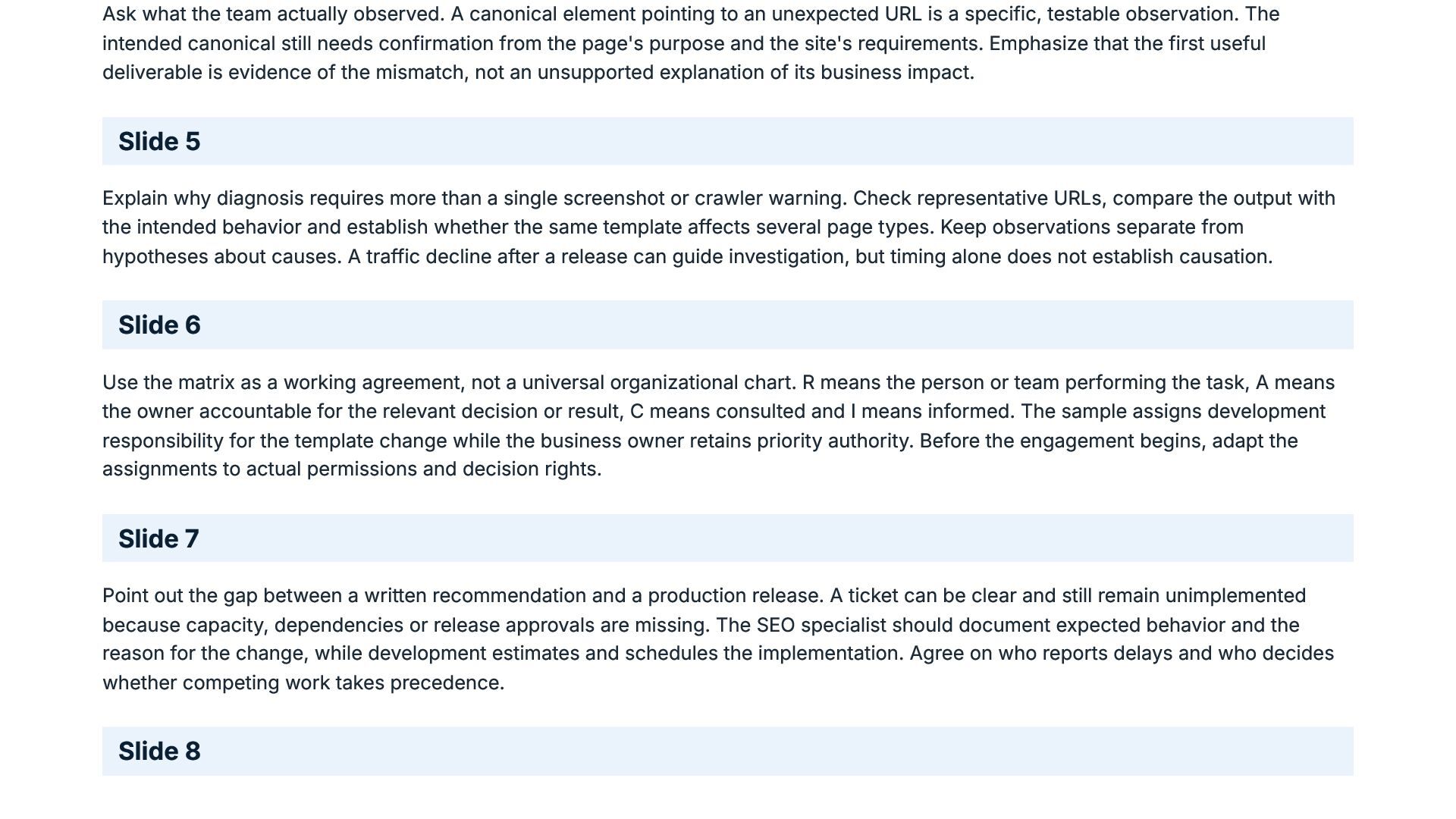
Ask what the team actually observed. A canonical element pointing
to an unexpected URL is a specific, testable observation. The intended canonical still needs confirmation from the page's purpose and the site's requirements. Emphasize that the first useful deliverable is evidence of the mismatch, not an unsupported explanation of its business impact. Slide 5 Explain why diagnosis requires more than a single screenshot or crawler warning. Check representative URLs, compare the output with the intended behavior and establish whether the same template affects several page types. Keep observations separate from hypotheses about causes. A traffic decline after a release can guide investigation, but timing alone does not establish causation. Slide 6 Use the matrix as a working agreement, not a universal organizational chart. R means the person or team performing the task, A means the owner accountable for the relevant decision or result, C means consulted and I means informed. The sample assigns development responsibility for the template change while the business owner retains priority authority. Before the engagement begins, adapt the assignments to actual permissions and decision rights. Slide 7 Point out the gap between a written recommendation and a production release. A ticket can be clear and still remain unimplemented because capacity, dependencies or release approvals are missing. The SEO specialist should document expected behavior and the reason for the change, while development estimates and schedules the implementation. Agree on who reports delays and who decides whether competing work takes precedence. Slide 8 -
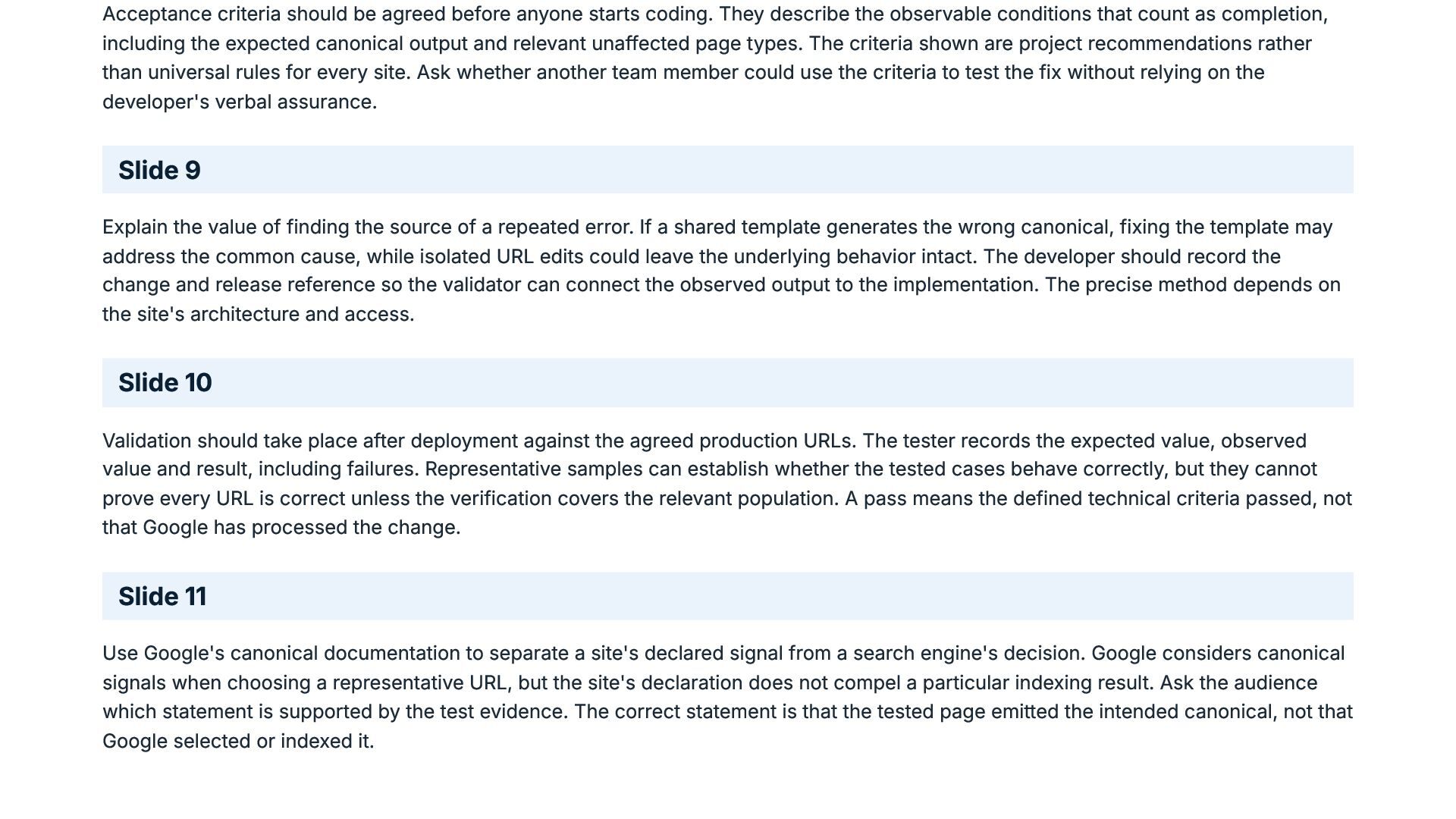
Acceptance criteria should be agreed before anyone starts coding. They
describe the observable conditions that count as completion, including the expected canonical output and relevant unaffected page types. The criteria shown are project recommendations rather than universal rules for every site. Ask whether another team member could use the criteria to test the fix without relying on the developer's verbal assurance. Slide 9 Explain the value of finding the source of a repeated error. If a shared template generates the wrong canonical, fixing the template may address the common cause, while isolated URL edits could leave the underlying behavior intact. The developer should record the change and release reference so the validator can connect the observed output to the implementation. The precise method depends on the site's architecture and access. Slide 10 Validation should take place after deployment against the agreed production URLs. The tester records the expected value, observed value and result, including failures. Representative samples can establish whether the tested cases behave correctly, but they cannot prove every URL is correct unless the verification covers the relevant population. A pass means the defined technical criteria passed, not that Google has processed the change. Slide 11 Use Google's canonical documentation to separate a site's declared signal from a search engine's decision. Google considers canonical signals when choosing a representative URL, but the site's declaration does not compel a particular indexing result. Ask the audience which statement is supported by the test evidence. The correct statement is that the tested page emitted the intended canonical, not that Google selected or indexed it. -
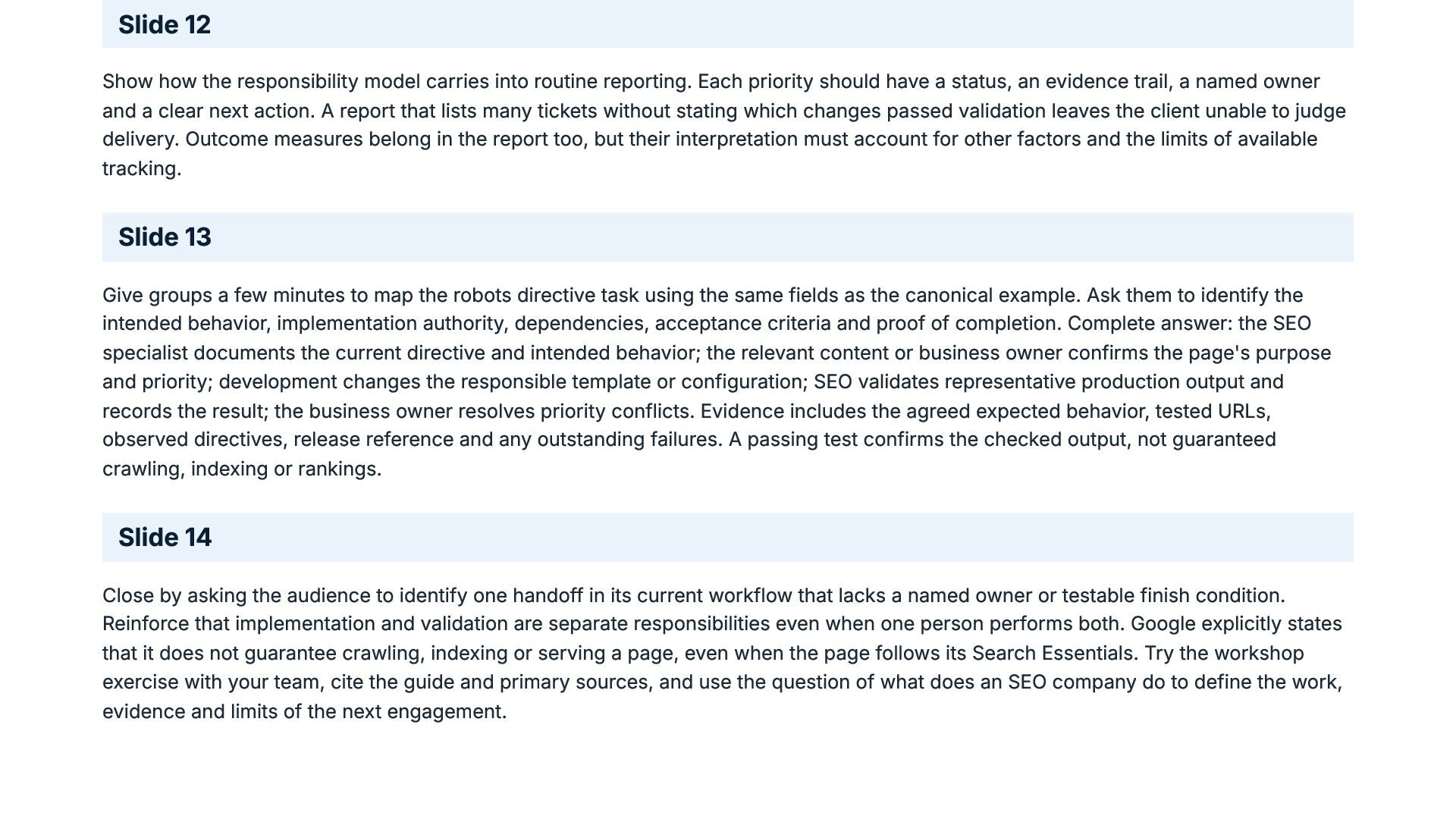
Slide 12 Show how the responsibility model carries into routine
reporting. Each priority should have a status, an evidence trail, a named owner and a clear next action. A report that lists many tickets without stating which changes passed validation leaves the client unable to judge delivery. Outcome measures belong in the report too, but their interpretation must account for other factors and the limits of available tracking. Slide 13 Give groups a few minutes to map the robots directive task using the same fields as the canonical example. Ask them to identify the intended behavior, implementation authority, dependencies, acceptance criteria and proof of completion. Complete answer: the SEO specialist documents the current directive and intended behavior; the relevant content or business owner confirms the page's purpose and priority; development changes the responsible template or configuration; SEO validates representative production output and records the result; the business owner resolves priority conflicts. Evidence includes the agreed expected behavior, tested URLs, observed directives, release reference and any outstanding failures. A passing test confirms the checked output, not guaranteed crawling, indexing or rankings. Slide 14 Close by asking the audience to identify one handoff in its current workflow that lacks a named owner or testable finish condition. Reinforce that implementation and validation are separate responsibilities even when one person performs both. Google explicitly states that it does not guarantee crawling, indexing or serving a page, even when the page follows its Search Essentials. Try the workshop exercise with your team, cite the guide and primary sources, and use the question of what does an SEO company do to define the work, evidence and limits of the next engagement. -
Sources https://guaranteedseoservices.com/what-does-an-seo-company-do/ Google Search Central: Do you need an SEO?
Google Search Central: How Search works Google Search Central: How to specify a canonical URL
 guaranteedseoservices
 alexmossuk
 metehanyesilyurt
 manuelmadeddu
 sarosaro
 clarasoteras
 samtorres
 gkoivikko
 aleyda
 edwords
 owainlw
 tenshoku_draft
 mojombo
 davetheseo
 ivargrimstad
 marktimemedia
 michielstock
 morganepeng
 inesmontani
 tamaranovitovic
 codingconduct
 swwweet
 kristinabergwall1