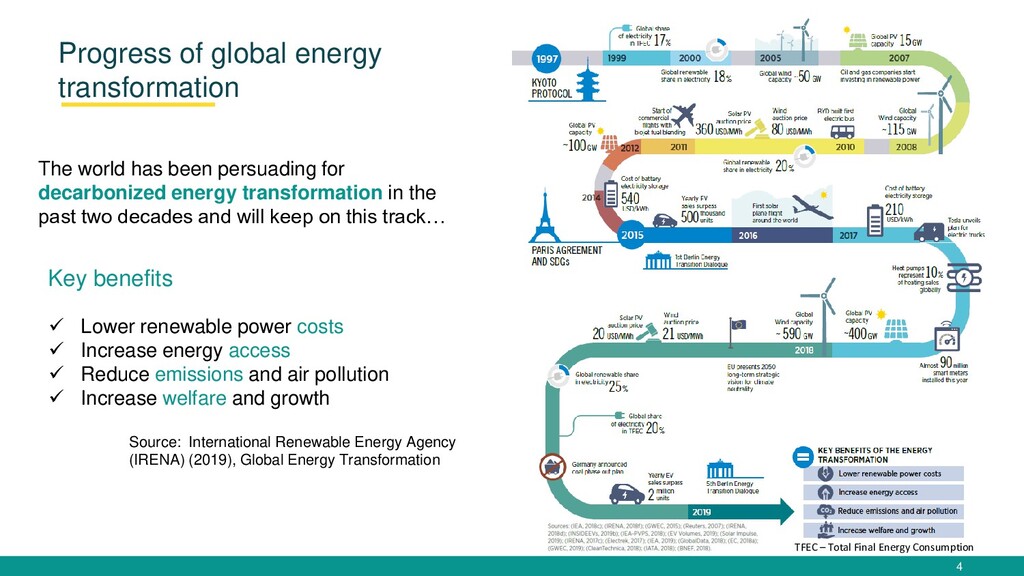
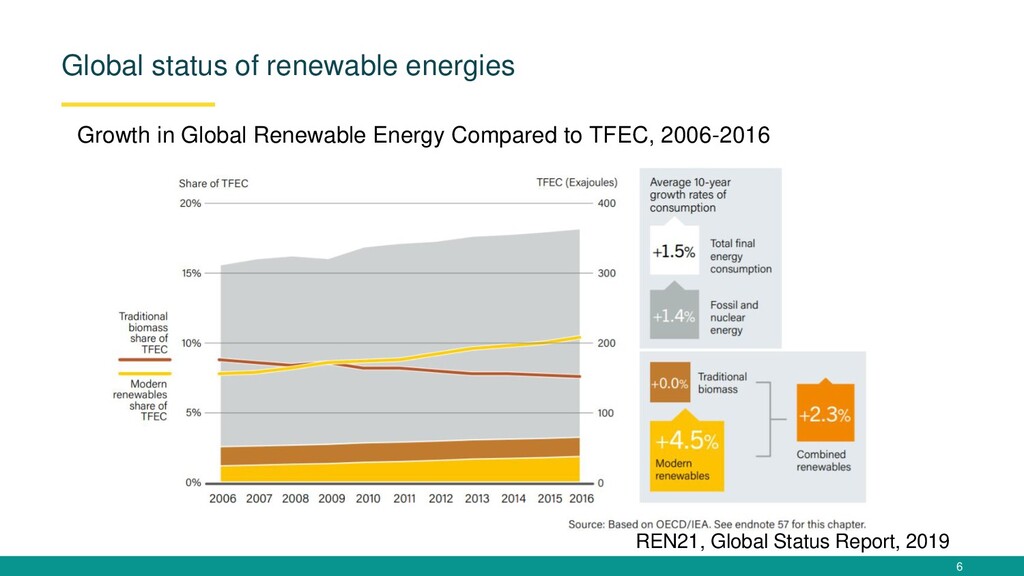
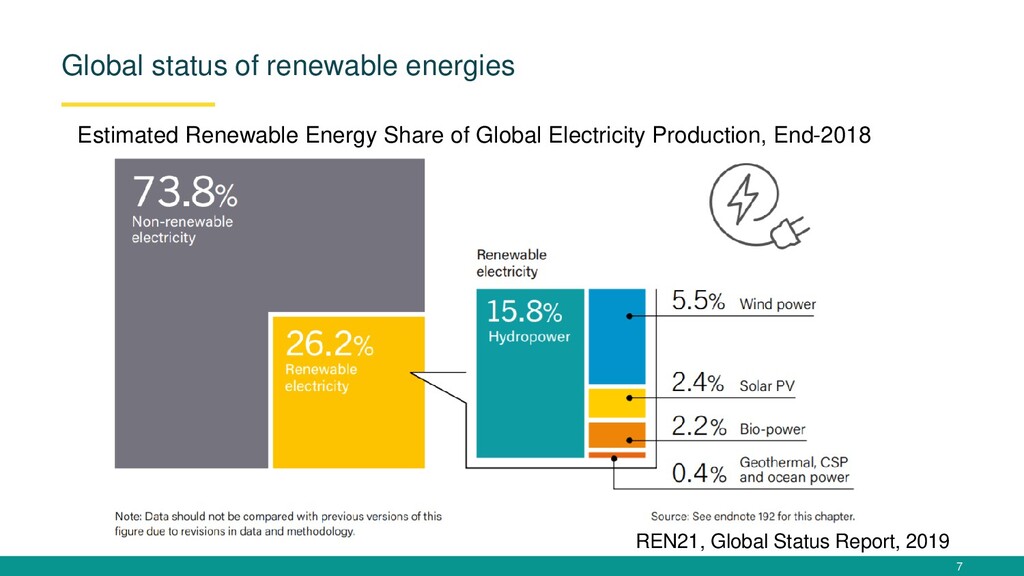
Energy Consumption Source: International Renewable Energy Agency (IRENA) (2019), Global Energy Transformation ✓ Lower renewable power costs ✓ Increase energy access ✓ Reduce emissions and air pollution ✓ Increase welfare and growth The world has been persuading for decarbonized energy transformation in the past two decades and will keep on this track… Key benefits
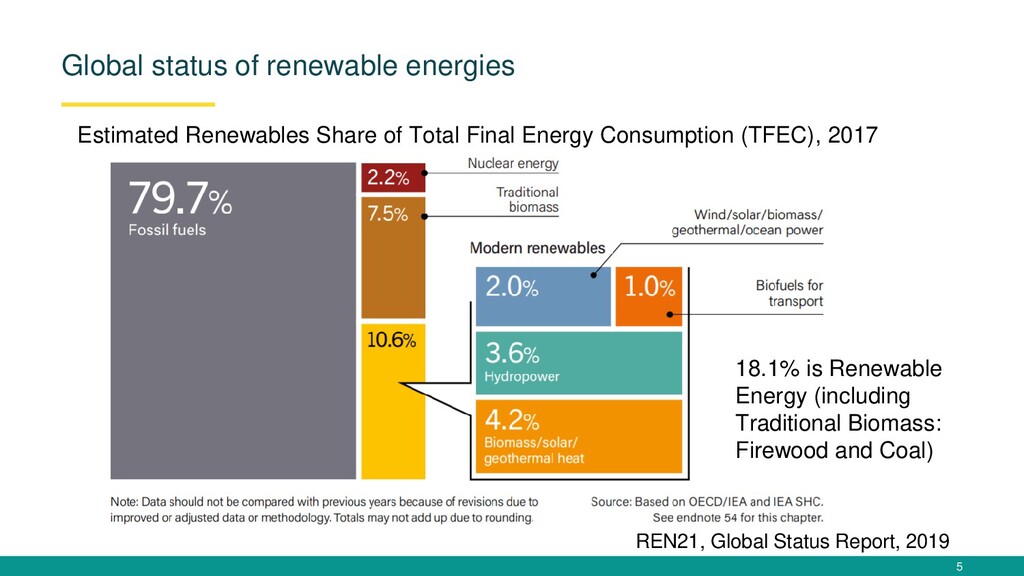
Total Final Energy Consumption (TFEC), 2017 REN21, Global Status Report, 2019 18.1% is Renewable Energy (including Traditional Biomass: Firewood and Coal)
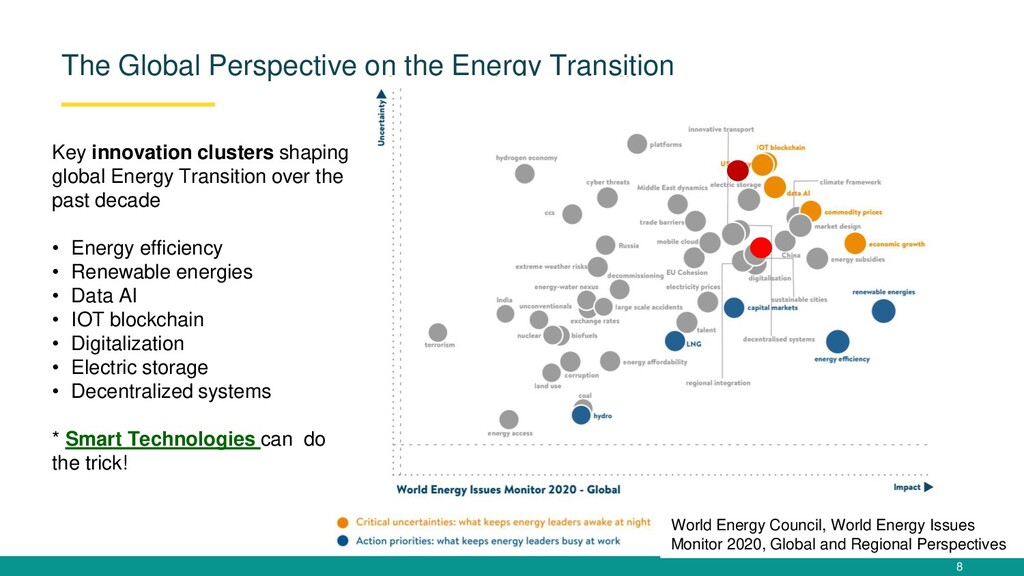
clusters shaping global Energy Transition over the past decade • Energy efficiency • Renewable energies • Data AI • IOT blockchain • Digitalization • Electric storage • Decentralized systems * Smart Technologies can do the trick! World Energy Council, World Energy Issues Monitor 2020, Global and Regional Perspectives
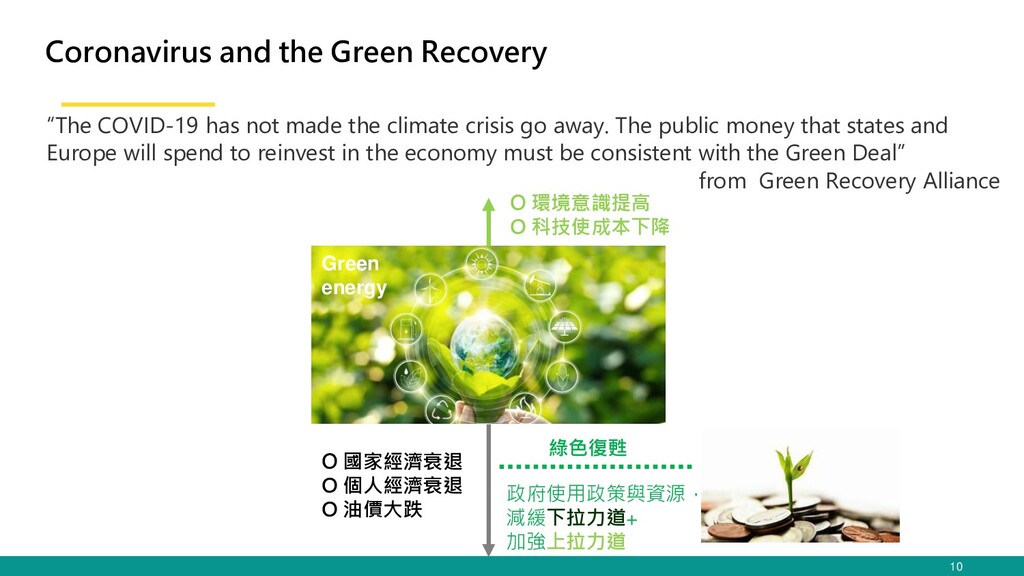
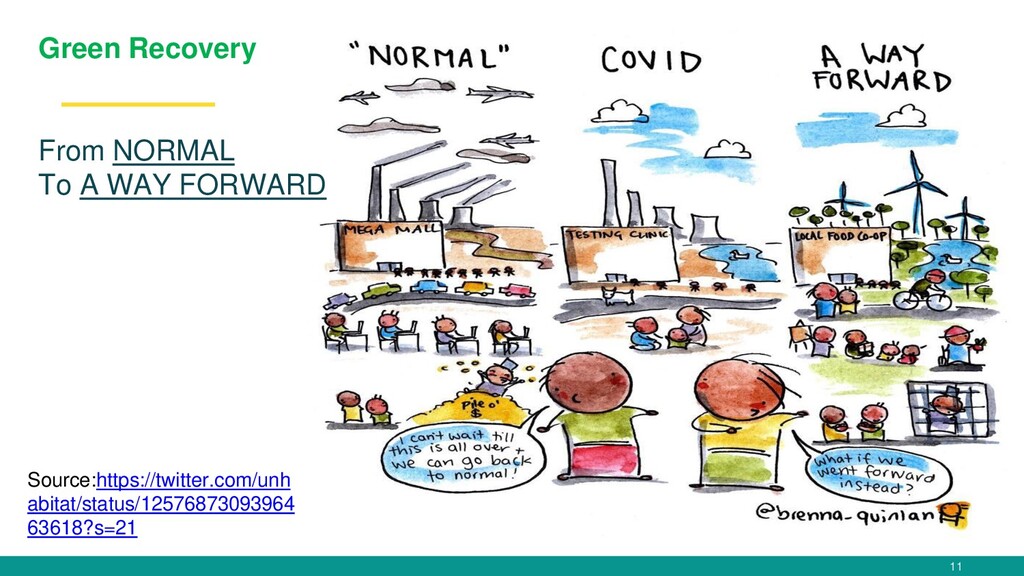
O 個人經濟衰退 O 油價大跌 O 環境意識提高 O 科技使成本下降 政府使用政策與資源, 減緩下拉力道+ 加強上拉力道 綠色復甦 “The COVID-19 has not made the climate crisis go away. The public money that states and Europe will spend to reinvest in the economy must be consistent with the Green Deal” from Green Recovery Alliance
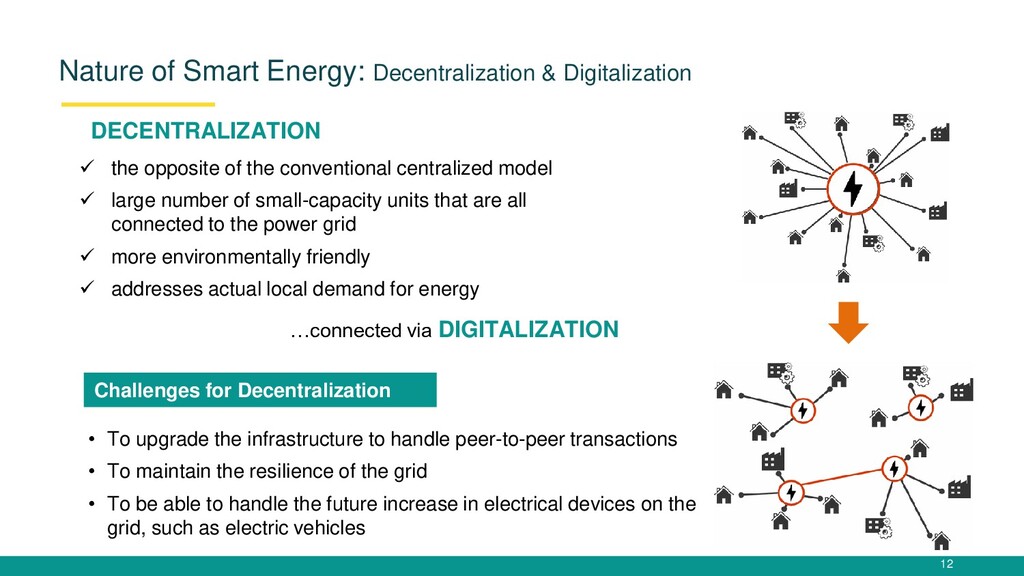
the opposite of the conventional centralized model ✓ large number of small-capacity units that are all connected to the power grid ✓ more environmentally friendly ✓ addresses actual local demand for energy …connected via DIGITALIZATION Challenges for Decentralization • To upgrade the infrastructure to handle peer-to-peer transactions • To maintain the resilience of the grid • To be able to handle the future increase in electrical devices on the grid, such as electric vehicles
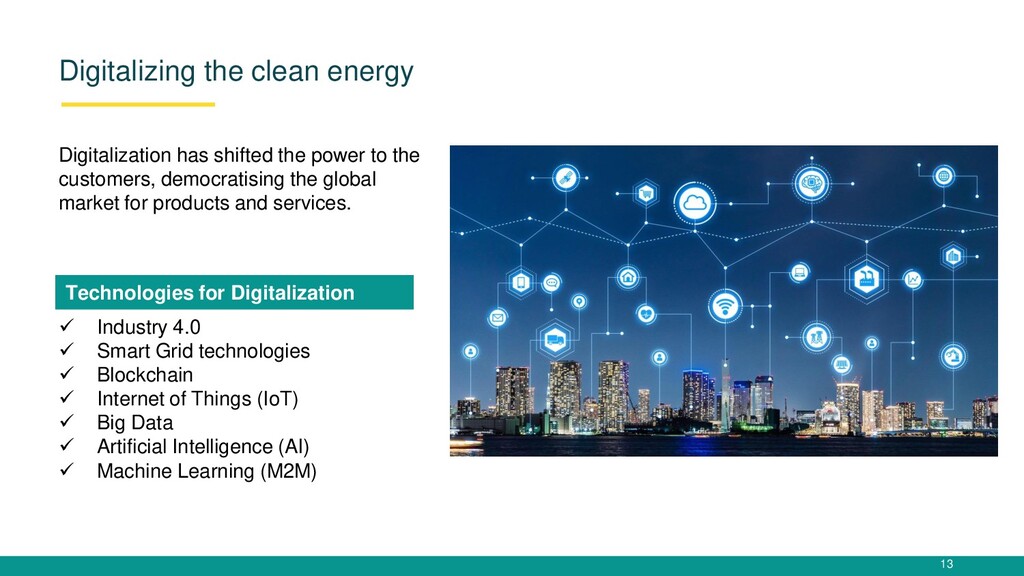
Grid technologies ✓ Blockchain ✓ Internet of Things (IoT) ✓ Big Data ✓ Artificial Intelligence (AI) ✓ Machine Learning (M2M) Digitalization has shifted the power to the customers, democratising the global market for products and services. Technologies for Digitalization
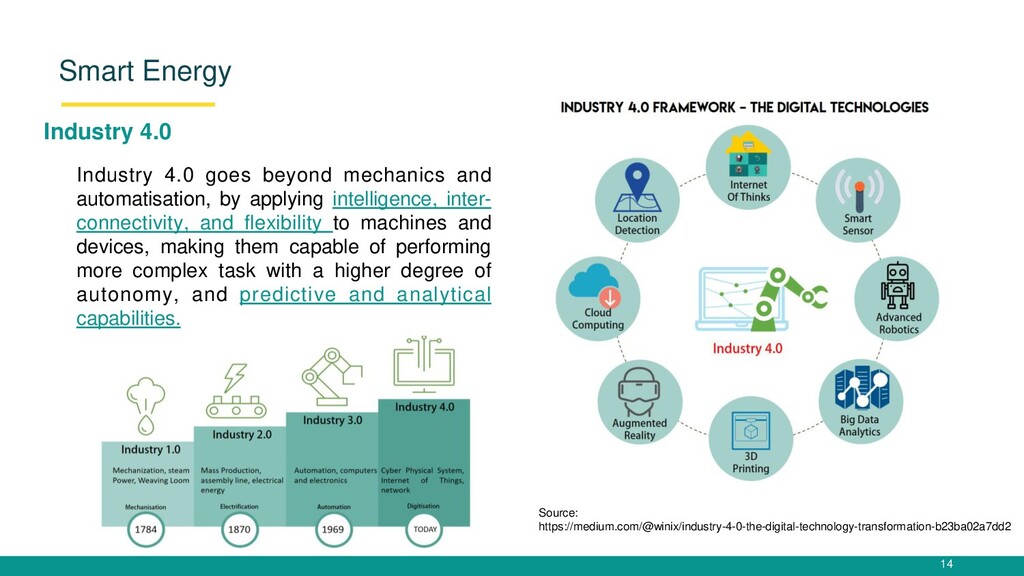
beyond mechanics and automatisation, by applying intelligence, inter- connectivity, and flexibility to machines and devices, making them capable of performing more complex task with a higher degree of autonomy, and predictive and analytical capabilities.
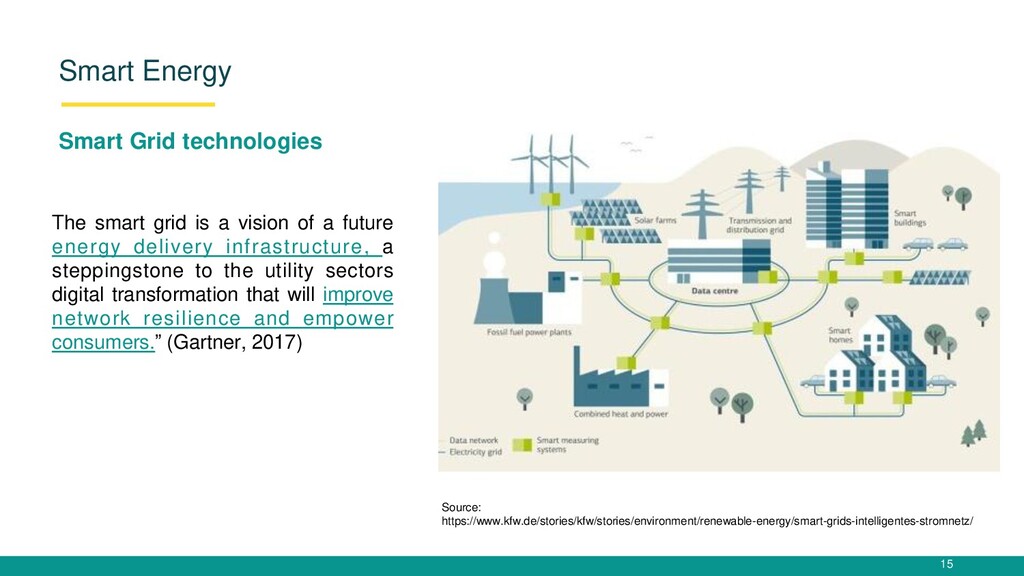
grid is a vision of a future energy delivery infrastructure, a steppingstone to the utility sectors digital transformation that will improve network resilience and empower consumers.” (Gartner, 2017)
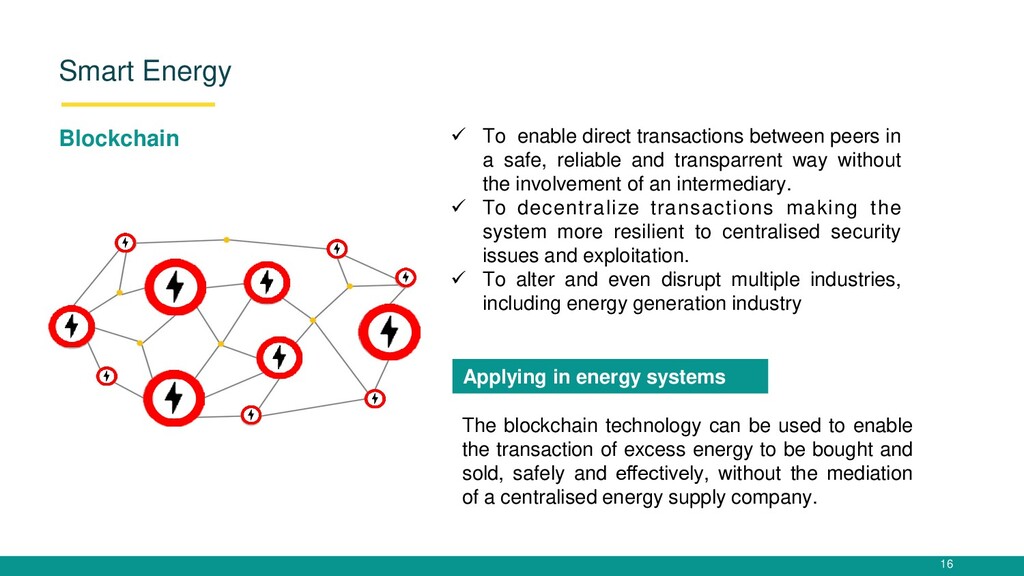
peers in a safe, reliable and transparrent way without the involvement of an intermediary. ✓ To decentralize transactions making the system more resilient to centralised security issues and exploitation. ✓ To alter and even disrupt multiple industries, including energy generation industry The blockchain technology can be used to enable the transaction of excess energy to be bought and sold, safely and effectively, without the mediation of a centralised energy supply company. Applying in energy systems
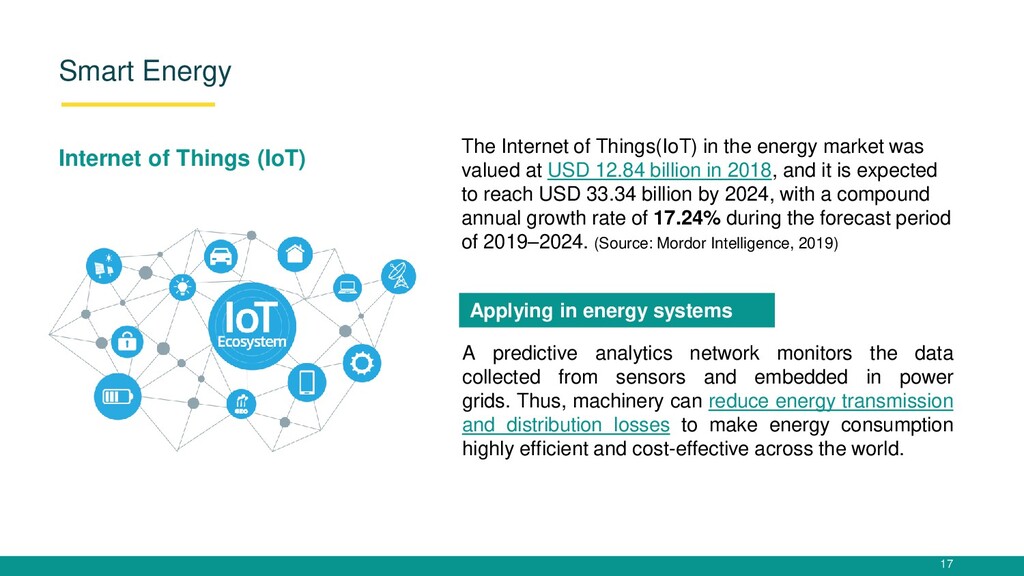
systems A predictive analytics network monitors the data collected from sensors and embedded in power grids. Thus, machinery can reduce energy transmission and distribution losses to make energy consumption highly efficient and cost-effective across the world. The Internet of Things(IoT) in the energy market was valued at USD 12.84 billion in 2018, and it is expected to reach USD 33.34 billion by 2024, with a compound annual growth rate of 17.24% during the forecast period of 2019–2024. (Source: Mordor Intelligence, 2019)
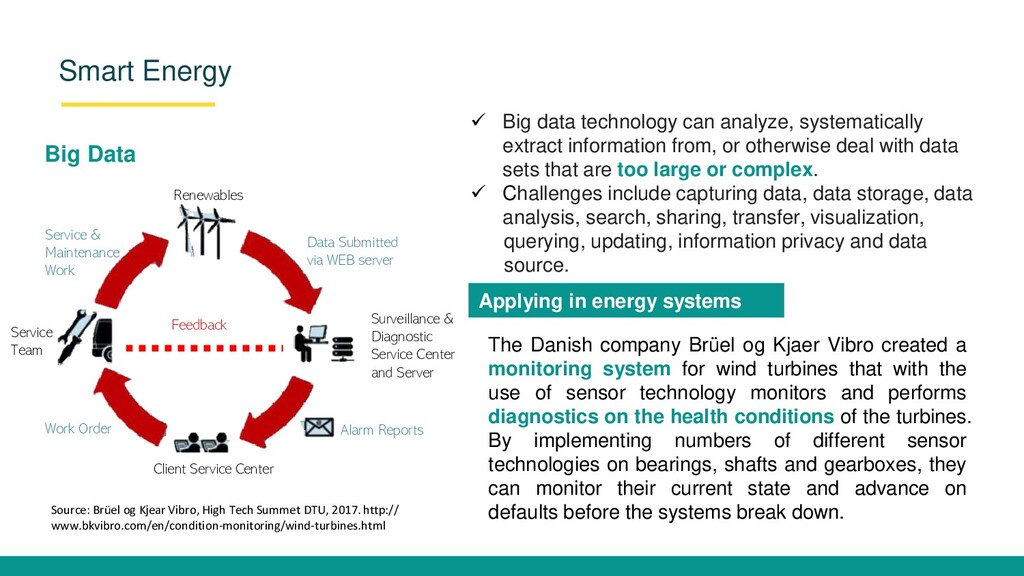
Tech Summet DTU, 2017. http:// www.bkvibro.com/en/condition-monitoring/wind-turbines.html Surveillance & Diagnostic Service Center and Server Renewables Data Submitted via WEB server Service & Maintenance Work Feedback Service Team Work Order Client Service Center Alarm Reports Applying in energy systems The Danish company Brüel og Kjaer Vibro created a monitoring system for wind turbines that with the use of sensor technology monitors and performs diagnostics on the health conditions of the turbines. By implementing numbers of different sensor technologies on bearings, shafts and gearboxes, they can monitor their current state and advance on defaults before the systems break down. ✓ Big data technology can analyze, systematically extract information from, or otherwise deal with data sets that are too large or complex. ✓ Challenges include capturing data, data storage, data analysis, search, sharing, transfer, visualization, querying, updating, information privacy and data source.
intelligence-real-world-applications Applying in energy systems AI and machine learning can be used to turn data into insights and analytics into predictions. In a decentralised heating system, these tech- nologies can be used to forecast the most optimal flow temperature, by combining weather forecast, consumption patterns, etc. Using technology such as sensors in combination with AI, this information can be analysed in real time, providing a foundation for optimal performance. The key benefits of Artificial Intelligence and machine learning, is that it can be used to solve highly complex issues, by the process of observing, analysing, predicting and suggesting, faster and more precise than humanly possible.
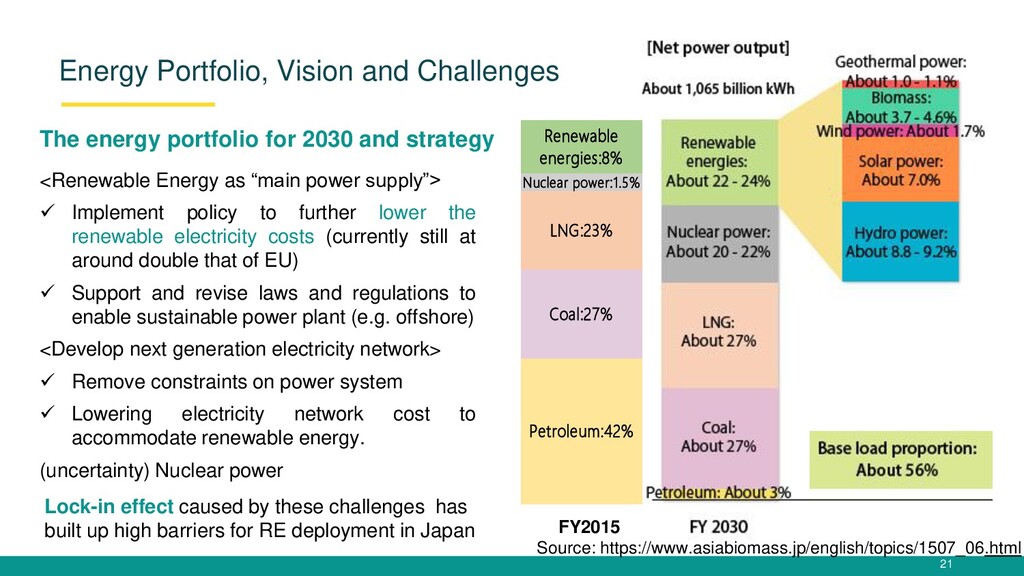
2030 and strategy Renewable energies:8% Nuclear power:1.5% LNG:23% Coal:27% Petroleum:42% FY2015 Source: https://www.asiabiomass.jp/english/topics/1507_06.html <Renewable Energy as “main power supply”> ✓ Implement policy to further lower the renewable electricity costs (currently still at around double that of EU) ✓ Support and revise laws and regulations to enable sustainable power plant (e.g. offshore) <Develop next generation electricity network> ✓ Remove constraints on power system ✓ Lowering electricity network cost to accommodate renewable energy. (uncertainty) Nuclear power Lock-in effect caused by these challenges has built up high barriers for RE deployment in Japan
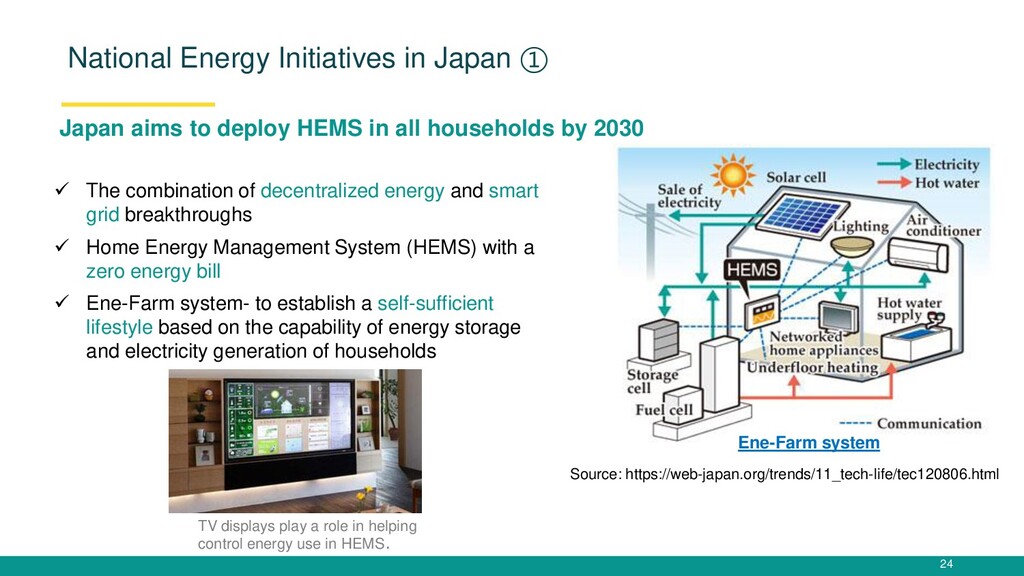
2030 Source: https://web-japan.org/trends/11_tech-life/tec120806.html TV displays play a role in helping control energy use in HEMS. Ene-Farm system National Energy Initiatives in Japan ① ✓ The combination of decentralized energy and smart grid breakthroughs ✓ Home Energy Management System (HEMS) with a zero energy bill ✓ Ene-Farm system- to establish a self-sufficient lifestyle based on the capability of energy storage and electricity generation of households
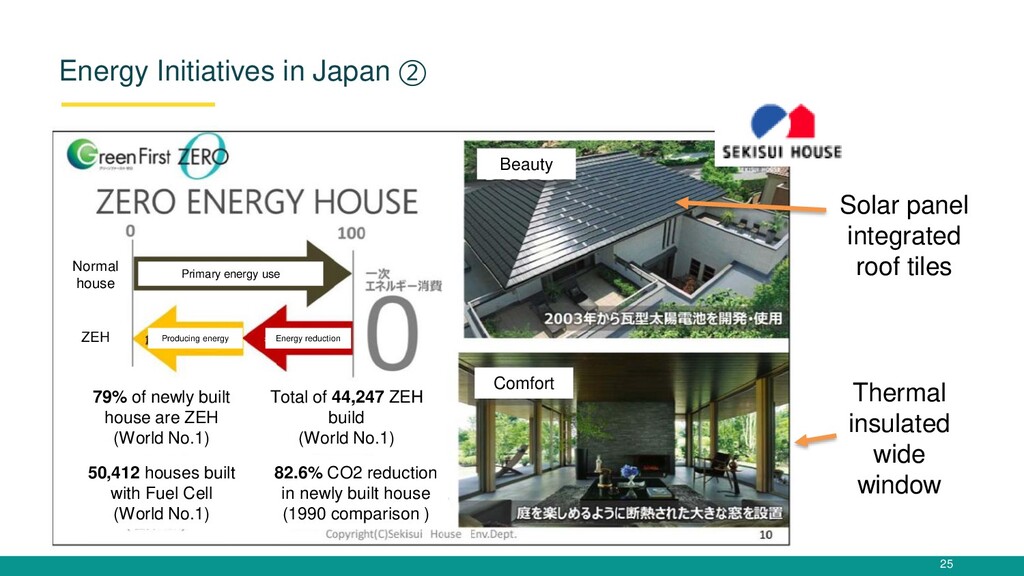
house are ZEH (World No.1) Total of 44,247 ZEH build (World No.1) 50,412 houses built with Fuel Cell (World No.1) 82.6% CO2 reduction in newly built house (1990 comparison ) Beauty Comfort Normal house ZEH Primary energy use Producing energy Energy reduction Solar panel integrated roof tiles Thermal insulated wide window
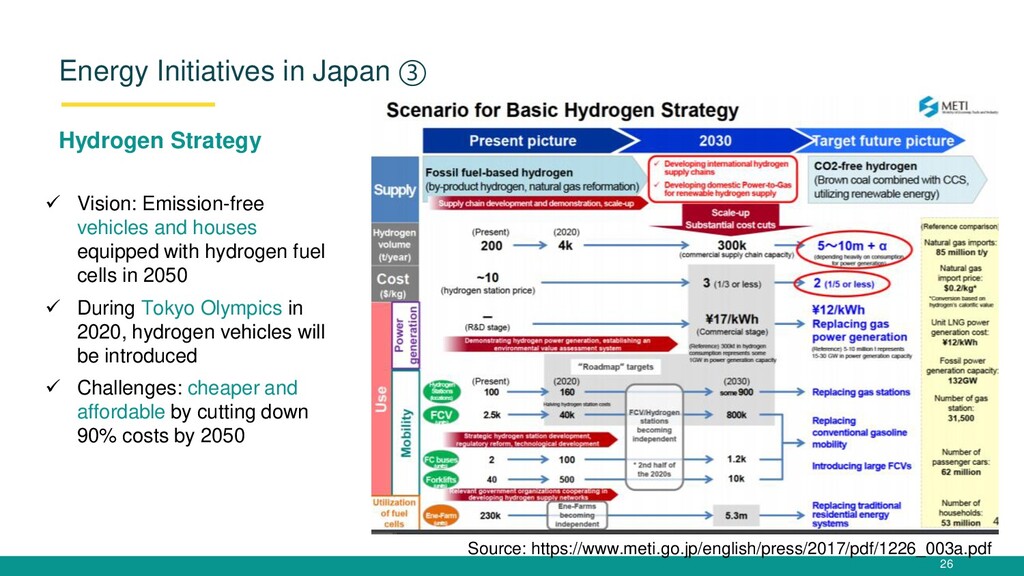
✓ Vision: Emission-free vehicles and houses equipped with hydrogen fuel cells in 2050 ✓ During Tokyo Olympics in 2020, hydrogen vehicles will be introduced ✓ Challenges: cheaper and affordable by cutting down 90% costs by 2050
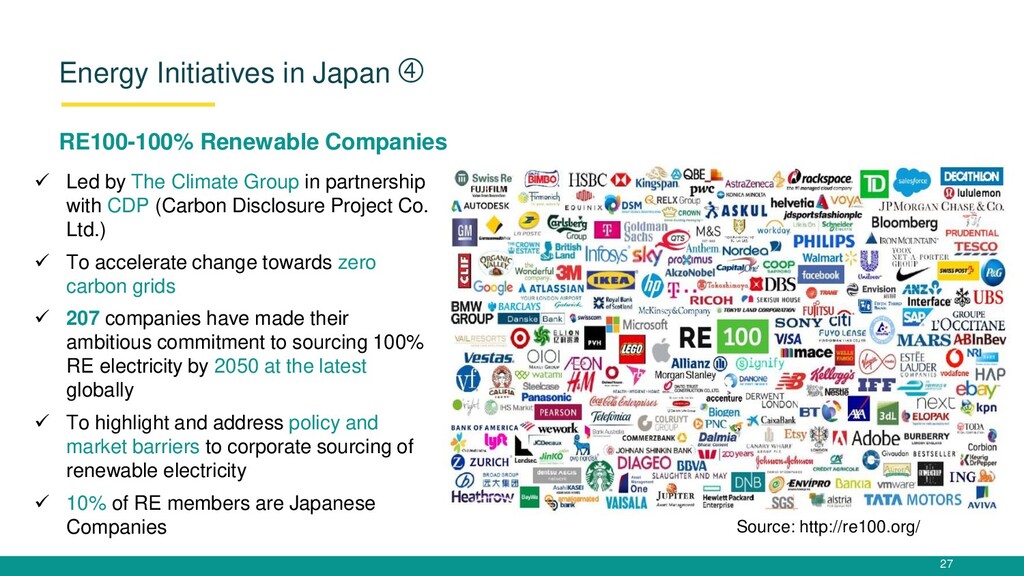
Led by The Climate Group in partnership with CDP (Carbon Disclosure Project Co. Ltd.) ✓ To accelerate change towards zero carbon grids ✓ 207 companies have made their ambitious commitment to sourcing 100% RE electricity by 2050 at the latest globally ✓ To highlight and address policy and market barriers to corporate sourcing of renewable electricity ✓ 10% of RE members are Japanese Companies Source: http://re100.org/
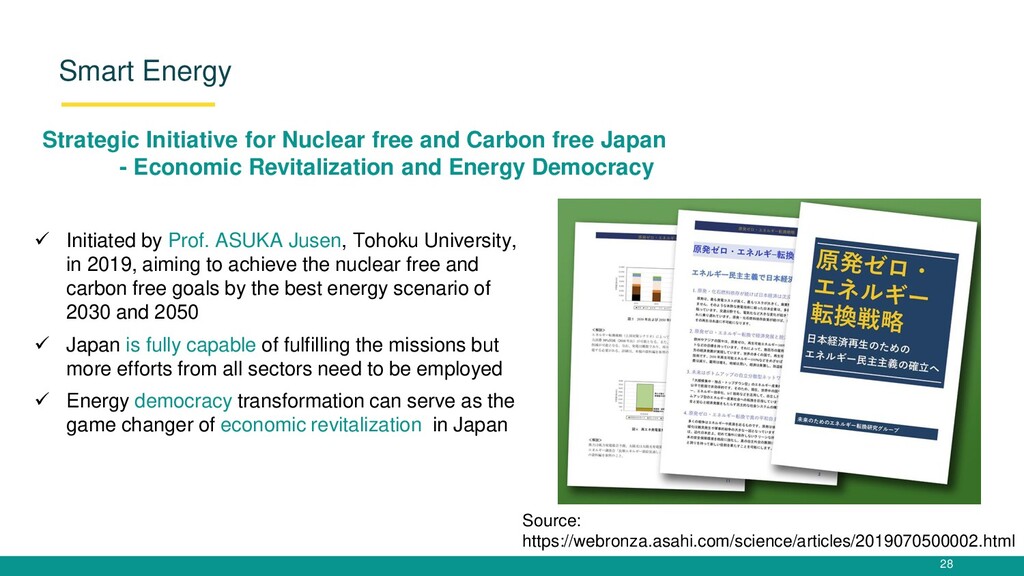
free Japan - Economic Revitalization and Energy Democracy Source: https://webronza.asahi.com/science/articles/2019070500002.html ✓ Initiated by Prof. ASUKA Jusen, Tohoku University, in 2019, aiming to achieve the nuclear free and carbon free goals by the best energy scenario of 2030 and 2050 ✓ Japan is fully capable of fulfilling the missions but more efforts from all sectors need to be employed ✓ Energy democracy transformation can serve as the game changer of economic revitalization in Japan
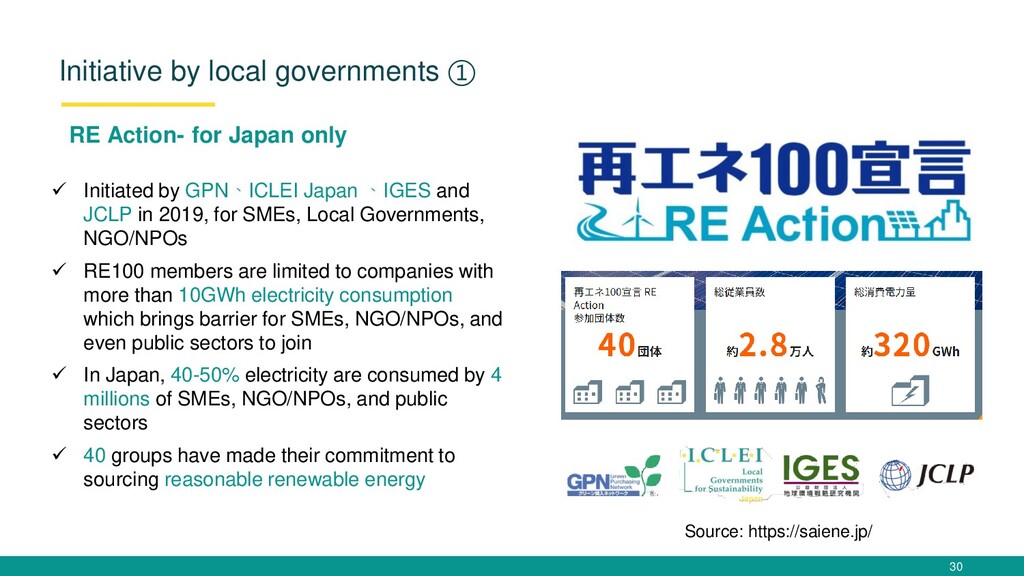
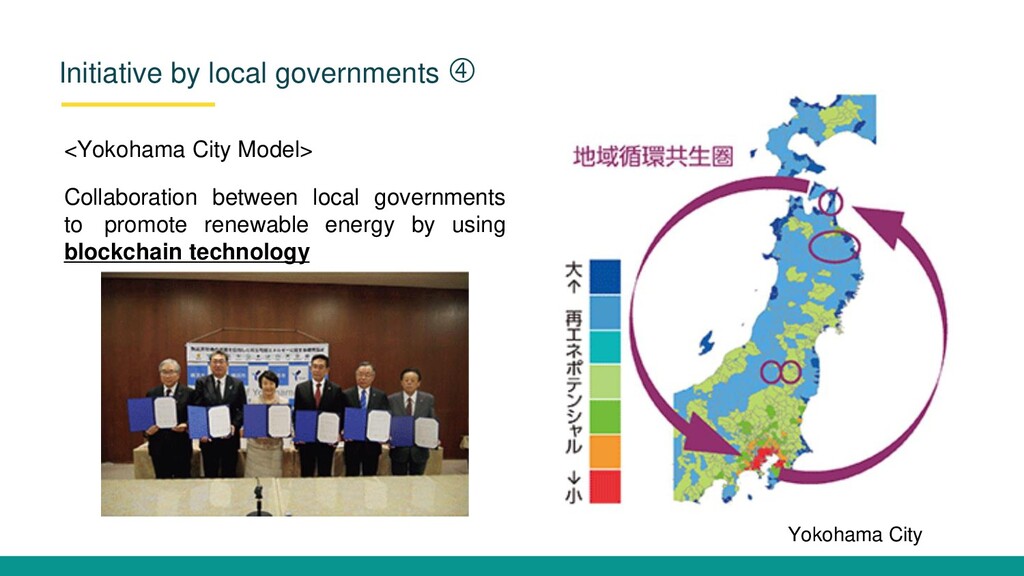
by GPN、ICLEI Japan 、IGES and JCLP in 2019, for SMEs, Local Governments, NGO/NPOs ✓ RE100 members are limited to companies with more than 10GWh electricity consumption which brings barrier for SMEs, NGO/NPOs, and even public sectors to join ✓ In Japan, 40-50% electricity are consumed by 4 millions of SMEs, NGO/NPOs, and public sectors ✓ 40 groups have made their commitment to sourcing reasonable renewable energy Initiative by local governments ①
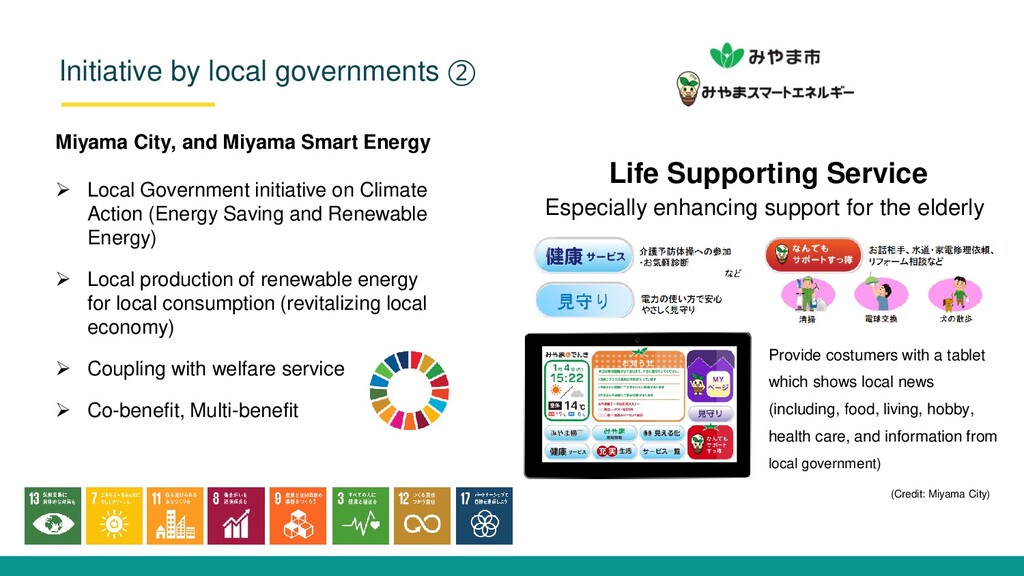
on Climate Action (Energy Saving and Renewable Energy) ➢ Local production of renewable energy for local consumption (revitalizing local economy) ➢ Coupling with welfare service ➢ Co-benefit, Multi-benefit Initiative by local governments ② Life Supporting Service Especially enhancing support for the elderly Provide costumers with a tablet which shows local news (including, food, living, hobby, health care, and information from local government) (Credit: Miyama City)
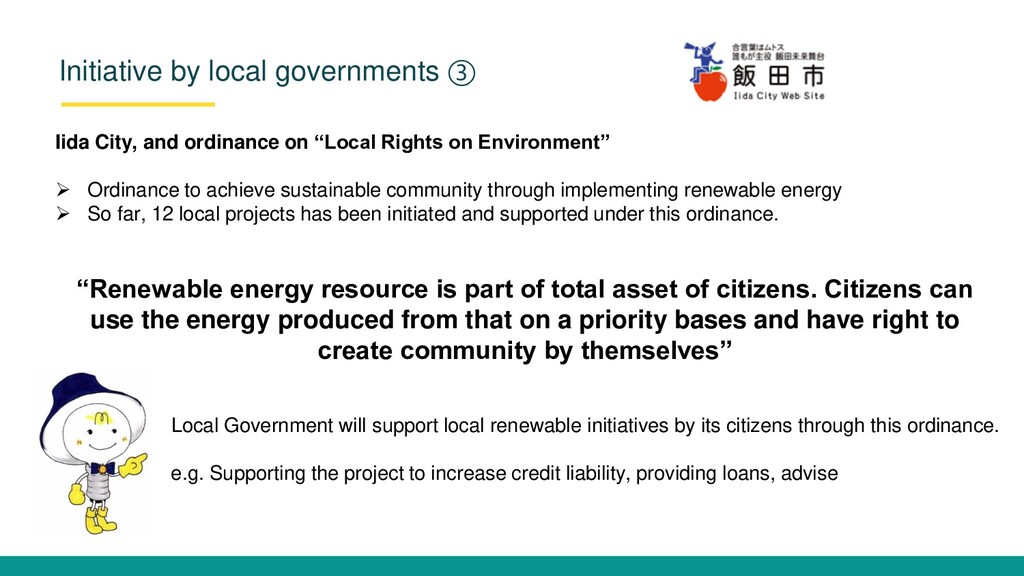
“Local Rights on Environment” ➢ Ordinance to achieve sustainable community through implementing renewable energy ➢ So far, 12 local projects has been initiated and supported under this ordinance. “Renewable energy resource is part of total asset of citizens. Citizens can use the energy produced from that on a priority bases and have right to create community by themselves” Local Government will support local renewable initiatives by its citizens through this ordinance. e.g. Supporting the project to increase credit liability, providing loans, advise
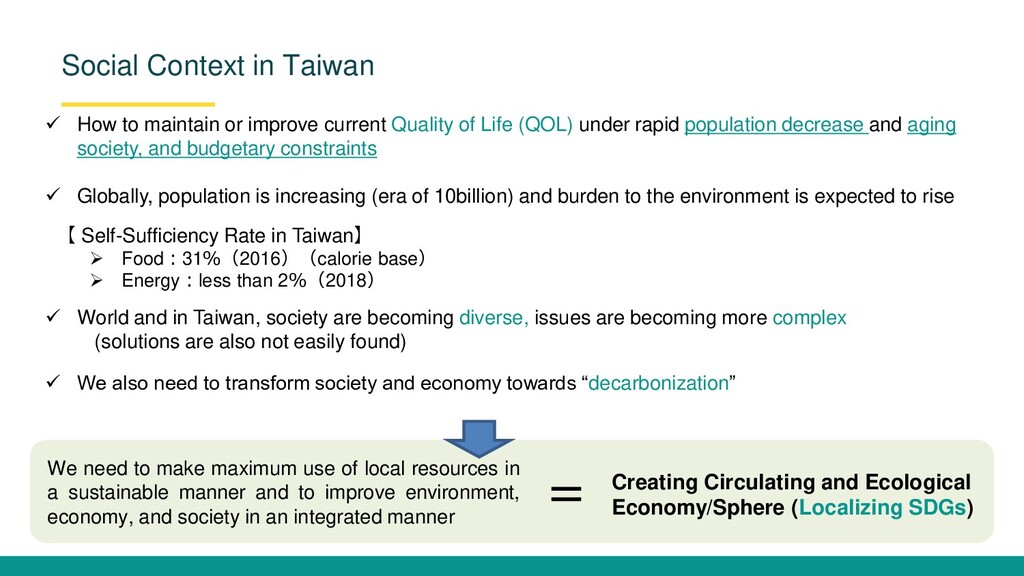
current Quality of Life (QOL) under rapid population decrease and aging society, and budgetary constraints ✓ Globally, population is increasing (era of 10billion) and burden to the environment is expected to rise 【 Self-Sufficiency Rate in Taiwan】 ➢ Food:31%(2016)(calorie base) ➢ Energy:less than 2%(2018) ✓ World and in Taiwan, society are becoming diverse, issues are becoming more complex (solutions are also not easily found) ✓ We also need to transform society and economy towards “decarbonization” We need to make maximum use of local resources in a sustainable manner and to improve environment, economy, and society in an integrated manner = Creating Circulating and Ecological Economy/Sphere (Localizing SDGs)
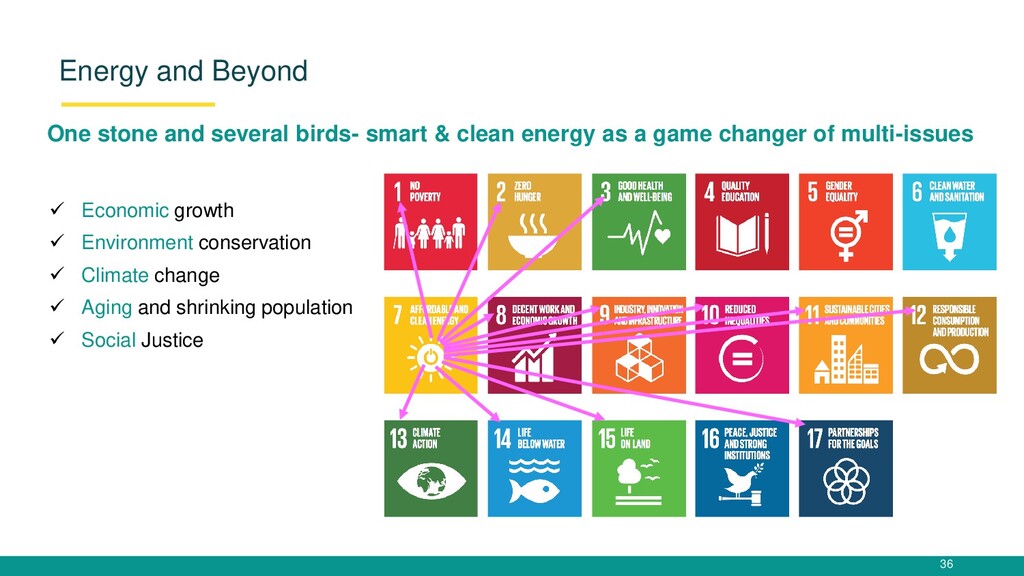
& clean energy as a game changer of multi-issues ✓ Economic growth ✓ Environment conservation ✓ Climate change ✓ Aging and shrinking population ✓ Social Justice


 learnenergy
 yatabe
 matleenalaakso
 akiraasano
 pawan_pharm
 drpoonamkc
 eller86
 terasawat
 naoji_taniguchi_ksk_0827
 ytapples613
 uchi8977
 ainischool
 swwweet
 nikkihalliwell
 tamaranovitovic
 mfonobong
 nonsquared
 maltzj
 marketingsoph
 tammyeverts
 raygrieselhuber
 davetheseo
 seathinner
 philnash