Upgrade to Pro — share decks privately, control downloads, hide ads and more …

Orchestrating AI Agents in Spec-Driven Developm...

Sponsored · Your Podcast. Everywhere. Effortlessly. Share. Educate. Inspire. Entertain. You do you. We'll handle the rest. →

Orchestrating AI Agents in Spec-Driven Development with Kiro IDE

These slides were presented at GDG DevFest Roma 2026 on October 10, 2026.

AI is dramatically changing software development. As generating code becomes faster and cheaper, the real challenges are shifting toward defining requirements, coordinating AI agents, verifying results, and maintaining reliable software systems.

In this talk, delivered at **GDG DevFest Roma 2026**, I explored how **Spec-Driven Development (SDD)** and **Kiro IDE** enable a more structured approach to AI-assisted software engineering.

The presentation covers the transition from prompt-driven development and vibe coding toward specifications as persistent, verifiable artifacts that coordinate development activities.

Key topics include:

- **Spec-Driven Development:** Requirements, steering documents, technical designs, EARS, and implementation tasks.
- **Kiro IDE:** Its development process and the broader Kiro tools ecosystem.
- **Agent Hooks:** Automating code reviews, testing, documentation, and other development activities.
- **Subagents:** Delegating specialized tasks to multiple AI agents.
- **Orchestration Patterns:** Reviewer loops, coordinator-worker models, sequential pipelines, parallel specialists, and event-driven agents.
- **Parallel Execution:** Managing task dependencies and concurrent execution.
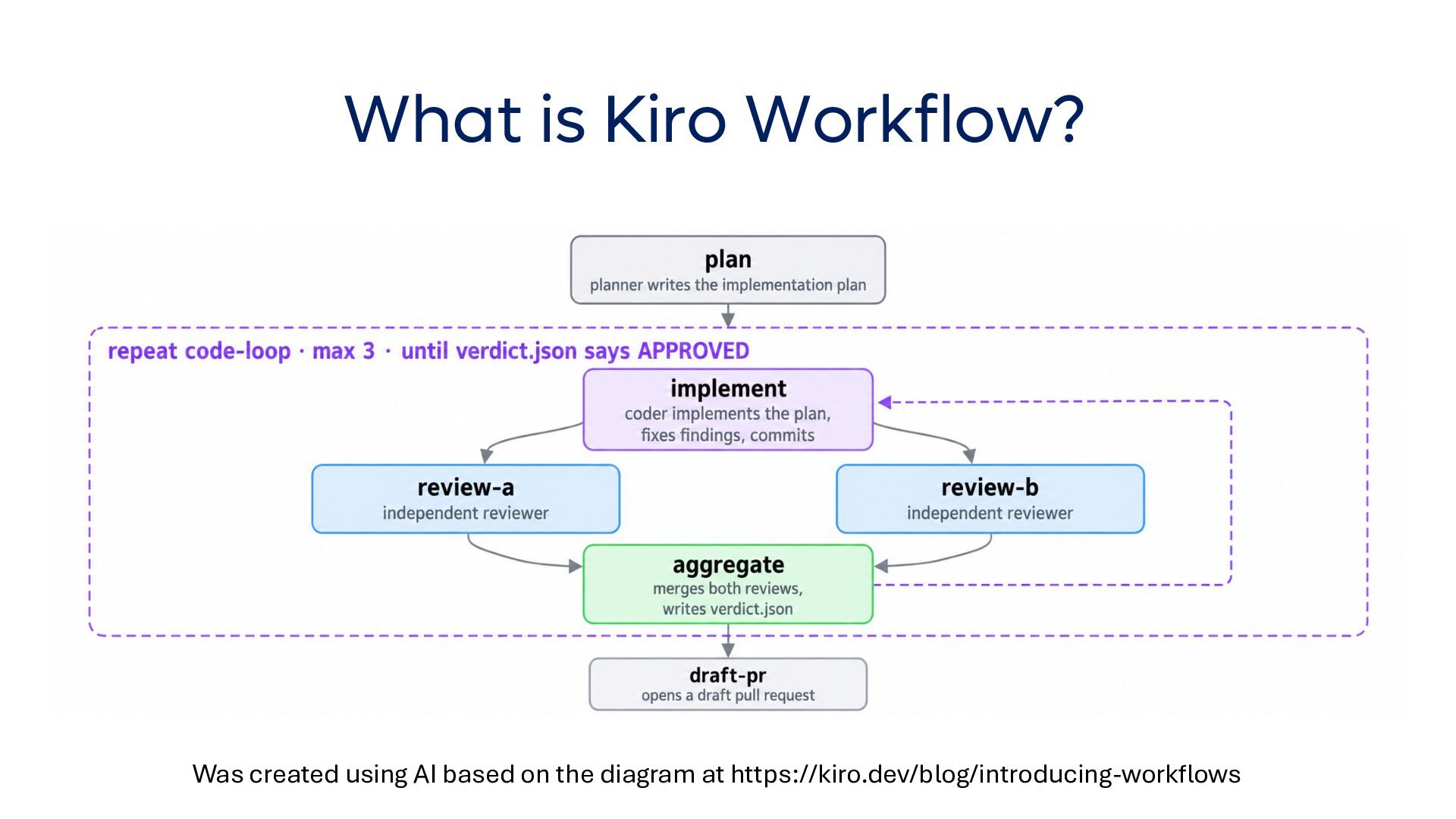
- **Kiro Workflows:** Defining reusable multi-agent workflows with sequential steps, parallel execution, and iterative loops.
- **Cloud-Based Agents and Kiro Crew:** Persistent orchestration, long-running tasks, and observability.
- **Best Practices:** Maintaining specifications, reviewing technical designs, and optimizing agent execution using MCP servers, skills, and Kiro Powers.

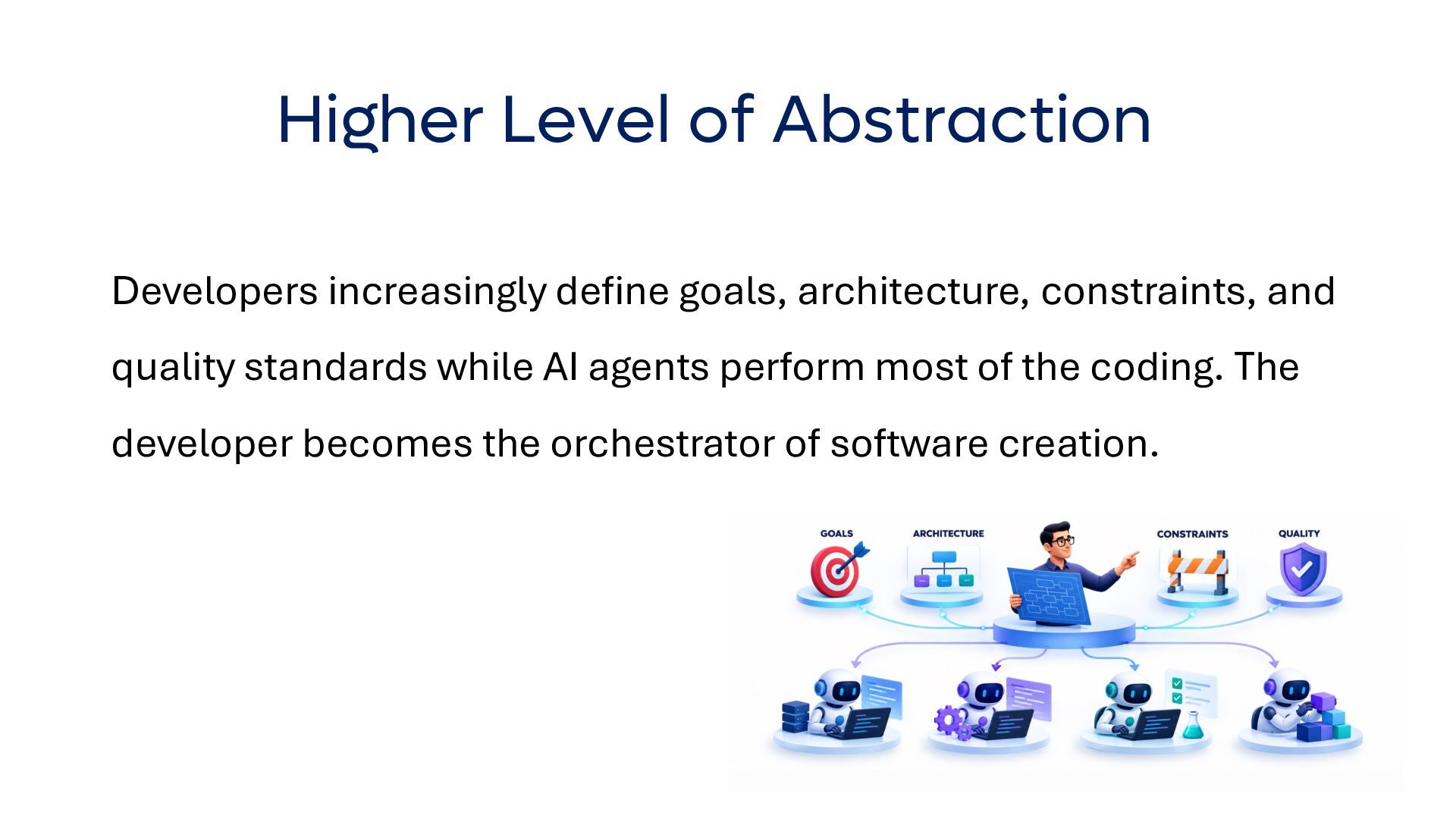
The central message is that **software development is moving to a higher level of abstraction**. Developers increasingly define goals, architecture, constraints, and quality standards while AI agents perform much of the implementation.

The future of software engineering is not merely about generating more code. It is about **orchestrating AI agents effectively while maintaining control, traceability, and software quality**.

You can find the post I have written to summarize my experience delivering this talk at https://lifemichael.com/en/devfest-roma-2026-orchestrating-ai-agents-with-kiro-ide/

Avatar for life michael

life michael

October 10, 2026

More Decks by life michael

Other Decks in Technology

Transcript

  1. Orchestrating AI Agents in Spec-Driven Development with Kiro IDE Haim

    Michael Founder & CEO @ Zindell Technologies www.zindell.com | blog.lifemichael.com life michael
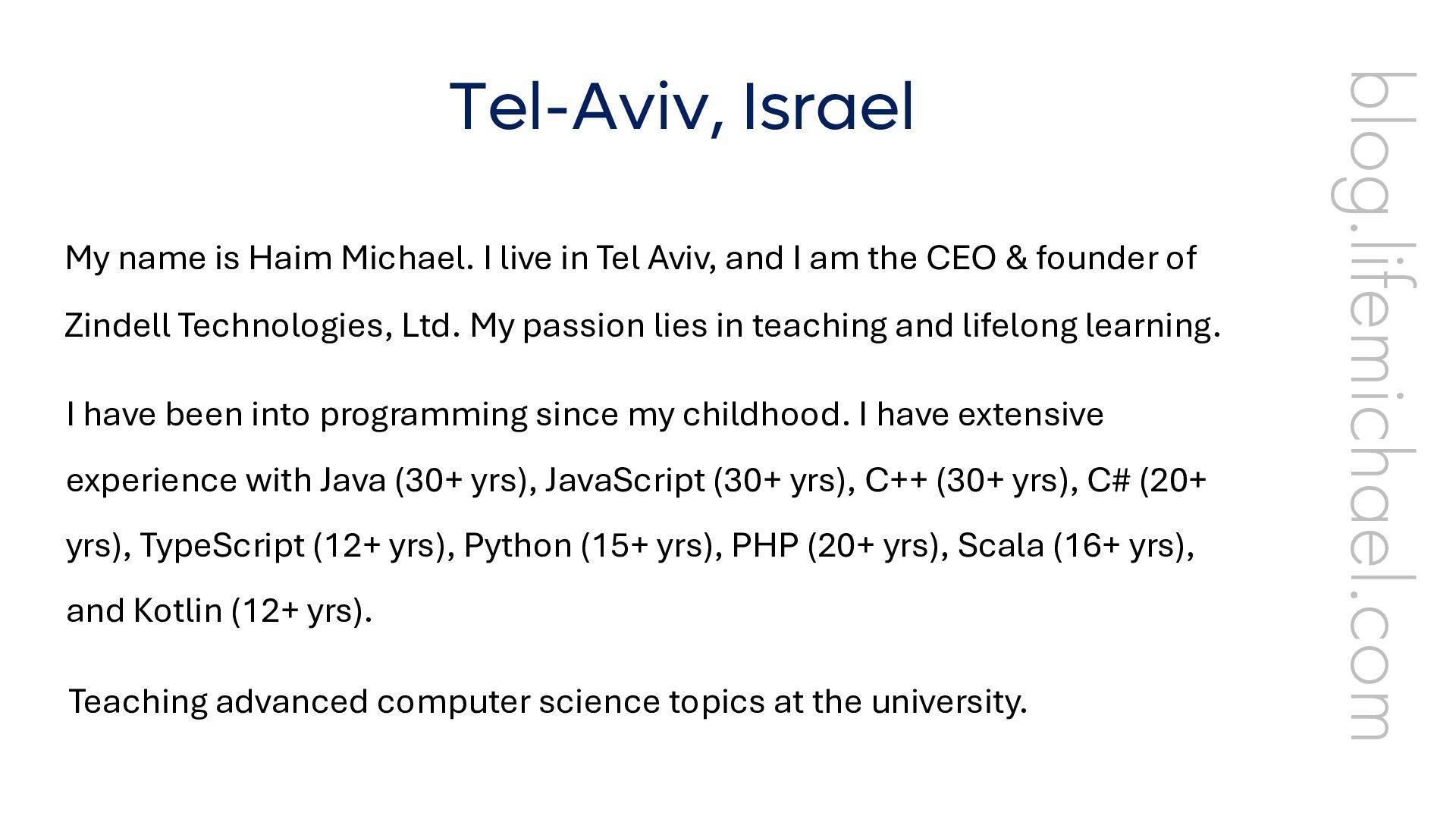
  2. My name is Haim Michael. I live in Tel Aviv,

    and I am the CEO & founder of Zindell Technologies, Ltd. My passion lies in teaching and lifelong learning. I have been into programming since my childhood. I have extensive experience with Java (30+ yrs), JavaScript (30+ yrs), C++ (30+ yrs), C# (20+ yrs), TypeScript (12+ yrs), Python (15+ yrs), PHP (20+ yrs), Scala (16+ yrs), and Kotlin (12+ yrs). Teaching advanced computer science topics at the university. blog.lifemichael.com Tel-Aviv, Israel
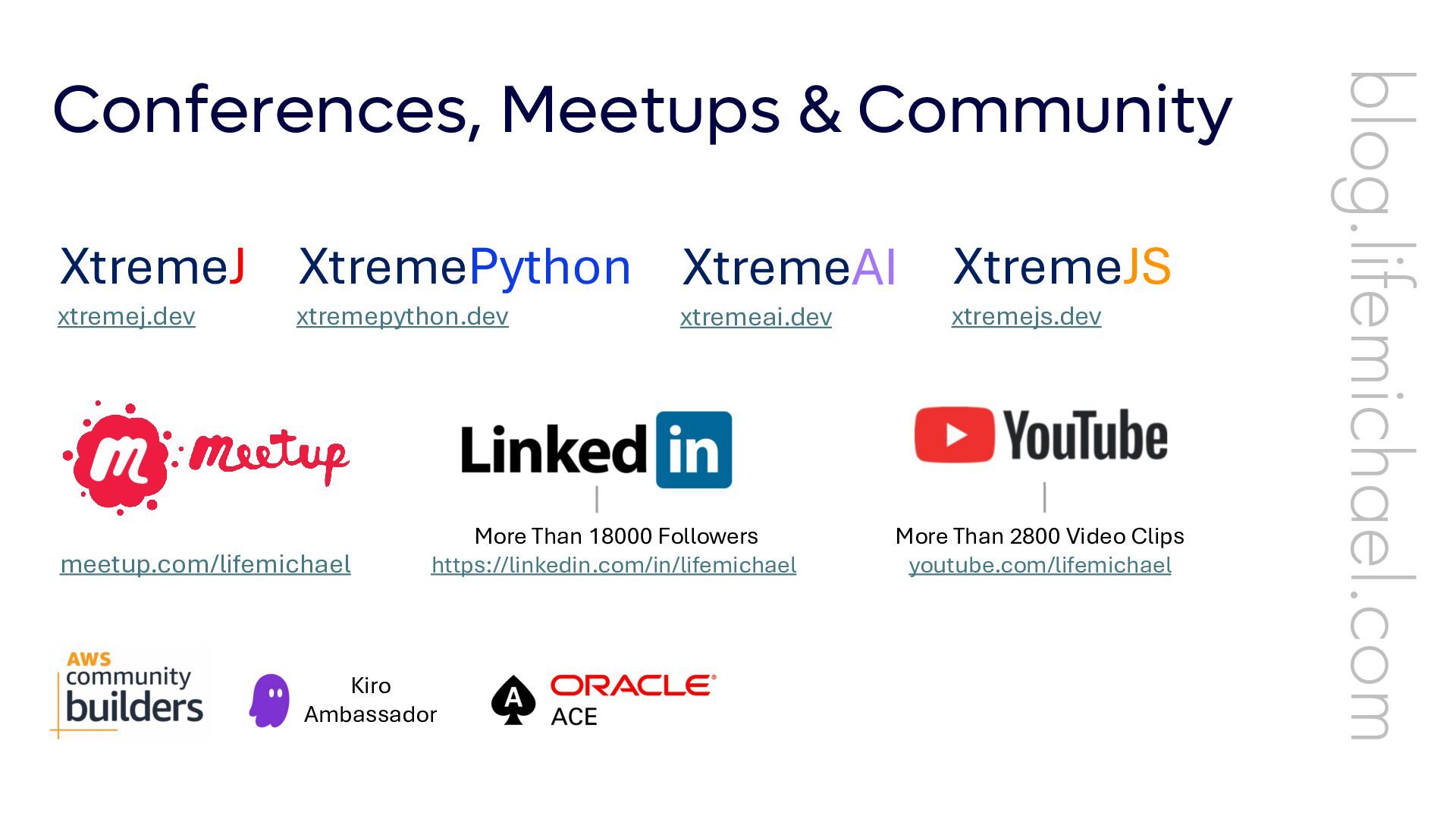
  3. XtremeJ XtremePython XtremeAI xtremej.dev xtremepython.dev meetup.com/lifemichael xtremeai.dev More Than 18000

    Followers https://linkedin.com/in/lifemichael Kiro Ambassador XtremeJS xtremejs.dev More Than 2800 Video Clips youtube.com/lifemichael blog.lifemichael.com Conferences, Meetups & Community
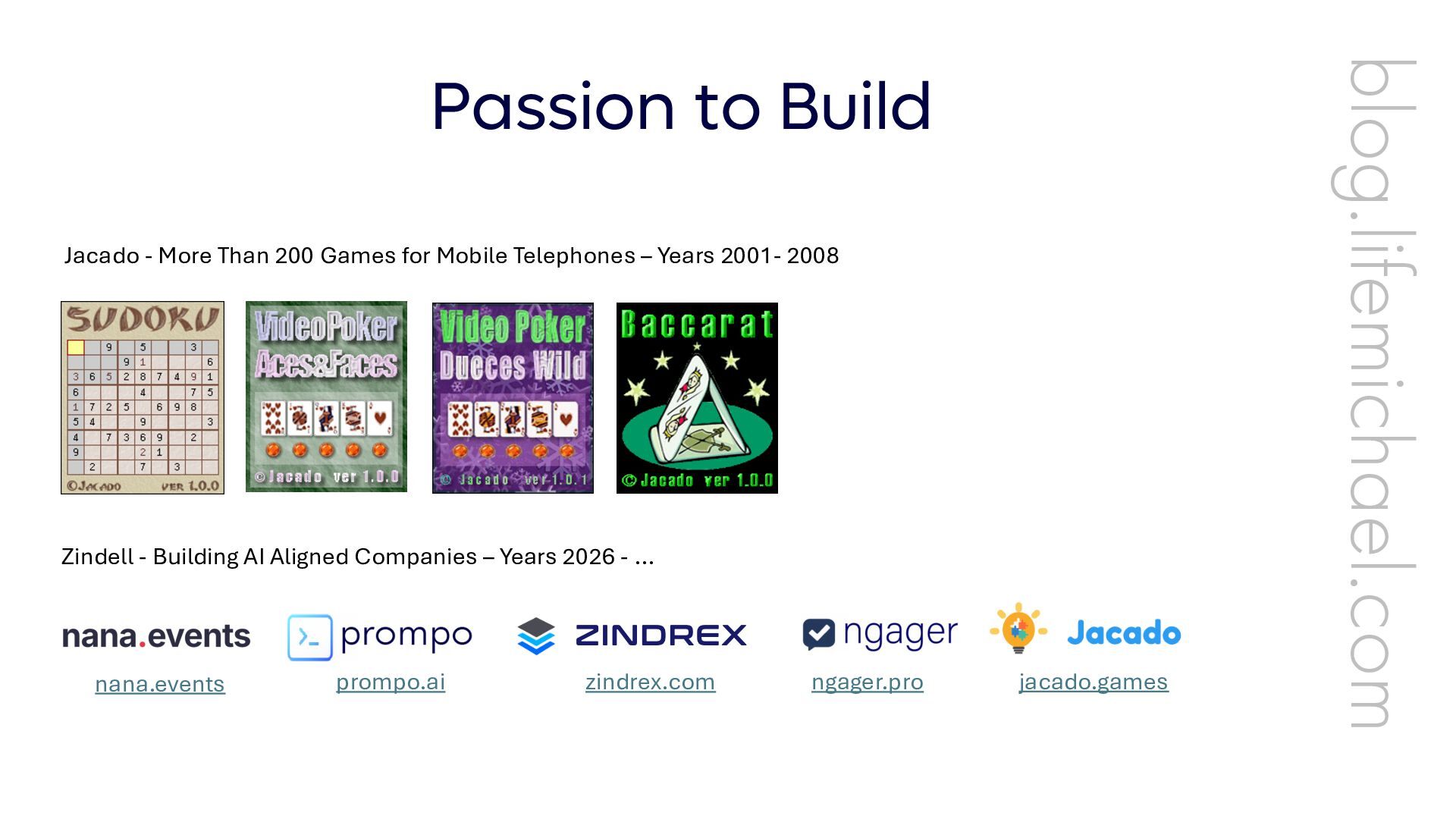
  4. Jacado - More Than 200 Games for Mobile Telephones –

    Years 2001- 2008 Zindell - Building AI Aligned Companies – Years 2026 - … nana.events prompo.ai zindrex.com ngager.pro jacado.games blog.lifemichael.com Passion to Build
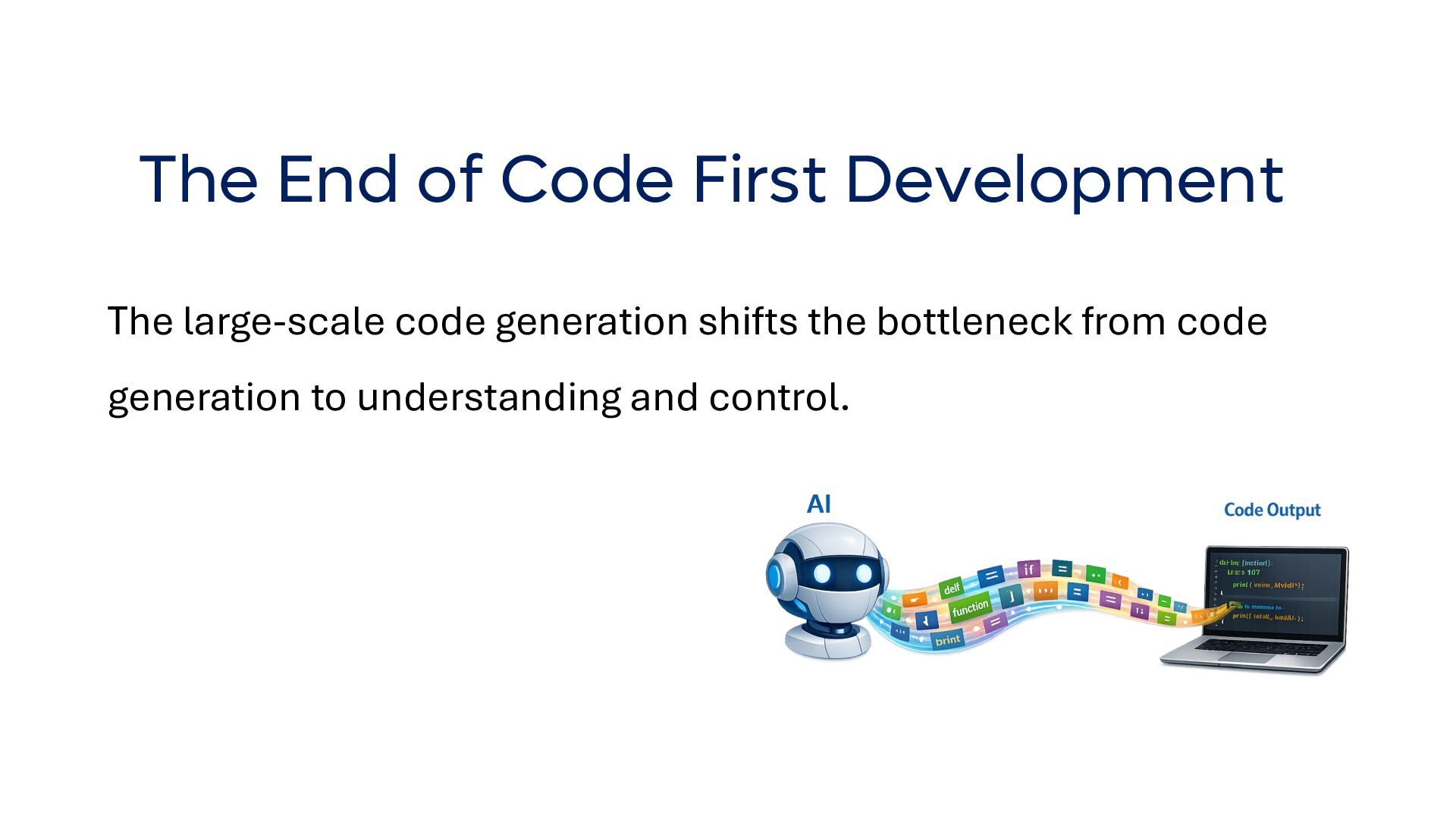
  5. The End of Code First Development The large-scale code generation

    shifts the bottleneck from code generation to understanding and control.
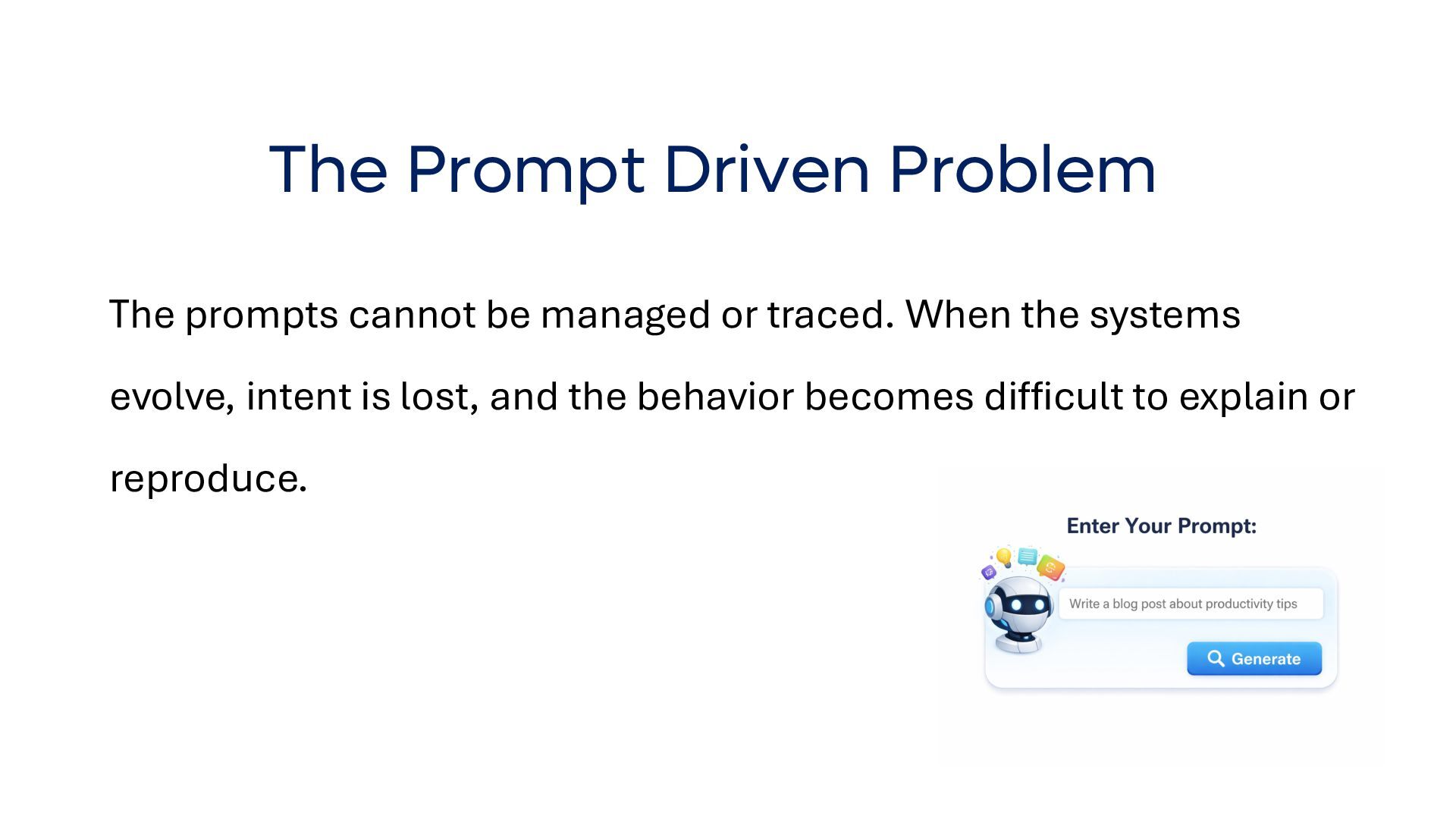
  6. The Prompt Driven Problem The prompts cannot be managed or

    traced. When the systems evolve, intent is lost, and the behavior becomes difficult to explain or reproduce.
  7. The Vibe Coding Trap The core limitation of vibe coding

    is not the code quality. It is the lack of institutional memory. Decisions live in conversations with an AI rather than in durable artifacts. When systems grow, no one can reliably explain why a particular design exists or what must remain true as changes are introduced.
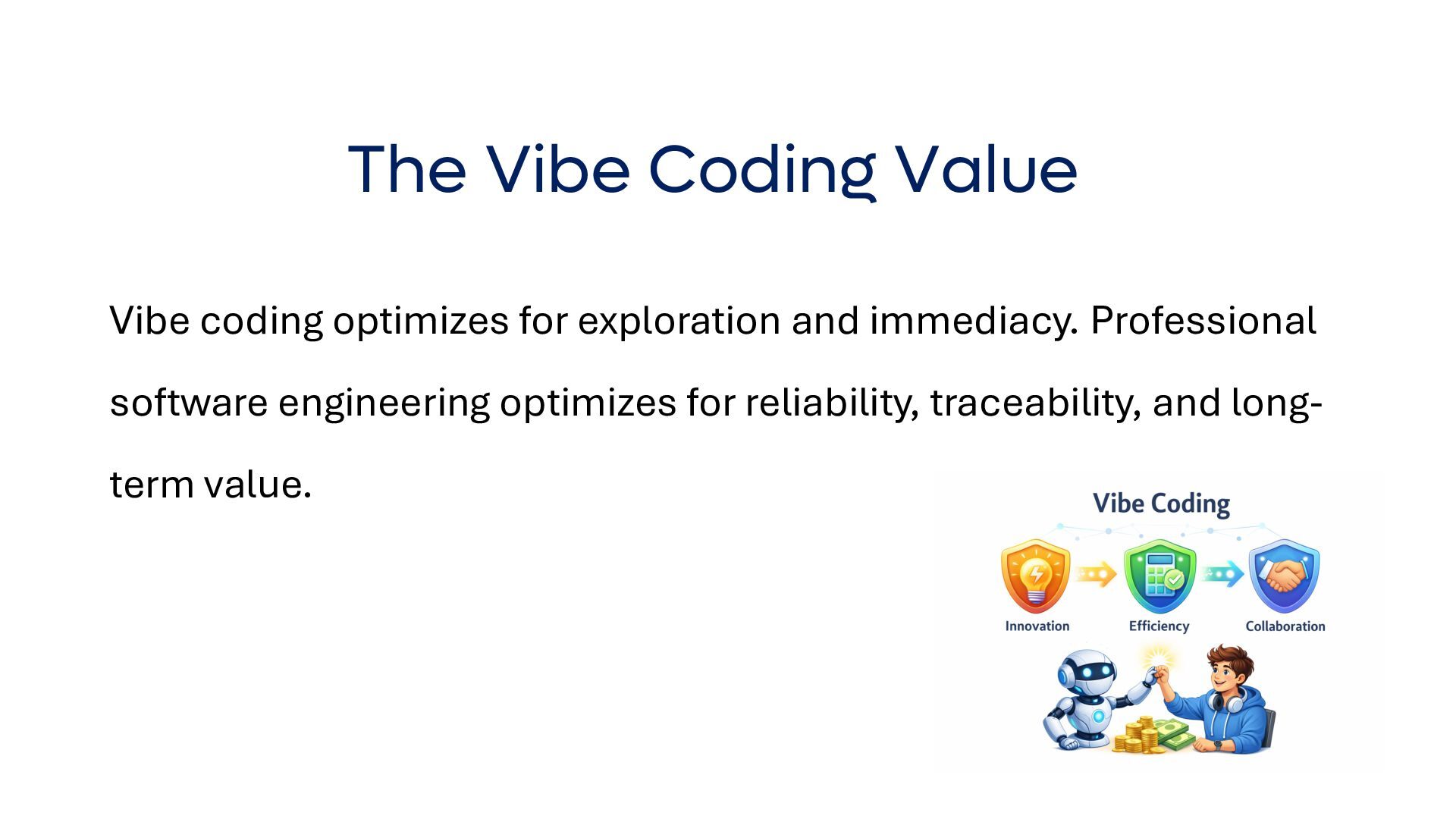
  8. The Vibe Coding Value Vibe coding optimizes for exploration and

    immediacy. Professional software engineering optimizes for reliability, traceability, and longterm value.
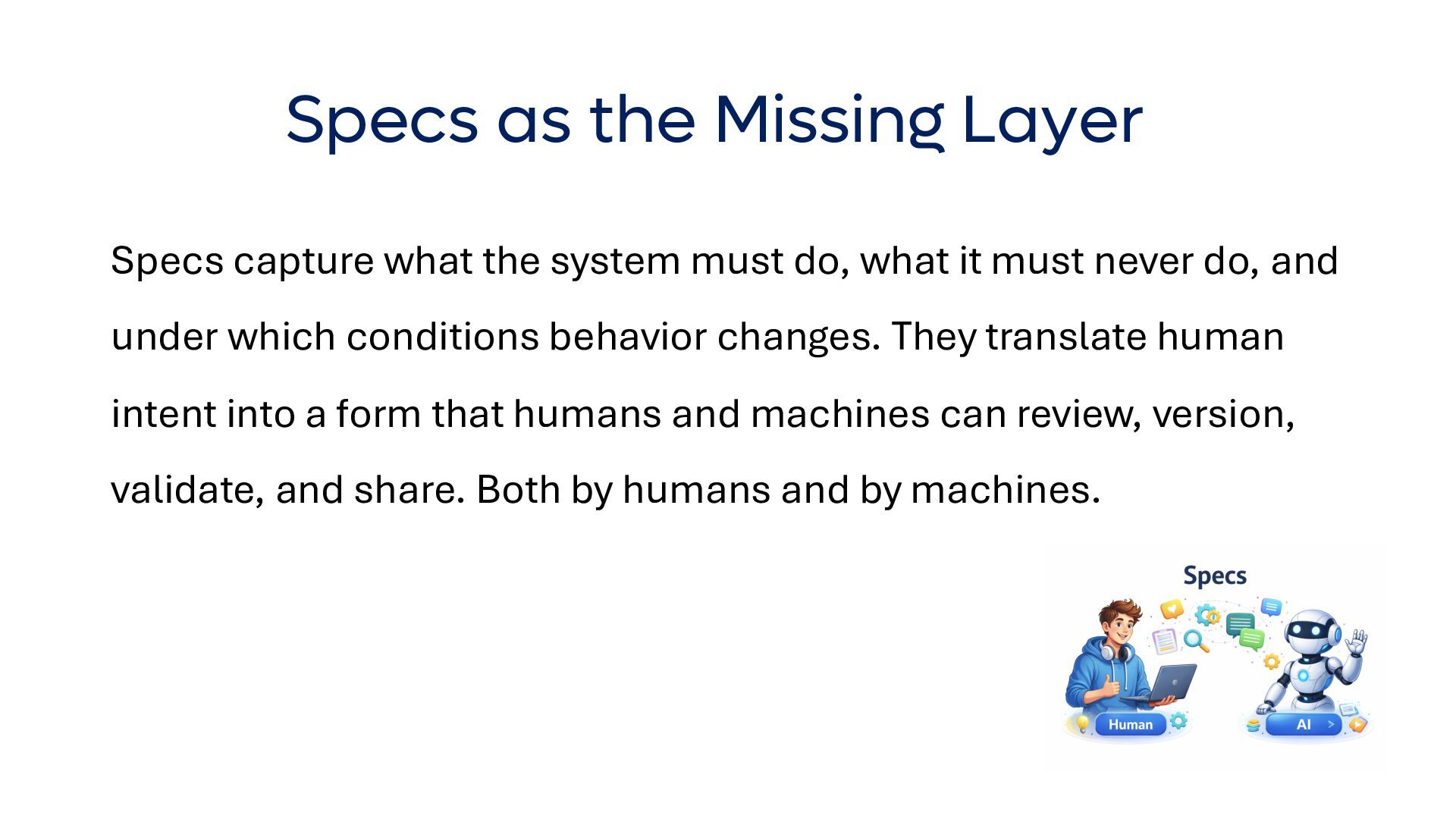
  9. Specs as the Missing Layer Specs capture what the system

    must do, what it must never do, and under which conditions behavior changes. They translate human intent into a form that humans and machines can review, version, validate, and share. Both by humans and by machines.
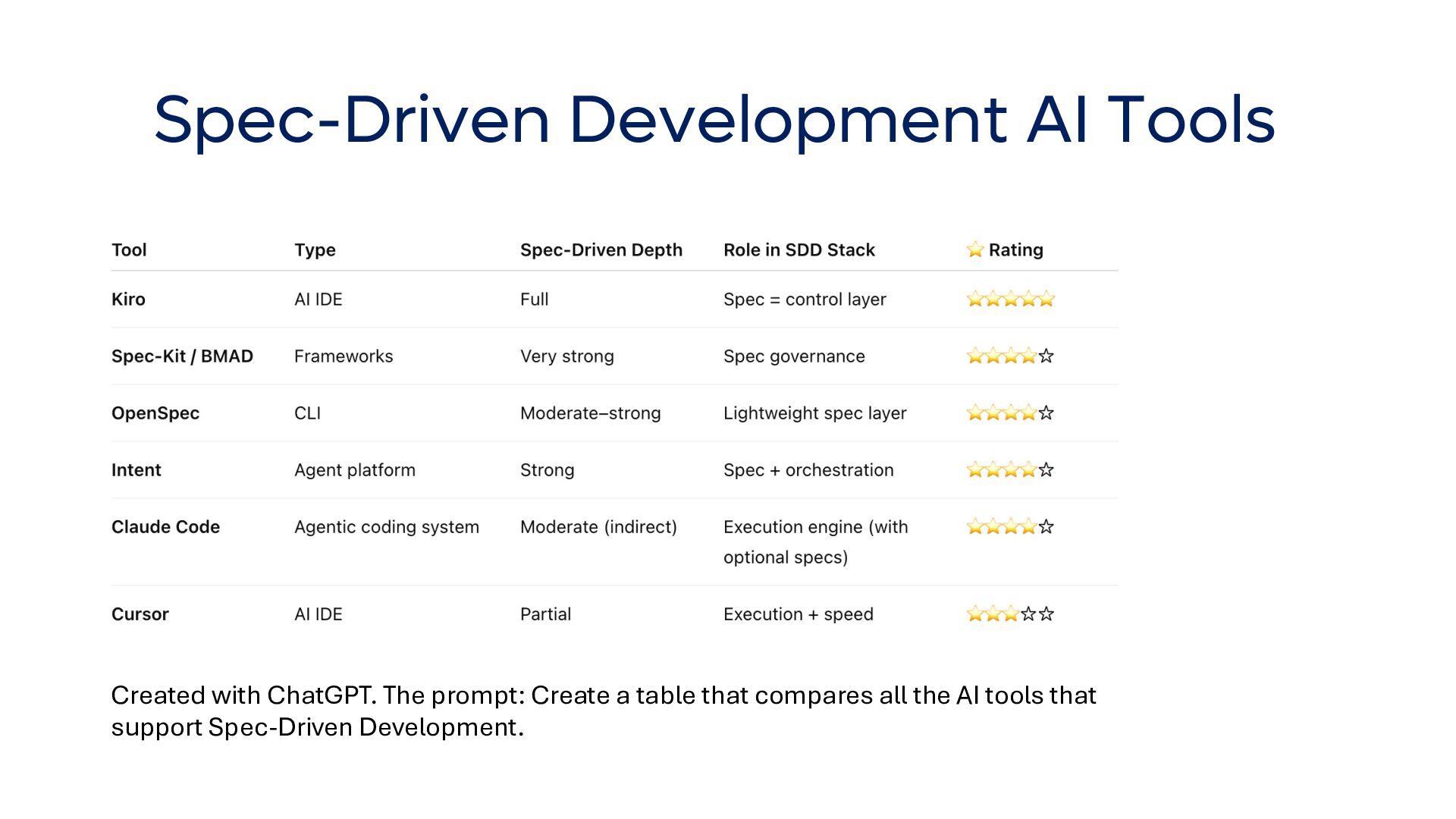
  10. Spec-Driven Development AI Tools Created with ChatGPT. The prompt: Create

    a table that compares all the AI tools that support Spec-Driven Development.
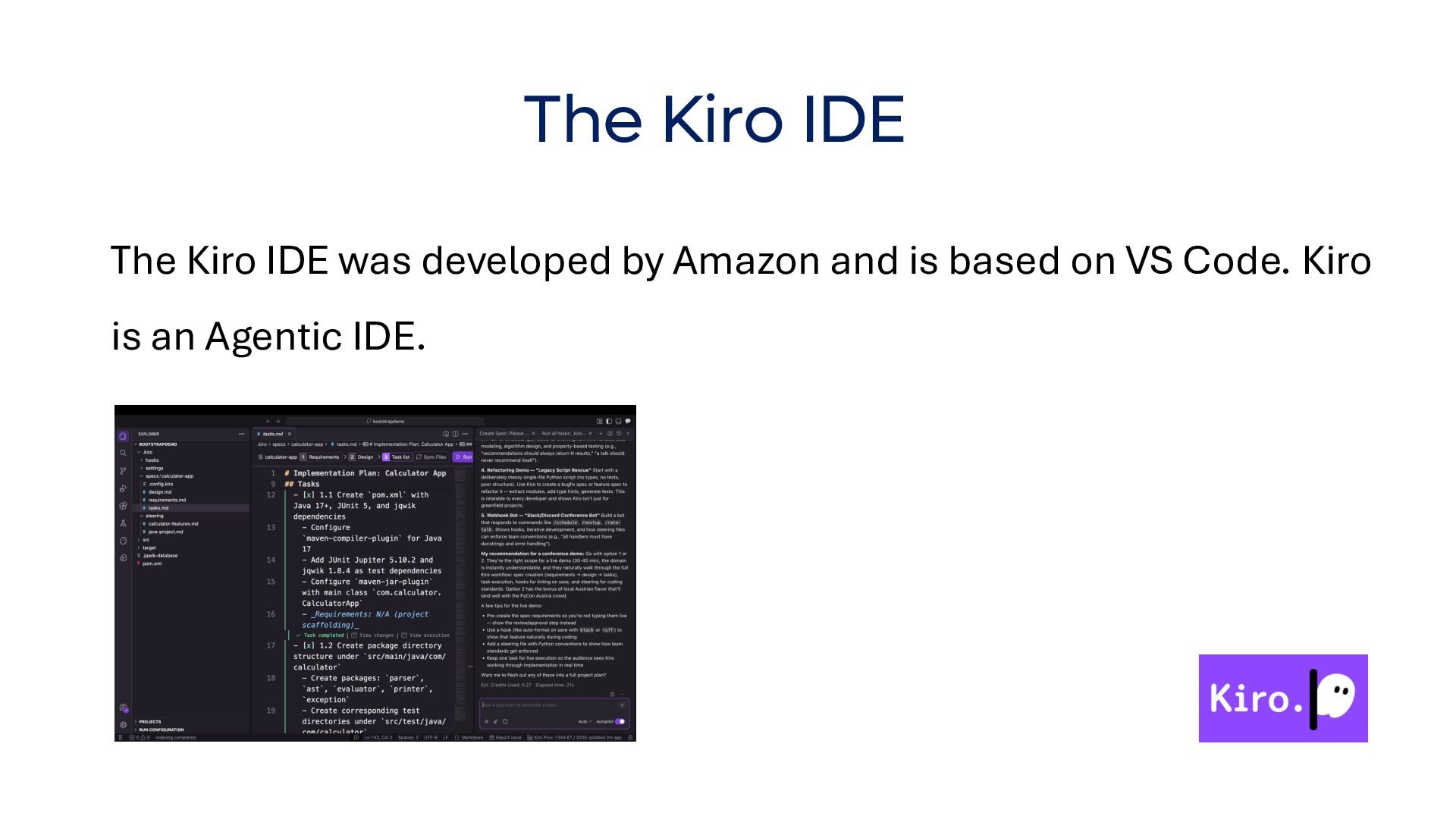
  11. The Kiro IDE The Kiro IDE was developed by Amazon

    and is based on VS Code. Kiro is an Agentic IDE.
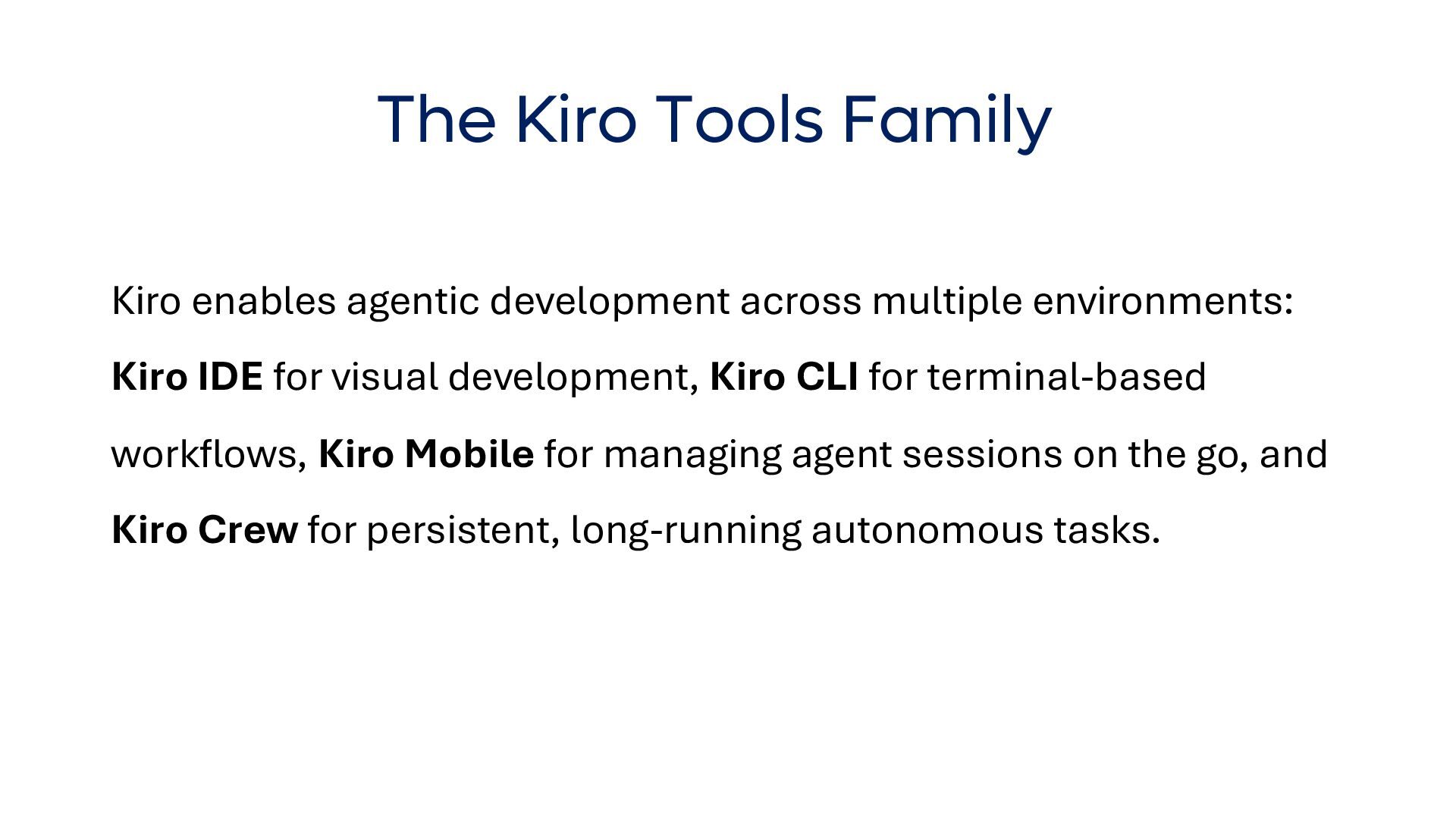
  12. The Kiro Tools Family Kiro enables agentic development across multiple

    environments: Kiro IDE for visual development, Kiro CLI for terminal-based workflows, Kiro Mobile for managing agent sessions on the go, and Kiro Crew for persistent, long-running autonomous tasks.
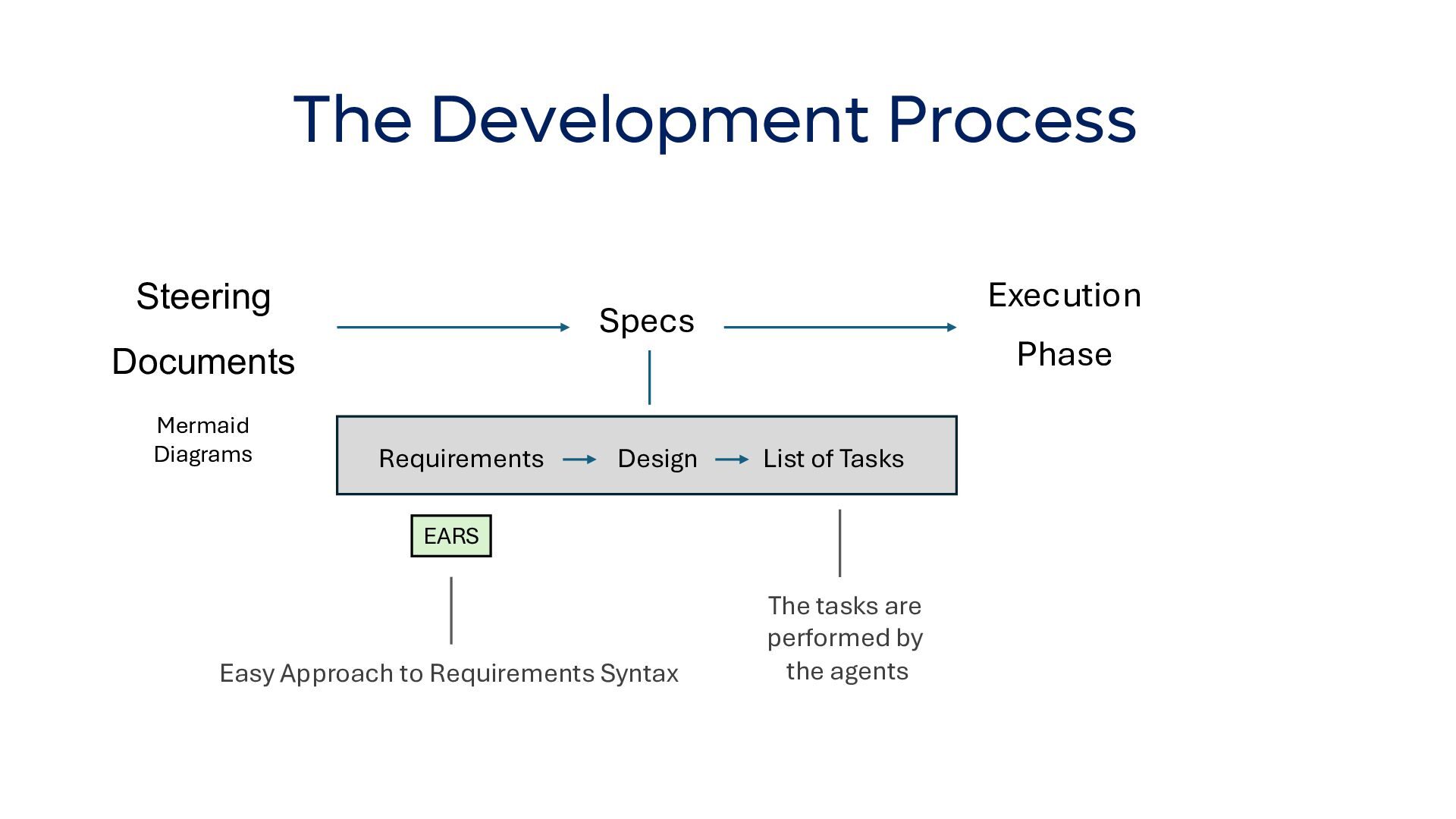
  13. The Development Process Steering Specs Documents Mermaid Diagrams Execution Requirements

    Design Phase List of Tasks EARS Easy Approach to Requirements Syntax The tasks are performed by the agents
  14. What are Agent Hooks? Agent hooks are automated triggers that

    execute predefined agent prompts or shell commands when specific events occur in your IDE. Rather than manually asking for routine tasks to be performed, hooks set up automated responses to events such as: Linting Updating Other Files Create Tests Static Analysis Tools Code Formatting Updating Related Files Generating Documentation
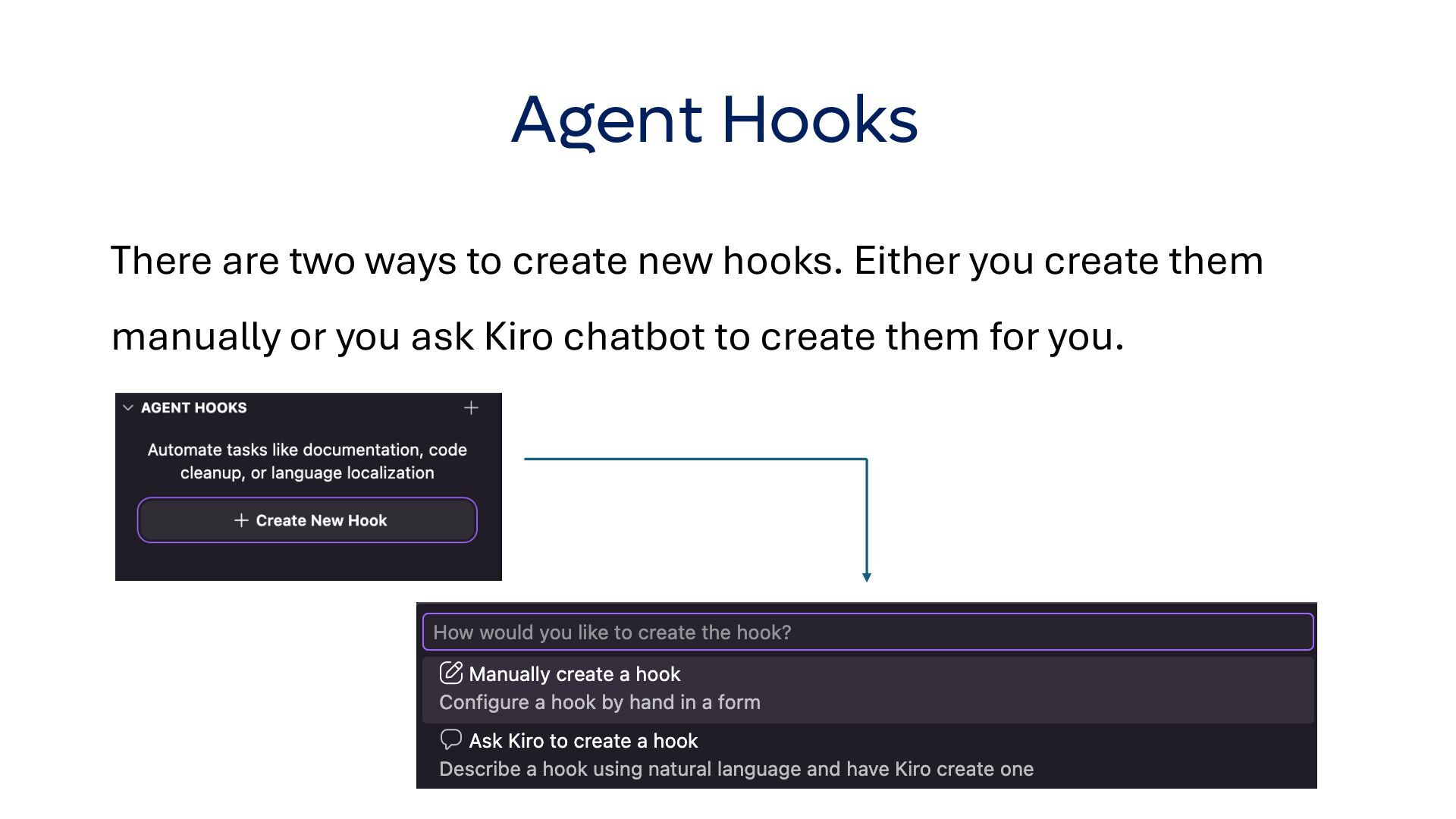
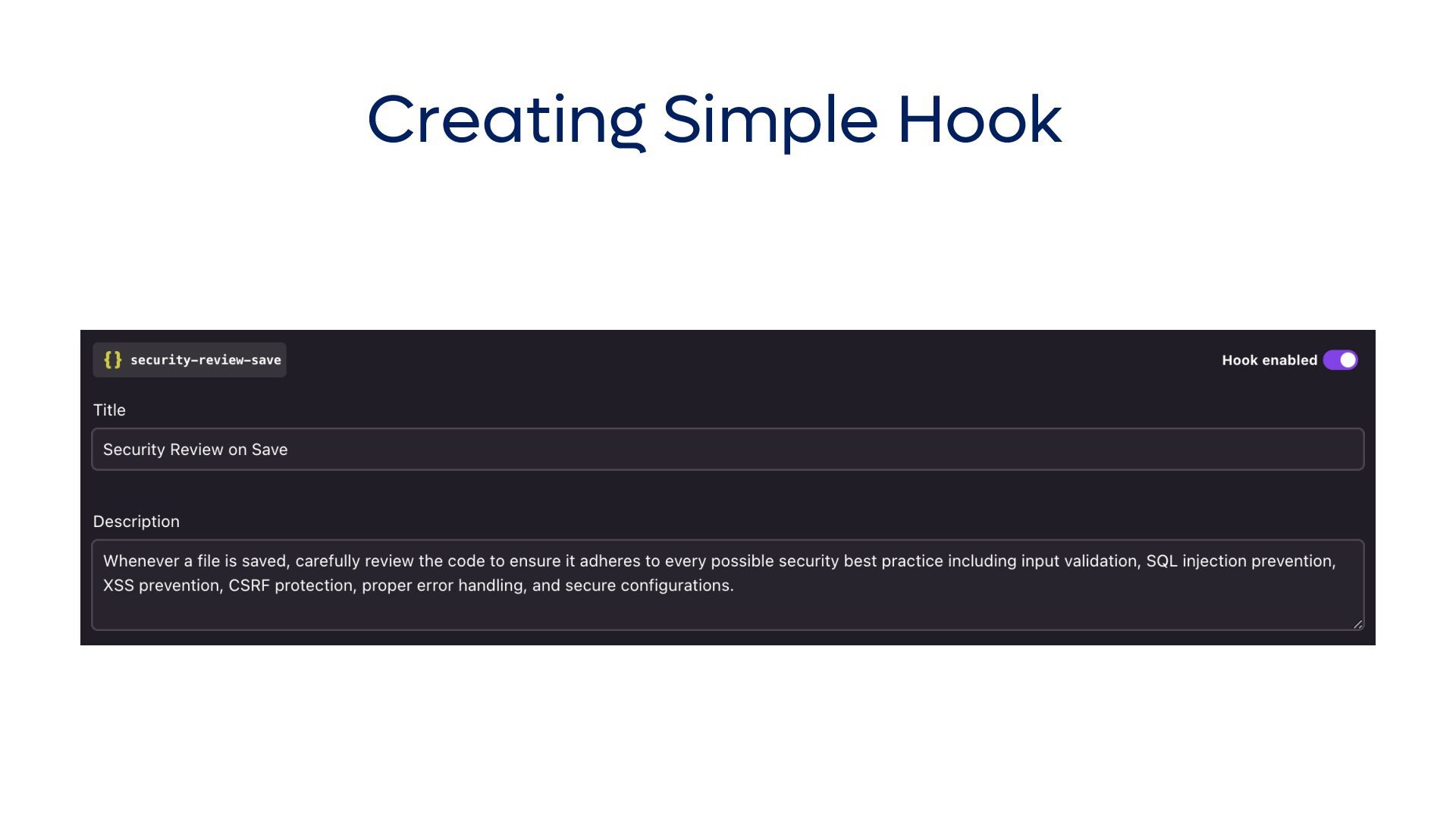
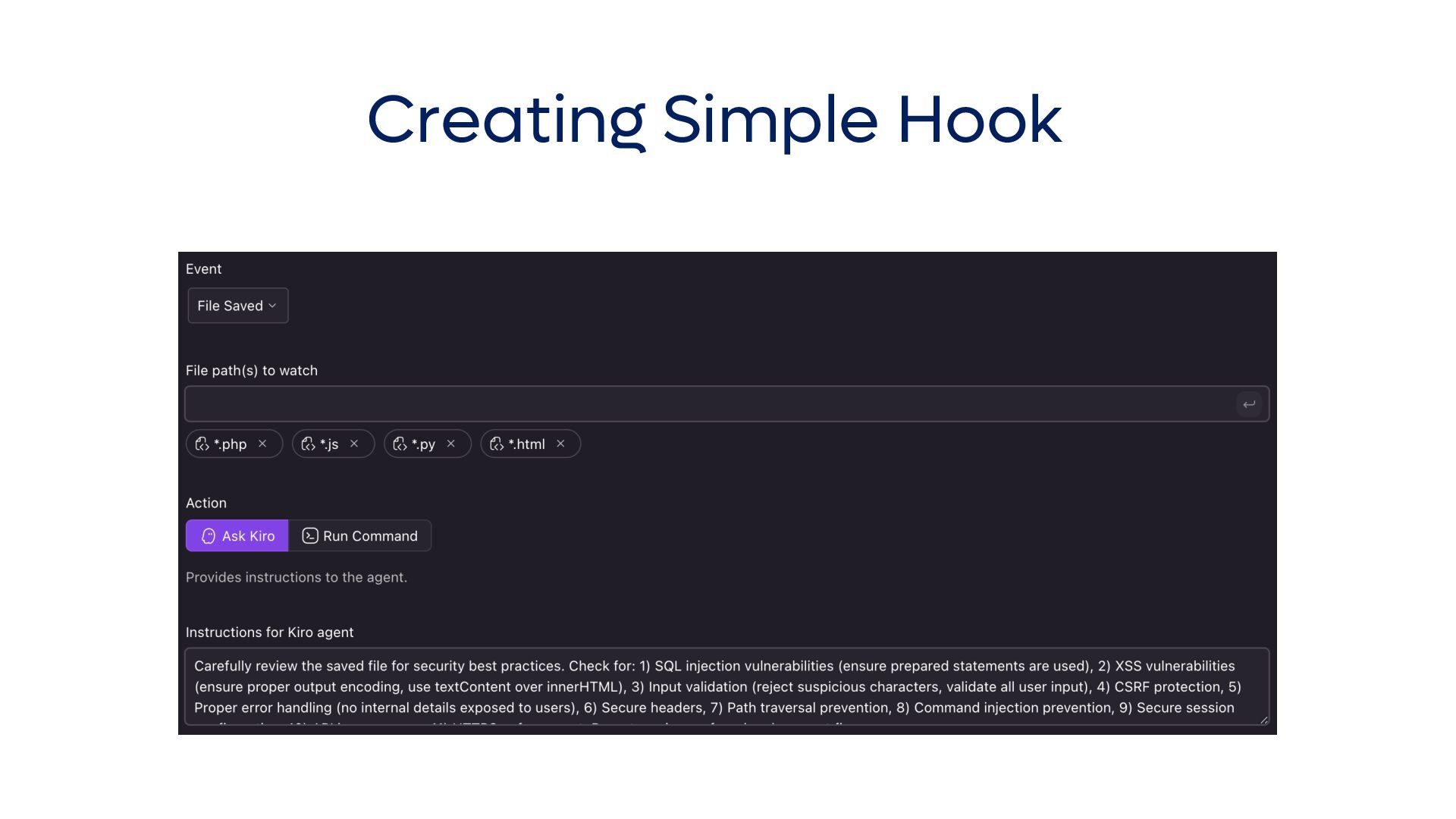
  15. Agent Hooks There are two ways to create new hooks.

    Either you create them manually or you ask Kiro chatbot to create them for you.
  16. What are Subagents? The subagents allow Kiro to run multiple

    tasks parallelly or to delegate specific tasks to subagents that specialize in those tasks.
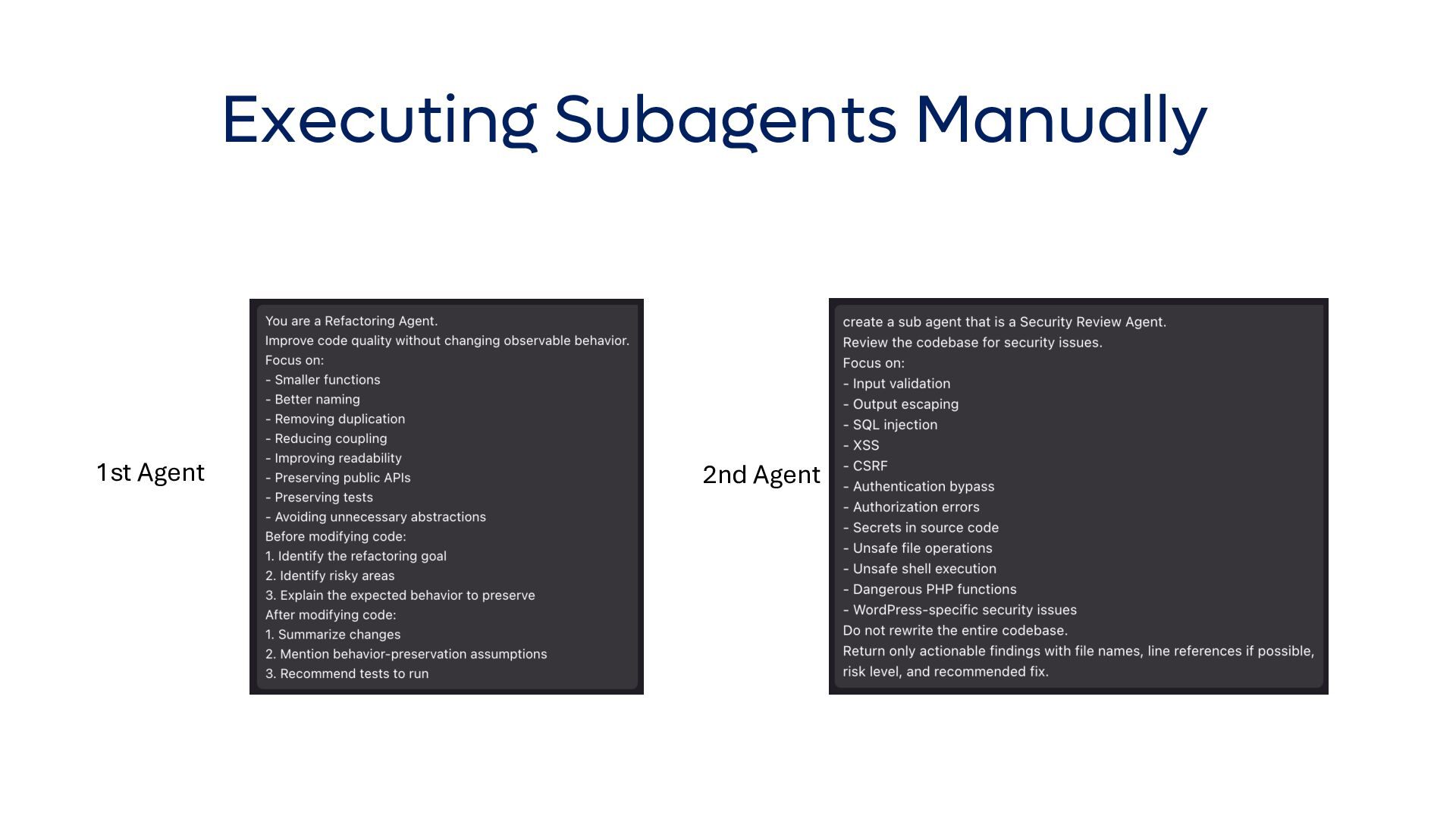
  17. Executing Subagents Manually We can launch subagents manually by instructing

    Kiro to do so via a prompt such as ”run subagents to do this and that...".
  18. Common Orchestration Patterns There are common scenarios and common patterns

    when developing software applications with the help of AI agents: Reviewer Loop One agent produces work, and another verifies it. Event-Driven Agents External events trigger agents to perform specific tasks.
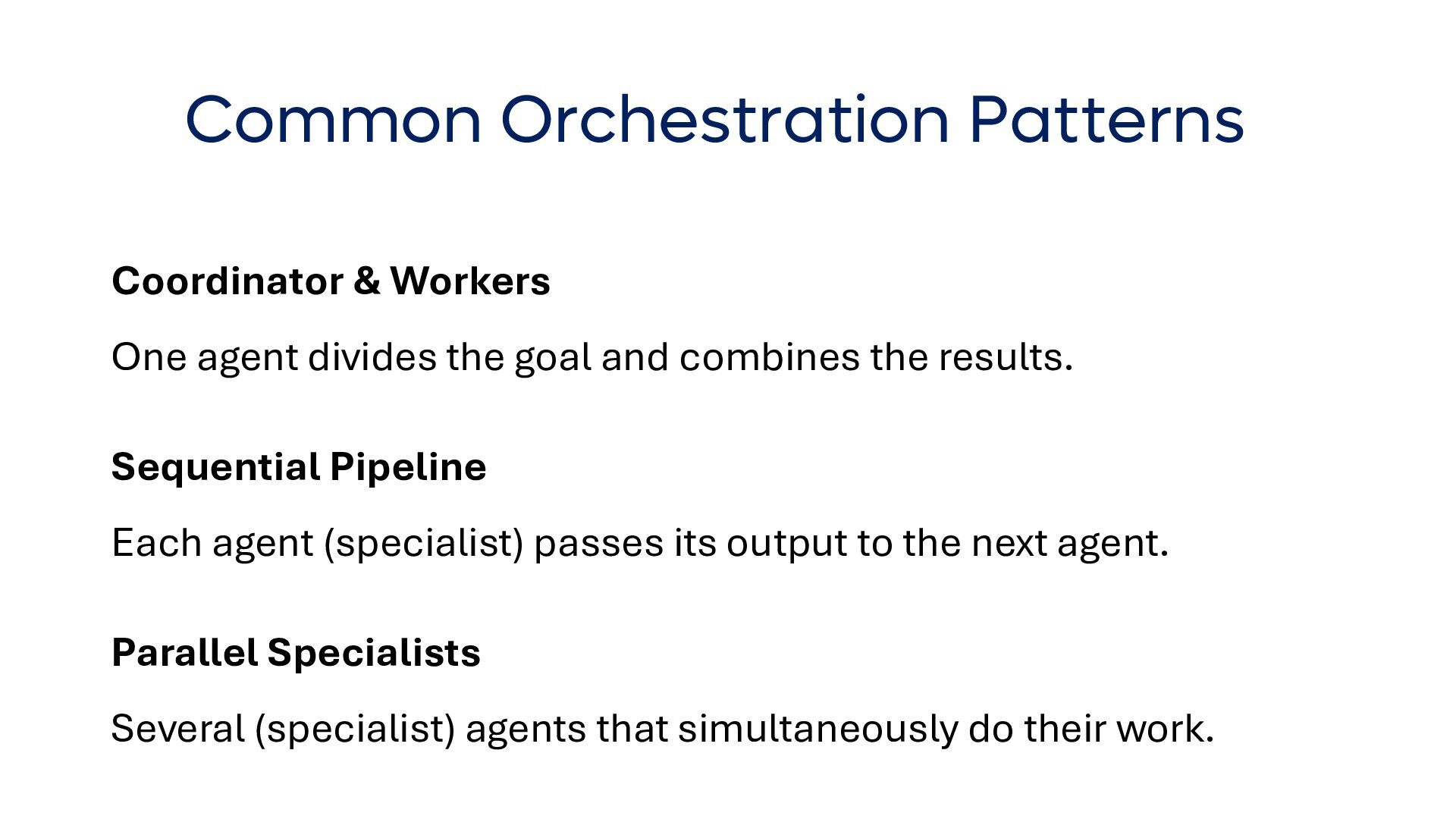
  19. Common Orchestration Patterns Coordinator & Workers One agent divides the

    goal and combines the results. Sequential Pipeline Each agent (specialist) passes its output to the next agent. Parallel Specialists Several (specialist) agents that simultaneously do their work.
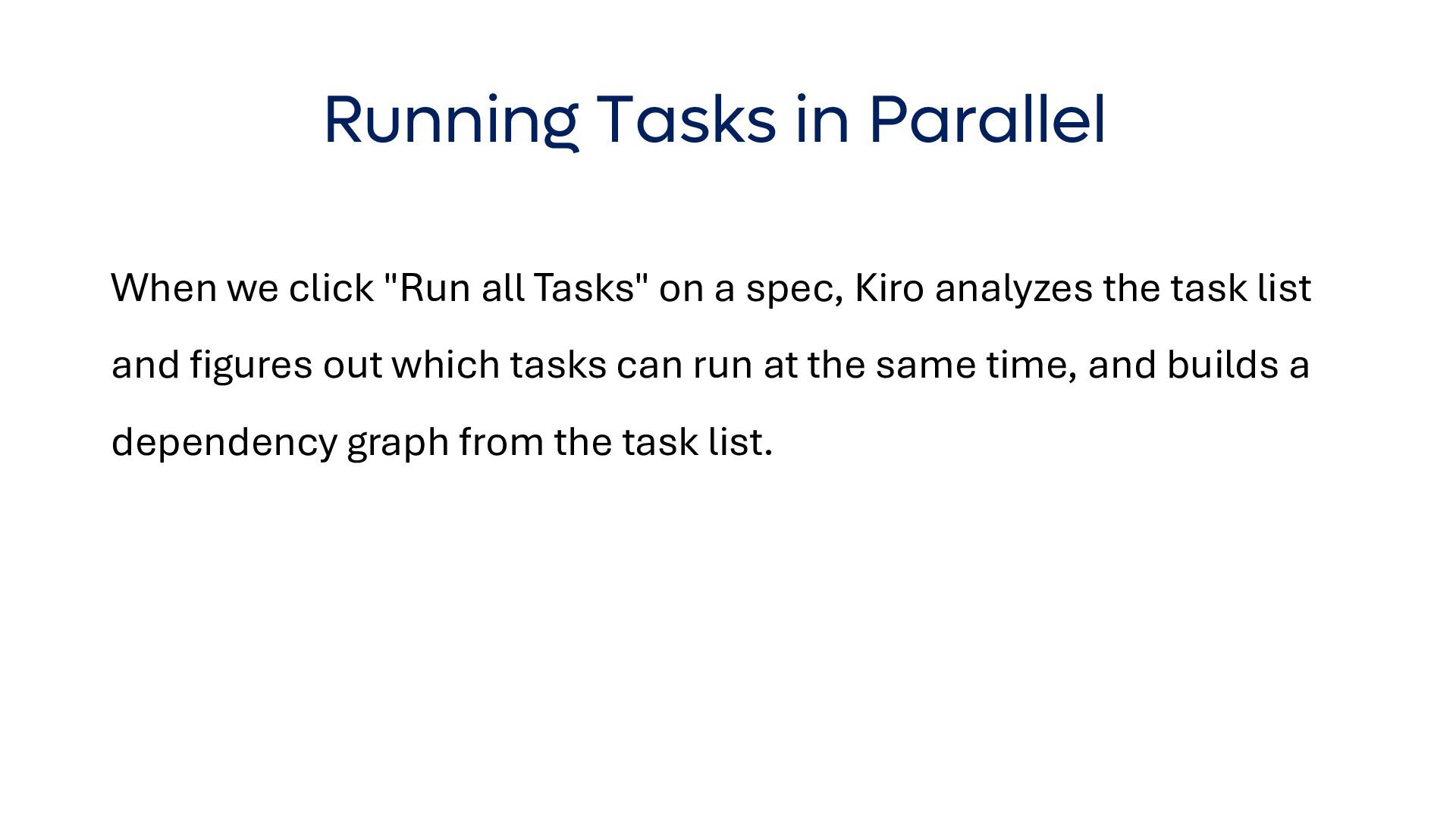
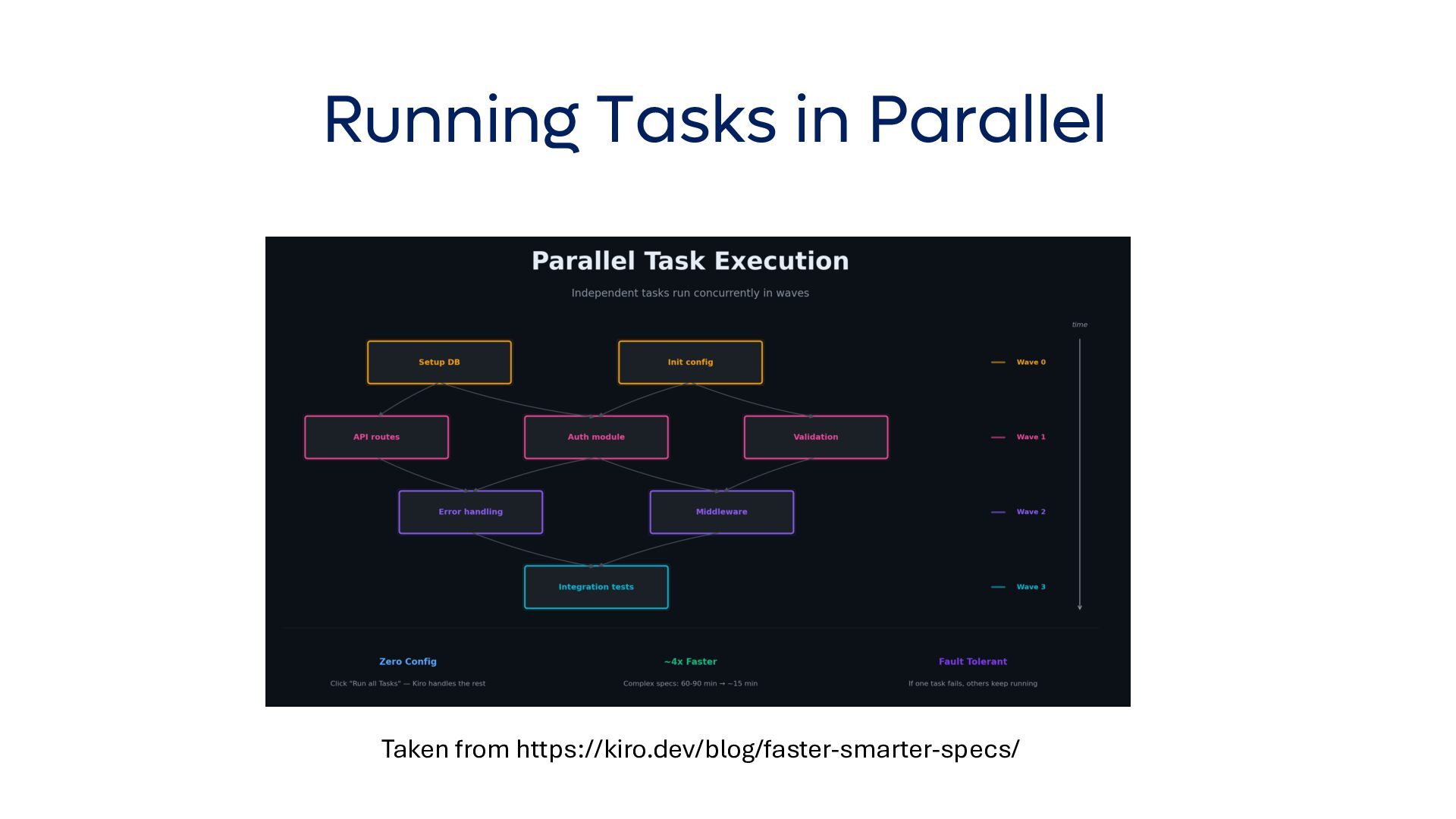
  20. Running Tasks in Parallel When we click "Run all Tasks"

    on a spec, Kiro analyzes the task list and figures out which tasks can run at the same time, and builds a dependency graph from the task list.
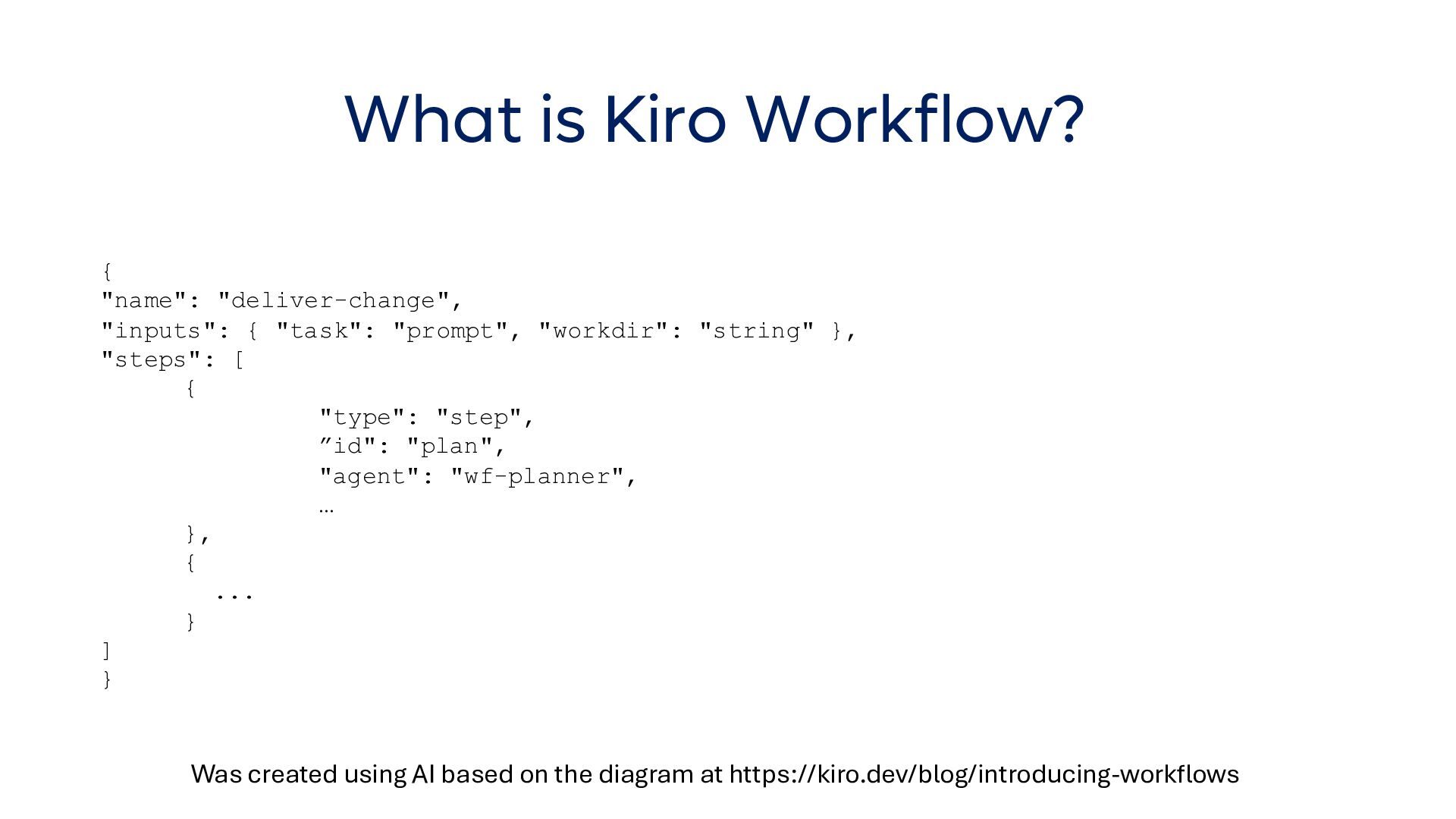
  21. What is Kiro Workflow? Kiro Workflows automate complex, multi-step tasks

    by orchestrating multiple AI agents through sequential steps, parallel execution, and iterative loops. Each agent operates in an independent session, enabling reusable workflows that run with minimal human supervision.
  22. What is Kiro Workflow? Was created using AI based on

    the diagram at https://kiro.dev/blog/introducing-workflows
  23. What is Kiro Workflow? { "name": "deliver-change", "inputs": { "task":

    "prompt", "workdir": "string" }, "steps": [ { "type": "step", ”id": "plan", "agent": "wf-planner", … }, { ... } ] } Was created using AI based on the diagram at https://kiro.dev/blog/introducing-workflows
  24. AI Agents in the Cloud Cloud-based AI agents can operate

    continuously without relying on a developer’s local machine. They can respond to events, execute longrunning tasks, collaborate with other agents, and scale dynamically while maintaining secure access to development tools and organizational resources.
  25. Common Use Cases There are various cases in which having

    AI agents on the cloud can be highly useful: • Monitoring Systems • Responding to Incidents • Reviewing Code
  26. Common Use Cases • Processing Data • Generating Recurring Reports

    • Handling Support Requests • Complex Development Tasks • Running Tests
  27. Agents Observability Agent orchestration must remain observable. Kiro Crew exposes

    agent activity, tool calls, approvals, and results as the work progresses.
  28. Update Spec First Whenever you add a new feature or

    fix a bug, start by updating the spec. The code, including the tests, should be aligned with the spec.
  29. Detailed Steering Documents When having detailed steering documents, the steps

    that follow will produce better results. By doing so, you reduce re-work, backtracking, and misalignment across humans and the AI.
  30. Technical Design When we finish with the requirements, Kiro produces

    the design artifacts: diagrams, interfaces, schemas, and API endpoints. Make sure you carefully review these documents. Introducing AI-driven changes might pose technical challenges you will need to overcome.
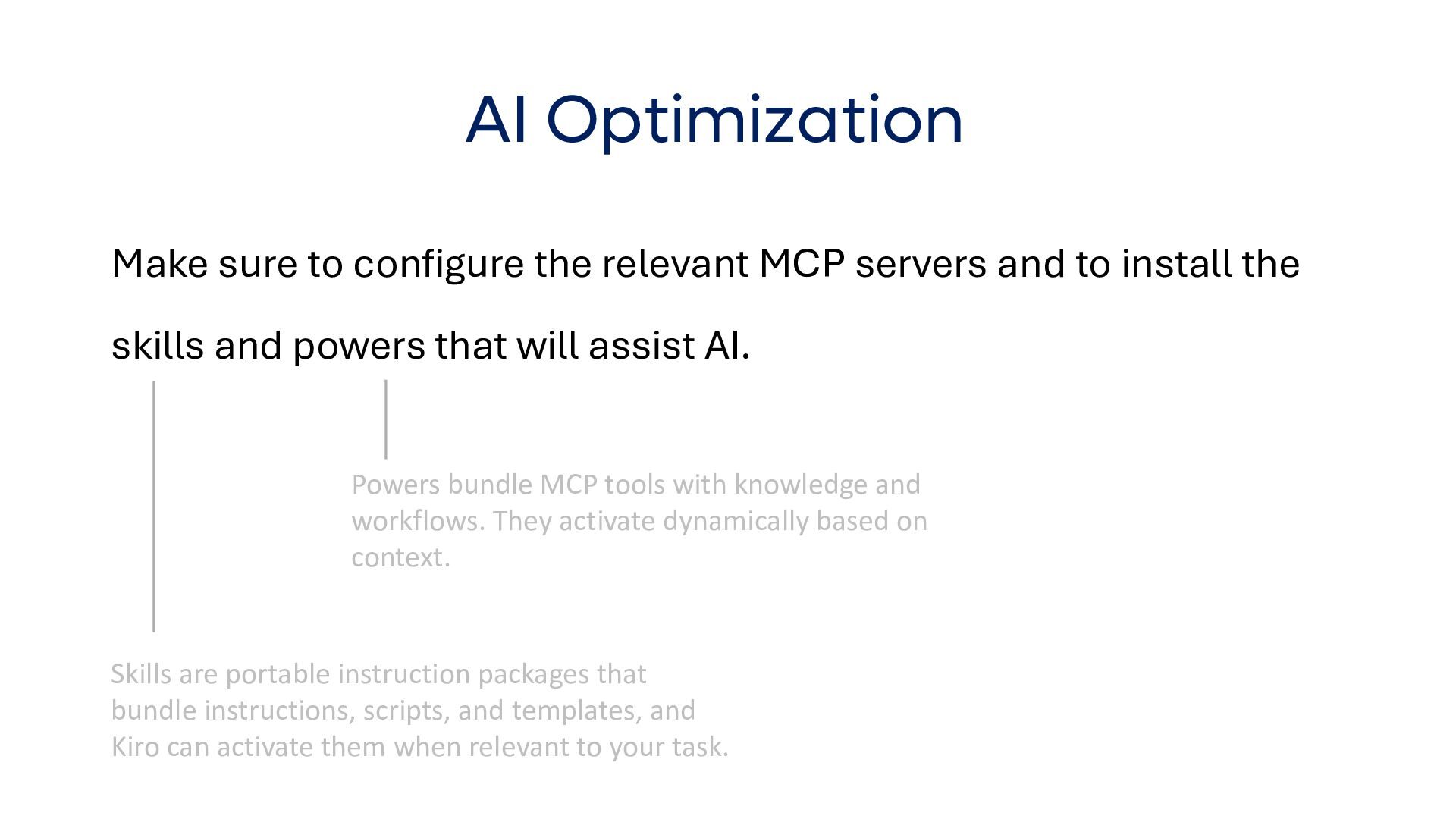
  31. AI Optimization Make sure to configure the relevant MCP servers

    and to install the skills and powers that will assist AI. Powers bundle MCP tools with knowledge and workflows. They activate dynamically based on context. Skills are portable instruction packages that bundle instructions, scripts, and templates, and Kiro can activate them when relevant to your task.
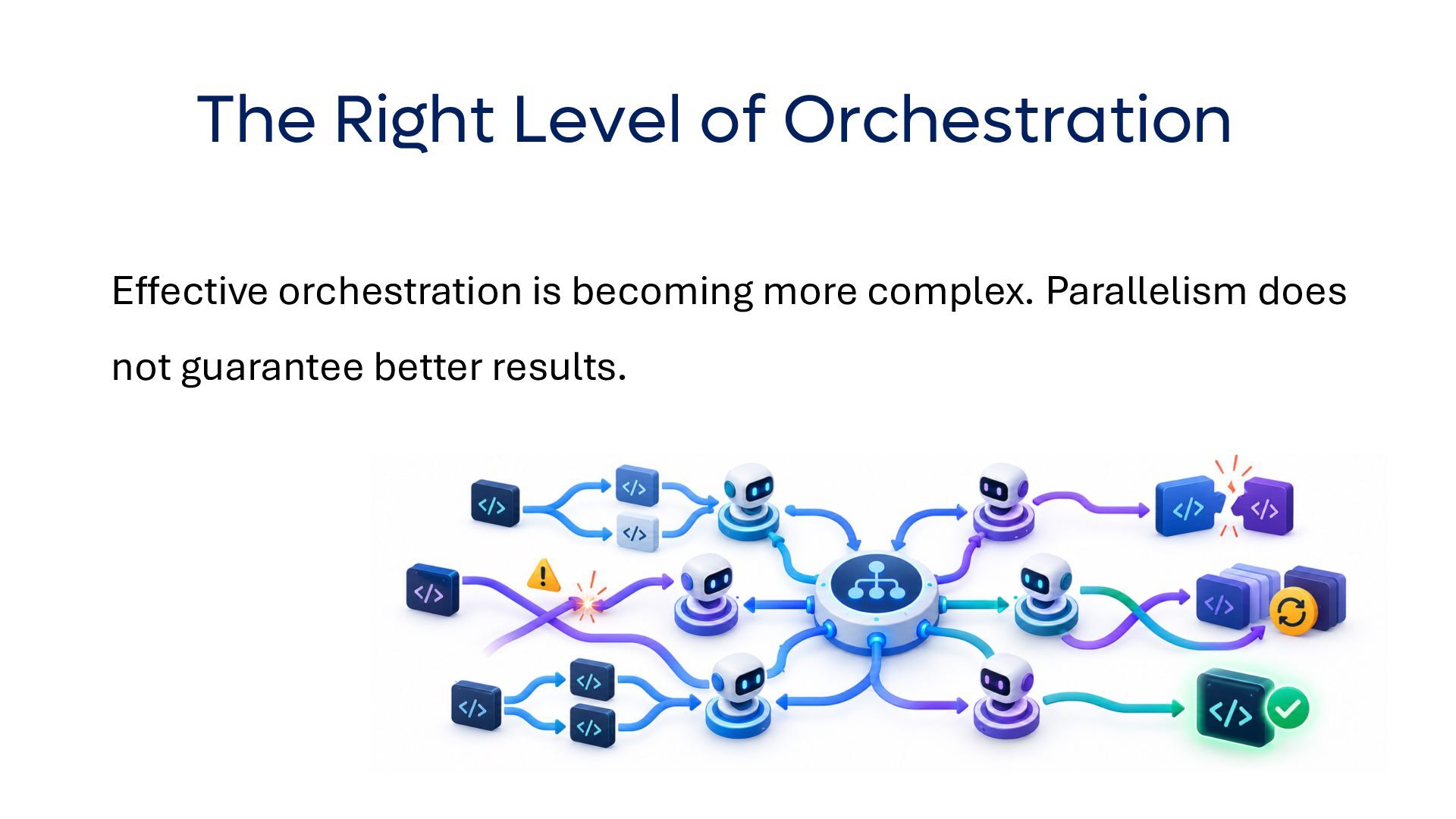
  32. The Right Level of Orchestration Effective orchestration is becoming more

    complex. Parallelism does not guarantee better results.
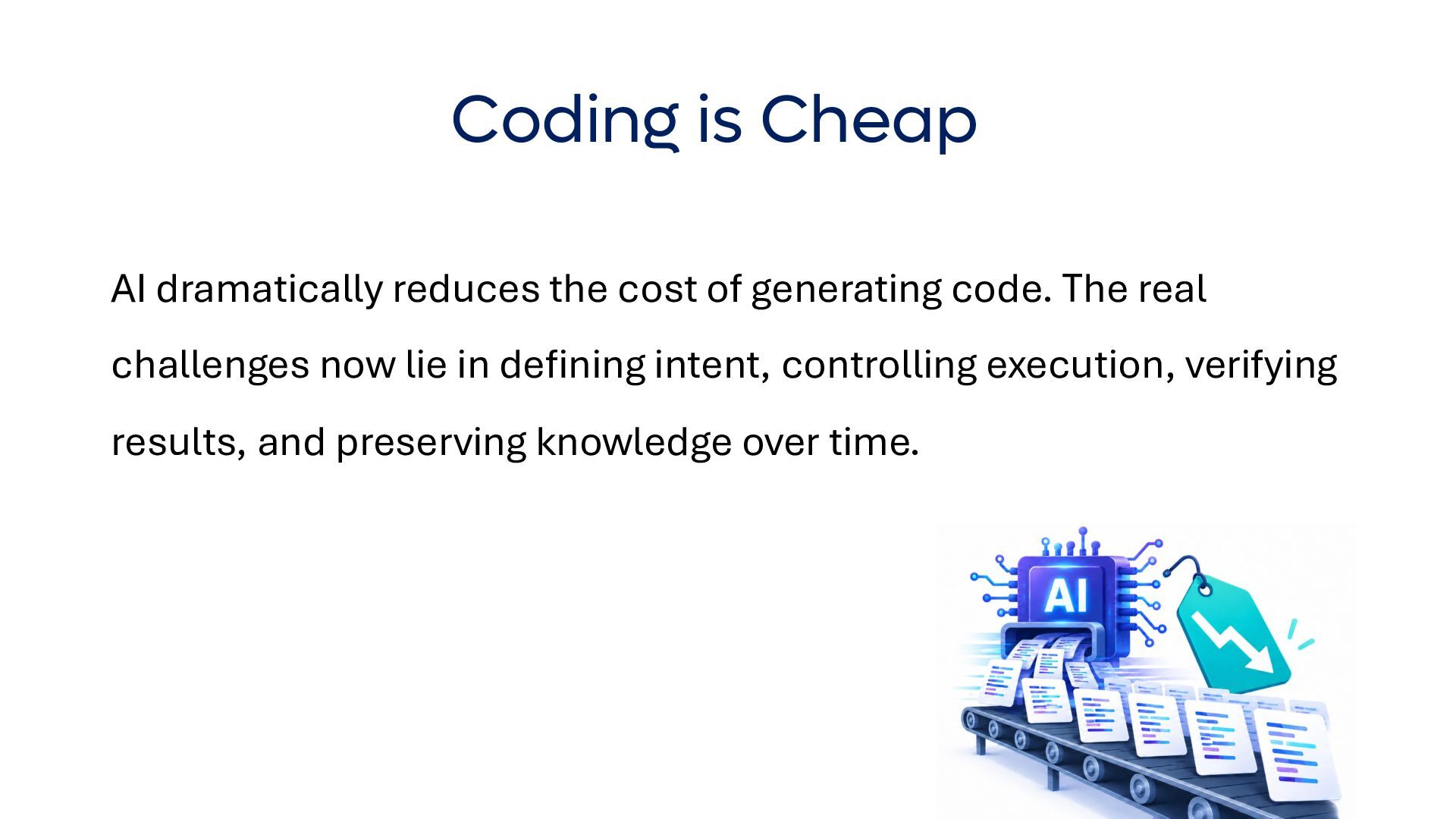
  33. Coding is Cheap AI dramatically reduces the cost of generating

    code. The real challenges now lie in defining intent, controlling execution, verifying results, and preserving knowledge over time.
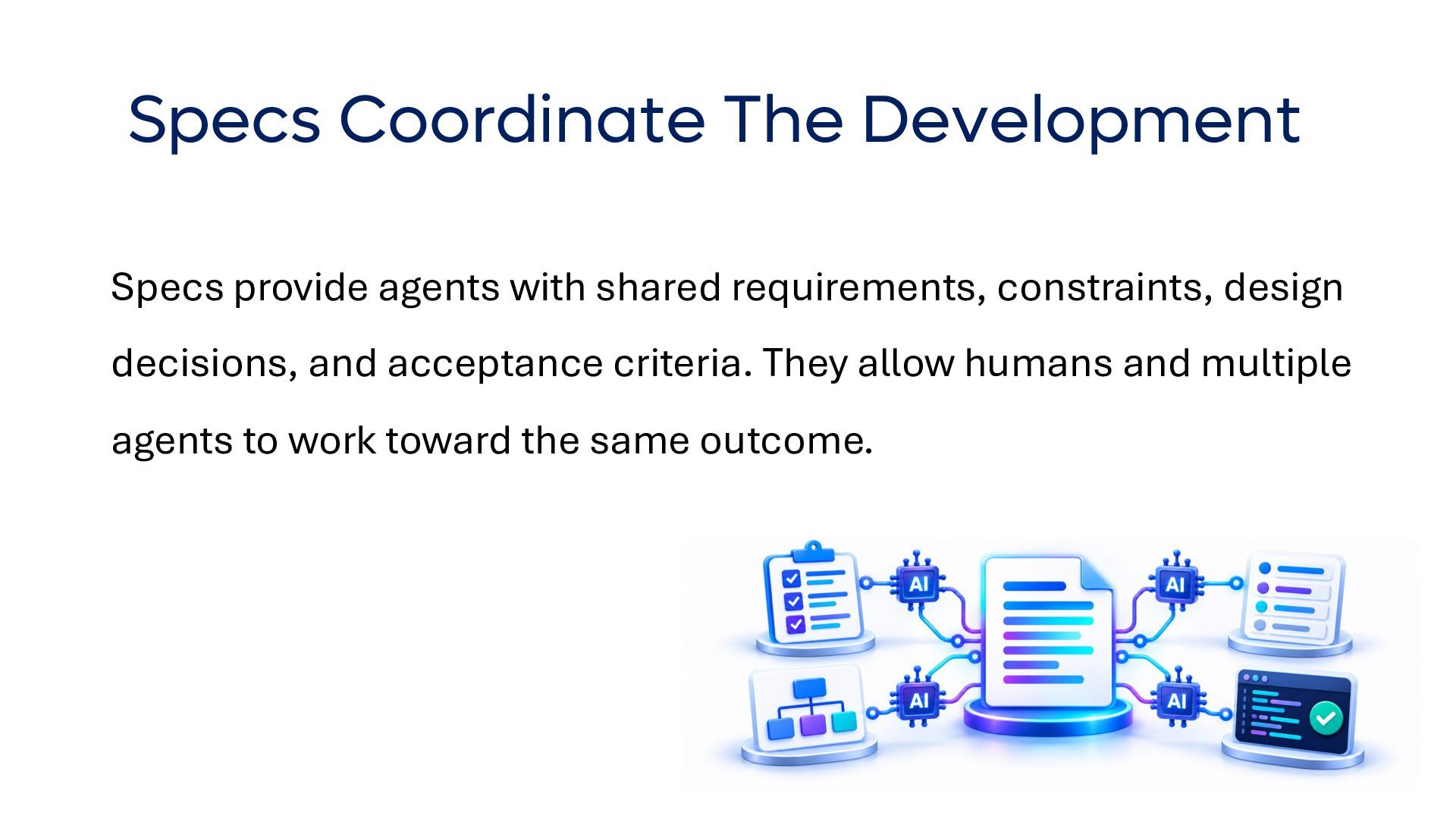
  34. Specs Coordinate The Development Specs provide agents with shared requirements,

    constraints, design decisions, and acceptance criteria. They allow humans and multiple agents to work toward the same outcome.
  35. Higher Level of Abstraction Developers increasingly define goals, architecture, constraints,

    and quality standards while AI agents perform most of the coding. The developer becomes the orchestrator of software creation.
  36. Q&A nana.events Thanks for attending my talk :) nana.events WhatsApp

    +972.54.6655837 prompo.ai [email protected] https://blog.lifemichael.com prompo.ai ngager.pro life michael zindrex.com XtremeJ xtremej.dev life michael XtremeJS xtremejs.dev XtremePython xtremepython.dev XtremeAI xtremeai.dev lifemichael.com meetup.com/lifemichael Monolith vs Microservices