Upgrade to Pro — share decks privately, control downloads, hide ads and more …

RiceShift — NASA-Powered Rotation Advisor for C...

Sponsored · Your Podcast. Everywhere. Effortlessly. Share. Educate. Inspire. Entertain. You do you. We'll handle the rest. →
takeofuture
November 15, 2026

RiceShift — NASA-Powered Rotation Advisor for California Rice Farms | NASA Space Apps Challenge 2026

RiceShift is a decision-support prototype developed by Team Hachi for the NASA Space Apps Challenge 2026 challenge, “Field Shift: Adapting Farms with NASA Data.”

The project explores how NASA Earth observations can contribute measurable evidence to crop-rotation decisions for rice farms in California’s Sacramento Valley.

RiceShift combines NASA MODIS and SMAP observations with USDA Cropland Data Layer (CDL), USDA NASS agricultural statistics, USDA NRCS SSURGO soil information, published UC Davis / UC ANR agronomic research, regional agricultural statistics, and economic and policy context.

The prototype evaluates three candidate management strategies:

• Continuous Rice
• Rice → Winter Vetch → Rice
• Rice → Winter Cover Crop Mix → Rice

The analysis tests whether winter represents a distinct environmental management window, whether NASA environmental indicators are associated with agricultural outcomes, and whether those indicators provide useful predictive information. It then combines these findings with long-term crop history, soil feasibility, published cover-crop experiments, nitrogen-management evidence, and economic considerations.

Key findings include:

• NASA SMAP showed a clear seasonal separation between winter and the rice-growing season.
• NASA MODIS indicators provided environmental signals, but were not sufficient as a stand-alone yield-prediction or crop-selection model.
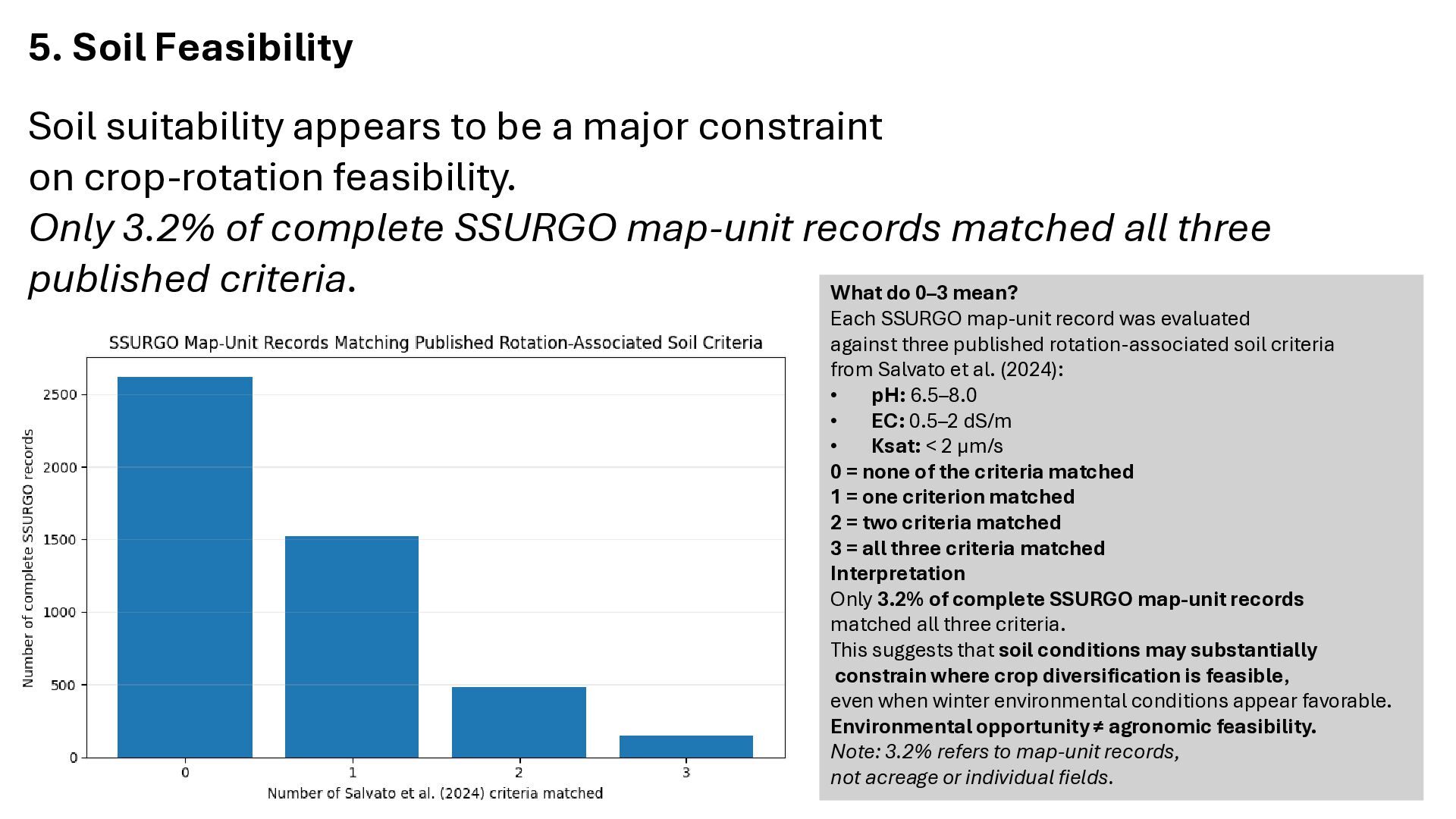
• SSURGO soil characteristics showed that agronomic feasibility can substantially constrain where crop diversification is appropriate.
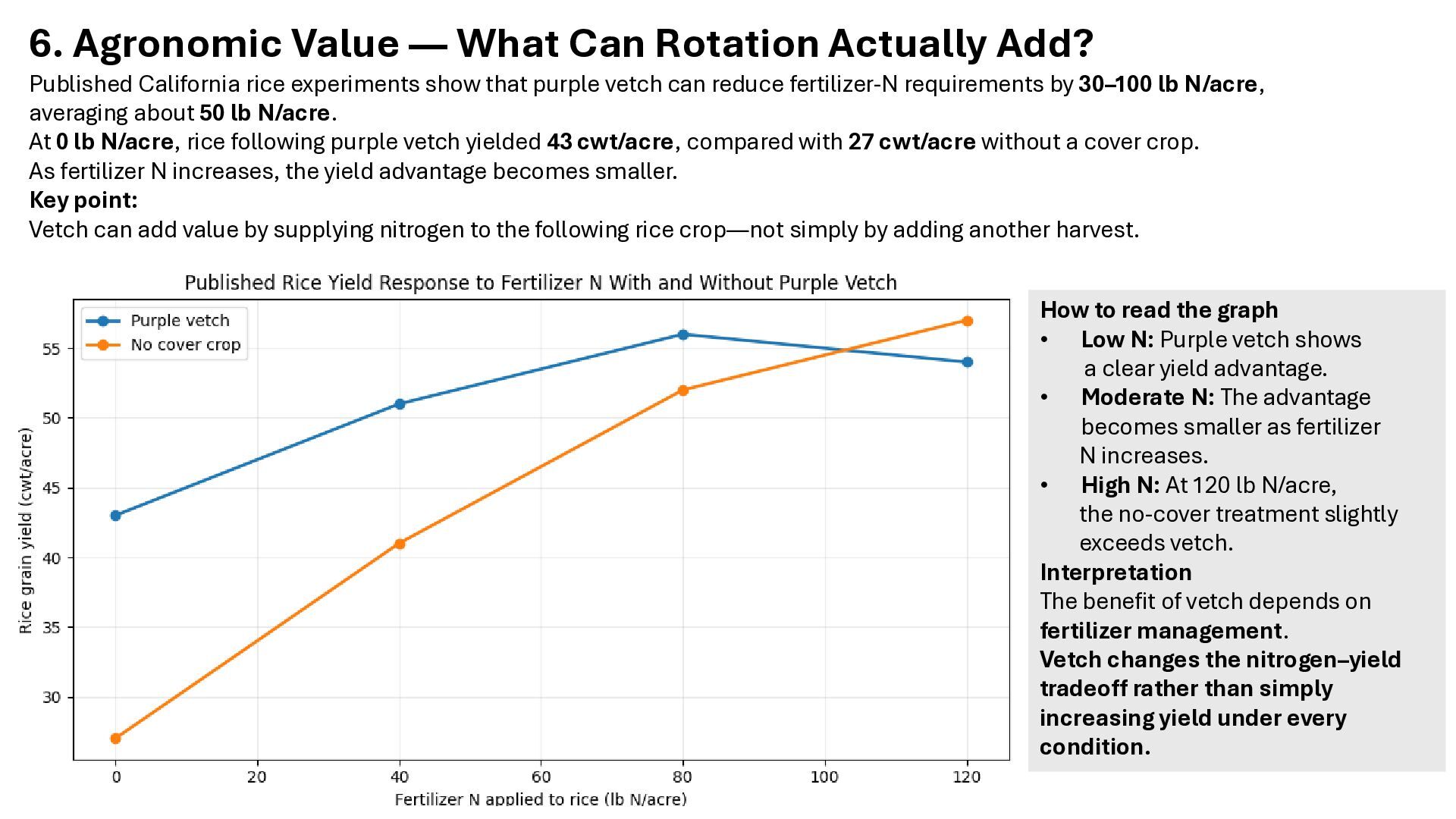
• Published California experiments show that winter vetch can reduce fertilizer-N requirements and alter the nitrogen–yield relationship of the following rice crop.
• Regional agricultural statistics demonstrate the substantial economic importance of rice production in the Sacramento Valley.

RiceShift therefore does not ask NASA data to directly select a crop. Instead, it uses NASA observations to identify environmental opportunity, crop history and soil information to test feasibility, and agronomic and economic evidence to support the final farm-management decision.

The demonstration is fully reproducible in Google Colaboratory using the public RiceShift GitHub repository.

GitHub:
https://github.com/takeofuture/riceshift

Team Hachi
NASA Space Apps Challenge 2026
Field Shift: Adapting Farms with NASA Data

takeofuture

November 15, 2026

Transcript

7 slides
  1. 1. Open RiceShift in Google Colaboratory and Run It in

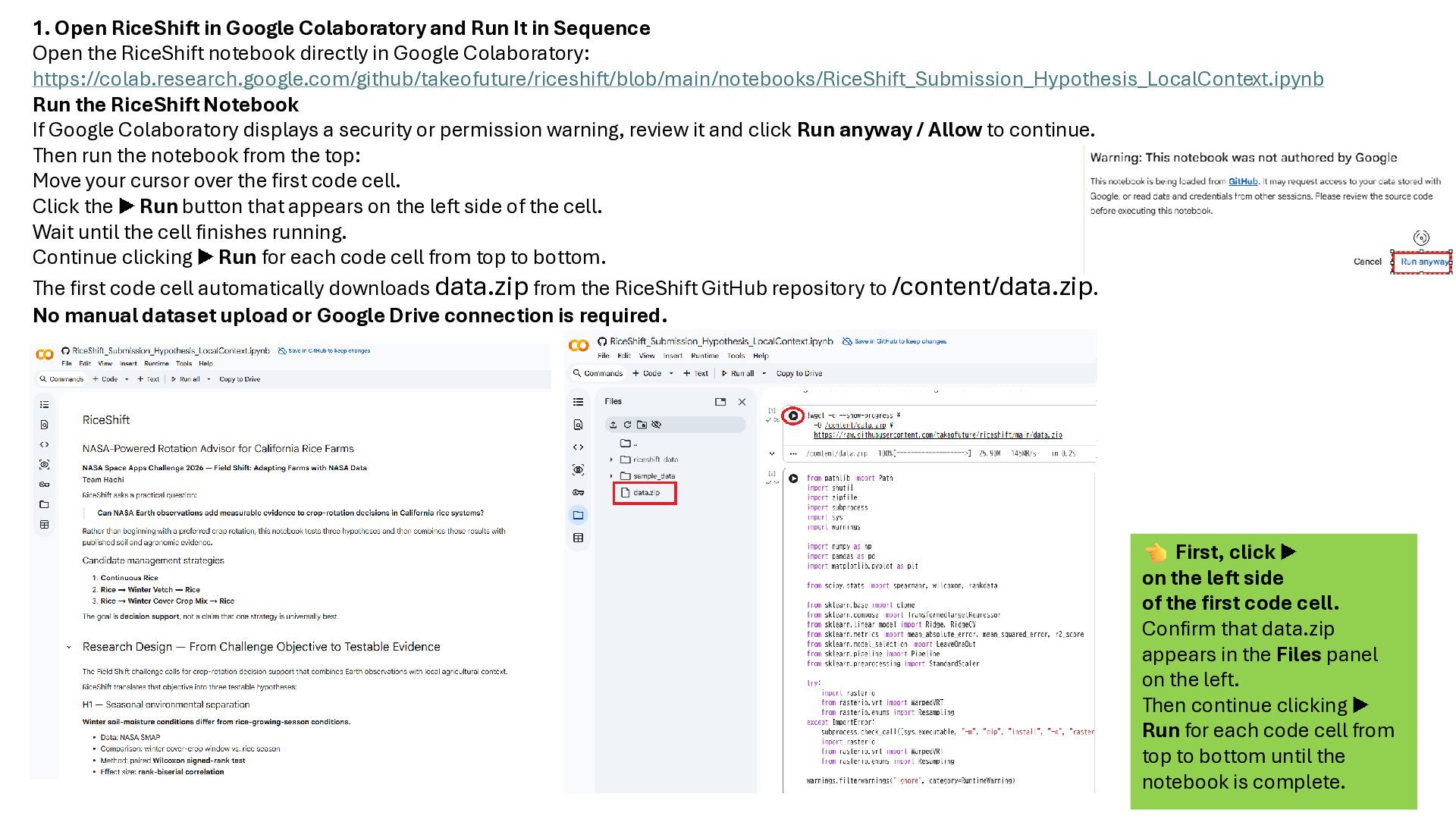
    Sequence Open the RiceShift notebook directly in Google Colaboratory: https://colab.research.google.com/github/takeofuture/riceshift/blob/main/notebooks/RiceShift_Submission_Hypothesis_LocalContext.ipynb Run the RiceShift Notebook If Google Colaboratory displays a security or permission warning, review it and click Run anyway / Allow to continue. Then run the notebook from the top: Move your cursor over the first code cell. Click the Run button that appears on the left side of the cell. Wait until the cell finishes running. Continue clicking Run for each code cell from top to bottom. The first code cell automatically downloads data.zip from the RiceShift GitHub repository to /content/data.zip. No manual dataset upload or Google Drive connection is required. First, click on the left side of the first code cell. Confirm that data.zip appears in the Files panel on the left. Then continue clicking Run for each code cell from top to bottom until the notebook is complete.
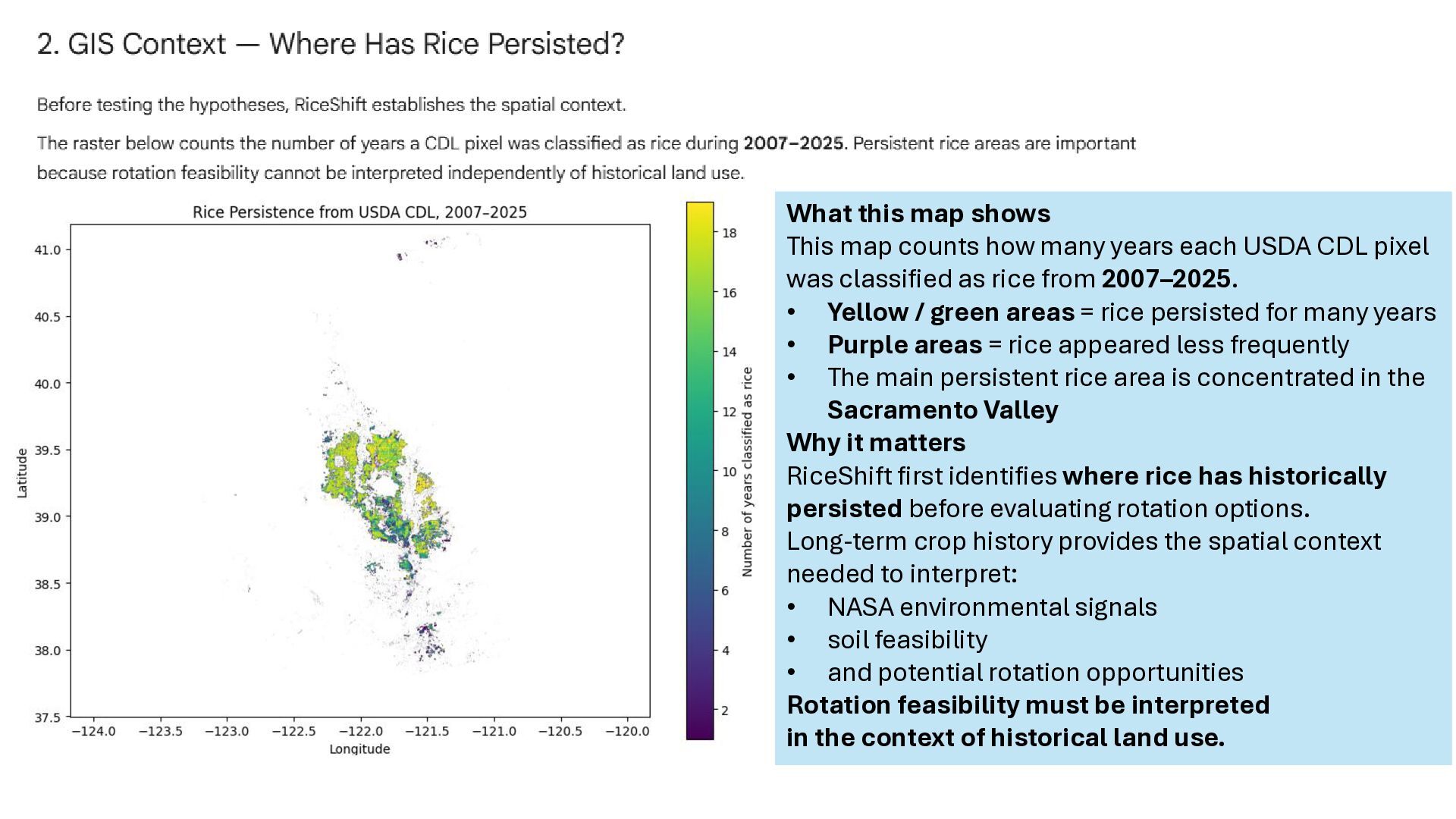
  2. What this map shows This map counts how many years

    each USDA CDL pixel was classified as rice from 2007–2025. • Yellow / green areas = rice persisted for many years • Purple areas = rice appeared less frequently • The main persistent rice area is concentrated in the Sacramento Valley Why it matters RiceShift first identifies where rice has historically persisted before evaluating rotation options. Long-term crop history provides the spatial context needed to interpret: • NASA environmental signals • soil feasibility • and potential rotation opportunities Rotation feasibility must be interpreted in the context of historical land use.
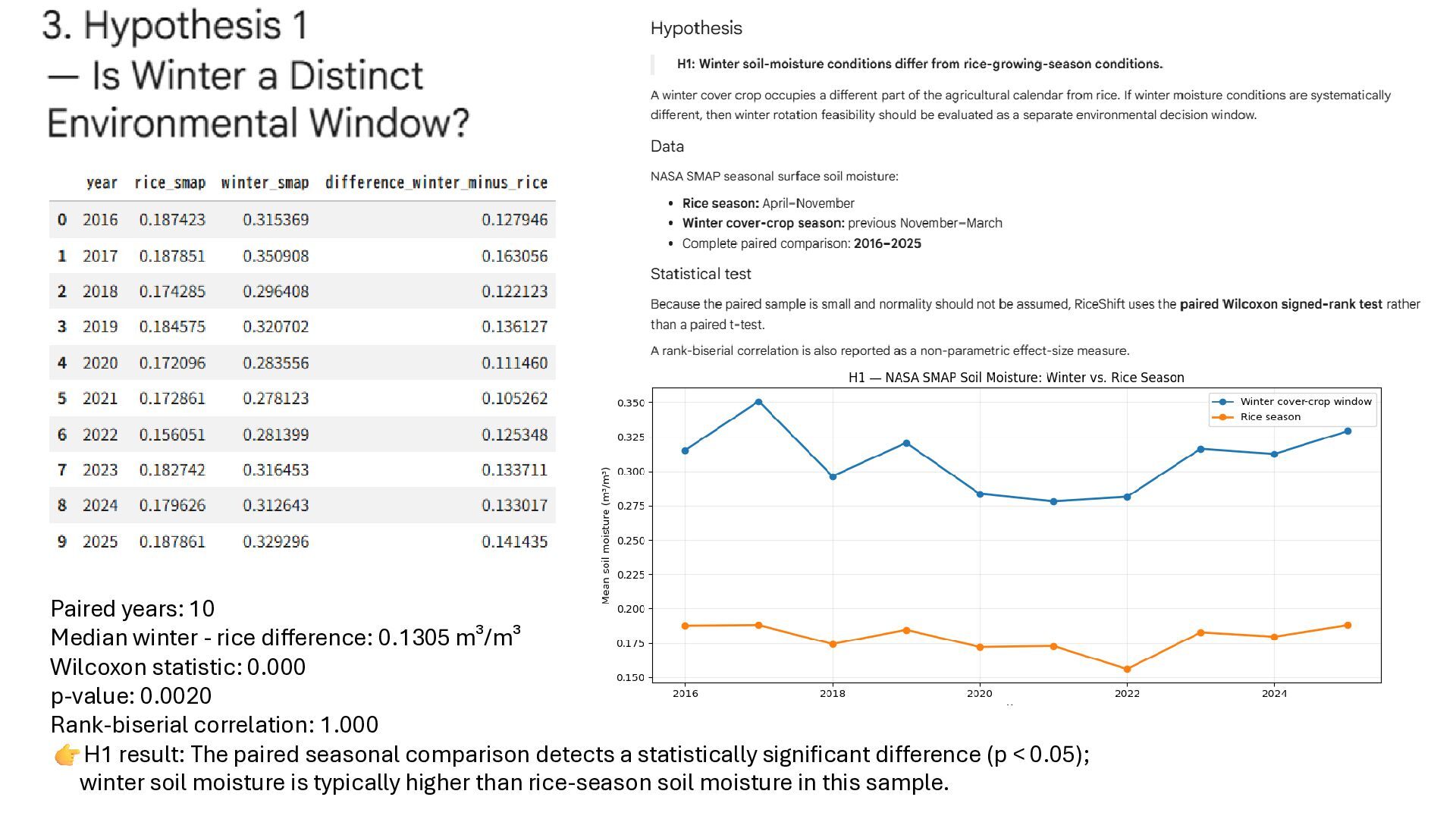
  3. Paired years: 10 Median winter - rice difference: 0.1305 m³/m³

    Wilcoxon statistic: 0.000 p-value: 0.0020 Rank-biserial correlation: 1.000 H1 result: The paired seasonal comparison detects a statistically significant difference (p < 0.05); winter soil moisture is typically higher than rice-season soil moisture in this sample.
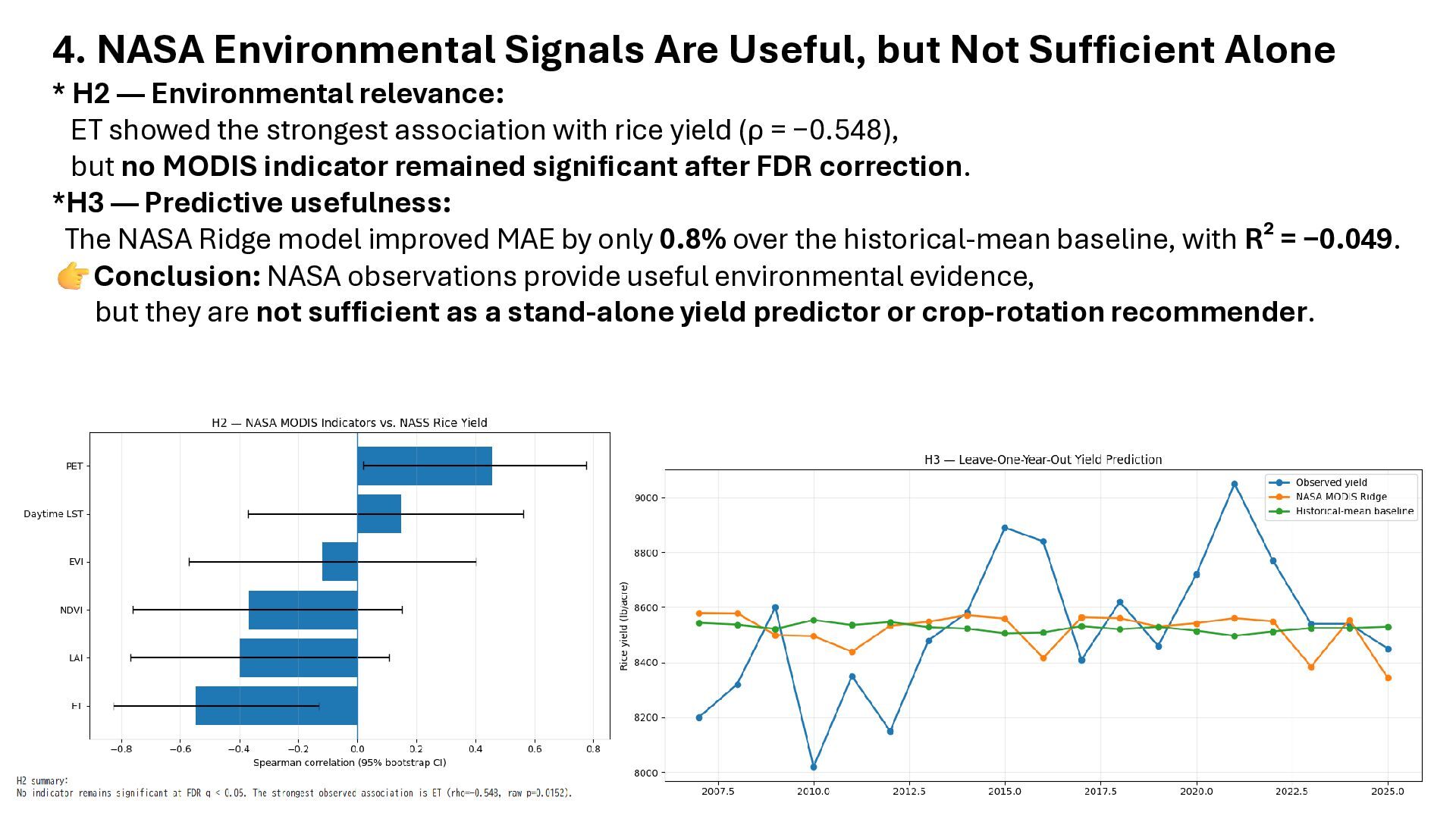
  4. 4. NASA Environmental Signals Are Useful, but Not Sufficient Alone

    * H2 — Environmental relevance: ET showed the strongest association with rice yield (ρ = −0.548), but no MODIS indicator remained significant after FDR correction. *H3 — Predictive usefulness: The NASA Ridge model improved MAE by only 0.8% over the historical-mean baseline, with R² = −0.049. Conclusion: NASA observations provide useful environmental evidence, but they are not sufficient as a stand-alone yield predictor or crop-rotation recommender.
  5. 5. Soil Feasibility Soil suitability appears to be a major

    constraint on crop-rotation feasibility. Only 3.2% of complete SSURGO map-unit records matched all three published criteria. What do 0–3 mean? Each SSURGO map-unit record was evaluated against three published rotation-associated soil criteria from Salvato et al. (2024): • pH: 6.5–8.0 • EC: 0.5–2 dS/m • Ksat: < 2 μm/s 0 = none of the criteria matched 1 = one criterion matched 2 = two criteria matched 3 = all three criteria matched Interpretation Only 3.2% of complete SSURGO map-unit records matched all three criteria. This suggests that soil conditions may substantially constrain where crop diversification is feasible, even when winter environmental conditions appear favorable. Environmental opportunity ≠ agronomic feasibility. Note: 3.2% refers to map-unit records, not acreage or individual fields.
  6. 6. Agronomic Value — What Can Rotation Actually Add? Published

    California rice experiments show that purple vetch can reduce fertilizer-N requirements by 30–100 lb N/acre, averaging about 50 lb N/acre. At 0 lb N/acre, rice following purple vetch yielded 43 cwt/acre, compared with 27 cwt/acre without a cover crop. As fertilizer N increases, the yield advantage becomes smaller. Key point: Vetch can add value by supplying nitrogen to the following rice crop—not simply by adding another harvest. How to read the graph • Low N: Purple vetch shows a clear yield advantage. • Moderate N: The advantage becomes smaller as fertilizer N increases. • High N: At 120 lb N/acre, the no-cover treatment slightly exceeds vetch. Interpretation The benefit of vetch depends on fertilizer management. Vetch changes the nitrogen–yield tradeoff rather than simply increasing yield under every condition.
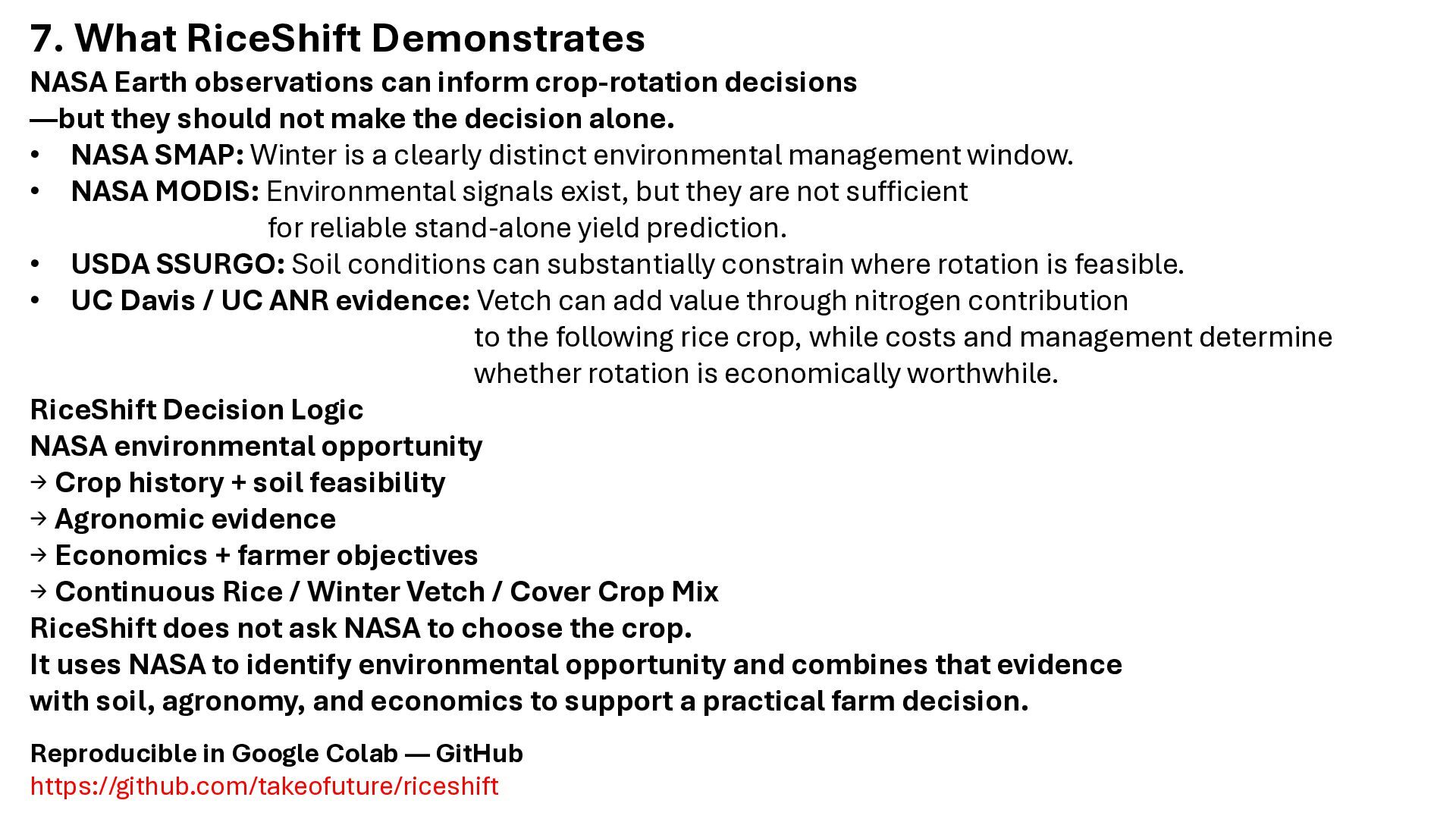
  7. 7. What RiceShift Demonstrates NASA Earth observations can inform crop-rotation

    decisions —but they should not make the decision alone. • NASA SMAP: Winter is a clearly distinct environmental management window. • NASA MODIS: Environmental signals exist, but they are not sufficient for reliable stand-alone yield prediction. • USDA SSURGO: Soil conditions can substantially constrain where rotation is feasible. • UC Davis / UC ANR evidence: Vetch can add value through nitrogen contribution to the following rice crop, while costs and management determine whether rotation is economically worthwhile. RiceShift Decision Logic NASA environmental opportunity → Crop history + soil feasibility → Agronomic evidence → Economics + farmer objectives → Continuous Rice / Winter Vetch / Cover Crop Mix RiceShift does not ask NASA to choose the crop. It uses NASA to identify environmental opportunity and combines that evidence with soil, agronomy, and economics to support a practical farm decision. Reproducible in Google Colab — GitHub https://github.com/takeofuture/riceshift

More Decks by takeofuture

Other Decks in Research