Upgrade to Pro — share decks privately, control downloads, hide ads and more …

Exo-Obs Course: Microlensing

Sponsored · Your Podcast. Everywhere. Effortlessly. Share. Educate. Inspire. Entertain. You do you. We'll handle the rest.
Avatar for Adina Adina
March 05, 2026

Exo-Obs Course: Microlensing

I will be sharing the slides I developed for a graduate level course on Exoplanets and Observational Astronomy. This is the seventh and final completed slide deck for this course. It covers topics on microlensing. In theory, it should cover topics such as astrometry and microlensing as well, however class time did not allow for these topics to be covered.

Avatar for Adina

Adina

March 05, 2026
Tweet

More Decks by Adina

Other Decks in Science

Transcript

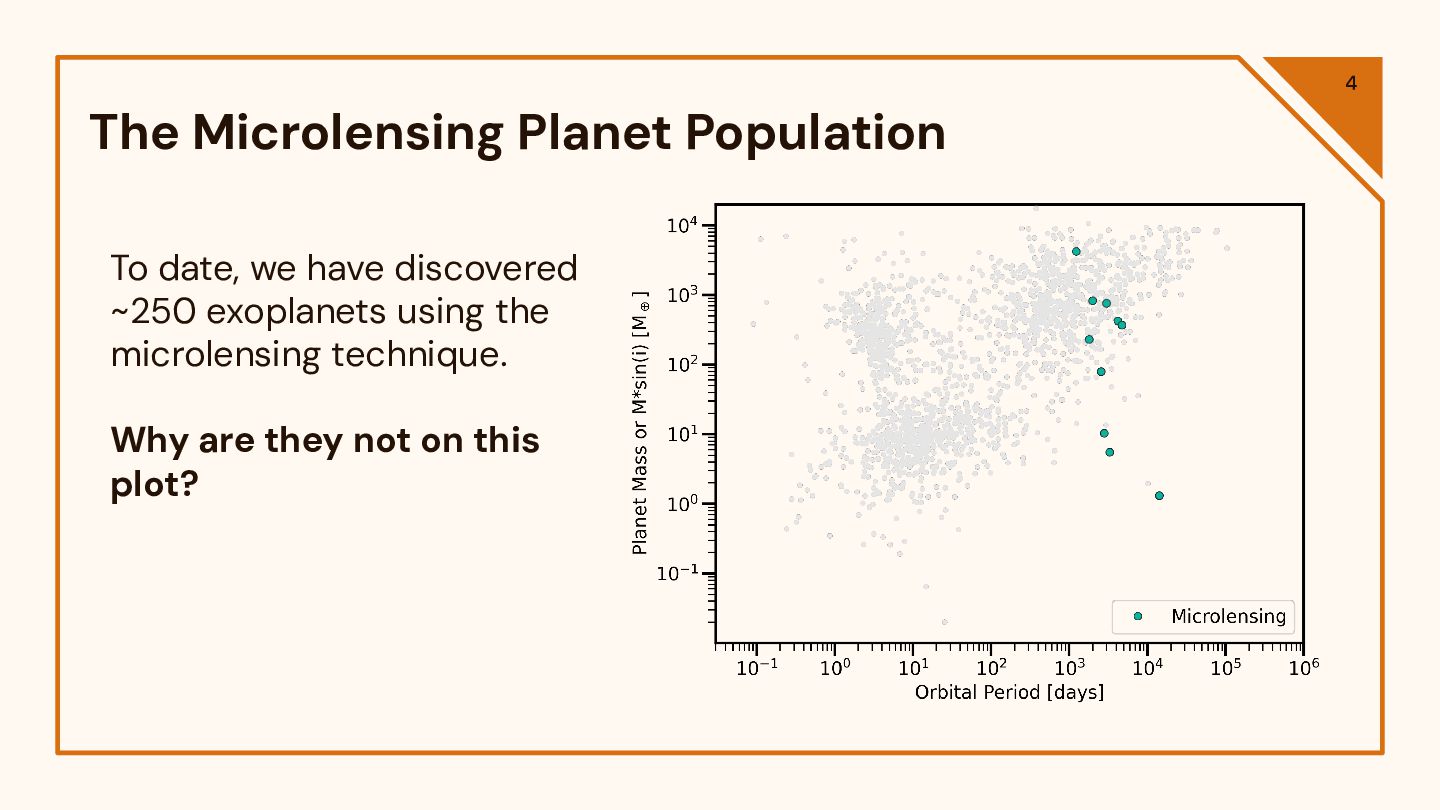
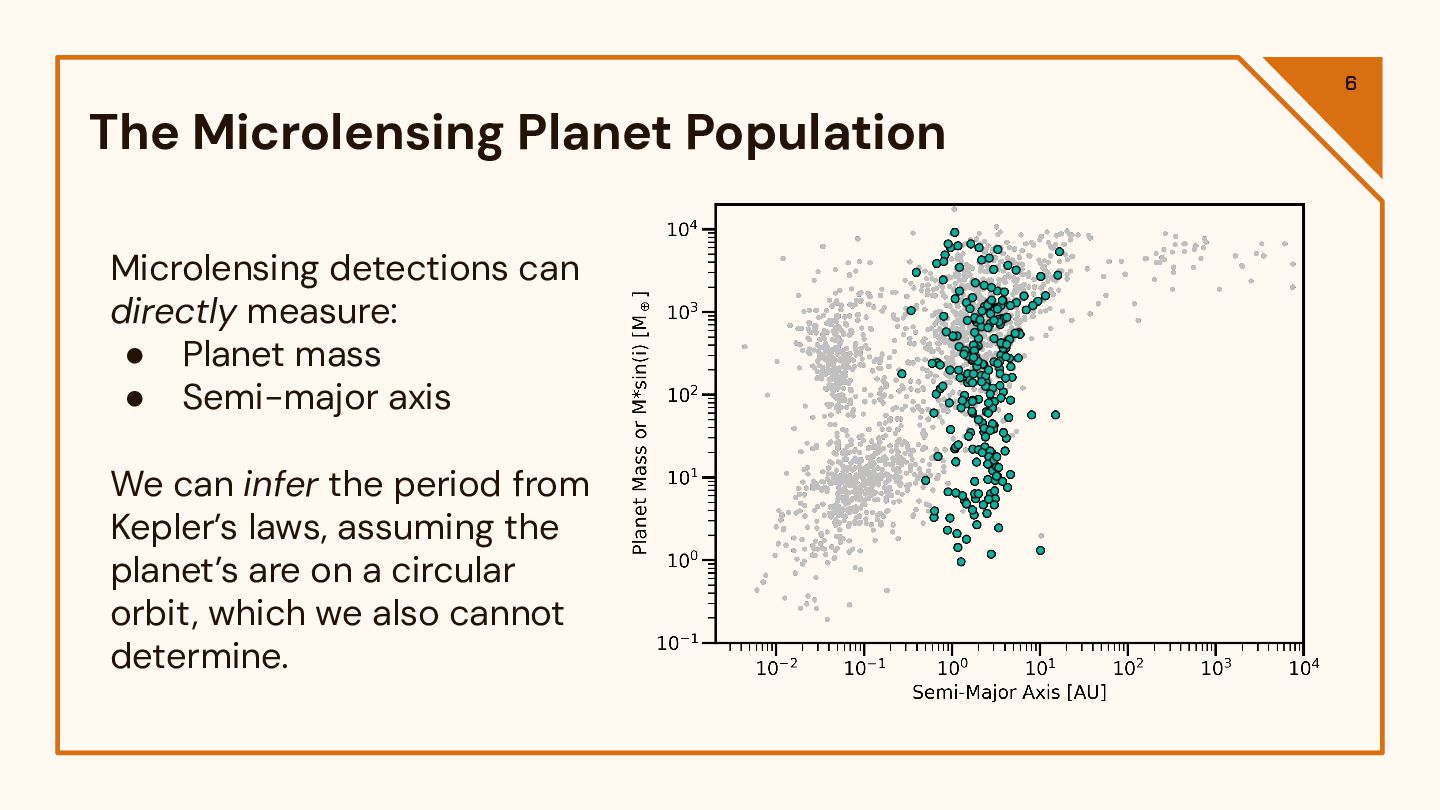
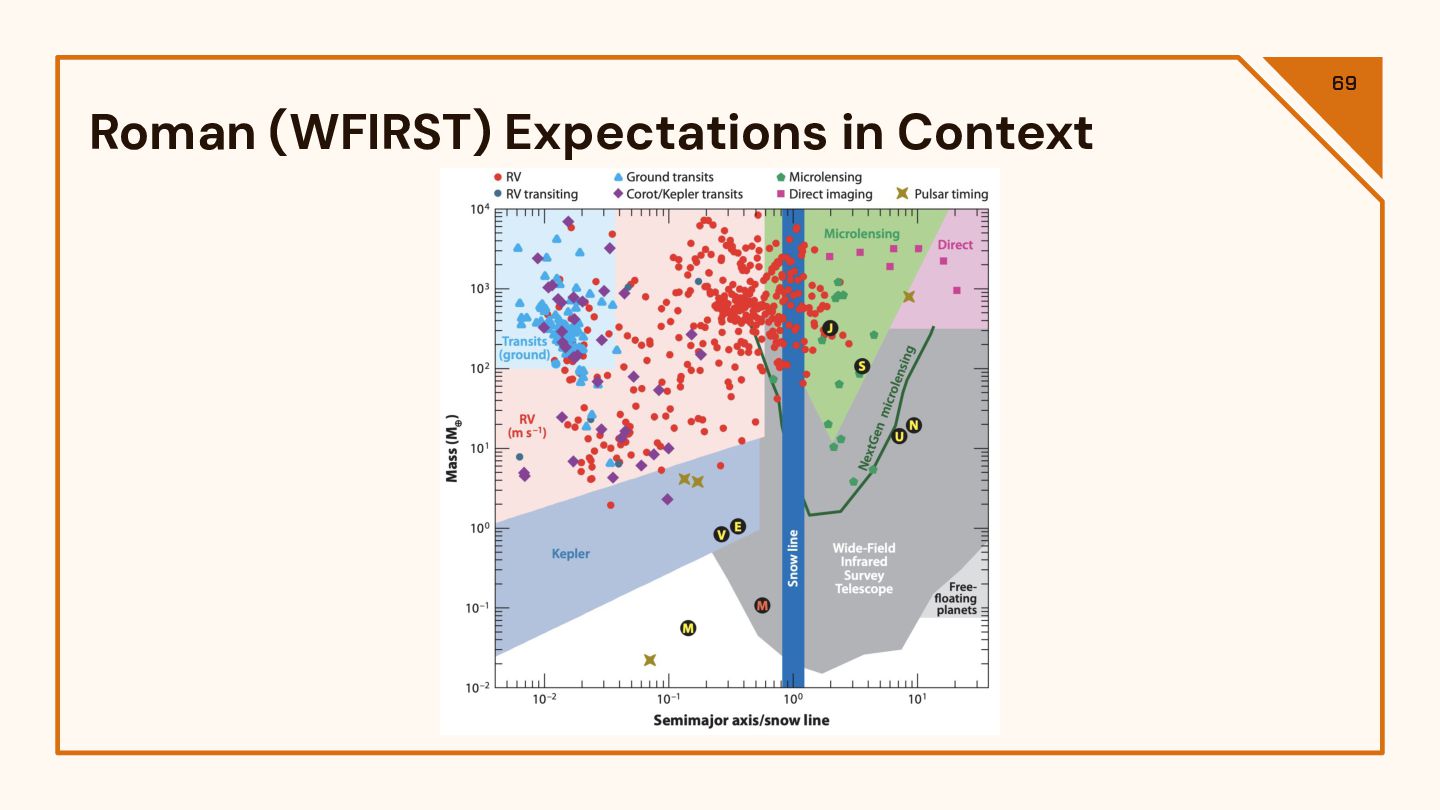
  1. The Microlensing Planet Population 4 To date, we have discovered

    ~250 exoplanets using the microlensing technique. Why are they not on this plot?
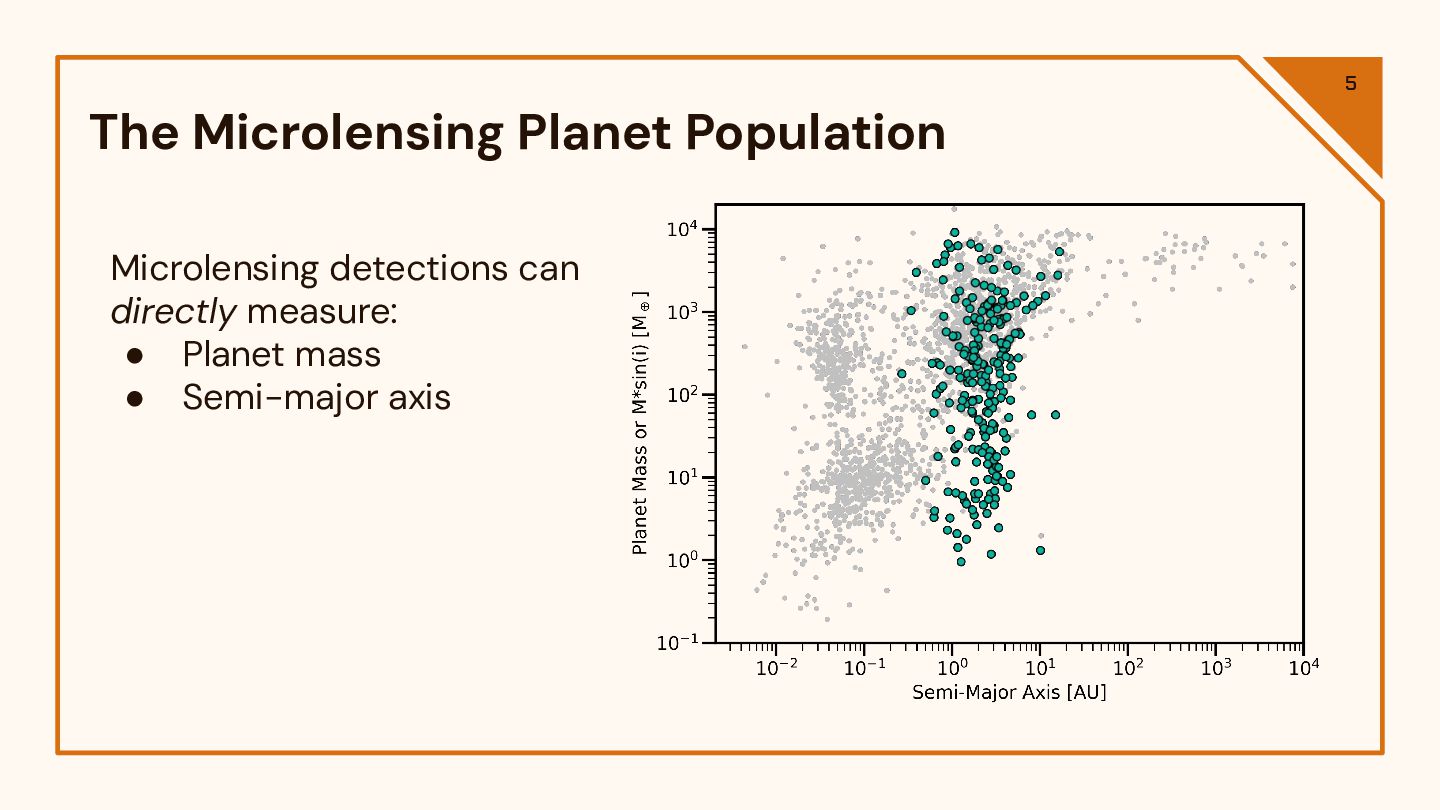
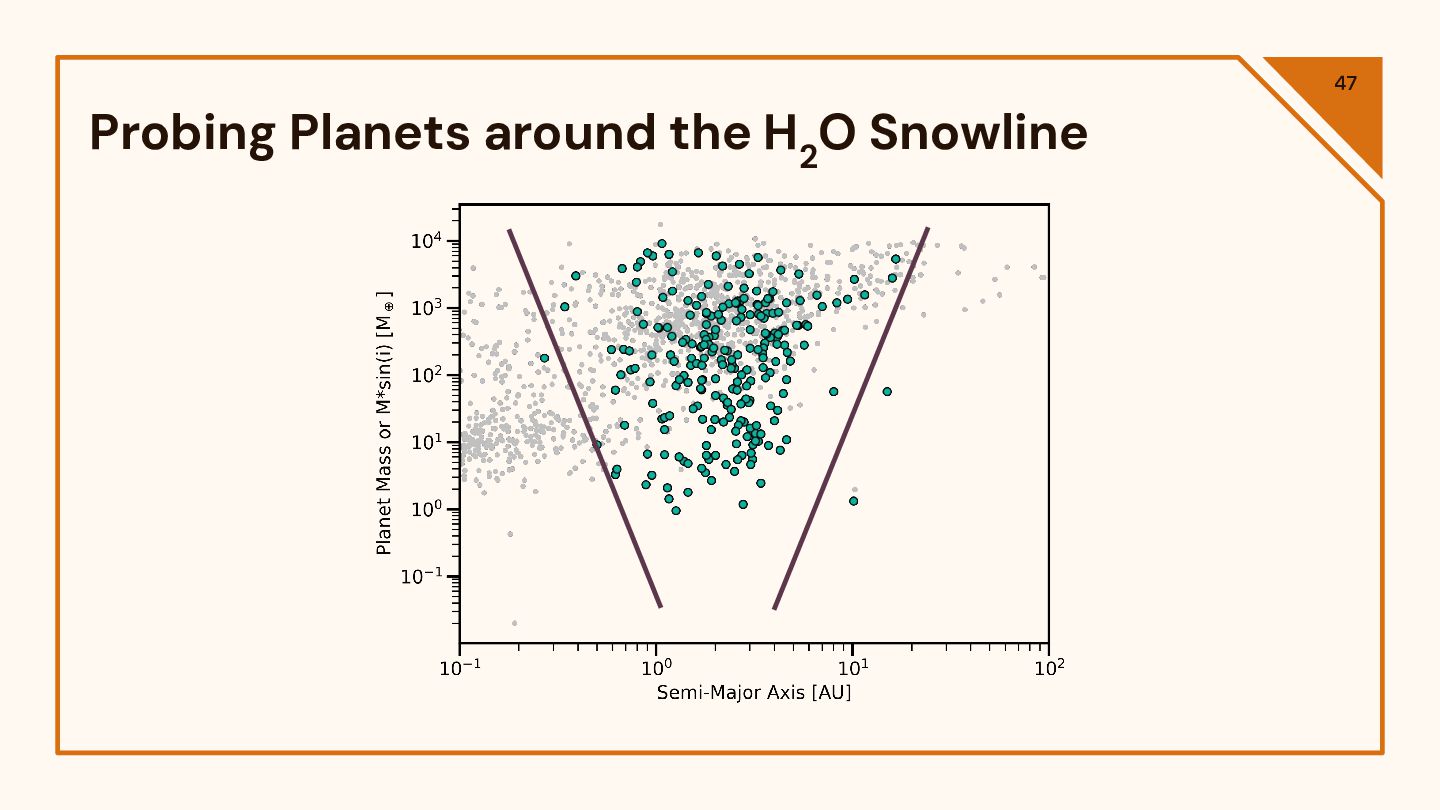
  2. The Microlensing Planet Population 6 Microlensing detections can directly measure:

    • Planet mass • Semi-major axis We can infer the period from Kepler’s laws, assuming the planet’s are on a circular orbit, which we also cannot determine.
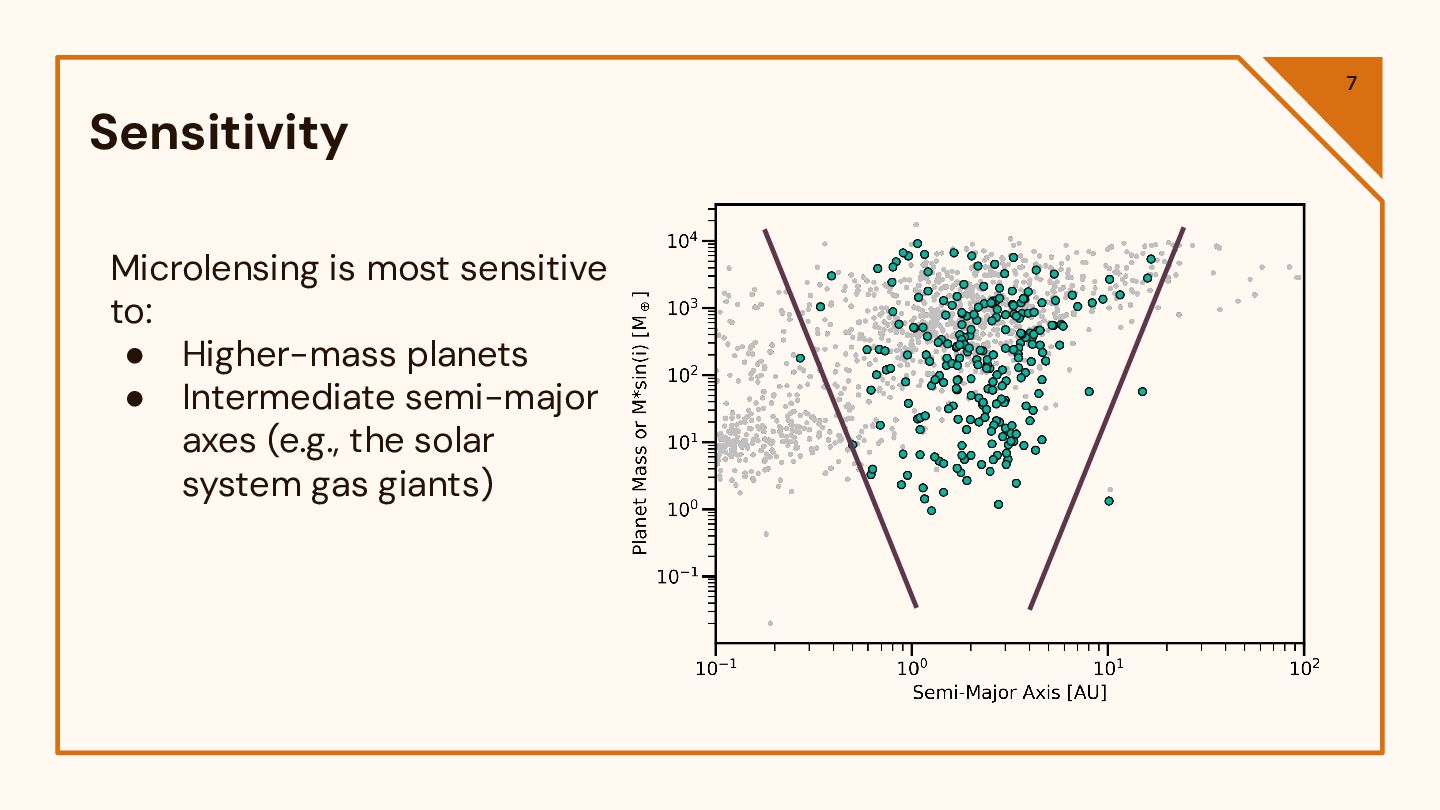
  3. Sensitivity 7 Microlensing is most sensitive to: • Higher-mass planets

    • Intermediate semi-major axes (e.g., the solar system gas giants)
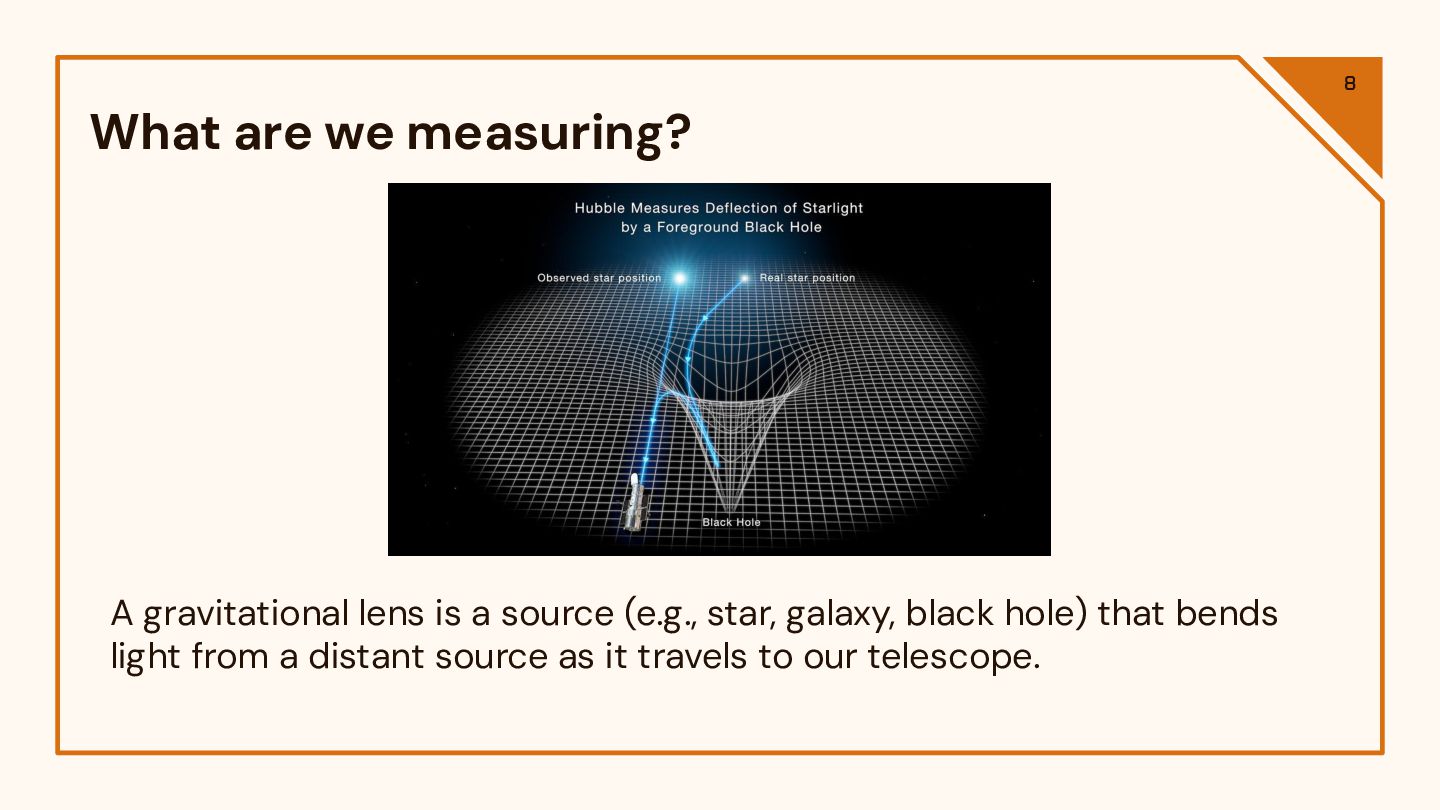
  4. What are we measuring? 8 A gravitational lens is a

    source (e.g., star, galaxy, black hole) that bends light from a distant source as it travels to our telescope.
  5. Eddington Experiment 9 The first observational confirmation of general relativity

    came from the observation of star positions measured near the Sun during a solar eclipse in 1919 by Arthur Eddington. Setup: two expeditions (one on the West African island of Príncipe and the other in the Brazilian town of Sobral) Objective: Measure the gravitational deflection of starlight passing near the Sun (as predicted by Einstein in 1911)
  6. 10 The expedition at the location in Príncipe was nearly

    foiled by clouds, “We took sixteen photographs. They are all good of the sun, showing a very remarkable prominence; but the cloud has interfered with the star images. The last few photographs show a few images which I hope will give us what we need …” They measured a slight deflection from these observations. The experiment was later repeated in 1922 in Australia and the Lick Observatory. The repeated results gave confidence that their measurements were accurate. Eddington Experiment
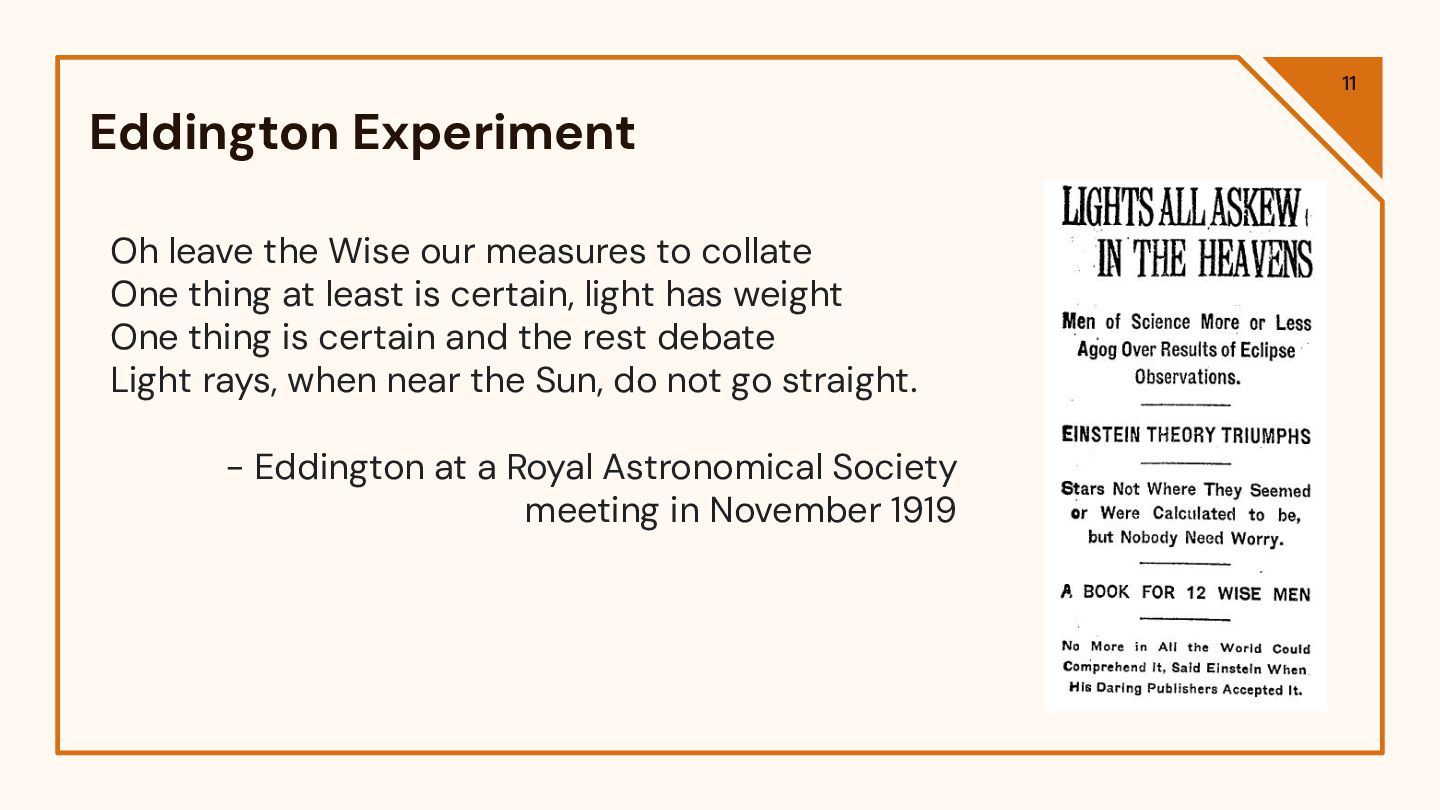
  7. 11 Oh leave the Wise our measures to collate One

    thing at least is certain, light has weight One thing is certain and the rest debate Light rays, when near the Sun, do not go straight. - Eddington at a Royal Astronomical Society meeting in November 1919 Eddington Experiment
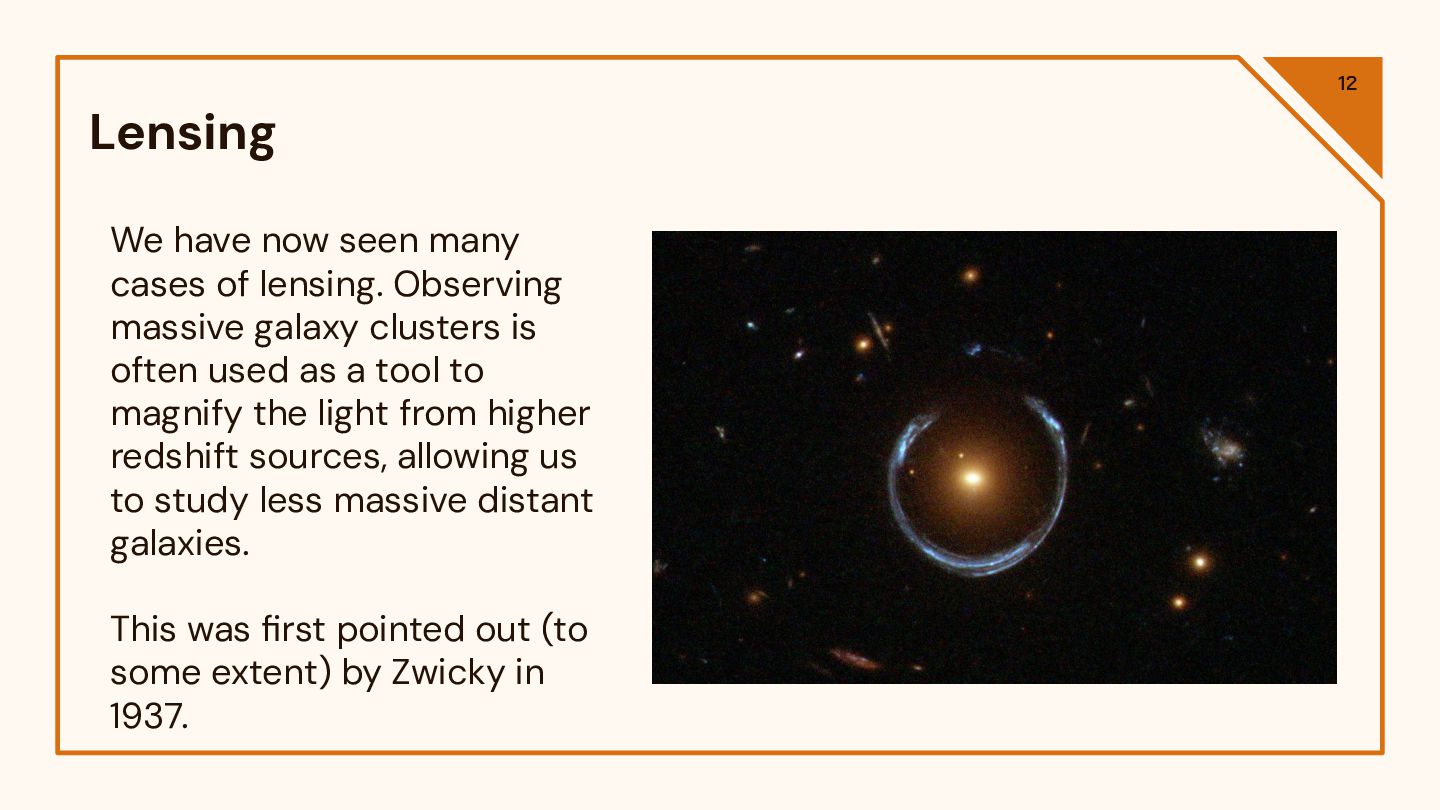
  8. Lensing 12 We have now seen many cases of lensing.

    Observing massive galaxy clusters is often used as a tool to magnify the light from higher redshift sources, allowing us to study less massive distant galaxies. This was first pointed out (to some extent) by Zwicky in 1937.
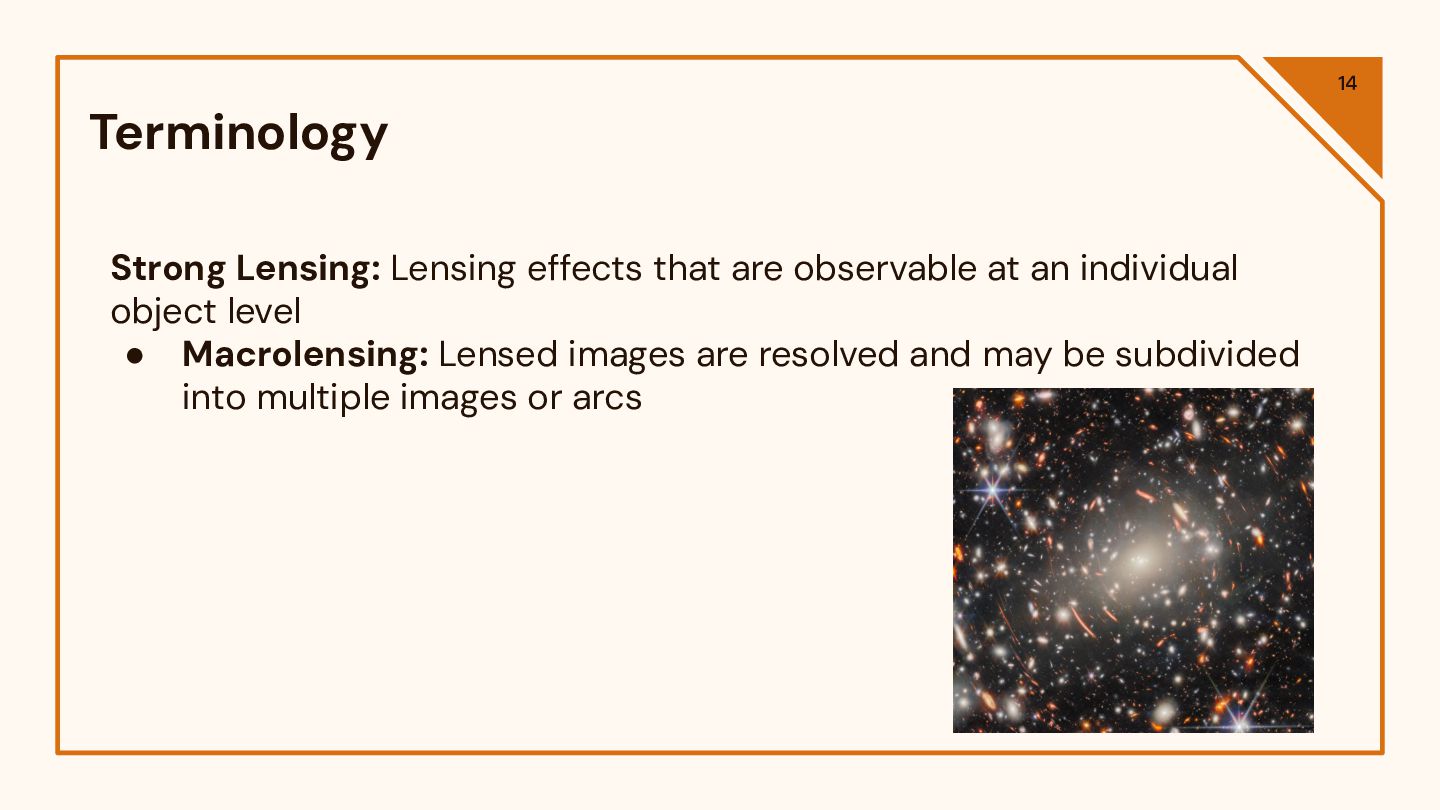
  9. Terminology 14 Strong Lensing: Lensing effects that are observable at

    an individual object level • Macrolensing: Lensed images are resolved and may be subdivided into multiple images or arcs
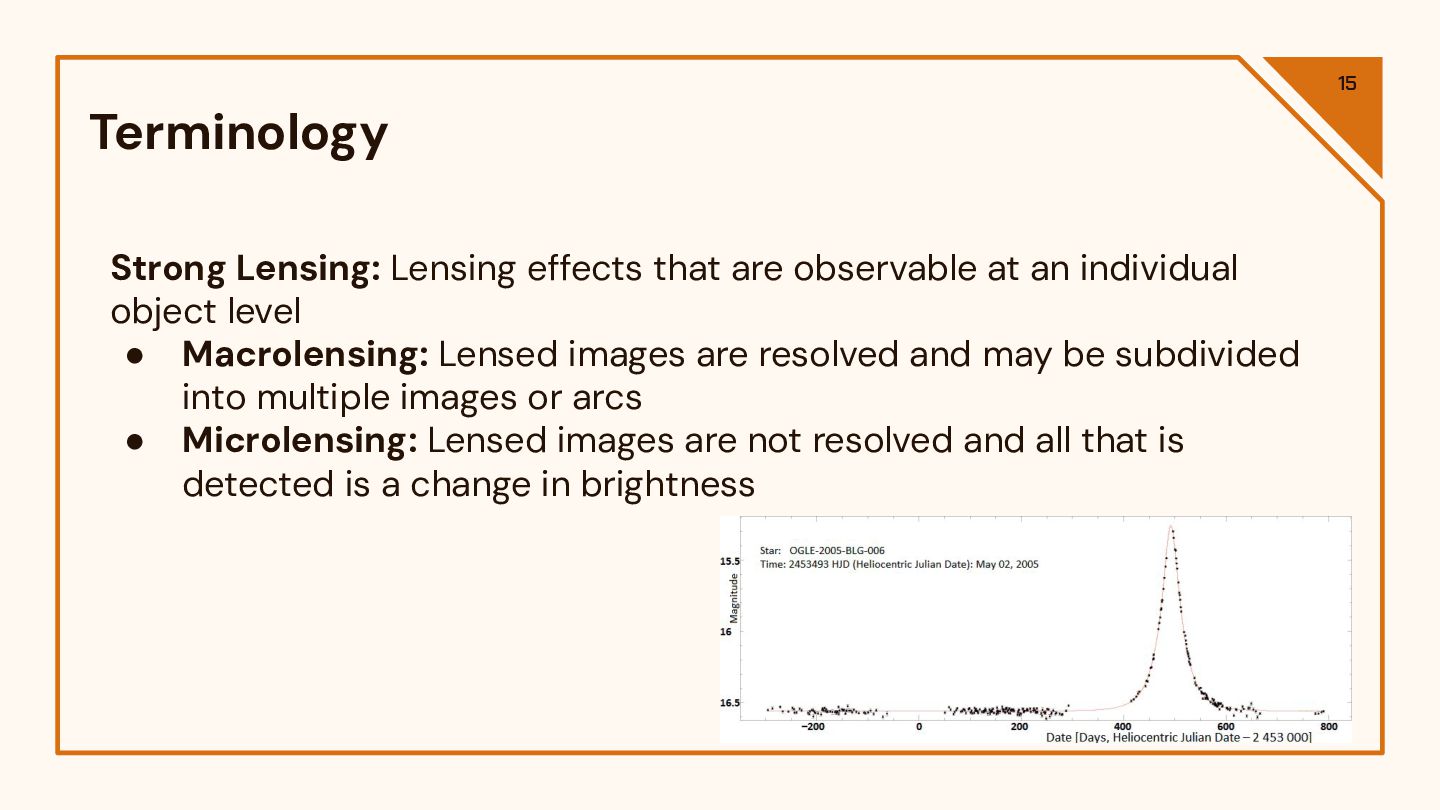
  10. Terminology 15 Strong Lensing: Lensing effects that are observable at

    an individual object level • Macrolensing: Lensed images are resolved and may be subdivided into multiple images or arcs • Microlensing: Lensed images are not resolved and all that is detected is a change in brightness
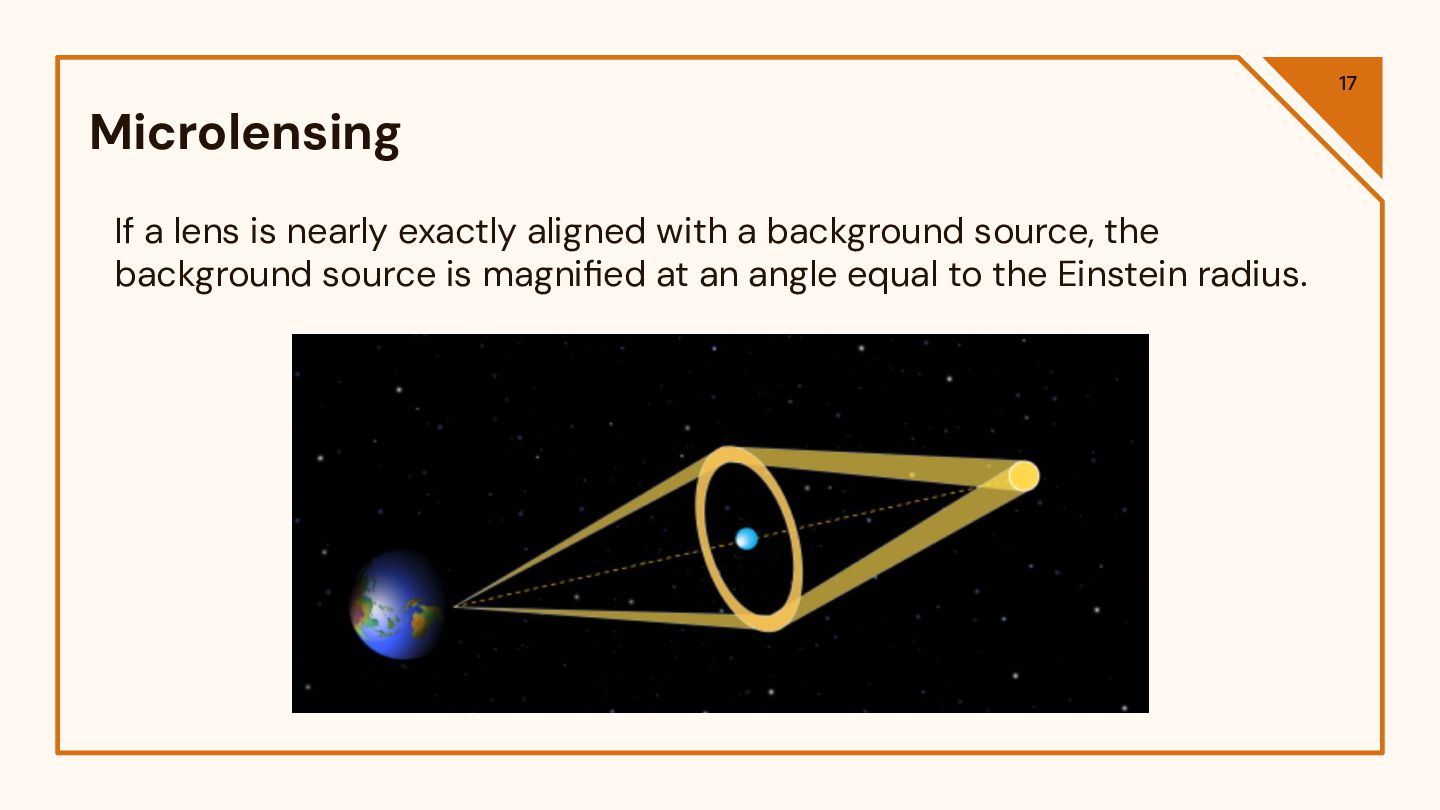
  11. Microlensing 17 If a lens is nearly exactly aligned with

    a background source, the background source is magnified at an angle equal to the Einstein radius.
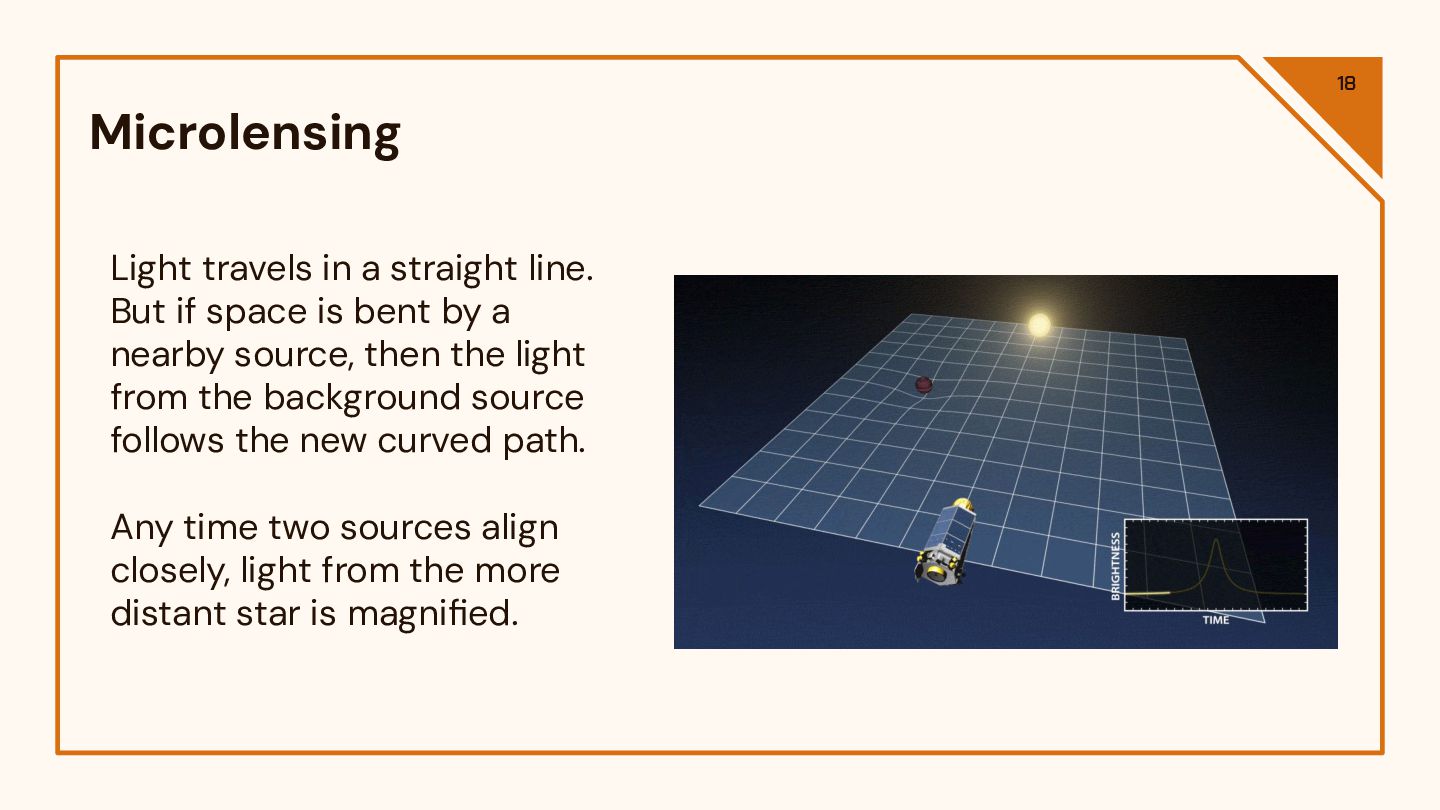
  12. Microlensing 18 Light travels in a straight line. But if

    space is bent by a nearby source, then the light from the background source follows the new curved path. Any time two sources align closely, light from the more distant star is magnified.
  13. Microlensing now with an Exoplanet 19 For exoplanets, the lens

    is the star with the planet. Planets orbiting the lens star can produce a similar effect on the background star, but on a smaller scale.
  14. Where to target Microlensing Searches 20 Title: Gravitational Microlensing by

    the Galactic Halo Abstract: The massive halo of our Galaxy has an optical depth to gravitational microlensing τ≈10-6. If the halo is made of objects more massive than ~10-8M sun , then any star in a nearby galaxy has a probability of 10-6 to be strongly microlensed at any time. The lensing events last ~2 hours… Monitoring the brightness of a few million stars in the Magellanic Clouds over a time scale between 2 hours and 2 years may lead to a discovery of “dark halo” objects in the mass range of 10-6 - 102 M sun . Paczynski (1986)
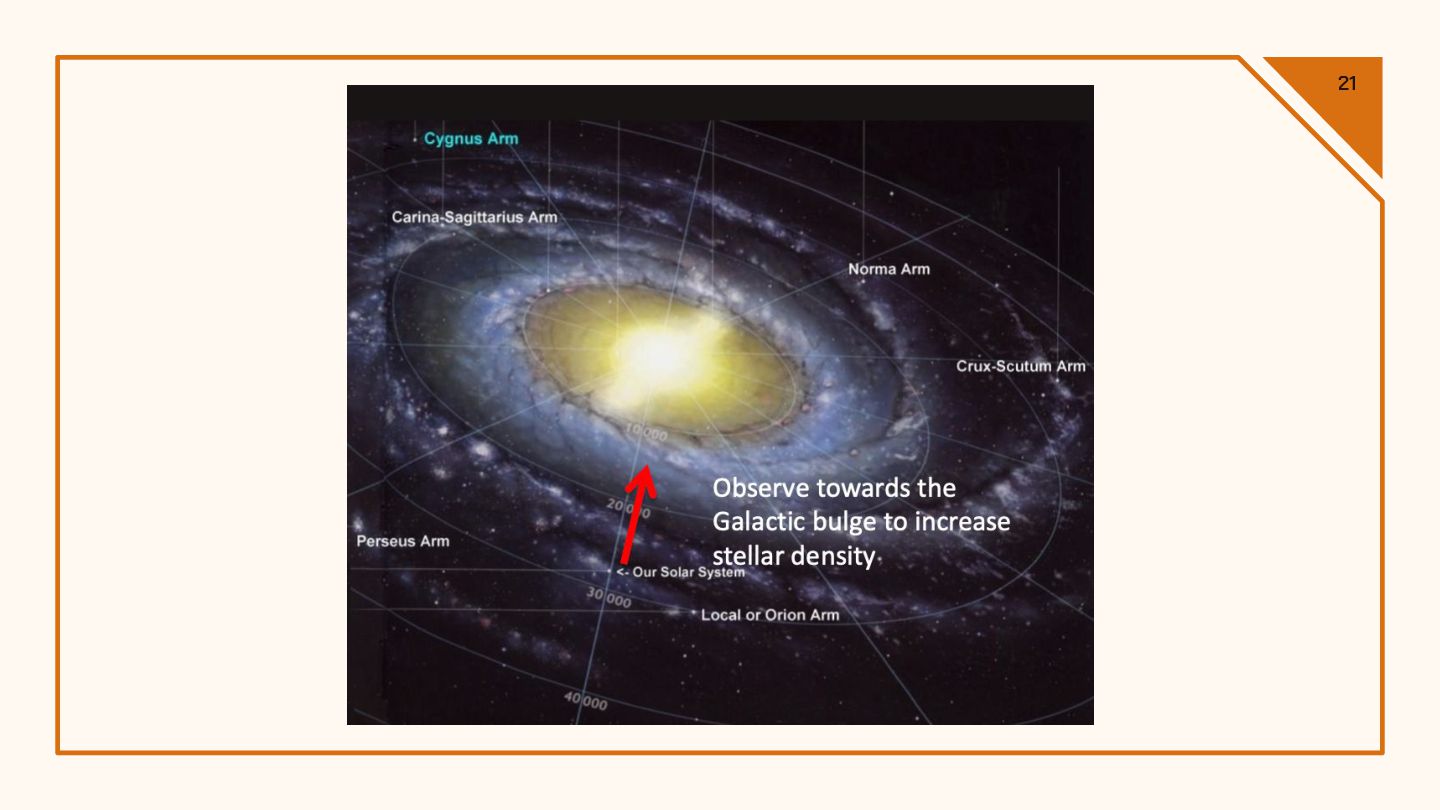
  15. 21

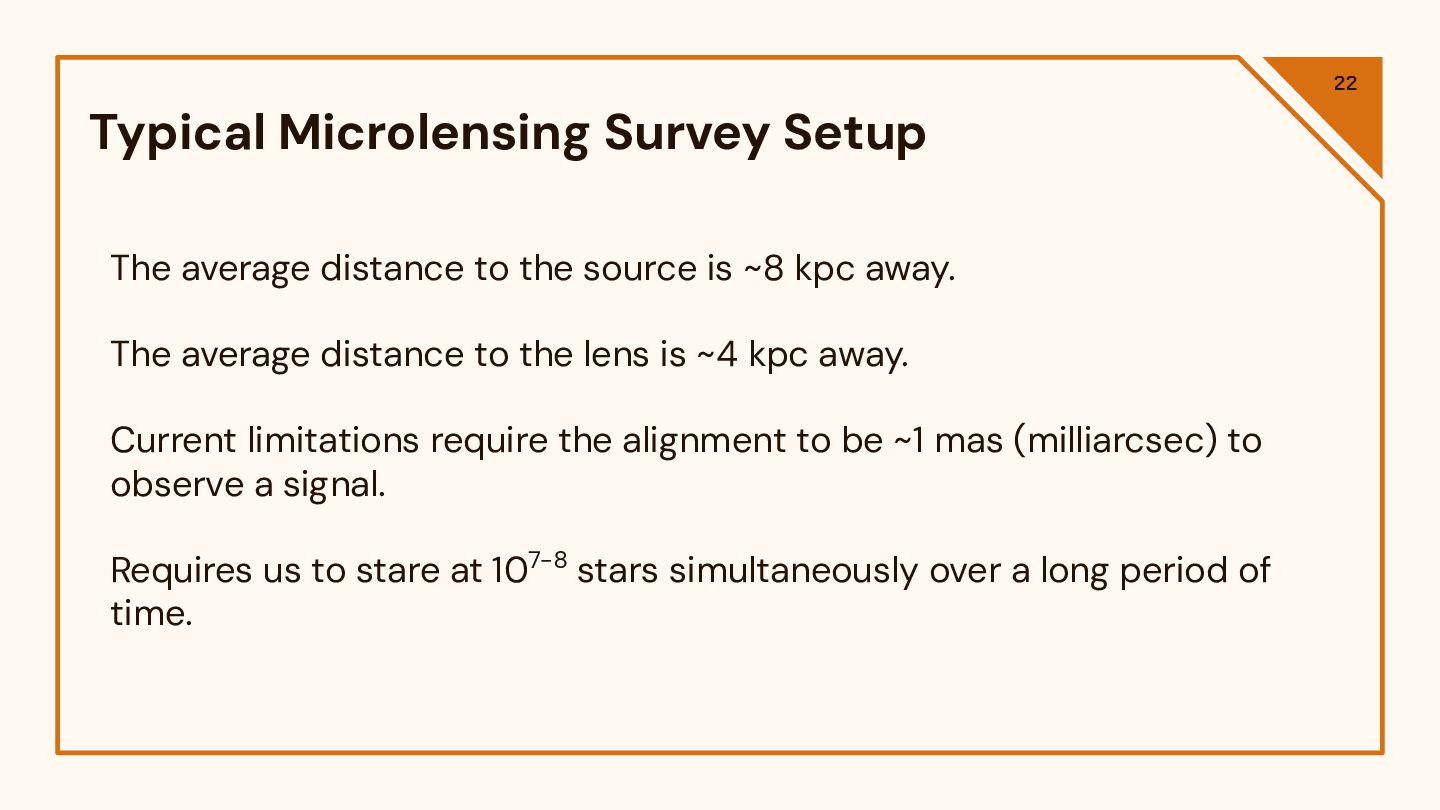
  16. Typical Microlensing Survey Setup 22 The average distance to the

    source is ~8 kpc away. The average distance to the lens is ~4 kpc away. Current limitations require the alignment to be ~1 mas (milliarcsec) to observe a signal. Requires us to stare at 107-8 stars simultaneously over a long period of time.
  17. 28 Image 1 [+] Image 1 [-] Source Lens ɑ

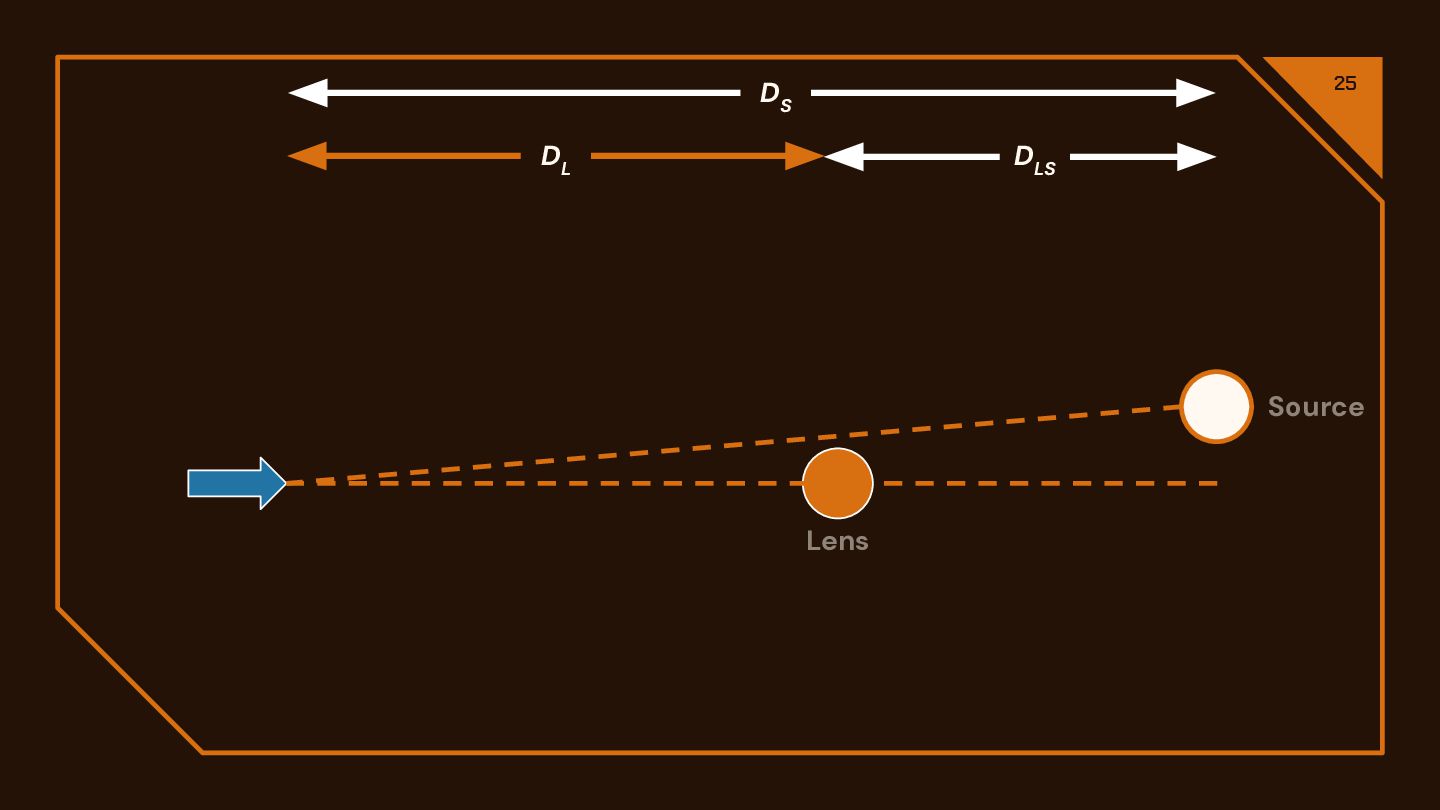
    GR θ S θ I b D L D LS D S
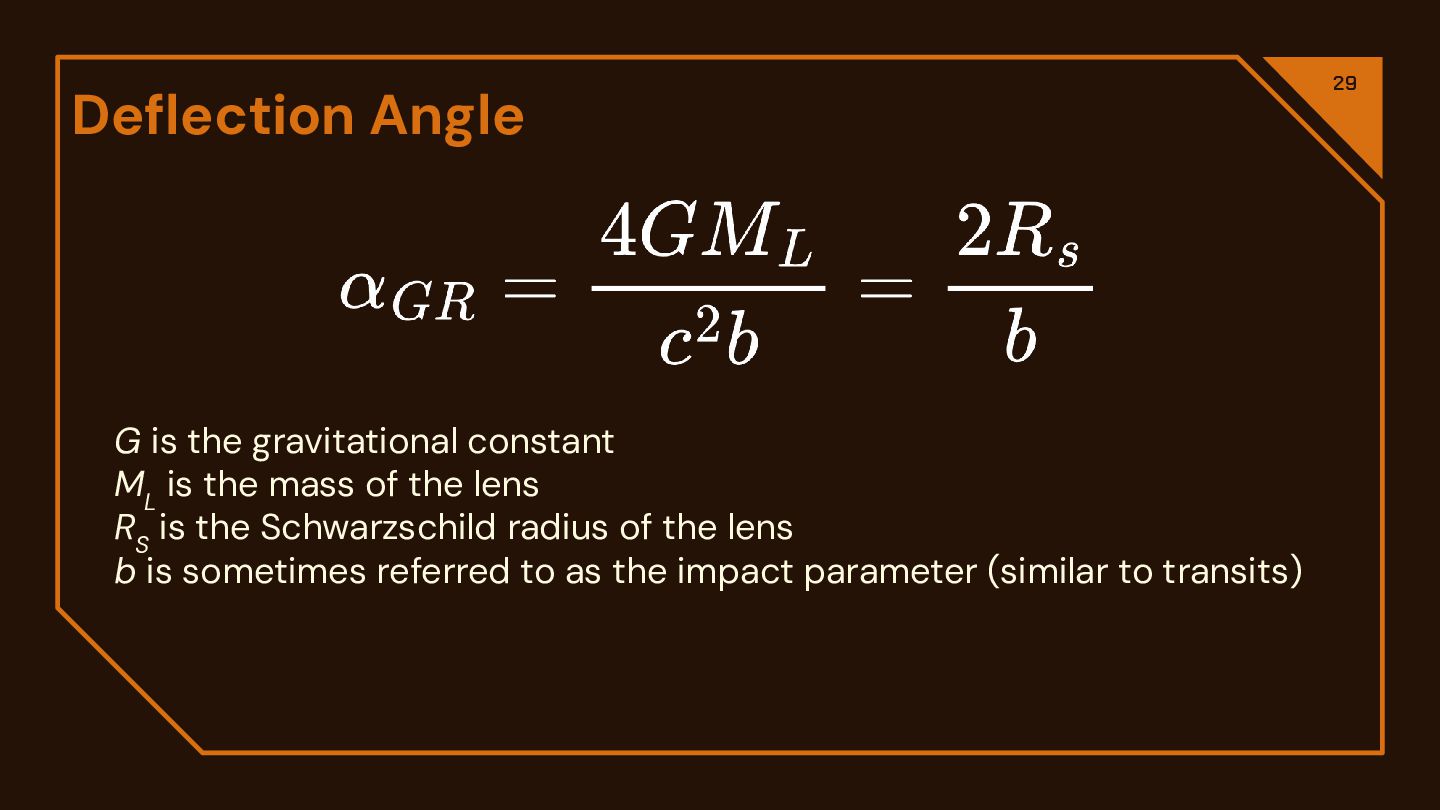
  18. 29 Deflection Angle G is the gravitational constant M L

    is the mass of the lens R S is the Schwarzschild radius of the lens b is sometimes referred to as the impact parameter (similar to transits)
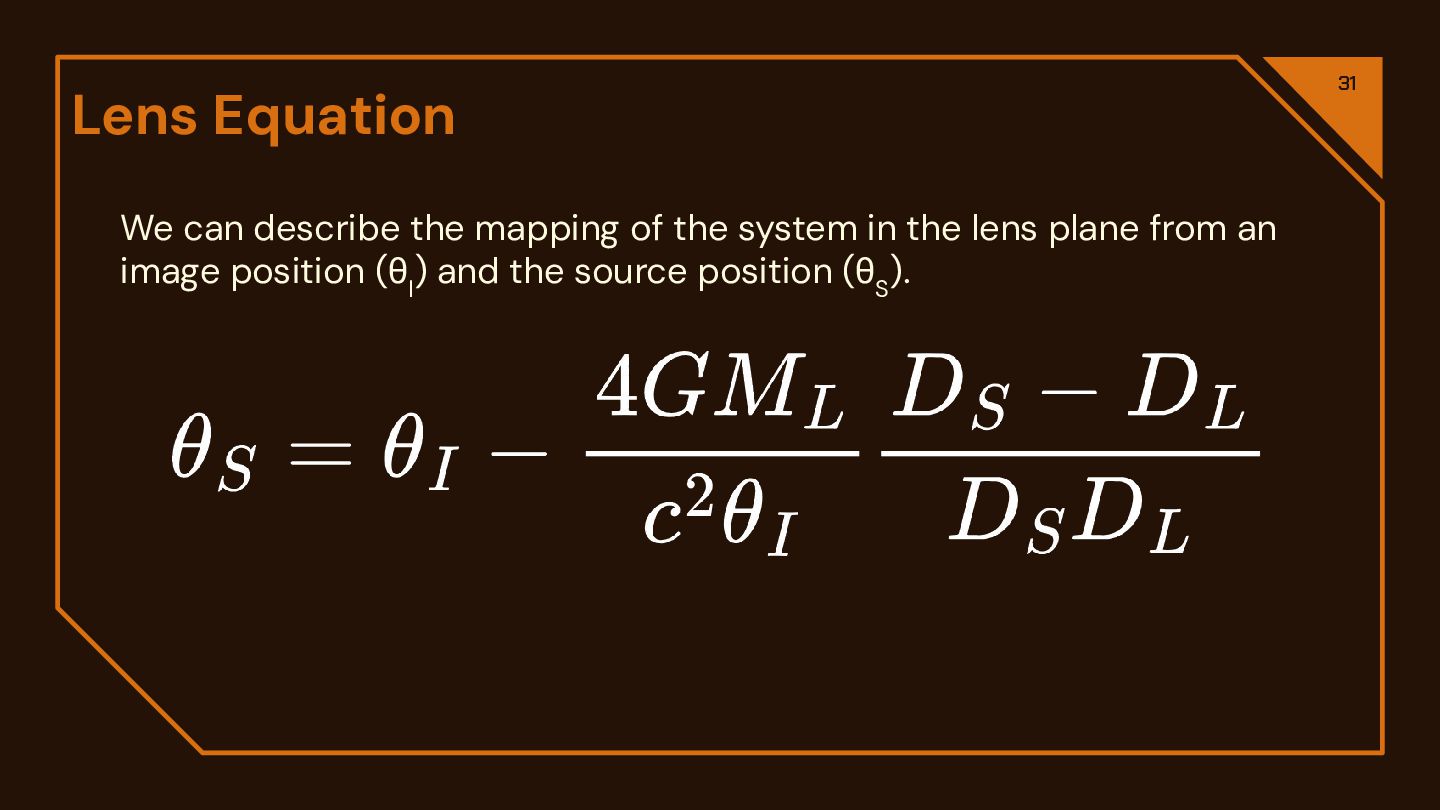
  19. 31 Lens Equation We can describe the mapping of the

    system in the lens plane from an image position (θ I ) and the source position (θ S ).
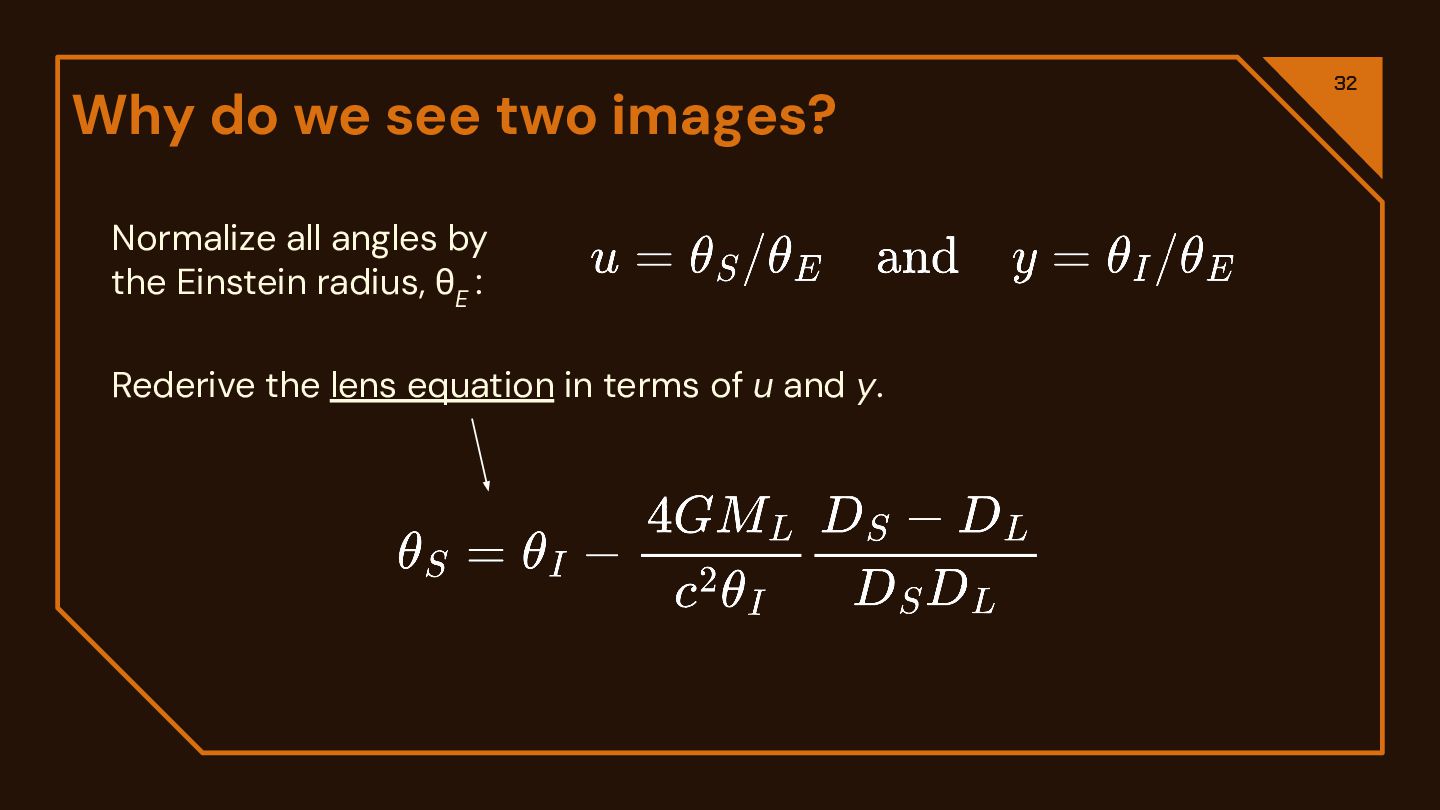
  20. 32 Why do we see two images? Normalize all angles

    by the Einstein radius, θ E : Rederive the lens equation in terms of u and y.
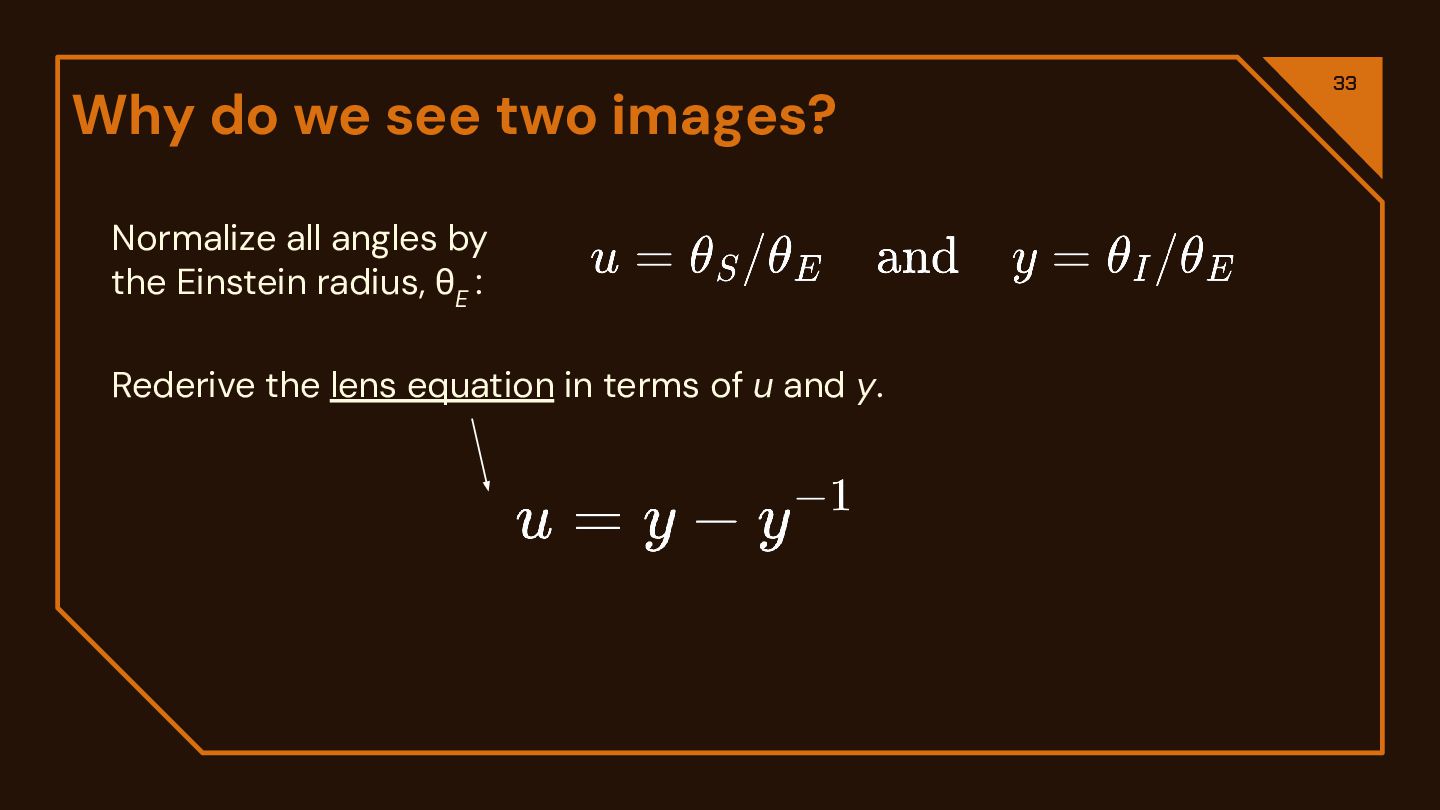
  21. 33 Why do we see two images? Normalize all angles

    by the Einstein radius, θ E : Rederive the lens equation in terms of u and y.
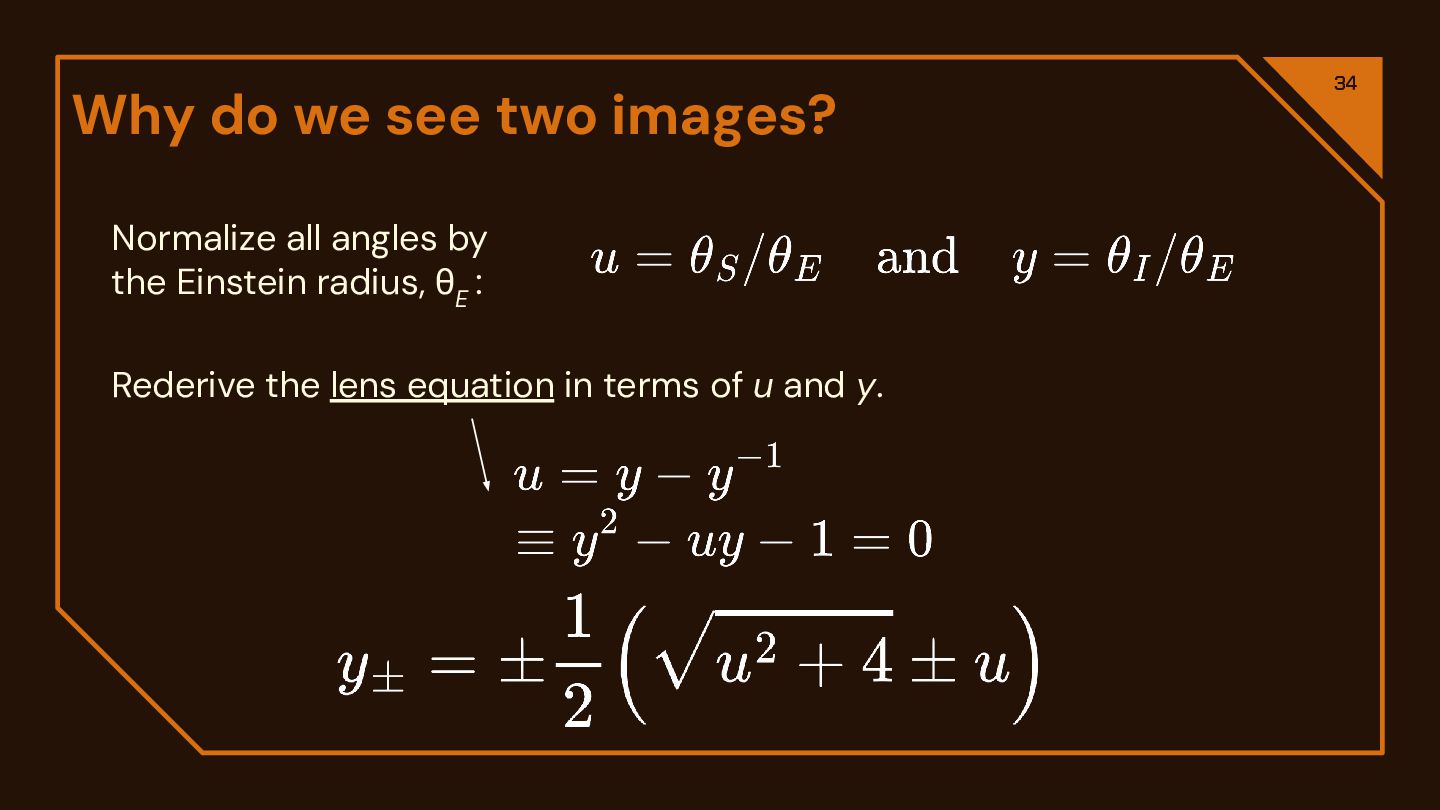
  22. 34 Why do we see two images? Normalize all angles

    by the Einstein radius, θ E : Rederive the lens equation in terms of u and y.
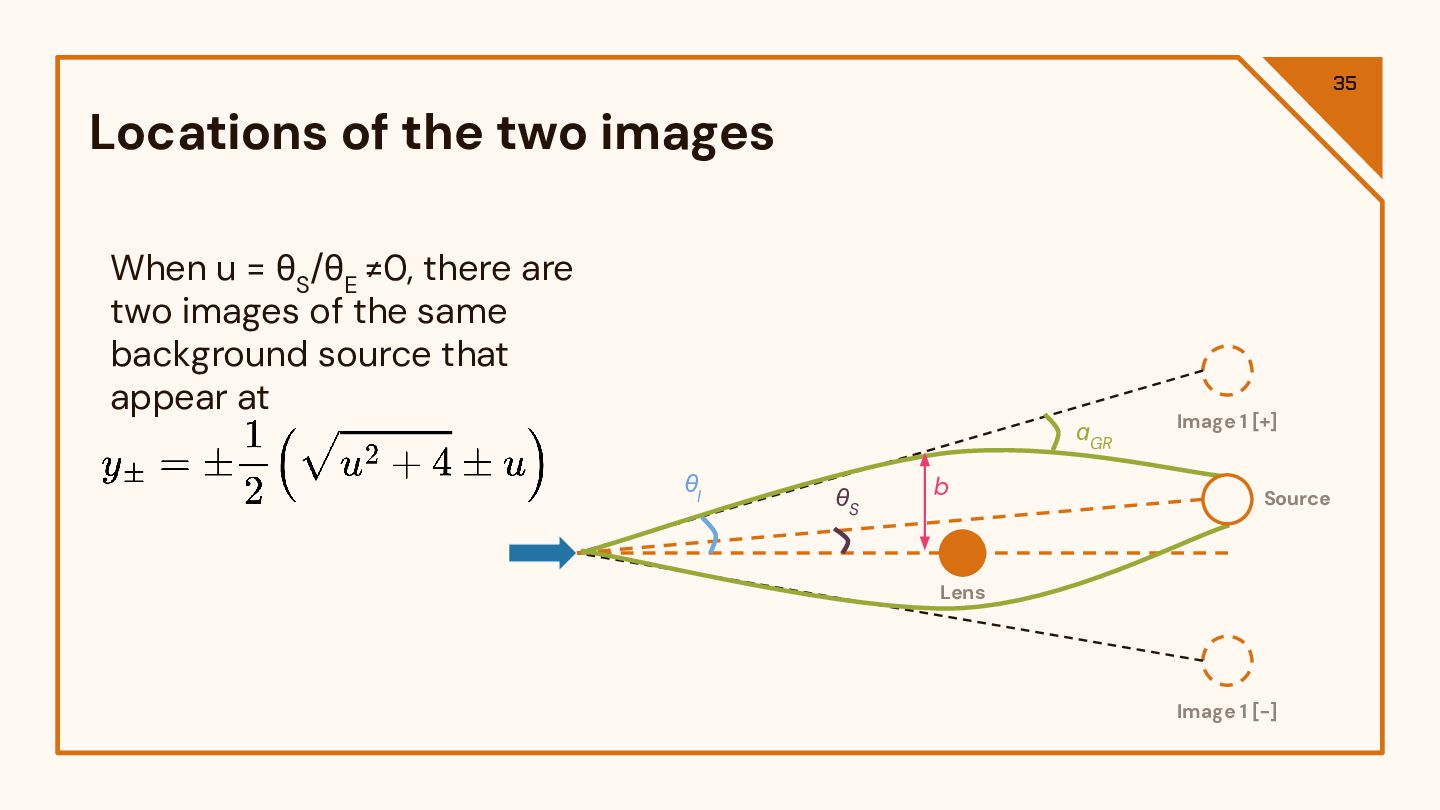
  23. Locations of the two images 35 When u = θ

    S /θ E ≠0, there are two images of the same background source that appear at Image 1 [+] Image 1 [-] Source Lens ɑ GR θ S θ I b
  24. Locations of the two images 36 When there is a

    perfect alignment, the two images merge to form an Einstein ring. For all other positions, one image lies outside of θ E while one lies inside.
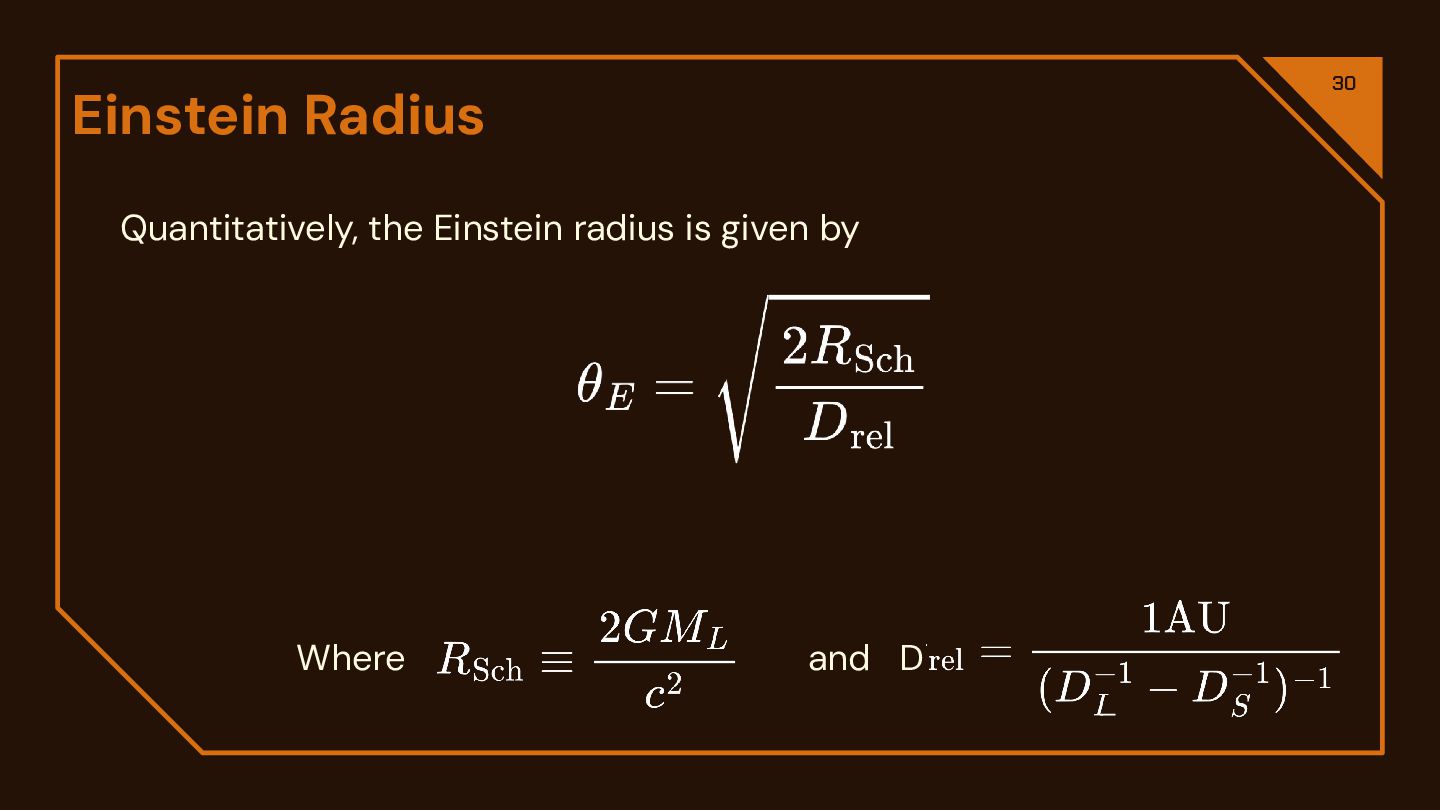
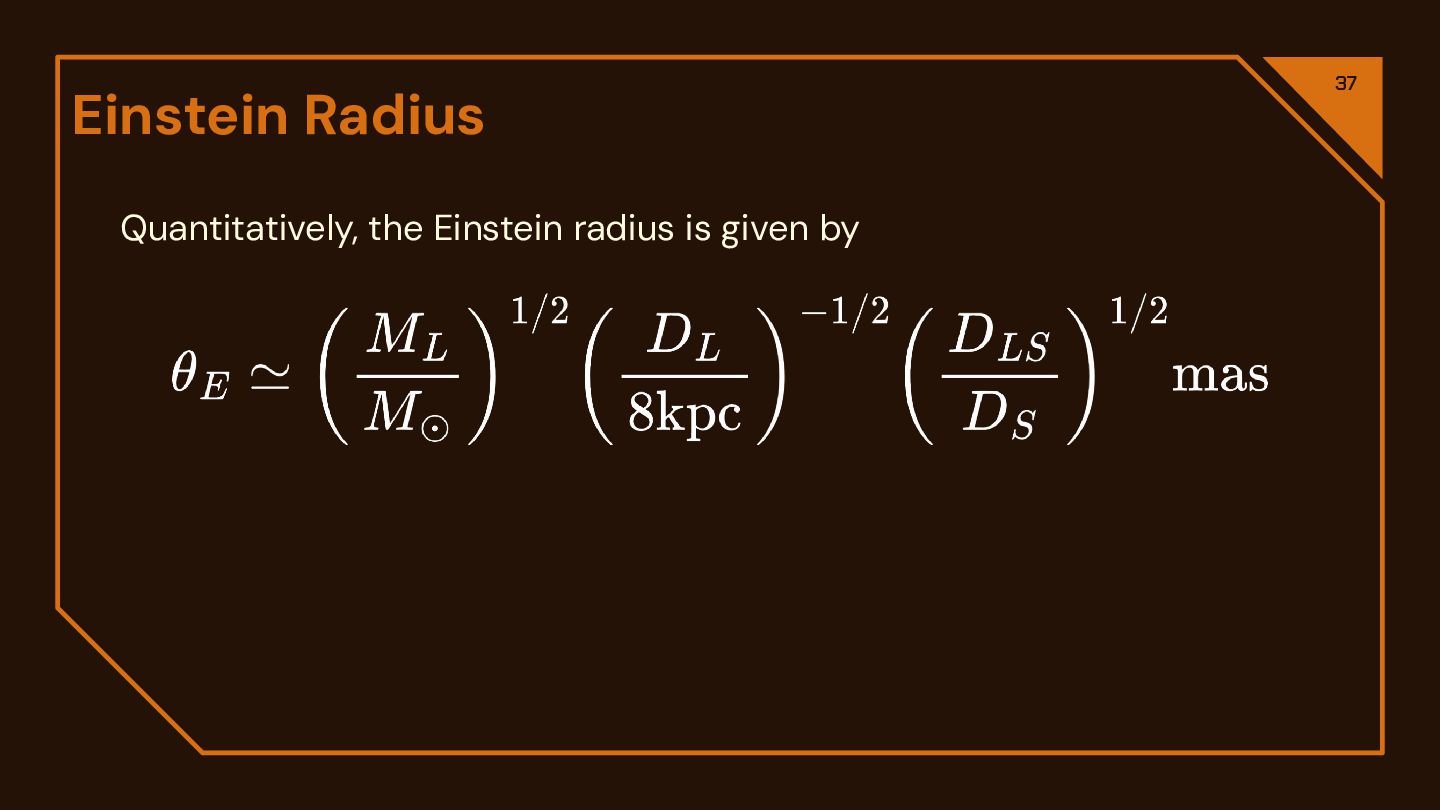
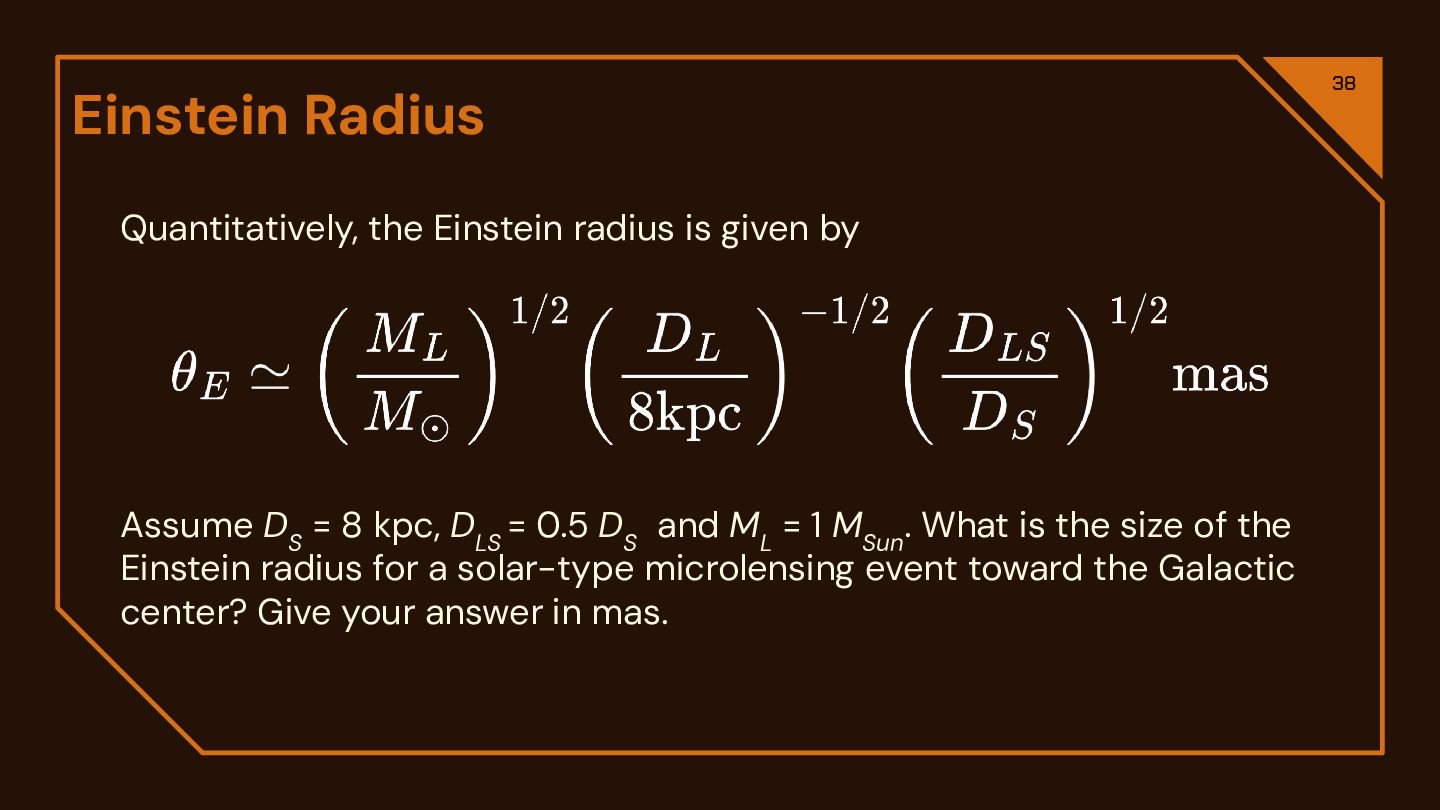
  25. 38 Einstein Radius Quantitatively, the Einstein radius is given by

    Assume D S = 8 kpc, D LS = 0.5 D S and M L = 1 M Sun . What is the size of the Einstein radius for a solar-type microlensing event toward the Galactic center? Give your answer in mas.
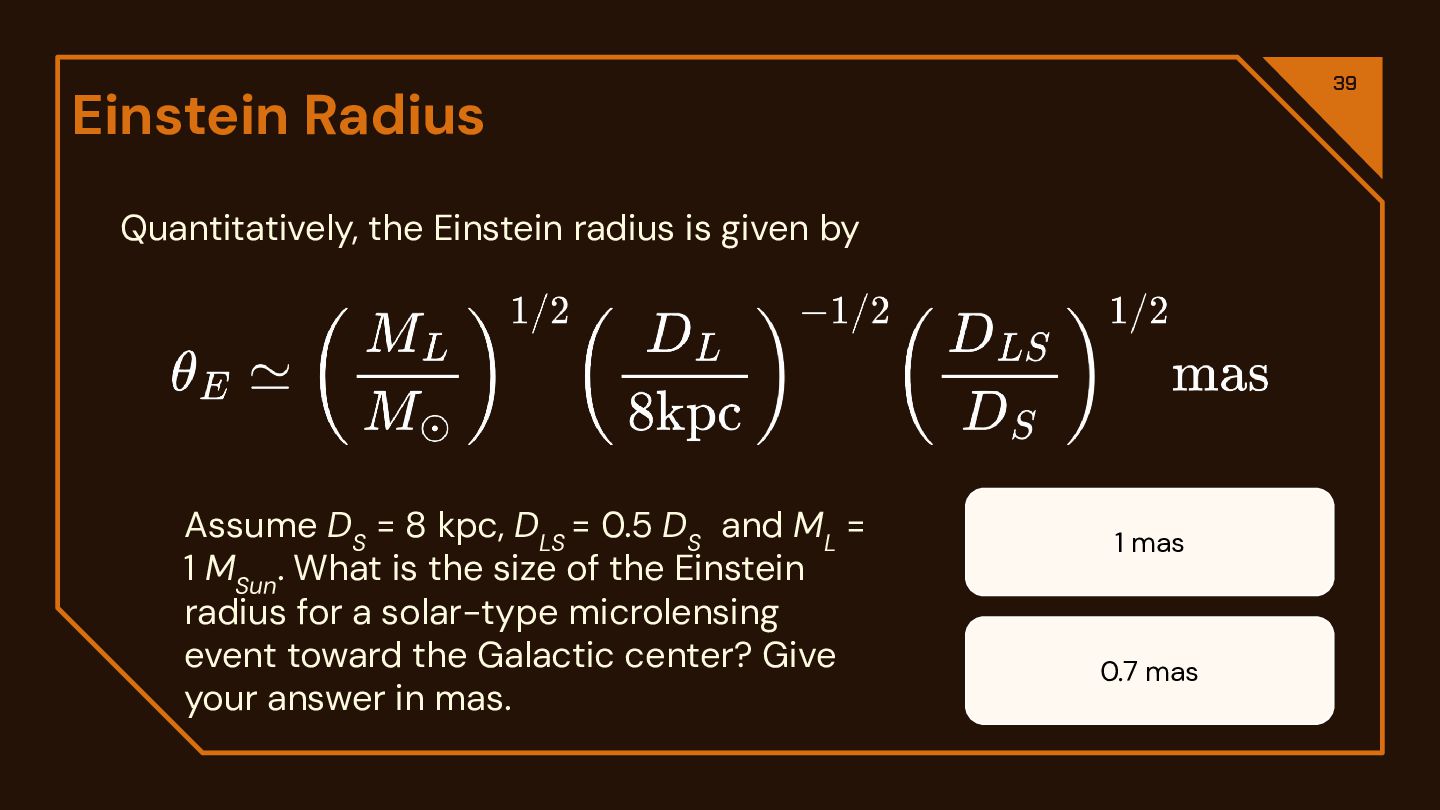
  26. 39 Einstein Radius Quantitatively, the Einstein radius is given by

    Assume D S = 8 kpc, D LS = 0.5 D S and M L = 1 M Sun . What is the size of the Einstein radius for a solar-type microlensing event toward the Galactic center? Give your answer in mas. 1 mas 0.7 mas
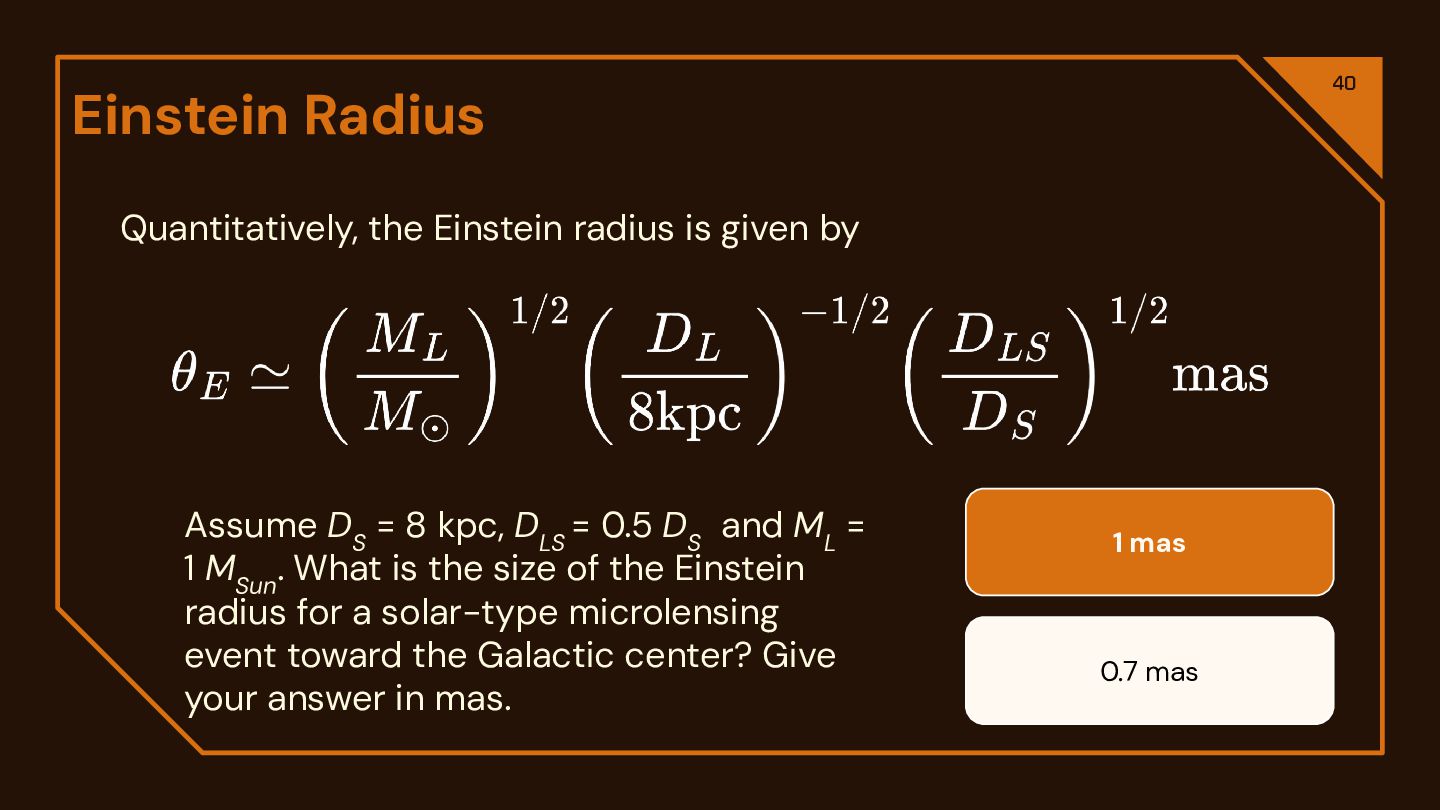
  27. 40 Einstein Radius Quantitatively, the Einstein radius is given by

    Assume D S = 8 kpc, D LS = 0.5 D S and M L = 1 M Sun . What is the size of the Einstein radius for a solar-type microlensing event toward the Galactic center? Give your answer in mas. 1 mas 0.7 mas
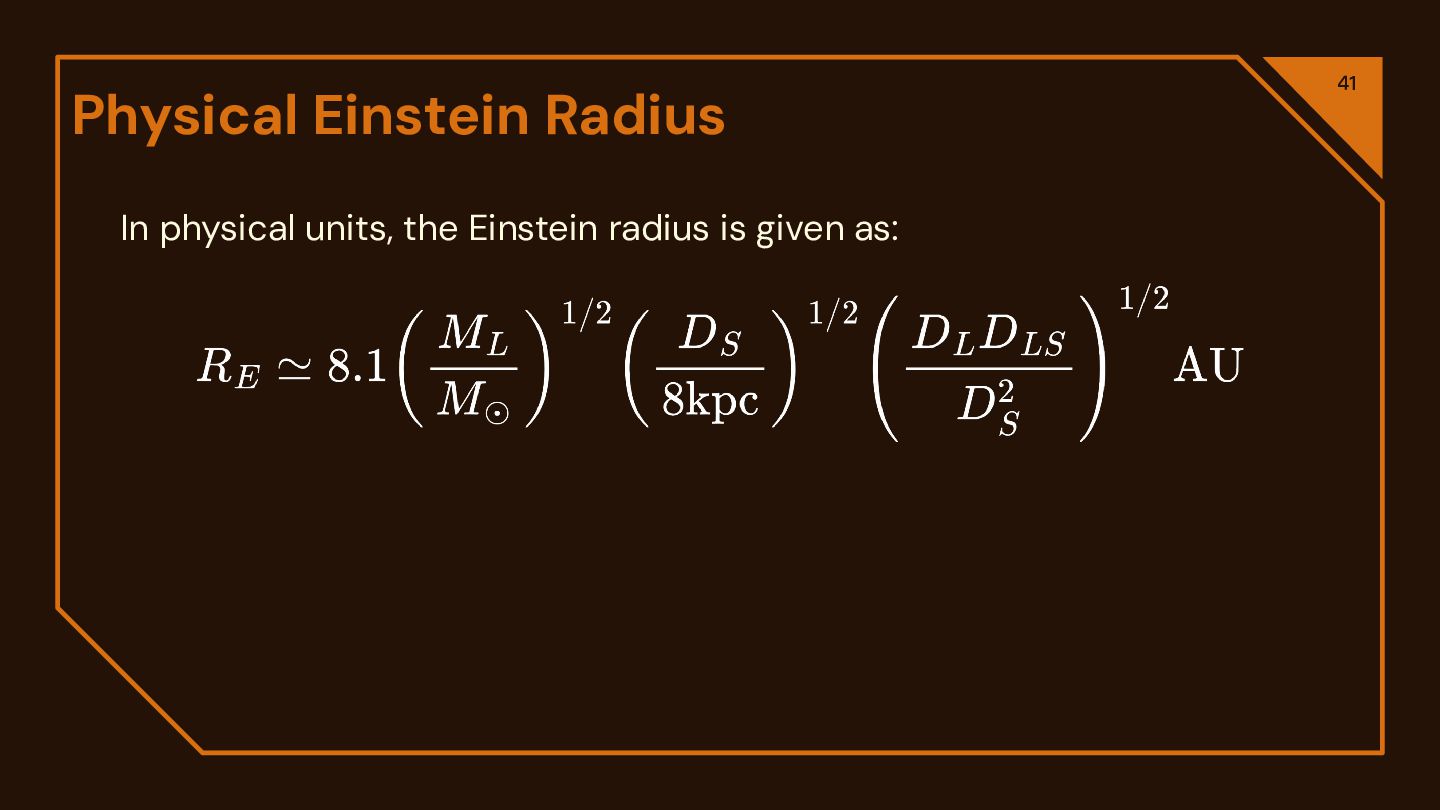
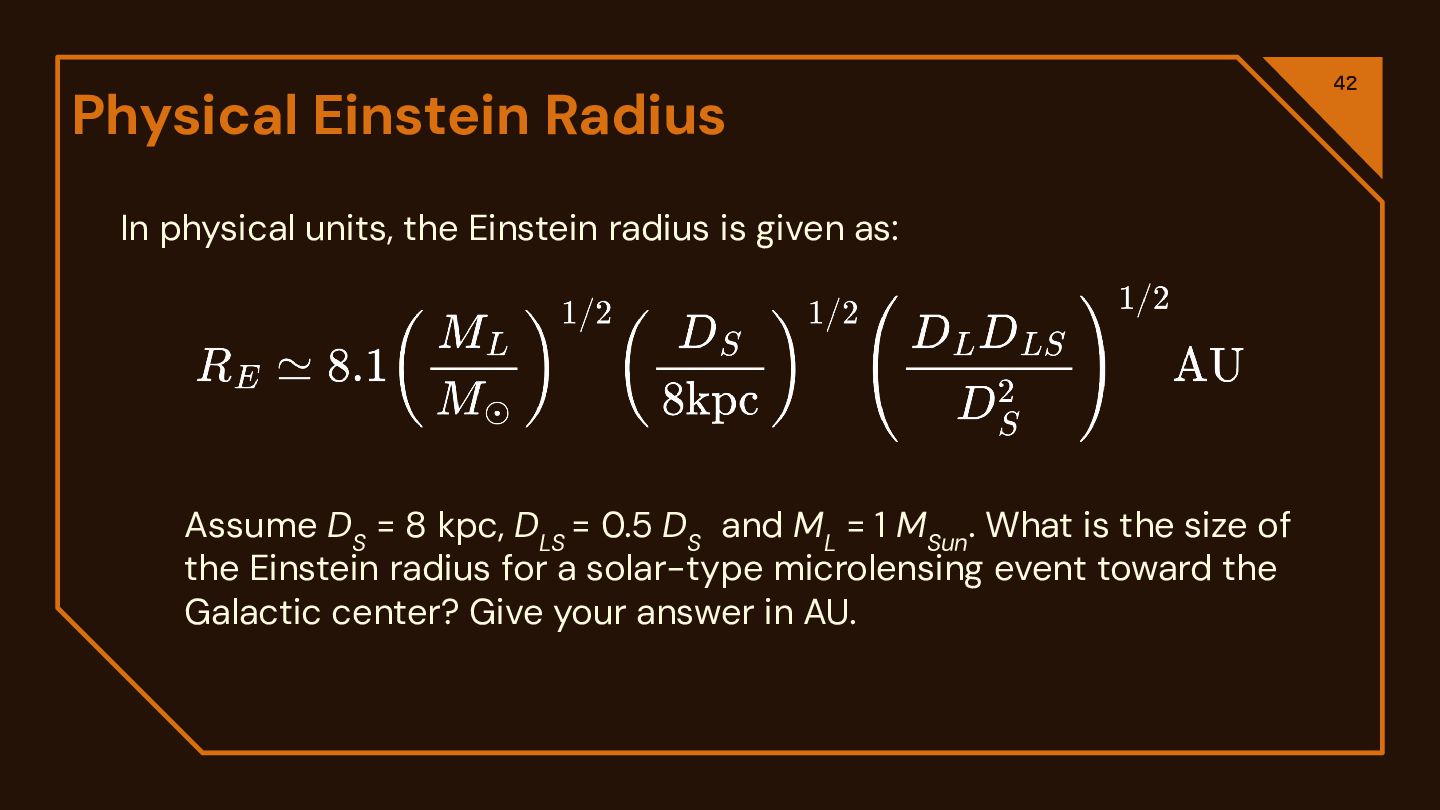
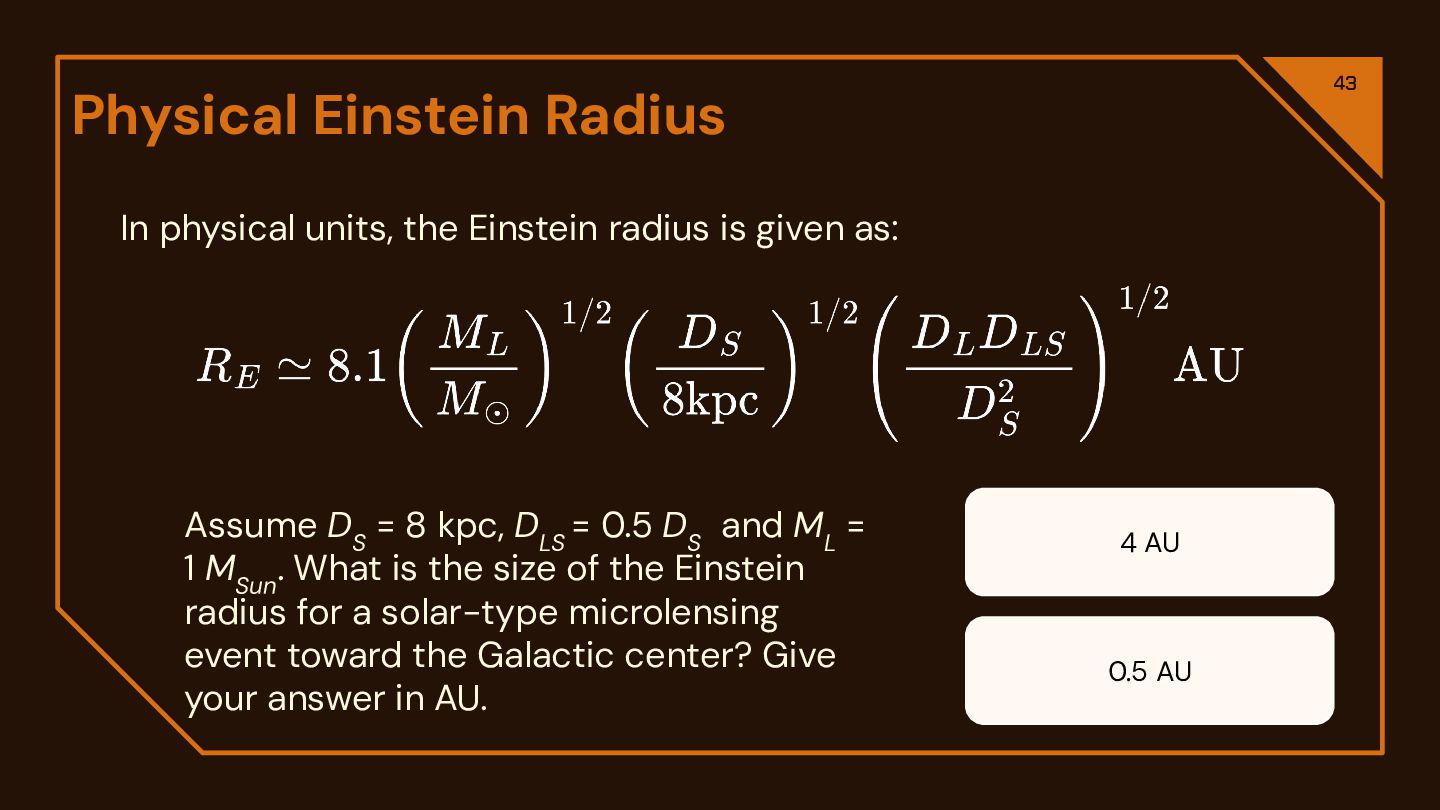
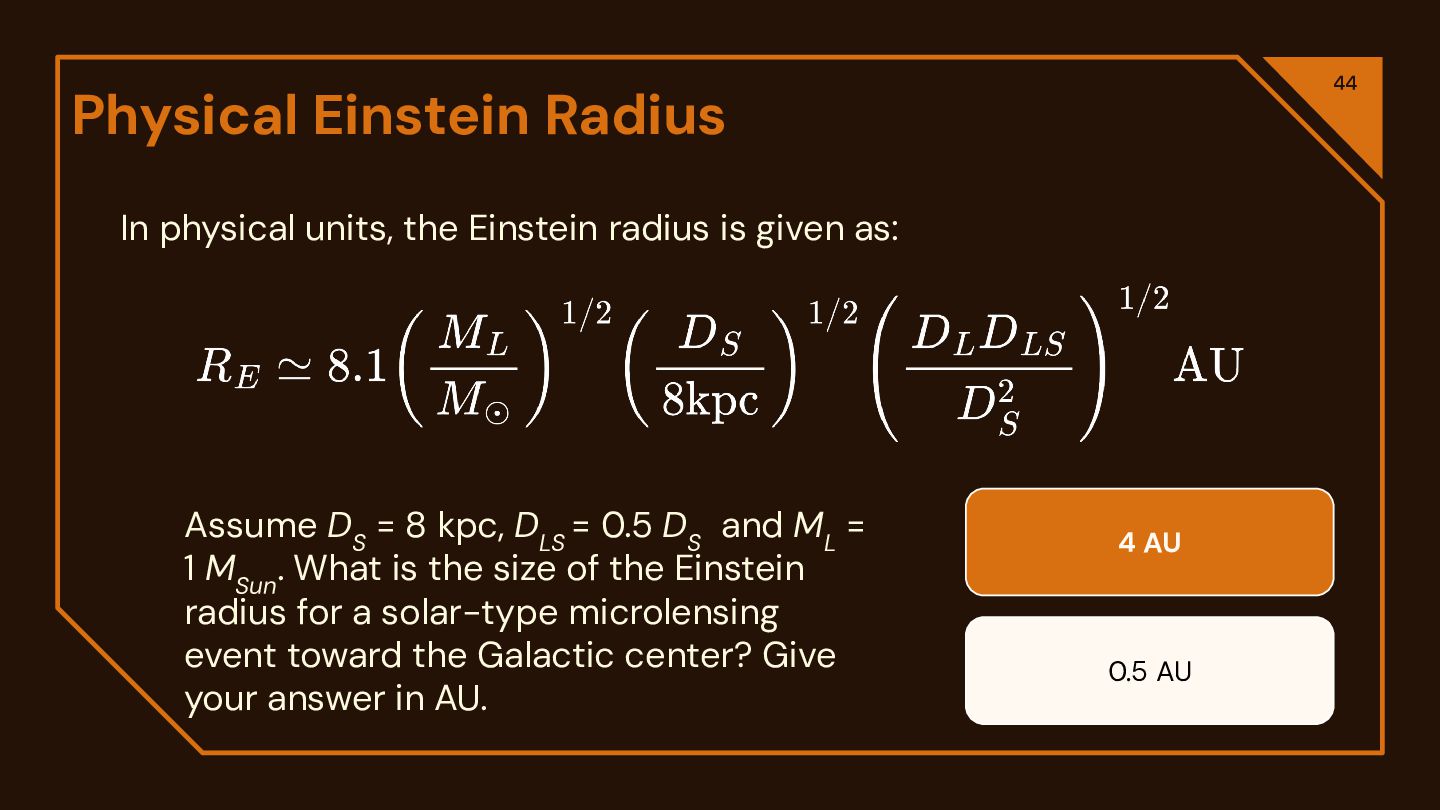
  28. 42 Physical Einstein Radius In physical units, the Einstein radius

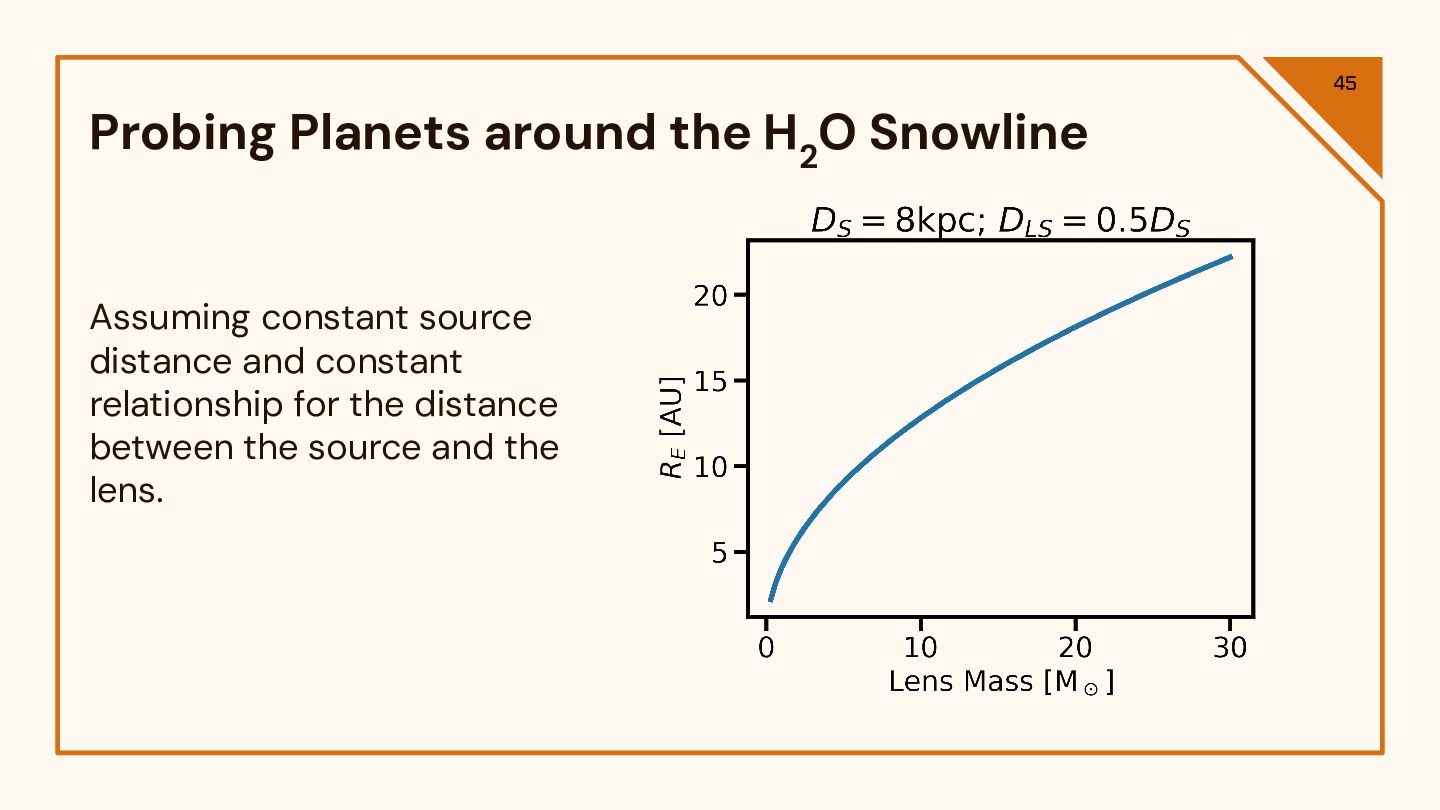
    is given as: Assume D S = 8 kpc, D LS = 0.5 D S and M L = 1 M Sun . What is the size of the Einstein radius for a solar-type microlensing event toward the Galactic center? Give your answer in AU.
  29. 43 Physical Einstein Radius In physical units, the Einstein radius

    is given as: Assume D S = 8 kpc, D LS = 0.5 D S and M L = 1 M Sun . What is the size of the Einstein radius for a solar-type microlensing event toward the Galactic center? Give your answer in AU. 4 AU 0.5 AU
  30. 44 Physical Einstein Radius In physical units, the Einstein radius

    is given as: Assume D S = 8 kpc, D LS = 0.5 D S and M L = 1 M Sun . What is the size of the Einstein radius for a solar-type microlensing event toward the Galactic center? Give your answer in AU. 4 AU 0.5 AU
  31. Probing Planets around the H 2 O Snowline 45 Assuming

    constant source distance and constant relationship for the distance between the source and the lens.
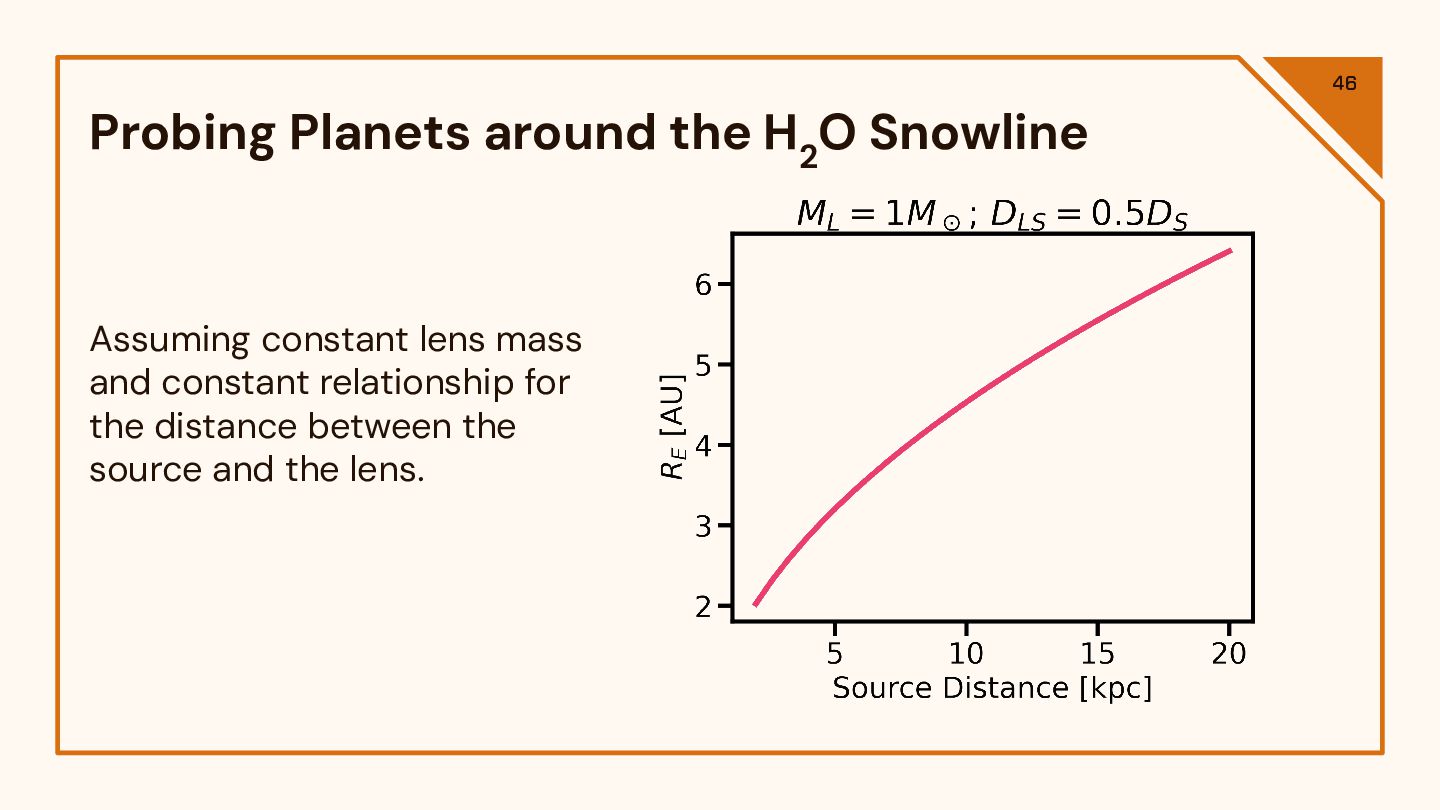
  32. Probing Planets around the H 2 O Snowline 46 Assuming

    constant lens mass and constant relationship for the distance between the source and the lens.
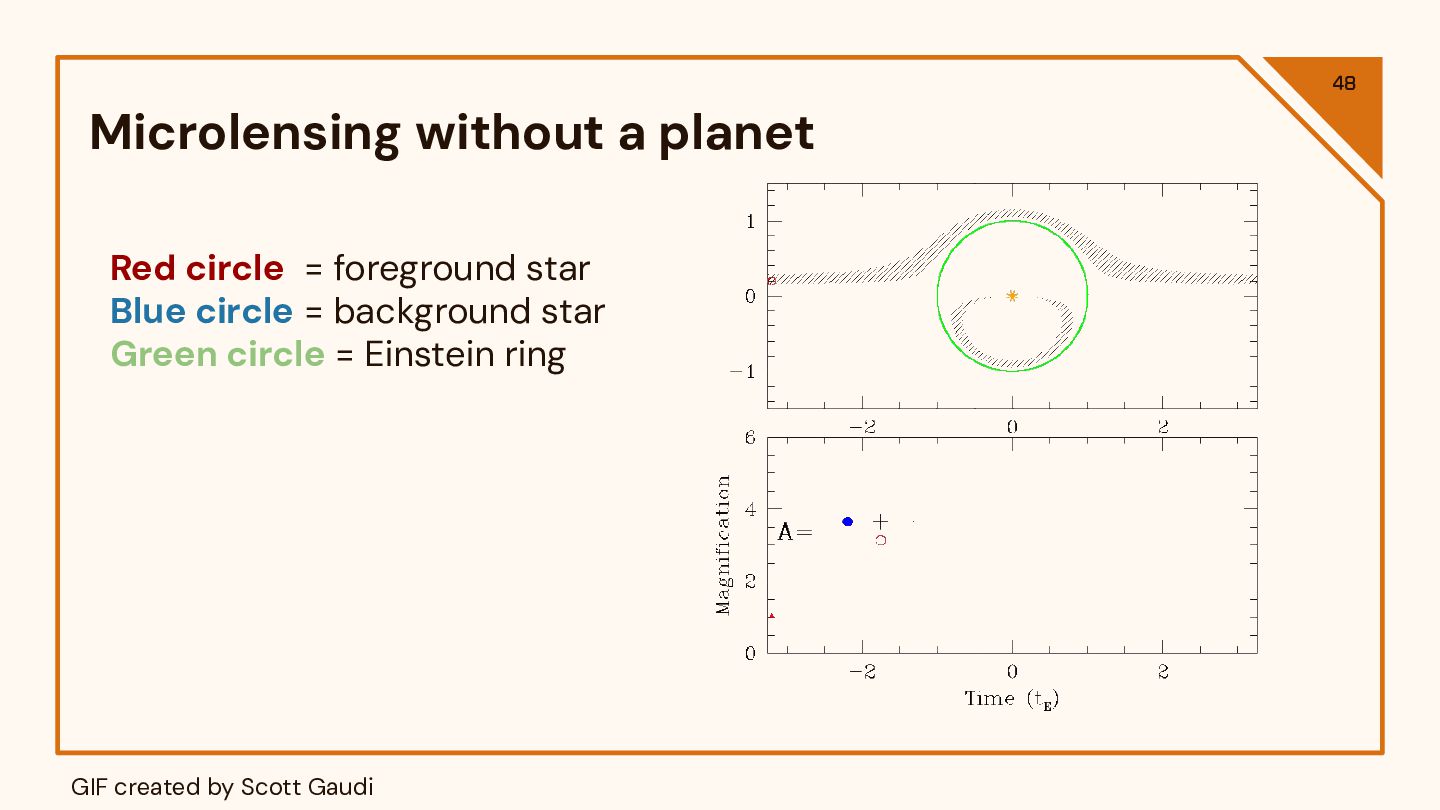
  33. Microlensing without a planet 48 GIF created by Scott Gaudi

    Red circle = foreground star Blue circle = background star Green circle = Einstein ring
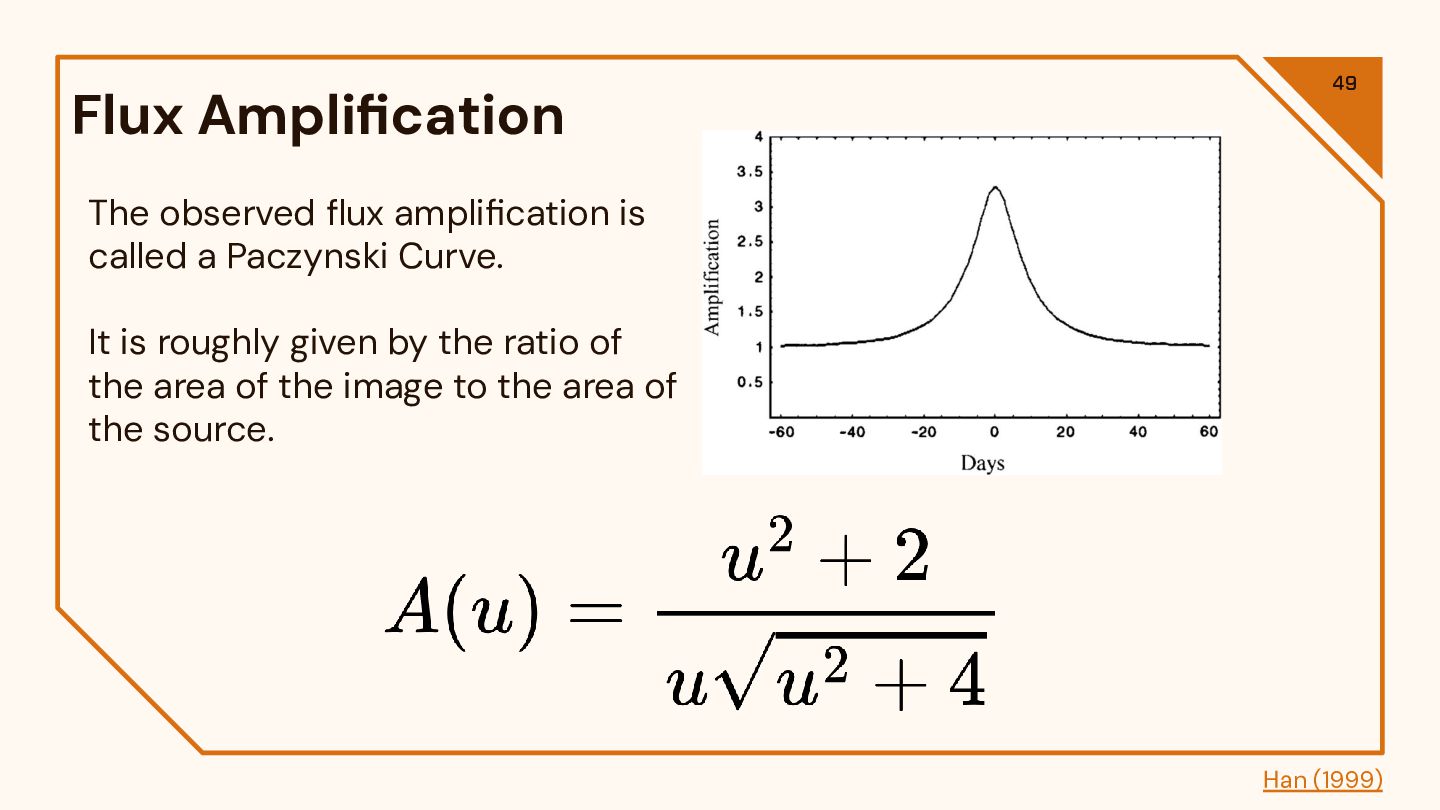
  34. 49 Flux Amplification The observed flux amplification is called a

    Paczynski Curve. It is roughly given by the ratio of the area of the image to the area of the source. Han (1999)
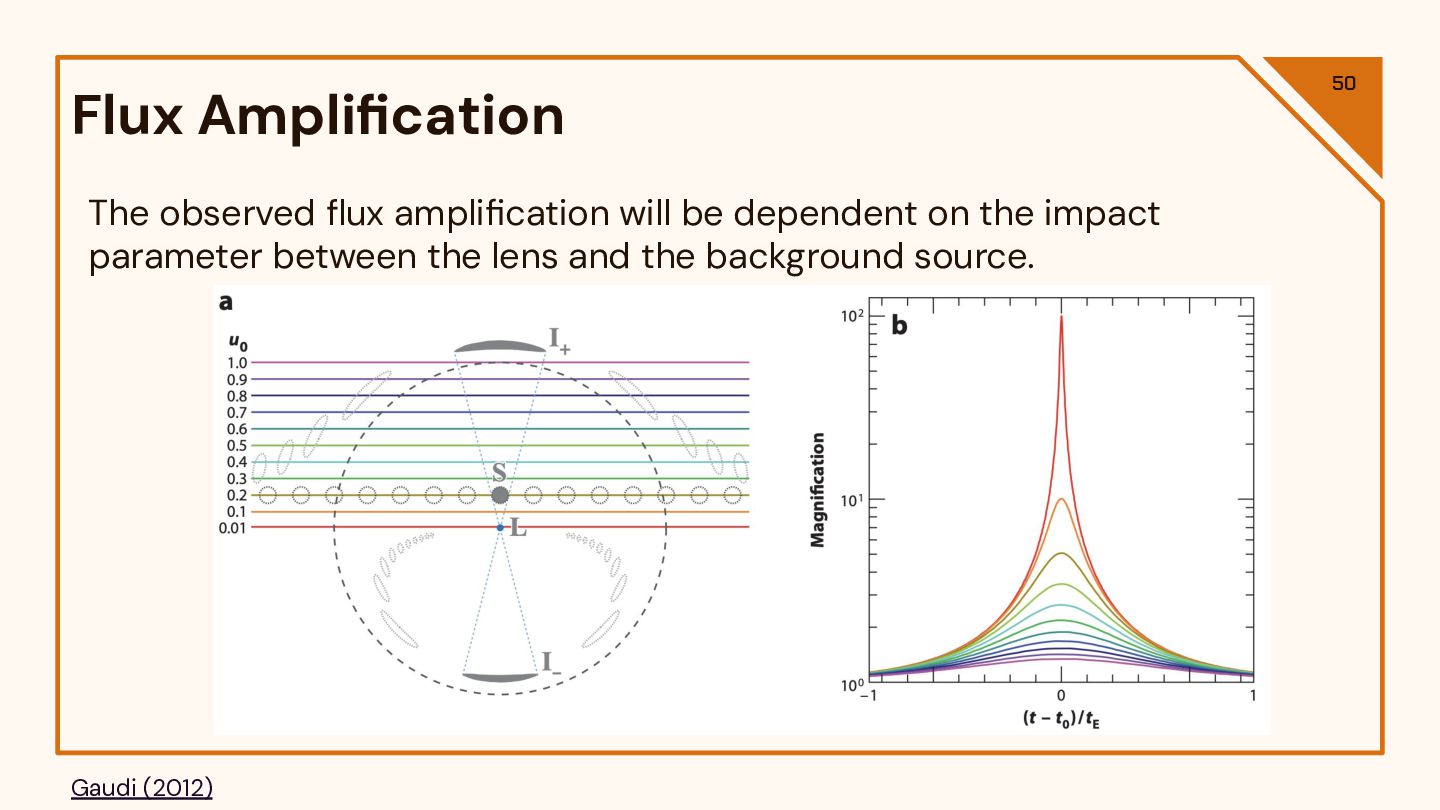
  35. 50 Flux Amplification The observed flux amplification will be dependent

    on the impact parameter between the lens and the background source. Gaudi (2012)
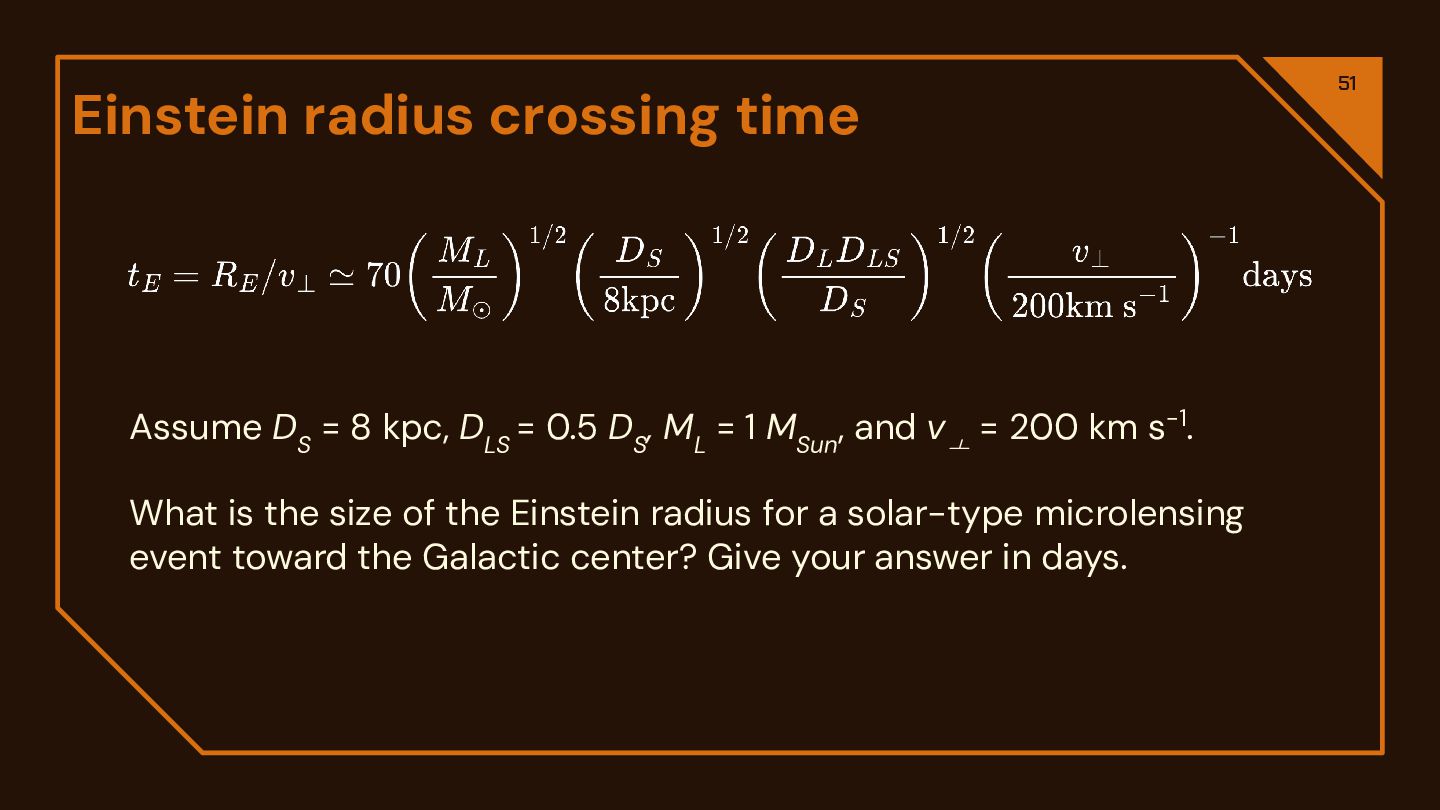
  36. 51 Einstein radius crossing time Assume D S = 8

    kpc, D LS = 0.5 D S , M L = 1 M Sun , and vㅗ = 200 km s-1. What is the size of the Einstein radius for a solar-type microlensing event toward the Galactic center? Give your answer in days.
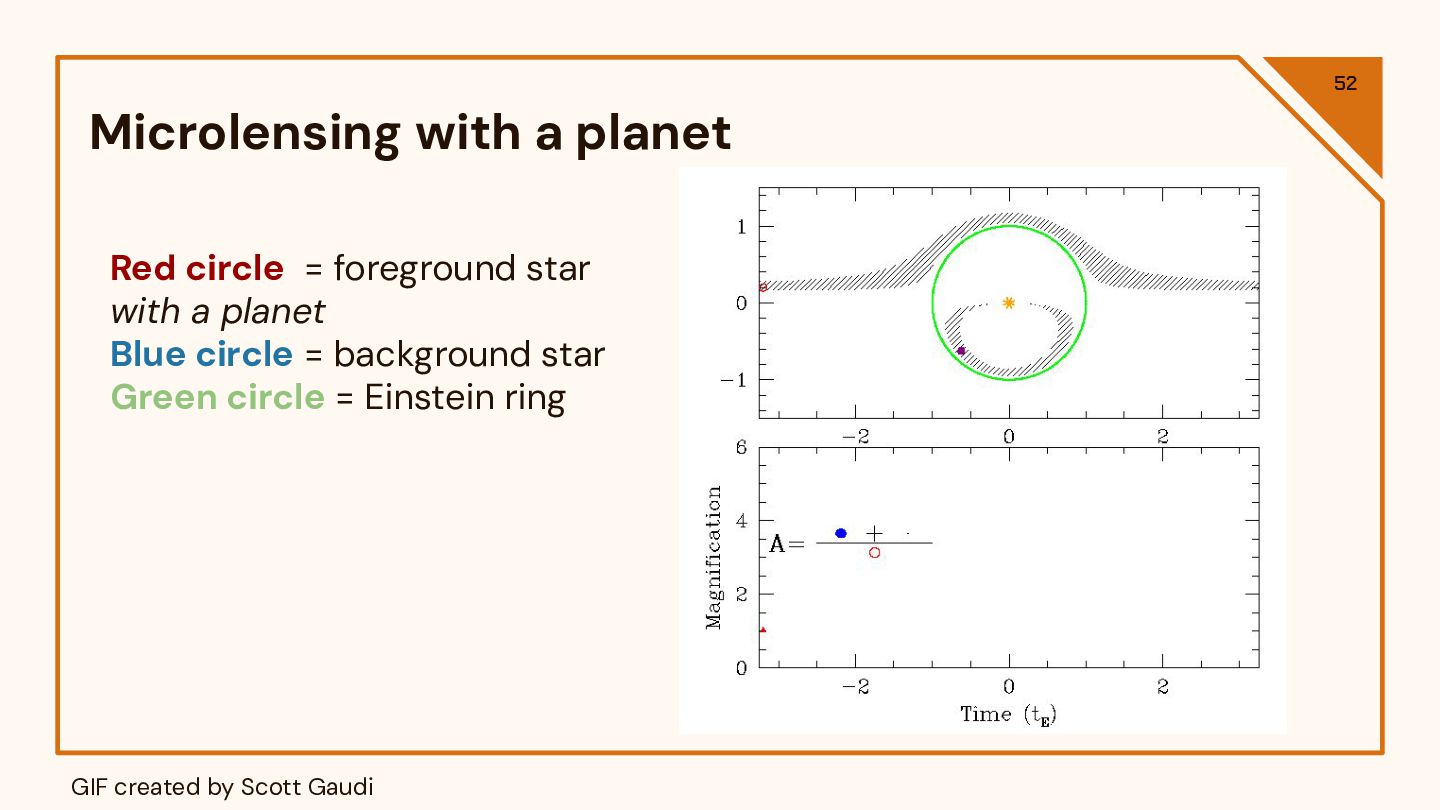
  37. Microlensing with a planet 52 GIF created by Scott Gaudi

    Red circle = foreground star with a planet Blue circle = background star Green circle = Einstein ring
  38. What can we learn? 53 From the planetary perturbation, we

    see magnified images along the Einstein radius near the planet. The key parameters we can measure are: • The mass ratio - q = M P / M S • The projected separation - d = a / R E • The angle of the source trajectory relative to the binary axis - ɑ
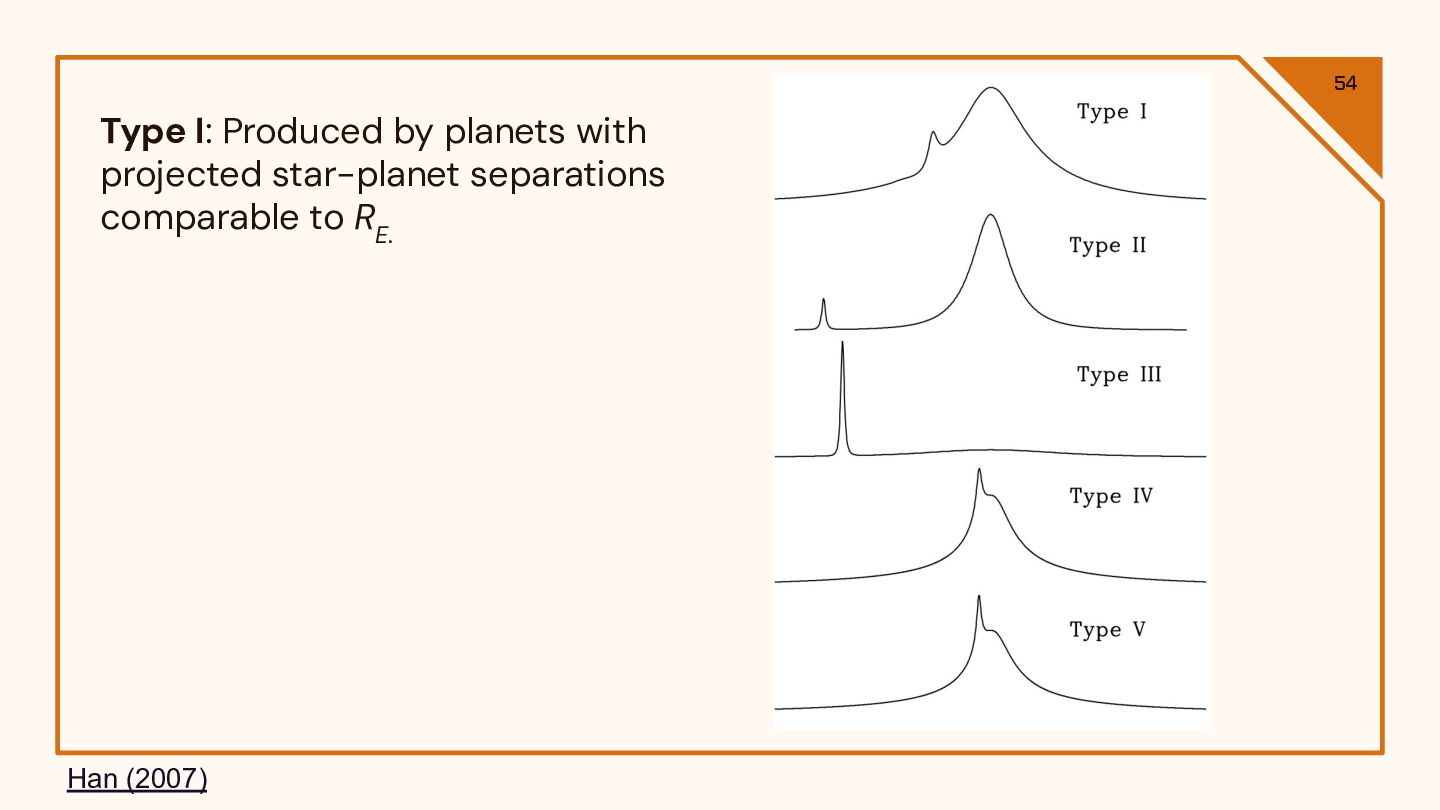
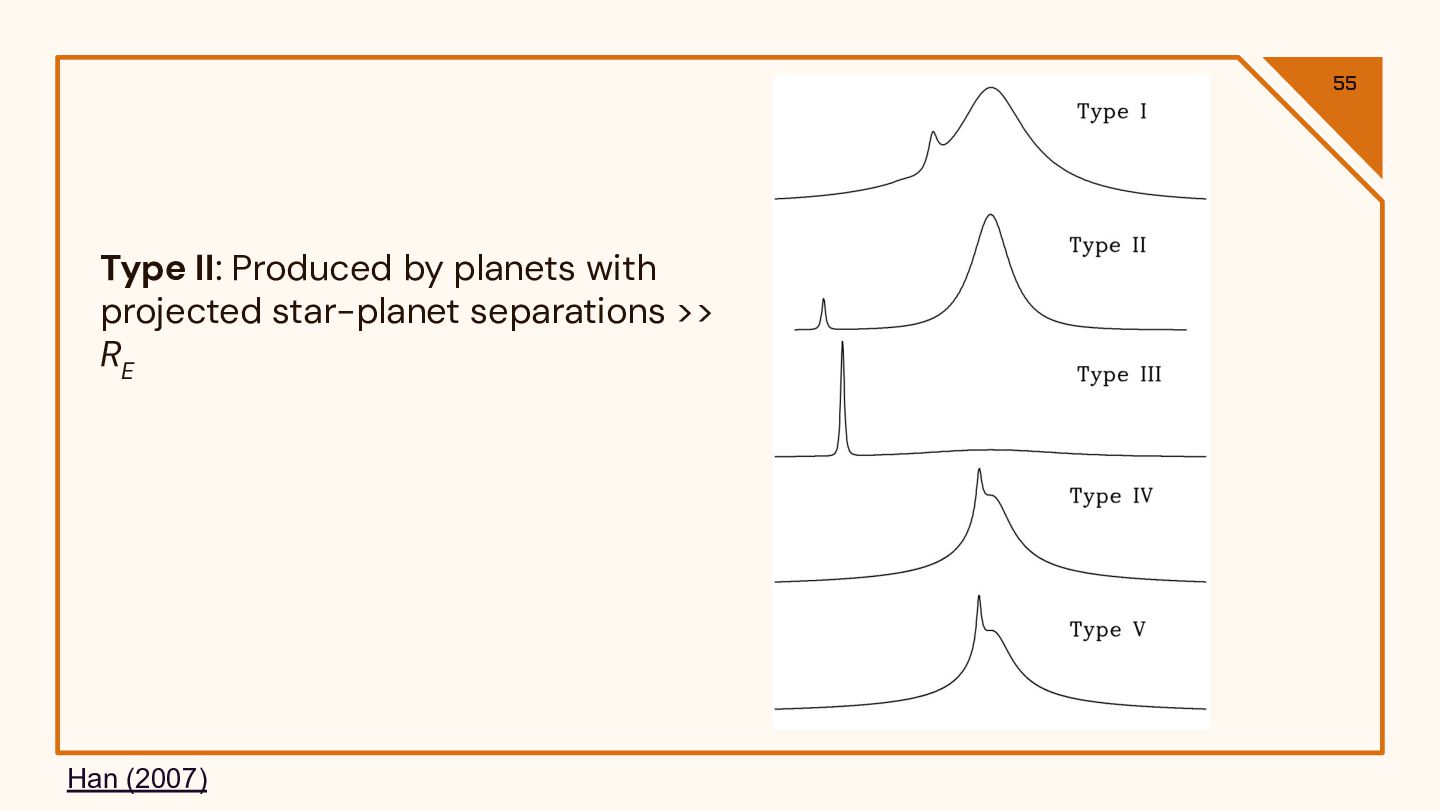
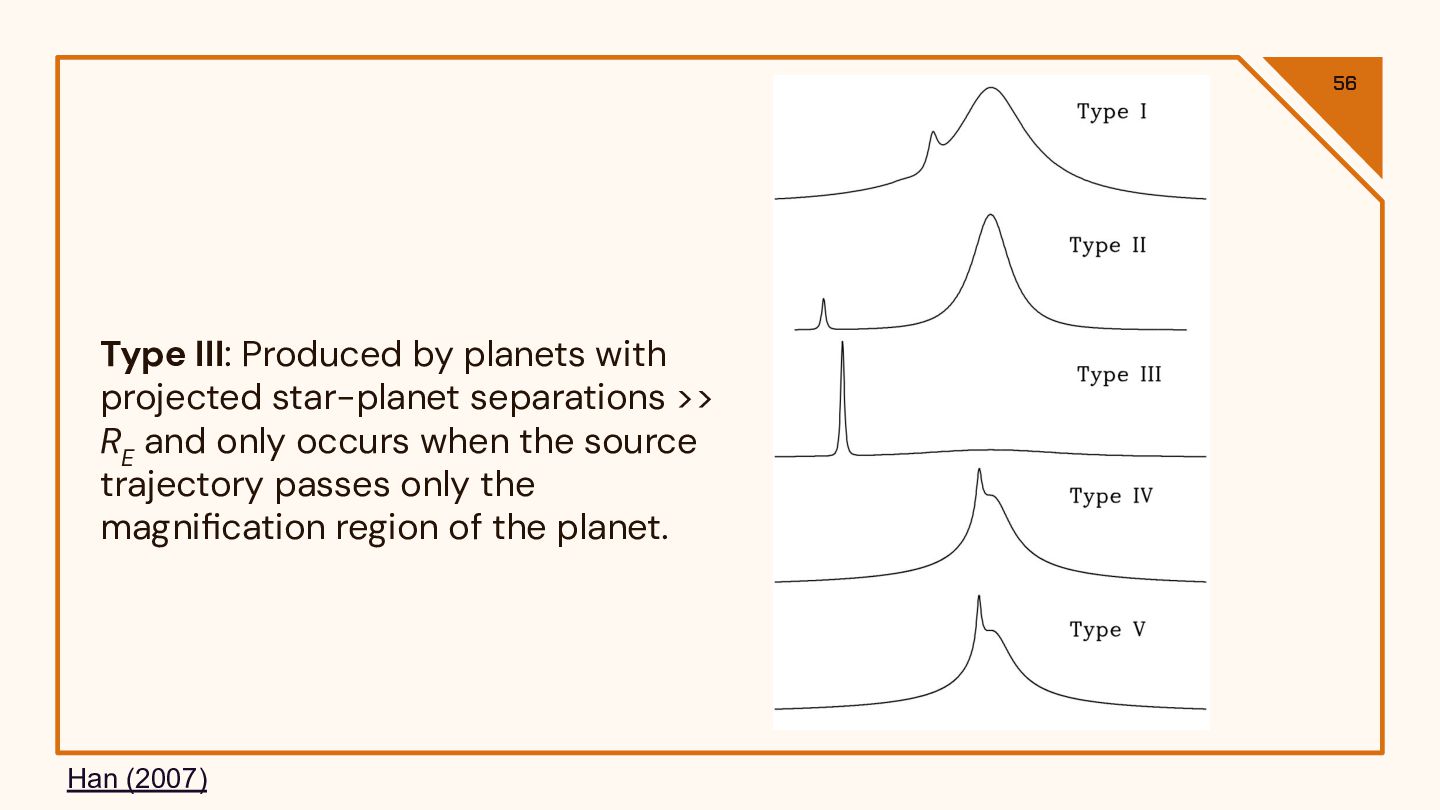
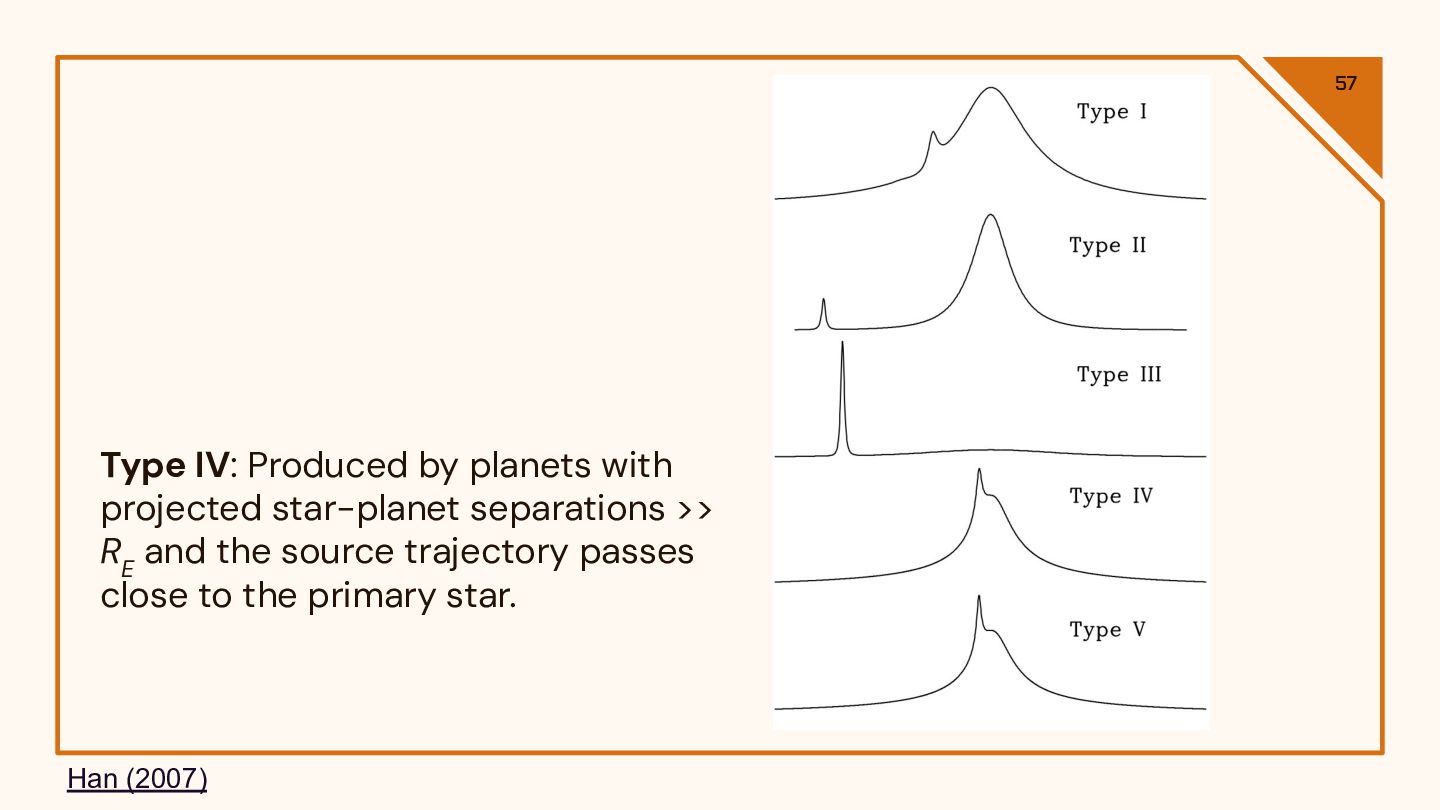
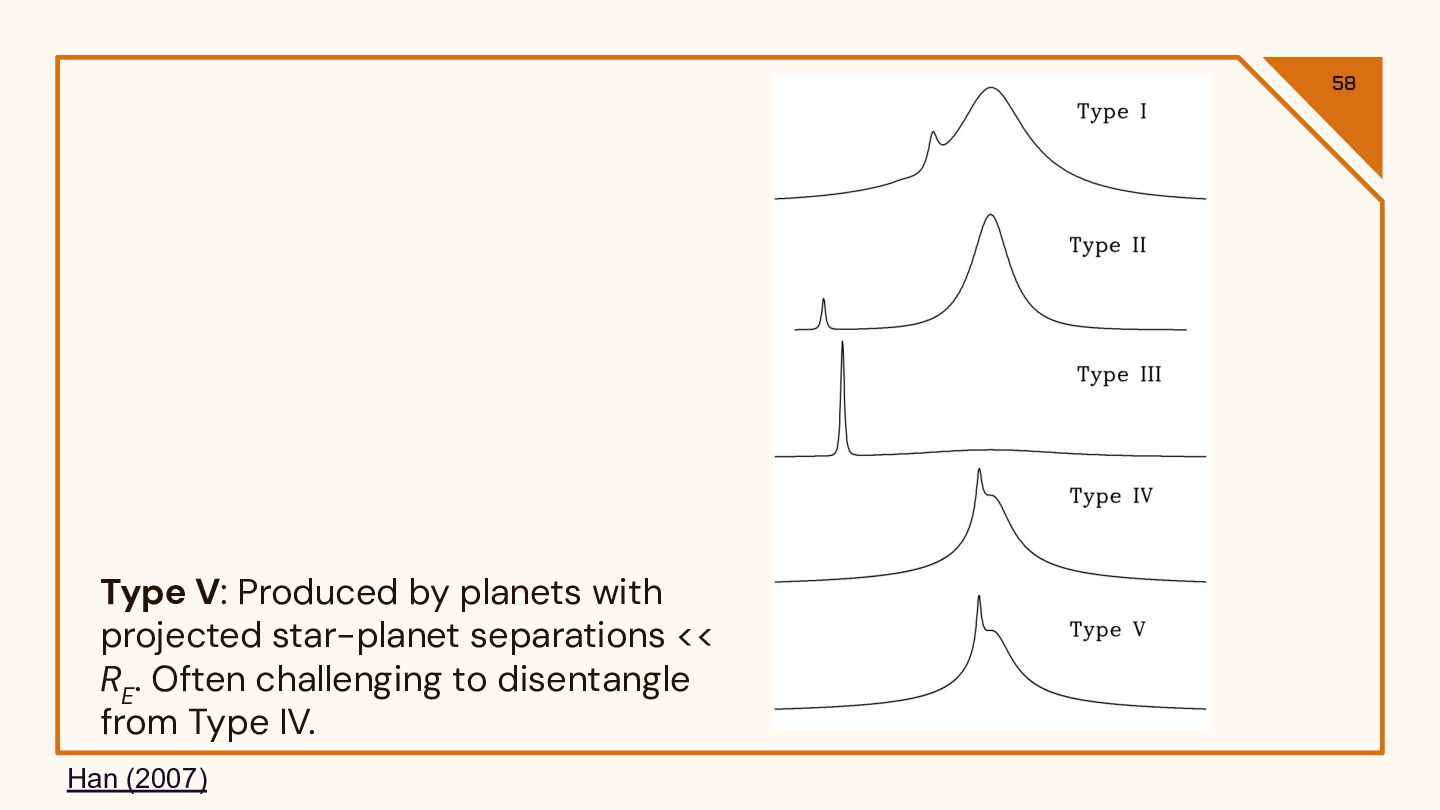
  39. 56 Han (2007) Type III: Produced by planets with projected

    star-planet separations >> R E and only occurs when the source trajectory passes only the magnification region of the planet.
  40. 57 Han (2007) Type IV: Produced by planets with projected

    star-planet separations >> R E and the source trajectory passes close to the primary star.
  41. 58 Han (2007) Type V: Produced by planets with projected

    star-planet separations << R E . Often challenging to disentangle from Type IV.
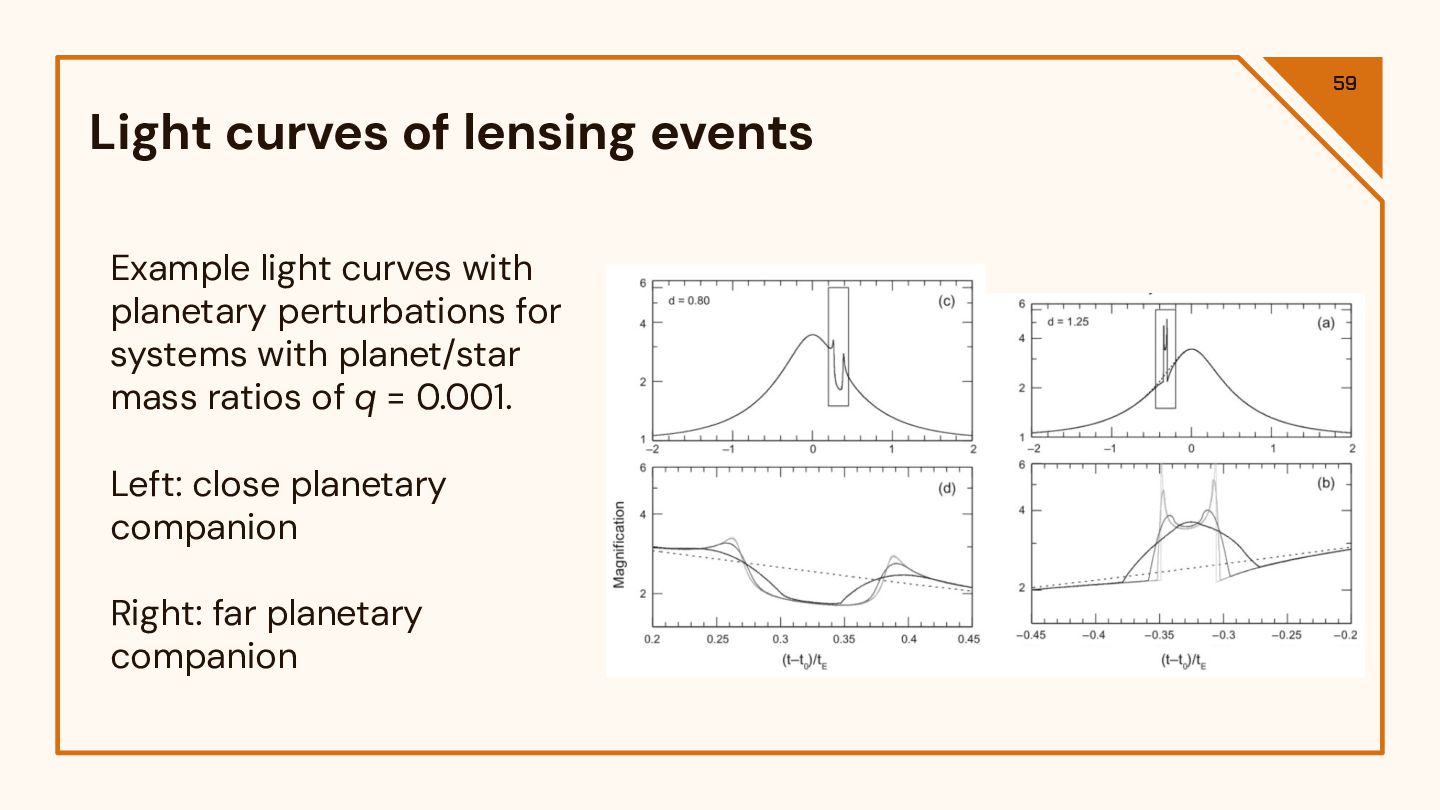
  42. Light curves of lensing events 59 Example light curves with

    planetary perturbations for systems with planet/star mass ratios of q = 0.001. Left: close planetary companion Right: far planetary companion
  43. What can we learn? 60 Planetary Perturbation: • Measure the

    maximum magnification, the maximum magnification of the event, and the duration • The duration is proportional to the planet-to-star mass ratio (q = M P /M S ) as t ∝ q1/2t E • The time and magnitude of the perturbation give the separation and position angle of the planet
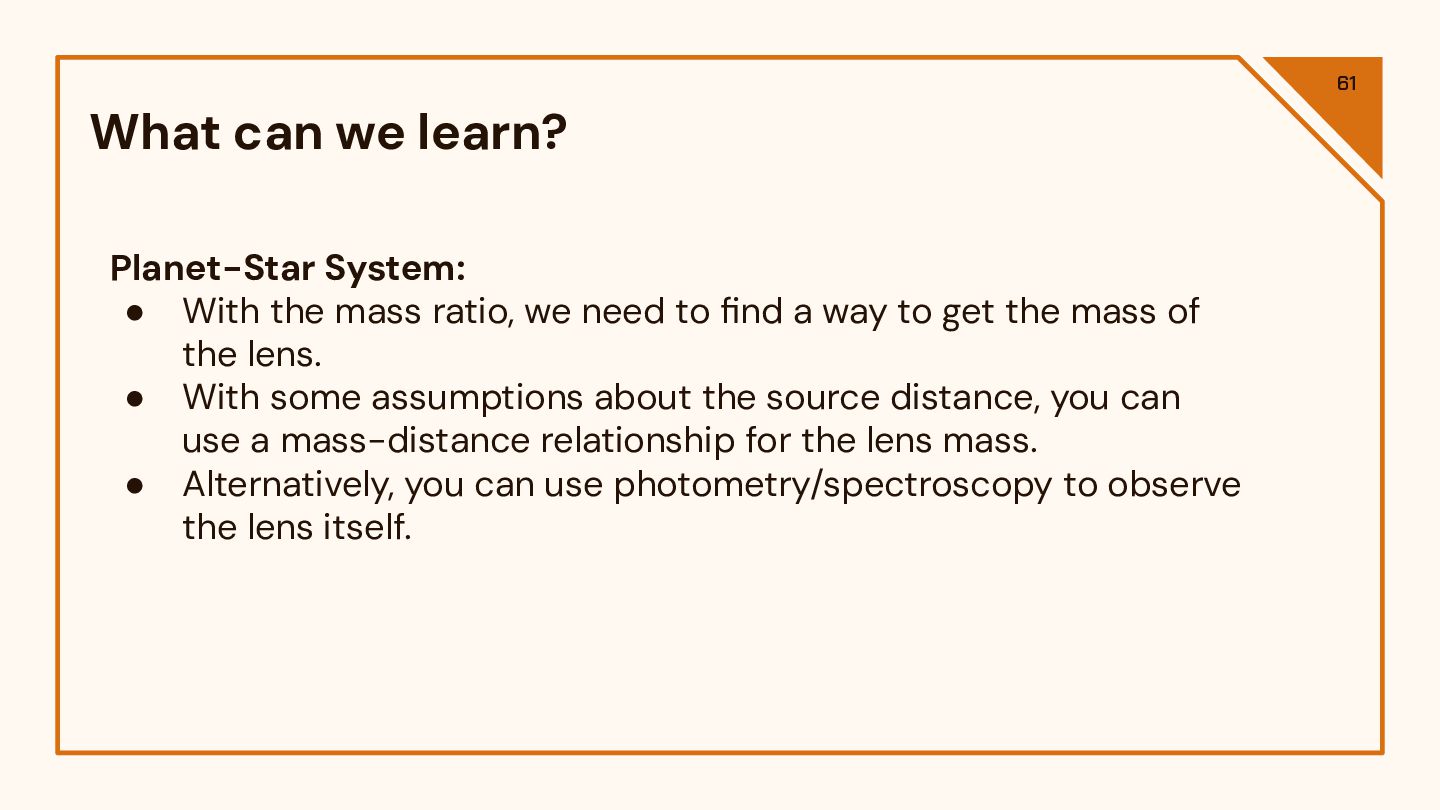
  44. What can we learn? 61 Planet-Star System: • With the

    mass ratio, we need to find a way to get the mass of the lens. • With some assumptions about the source distance, you can use a mass-distance relationship for the lens mass. • Alternatively, you can use photometry/spectroscopy to observe the lens itself.
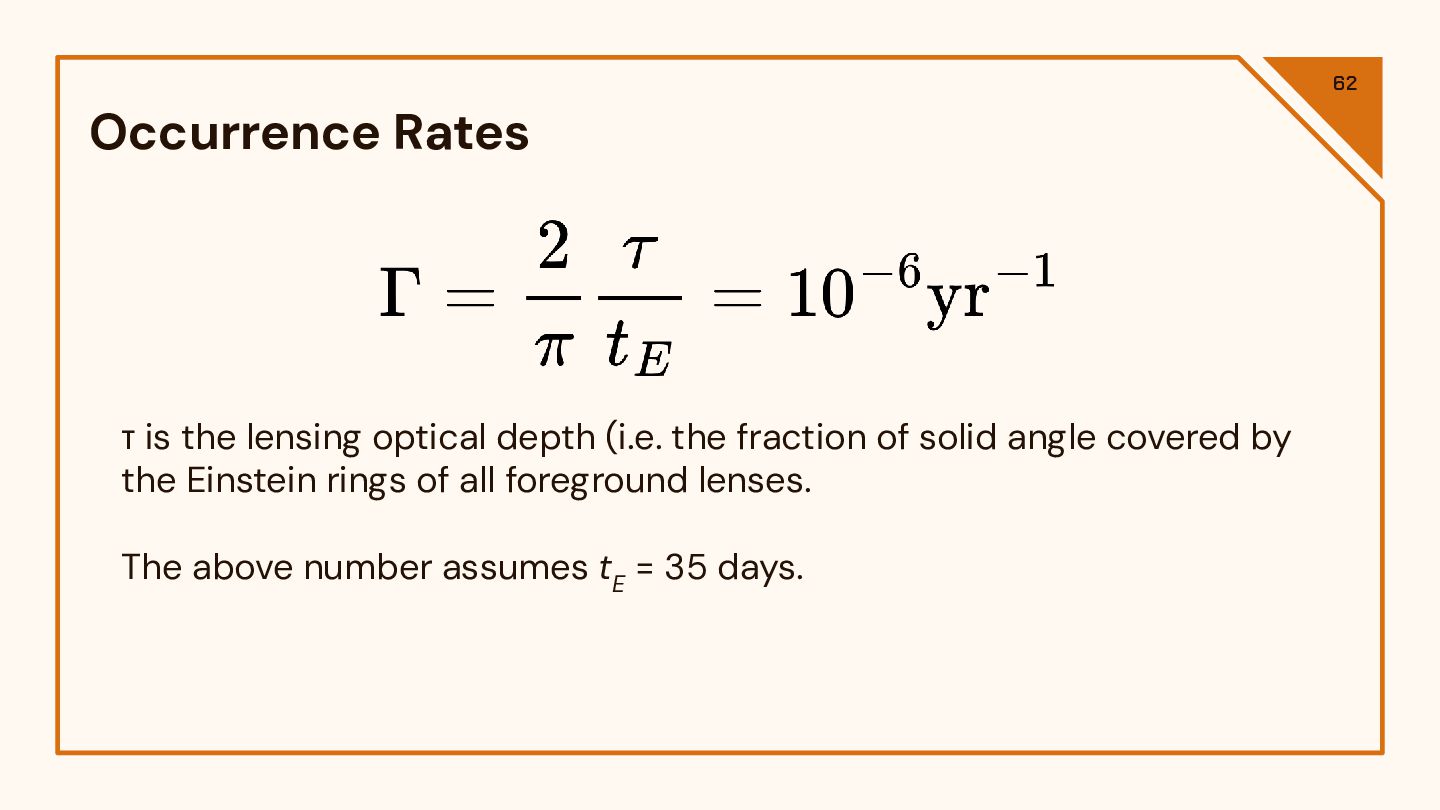
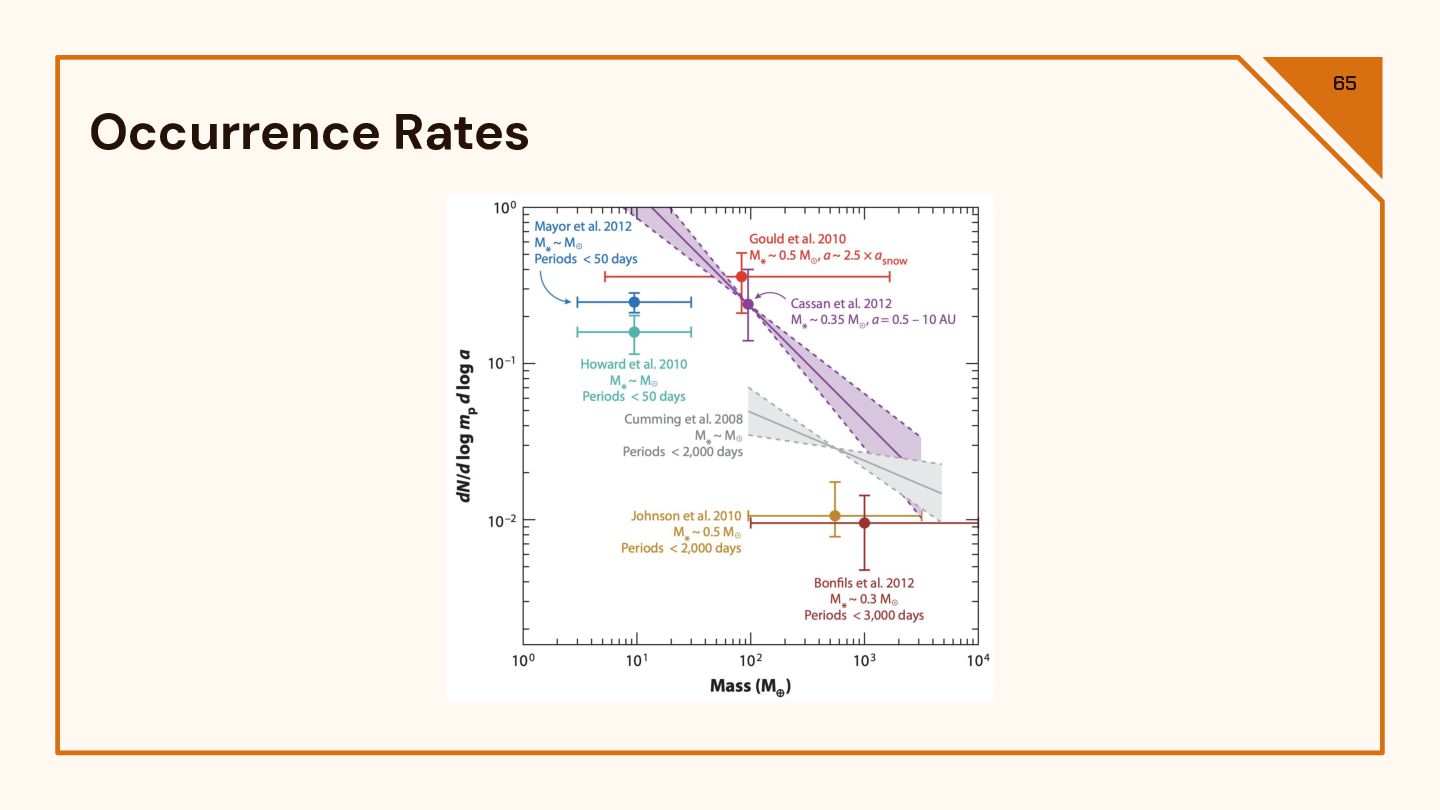
  45. Occurrence Rates 62 τ is the lensing optical depth (i.e.

    the fraction of solid angle covered by the Einstein rings of all foreground lenses. The above number assumes t E = 35 days.
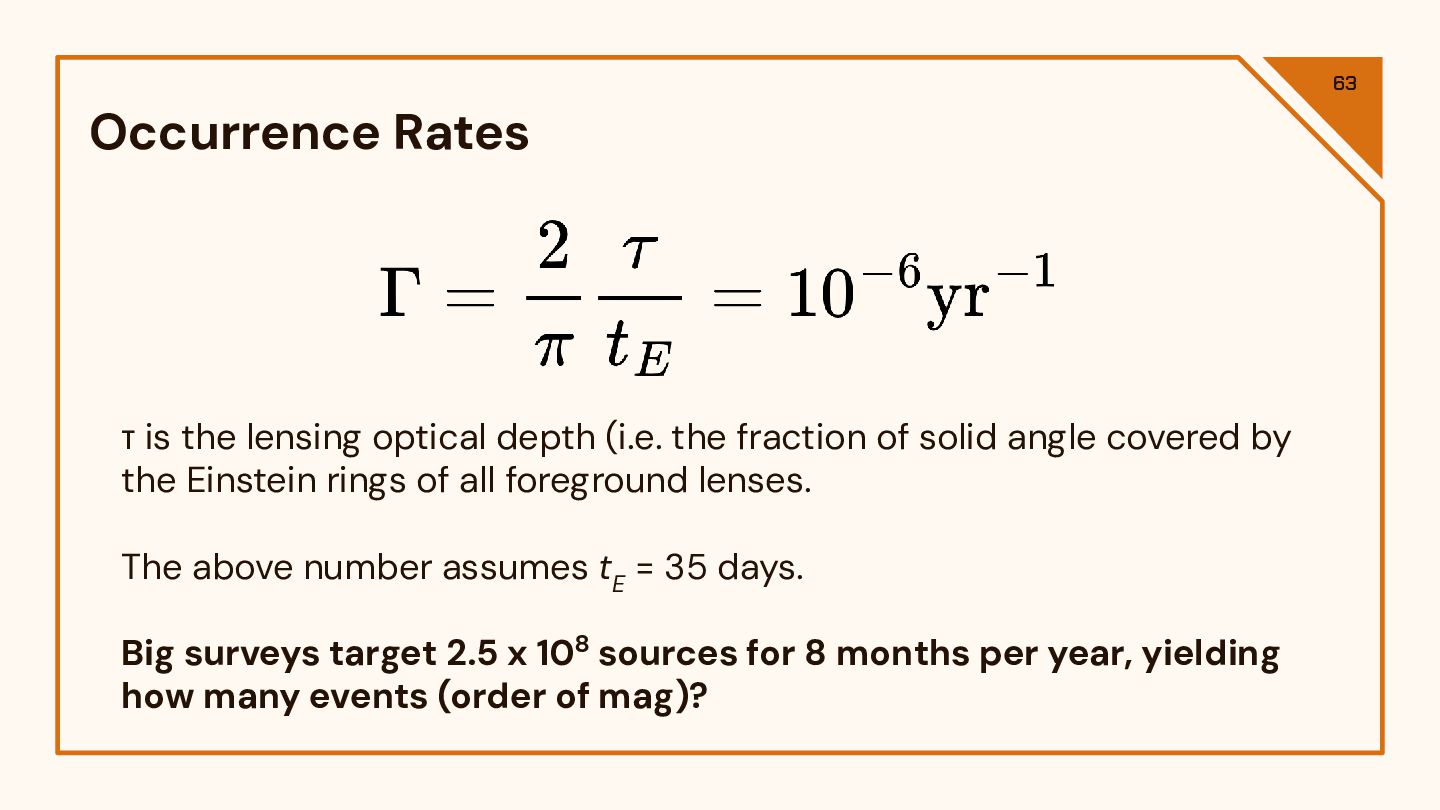
  46. Occurrence Rates 63 τ is the lensing optical depth (i.e.

    the fraction of solid angle covered by the Einstein rings of all foreground lenses. The above number assumes t E = 35 days. Big surveys target 2.5 x 10⁸ sources for 8 months per year, yielding how many events (order of mag)?
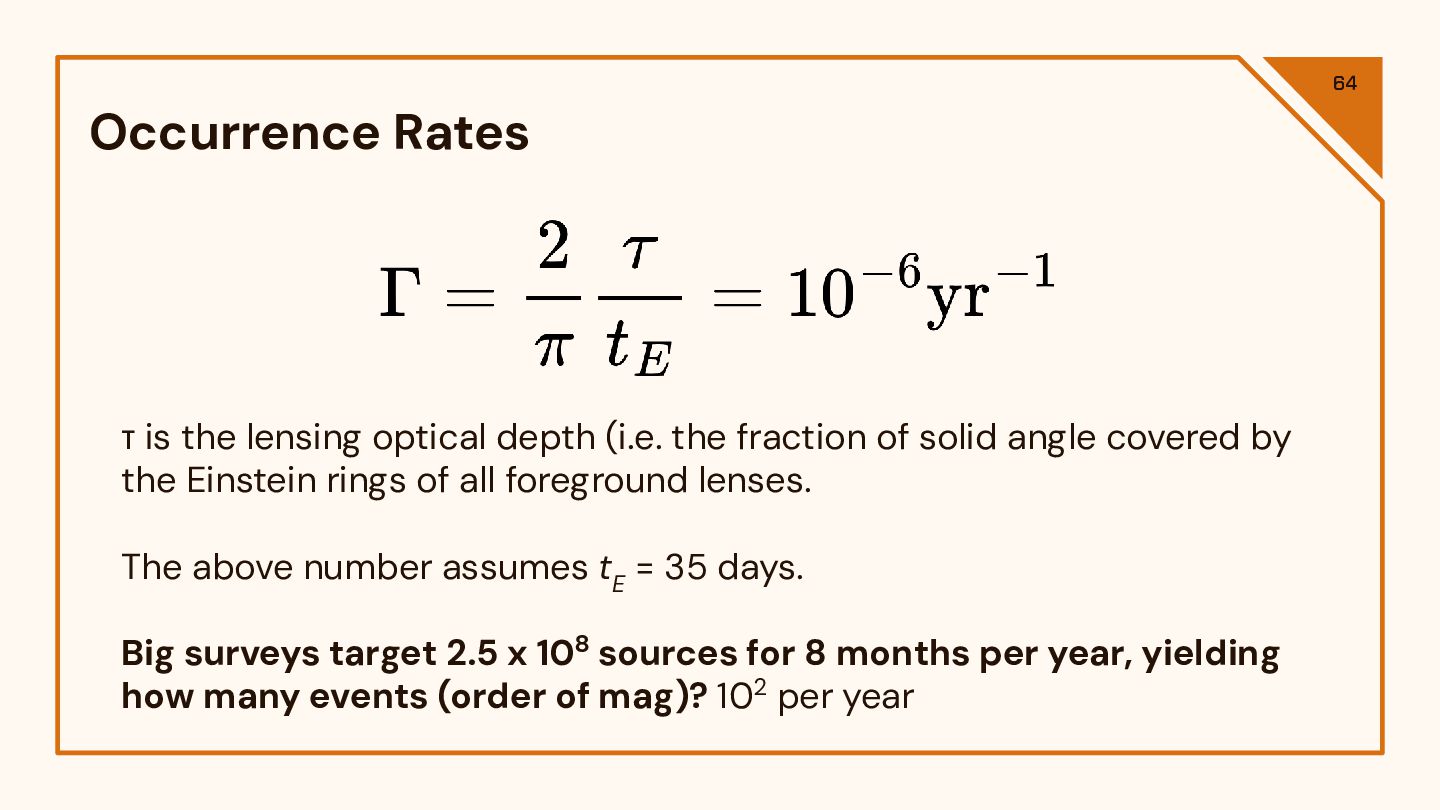
  47. Occurrence Rates 64 τ is the lensing optical depth (i.e.

    the fraction of solid angle covered by the Einstein rings of all foreground lenses. The above number assumes t E = 35 days. Big surveys target 2.5 x 10⁸ sources for 8 months per year, yielding how many events (order of mag)? 102 per year