Upgrade to Pro — share decks privately, control downloads, hide ads and more …

The Surveillance Architecture of the IPv8 draft

Avatar for dyb dyb
June 16, 2026

The Surveillance Architecture of the IPv8 draft

| Section | Slides | Content |
| --------------------------------------- | ------ | ----------------------------------------------------------------------------------------------------------------------------------------- |
| **Cover & TOC** | 1–2 | Title page and executive overview |
| **Ch.1: What IPv8 Gets Right** | 3–5 | IPv4 backward compatibility, address exhaustion solution, WHOIS8 validation, Cost Factor metric, management unification, transition model |
| **Ch.2: Critical Design Flaws** | 6–9 | 64-bit address space limitations, DNS8+WHOIS8 as censorship architecture, fail-closed design, the "no flag day" lie, RFC violations |
| **Ch.3: The Surveillance Architecture** | 10–13 | Mandatory hardware identity binding, Zone Server panopticon, NIC firmware control, RTOS incompatibility, safety-critical system risks |
| **Ch.4: Scale of Threat** | 14–16 | Surveillance toolkit comparison table (Nation→Household), no exit path to anonymity |
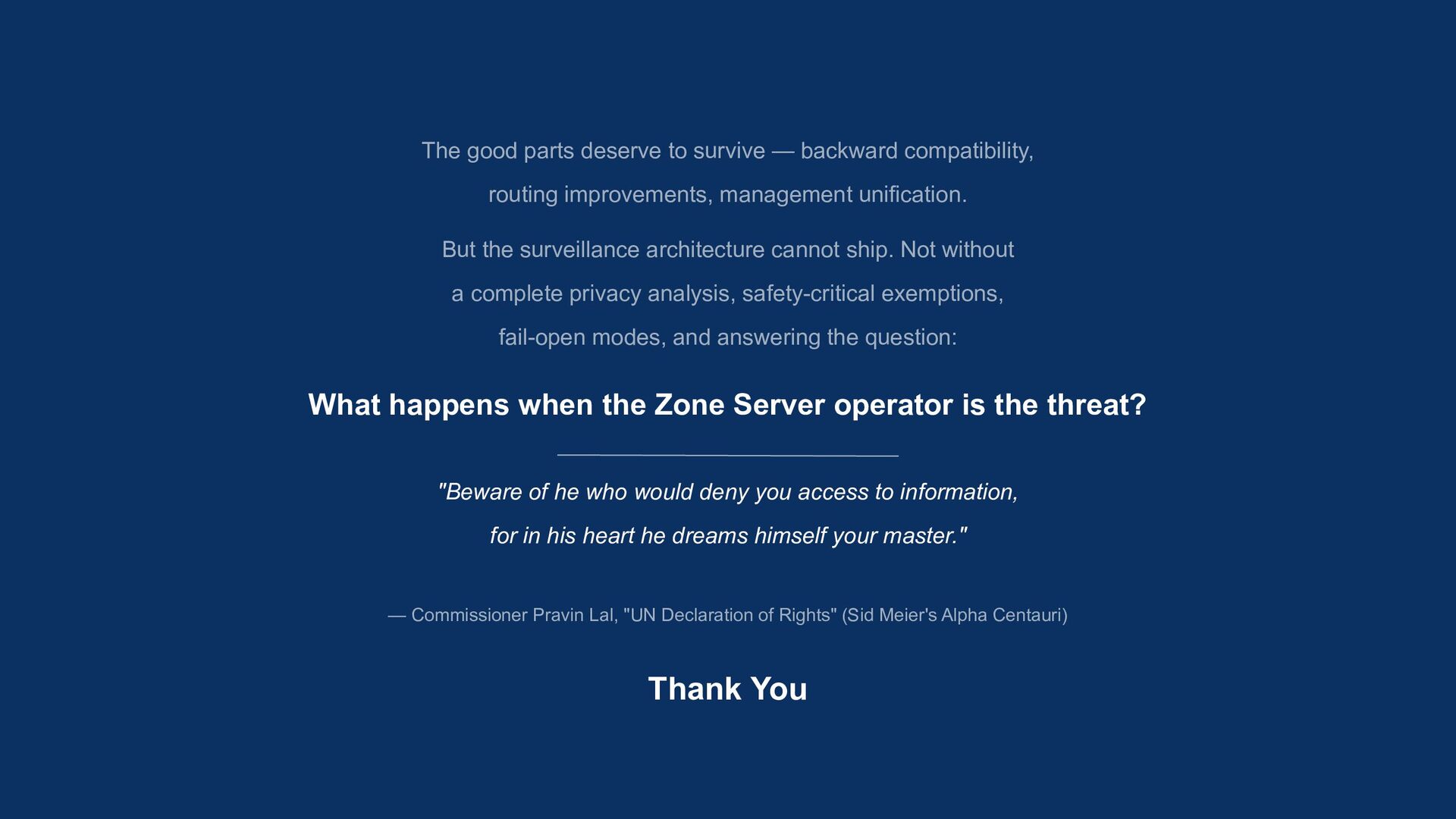
| **Closing** | 17 | Core question, Pravin Lal quote, call to action |

Avatar for dyb

dyb

June 16, 2026

More Decks by dyb

Other Decks in Research

Transcript

  1. We Need to Talk About the IPv8 Draft A Critical

    Analysis of the Most Surveillance-Friendly Internet Protocol Ever Proposed Technical Policy Analysis by Wolfi We Need to Talk About the IPv8 Draft - wolfy June 2026
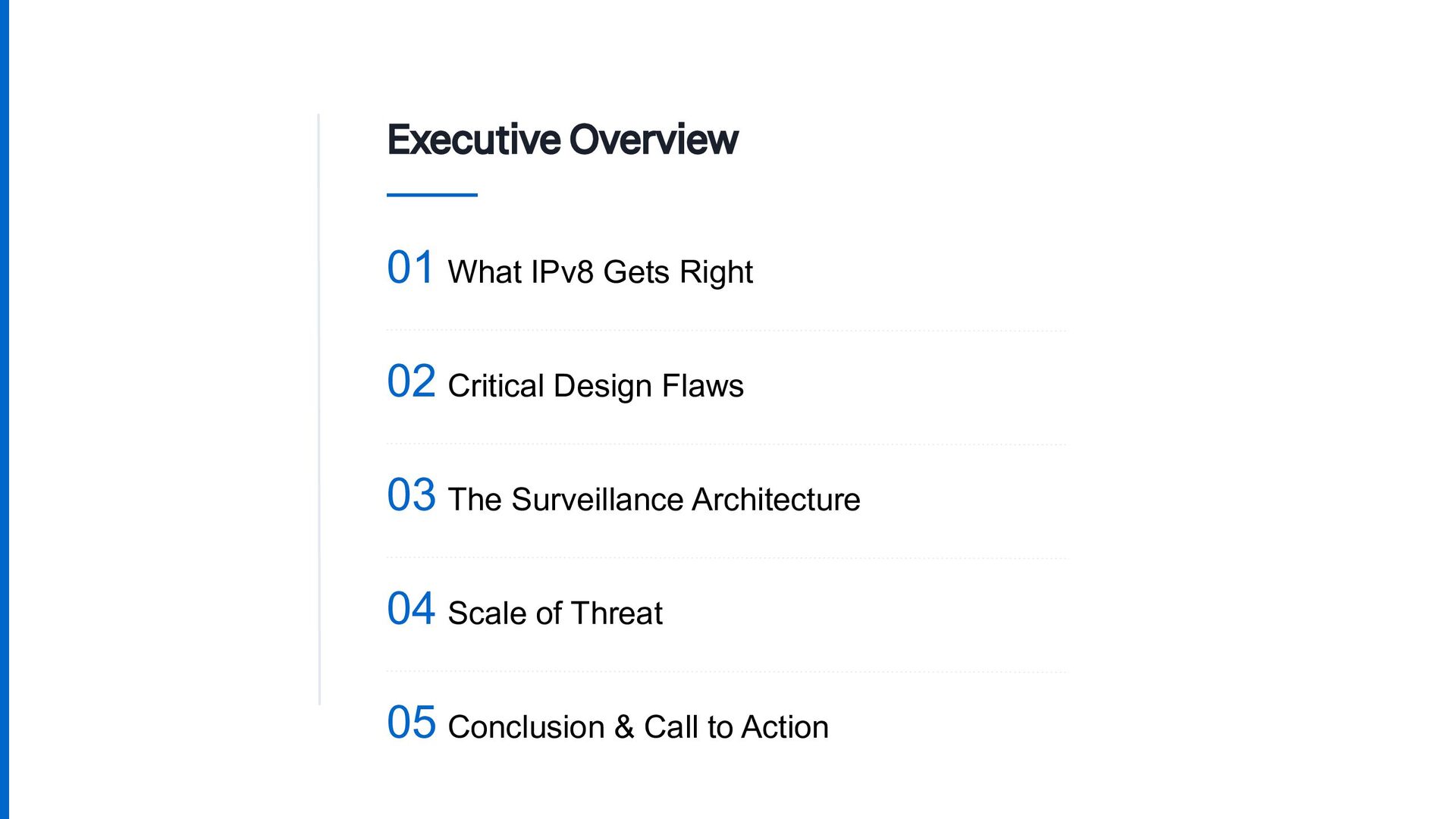
  2. Executive Overview 01 What IPv8 Gets Right 02 Critical Design

    Flaws 03 The Surveillance Architecture 04 Scale of Threat 05 Conclusion & Call to Action
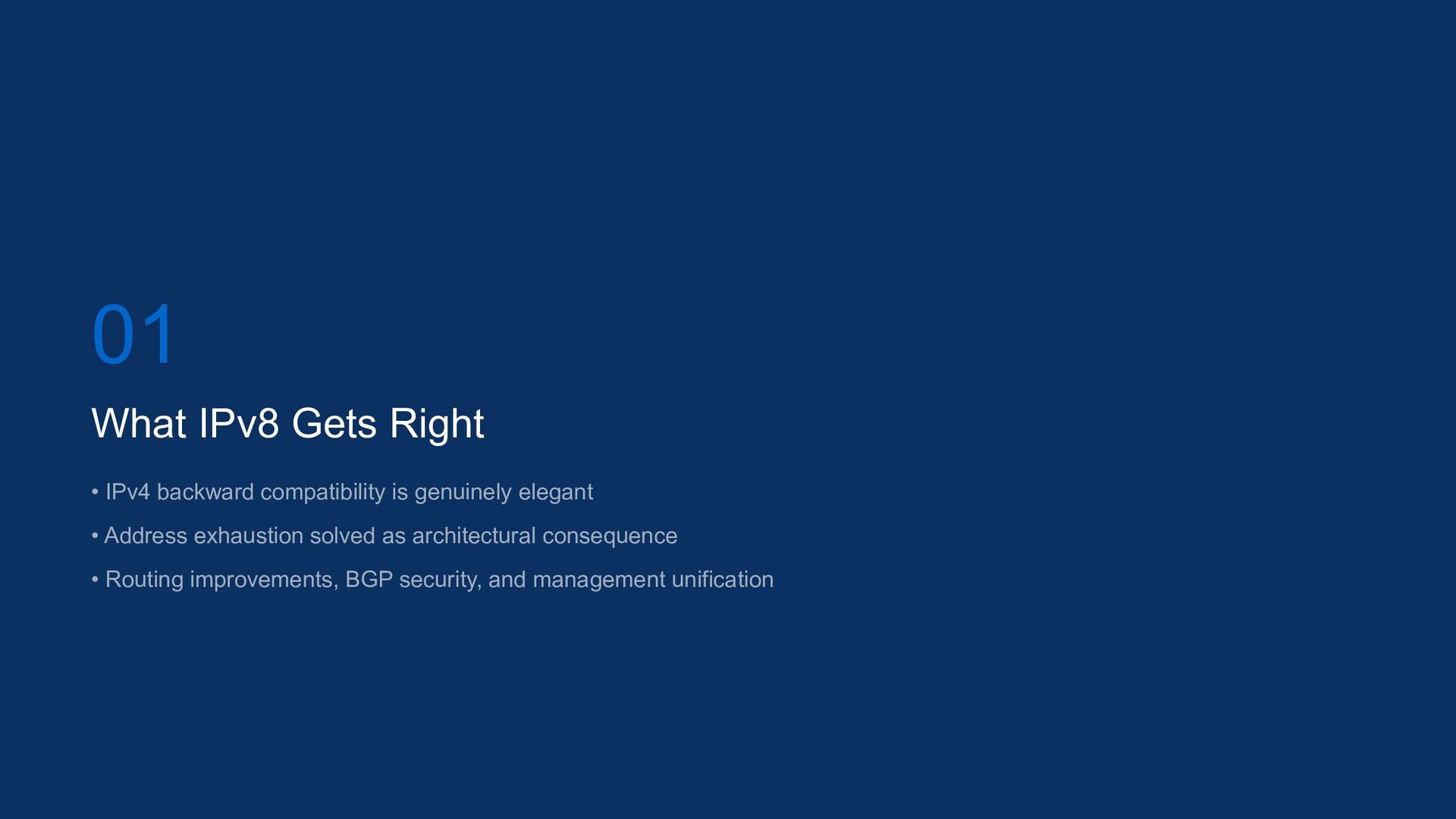
  3. 01 What IPv8 Gets Right • IPv4 backward compatibility is

    genuinely elegant • Address exhaustion solved as architectural consequence • Routing improvements, BGP security, and management unification
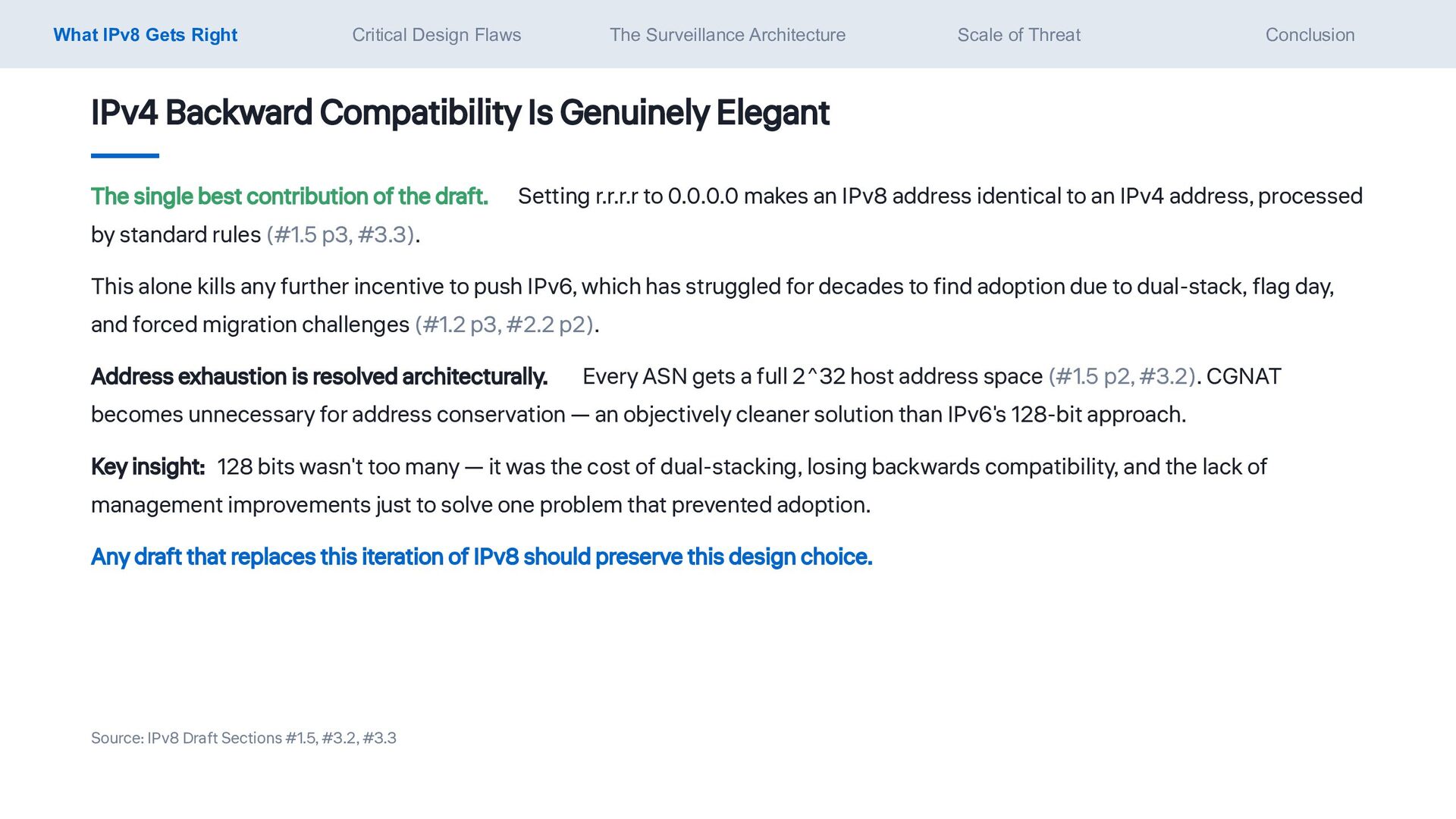
  4. What IPv8 Gets Right Critical Design Flaws The Surveillance Architecture

    Scale of Threat Conclusion IPv4 Backward Compatibility Is Genuinely Elegant The single best contribution of the draft. Setting r.r.r.r to 0.0.0.0 makes an IPv8 address identical to an IPv4 address, processed by standard rules (#1.5 p3, #3.3). This alone kills any further incentive to push IPv6, which has struggled for decades to find adoption due to dual-stack, flag day, and forced migration challenges (#1.2 p3, #2.2 p2). Address exhaustion is resolved architecturally. Every ASN gets a full 2^32 host address space (#1.5 p2, #3.2). CGNAT becomes unnecessary for address conservation — an objectively cleaner solution than IPv6's 128-bit approach. Key insight: 128 bits wasn't too many — it was the cost of dual-stacking, losing backwards compatibility, and the lack of management improvements just to solve one problem that prevented adoption. Any draft that replaces this iteration of IPv8 should preserve this design choice. Source: IPv8 Draft Sections #1.5, #3.2, #3.3
  5. What IPv8 Gets Right Critical Design Flaws The Surveillance Architecture

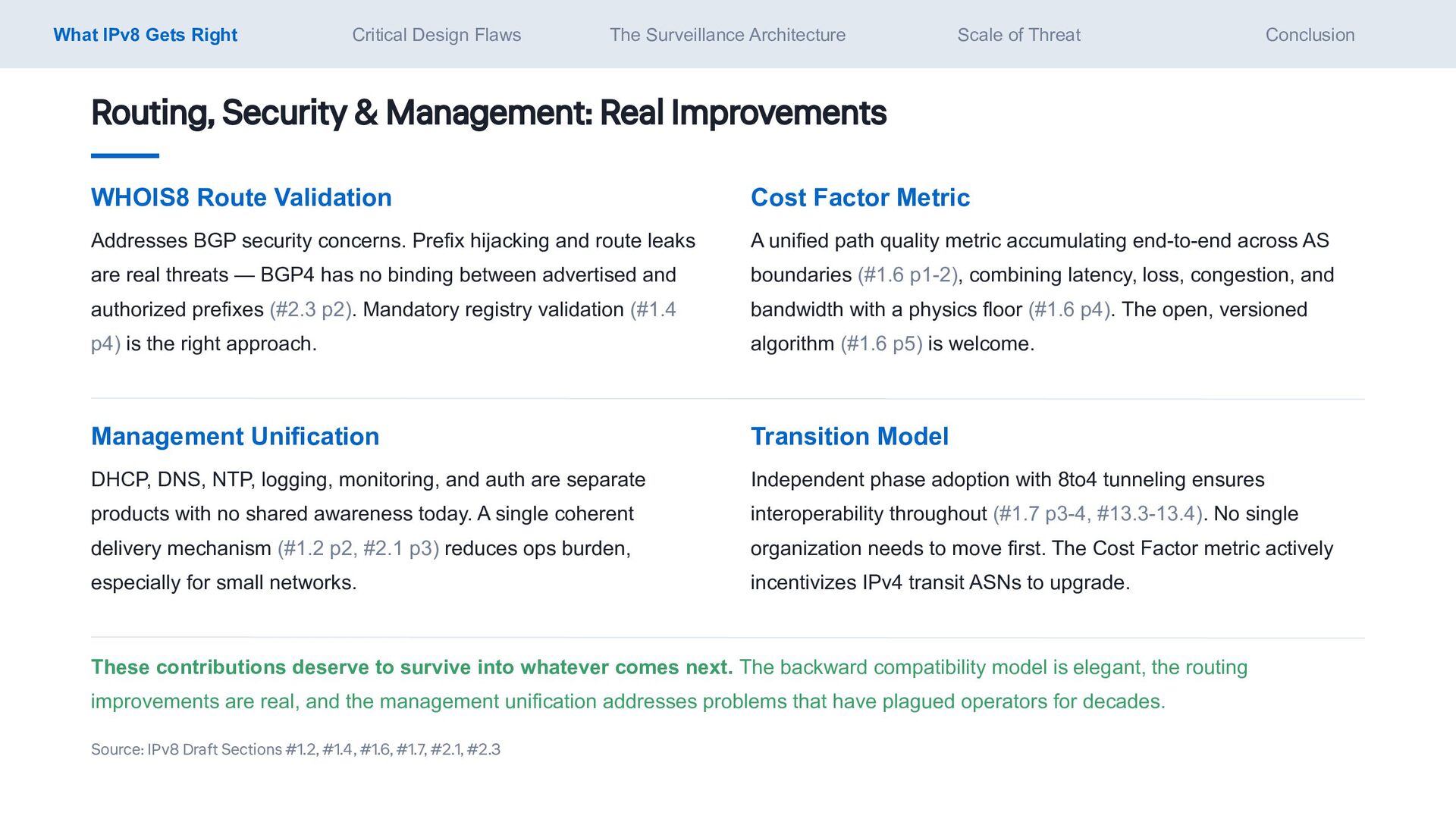
    Scale of Threat Conclusion Routing, Security & Management: Real Improvements WHOIS8 Route Validation Addresses BGP security concerns. Prefix hijacking and route leaks are real threats — BGP4 has no binding between advertised and authorized prefixes (#2.3 p2). Mandatory registry validation (#1.4 p4) is the right approach. Cost Factor Metric A unified path quality metric accumulating end-to-end across AS boundaries (#1.6 p1-2), combining latency, loss, congestion, and bandwidth with a physics floor (#1.6 p4). The open, versioned algorithm (#1.6 p5) is welcome. Management Unification DHCP, DNS, NTP, logging, monitoring, and auth are separate products with no shared awareness today. A single coherent delivery mechanism (#1.2 p2, #2.1 p3) reduces ops burden, especially for small networks. Transition Model Independent phase adoption with 8to4 tunneling ensures interoperability throughout (#1.7 p3-4, #13.3-13.4). No single organization needs to move first. The Cost Factor metric actively incentivizes IPv4 transit ASNs to upgrade. These contributions deserve to survive into whatever comes next. The backward compatibility model is elegant, the routing improvements are real, and the management unification addresses problems that have plagued operators for decades. Source: IPv8 Draft Sections #1.2, #1.4, #1.6, #1.7, #2.1, #2.3
  6. 02 Critical Design Flaws • 64-bit address space may exhaust

    within 15 years • DNS8 + WHOIS8 creates a censorship architecture at every scale • Fail-closed design and the "no flag day" management layer lie
  7. What IPv8 Gets Right Critical Design Flaws The Surveillance Architecture

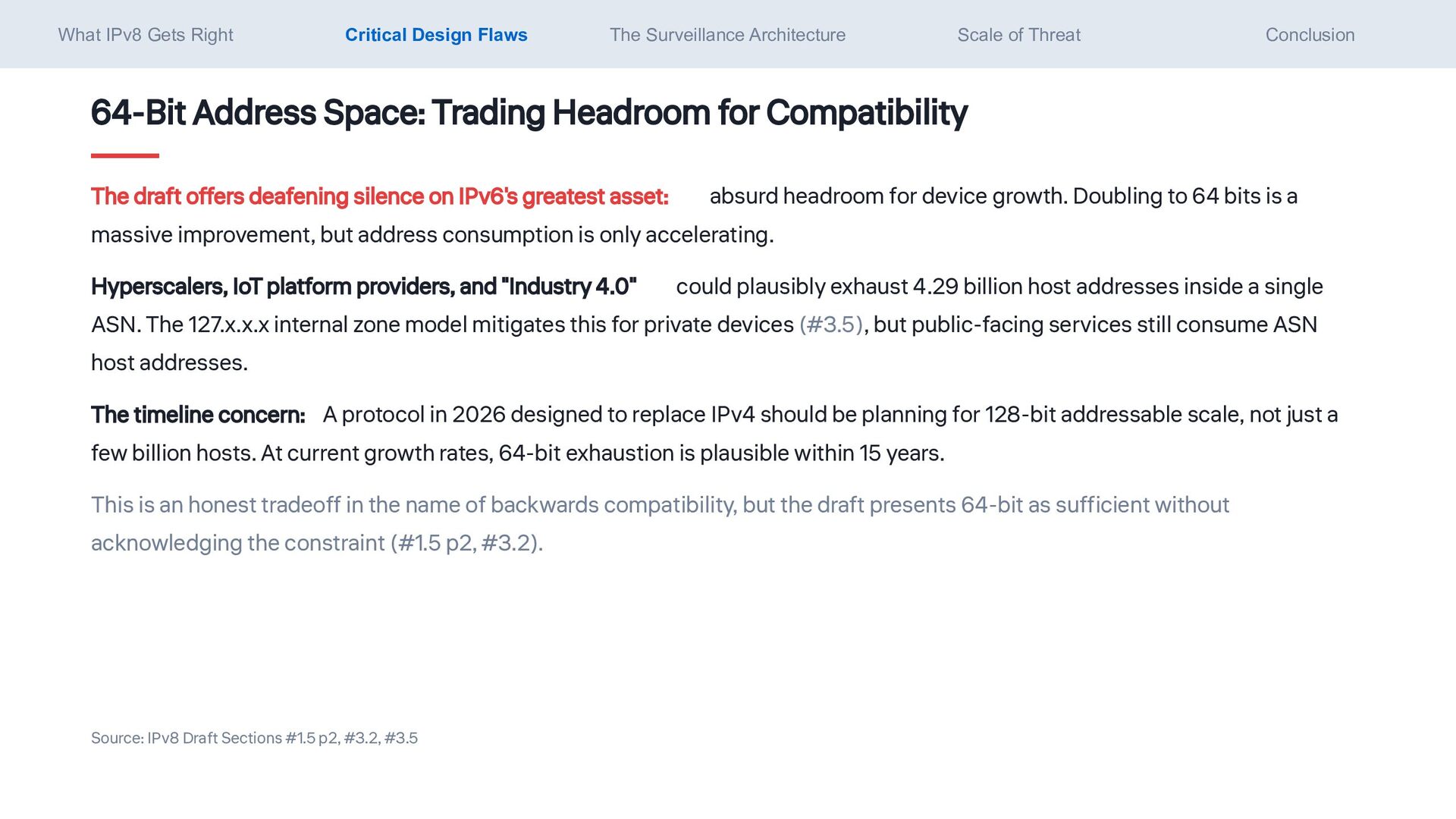
    Scale of Threat Conclusion 64-Bit Address Space: Trading Headroom for Compatibility The draft offers deafening silence on IPv6's greatest asset: absurd headroom for device growth. Doubling to 64 bits is a massive improvement, but address consumption is only accelerating. Hyperscalers, IoT platform providers, and "Industry 4.0" could plausibly exhaust 4.29 billion host addresses inside a single ASN. The 127.x.x.x internal zone model mitigates this for private devices (#3.5), but public-facing services still consume ASN host addresses. The timeline concern: A protocol in 2026 designed to replace IPv4 should be planning for 128-bit addressable scale, not just a few billion hosts. At current growth rates, 64-bit exhaustion is plausible within 15 years. This is an honest tradeoff in the name of backwards compatibility, but the draft presents 64-bit as sufficient without acknowledging the constraint (#1.5 p2, #3.2). Source: IPv8 Draft Sections #1.5 p2, #3.2, #3.5
  8. What IPv8 Gets Right Critical Design Flaws The Surveillance Architecture

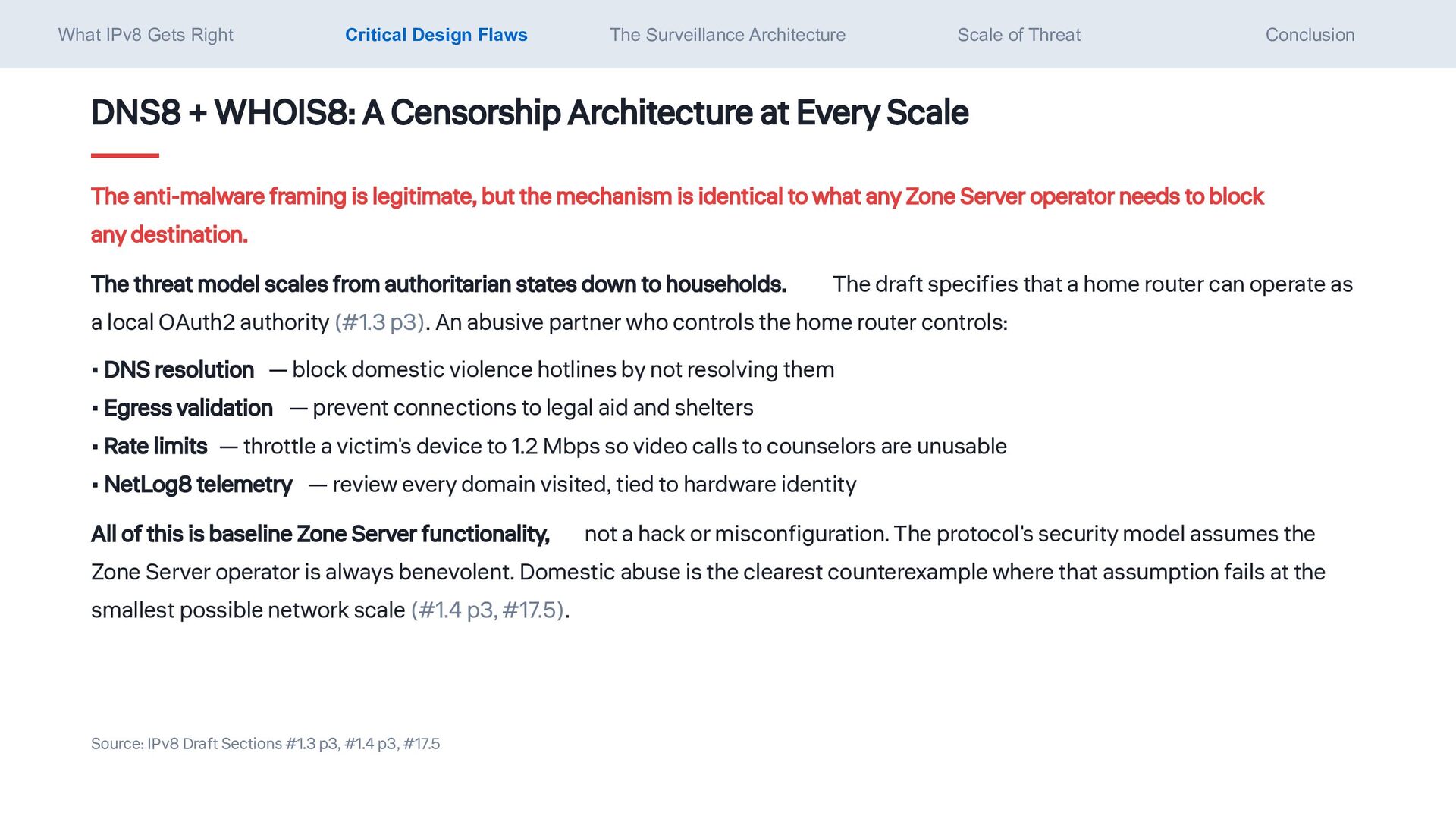
    Scale of Threat Conclusion DNS8 + WHOIS8: A Censorship Architecture at Every Scale The anti-malware framing is legitimate, but the mechanism is identical to what any Zone Server operator needs to block any destination. The threat model scales from authoritarian states down to households. The draft specifies that a home router can operate as a local OAuth2 authority (#1.3 p3). An abusive partner who controls the home router controls: • DNS resolution — block domestic violence hotlines by not resolving them • Egress validation — prevent connections to legal aid and shelters • Rate limits — throttle a victim's device to 1.2 Mbps so video calls to counselors are unusable • NetLog8 telemetry — review every domain visited, tied to hardware identity All of this is baseline Zone Server functionality, not a hack or misconfiguration. The protocol's security model assumes the Zone Server operator is always benevolent. Domestic abuse is the clearest counterexample where that assumption fails at the smallest possible network scale (#1.4 p3, #17.5). Source: IPv8 Draft Sections #1.3 p3, #1.4 p3, #17.5
  9. What IPv8 Gets Right Critical Design Flaws The Surveillance Architecture

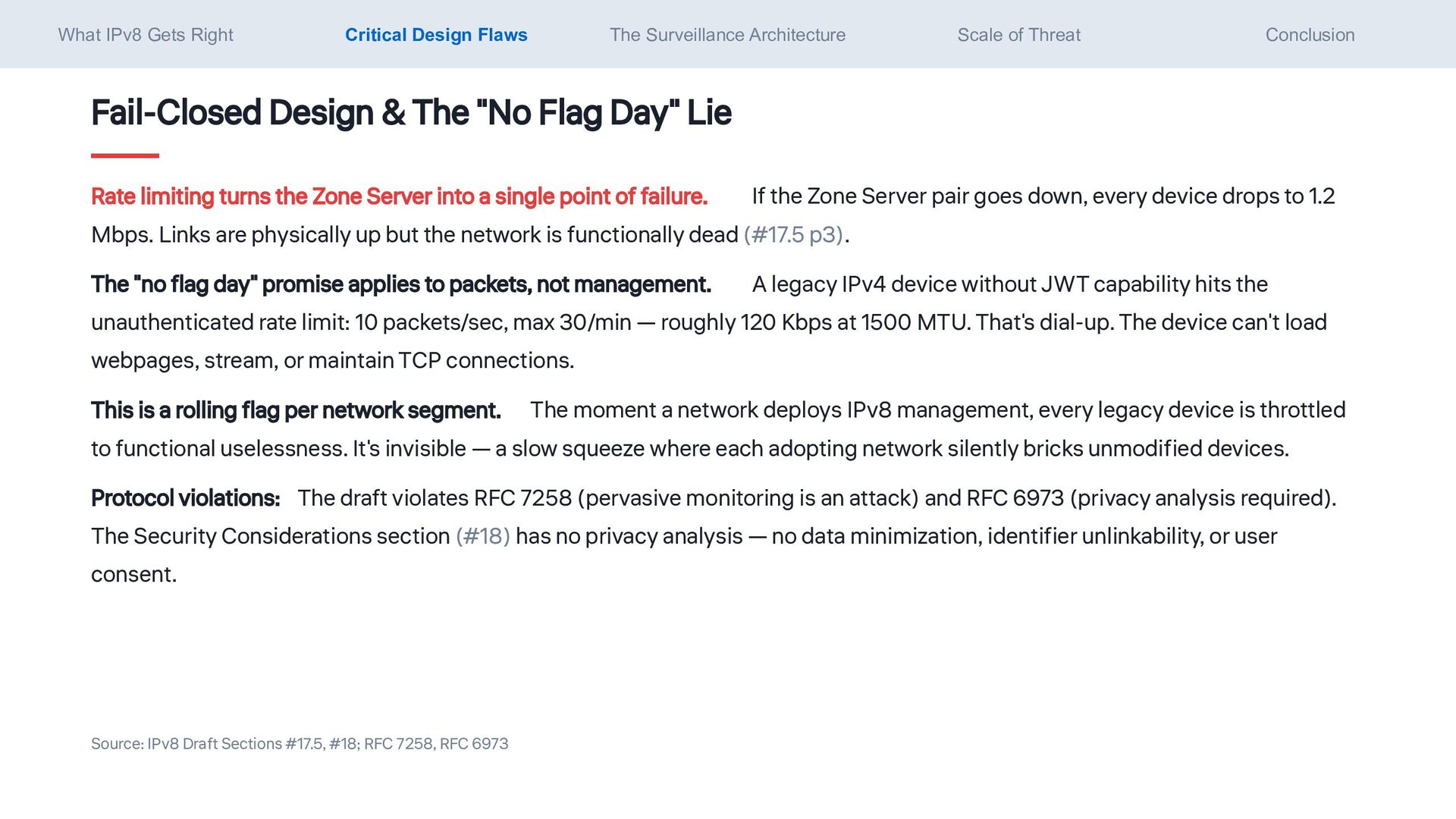
    Scale of Threat Conclusion Fail-Closed Design & The "No Flag Day" Lie Rate limiting turns the Zone Server into a single point of failure. If the Zone Server pair goes down, every device drops to 1.2 Mbps. Links are physically up but the network is functionally dead (#17.5 p3). The "no flag day" promise applies to packets, not management. A legacy IPv4 device without JWT capability hits the unauthenticated rate limit: 10 packets/sec, max 30/min — roughly 120 Kbps at 1500 MTU. That's dial-up. The device can't load webpages, stream, or maintain TCP connections. This is a rolling flag per network segment. The moment a network deploys IPv8 management, every legacy device is throttled to functional uselessness. It's invisible — a slow squeeze where each adopting network silently bricks unmodified devices. Protocol violations: The draft violates RFC 7258 (pervasive monitoring is an attack) and RFC 6973 (privacy analysis required). The Security Considerations section (#18) has no privacy analysis — no data minimization, identifier unlinkability, or user consent. Source: IPv8 Draft Sections #17.5, #18; RFC 7258, RFC 6973
  10. 03 The Surveillance Architecture • Mandatory hardware identity binding eliminates

    anonymity by default • The Zone Server becomes a single-point panopticon • Incompatible with real-time safety-critical systems
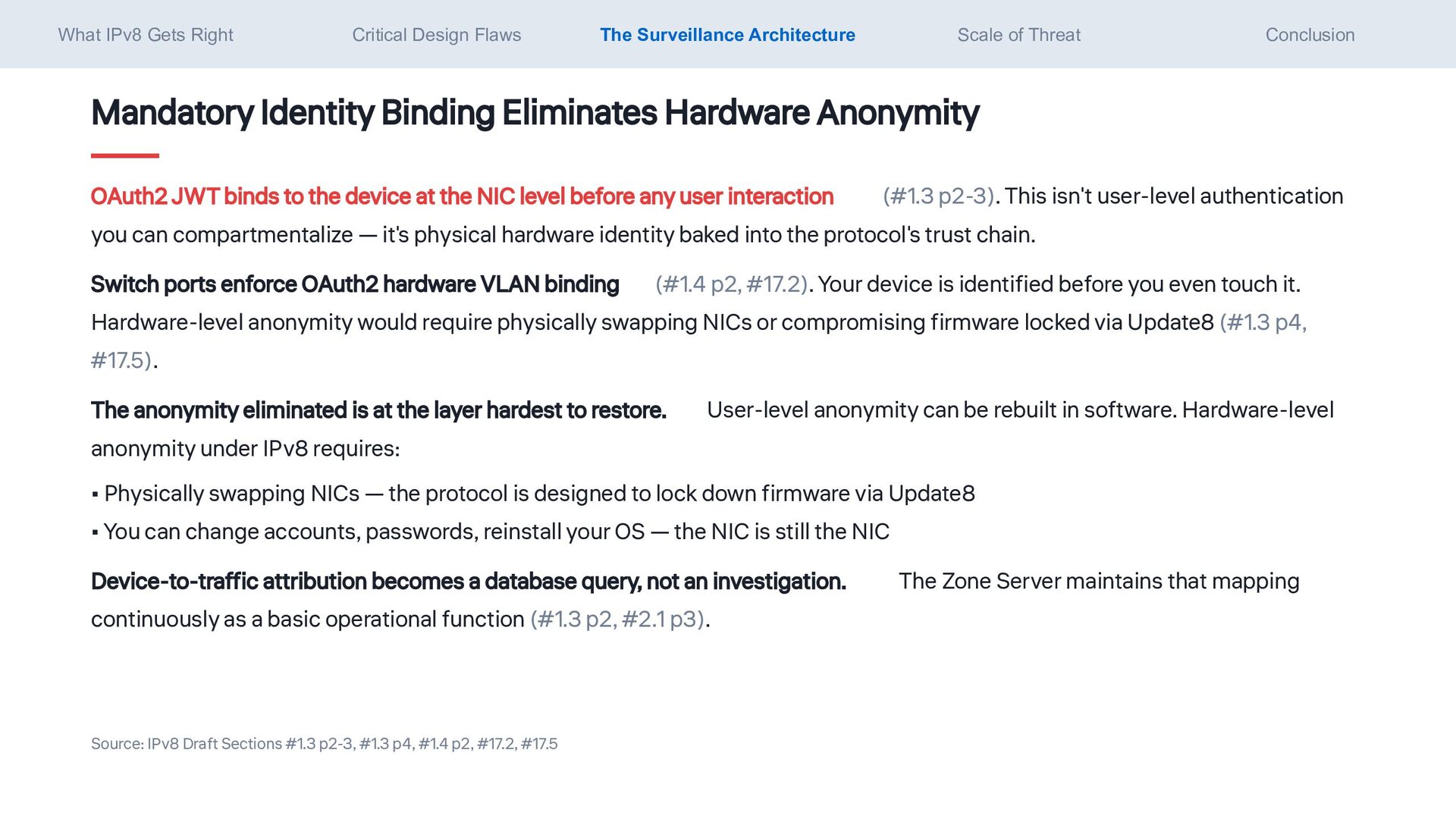
  11. What IPv8 Gets Right Critical Design Flaws The Surveillance Architecture

    Scale of Threat Conclusion Mandatory Identity Binding Eliminates Hardware Anonymity OAuth2 JWT binds to the device at the NIC level before any user interaction (#1.3 p2-3). This isn't user-level authentication you can compartmentalize — it's physical hardware identity baked into the protocol's trust chain. Switch ports enforce OAuth2 hardware VLAN binding (#1.4 p2, #17.2). Your device is identified before you even touch it. Hardware-level anonymity would require physically swapping NICs or compromising firmware locked via Update8 (#1.3 p4, #17.5). The anonymity eliminated is at the layer hardest to restore. User-level anonymity can be rebuilt in software. Hardware-level anonymity under IPv8 requires: • Physically swapping NICs — the protocol is designed to lock down firmware via Update8 • You can change accounts, passwords, reinstall your OS — the NIC is still the NIC Device-to-traffic attribution becomes a database query, not an investigation. The Zone Server maintains that mapping continuously as a basic operational function (#1.3 p2, #2.1 p3). Source: IPv8 Draft Sections #1.3 p2-3, #1.3 p4, #1.4 p2, #17.2, #17.5
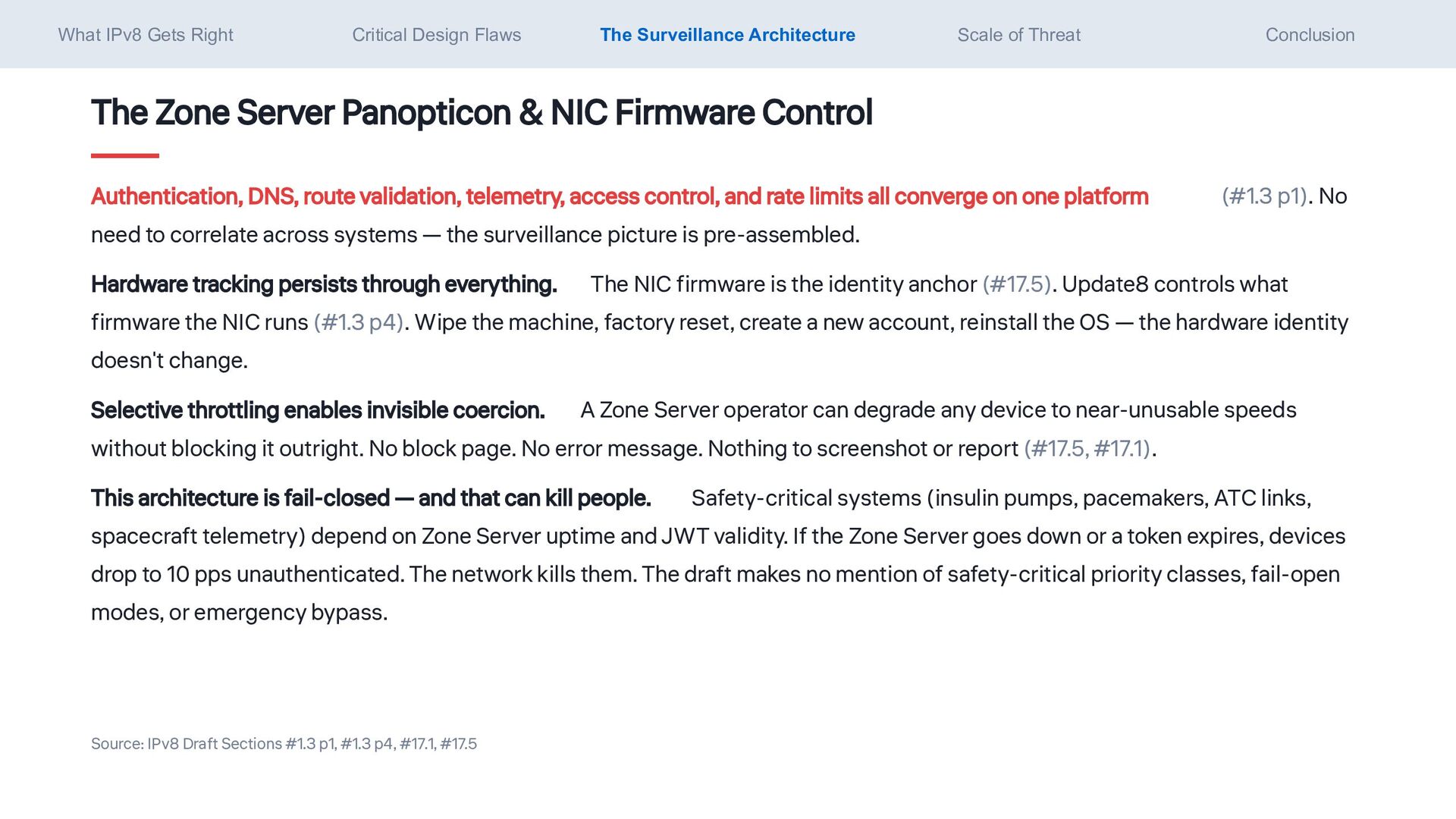
  12. What IPv8 Gets Right Critical Design Flaws The Surveillance Architecture

    Scale of Threat Conclusion The Zone Server Panopticon & NIC Firmware Control Authentication, DNS, route validation, telemetry, access control, and rate limits all converge on one platform (#1.3 p1). No need to correlate across systems — the surveillance picture is pre-assembled. Hardware tracking persists through everything. The NIC firmware is the identity anchor (#17.5). Update8 controls what firmware the NIC runs (#1.3 p4). Wipe the machine, factory reset, create a new account, reinstall the OS — the hardware identity doesn't change. Selective throttling enables invisible coercion. A Zone Server operator can degrade any device to near-unusable speeds without blocking it outright. No block page. No error message. Nothing to screenshot or report (#17.5, #17.1). This architecture is fail-closed — and that can kill people. Safety-critical systems (insulin pumps, pacemakers, ATC links, spacecraft telemetry) depend on Zone Server uptime and JWT validity. If the Zone Server goes down or a token expires, devices drop to 10 pps unauthenticated. The network kills them. The draft makes no mention of safety-critical priority classes, fail-open modes, or emergency bypass. Source: IPv8 Draft Sections #1.3 p1, #1.3 p4, #17.1, #17.5
  13. What IPv8 Gets Right Critical Design Flaws The Surveillance Architecture

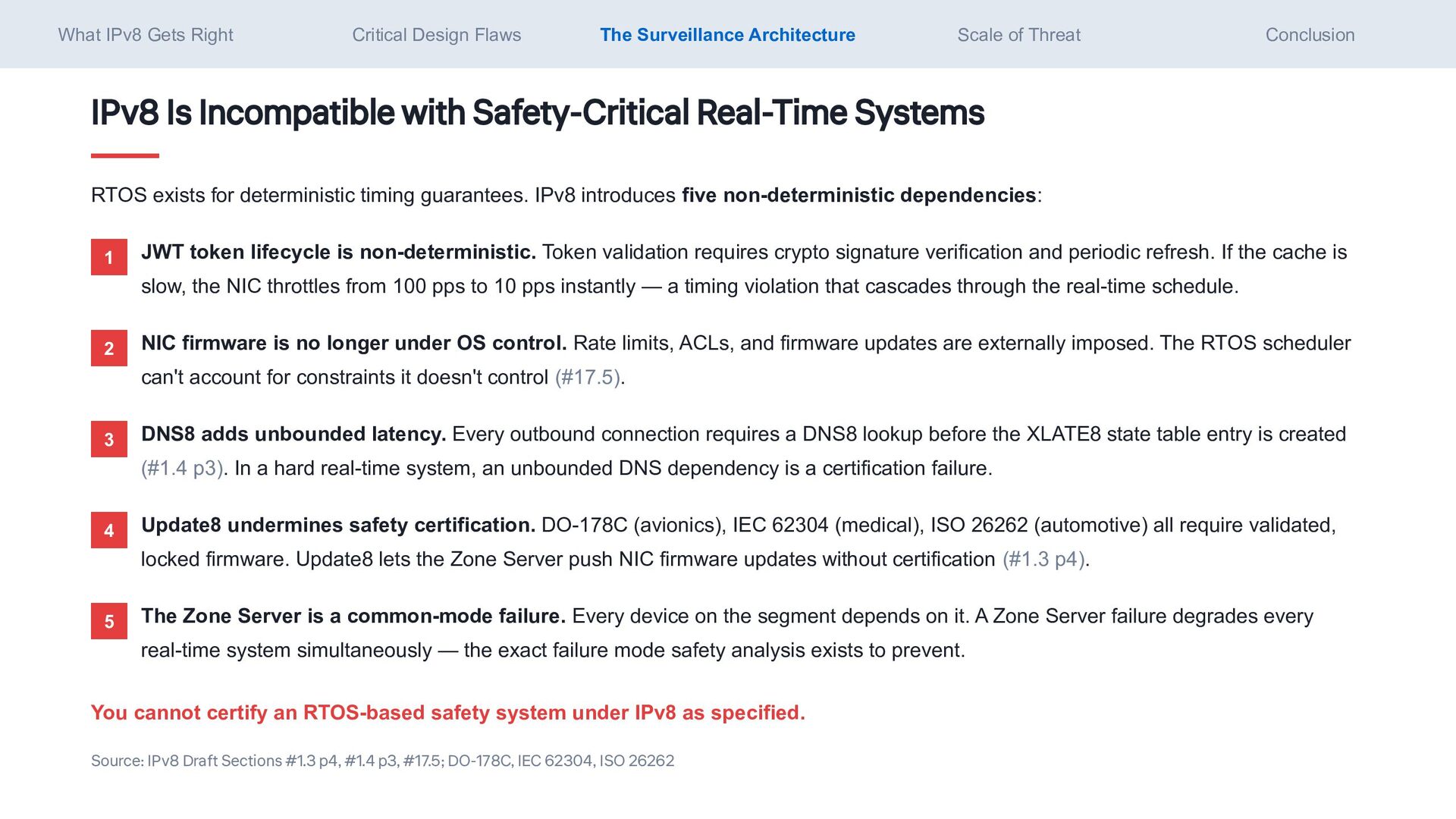
    Scale of Threat Conclusion IPv8 Is Incompatible with Safety-Critical Real-Time Systems RTOS exists for deterministic timing guarantees. IPv8 introduces five non-deterministic dependencies: 1 JWT token lifecycle is non-deterministic. Token validation requires crypto signature verification and periodic refresh. If the cache is slow, the NIC throttles from 100 pps to 10 pps instantly — a timing violation that cascades through the real-time schedule. 2 NIC firmware is no longer under OS control. Rate limits, ACLs, and firmware updates are externally imposed. The RTOS scheduler can't account for constraints it doesn't control (#17.5). 3 DNS8 adds unbounded latency. Every outbound connection requires a DNS8 lookup before the XLATE8 state table entry is created (#1.4 p3). In a hard real-time system, an unbounded DNS dependency is a certification failure. 4 Update8 undermines safety certification. DO-178C (avionics), IEC 62304 (medical), ISO 26262 (automotive) all require validated, locked firmware. Update8 lets the Zone Server push NIC firmware updates without certification (#1.3 p4). 5 The Zone Server is a common-mode failure. Every device on the segment depends on it. A Zone Server failure degrades every real-time system simultaneously — the exact failure mode safety analysis exists to prevent. You cannot certify an RTOS-based safety system under IPv8 as specified. Source: IPv8 Draft Sections #1.3 p4, #1.4 p3, #17.5; DO-178C, IEC 62304, ISO 26262
  14. 04 Scale of Threat • Every Zone Server operator gets

    the same surveillance toolkit • From national ISPs to home routers — identical capabilities • There is no path to anonymity under IPv8 as specified
  15. What IPv8 Gets Right Critical Design Flaws The Surveillance Architecture

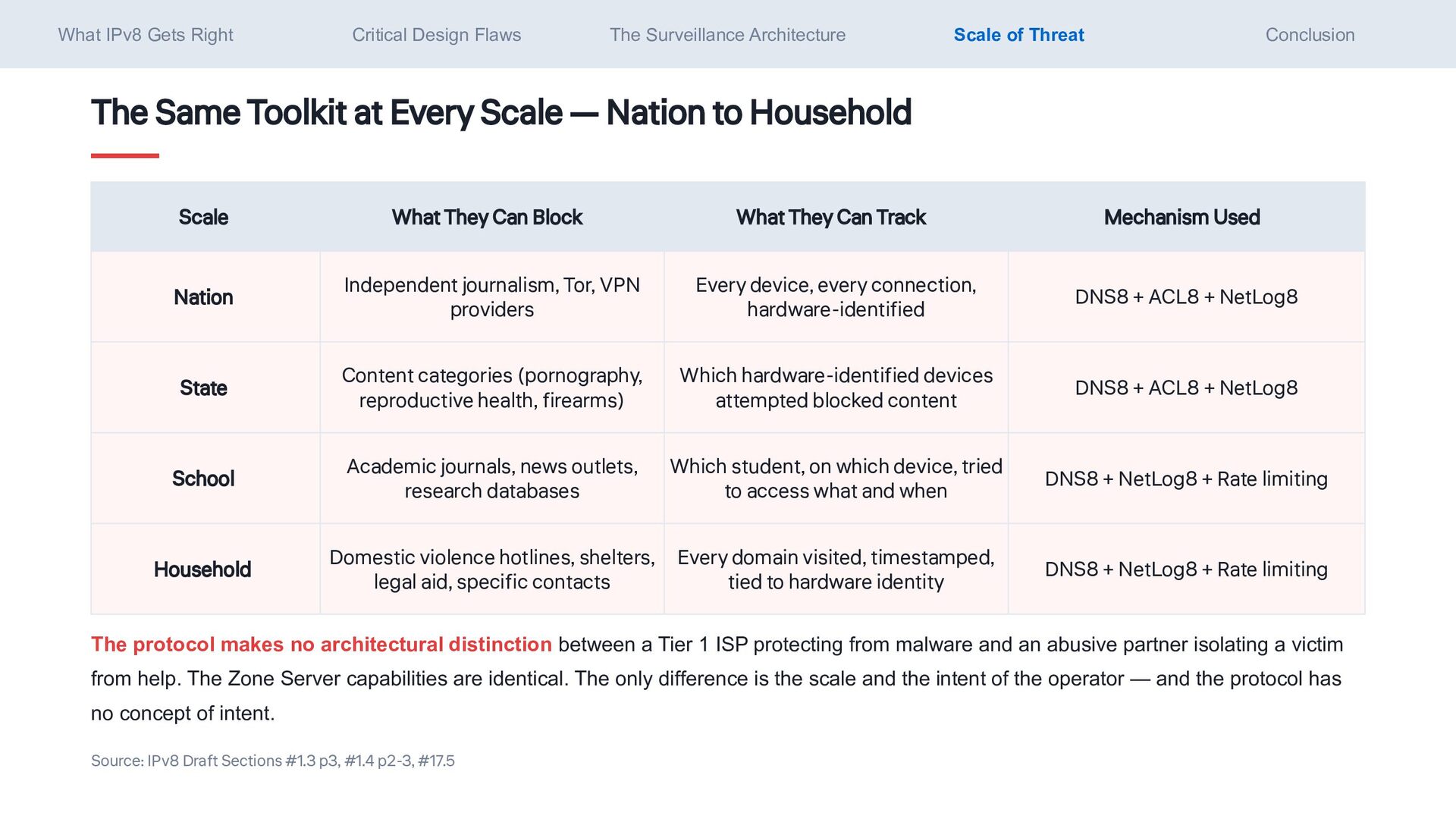
    Scale of Threat Conclusion The Same Toolkit at Every Scale — Nation to Household Scale What They Can Block What They Can Track Mechanism Used Nation Independent journalism, Tor, VPN providers Every device, every connection, hardware-identified DNS8 + ACL8 + NetLog8 State Content categories (pornography, reproductive health, firearms) Which hardware-identified devices attempted blocked content DNS8 + ACL8 + NetLog8 School Academic journals, news outlets, research databases Which student, on which device, tried to access what and when DNS8 + NetLog8 + Rate limiting Household Domestic violence hotlines, shelters, legal aid, specific contacts Every domain visited, timestamped, tied to hardware identity DNS8 + NetLog8 + Rate limiting The protocol makes no architectural distinction between a Tier 1 ISP protecting from malware and an abusive partner isolating a victim from help. The Zone Server capabilities are identical. The only difference is the scale and the intent of the operator — and the protocol has no concept of intent. Source: IPv8 Draft Sections #1.3 p3, #1.4 p2-3, #17.5
  16. What IPv8 Gets Right Critical Design Flaws The Surveillance Architecture

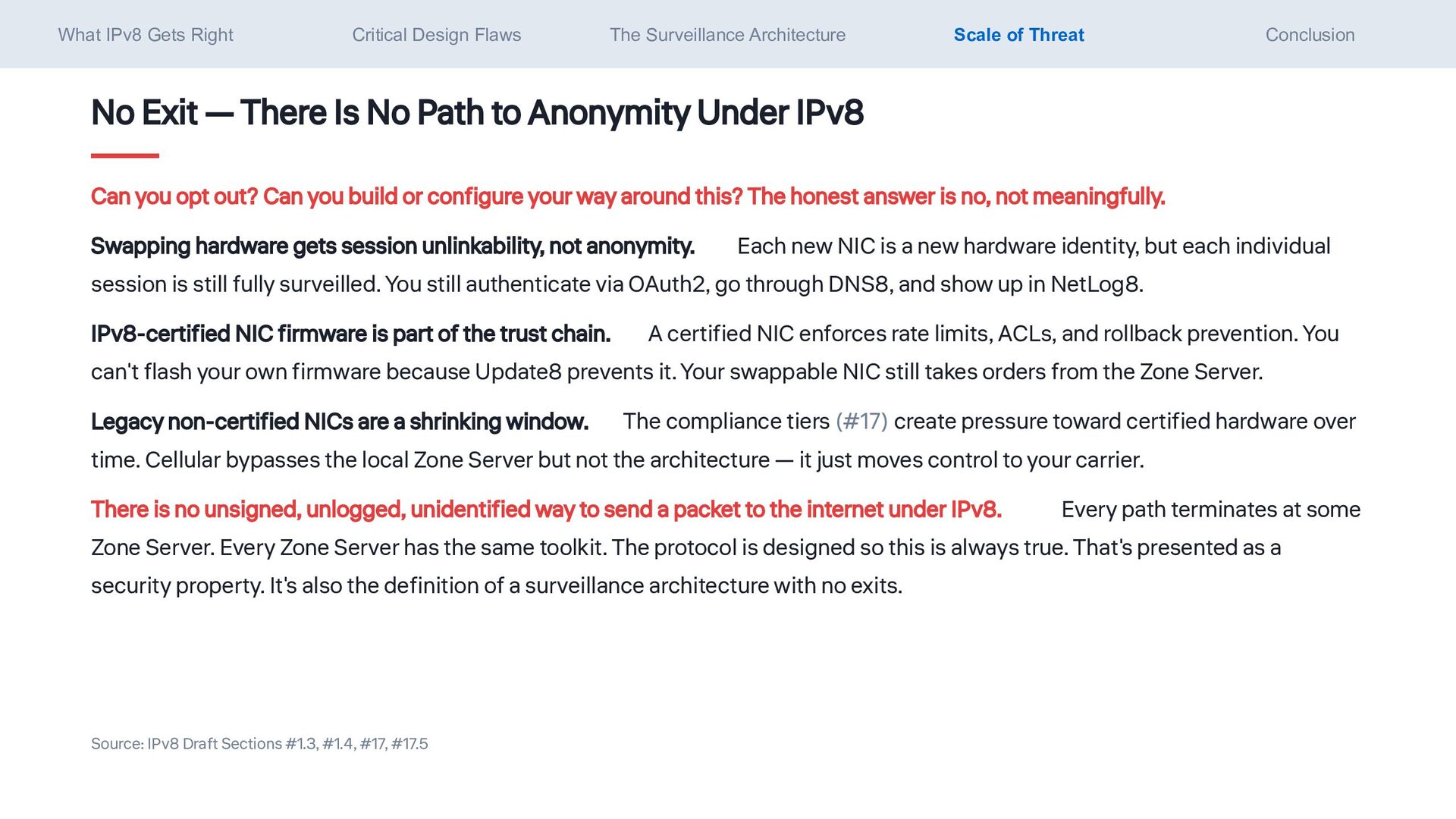
    Scale of Threat Conclusion No Exit — There Is No Path to Anonymity Under IPv8 Can you opt out? Can you build or configure your way around this? The honest answer is no, not meaningfully. Swapping hardware gets session unlinkability, not anonymity. Each new NIC is a new hardware identity, but each individual session is still fully surveilled. You still authenticate via OAuth2, go through DNS8, and show up in NetLog8. IPv8-certified NIC firmware is part of the trust chain. A certified NIC enforces rate limits, ACLs, and rollback prevention. You can't flash your own firmware because Update8 prevents it. Your swappable NIC still takes orders from the Zone Server. Legacy non-certified NICs are a shrinking window. The compliance tiers (#17) create pressure toward certified hardware over time. Cellular bypasses the local Zone Server but not the architecture — it just moves control to your carrier. There is no unsigned, unlogged, unidentified way to send a packet to the internet under IPv8. Every path terminates at some Zone Server. Every Zone Server has the same toolkit. The protocol is designed so this is always true. That's presented as a security property. It's also the definition of a surveillance architecture with no exits. Source: IPv8 Draft Sections #1.3, #1.4, #17, #17.5
  17. The good parts deserve to survive — backward compatibility, routing

    improvements, management unification. But the surveillance architecture cannot ship. Not without a complete privacy analysis, safety-critical exemptions, fail-open modes, and answering the question: What happens when the Zone Server operator is the threat? "Beware of he who would deny you access to information, for in his heart he dreams himself your master." — Commissioner Pravin Lal, "UN Declaration of Rights" (Sid Meier's Alpha Centauri) Thank You