Upgrade to Pro — share decks privately, control downloads, hide ads and more …

How to Do Local SEO: Sequence the Work

Sponsored · SiteGround - Reliable hosting with speed, security, and support you can count on. →

How to Do Local SEO: Sequence the Work

Learn how to do local SEO by connecting approved business facts, website content, structured data and Business Profile updates. This workshop shows technical teams how to test contact paths, distinguish form events from received inquiries, and sequence tasks by dependency. Use the exercise and source guide to plan how to do local SEO with evidence and clear acceptance tests: https://guaranteedseoservices.com/how-to-do-local-seo/?utm_source=speakerdeck&utm_medium=referral&utm_campaign=blog-how-to-do-local-seo

Avatar for GuaranteedSEOServices

GuaranteedSEOServices

October 26, 2026

More Decks by GuaranteedSEOServices

Other Decks in Marketing & SEO

Transcript

  1. How to Do Local SEO: Sequence Profile, Website and Measurement

    Work Your client changed their hours. How many places in your build need to change? A workshop for web developers and small-agency builders on making business facts consistent, testing the inquiry path, and sequencing local SEO work by dependency rather than by checklist. GuaranteedSEOServices.com October 27, 2026
  2. How to Do Local SEO Starts With One Business Record

    Your client changed their hours. How many places in your build need to change? Learning how to do local SEO starts with identifying where business facts are stored and who approves changes. If the website, Google Business Profile and external listings hold different answers, the team has a data ownership problem. Before submitting directories or adding markup, establish which business facts are approved, who approves changes, and how those changes reach every public destination. Guide: https://guaranteedseoservices.com/how-to-do-local-seo/ Source: guaranteedseoservices.com/how-to-do-local-seo/ · GuaranteedSEOServices.com
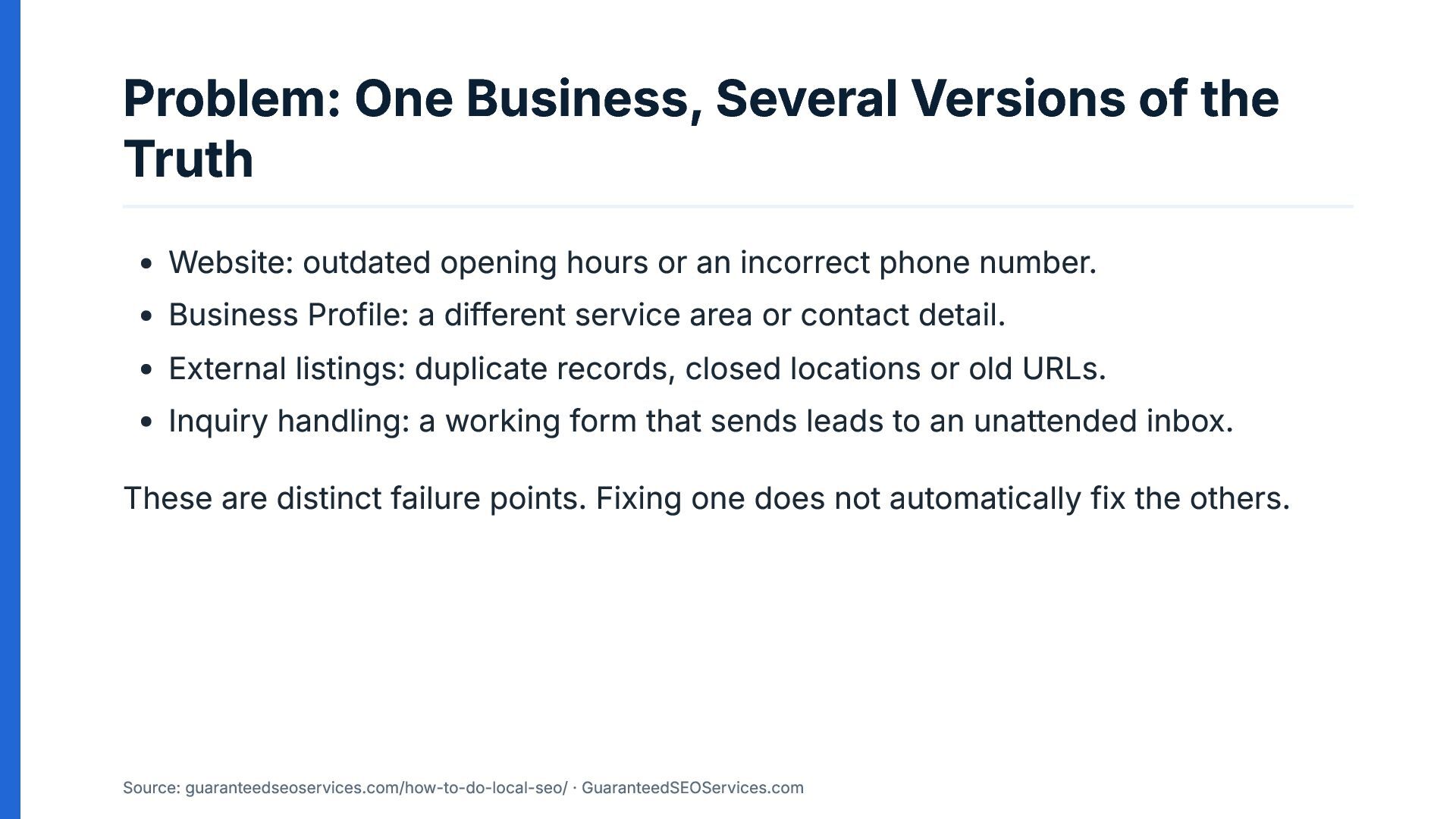
  3. Problem: One Business, Several Versions of the Truth Website: outdated

    opening hours or an incorrect phone number. Business Profile: a different service area or contact detail. External listings: duplicate records, closed locations or old URLs. Inquiry handling: a working form that sends leads to an unattended inbox. These are distinct failure points. Fixing one does not automatically fix the others. Source: guaranteedseoservices.com/how-to-do-local-seo/ · GuaranteedSEOServices.com
  4. Start With Evidence, Not a Submission Count Local SEO begins

    with accurate representation of a real business and a clear path for suitable customers to act. Inspect the existing website and profile before proposing changes. Verify the business name, actual services, locations, service area, contact details, hours and responsible staff. Record what is confirmed, what remains uncertain and who can resolve each gap. Google's local results guidance identifies relevance, distance and popularity as the main factors. A directory checklist cannot substitute for accurate business information or a useful contact path. Source: guaranteedseoservices.com/how-to-do-local-seo/ · GuaranteedSEOServices.com
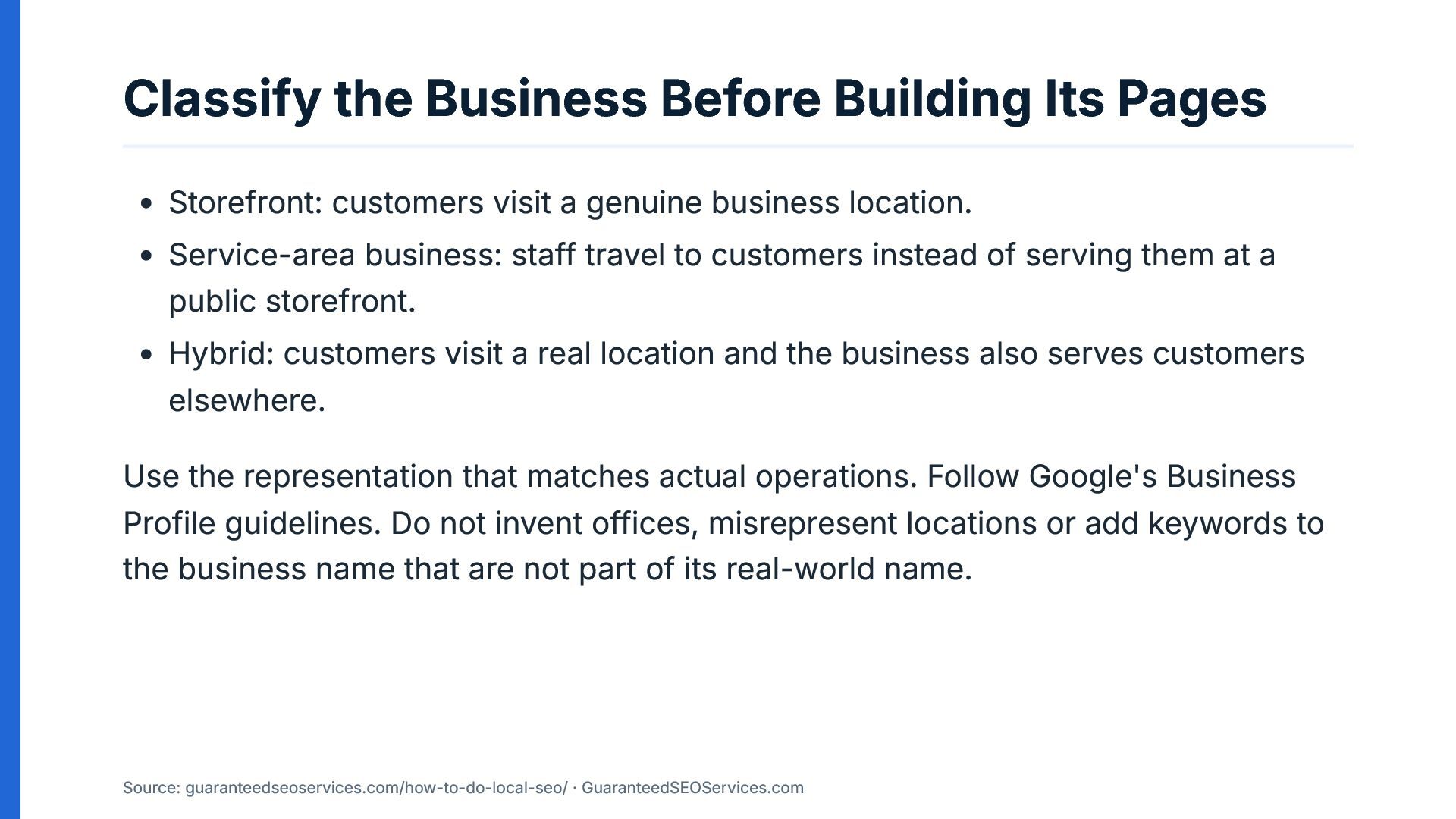
  5. Classify the Business Before Building Its Pages Storefront: customers visit

    a genuine business location. Service-area business: staff travel to customers instead of serving them at a public storefront. Hybrid: customers visit a real location and the business also serves customers elsewhere. Use the representation that matches actual operations. Follow Google's Business Profile guidelines. Do not invent offices, misrepresent locations or add keywords to the business name that are not part of its real-world name. Source: guaranteedseoservices.com/how-to-do-local-seo/ · GuaranteedSEOServices.com
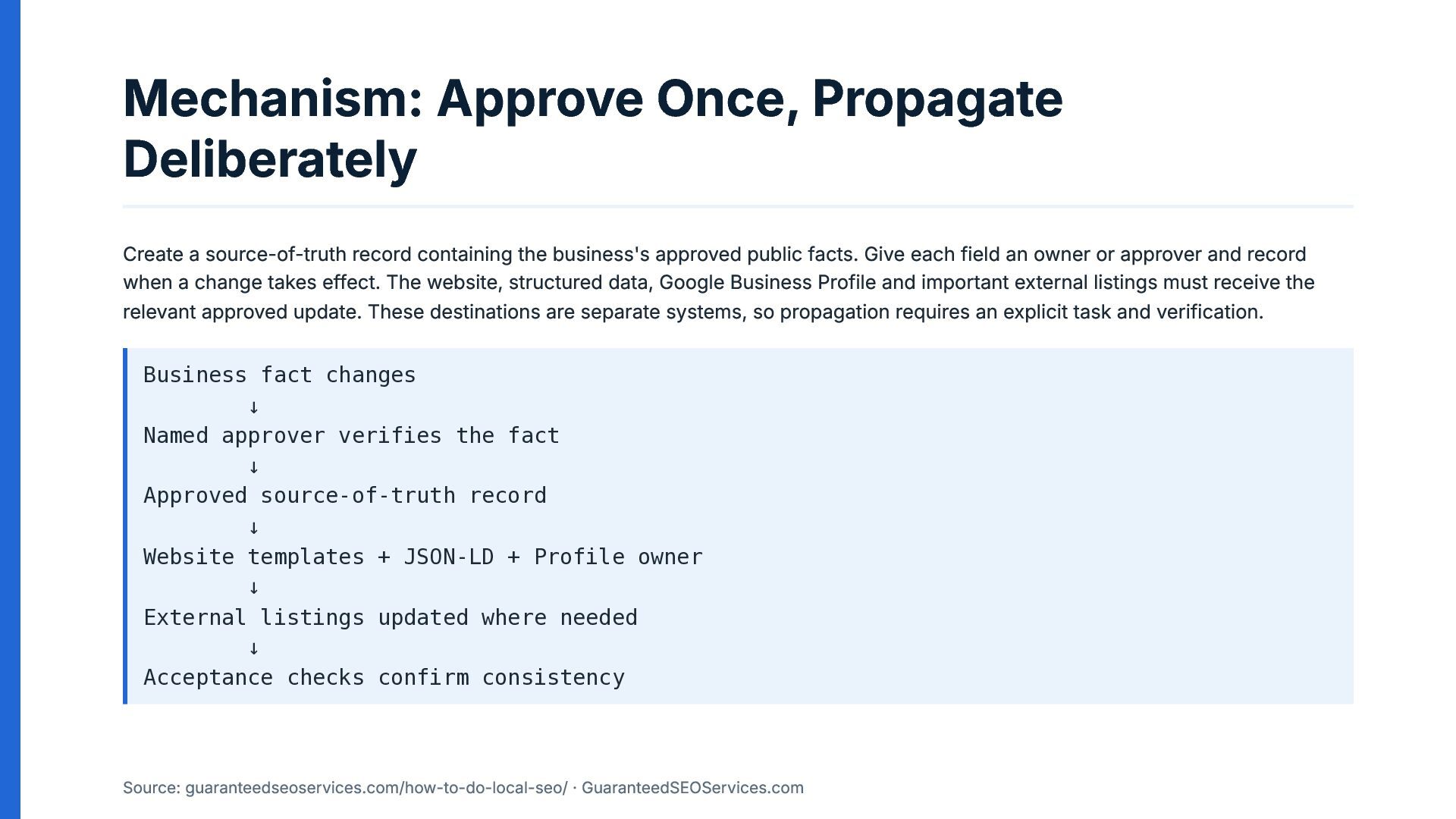
  6. Mechanism: Approve Once, Propagate Deliberately Create a source-of-truth record containing

    the business's approved public facts. Give each field an owner or approver and record when a change takes effect. The website, structured data, Google Business Profile and important external listings must receive the relevant approved update. These destinations are separate systems, so propagation requires an explicit task and verification. Business fact changes ↓ Named approver verifies the fact ↓ Approved source-of-truth record ↓ Website templates + JSON-LD + Profile owner ↓ External listings updated where needed ↓ Acceptance checks confirm consistency Source: guaranteedseoservices.com/how-to-do-local-seo/ · GuaranteedSEOServices.com
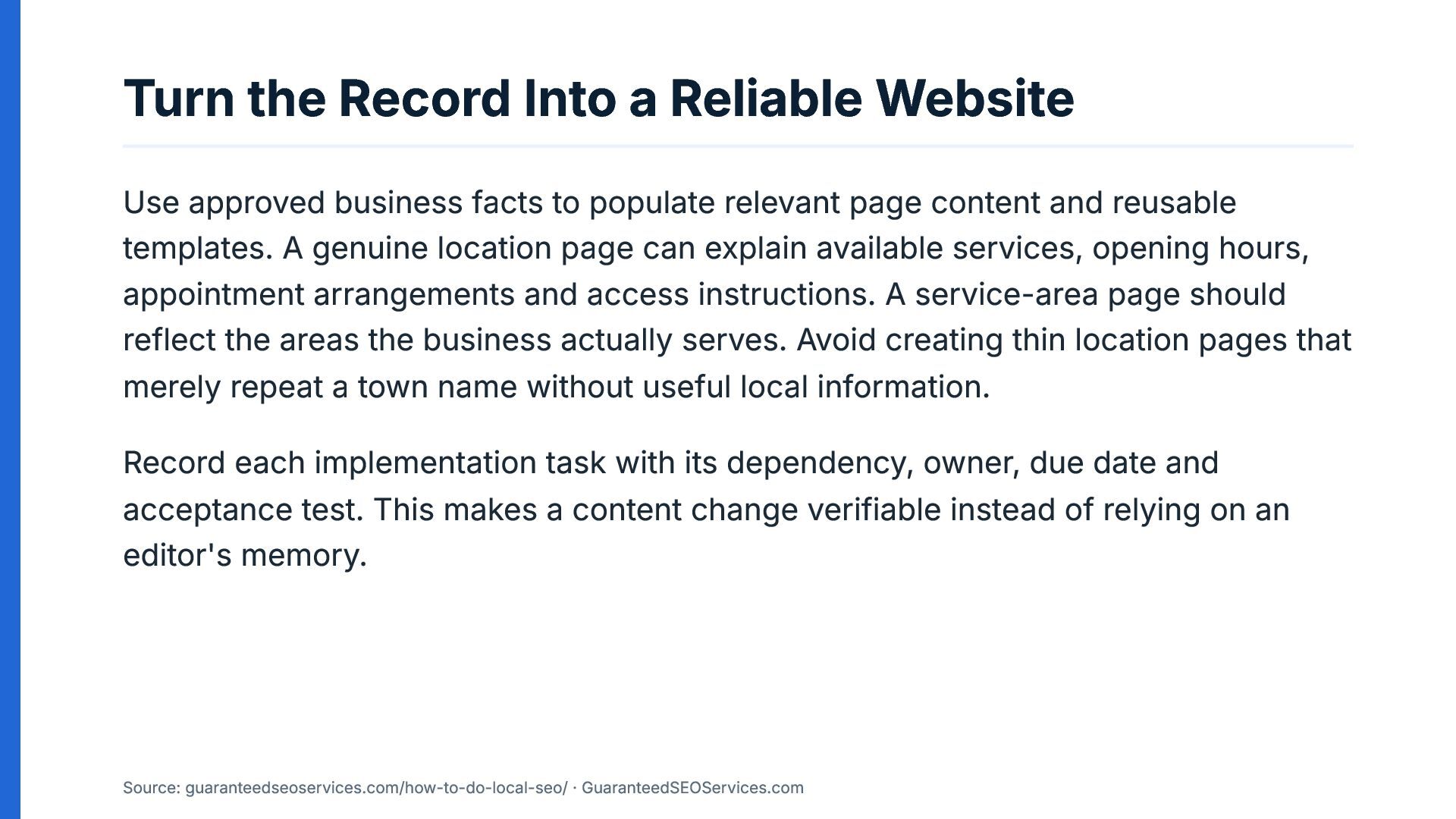
  7. Turn the Record Into a Reliable Website Use approved business

    facts to populate relevant page content and reusable templates. A genuine location page can explain available services, opening hours, appointment arrangements and access instructions. A service-area page should reflect the areas the business actually serves. Avoid creating thin location pages that merely repeat a town name without useful local information. Record each implementation task with its dependency, owner, due date and acceptance test. This makes a content change verifiable instead of relying on an editor's memory. Source: guaranteedseoservices.com/how-to-do-local-seo/ · GuaranteedSEOServices.com
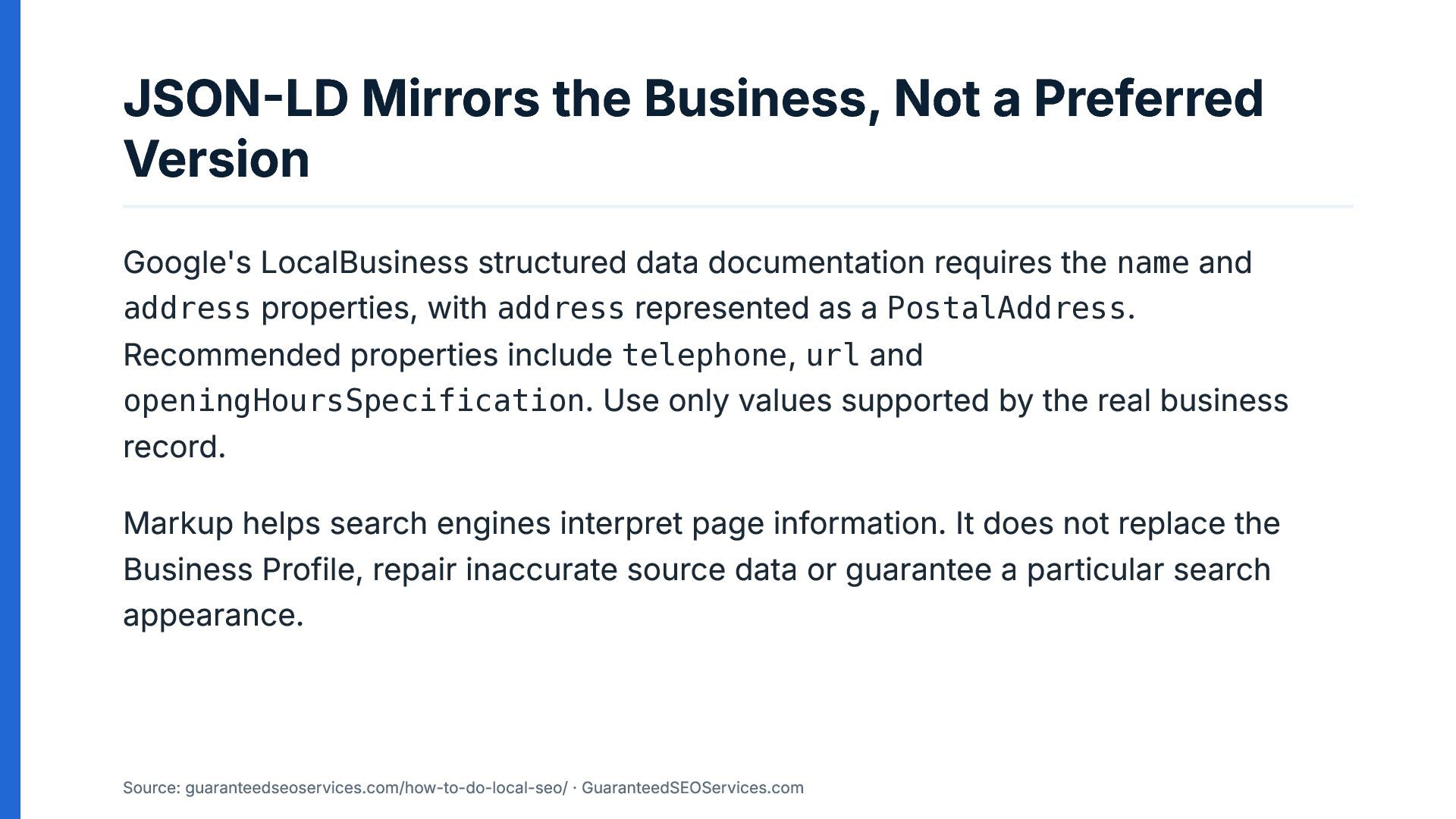
  8. JSON-LD Mirrors the Business, Not a Preferred Version Google's LocalBusiness

    structured data documentation requires the name and address properties, with address represented as a PostalAddress. Recommended properties include telephone, url and openingHoursSpecification. Use only values supported by the real business record. Markup helps search engines interpret page information. It does not replace the Business Profile, repair inaccurate source data or guarantee a particular search appearance. Source: guaranteedseoservices.com/how-to-do-local-seo/ · GuaranteedSEOServices.com
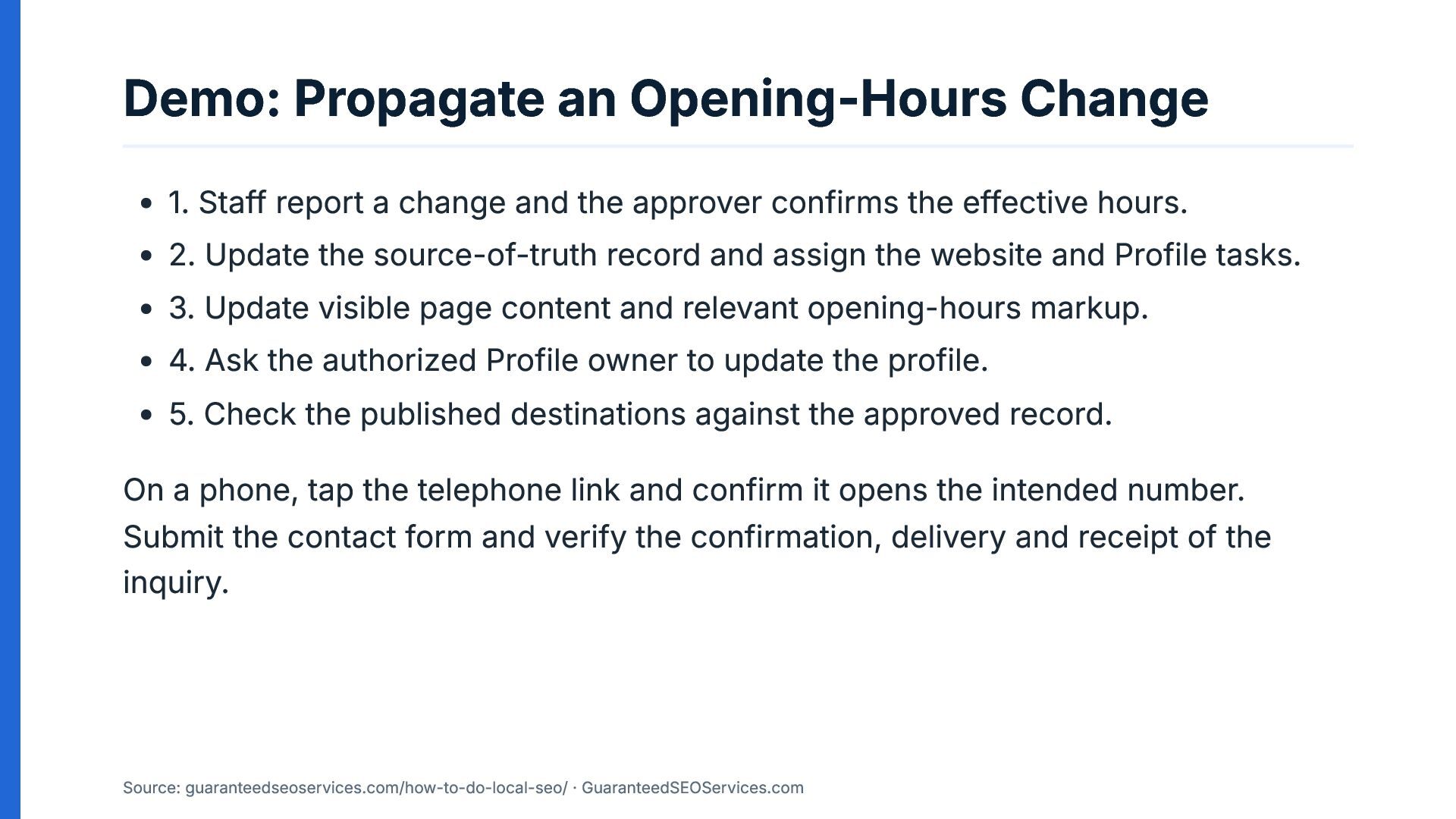
  9. Demo: Propagate an Opening-Hours Change 1. Staff report a change

    and the approver confirms the effective hours. 2. Update the source-of-truth record and assign the website and Profile tasks. 3. Update visible page content and relevant opening-hours markup. 4. Ask the authorized Profile owner to update the profile. 5. Check the published destinations against the approved record. On a phone, tap the telephone link and confirm it opens the intended number. Submit the contact form and verify the confirmation, delivery and receipt of the inquiry. Source: guaranteedseoservices.com/how-to-do-local-seo/ · GuaranteedSEOServices.com
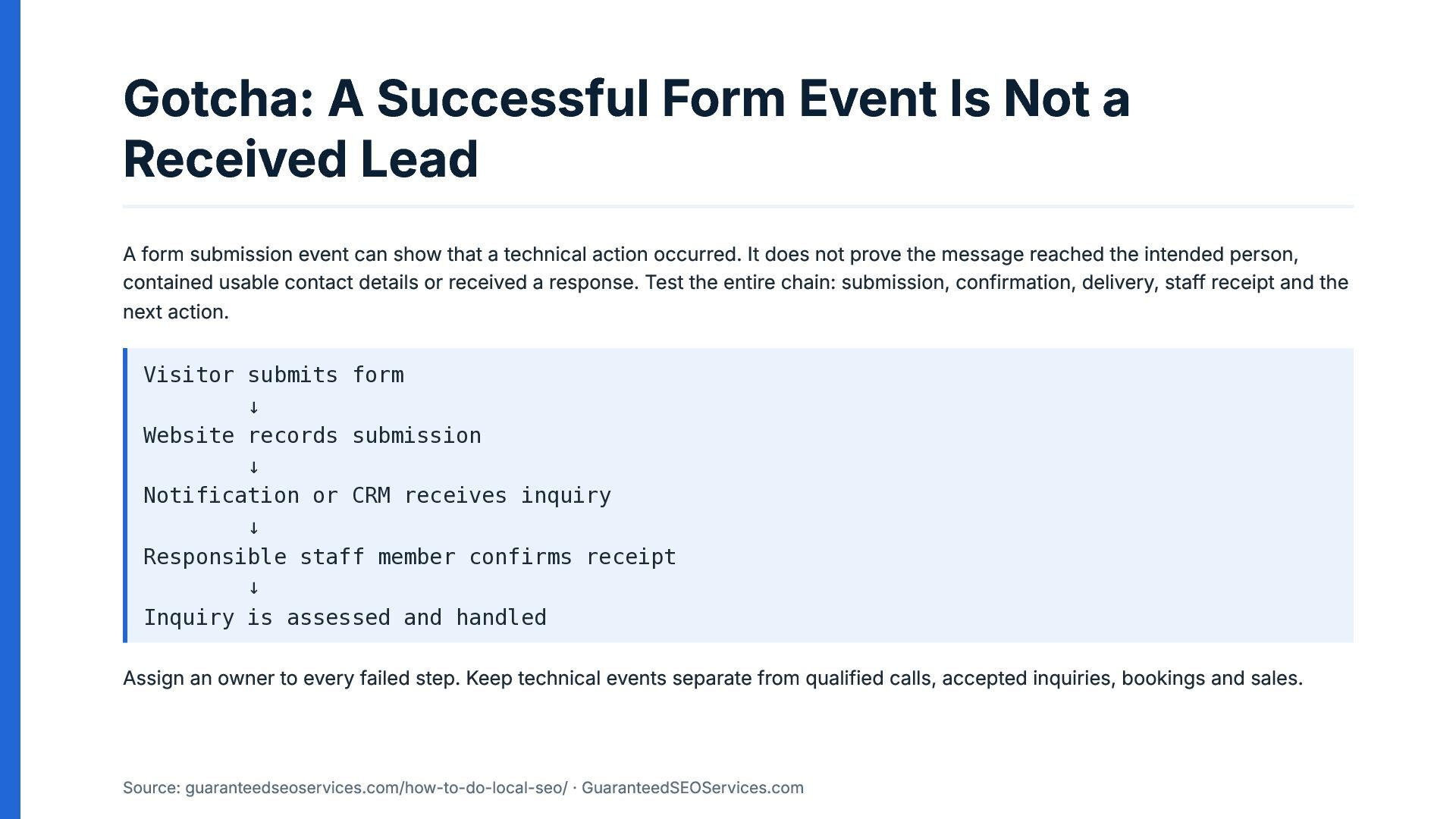
  10. Gotcha: A Successful Form Event Is Not a Received Lead

    A form submission event can show that a technical action occurred. It does not prove the message reached the intended person, contained usable contact details or received a response. Test the entire chain: submission, confirmation, delivery, staff receipt and the next action. Visitor submits form ↓ Website records submission ↓ Notification or CRM receives inquiry ↓ Responsible staff member confirms receipt ↓ Inquiry is assessed and handled Assign an owner to every failed step. Keep technical events separate from qualified calls, accepted inquiries, bookings and sales. Source: guaranteedseoservices.com/how-to-do-local-seo/ · GuaranteedSEOServices.com
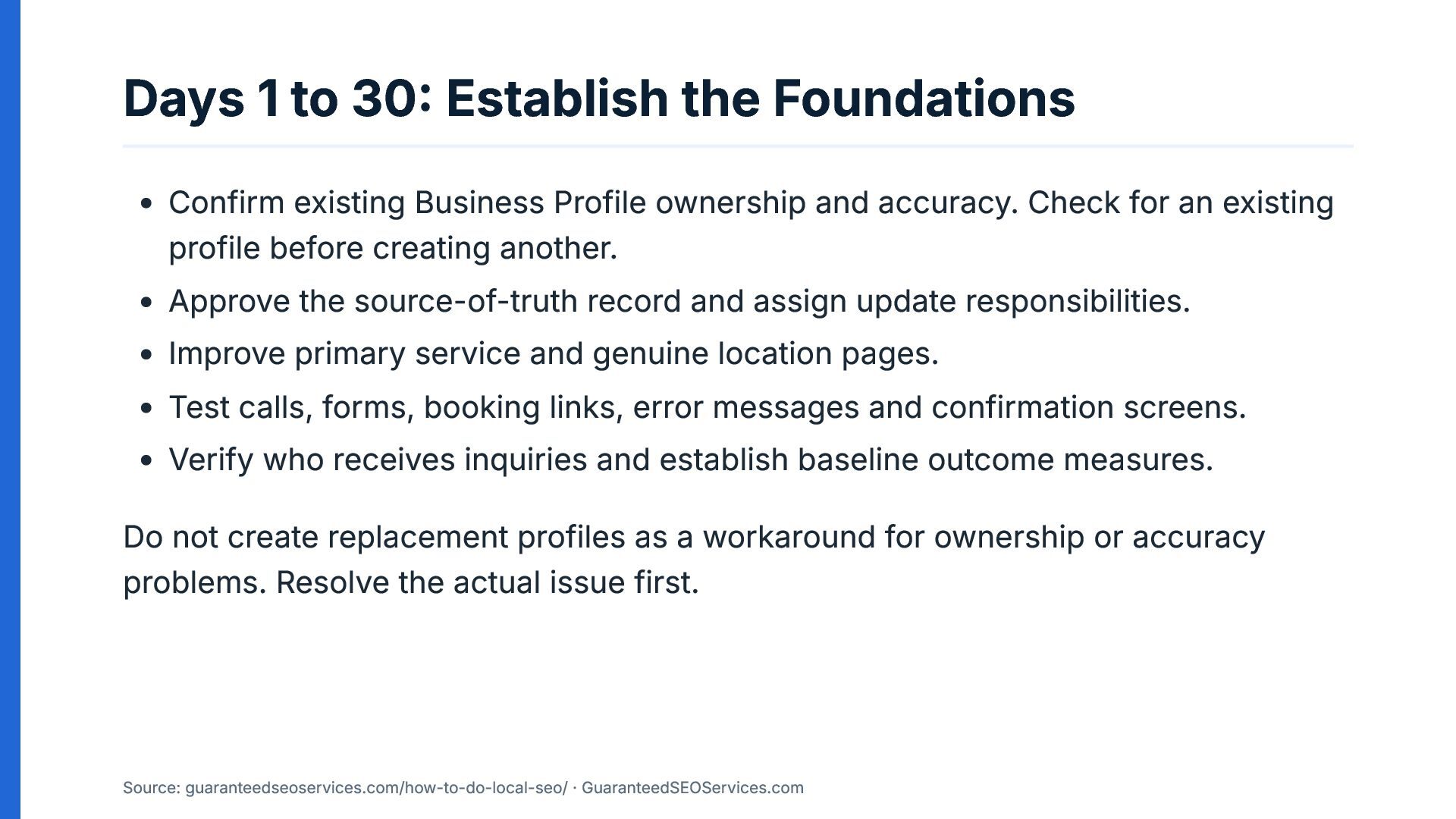
  11. Days 1 to 30: Establish the Foundations Confirm existing Business

    Profile ownership and accuracy. Check for an existing profile before creating another. Approve the source-of-truth record and assign update responsibilities. Improve primary service and genuine location pages. Test calls, forms, booking links, error messages and confirmation screens. Verify who receives inquiries and establish baseline outcome measures. Do not create replacement profiles as a workaround for ownership or accuracy problems. Resolve the actual issue first. Source: guaranteedseoservices.com/how-to-do-local-seo/ · GuaranteedSEOServices.com
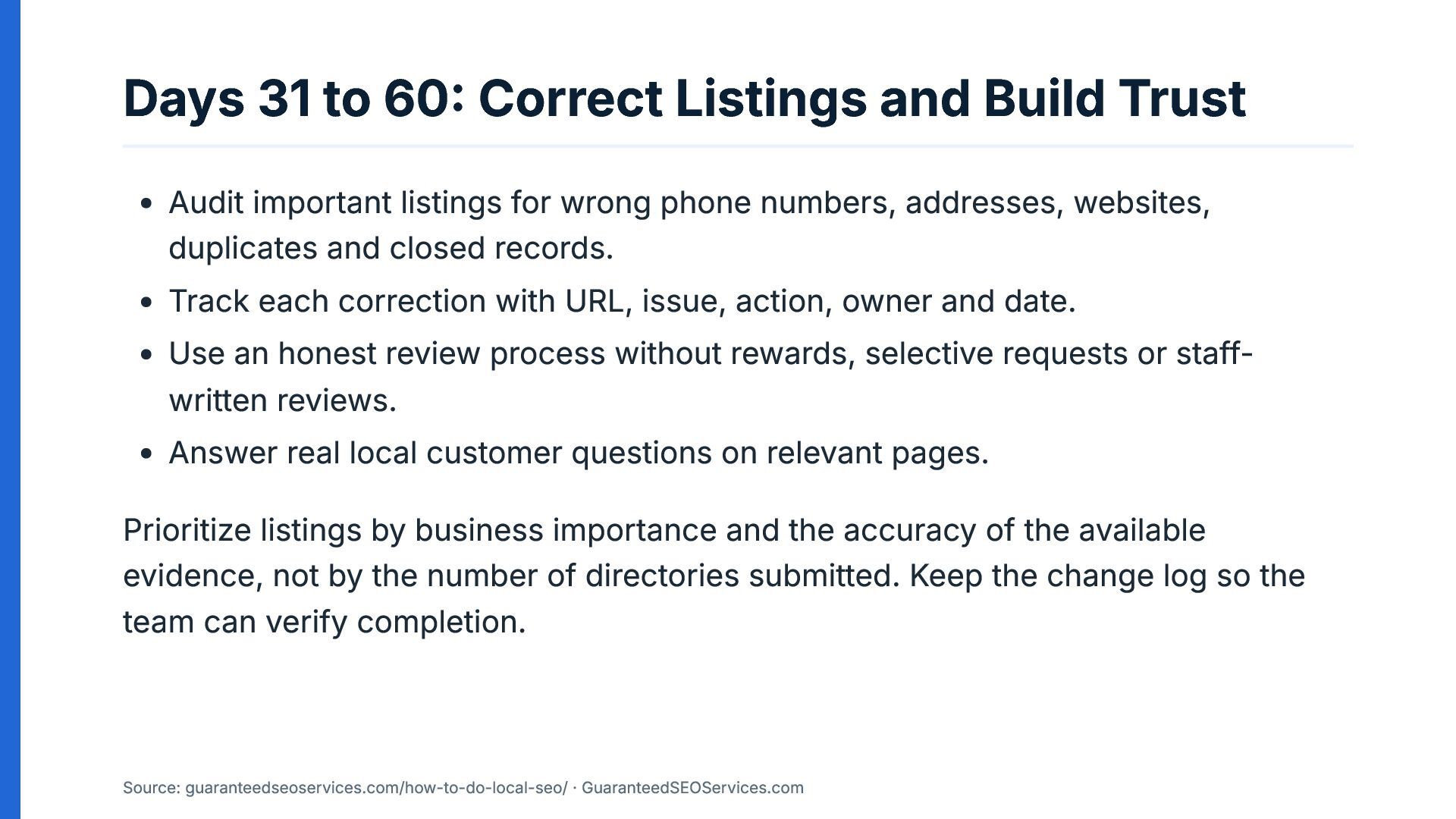
  12. Days 31 to 60: Correct Listings and Build Trust Audit

    important listings for wrong phone numbers, addresses, websites, duplicates and closed records. Track each correction with URL, issue, action, owner and date. Use an honest review process without rewards, selective requests or staffwritten reviews. Answer real local customer questions on relevant pages. Prioritize listings by business importance and the accuracy of the available evidence, not by the number of directories submitted. Keep the change log so the team can verify completion. Source: guaranteedseoservices.com/how-to-do-local-seo/ · GuaranteedSEOServices.com
  13. Days 61 to 90: Refine Based on What You Can

    Verify Review where qualified inquiries originate, using the available measurement evidence. Check whether calls, bookings and accepted inquiries are being recorded consistently. Identify relevant local organizations and build genuine relationships where there is a reason to collaborate. Revisit unresolved business facts, broken contact paths and inconsistent listings. Use observed outcomes to decide what to improve next. The 90-day schedule is a planning horizon, not a promise of rankings, leads or a specific deadline for results. Source: guaranteedseoservices.com/how-to-do-local-seo/ · GuaranteedSEOServices.com
  14. Audience Exercise: Order the Work by Dependency A local service

    business has unverified Profile ownership, inconsistent opening hours, outdated directory phone numbers, an untested contact form and no reliable qualified-inquiry baseline. The team has limited implementation capacity. Put these tasks in a workable order, identifying which tasks can run in parallel once their prerequisites are met. A. Correct important external listings. B. Verify profile ownership and approve the business record. C. Test form delivery and phone calls, then establish a baseline. D. Update website facts and relevant structured data. E. Review qualified inquiries and prioritize the next improvements. Discuss what evidence would let the team mark each task complete. Source: guaranteedseoservices.com/how-to-do-local-seo/ · GuaranteedSEOServices.com
  15. Lessons: Make Every Task Verifiable Task: state the exact change,

    not just “improve local SEO.” Starting evidence: record the observed mismatch or failed test. Dependency: identify the approval, access or data needed first. Owner and due date: assign responsibility within real team capacity. Acceptance test: define what proves the change works. Outcome measure: distinguish implementation from business results. For every task, record the evidence and the next action. A closed ticket is useful only when the agreed acceptance test has passed. Source: guaranteedseoservices.com/how-to-do-local-seo/ · GuaranteedSEOServices.com
  16. How to Do Local SEO: Take the Workshop Back to

    Your Team Start with approved business facts, propagate changes deliberately, test the real inquiry path and use verified outcomes to guide the next cycle. Keep the business record and change log accessible to everyone who maintains the website or public profiles. Try the workshop exercise with your team, cite the guide and primary sources, and use the checklist to plan your own 90-day sequence. Guide: https://guaranteedseoservices.com/how-to-do-local-seo/ Primary sources: Google Search Central: LocalBusiness structured data, Google Business Profile guidelines, Google: Improve your local ranking on Google. Source: guaranteedseoservices.com/how-to-do-local-seo/ · GuaranteedSEOServices.com
  17. Speaker Notes Slide 1 Open with the hours-change question and

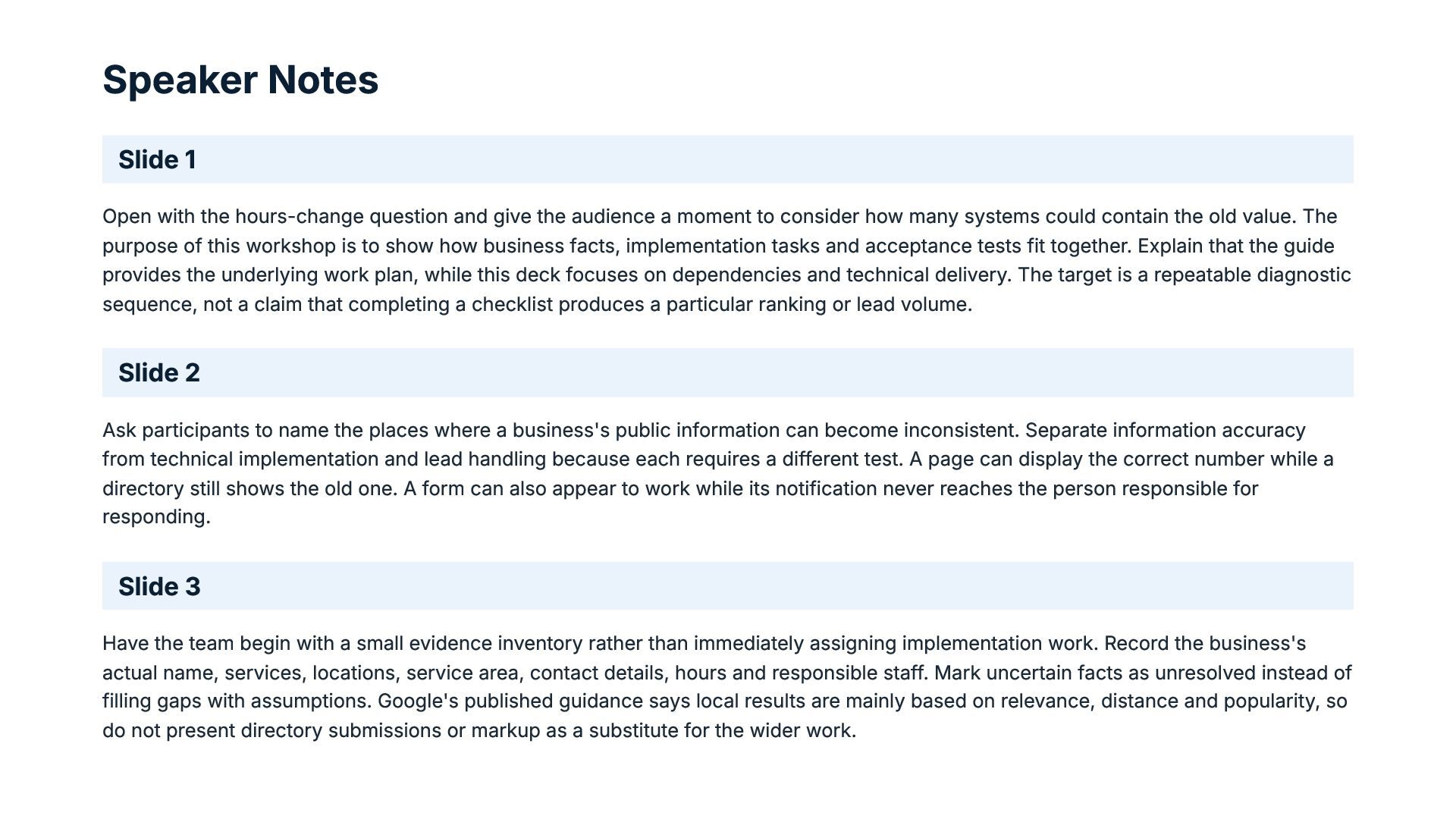
    give the audience a moment to consider how many systems could contain the old value. The purpose of this workshop is to show how business facts, implementation tasks and acceptance tests fit together. Explain that the guide provides the underlying work plan, while this deck focuses on dependencies and technical delivery. The target is a repeatable diagnostic sequence, not a claim that completing a checklist produces a particular ranking or lead volume. Slide 2 Ask participants to name the places where a business's public information can become inconsistent. Separate information accuracy from technical implementation and lead handling because each requires a different test. A page can display the correct number while a directory still shows the old one. A form can also appear to work while its notification never reaches the person responsible for responding. Slide 3 Have the team begin with a small evidence inventory rather than immediately assigning implementation work. Record the business's actual name, services, locations, service area, contact details, hours and responsible staff. Mark uncertain facts as unresolved instead of filling gaps with assumptions. Google's published guidance says local results are mainly based on relevance, distance and popularity, so do not present directory submissions or markup as a substitute for the wider work.
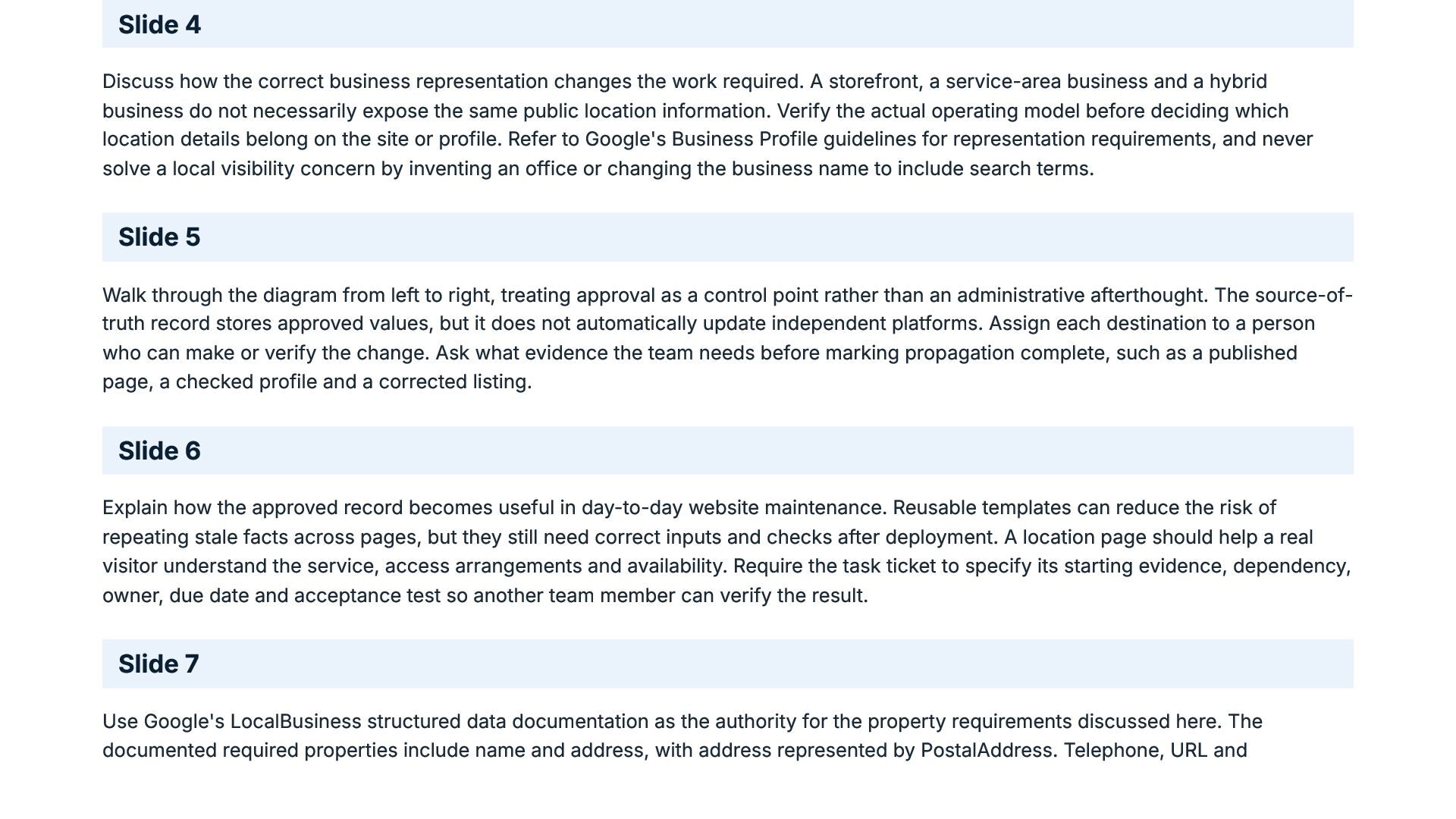
  18. Slide 4 Discuss how the correct business representation changes the

    work required. A storefront, a service-area business and a hybrid business do not necessarily expose the same public location information. Verify the actual operating model before deciding which location details belong on the site or profile. Refer to Google's Business Profile guidelines for representation requirements, and never solve a local visibility concern by inventing an office or changing the business name to include search terms. Slide 5 Walk through the diagram from left to right, treating approval as a control point rather than an administrative afterthought. The source-oftruth record stores approved values, but it does not automatically update independent platforms. Assign each destination to a person who can make or verify the change. Ask what evidence the team needs before marking propagation complete, such as a published page, a checked profile and a corrected listing. Slide 6 Explain how the approved record becomes useful in day-to-day website maintenance. Reusable templates can reduce the risk of repeating stale facts across pages, but they still need correct inputs and checks after deployment. A location page should help a real visitor understand the service, access arrangements and availability. Require the task ticket to specify its starting evidence, dependency, owner, due date and acceptance test so another team member can verify the result. Slide 7 Use Google's LocalBusiness structured data documentation as the authority for the property requirements discussed here. The documented required properties include name and address, with address represented by PostalAddress. Telephone, URL and
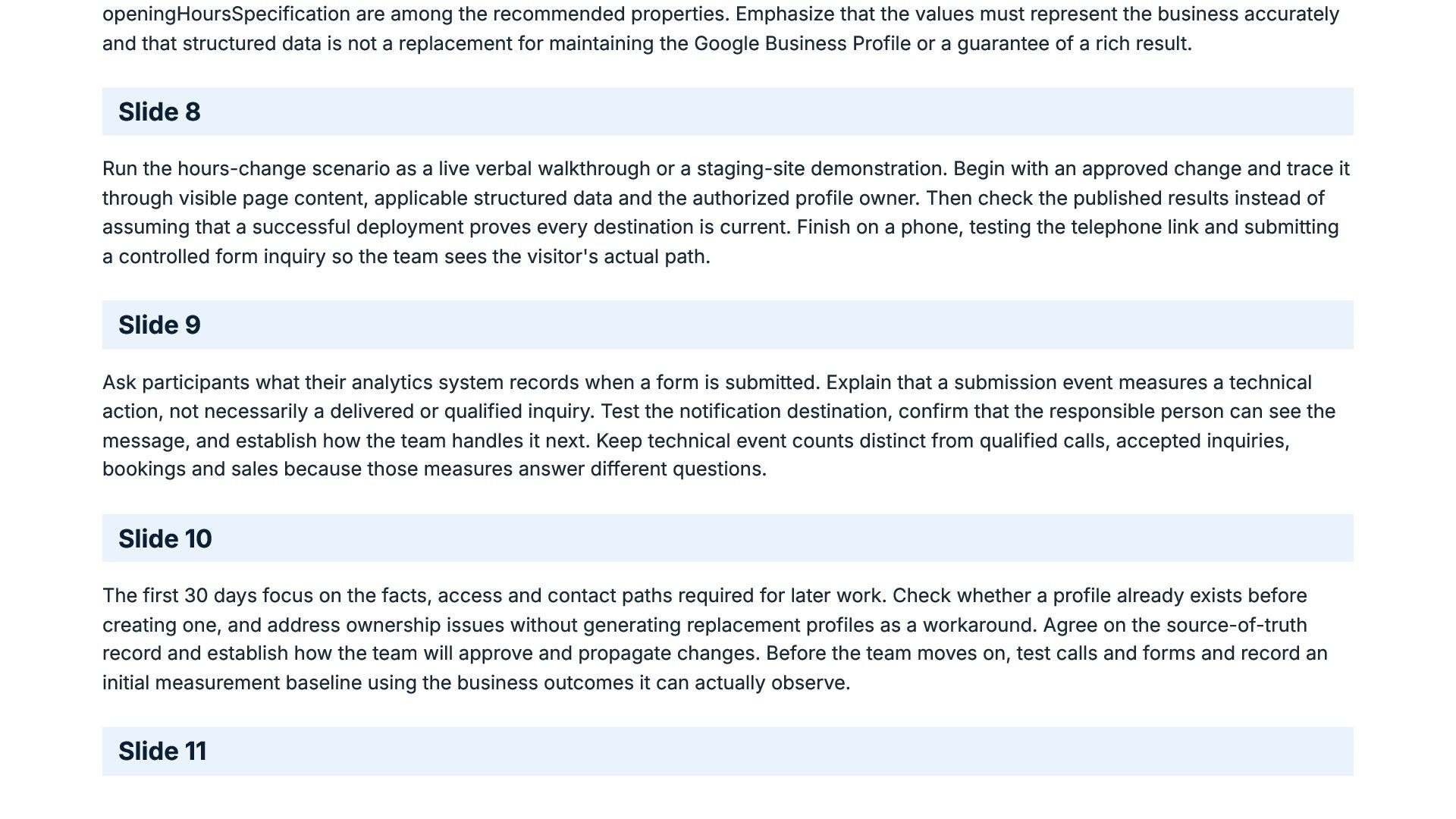
  19. openingHoursSpecification are among the recommended properties. Emphasize that the values

    must represent the business accurately and that structured data is not a replacement for maintaining the Google Business Profile or a guarantee of a rich result. Slide 8 Run the hours-change scenario as a live verbal walkthrough or a staging-site demonstration. Begin with an approved change and trace it through visible page content, applicable structured data and the authorized profile owner. Then check the published results instead of assuming that a successful deployment proves every destination is current. Finish on a phone, testing the telephone link and submitting a controlled form inquiry so the team sees the visitor's actual path. Slide 9 Ask participants what their analytics system records when a form is submitted. Explain that a submission event measures a technical action, not necessarily a delivered or qualified inquiry. Test the notification destination, confirm that the responsible person can see the message, and establish how the team handles it next. Keep technical event counts distinct from qualified calls, accepted inquiries, bookings and sales because those measures answer different questions. Slide 10 The first 30 days focus on the facts, access and contact paths required for later work. Check whether a profile already exists before creating one, and address ownership issues without generating replacement profiles as a workaround. Agree on the source-of-truth record and establish how the team will approve and propagate changes. Before the team moves on, test calls and forms and record an initial measurement baseline using the business outcomes it can actually observe. Slide 11
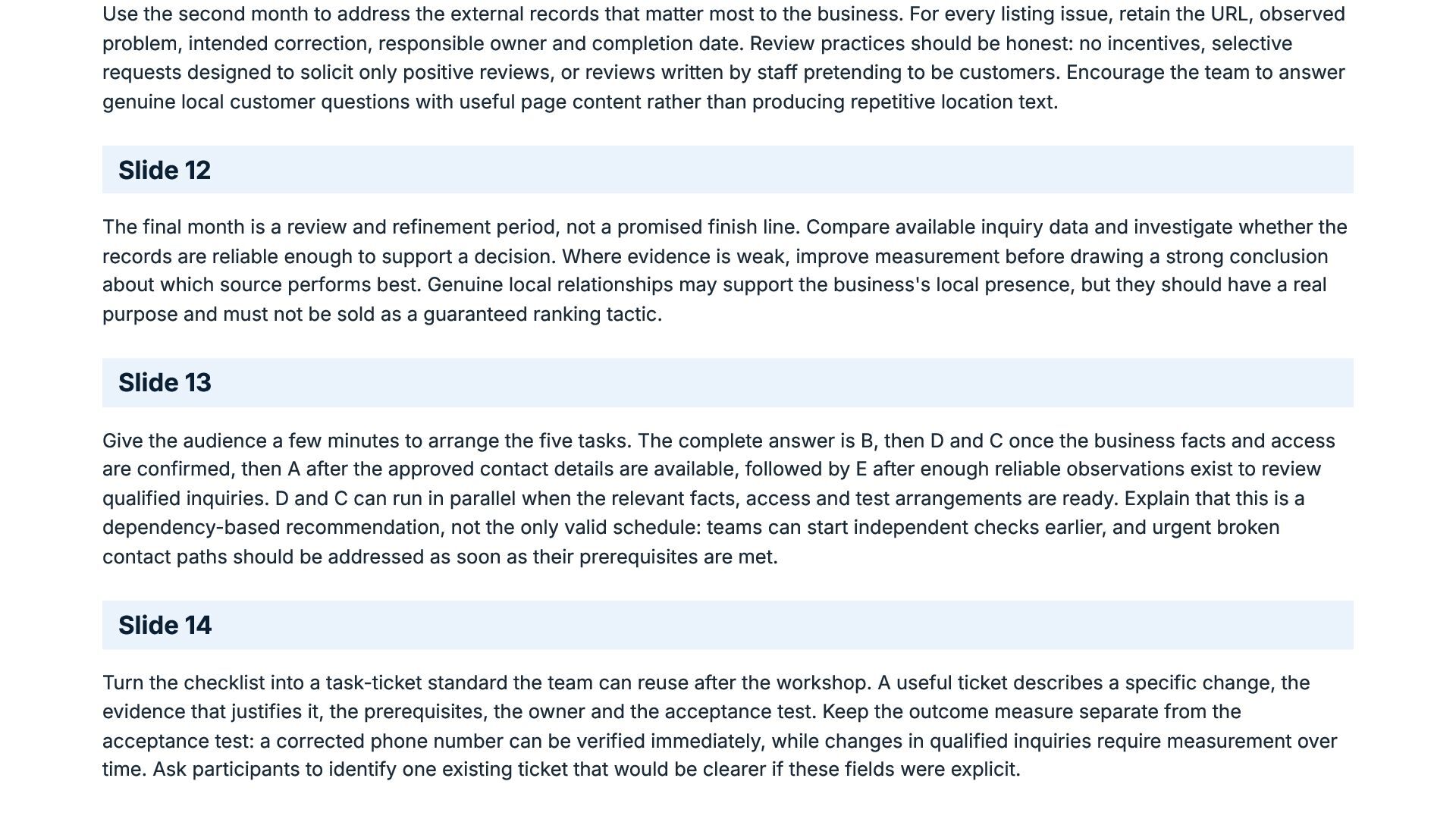
  20. Use the second month to address the external records that

    matter most to the business. For every listing issue, retain the URL, observed problem, intended correction, responsible owner and completion date. Review practices should be honest: no incentives, selective requests designed to solicit only positive reviews, or reviews written by staff pretending to be customers. Encourage the team to answer genuine local customer questions with useful page content rather than producing repetitive location text. Slide 12 The final month is a review and refinement period, not a promised finish line. Compare available inquiry data and investigate whether the records are reliable enough to support a decision. Where evidence is weak, improve measurement before drawing a strong conclusion about which source performs best. Genuine local relationships may support the business's local presence, but they should have a real purpose and must not be sold as a guaranteed ranking tactic. Slide 13 Give the audience a few minutes to arrange the five tasks. The complete answer is B, then D and C once the business facts and access are confirmed, then A after the approved contact details are available, followed by E after enough reliable observations exist to review qualified inquiries. D and C can run in parallel when the relevant facts, access and test arrangements are ready. Explain that this is a dependency-based recommendation, not the only valid schedule: teams can start independent checks earlier, and urgent broken contact paths should be addressed as soon as their prerequisites are met. Slide 14 Turn the checklist into a task-ticket standard the team can reuse after the workshop. A useful ticket describes a specific change, the evidence that justifies it, the prerequisites, the owner and the acceptance test. Keep the outcome measure separate from the acceptance test: a corrected phone number can be verified immediately, while changes in qualified inquiries require measurement over time. Ask participants to identify one existing ticket that would be clearer if these fields were explicit.
  21. Slide 15 Close by asking each participant to identify the

    first business fact they would verify on their next local project. Reinforce the sequence: confirm the real business, approve its public facts, implement and propagate the changes, test the contact path, then review evidence before choosing the next task. Invite the team to complete the exercise together and cite the guide and Google's primary documentation when explaining its choices. How to do local SEO means coordinating accurate business information, verified implementation and measured follow-through, not promising a ranking or a deadline.
  22. Sources https://guaranteedseoservices.com/how-to-do-local-seo/ Google Search Central: LocalBusiness structured data Google Business

    Profile: Guidelines for representing your business on Google Google Business Profile: Improve your local ranking on Google