Upgrade to Pro — share decks privately, control downloads, hide ads and more …

How to Measure SEO Success: Trace Metrics to Bu...

How to Measure SEO Success: Trace Metrics to Business Outcomes

Learn how to measure SEO success by tracing the path from organic search to qualified leads without confusing tracking events with business outcomes. This workshop explains GA4 attribution scopes, event definitions, denominators and technical checks that make reports easier to interpret. If you are working out how to measure SEO success, start with the guide: https://guaranteedseoservices.com/seo-kpis-measure-seo-success/?utm_source=speakerdeck&utm_medium=referral&utm_campaign=blog-seo-kpis-measure-seo-success

GuaranteedSEOServices

October 26, 2026

Transcript

21 slides
  1. How to Measure SEO Success: Trace a Business Question Through

    Search and Conversion Metrics How to measure SEO success starts with a distinction many reporting pipelines miss: a click, a submitted form, a received inquiry and an accepted lead are four different states. This workshop traces data from search acquisition to a business outcome without collapsing the evidence. GuaranteedSEOServices.com October 27, 2026
  2. 1. Four Events, One Misleading Conversion “Click,” “submit,” “received,” “accepted”:

    four events your dashboard probably counts as one. How to measure SEO success means tracing each state separately, from the visitor's action to the sales team's decision. Start with the original guide: https://guaranteedseoservices.com/seo-kpis-measure-seo-success/ Source: guaranteedseoservices.com/seo-kpis-measure-seo-success/ · GuaranteedSEOServices.com
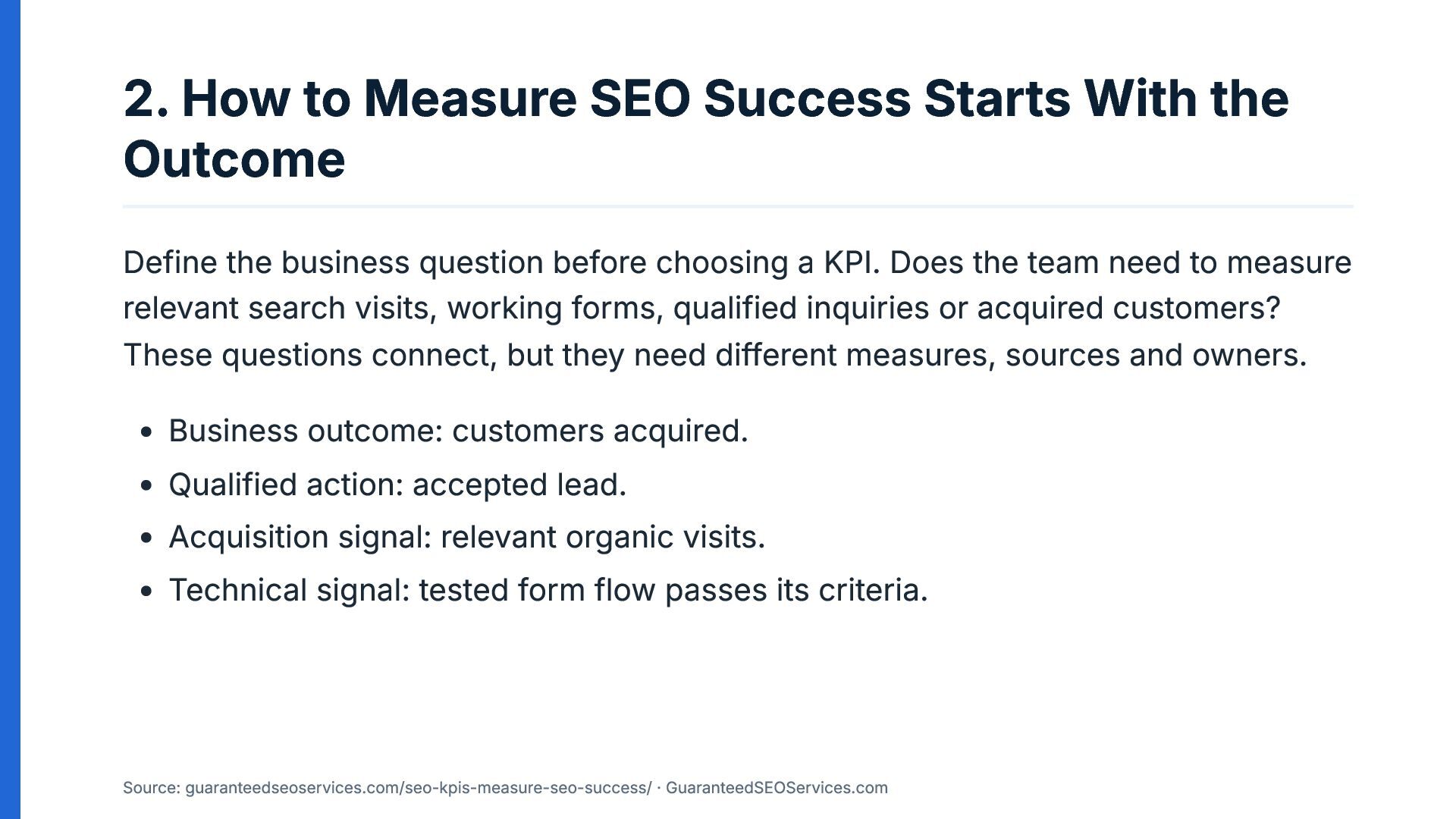
  3. 2. How to Measure SEO Success Starts With the Outcome

    Define the business question before choosing a KPI. Does the team need to measure relevant search visits, working forms, qualified inquiries or acquired customers? These questions connect, but they need different measures, sources and owners. Business outcome: customers acquired. Qualified action: accepted lead. Acquisition signal: relevant organic visits. Technical signal: tested form flow passes its criteria. Source: guaranteedseoservices.com/seo-kpis-measure-seo-success/ · GuaranteedSEOServices.com
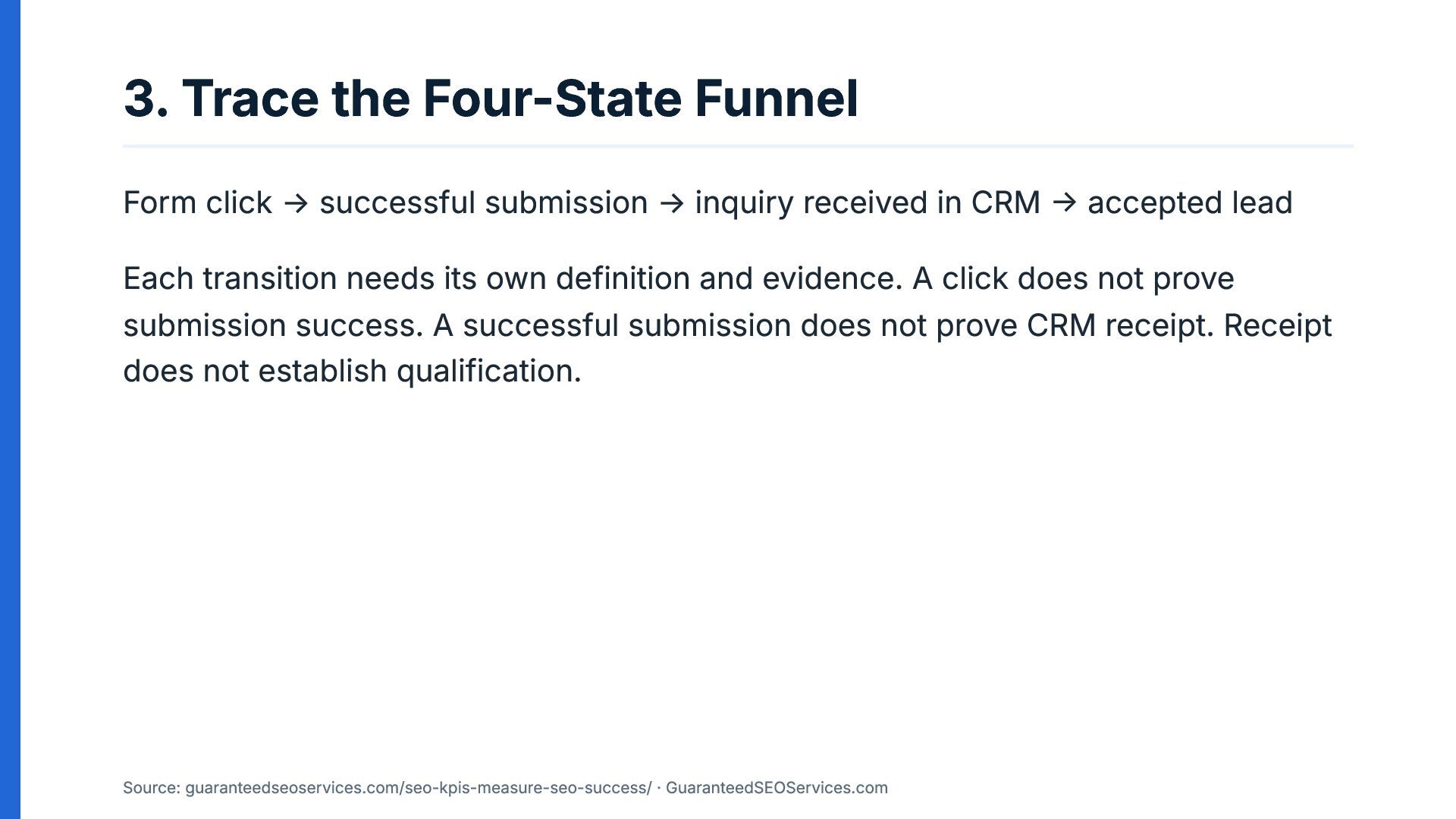
  4. 3. Trace the Four-State Funnel Form click → successful submission

    → inquiry received in CRM → accepted lead Each transition needs its own definition and evidence. A click does not prove submission success. A successful submission does not prove CRM receipt. Receipt does not establish qualification. Source: guaranteedseoservices.com/seo-kpis-measure-seo-success/ · GuaranteedSEOServices.com
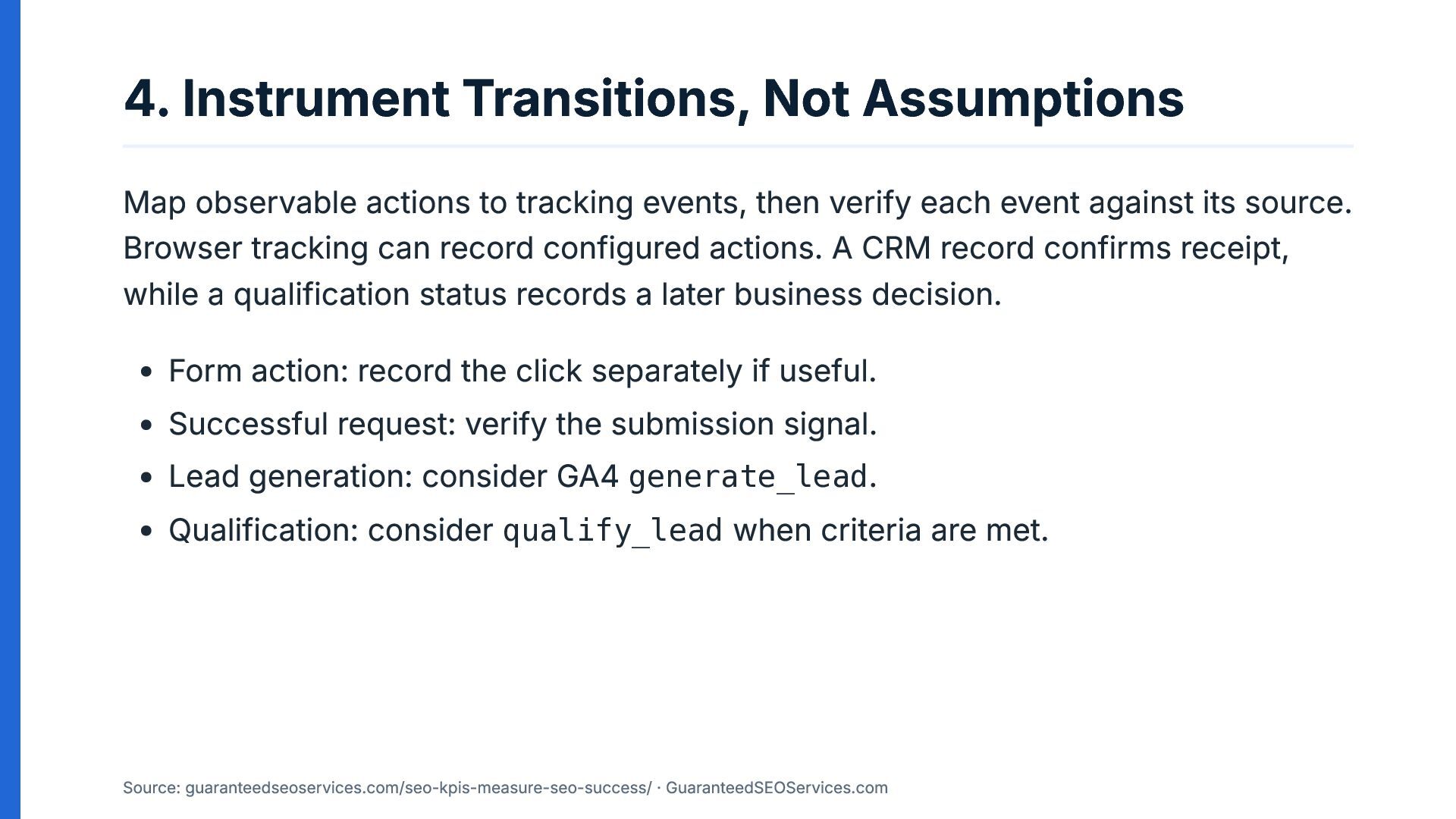
  5. 4. Instrument Transitions, Not Assumptions Map observable actions to tracking

    events, then verify each event against its source. Browser tracking can record configured actions. A CRM record confirms receipt, while a qualification status records a later business decision. Form action: record the click separately if useful. Successful request: verify the submission signal. Lead generation: consider GA4 generate_lead. Qualification: consider qualify_lead when criteria are met. Source: guaranteedseoservices.com/seo-kpis-measure-seo-success/ · GuaranteedSEOServices.com
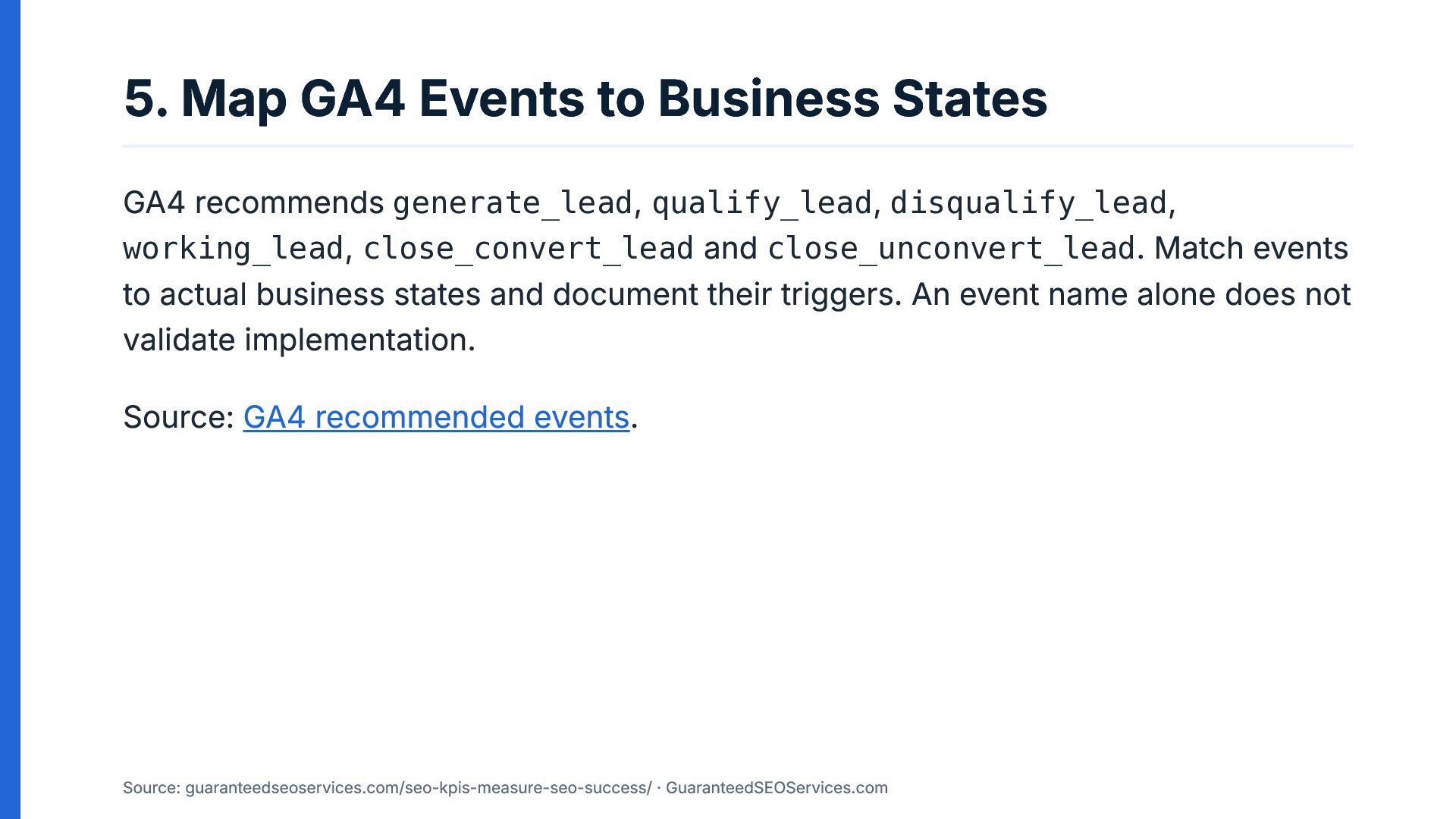
  6. 5. Map GA4 Events to Business States GA4 recommends generate_lead,

    qualify_lead, disqualify_lead, working_lead, close_convert_lead and close_unconvert_lead. Match events to actual business states and document their triggers. An event name alone does not validate implementation. Source: GA4 recommended events. Source: guaranteedseoservices.com/seo-kpis-measure-seo-success/ · GuaranteedSEOServices.com
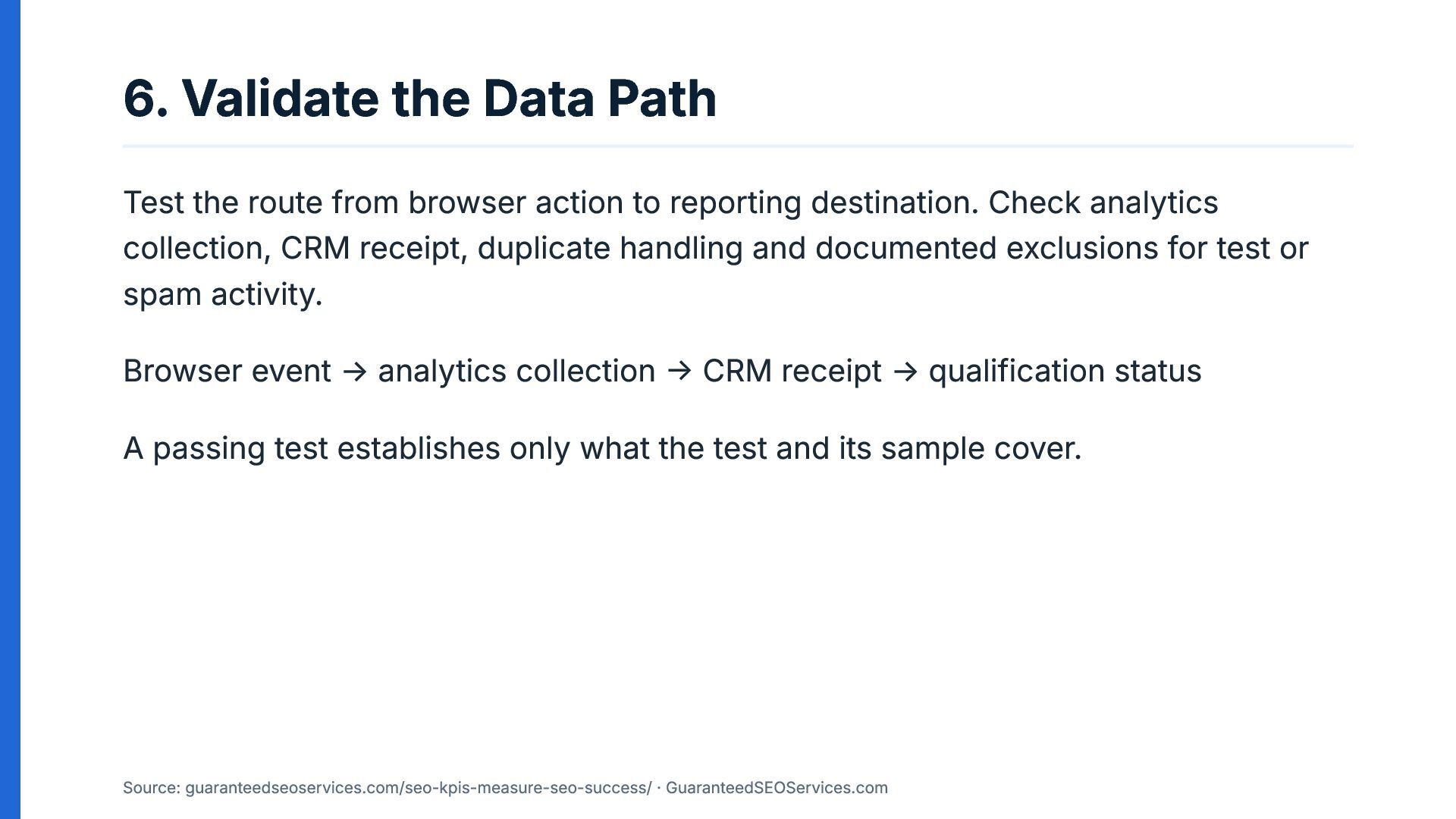
  7. 6. Validate the Data Path Test the route from browser

    action to reporting destination. Check analytics collection, CRM receipt, duplicate handling and documented exclusions for test or spam activity. Browser event → analytics collection → CRM receipt → qualification status A passing test establishes only what the test and its sample cover. Source: guaranteedseoservices.com/seo-kpis-measure-seo-success/ · GuaranteedSEOServices.com
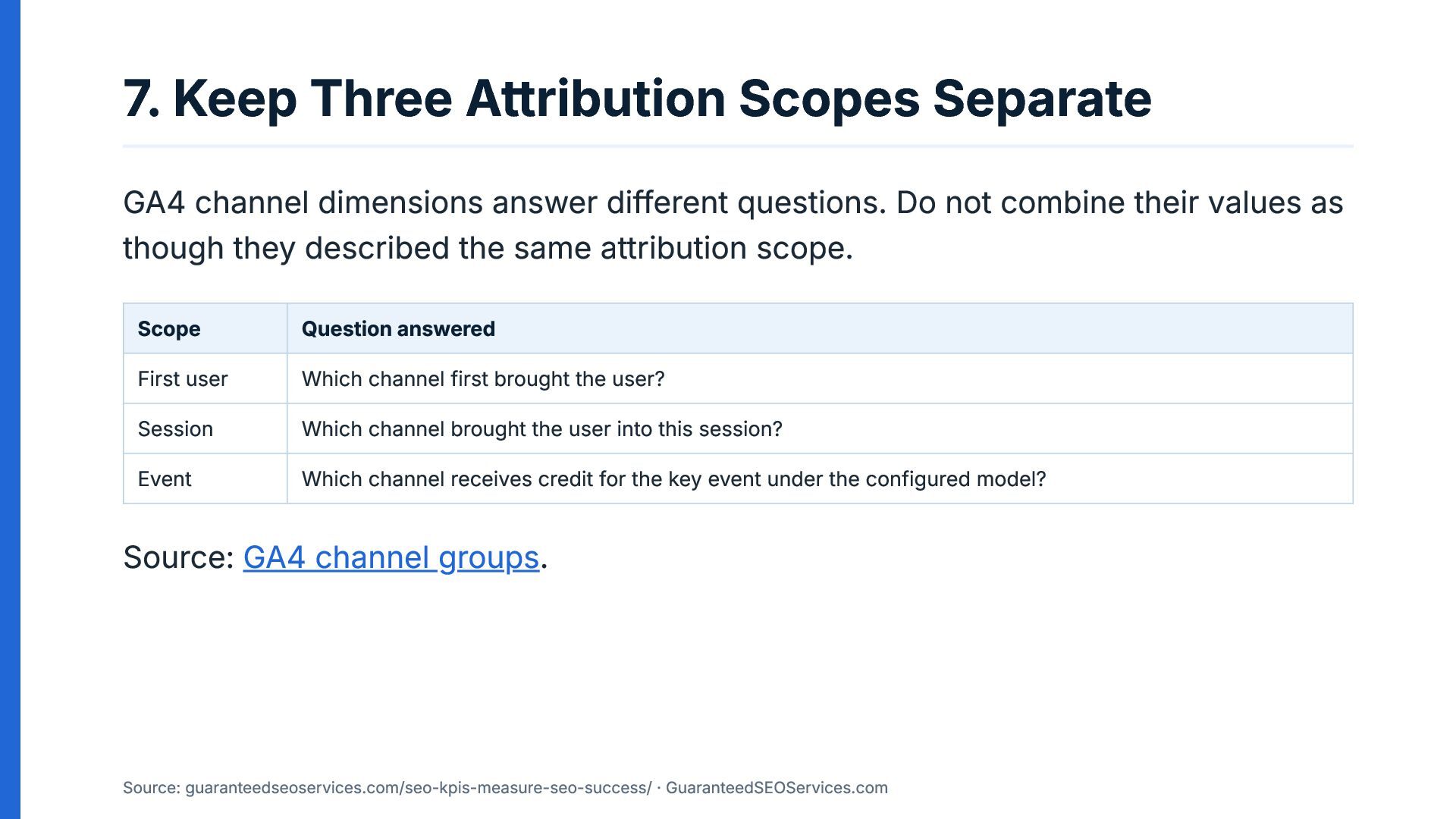
  8. 7. Keep Three Attribution Scopes Separate GA4 channel dimensions answer

    different questions. Do not combine their values as though they described the same attribution scope. Scope Question answered First user Which channel first brought the user? Session Which channel brought the user into this session? Event Which channel receives credit for the key event under the configured model? Source: GA4 channel groups. Source: guaranteedseoservices.com/seo-kpis-measure-seo-success/ · GuaranteedSEOServices.com
  9. 8. Attribution Is Credit, Not Causation Attribution applies a model

    to assign credit. It does not prove that a sale would not have happened without SEO. First-user acquisition, session acquisition and event attribution describe different relationships between channels and user activity. Keep the model and scope visible. Do not treat attributed conversions as a direct estimate of incremental sales without separate evidence. Source: guaranteedseoservices.com/seo-kpis-measure-seo-success/ · GuaranteedSEOServices.com
  10. 9. Every Rate Needs a Denominator A conversion rate without

    a defined population is difficult to interpret. State the numerator, denominator, filters and reporting period beside the formula. Submission rate: successful submissions divided by defined form starts. Qualification rate: accepted leads divided by received inquiries eligible for review. Template pass rate: passing tested templates divided by tested templates. These are proposed definitions. Verify that the underlying events and populations can be measured reliably. Source: guaranteedseoservices.com/seo-kpis-measure-seo-success/ · GuaranteedSEOServices.com
  11. 10. Report Technical Checks With Their Sample “All tested service

    templates passed” does not mean “all website pages passed.” State what was tested, when, against which acceptance criteria, and how many items were included. Record the sample, test date, pass criteria and exclusions. Fixing a delivery defect establishes a technical change, not a revenue increase. Source: guaranteedseoservices.com/seo-kpis-measure-seo-success/ · GuaranteedSEOServices.com
  12. 11. Read Search Metrics in Context Search Console reports clicks,

    impressions, CTR and average position. Query mix and result context affect interpretation. Average position can shift when the queries being measured change. Incomplete query exports are not a census of all search activity. Segment usefully, check the reporting period, and avoid treating an aggregate number as a full explanation. Source: Search Console Performance report. Source: guaranteedseoservices.com/seo-kpis-measure-seo-success/ · GuaranteedSEOServices.com
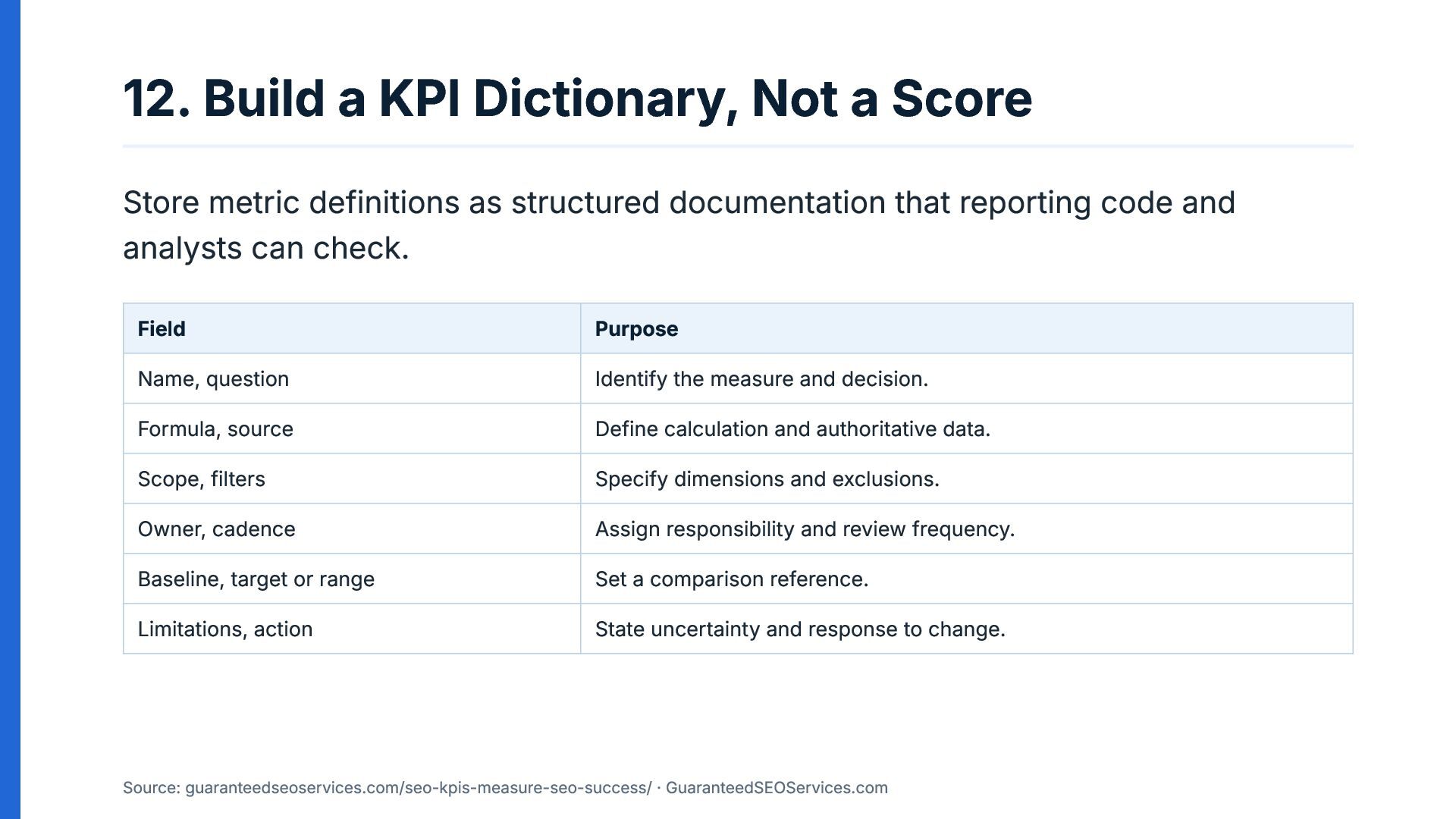
  13. 12. Build a KPI Dictionary, Not a Score Store metric

    definitions as structured documentation that reporting code and analysts can check. Field Purpose Name, question Identify the measure and decision. Formula, source Define calculation and authoritative data. Scope, filters Specify dimensions and exclusions. Owner, cadence Assign responsibility and review frequency. Baseline, target or range Set a comparison reference. Limitations, action State uncertainty and response to change. Source: guaranteedseoservices.com/seo-kpis-measure-seo-success/ · GuaranteedSEOServices.com
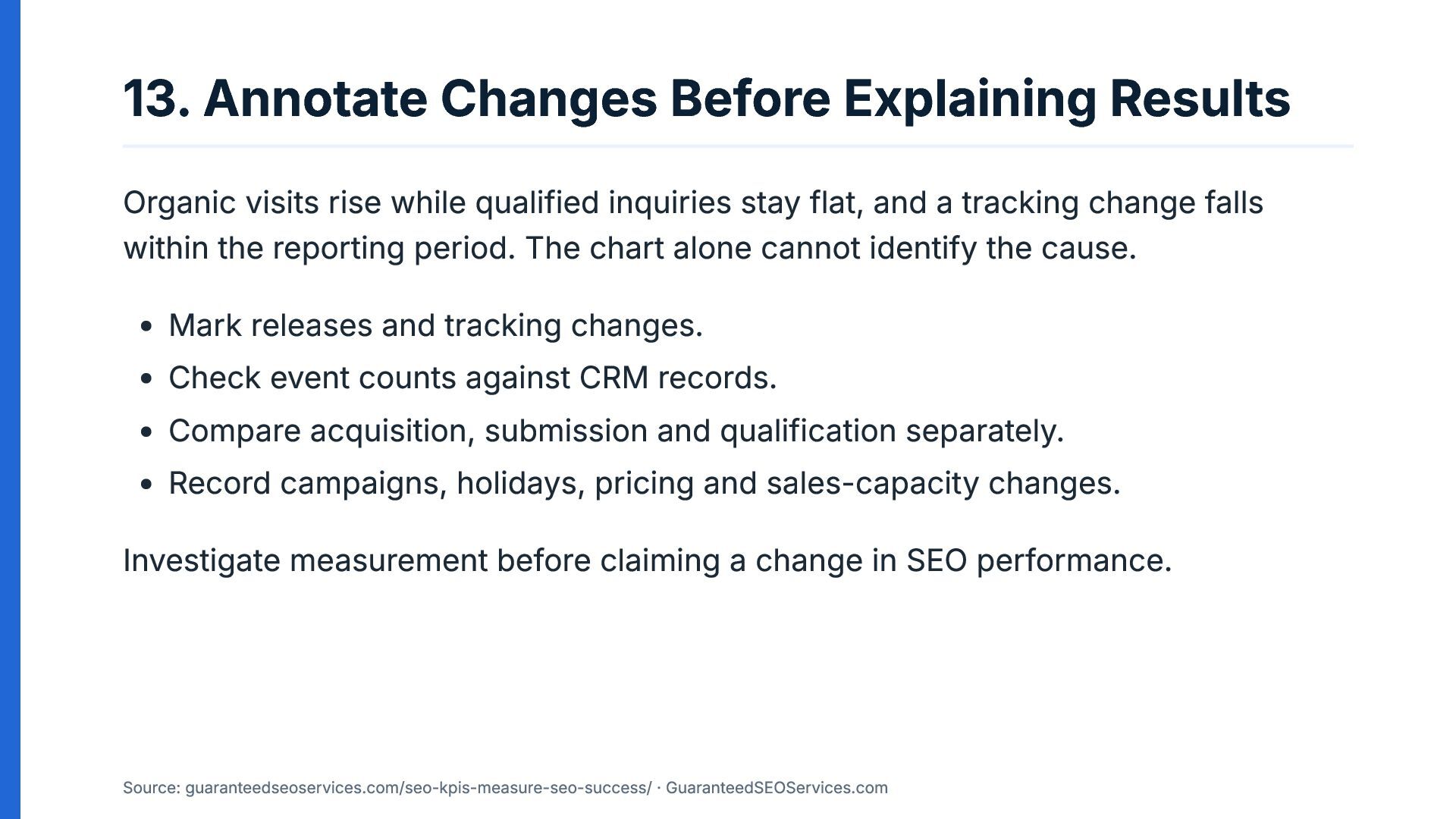
  14. 13. Annotate Changes Before Explaining Results Organic visits rise while

    qualified inquiries stay flat, and a tracking change falls within the reporting period. The chart alone cannot identify the cause. Mark releases and tracking changes. Check event counts against CRM records. Compare acquisition, submission and qualification separately. Record campaigns, holidays, pricing and sales-capacity changes. Investigate measurement before claiming a change in SEO performance. Source: guaranteedseoservices.com/seo-kpis-measure-seo-success/ · GuaranteedSEOServices.com
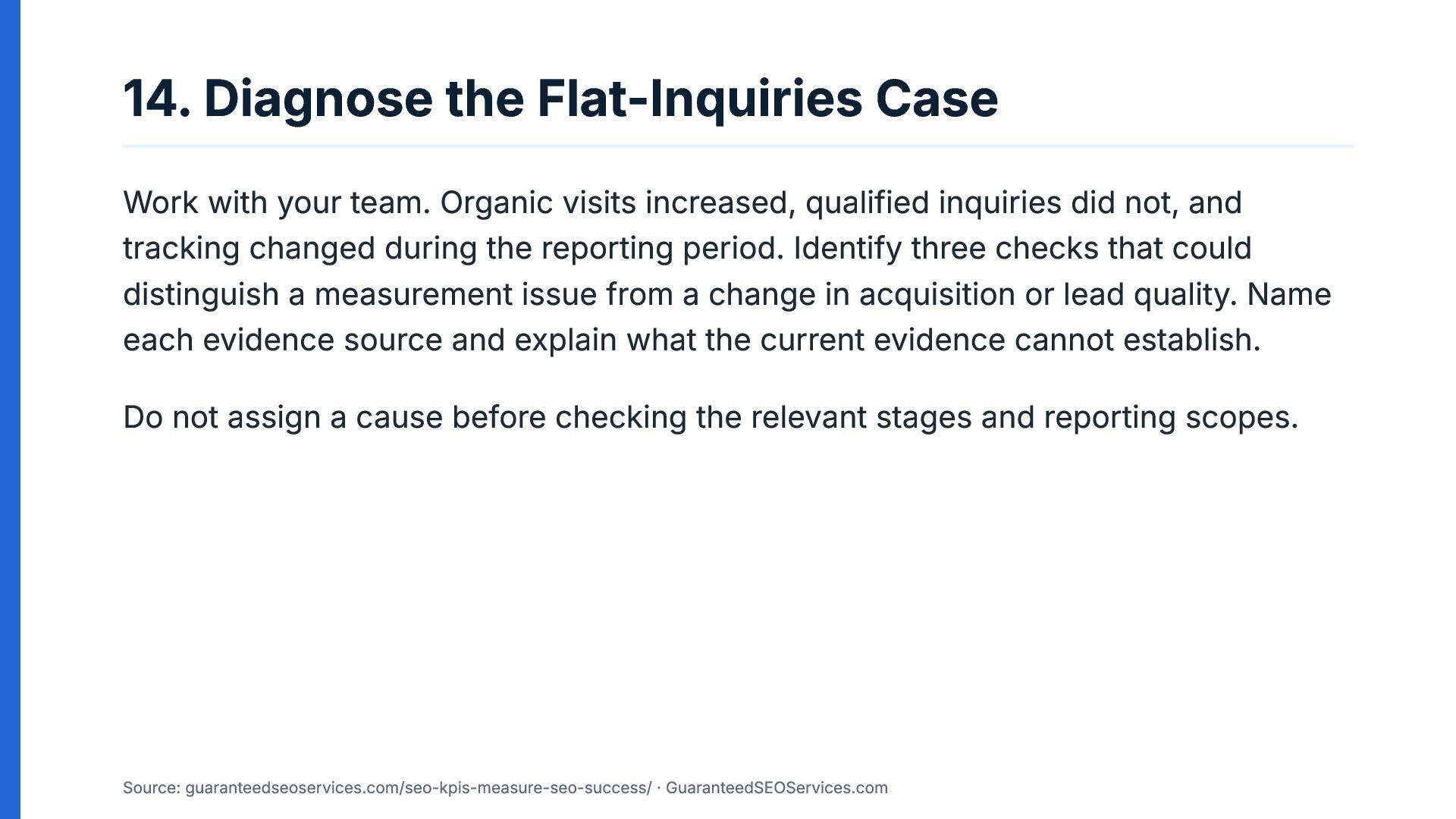
  15. 14. Diagnose the Flat-Inquiries Case Work with your team. Organic

    visits increased, qualified inquiries did not, and tracking changed during the reporting period. Identify three checks that could distinguish a measurement issue from a change in acquisition or lead quality. Name each evidence source and explain what the current evidence cannot establish. Do not assign a cause before checking the relevant stages and reporting scopes. Source: guaranteedseoservices.com/seo-kpis-measure-seo-success/ · GuaranteedSEOServices.com
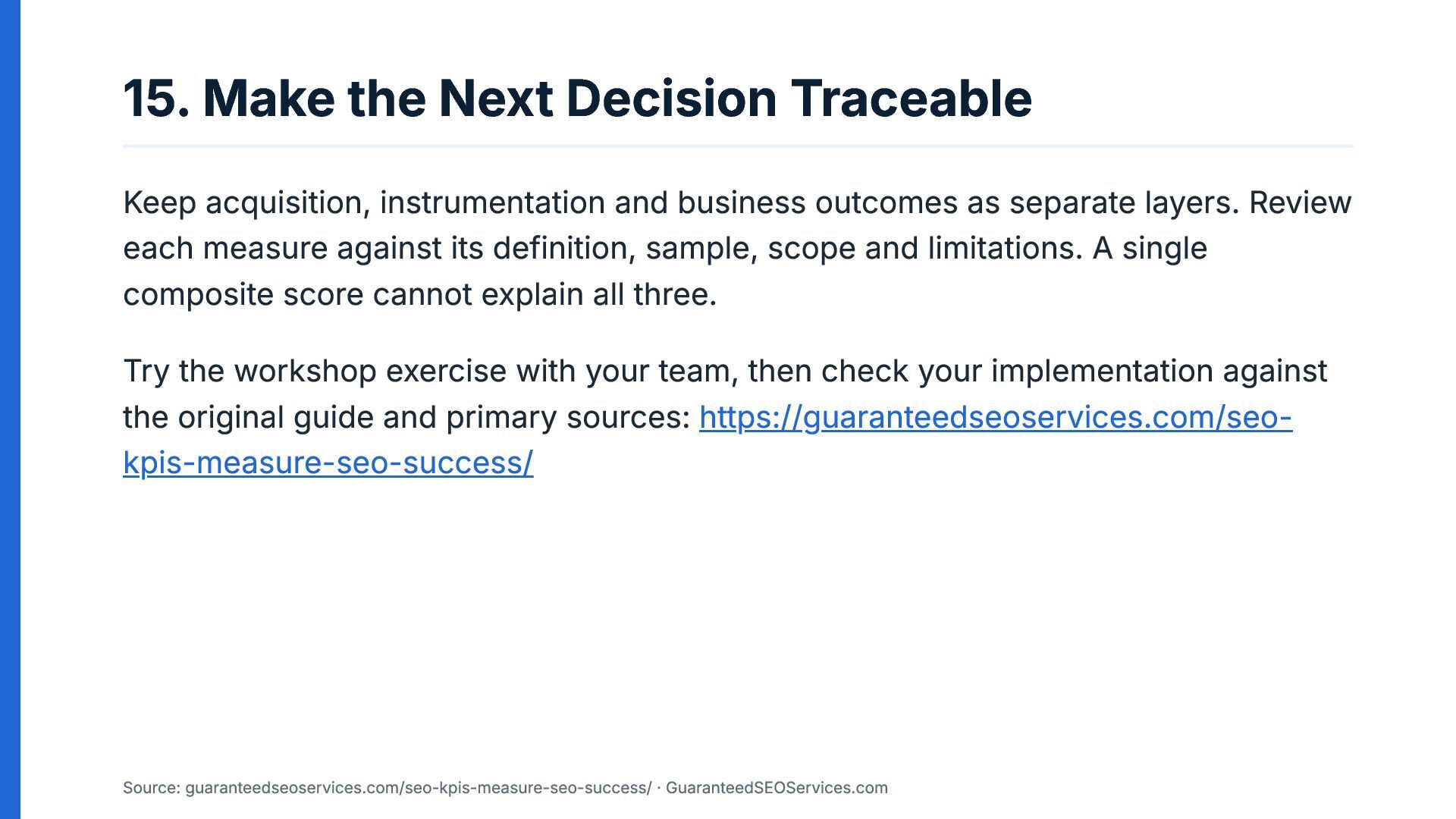
  16. 15. Make the Next Decision Traceable Keep acquisition, instrumentation and

    business outcomes as separate layers. Review each measure against its definition, sample, scope and limitations. A single composite score cannot explain all three. Try the workshop exercise with your team, then check your implementation against the original guide and primary sources: https://guaranteedseoservices.com/seokpis-measure-seo-success/ Source: guaranteedseoservices.com/seo-kpis-measure-seo-success/ · GuaranteedSEOServices.com
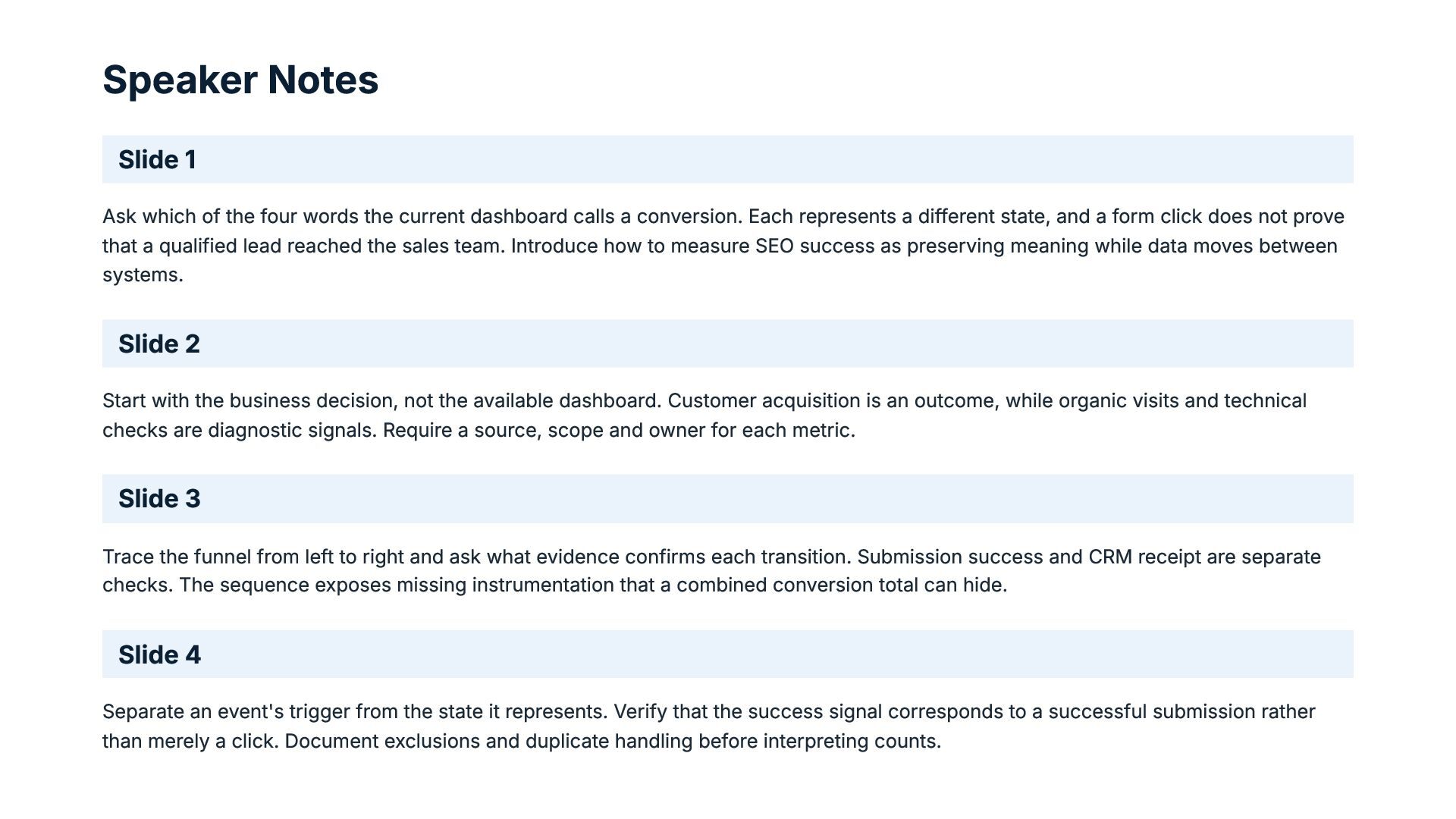
  17. Speaker Notes Slide 1 Ask which of the four words

    the current dashboard calls a conversion. Each represents a different state, and a form click does not prove that a qualified lead reached the sales team. Introduce how to measure SEO success as preserving meaning while data moves between systems. Slide 2 Start with the business decision, not the available dashboard. Customer acquisition is an outcome, while organic visits and technical checks are diagnostic signals. Require a source, scope and owner for each metric. Slide 3 Trace the funnel from left to right and ask what evidence confirms each transition. Submission success and CRM receipt are separate checks. The sequence exposes missing instrumentation that a combined conversion total can hide. Slide 4 Separate an event's trigger from the state it represents. Verify that the success signal corresponds to a successful submission rather than merely a click. Document exclusions and duplicate handling before interpreting counts.
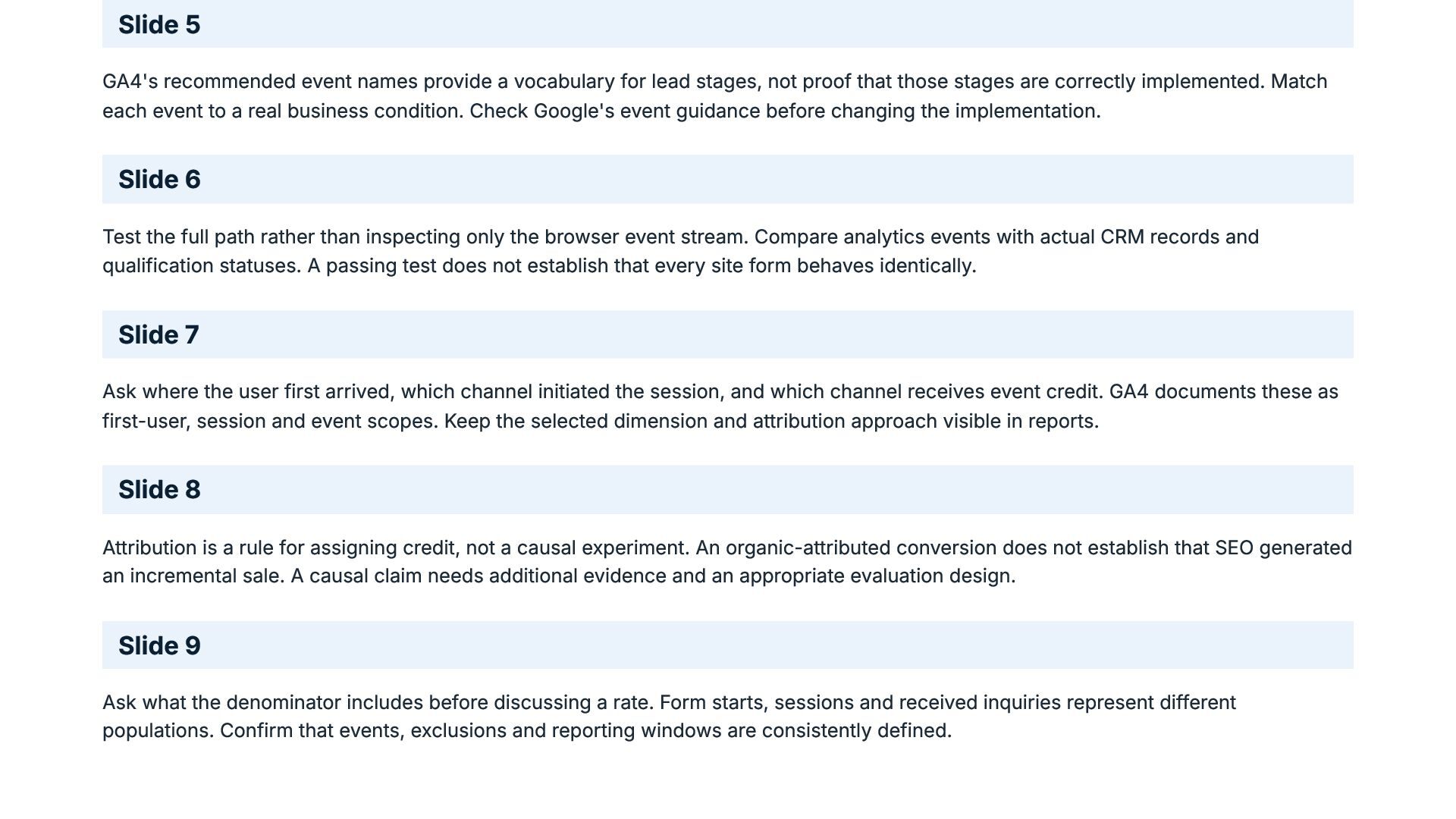
  18. Slide 5 GA4's recommended event names provide a vocabulary for

    lead stages, not proof that those stages are correctly implemented. Match each event to a real business condition. Check Google's event guidance before changing the implementation. Slide 6 Test the full path rather than inspecting only the browser event stream. Compare analytics events with actual CRM records and qualification statuses. A passing test does not establish that every site form behaves identically. Slide 7 Ask where the user first arrived, which channel initiated the session, and which channel receives event credit. GA4 documents these as first-user, session and event scopes. Keep the selected dimension and attribution approach visible in reports. Slide 8 Attribution is a rule for assigning credit, not a causal experiment. An organic-attributed conversion does not establish that SEO generated an incremental sale. A causal claim needs additional evidence and an appropriate evaluation design. Slide 9 Ask what the denominator includes before discussing a rate. Form starts, sessions and received inquiries represent different populations. Confirm that events, exclusions and reporting windows are consistently defined.
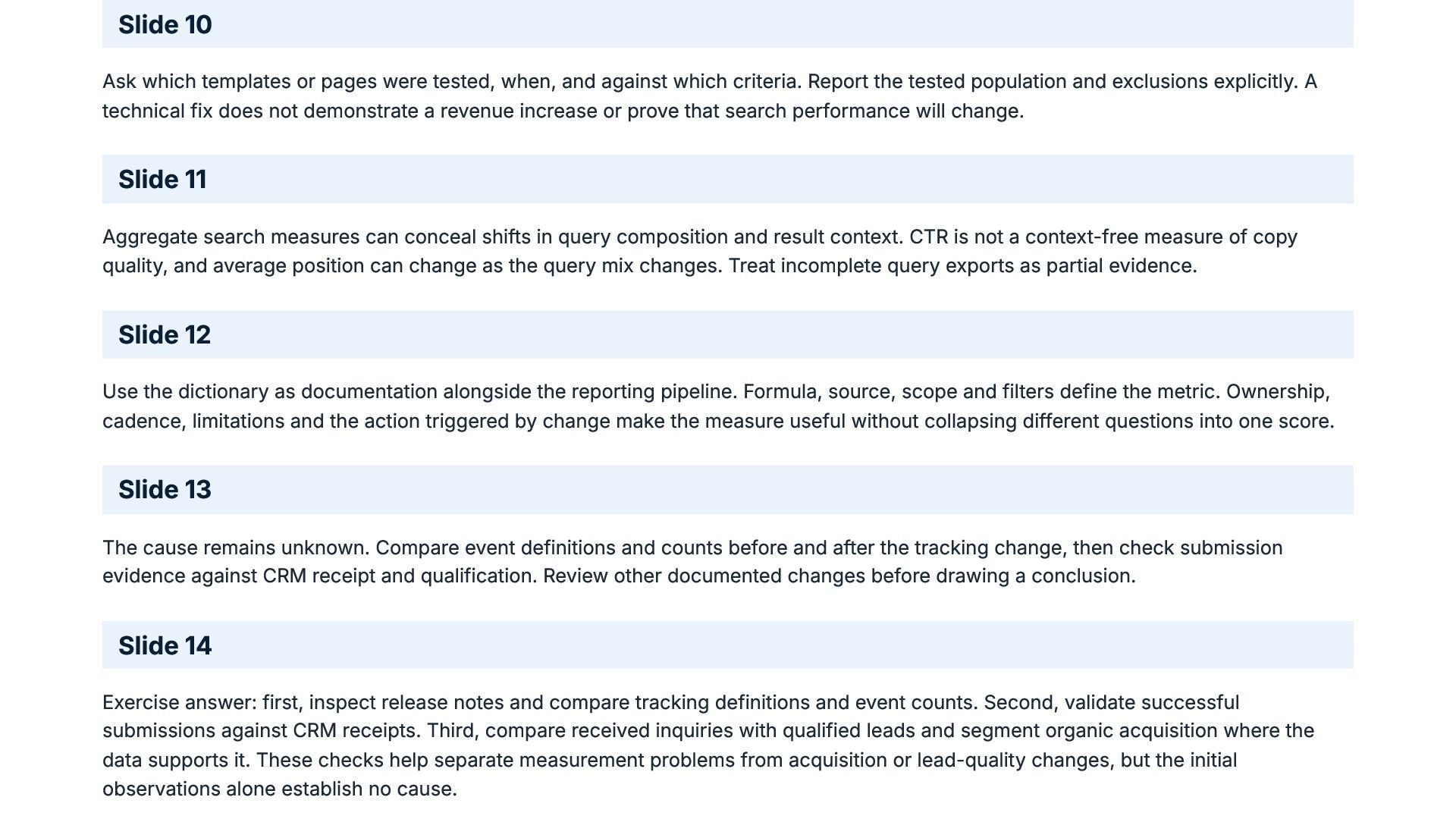
  19. Slide 10 Ask which templates or pages were tested, when,

    and against which criteria. Report the tested population and exclusions explicitly. A technical fix does not demonstrate a revenue increase or prove that search performance will change. Slide 11 Aggregate search measures can conceal shifts in query composition and result context. CTR is not a context-free measure of copy quality, and average position can change as the query mix changes. Treat incomplete query exports as partial evidence. Slide 12 Use the dictionary as documentation alongside the reporting pipeline. Formula, source, scope and filters define the metric. Ownership, cadence, limitations and the action triggered by change make the measure useful without collapsing different questions into one score. Slide 13 The cause remains unknown. Compare event definitions and counts before and after the tracking change, then check submission evidence against CRM receipt and qualification. Review other documented changes before drawing a conclusion. Slide 14 Exercise answer: first, inspect release notes and compare tracking definitions and event counts. Second, validate successful submissions against CRM receipts. Third, compare received inquiries with qualified leads and segment organic acquisition where the data supports it. These checks help separate measurement problems from acquisition or lead-quality changes, but the initial observations alone establish no cause.
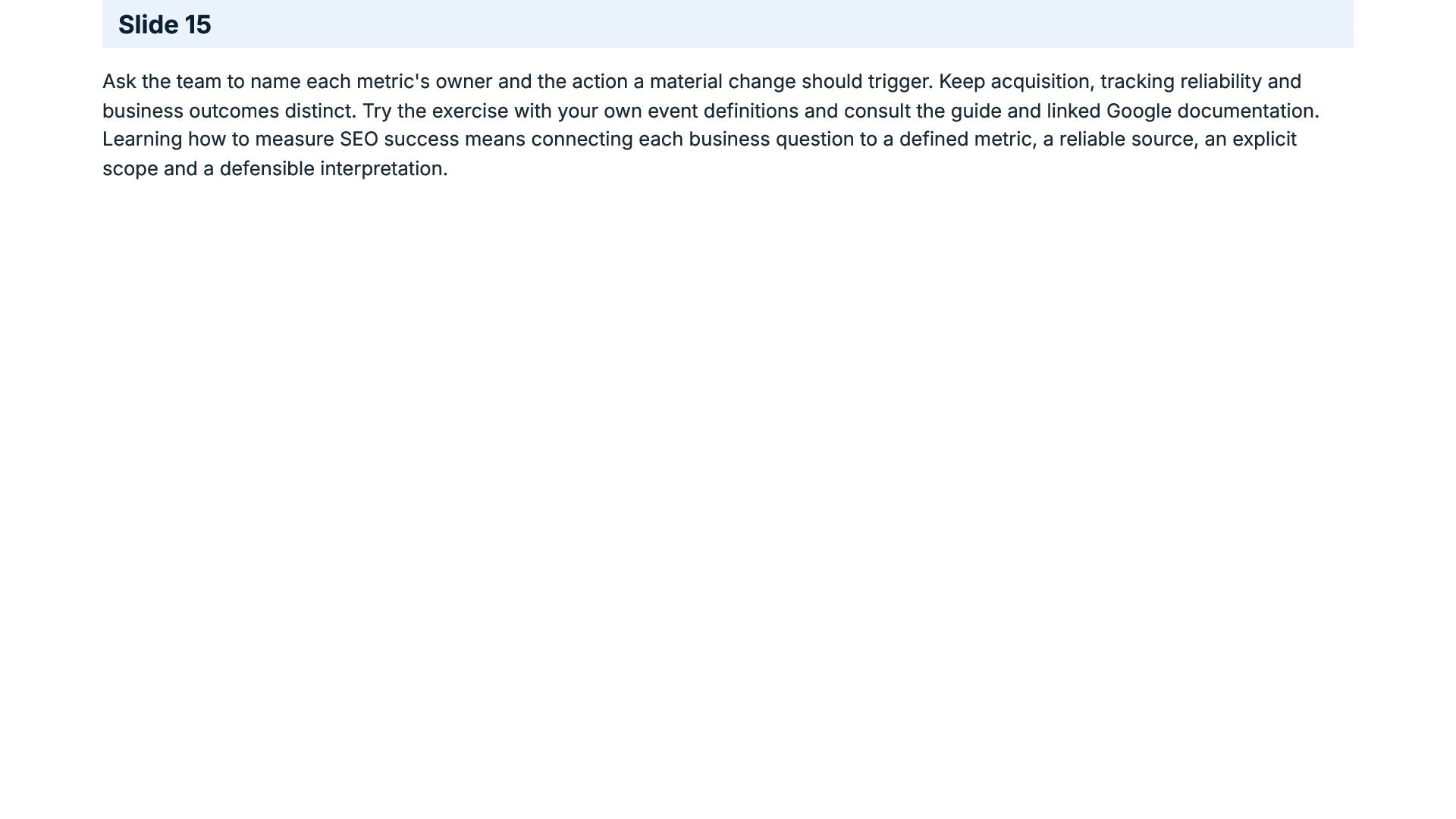
  20. Slide 15 Ask the team to name each metric's owner

    and the action a material change should trigger. Keep acquisition, tracking reliability and business outcomes distinct. Try the exercise with your own event definitions and consult the guide and linked Google documentation. Learning how to measure SEO success means connecting each business question to a defined metric, a reliable source, an explicit scope and a defensible interpretation.

More Decks by GuaranteedSEOServices

Other Decks in Marketing & SEO