Trinity: The Three Levels of Harmony as Compone...
Sponsored
·
 Your Podcast. Everywhere. Effortlessly.
Share. Educate. Inspire. Entertain. You do you. We'll handle the rest.
→
Your Podcast. Everywhere. Effortlessly.
Share. Educate. Inspire. Entertain. You do you. We'll handle the rest.
→

Share
Embed
Trinity: The Three Levels of Harmony as Components of One Isomorphism, and How They Come Apart (LENLS22)
Slides for my talk at LENLS22 (Kobe University, 28 November 2026). The three levels of harmony in proof-theoretic semantics (local: inversion principle; intermediate: normalization; global: conservativity) are read as components of one isomorphism between the category of proofs of unit-free MLL and the category of proof nets. We then look at how they come apart under mix, cyclic exchange, units and structural rules. Public version, with slides added after the Q&A.

Shunsuke Yatabe
November 28, 2026
Annual Pro sale · Save $30
Have presentations of your own?
Share with private links, password protection, and more control over your work.
Transcript
31 slides
-
Trinity The Three Levels of Harmony as Components of One
Isomorphism, and How They Come Apart Shunsuke Yatabe Ochanomizu University LENLS22, Kobe University, 28 November 2026 1 / 19 -
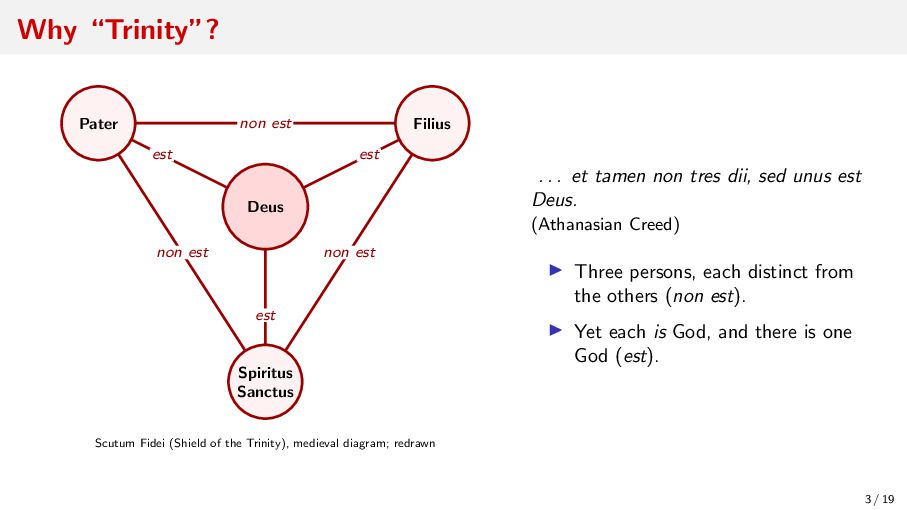
Why “Trinity”? non est Pater est Filius est . .
. et tamen non tres dii, sed unus est Deus. Deus (Athanasian Creed) non est non est ▶ Three persons, each distinct from the others (non est). est ▶ Yet each is God, and there is one God (est). Spiritus Sanctus Scutum Fidei (Shield of the Trinity), medieval diagram; redrawn 3 / 19 -
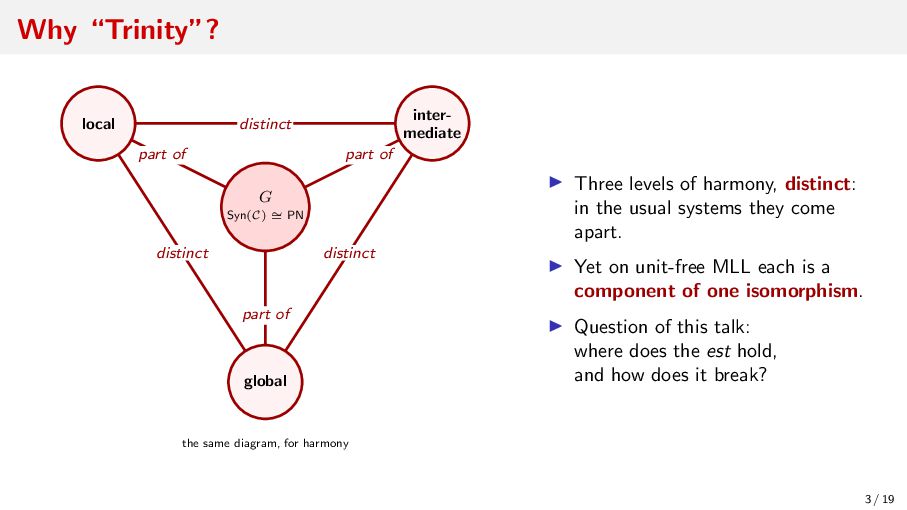
Why “Trinity”? local intermediate distinct part of part of ▶
Three levels of harmony, distinct: in the usual systems they come apart. G Syn(C) ∼ = PN distinct distinct part of global ▶ Yet on unit-free MLL each is a component of one isomorphism. ▶ Question of this talk: where does the est hold, and how does it break? the same diagram, for harmony 3 / 19 -
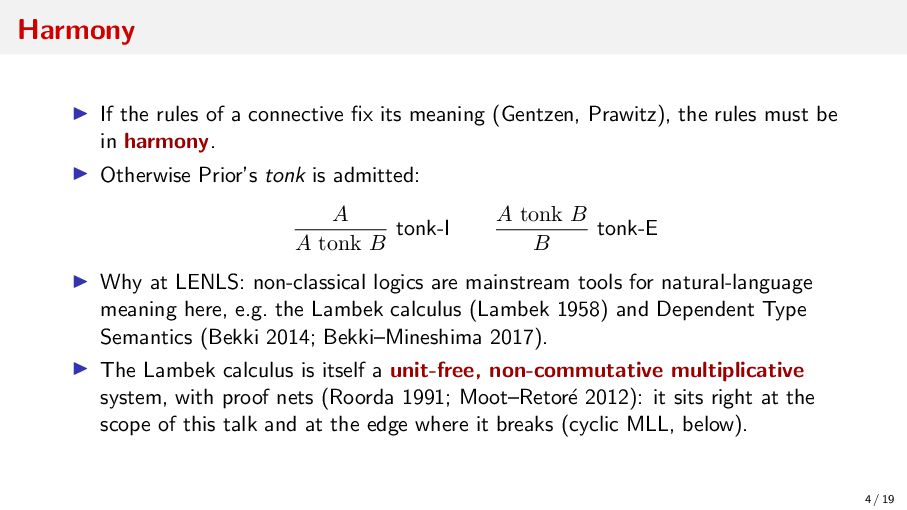
Harmony ▶ If the rules of a connective fix its
meaning (Gentzen, Prawitz), the rules must be in harmony. ▶ Otherwise Prior’s tonk is admitted: A tonk-I A tonk B A tonk B tonk-E B ▶ Why at LENLS: non-classical logics are mainstream tools for natural-language meaning here, e.g. the Lambek calculus (Lambek 1958) and Dependent Type Semantics (Bekki 2014; Bekki–Mineshima 2017). ▶ The Lambek calculus is itself a unit-free, non-commutative multiplicative system, with proof nets (Roorda 1991; Moot–Retoré 2012): it sits right at the scope of this talk and at the edge where it breaks (cyclic MLL, below). 4 / 19 -
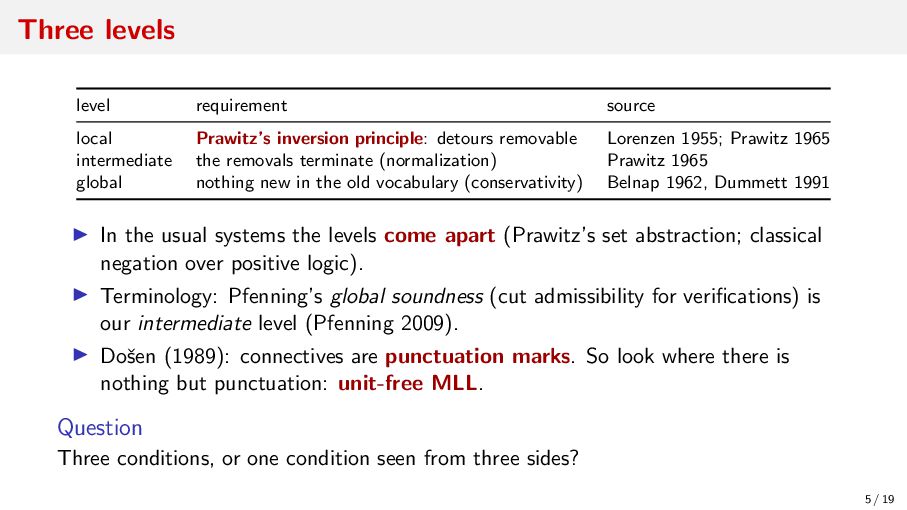
Three levels level requirement source local intermediate global Prawitz’s inversion
principle: detours removable the removals terminate (normalization) nothing new in the old vocabulary (conservativity) Lorenzen 1955; Prawitz 1965 Prawitz 1965 Belnap 1962, Dummett 1991 ▶ In the usual systems the levels come apart (Prawitz’s set abstraction; classical negation over positive logic). ▶ Terminology: Pfenning’s global soundness (cut admissibility for verifications) is our intermediate level (Pfenning 2009). ▶ Došen (1989): connectives are punctuation marks. So look where there is nothing but punctuation: unit-free MLL. Question Three conditions, or one condition seen from three sides? 5 / 19 -
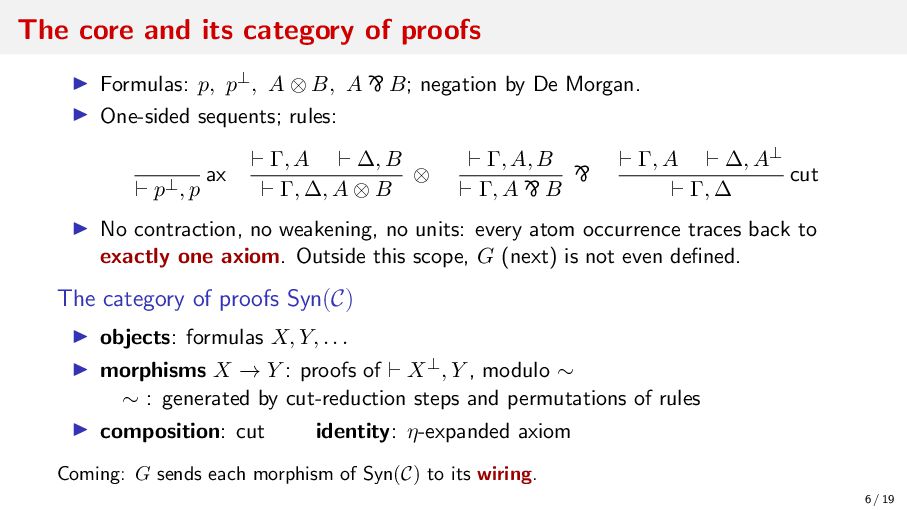
The core and its category of proofs B; negation by
De Morgan. ⊢ Γ, A, B ⊢ Γ, A B & ⊢ Γ, A ⊢ ∆, B ⊗ ⊢ Γ, ∆, A ⊗ B & ⊢ p⊥ , p ax & ▶ Formulas: p, p⊥ , A ⊗ B, A ▶ One-sided sequents; rules: ⊢ Γ, A ⊢ ∆, A⊥ cut ⊢ Γ, ∆ ▶ No contraction, no weakening, no units: every atom occurrence traces back to exactly one axiom. Outside this scope, G (next) is not even defined. The category of proofs Syn(C) ▶ objects: formulas X, Y, . . . ▶ morphisms X → Y : proofs of ⊢ X ⊥ , Y , modulo ∼ ∼ : generated by cut-reduction steps and permutations of rules ▶ composition: cut identity: η-expanded axiom Coming: G sends each morphism of Syn(C) to its wiring. 6 / 19 -
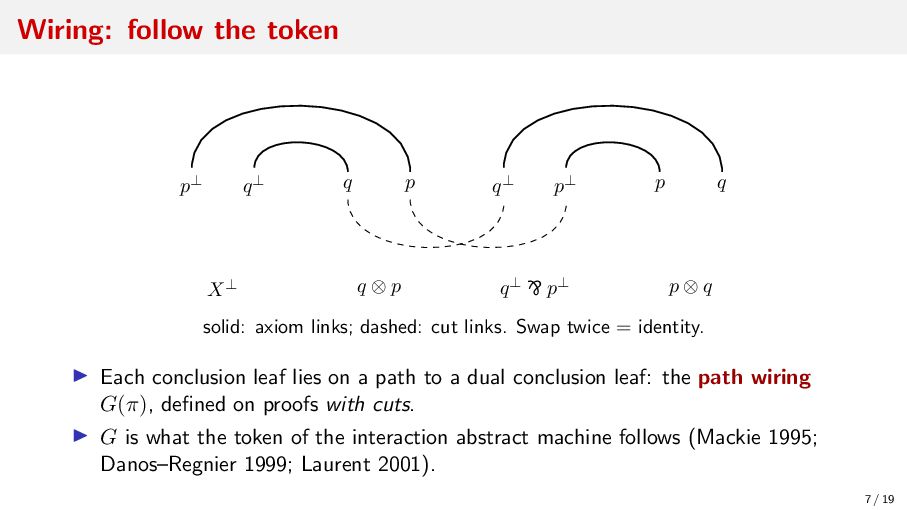
Wiring: follow the token q⊥ X⊥ q p q⊗p q⊥
q⊥ p⊥ & p⊥ p⊥ p q p⊗q solid: axiom links; dashed: cut links. Swap twice = identity. ▶ Each conclusion leaf lies on a path to a dual conclusion leaf: the path wiring G(π), defined on proofs with cuts. ▶ G is what the token of the interaction abstract machine follows (Mackie 1995; Danos–Regnier 1999; Laurent 2001). 7 / 19 -
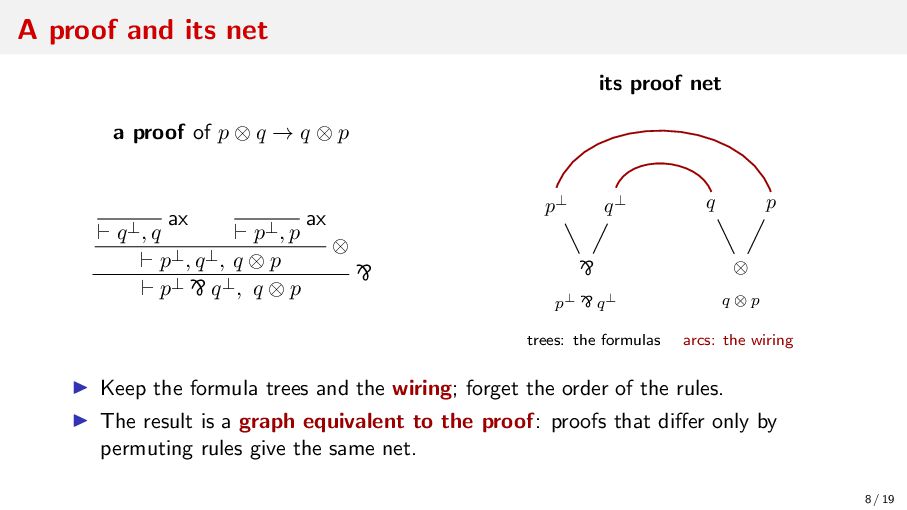
A proof and its net its proof net a proof
of p ⊗ q → q ⊗ p q⊥ q p ⊗ p⊥ & & ⊢ q⊥, q ⊢ p⊥ , p ⊥ ⊥ ⊢ p ,q , q ⊗ p ⊢ p⊥ q ⊥ , q ⊗ p p⊥ ax & ax ⊗ q⊥ & trees: the formulas q⊗p arcs: the wiring ▶ Keep the formula trees and the wiring; forget the order of the rules. ▶ The result is a graph equivalent to the proof: proofs that differ only by permuting rules give the same net. 8 / 19 -
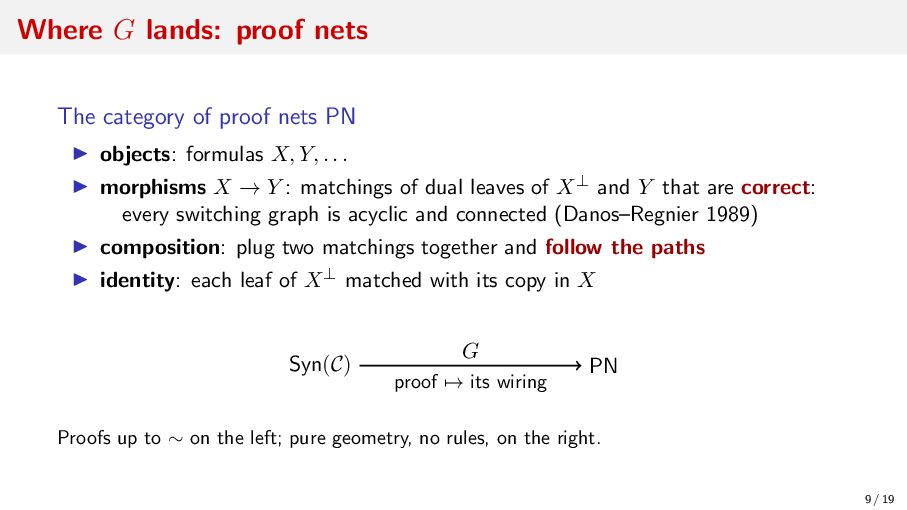
Where G lands: proof nets The category of proof nets
PN ▶ objects: formulas X, Y, . . . ▶ morphisms X → Y : matchings of dual leaves of X ⊥ and Y that are correct: every switching graph is acyclic and connected (Danos–Regnier 1989) ▶ composition: plug two matchings together and follow the paths ▶ identity: each leaf of X ⊥ matched with its copy in X Syn(C) G proof 7→ its wiring PN Proofs up to ∼ on the left; pure geometry, no rules, on the right. 9 / 19 -
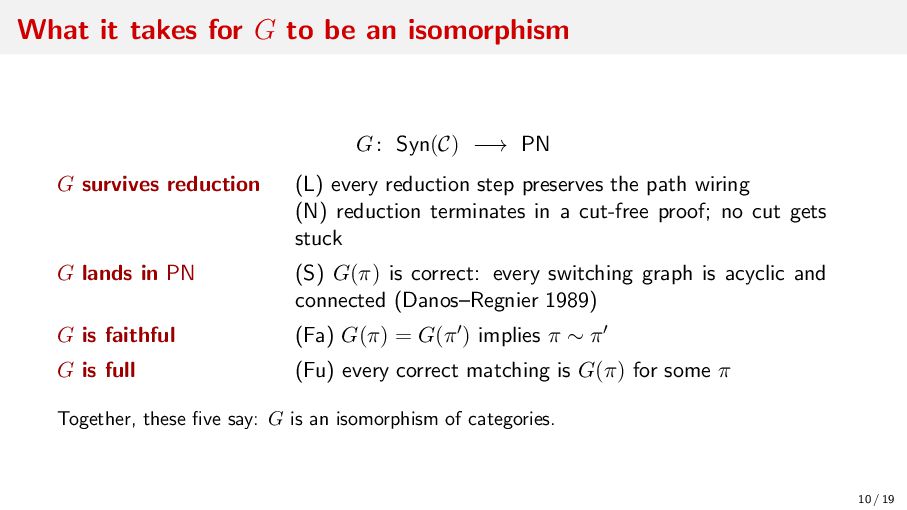
What it takes for G to be an isomorphism G
: Syn(C) −→ PN G survives reduction (L) every reduction step preserves the path wiring (N) reduction terminates in a cut-free proof; no cut gets stuck G lands in PN (S) G(π) is correct: every switching graph is acyclic and connected (Danos–Regnier 1989) G is faithful (Fa) G(π) = G(π ′ ) implies π ∼ π ′ G is full (Fu) every correct matching is G(π) for some π Together, these five say: G is an isomorphism of categories. 10 / 19 -
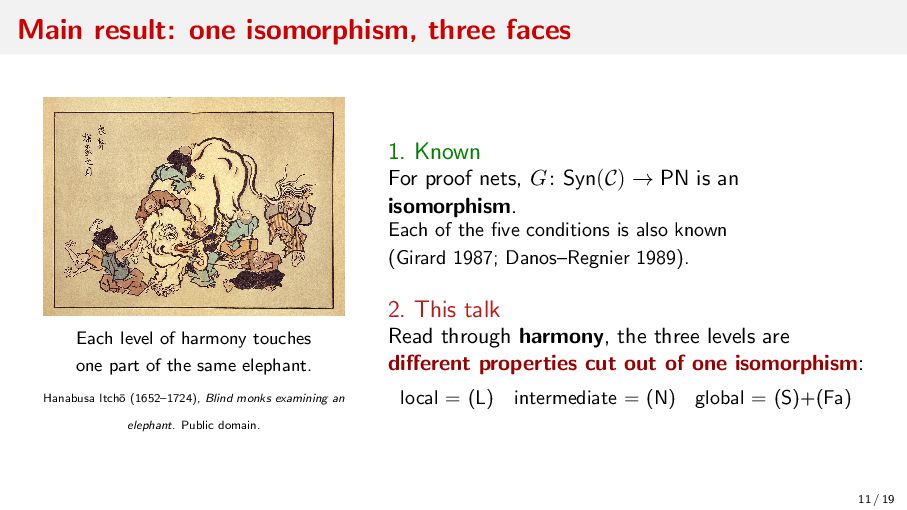
Main result: one isomorphism, three faces 1. Known For proof
nets, G : Syn(C) → PN is an isomorphism. Each of the five conditions is also known (Girard 1987; Danos–Regnier 1989). 2. This talk Each level of harmony touches one part of the same elephant. Hanabusa Itchō (1652–1724), Blind monks examining an Read through harmony, the three levels are different properties cut out of one isomorphism: local = (L) intermediate = (N) global = (S)+(Fa) elephant. Public domain. 11 / 19 -
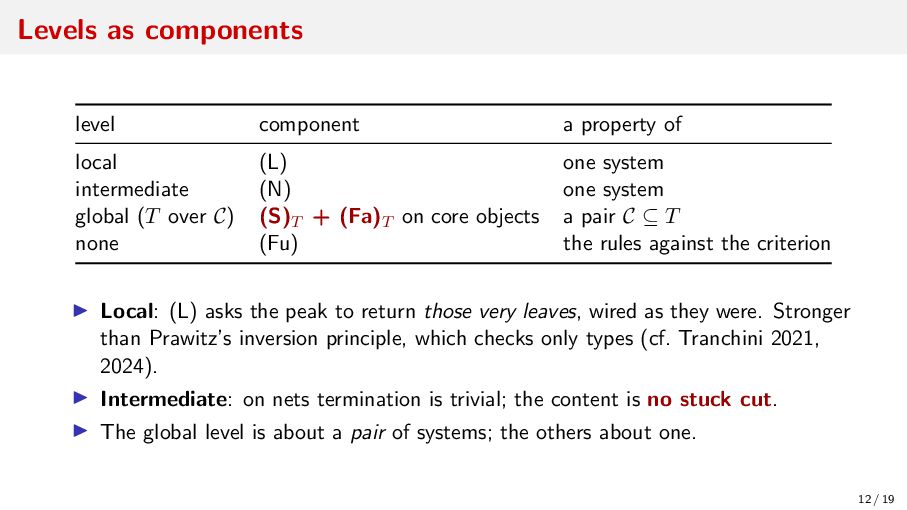
Levels as components level component a property of local intermediate
global (T over C) none (L) (N) (S)T + (Fa)T on core objects (Fu) one system one system a pair C ⊆ T the rules against the criterion ▶ Local: (L) asks the peak to return those very leaves, wired as they were. Stronger than Prawitz’s inversion principle, which checks only types (cf. Tranchini 2021, 2024). ▶ Intermediate: on nets termination is trivial; the content is no stuck cut. ▶ The global level is about a pair of systems; the others about one. 12 / 19 -
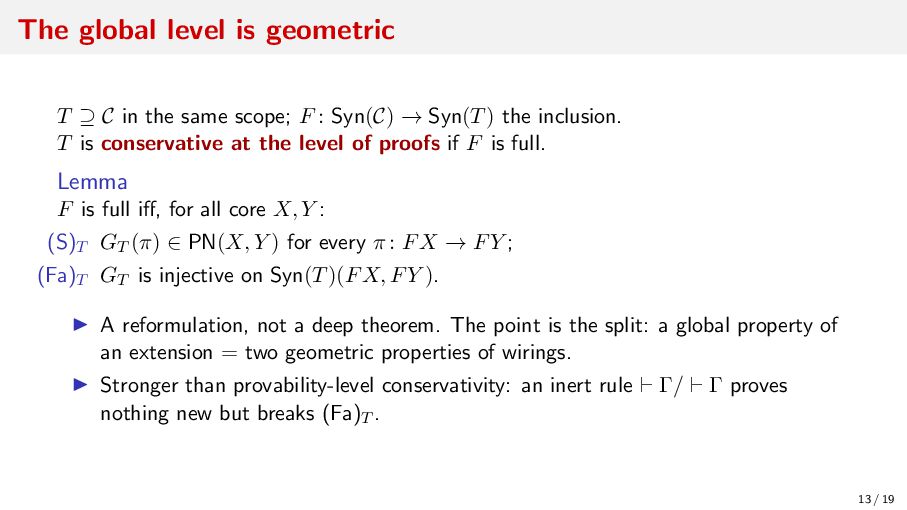
The global level is geometric T ⊇ C in the
same scope; F : Syn(C) → Syn(T ) the inclusion. T is conservative at the level of proofs if F is full. Lemma F is full iff, for all core X, Y : (S)T GT (π) ∈ PN(X, Y ) for every π : F X → F Y ; (Fa)T GT is injective on Syn(T )(F X, F Y ). ▶ A reformulation, not a deep theorem. The point is the split: a global property of an extension = two geometric properties of wirings. ▶ Stronger than provability-level conservativity: an inert rule ⊢ Γ/ ⊢ Γ proves nothing new but breaks (Fa)T . 13 / 19 -
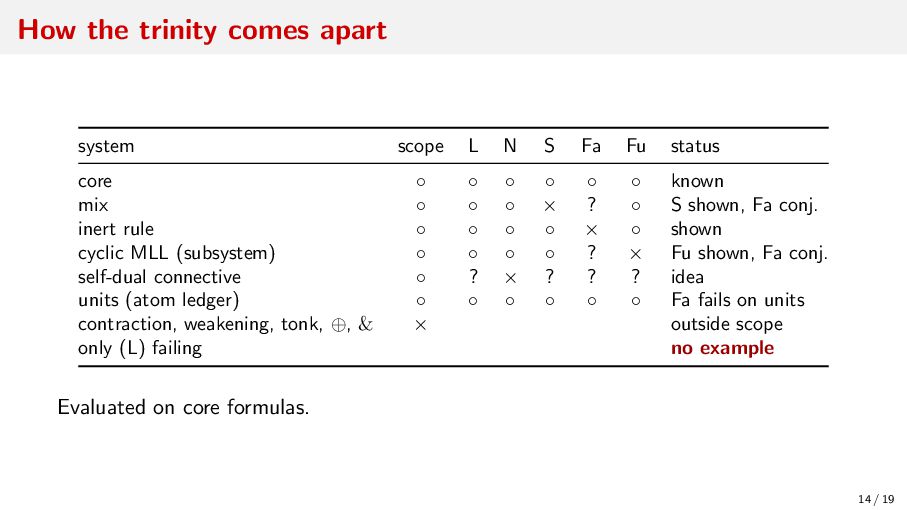
How the trinity comes apart system core mix inert rule
cyclic MLL (subsystem) self-dual connective units (atom ledger) contraction, weakening, tonk, ⊕, & only (L) failing scope L N S Fa Fu status ◦ ◦ ◦ ◦ ◦ ◦ × ◦ ◦ ◦ ◦ ? ◦ ◦ ◦ ◦ ◦ × ◦ ◦ × ◦ ◦ ? ◦ ◦ ? × ? ? ◦ ◦ ◦ ◦ × ? ◦ known S shown, Fa conj. shown Fu shown, Fa conj. idea Fa fails on units outside scope no example Evaluated on core formulas. 14 / 19 -
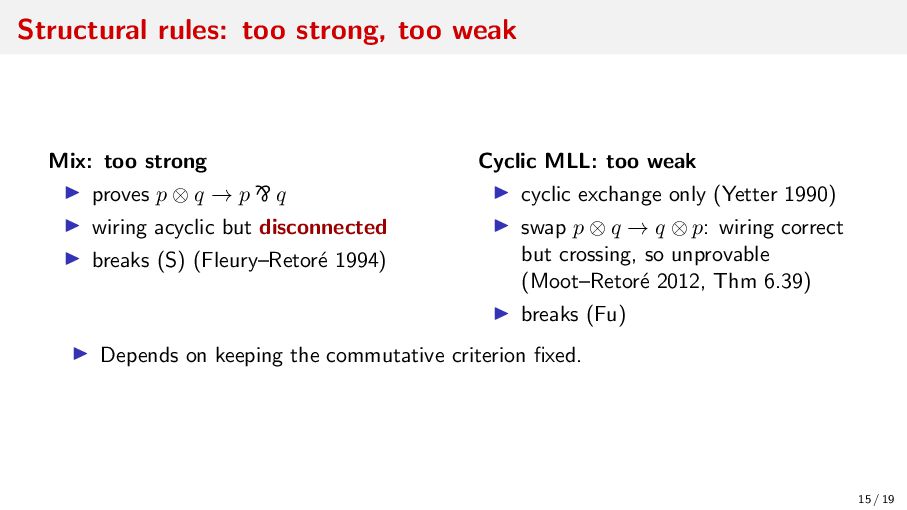
Structural rules: too strong, too weak & Mix: too strong
▶ proves p ⊗ q → p q ▶ wiring acyclic but disconnected ▶ breaks (S) (Fleury–Retoré 1994) Cyclic MLL: too weak ▶ cyclic exchange only (Yetter 1990) ▶ swap p ⊗ q → q ⊗ p: wiring correct but crossing, so unprovable (Moot–Retoré 2012, Thm 6.39) ▶ breaks (Fu) ▶ Depends on keeping the commutative criterion fixed. 15 / 19 -
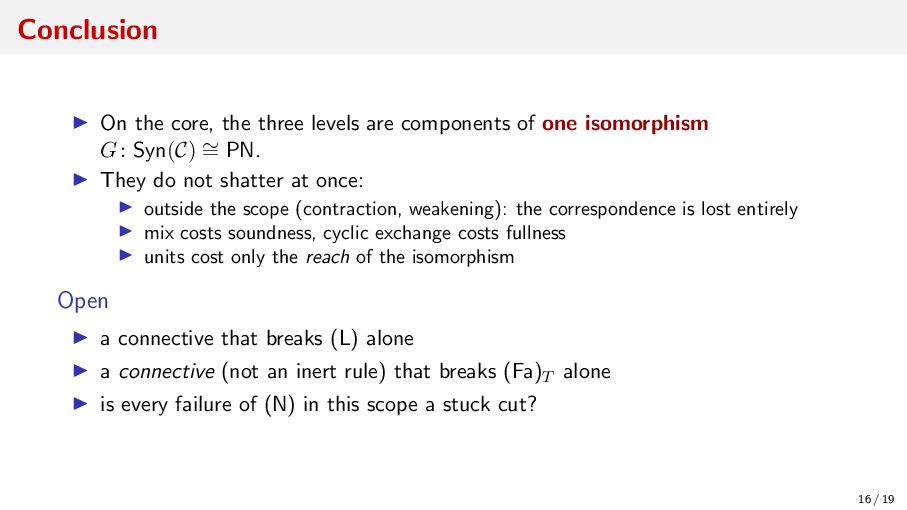
Conclusion ▶ On the core, the three levels are components
of one isomorphism G : Syn(C) ∼ = PN. ▶ They do not shatter at once: ▶ outside the scope (contraction, weakening): the correspondence is lost entirely ▶ mix costs soundness, cyclic exchange costs fullness ▶ units cost only the reach of the isomorphism Open ▶ a connective that breaks (L) alone ▶ a connective (not an inert rule) that breaks (Fa)T alone ▶ is every failure of (N) in this scope a stuck cut? 16 / 19 -
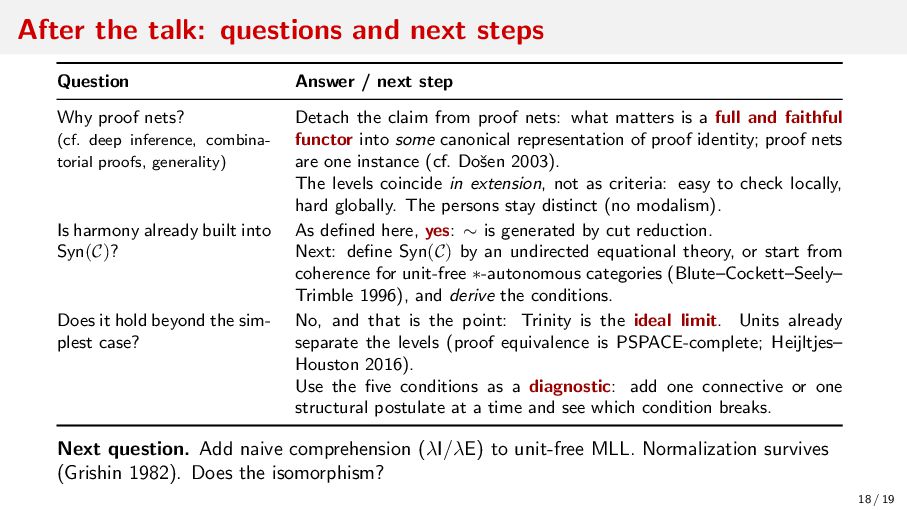
After the talk: questions and next steps Question Answer /
next step Why proof nets? Detach the claim from proof nets: what matters is a full and faithful functor into some canonical representation of proof identity; proof nets are one instance (cf. Došen 2003). The levels coincide in extension, not as criteria: easy to check locally, hard globally. The persons stay distinct (no modalism). As defined here, yes: ∼ is generated by cut reduction. Next: define Syn(C) by an undirected equational theory, or start from coherence for unit-free ∗-autonomous categories (Blute–Cockett–Seely– Trimble 1996), and derive the conditions. No, and that is the point: Trinity is the ideal limit. Units already separate the levels (proof equivalence is PSPACE-complete; Heijltjes– Houston 2016). Use the five conditions as a diagnostic: add one connective or one structural postulate at a time and see which condition breaks. (cf. deep inference, combinatorial proofs, generality) Is harmony already built into Syn(C)? Does it hold beyond the simplest case? Next question. Add naive comprehension (λI/λE) to unit-free MLL. Normalization survives (Grishin 1982). Does the isomorphism? 18 / 19 -
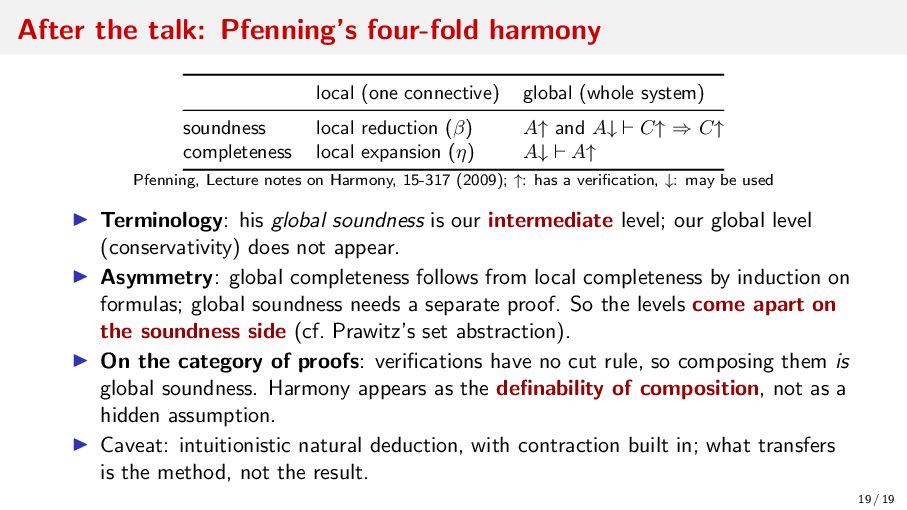
After the talk: Pfenning’s four-fold harmony soundness completeness local (one
connective) global (whole system) local reduction (β) local expansion (η) A↑ and A↓ ⊢ C↑ ⇒ C↑ A↓ ⊢ A↑ Pfenning, Lecture notes on Harmony, 15-317 (2009); ↑: has a verification, ↓: may be used ▶ Terminology: his global soundness is our intermediate level; our global level (conservativity) does not appear. ▶ Asymmetry: global completeness follows from local completeness by induction on formulas; global soundness needs a separate proof. So the levels come apart on the soundness side (cf. Prawitz’s set abstraction). ▶ On the category of proofs: verifications have no cut rule, so composing them is global soundness. Harmony appears as the definability of composition, not as a hidden assumption. ▶ Caveat: intuitionistic natural deduction, with contraction built in; what transfers is the method, not the result. 19 / 19 -
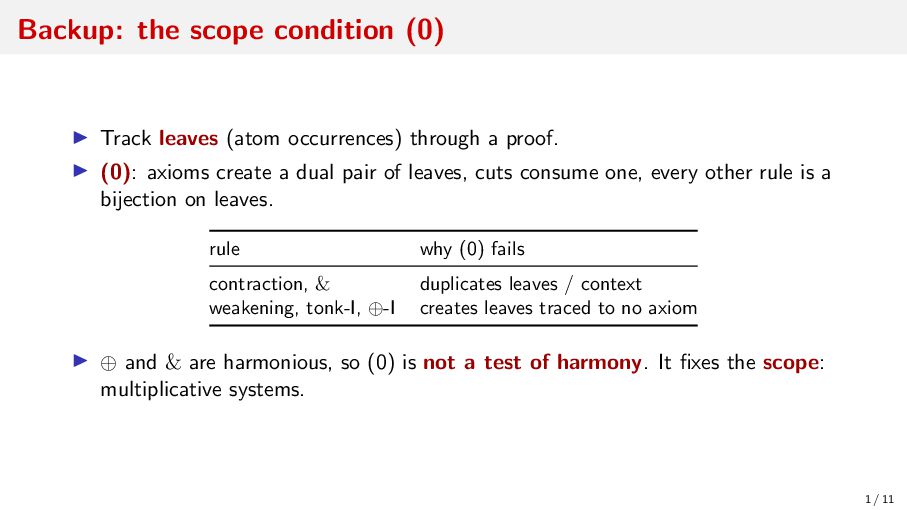
Backup: the scope condition (0) ▶ Track leaves (atom occurrences)
through a proof. ▶ (0): axioms create a dual pair of leaves, cuts consume one, every other rule is a bijection on leaves. rule why (0) fails contraction, & weakening, tonk-I, ⊕-I duplicates leaves / context creates leaves traced to no axiom ▶ ⊕ and & are harmonious, so (0) is not a test of harmony. It fixes the scope: multiplicative systems. 1 / 11 -
Backup: local harmony, an example ∧: the detour can be
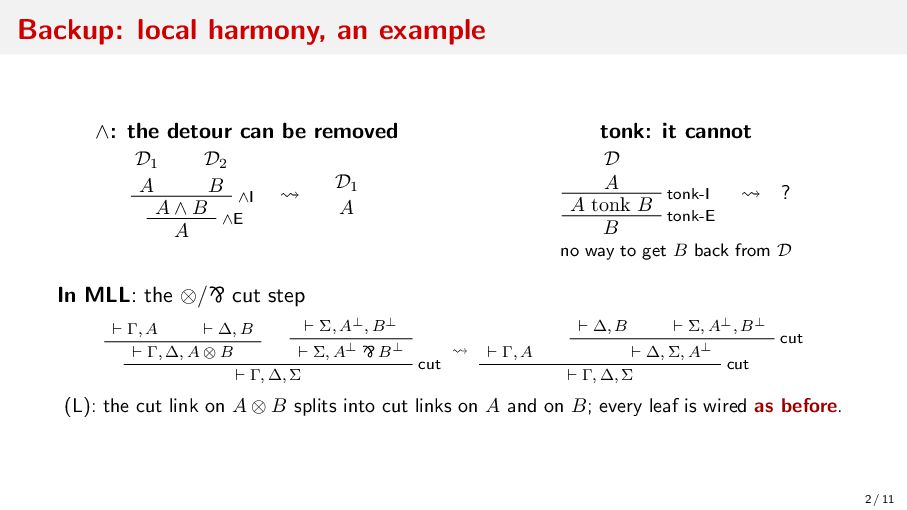
removed D1 D2 A B ∧I A ∧ B ∧E A ⇝ tonk: it cannot D A tonk-I A tonk B tonk-E B D1 A ⇝ ? no way to get B back from D & In MLL: the ⊗/ cut step ⊥ ⊥ ⊢ Σ, A , B ⊢ Γ, A ⊢ ∆, B ⇝ ⊢ Γ, ∆, A ⊗ B ⊢ Σ, A⊥ B ⊥ cut ⊢ Γ, ∆, Σ ⊢ ∆, B ⊢ Γ, A ⊢ Σ, A⊥ , B ⊥ ⊢ ∆, Σ, A⊥ cut ⊢ Γ, ∆, Σ cut & (L): the cut link on A ⊗ B splits into cut links on A and on B; every leaf is wired as before. 2 / 11 -
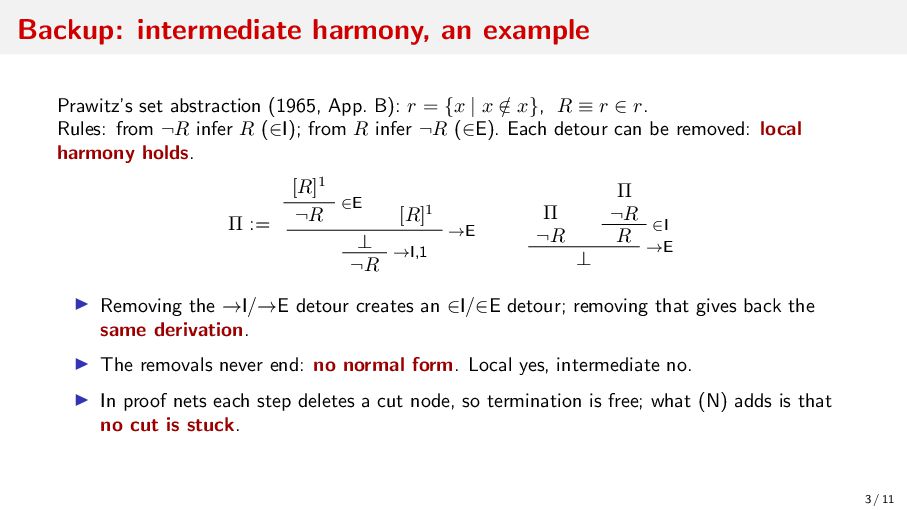
Backup: intermediate harmony, an example Prawitz’s set abstraction (1965, App.
B): r = {x | x ∈ / x}, R ≡ r ∈ r. Rules: from ¬R infer R (∈I); from R infer ¬R (∈E). Each detour can be removed: local harmony holds. Π := [R]1 ∈E ¬R [R]1 →E ⊥ →I,1 ¬R Π ¬R ⊥ Π ¬R ∈I R →E ▶ Removing the →I/→E detour creates an ∈I/∈E detour; removing that gives back the same derivation. ▶ The removals never end: no normal form. Local yes, intermediate no. ▶ In proof nets each step deletes a cut node, so termination is free; what (N) adds is that no cut is stuck. 3 / 11 -
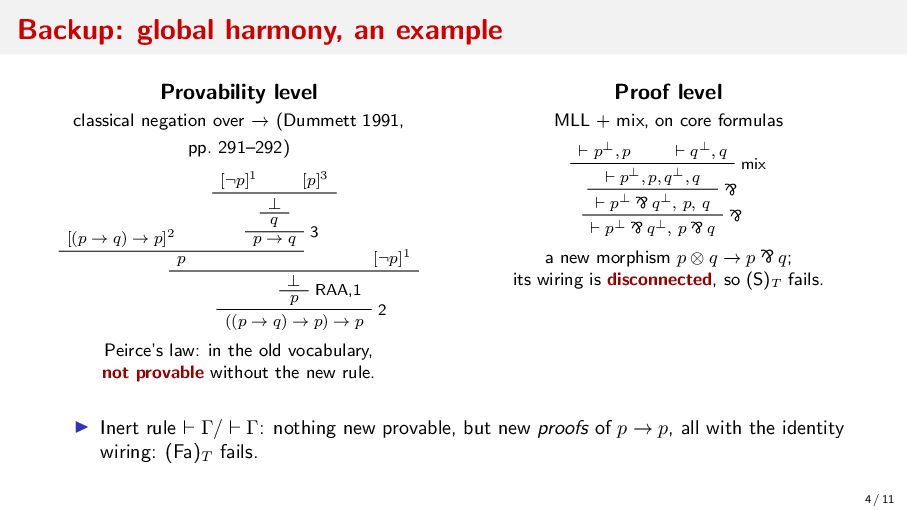
Backup: global harmony, an example Provability level Proof level classical
negation over → (Dummett 1991, MLL + mix, on core formulas ⊢ p⊥ , p, q ⊥ , q ⊥ p RAA,1 2 ((p → q) → p) → p q ⊥ , p, q q⊥ , p mix q & [¬p]1 & p ⊢ p⊥ & ⊢ p⊥ & [p]3 ⊥ q p→q 3 [(p → q) → p]2 ⊢ q⊥ , q & [¬p]1 ⊢ p⊥ , p & pp. 291–292) a new morphism p ⊗ q → p q; its wiring is disconnected, so (S)T fails. Peirce’s law: in the old vocabulary, not provable without the new rule. ▶ Inert rule ⊢ Γ/ ⊢ Γ: nothing new provable, but new proofs of p → p, all with the identity wiring: (Fa)T fails. 4 / 11 -
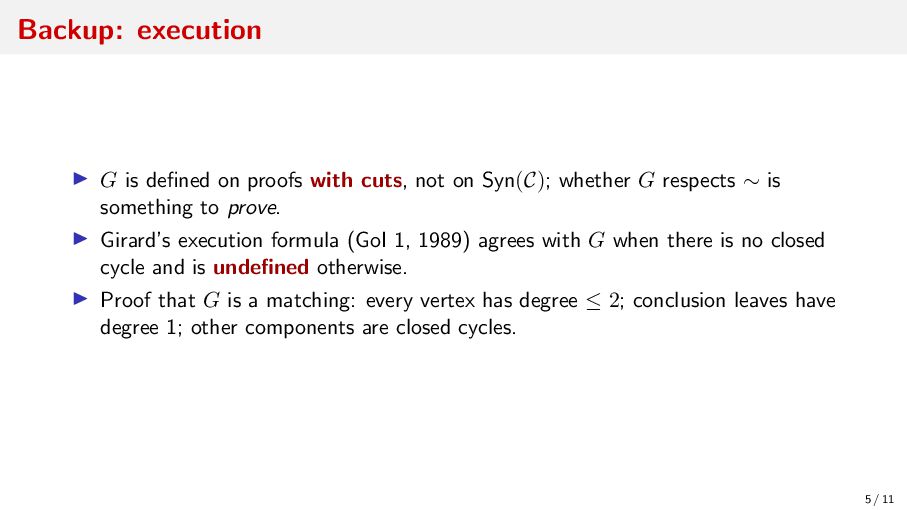
Backup: execution ▶ G is defined on proofs with cuts,
not on Syn(C); whether G respects ∼ is something to prove. ▶ Girard’s execution formula (GoI 1, 1989) agrees with G when there is no closed cycle and is undefined otherwise. ▶ Proof that G is a matching: every vertex has degree ≤ 2; conclusion leaves have degree 1; other components are closed cycles. 5 / 11 -
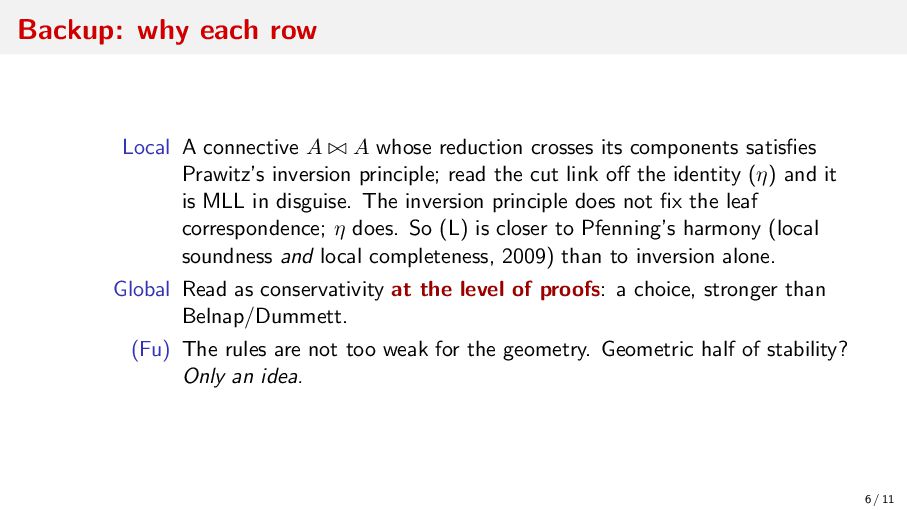
Backup: why each row Local A connective A ▷◁ A
whose reduction crosses its components satisfies Prawitz’s inversion principle; read the cut link off the identity (η) and it is MLL in disguise. The inversion principle does not fix the leaf correspondence; η does. So (L) is closer to Pfenning’s harmony (local soundness and local completeness, 2009) than to inversion alone. Global Read as conservativity at the level of proofs: a choice, stronger than Belnap/Dummett. (Fu) The rules are not too weak for the geometry. Geometric half of stability? Only an idea. 6 / 11 -
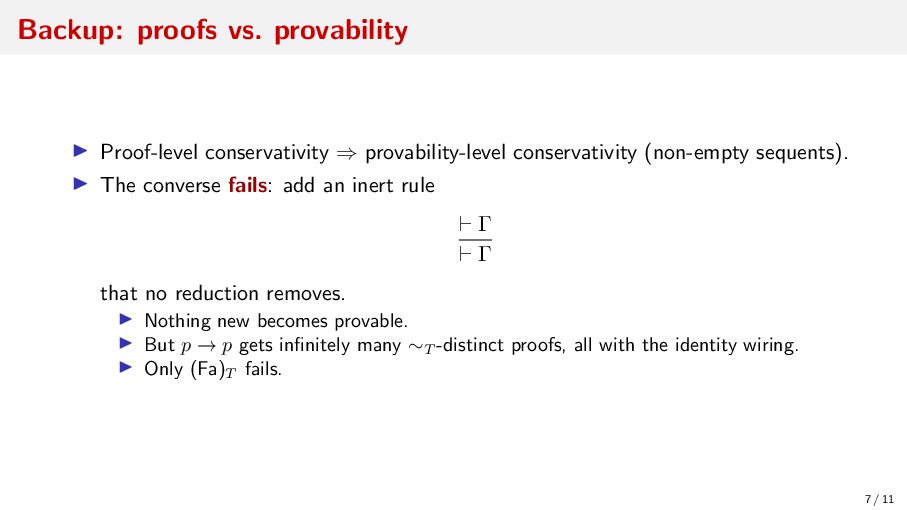
Backup: proofs vs. provability ▶ Proof-level conservativity ⇒ provability-level conservativity
(non-empty sequents). ▶ The converse fails: add an inert rule ⊢Γ ⊢Γ that no reduction removes. ▶ Nothing new becomes provable. ▶ But p → p gets infinitely many ∼T -distinct proofs, all with the identity wiring. ▶ Only (Fa)T fails. 7 / 11 -
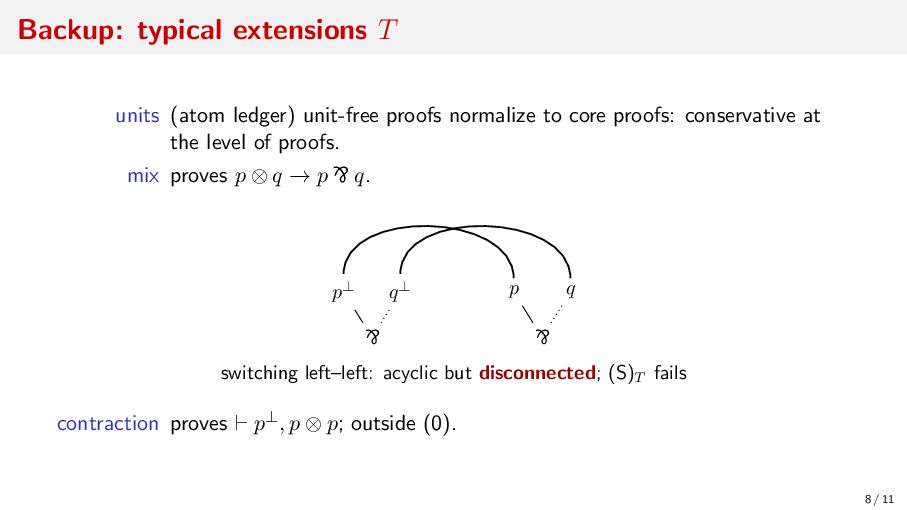
Backup: typical extensions T units (atom ledger) unit-free proofs normalize
to core proofs: conservative at the level of proofs. q. p⊥ q⊥ p q & & mix proves p ⊗ q → p & switching left–left: acyclic but disconnected; (S)T fails contraction proves ⊢ p⊥ , p ⊗ p; outside (0). 8 / 11 -
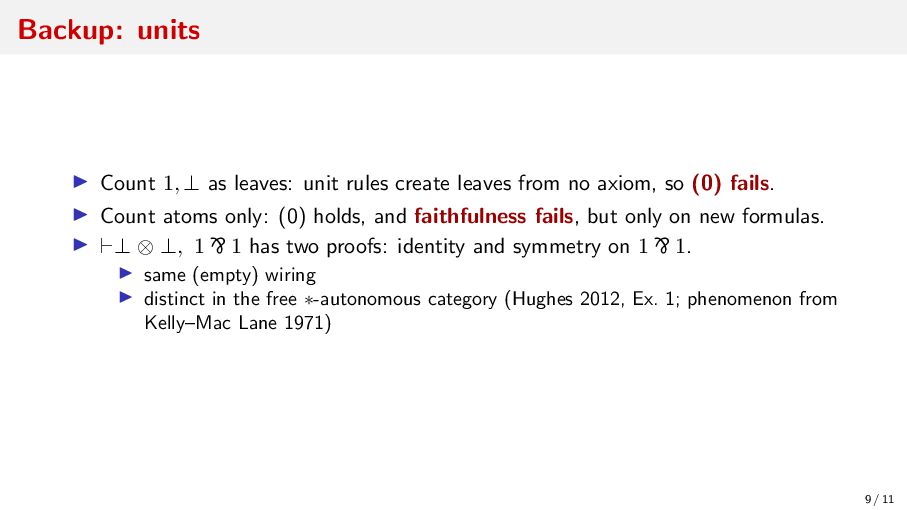
Backup: units ▶ Count 1, ⊥ as leaves: unit rules
create leaves from no axiom, so (0) fails. ▶ Count atoms only: (0) holds, and faithfulness fails, but only on new formulas. ▶ ⊢⊥ ⊗ ⊥, 1 1 has two proofs: identity and symmetry on 1 1. & & ▶ same (empty) wiring ▶ distinct in the free ∗-autonomous category (Hughes 2012, Ex. 1; phenomenon from Kelly–Mac Lane 1971) 9 / 11 -
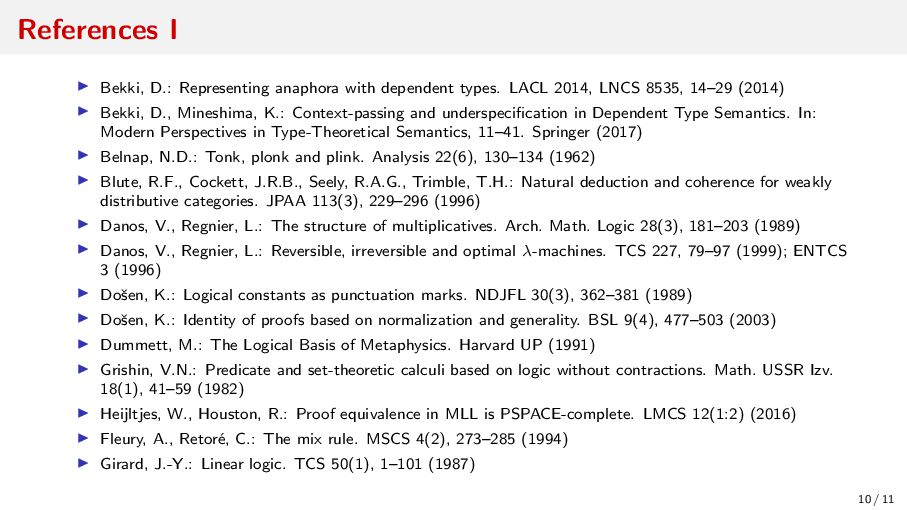
References I ▶ Bekki, D.: Representing anaphora with dependent types.
LACL 2014, LNCS 8535, 14–29 (2014) ▶ Bekki, D., Mineshima, K.: Context-passing and underspecification in Dependent Type Semantics. In: Modern Perspectives in Type-Theoretical Semantics, 11–41. Springer (2017) ▶ Belnap, N.D.: Tonk, plonk and plink. Analysis 22(6), 130–134 (1962) ▶ Blute, R.F., Cockett, J.R.B., Seely, R.A.G., Trimble, T.H.: Natural deduction and coherence for weakly distributive categories. JPAA 113(3), 229–296 (1996) ▶ Danos, V., Regnier, L.: The structure of multiplicatives. Arch. Math. Logic 28(3), 181–203 (1989) ▶ Danos, V., Regnier, L.: Reversible, irreversible and optimal λ-machines. TCS 227, 79–97 (1999); ENTCS 3 (1996) ▶ Došen, K.: Logical constants as punctuation marks. NDJFL 30(3), 362–381 (1989) ▶ Došen, K.: Identity of proofs based on normalization and generality. BSL 9(4), 477–503 (2003) ▶ Dummett, M.: The Logical Basis of Metaphysics. Harvard UP (1991) ▶ Grishin, V.N.: Predicate and set-theoretic calculi based on logic without contractions. Math. USSR Izv. 18(1), 41–59 (1982) ▶ Heijltjes, W., Houston, R.: Proof equivalence in MLL is PSPACE-complete. LMCS 12(1:2) (2016) ▶ Fleury, A., Retoré, C.: The mix rule. MSCS 4(2), 273–285 (1994) ▶ Girard, J.-Y.: Linear logic. TCS 50(1), 1–101 (1987) 10 / 11 -
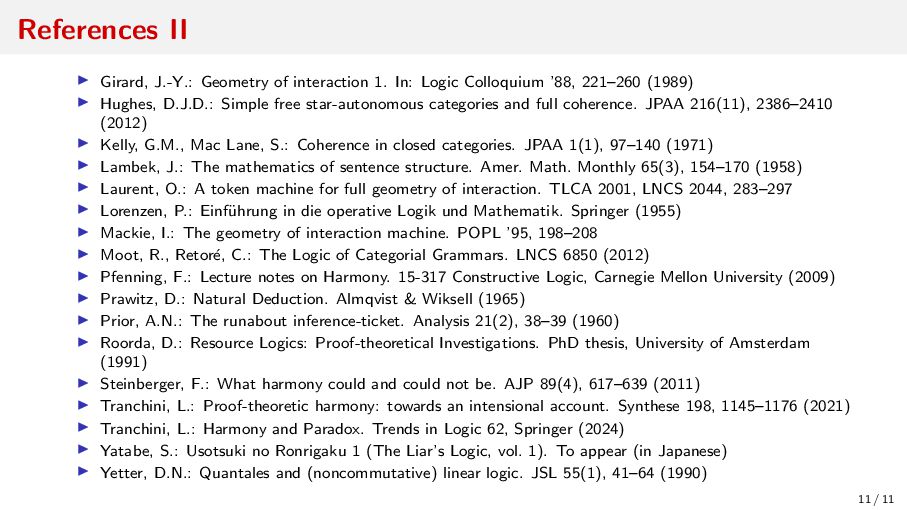
References II ▶ Girard, J.-Y.: Geometry of interaction 1. In:
Logic Colloquium ’88, 221–260 (1989) ▶ Hughes, D.J.D.: Simple free star-autonomous categories and full coherence. JPAA 216(11), 2386–2410 (2012) ▶ Kelly, G.M., Mac Lane, S.: Coherence in closed categories. JPAA 1(1), 97–140 (1971) ▶ Lambek, J.: The mathematics of sentence structure. Amer. Math. Monthly 65(3), 154–170 (1958) ▶ Laurent, O.: A token machine for full geometry of interaction. TLCA 2001, LNCS 2044, 283–297 ▶ Lorenzen, P.: Einführung in die operative Logik und Mathematik. Springer (1955) ▶ Mackie, I.: The geometry of interaction machine. POPL ’95, 198–208 ▶ Moot, R., Retoré, C.: The Logic of Categorial Grammars. LNCS 6850 (2012) ▶ Pfenning, F.: Lecture notes on Harmony. 15-317 Constructive Logic, Carnegie Mellon University (2009) ▶ Prawitz, D.: Natural Deduction. Almqvist & Wiksell (1965) ▶ Prior, A.N.: The runabout inference-ticket. Analysis 21(2), 38–39 (1960) ▶ Roorda, D.: Resource Logics: Proof-theoretical Investigations. PhD thesis, University of Amsterdam (1991) ▶ Steinberger, F.: What harmony could and could not be. AJP 89(4), 617–639 (2011) ▶ Tranchini, L.: Proof-theoretic harmony: towards an intensional account. Synthese 198, 1145–1176 (2021) ▶ Tranchini, L.: Harmony and Paradox. Trends in Logic 62, Springer (2024) ▶ Yatabe, S.: Usotsuki no Ronrigaku 1 (The Liar’s Logic, vol. 1). To appear (in Japanese) ▶ Yetter, D.N.: Quantales and (noncommutative) linear logic. JSL 55(1), 41–64 (1990) 11 / 11
 yatabe
 martinlippert
 hayashiyus884
 junkashihara
 hayataka88
 stillpedant
 psj59129
 nagano
 xspa2012
 signer
 bonotake
 lychee1223
 nozakijcom
 mayatellez
 aki_iinuma
 gurzu
 szymonslowik
 jct
 lara
 axbom
 joshbly
 eileencodes
 morganepeng
 reverentgeek