How Much Is an SEO Audit? Scope Before Price

Share
Embed
How Much Is an SEO Audit? Scope Before Price
How much is an SEO audit when the report needs to guide real engineering work? Learn how templates, access, sampling, root-cause grouping, and acceptance tests shape a useful SEO audit scope. Which missing field would you clarify before comparing two proposals? Before you ask how much is an SEO audit, read the full guide: https://guaranteedseoservices.com/seo-audit-cost/?utm_source=speakerdeck&utm_medium=referral&utm_campaign=blog-seo-audit-cost

GuaranteedSEOServices
October 26, 2026
Transcript
22 slides
-
How Much Is an SEO Audit? Estimate the Work Behind
the Report A technical workshop on templates, access, investigation depth, and the handoff from diagnosis to implementation. GuaranteedSEOServices.com October 27, 2026 -
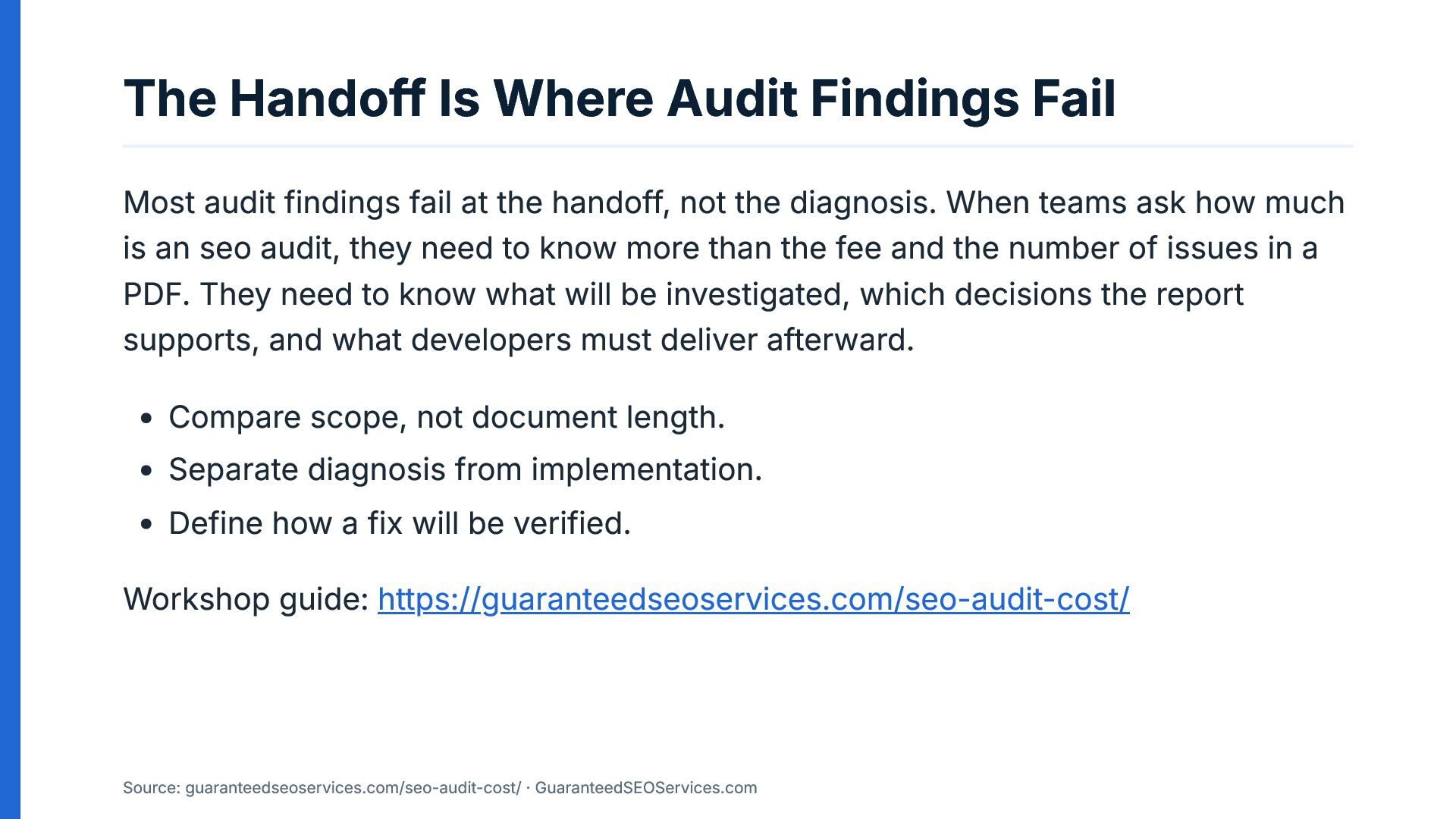
The Handoff Is Where Audit Findings Fail Most audit findings
fail at the handoff, not the diagnosis. When teams ask how much is an seo audit, they need to know more than the fee and the number of issues in a PDF. They need to know what will be investigated, which decisions the report supports, and what developers must deliver afterward. Compare scope, not document length. Separate diagnosis from implementation. Define how a fix will be verified. Workshop guide: https://guaranteedseoservices.com/seo-audit-cost/ Source: guaranteedseoservices.com/seo-audit-cost/ · GuaranteedSEOServices.com -
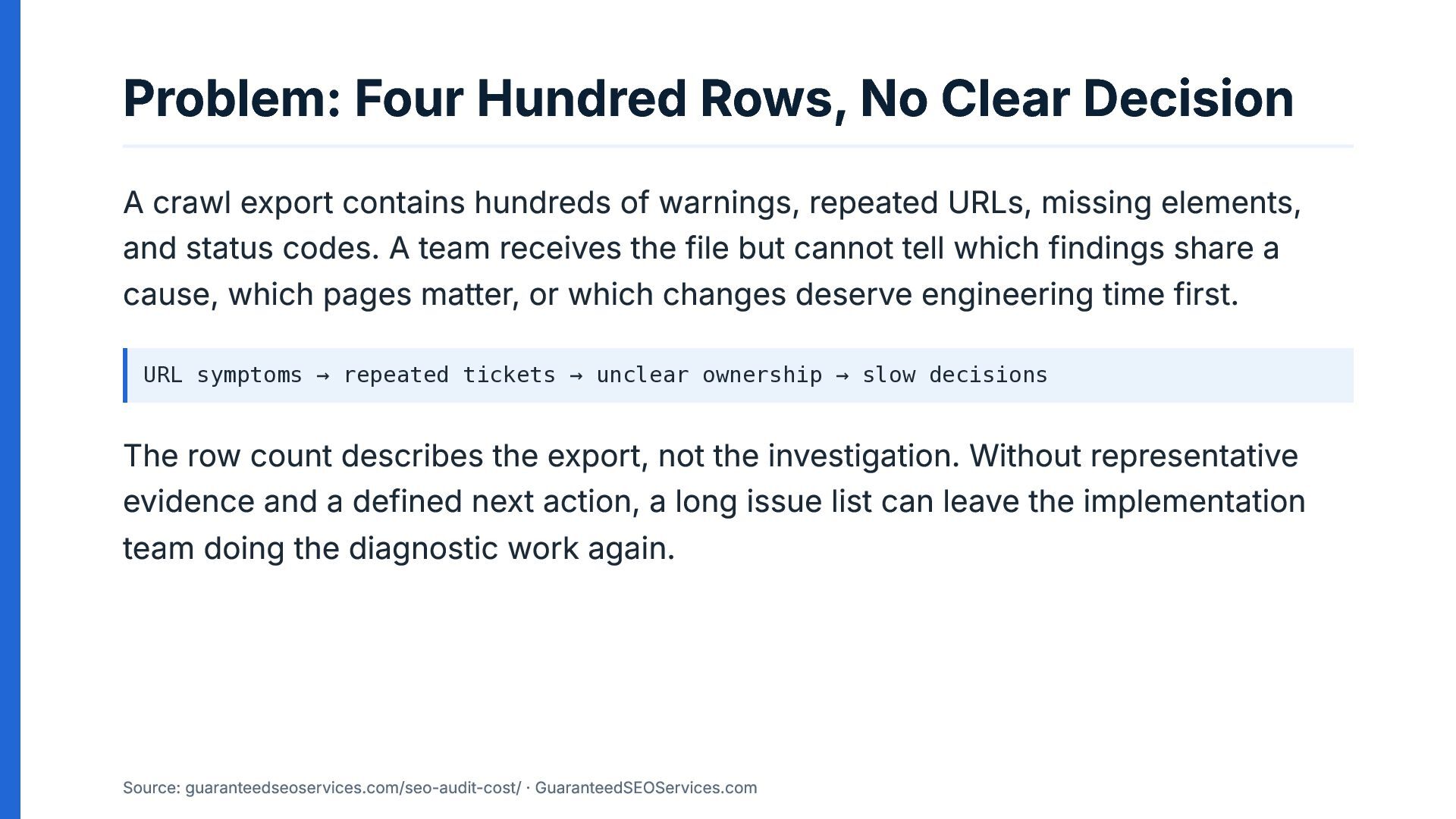
Problem: Four Hundred Rows, No Clear Decision A crawl export
contains hundreds of warnings, repeated URLs, missing elements, and status codes. A team receives the file but cannot tell which findings share a cause, which pages matter, or which changes deserve engineering time first. URL symptoms → repeated tickets → unclear ownership → slow decisions The row count describes the export, not the investigation. Without representative evidence and a defined next action, a long issue list can leave the implementation team doing the diagnostic work again. Source: guaranteedseoservices.com/seo-audit-cost/ · GuaranteedSEOServices.com -
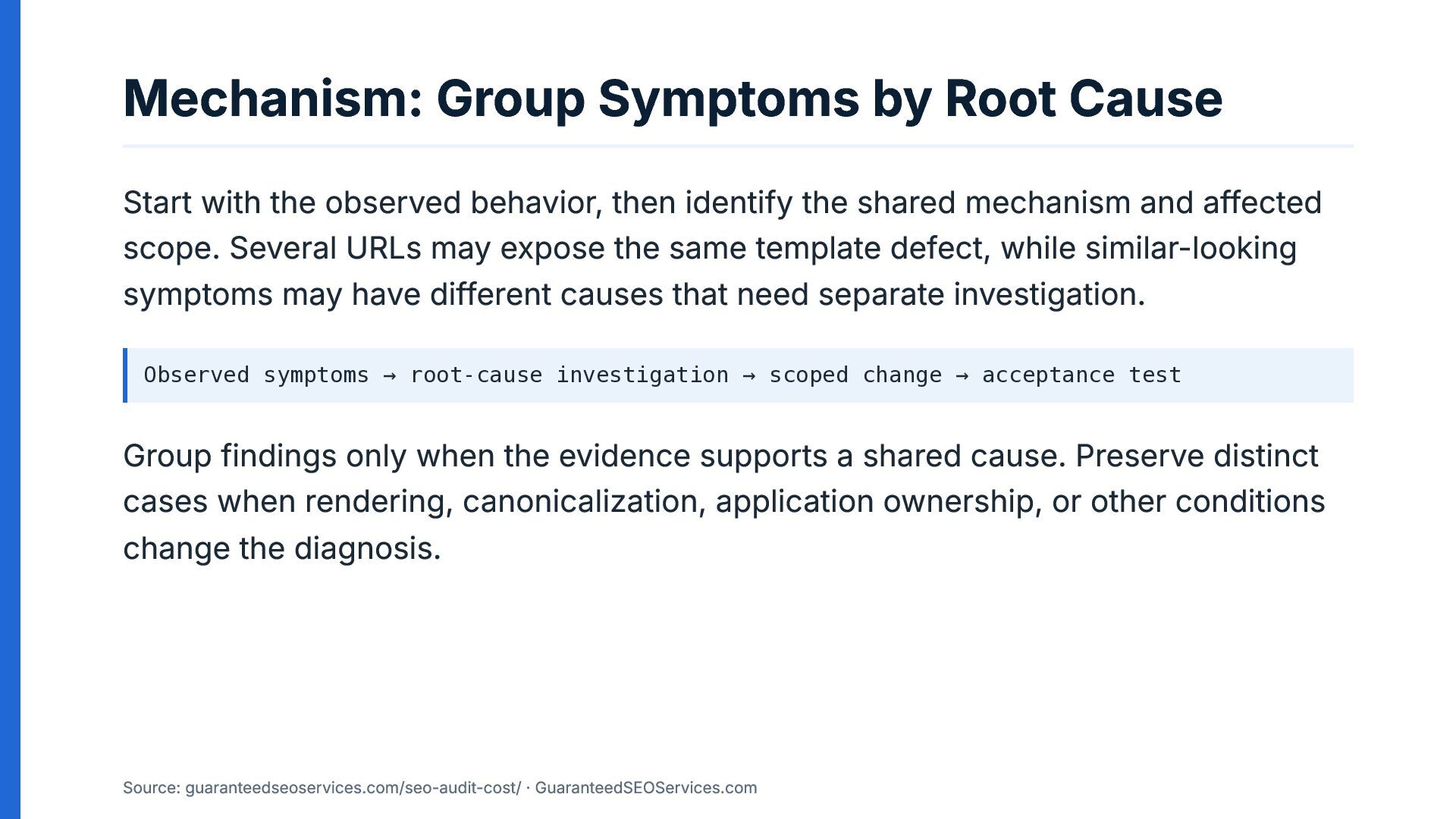
Mechanism: Group Symptoms by Root Cause Start with the observed
behavior, then identify the shared mechanism and affected scope. Several URLs may expose the same template defect, while similar-looking symptoms may have different causes that need separate investigation. Observed symptoms → root-cause investigation → scoped change → acceptance test Group findings only when the evidence supports a shared cause. Preserve distinct cases when rendering, canonicalization, application ownership, or other conditions change the diagnosis. Source: guaranteedseoservices.com/seo-audit-cost/ · GuaranteedSEOServices.com -
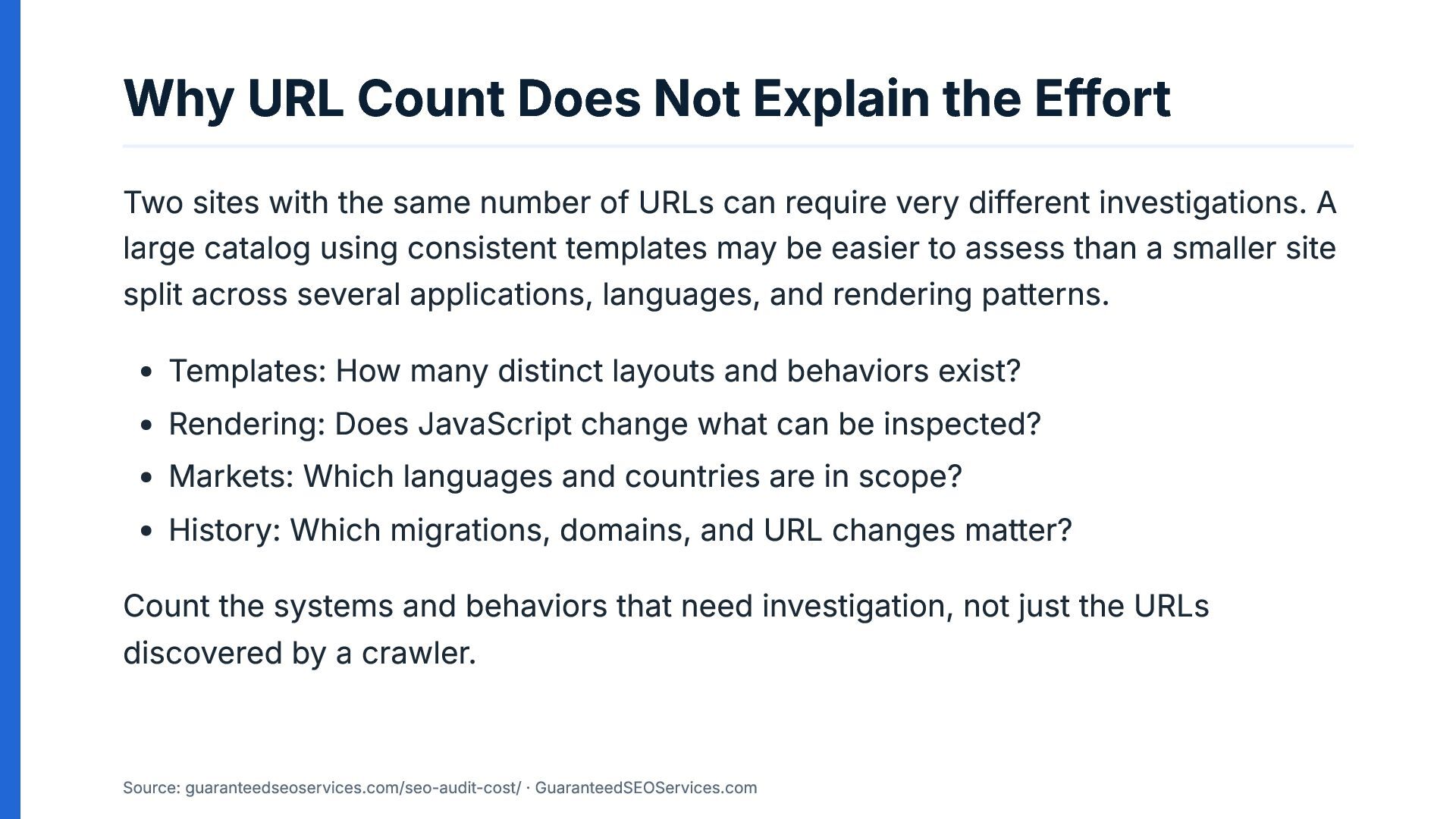
Why URL Count Does Not Explain the Effort Two sites
with the same number of URLs can require very different investigations. A large catalog using consistent templates may be easier to assess than a smaller site split across several applications, languages, and rendering patterns. Templates: How many distinct layouts and behaviors exist? Rendering: Does JavaScript change what can be inspected? Markets: Which languages and countries are in scope? History: Which migrations, domains, and URL changes matter? Count the systems and behaviors that need investigation, not just the URLs discovered by a crawler. Source: guaranteedseoservices.com/seo-audit-cost/ · GuaranteedSEOServices.com -
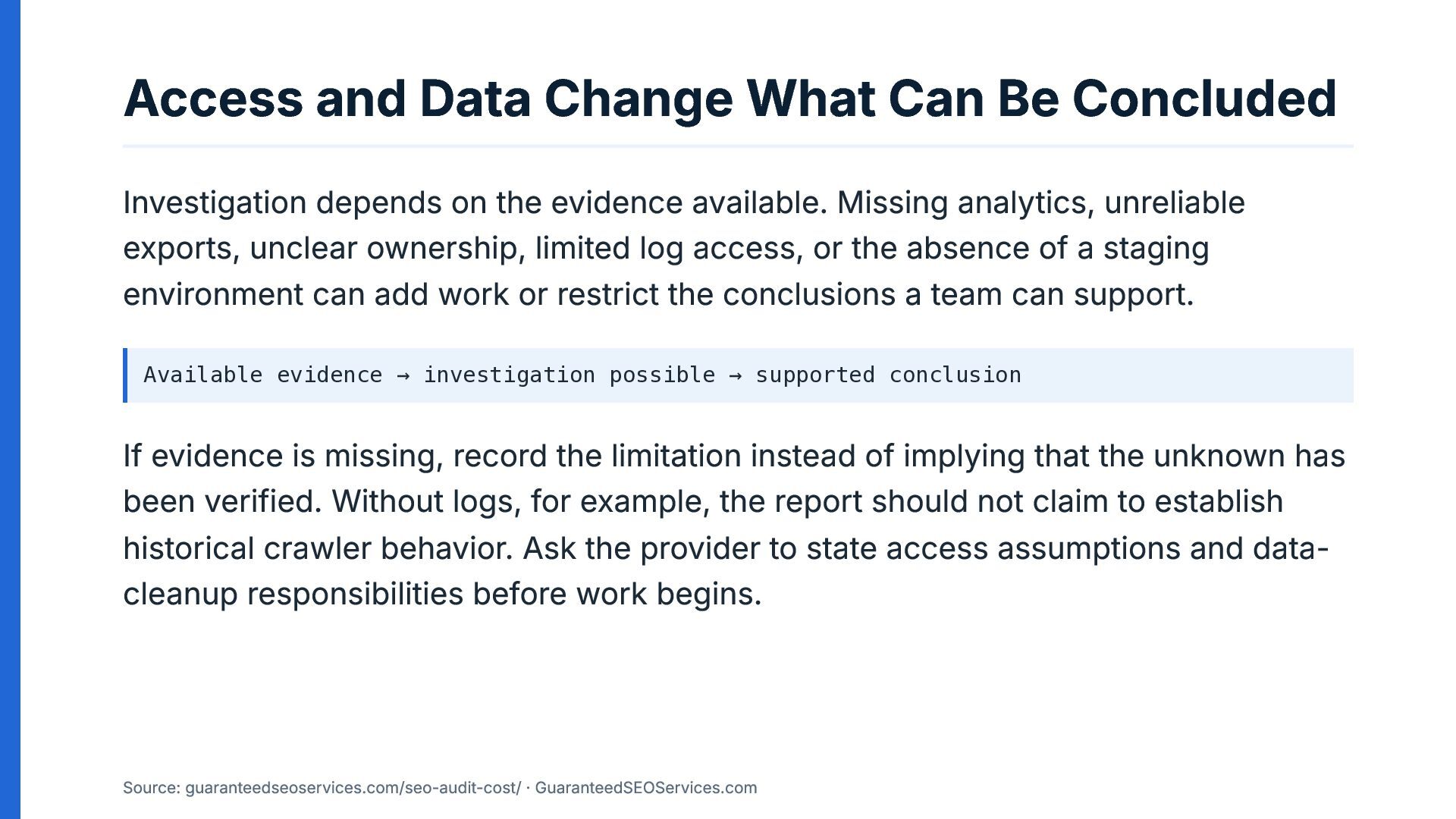
Access and Data Change What Can Be Concluded Investigation depends
on the evidence available. Missing analytics, unreliable exports, unclear ownership, limited log access, or the absence of a staging environment can add work or restrict the conclusions a team can support. Available evidence → investigation possible → supported conclusion If evidence is missing, record the limitation instead of implying that the unknown has been verified. Without logs, for example, the report should not claim to establish historical crawler behavior. Ask the provider to state access assumptions and datacleanup responsibilities before work begins. Source: guaranteedseoservices.com/seo-audit-cost/ · GuaranteedSEOServices.com -
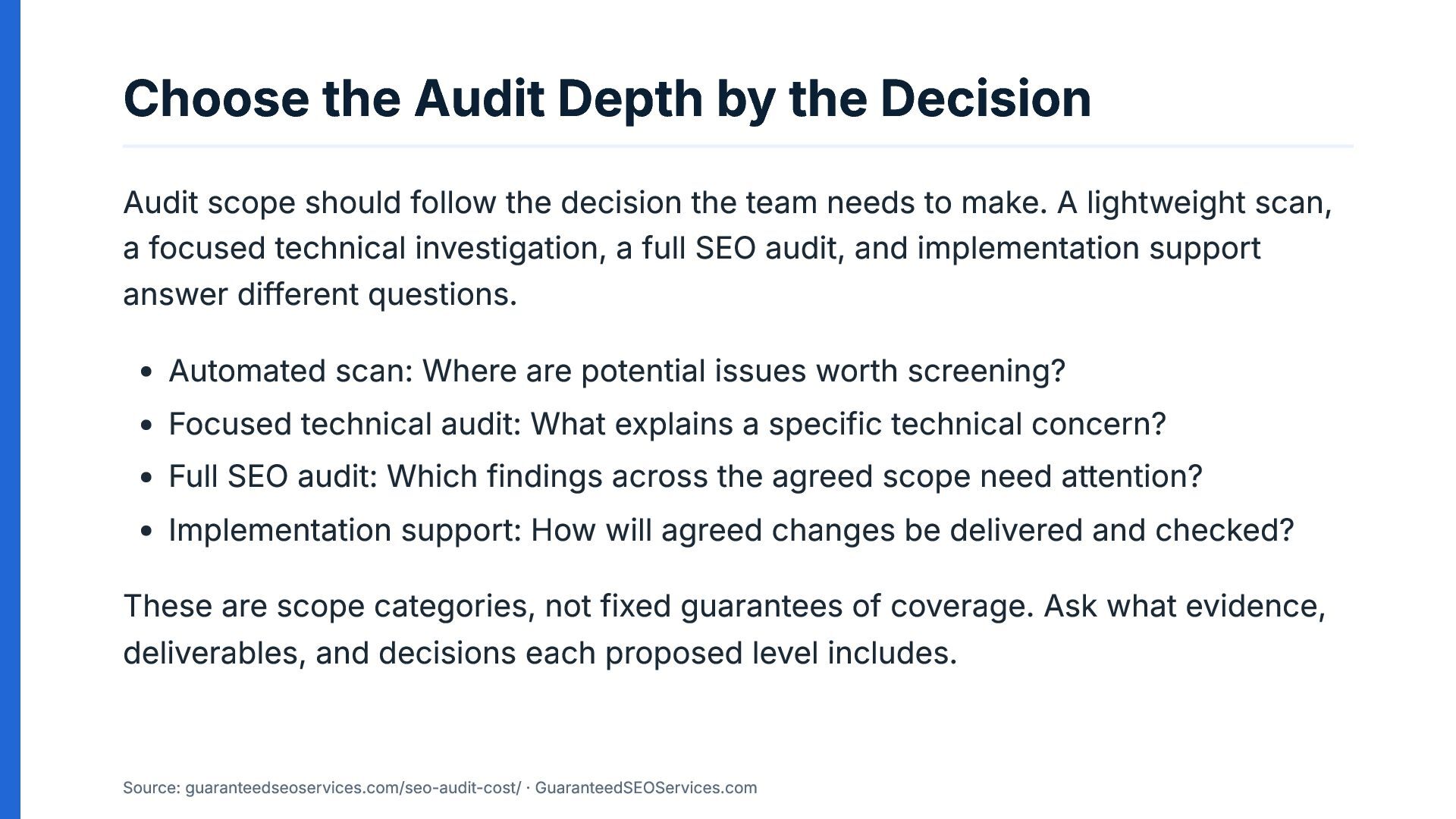
Choose the Audit Depth by the Decision Audit scope should
follow the decision the team needs to make. A lightweight scan, a focused technical investigation, a full SEO audit, and implementation support answer different questions. Automated scan: Where are potential issues worth screening? Focused technical audit: What explains a specific technical concern? Full SEO audit: Which findings across the agreed scope need attention? Implementation support: How will agreed changes be delivered and checked? These are scope categories, not fixed guarantees of coverage. Ask what evidence, deliverables, and decisions each proposed level includes. Source: guaranteedseoservices.com/seo-audit-cost/ · GuaranteedSEOServices.com -
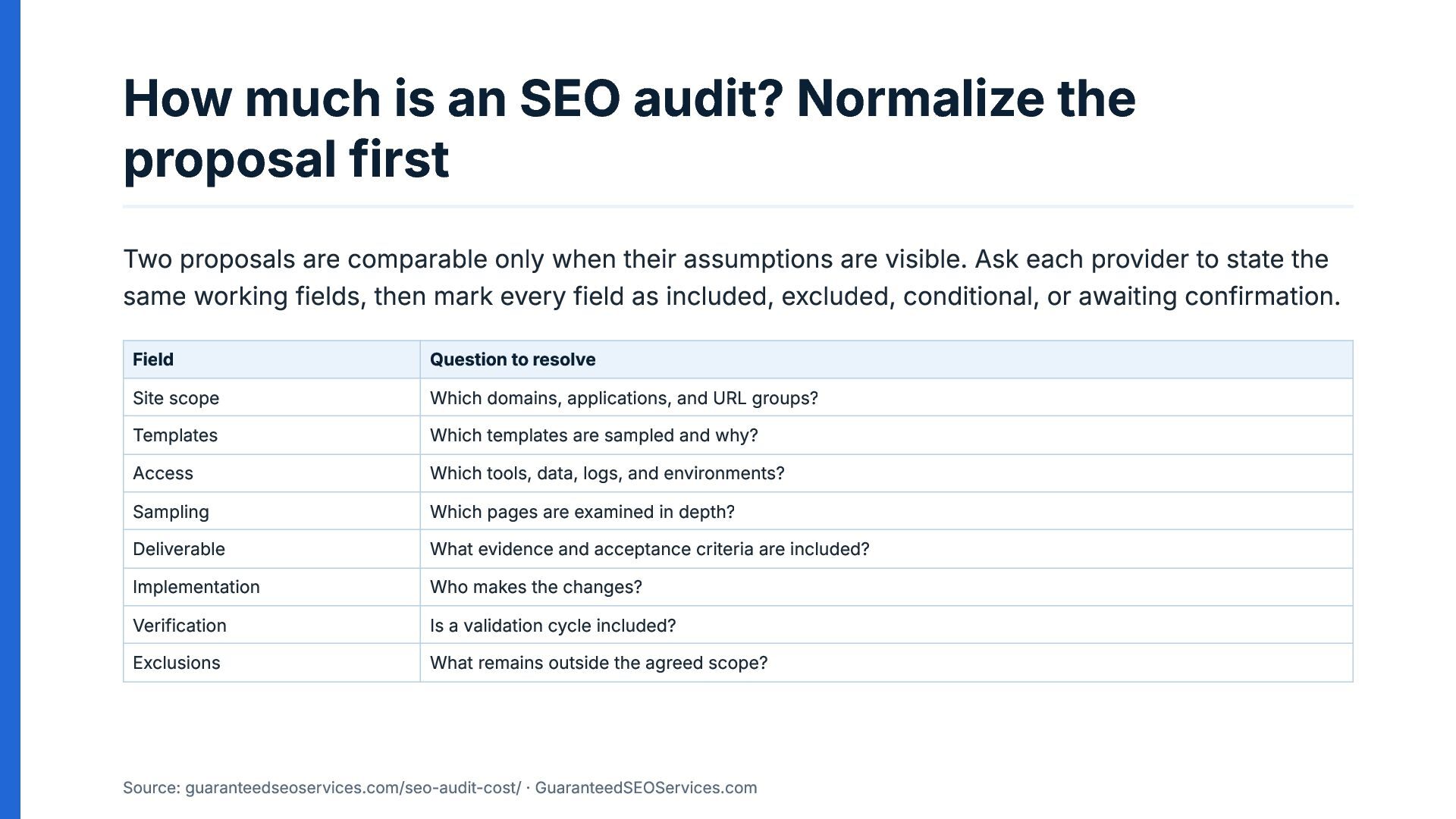
How much is an SEO audit? Normalize the proposal first
Two proposals are comparable only when their assumptions are visible. Ask each provider to state the same working fields, then mark every field as included, excluded, conditional, or awaiting confirmation. Field Question to resolve Site scope Which domains, applications, and URL groups? Templates Which templates are sampled and why? Access Which tools, data, logs, and environments? Sampling Which pages are examined in depth? Deliverable What evidence and acceptance criteria are included? Implementation Who makes the changes? Verification Is a validation cycle included? Exclusions What remains outside the agreed scope? Source: guaranteedseoservices.com/seo-audit-cost/ · GuaranteedSEOServices.com -
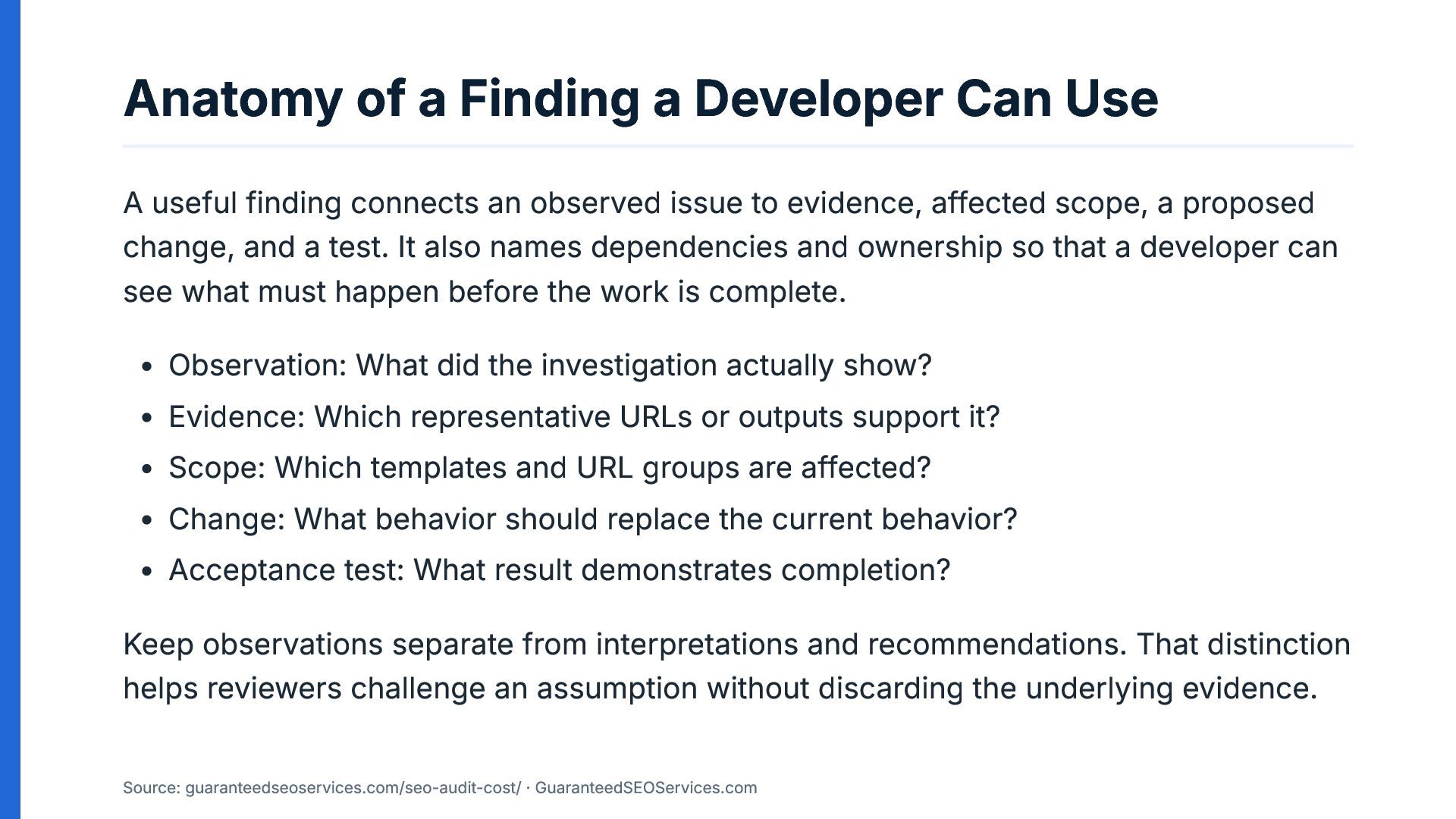
Anatomy of a Finding a Developer Can Use A useful
finding connects an observed issue to evidence, affected scope, a proposed change, and a test. It also names dependencies and ownership so that a developer can see what must happen before the work is complete. Observation: What did the investigation actually show? Evidence: Which representative URLs or outputs support it? Scope: Which templates and URL groups are affected? Change: What behavior should replace the current behavior? Acceptance test: What result demonstrates completion? Keep observations separate from interpretations and recommendations. That distinction helps reviewers challenge an assumption without discarding the underlying evidence. Source: guaranteedseoservices.com/seo-audit-cost/ · GuaranteedSEOServices.com -
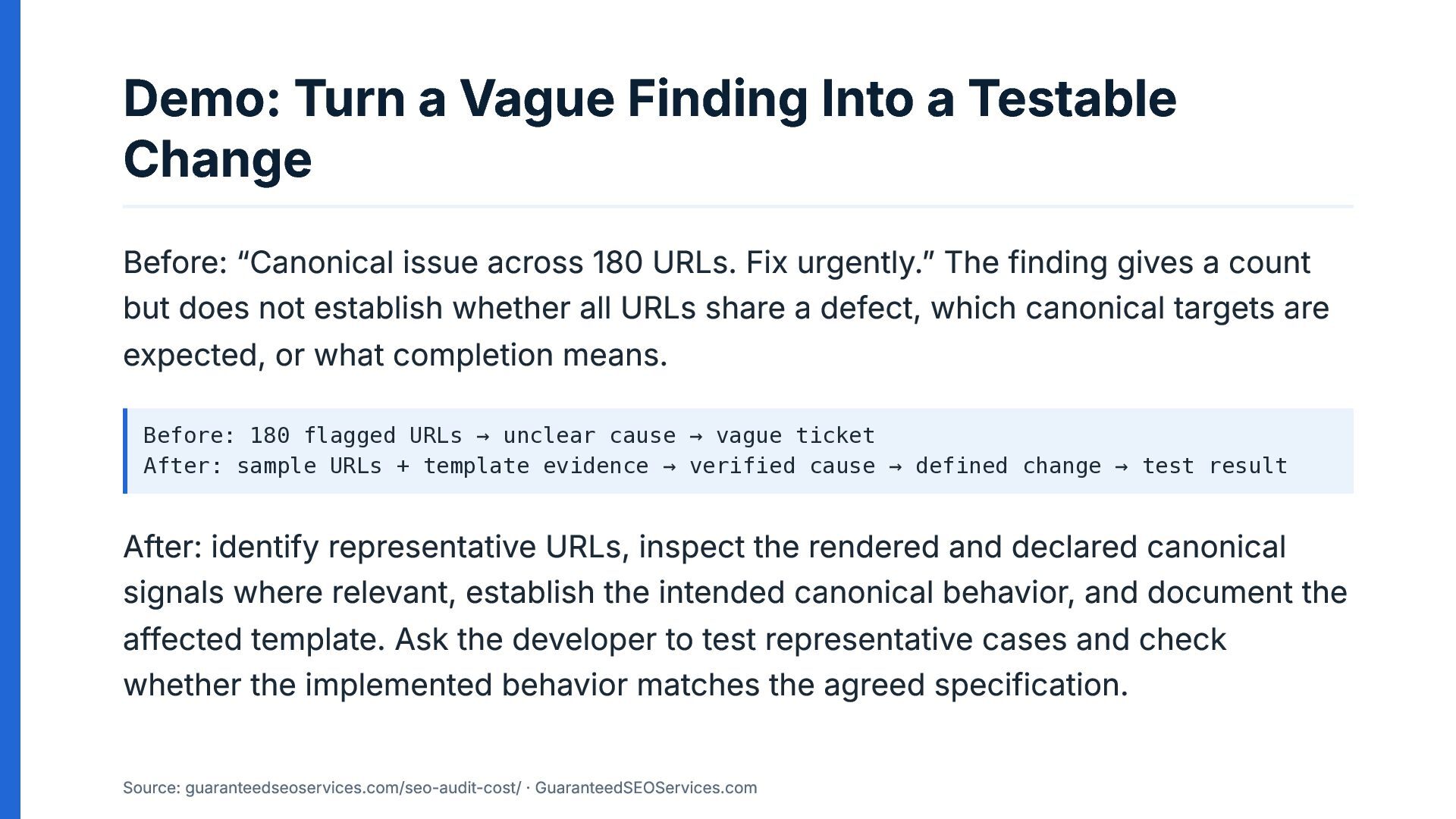
Demo: Turn a Vague Finding Into a Testable Change Before:
“Canonical issue across 180 URLs. Fix urgently.” The finding gives a count but does not establish whether all URLs share a defect, which canonical targets are expected, or what completion means. Before: 180 flagged URLs → unclear cause → vague ticket After: sample URLs + template evidence → verified cause → defined change → test result After: identify representative URLs, inspect the rendered and declared canonical signals where relevant, establish the intended canonical behavior, and document the affected template. Ask the developer to test representative cases and check whether the implemented behavior matches the agreed specification. Source: guaranteedseoservices.com/seo-audit-cost/ · GuaranteedSEOServices.com -
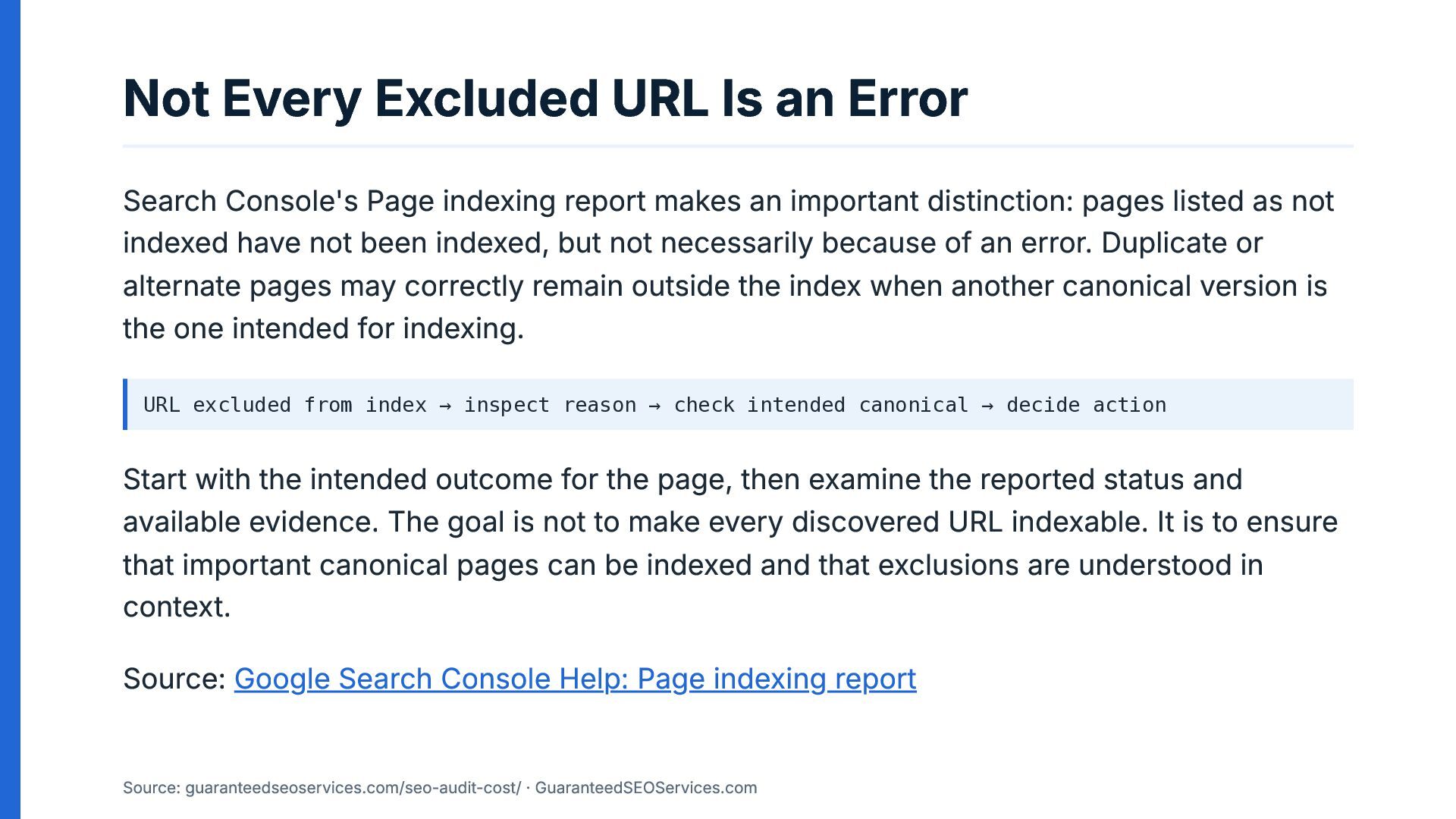
Not Every Excluded URL Is an Error Search Console's Page
indexing report makes an important distinction: pages listed as not indexed have not been indexed, but not necessarily because of an error. Duplicate or alternate pages may correctly remain outside the index when another canonical version is the one intended for indexing. URL excluded from index → inspect reason → check intended canonical → decide action Start with the intended outcome for the page, then examine the reported status and available evidence. The goal is not to make every discovered URL indexable. It is to ensure that important canonical pages can be indexed and that exclusions are understood in context. Source: Google Search Console Help: Page indexing report Source: guaranteedseoservices.com/seo-audit-cost/ · GuaranteedSEOServices.com -
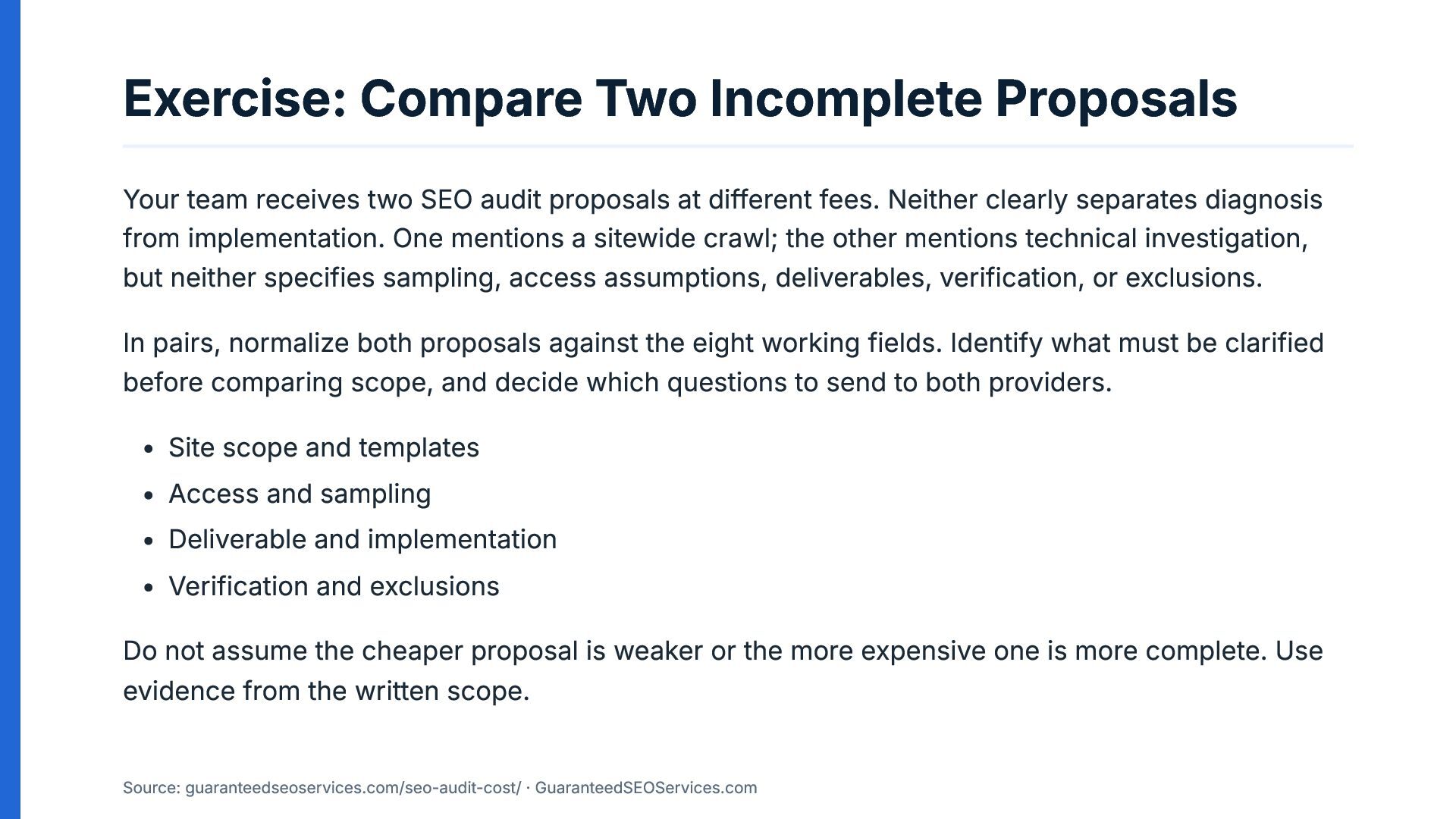
Exercise: Compare Two Incomplete Proposals Your team receives two SEO
audit proposals at different fees. Neither clearly separates diagnosis from implementation. One mentions a sitewide crawl; the other mentions technical investigation, but neither specifies sampling, access assumptions, deliverables, verification, or exclusions. In pairs, normalize both proposals against the eight working fields. Identify what must be clarified before comparing scope, and decide which questions to send to both providers. Site scope and templates Access and sampling Deliverable and implementation Verification and exclusions Do not assume the cheaper proposal is weaker or the more expensive one is more complete. Use evidence from the written scope. Source: guaranteedseoservices.com/seo-audit-cost/ · GuaranteedSEOServices.com -
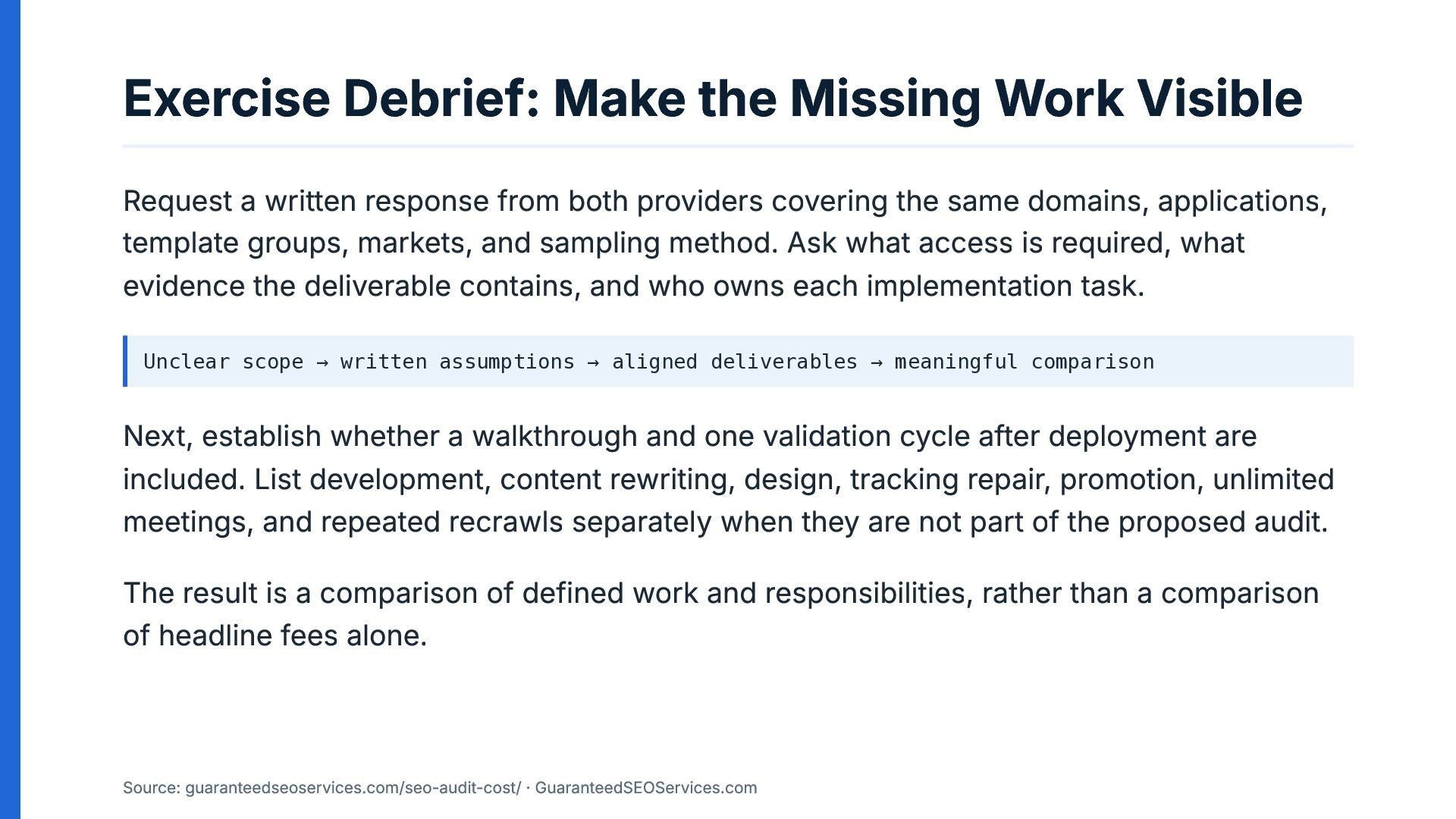
Exercise Debrief: Make the Missing Work Visible Request a written
response from both providers covering the same domains, applications, template groups, markets, and sampling method. Ask what access is required, what evidence the deliverable contains, and who owns each implementation task. Unclear scope → written assumptions → aligned deliverables → meaningful comparison Next, establish whether a walkthrough and one validation cycle after deployment are included. List development, content rewriting, design, tracking repair, promotion, unlimited meetings, and repeated recrawls separately when they are not part of the proposed audit. The result is a comparison of defined work and responsibilities, rather than a comparison of headline fees alone. Source: guaranteedseoservices.com/seo-audit-cost/ · GuaranteedSEOServices.com -
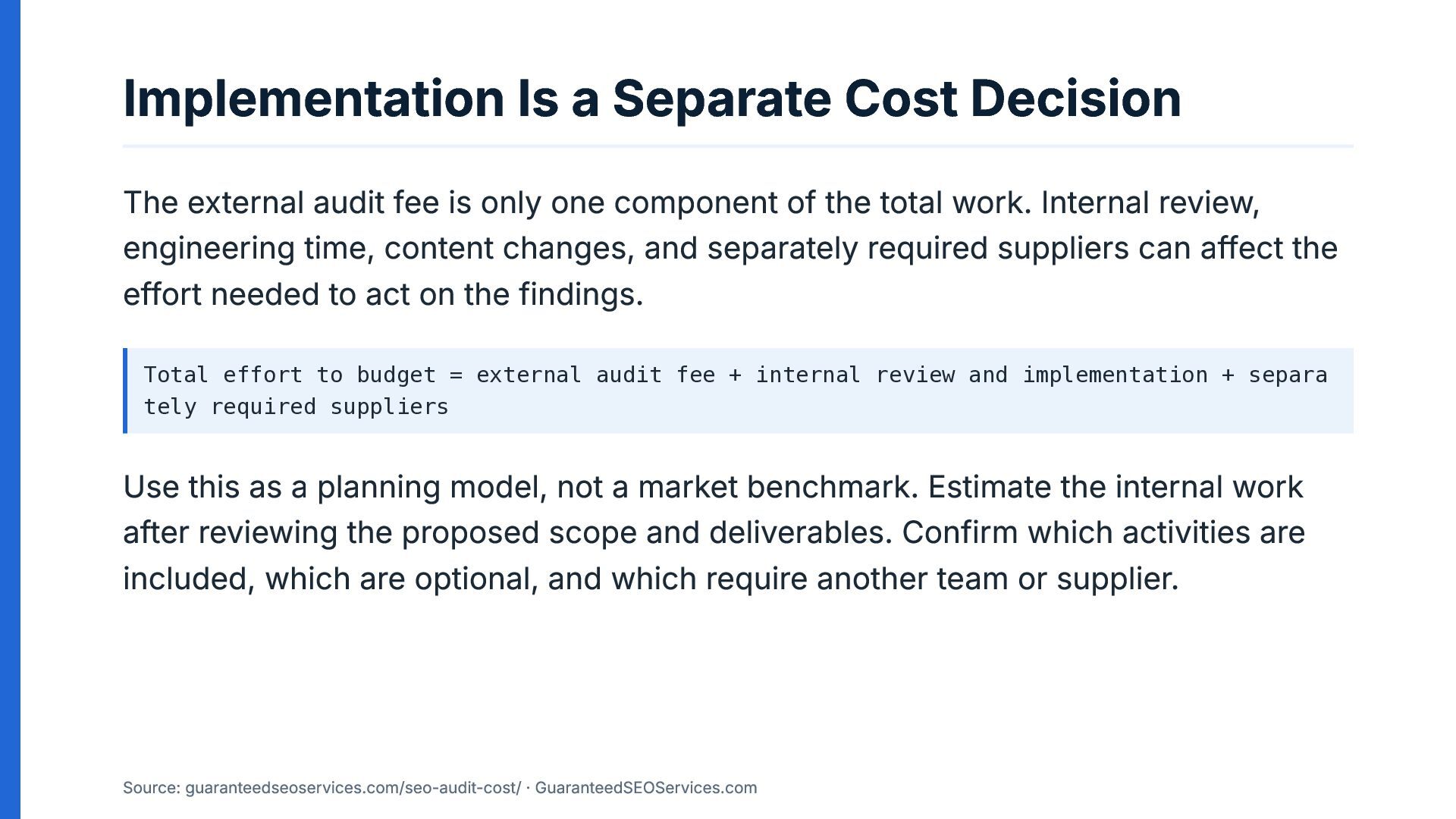
Implementation Is a Separate Cost Decision The external audit fee
is only one component of the total work. Internal review, engineering time, content changes, and separately required suppliers can affect the effort needed to act on the findings. Total effort to budget = external audit fee + internal review and implementation + separa tely required suppliers Use this as a planning model, not a market benchmark. Estimate the internal work after reviewing the proposed scope and deliverables. Confirm which activities are included, which are optional, and which require another team or supplier. Source: guaranteedseoservices.com/seo-audit-cost/ · GuaranteedSEOServices.com -
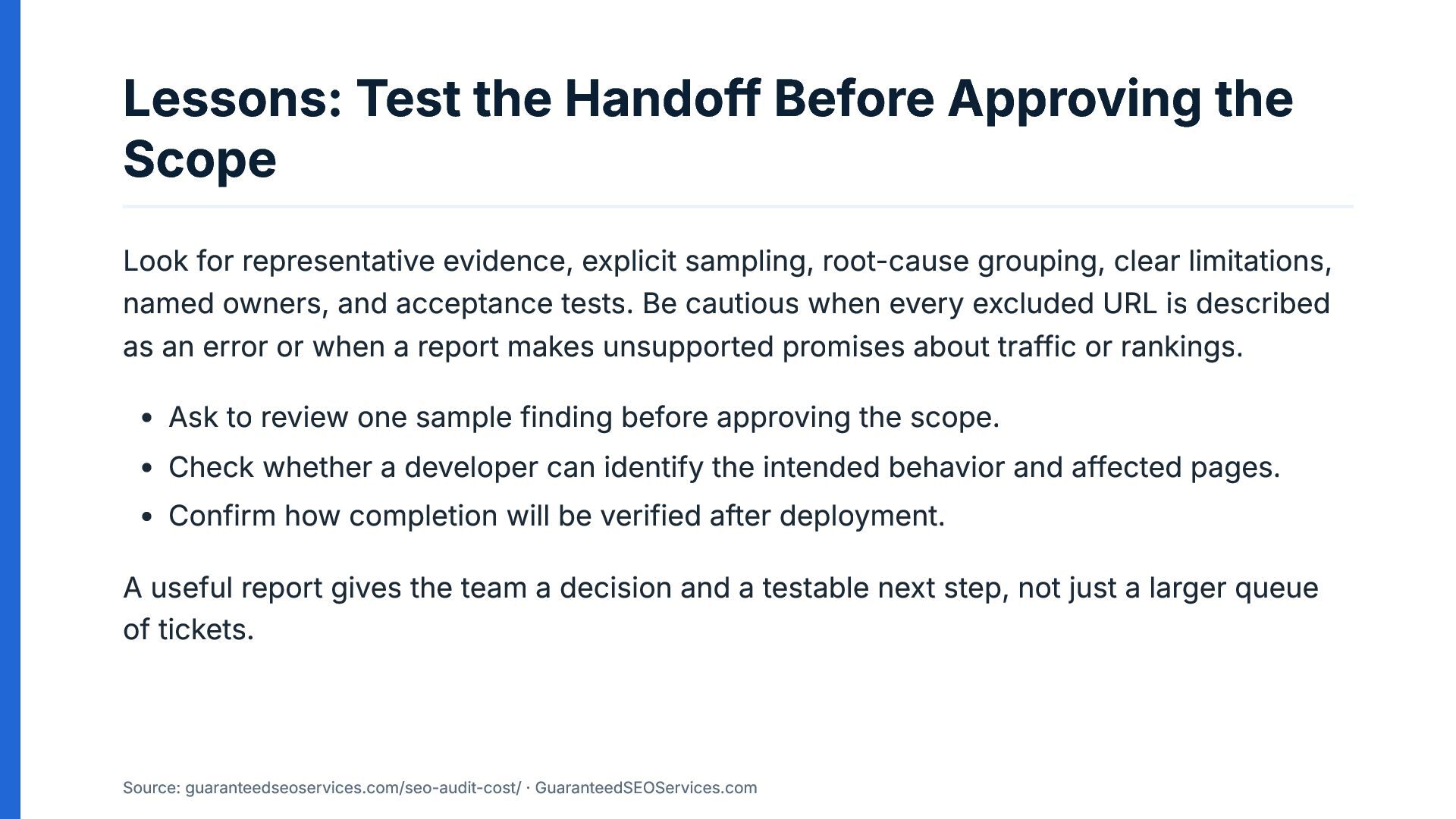
Lessons: Test the Handoff Before Approving the Scope Look for
representative evidence, explicit sampling, root-cause grouping, clear limitations, named owners, and acceptance tests. Be cautious when every excluded URL is described as an error or when a report makes unsupported promises about traffic or rankings. Ask to review one sample finding before approving the scope. Check whether a developer can identify the intended behavior and affected pages. Confirm how completion will be verified after deployment. A useful report gives the team a decision and a testable next step, not just a larger queue of tickets. Source: guaranteedseoservices.com/seo-audit-cost/ · GuaranteedSEOServices.com -
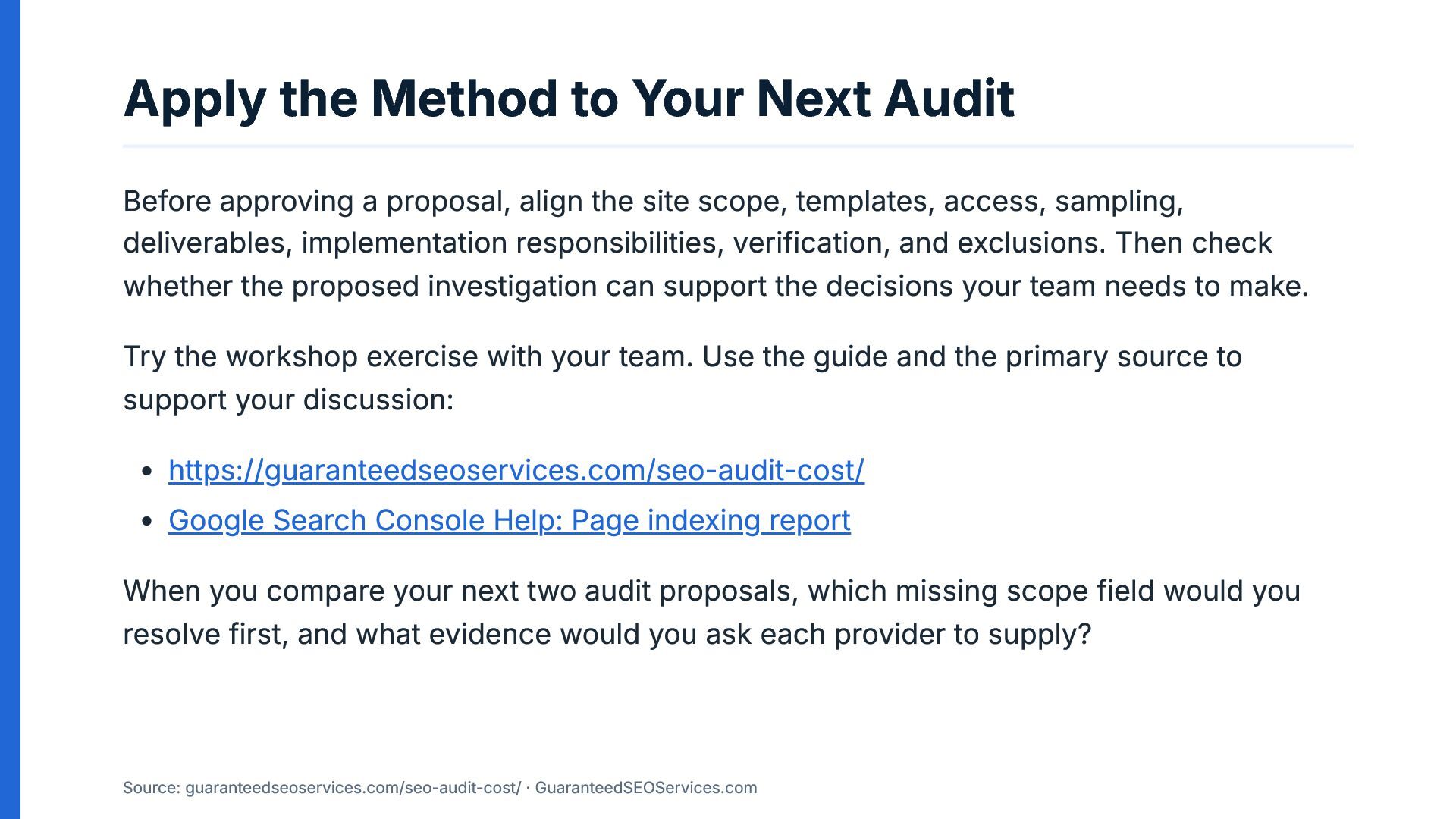
Apply the Method to Your Next Audit Before approving a
proposal, align the site scope, templates, access, sampling, deliverables, implementation responsibilities, verification, and exclusions. Then check whether the proposed investigation can support the decisions your team needs to make. Try the workshop exercise with your team. Use the guide and the primary source to support your discussion: https://guaranteedseoservices.com/seo-audit-cost/ Google Search Console Help: Page indexing report When you compare your next two audit proposals, which missing scope field would you resolve first, and what evidence would you ask each provider to supply? Source: guaranteedseoservices.com/seo-audit-cost/ · GuaranteedSEOServices.com -
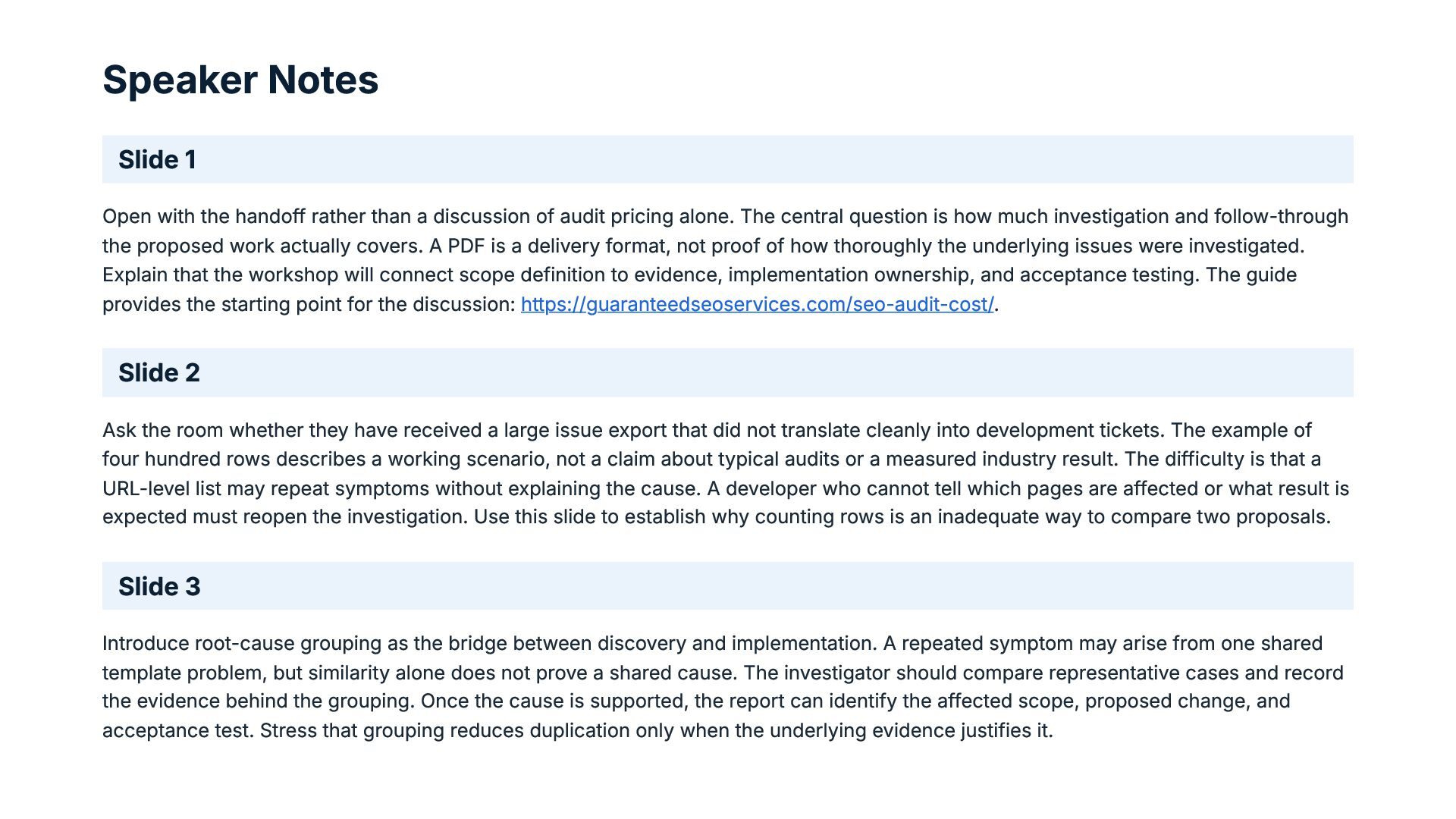
Speaker Notes Slide 1 Open with the handoff rather than
a discussion of audit pricing alone. The central question is how much investigation and follow-through the proposed work actually covers. A PDF is a delivery format, not proof of how thoroughly the underlying issues were investigated. Explain that the workshop will connect scope definition to evidence, implementation ownership, and acceptance testing. The guide provides the starting point for the discussion: https://guaranteedseoservices.com/seo-audit-cost/. Slide 2 Ask the room whether they have received a large issue export that did not translate cleanly into development tickets. The example of four hundred rows describes a working scenario, not a claim about typical audits or a measured industry result. The difficulty is that a URL-level list may repeat symptoms without explaining the cause. A developer who cannot tell which pages are affected or what result is expected must reopen the investigation. Use this slide to establish why counting rows is an inadequate way to compare two proposals. Slide 3 Introduce root-cause grouping as the bridge between discovery and implementation. A repeated symptom may arise from one shared template problem, but similarity alone does not prove a shared cause. The investigator should compare representative cases and record the evidence behind the grouping. Once the cause is supported, the report can identify the affected scope, proposed change, and acceptance test. Stress that grouping reduces duplication only when the underlying evidence justifies it. -
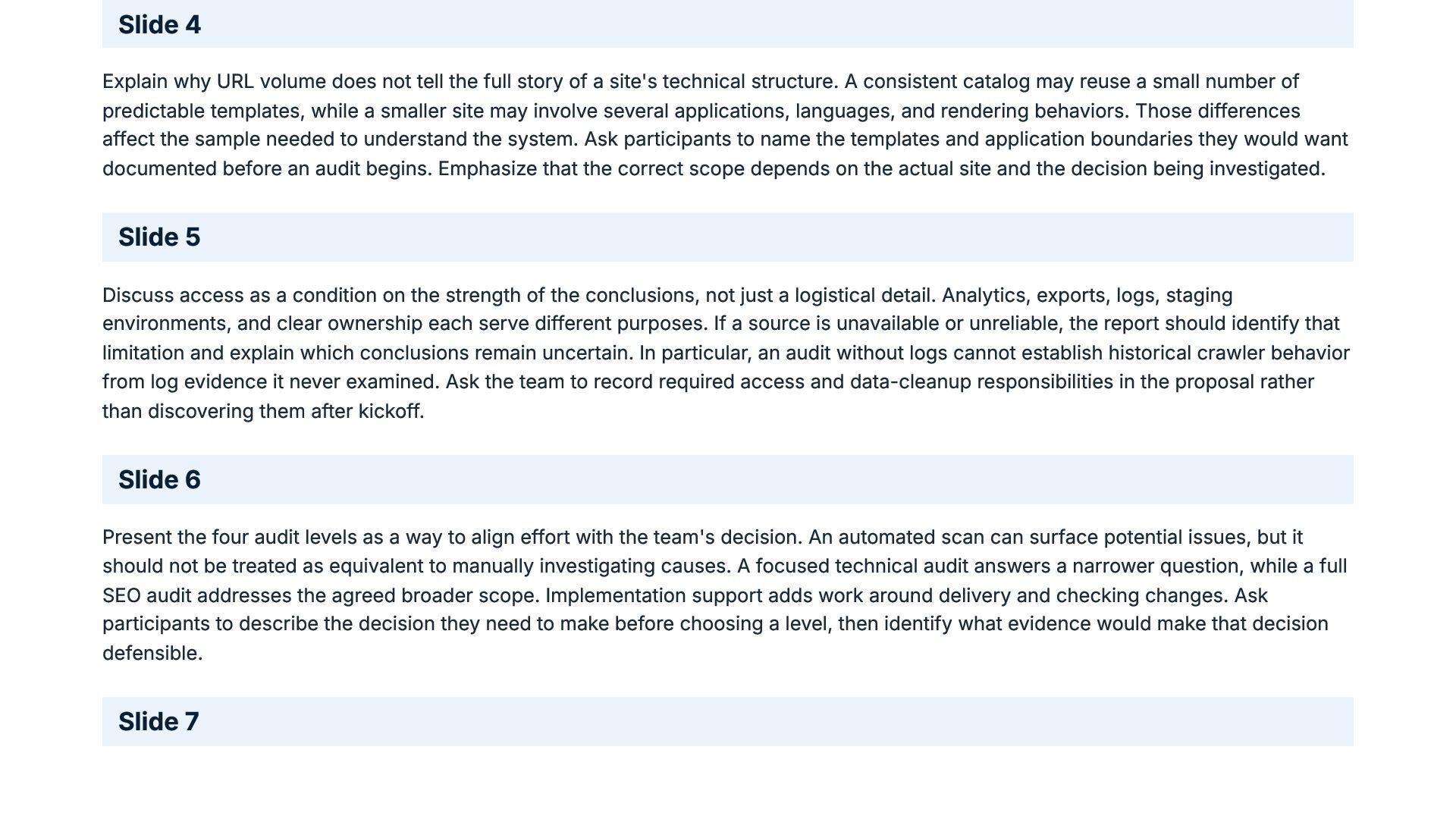
Slide 4 Explain why URL volume does not tell the
full story of a site's technical structure. A consistent catalog may reuse a small number of predictable templates, while a smaller site may involve several applications, languages, and rendering behaviors. Those differences affect the sample needed to understand the system. Ask participants to name the templates and application boundaries they would want documented before an audit begins. Emphasize that the correct scope depends on the actual site and the decision being investigated. Slide 5 Discuss access as a condition on the strength of the conclusions, not just a logistical detail. Analytics, exports, logs, staging environments, and clear ownership each serve different purposes. If a source is unavailable or unreliable, the report should identify that limitation and explain which conclusions remain uncertain. In particular, an audit without logs cannot establish historical crawler behavior from log evidence it never examined. Ask the team to record required access and data-cleanup responsibilities in the proposal rather than discovering them after kickoff. Slide 6 Present the four audit levels as a way to align effort with the team's decision. An automated scan can surface potential issues, but it should not be treated as equivalent to manually investigating causes. A focused technical audit answers a narrower question, while a full SEO audit addresses the agreed broader scope. Implementation support adds work around delivery and checking changes. Ask participants to describe the decision they need to make before choosing a level, then identify what evidence would make that decision defensible. Slide 7 -
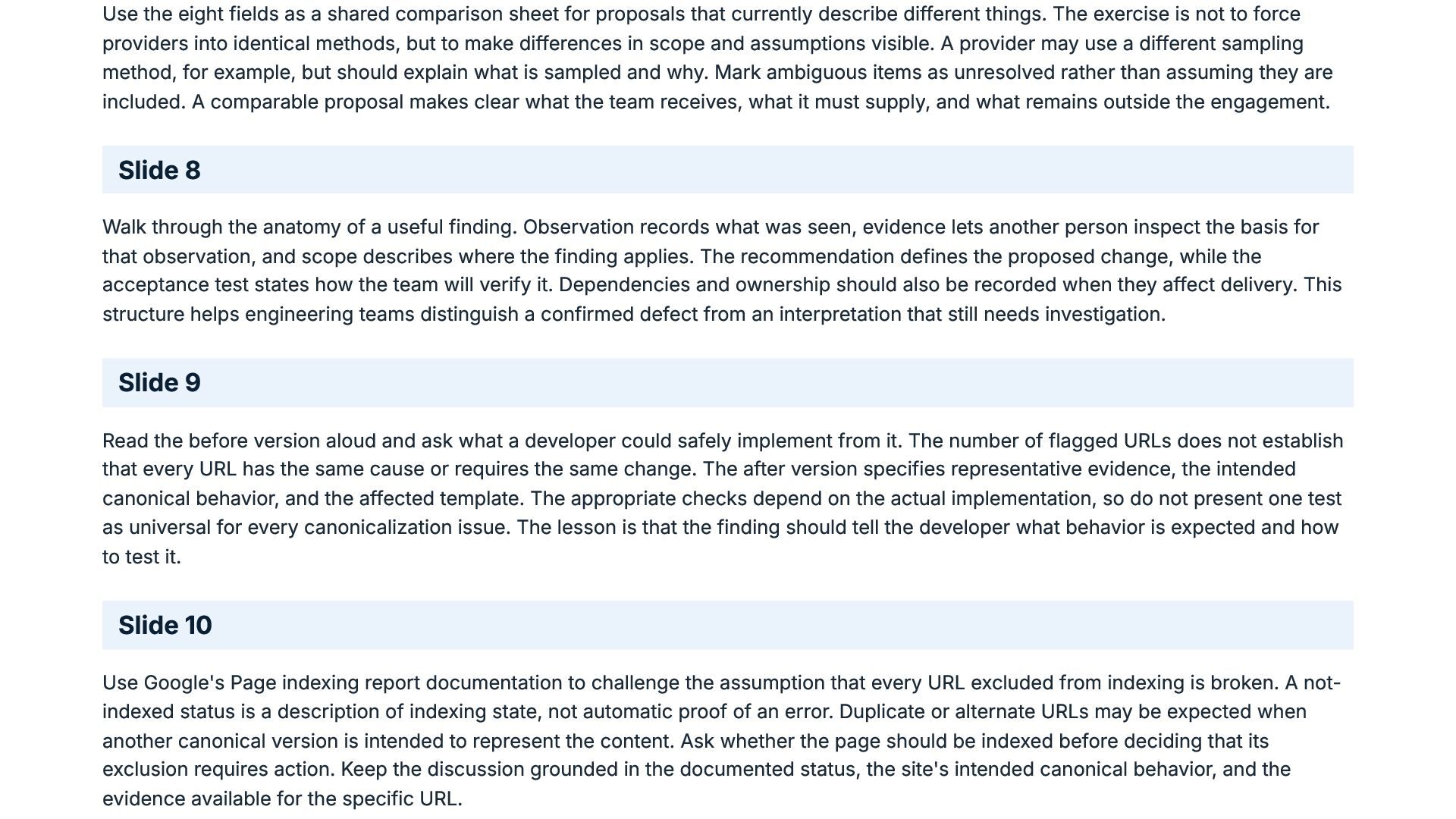
Use the eight fields as a shared comparison sheet for
proposals that currently describe different things. The exercise is not to force providers into identical methods, but to make differences in scope and assumptions visible. A provider may use a different sampling method, for example, but should explain what is sampled and why. Mark ambiguous items as unresolved rather than assuming they are included. A comparable proposal makes clear what the team receives, what it must supply, and what remains outside the engagement. Slide 8 Walk through the anatomy of a useful finding. Observation records what was seen, evidence lets another person inspect the basis for that observation, and scope describes where the finding applies. The recommendation defines the proposed change, while the acceptance test states how the team will verify it. Dependencies and ownership should also be recorded when they affect delivery. This structure helps engineering teams distinguish a confirmed defect from an interpretation that still needs investigation. Slide 9 Read the before version aloud and ask what a developer could safely implement from it. The number of flagged URLs does not establish that every URL has the same cause or requires the same change. The after version specifies representative evidence, the intended canonical behavior, and the affected template. The appropriate checks depend on the actual implementation, so do not present one test as universal for every canonicalization issue. The lesson is that the finding should tell the developer what behavior is expected and how to test it. Slide 10 Use Google's Page indexing report documentation to challenge the assumption that every URL excluded from indexing is broken. A notindexed status is a description of indexing state, not automatic proof of an error. Duplicate or alternate URLs may be expected when another canonical version is intended to represent the content. Ask whether the page should be indexed before deciding that its exclusion requires action. Keep the discussion grounded in the documented status, the site's intended canonical behavior, and the evidence available for the specific URL. -
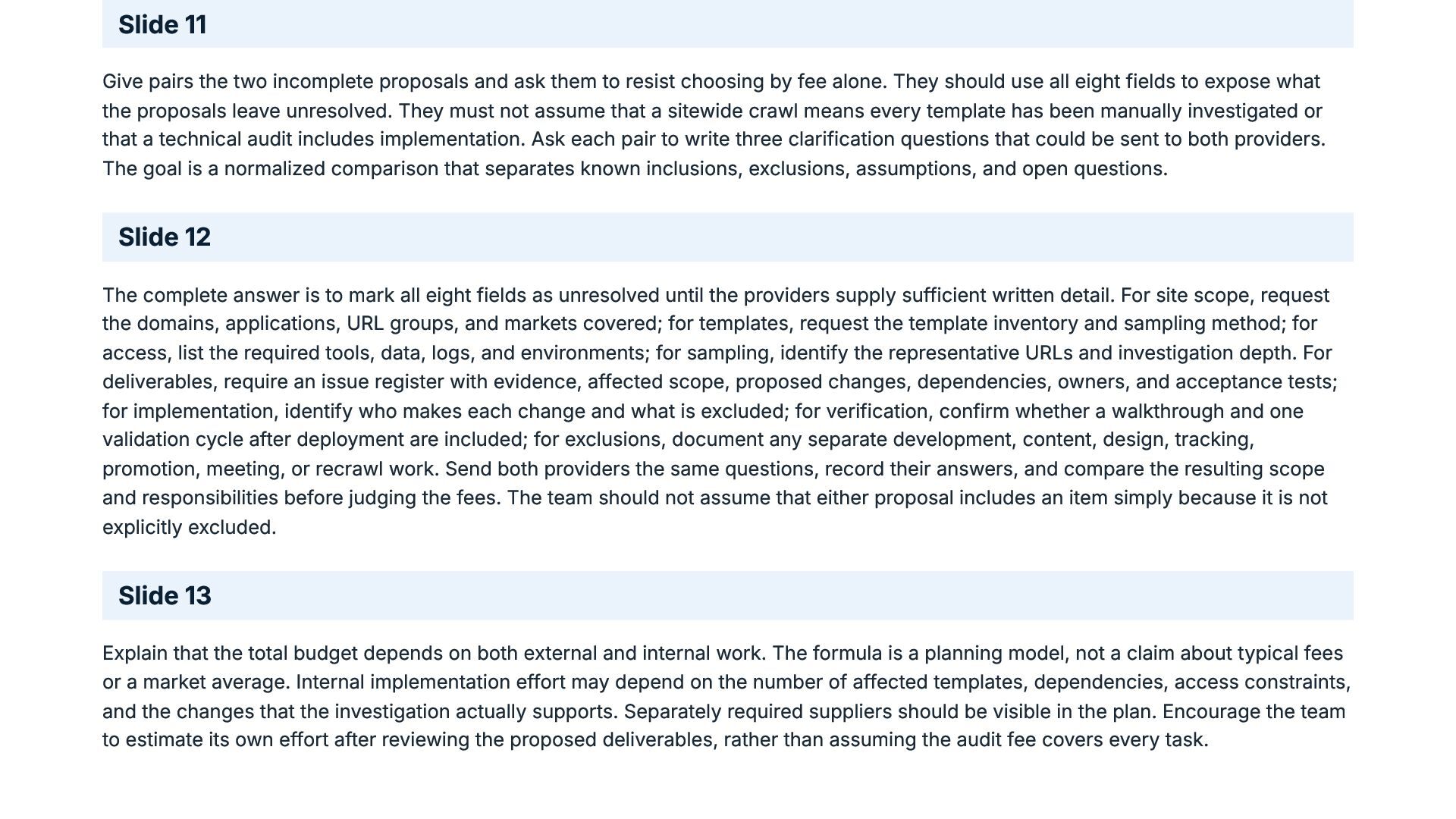
Slide 11 Give pairs the two incomplete proposals and ask
them to resist choosing by fee alone. They should use all eight fields to expose what the proposals leave unresolved. They must not assume that a sitewide crawl means every template has been manually investigated or that a technical audit includes implementation. Ask each pair to write three clarification questions that could be sent to both providers. The goal is a normalized comparison that separates known inclusions, exclusions, assumptions, and open questions. Slide 12 The complete answer is to mark all eight fields as unresolved until the providers supply sufficient written detail. For site scope, request the domains, applications, URL groups, and markets covered; for templates, request the template inventory and sampling method; for access, list the required tools, data, logs, and environments; for sampling, identify the representative URLs and investigation depth. For deliverables, require an issue register with evidence, affected scope, proposed changes, dependencies, owners, and acceptance tests; for implementation, identify who makes each change and what is excluded; for verification, confirm whether a walkthrough and one validation cycle after deployment are included; for exclusions, document any separate development, content, design, tracking, promotion, meeting, or recrawl work. Send both providers the same questions, record their answers, and compare the resulting scope and responsibilities before judging the fees. The team should not assume that either proposal includes an item simply because it is not explicitly excluded. Slide 13 Explain that the total budget depends on both external and internal work. The formula is a planning model, not a claim about typical fees or a market average. Internal implementation effort may depend on the number of affected templates, dependencies, access constraints, and the changes that the investigation actually supports. Separately required suppliers should be visible in the plan. Encourage the team to estimate its own effort after reviewing the proposed deliverables, rather than assuming the audit fee covers every task. -
Slide 14 Summarize the practical test: can a developer pick
up a representative finding, understand the intended behavior and affected scope, and verify completion? Review the proposal for explicit sampling, evidence, ownership, limitations, and acceptance criteria. Treat claims about fixed traffic outcomes or blanket URL errors as reasons to ask for supporting evidence, not as established results. Invite the audience to use the guide and the Search Console documentation when reviewing their next proposal. End with this exact question: When you compare your next two audit proposals, which missing scope field would you resolve first, and what evidence would you ask each provider to supply? Slide 15 Close by connecting the workshop's diagnostic sequence to the practical question of how much is an SEO audit. The answer depends on the investigation, scope, evidence, deliverables, and responsibilities that the proposal actually defines. Encourage participants to use the eight-field checklist with their teams before comparing fees. When you compare your next two audit proposals, which missing scope field would you resolve first, and what evidence would you ask each provider to supply?
 guaranteedseoservices
 samtorres
 aleyda
 portentint
 amandafloq
 clarasoteras
 rosshudgens
 speedyindexteam
 athenseo
 awsjcpm
 sarosaro
 venkatapagadala1
 jlugia
 wjessup
 rakko
 techseoconnect
 lara
 skipperchong
 rmw
 codingconduct
 rasmusluckow
 szymonslowik
 retrage